Beowulf takes a seat to think this dragon thing through (ll.2417-2424)

Recap
Synopsis
The Original Old English
My Translation
A Quick Interpretation
Closing
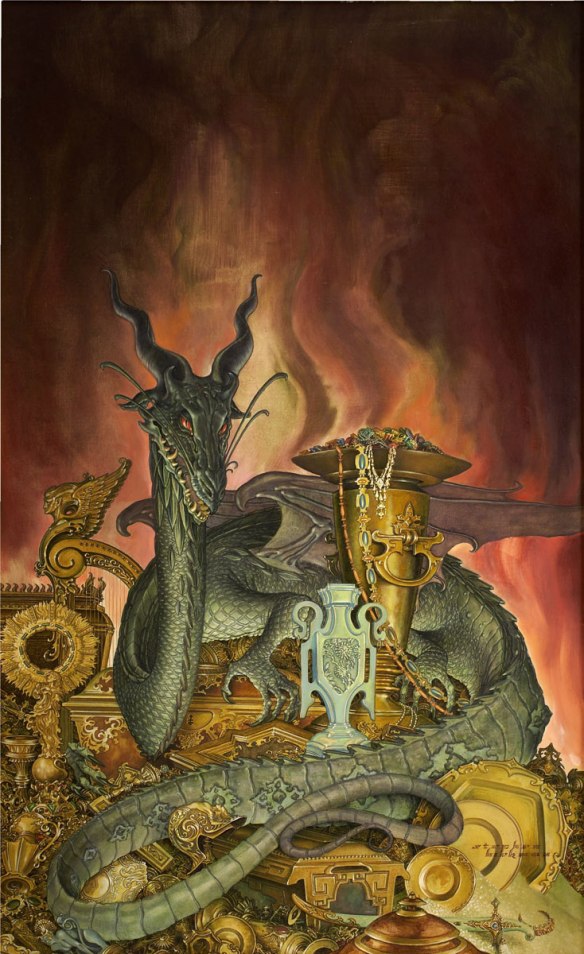
The kind of dragon perfectly at home in Beowulf.

An Anglo-Saxon dragon, complete with treasure hoard. Image from http://brer-powerofbabel.blogspot.ca/2011_09_01_archive.html.


Back To Top
Recap

In my last post, the poet shared how Beowulf rallied together 11 young Geatish warriors, took the dragon hoard thief as a guide, and started out to reckon with the dragon.


Back To Top
Synopsis

After coming to a clifftop overlooking the dragon’s barrow, Beowulf sits down and reflects on where he is in life.


Back To Top
The Original Old English

“Gesæt ða on næsse niðheard cyning,
þenden hælo abead heorðgeneatum,
goldwine Geata. Him wæs geomor sefa,
wæfre ond wælfus, wyrd ungemete neah,
se ðone gomelan gretan sceolde,
secean sawle hord, sundur gedælan
lif wið lice, no þon lange wæs
feorh æþelinges flæsce bewunden.”
(Beowulf ll.2417-2424)


Back To Top
My Translation

“Sat then the veteran king upon the clifftop.
He wished his hearth companions luck,
the gold friend of the Geats. His mind was sorrowful,
he was restless and ready for death, fate had come immeasurably near,
he knew that soon he would fully face old age,
that it would soon seek his soul’s hoard, tear his life
from his body. Not long from then would that lord’s
flesh unravel from his spirit.”
(Beowulf ll.2417-2424)


Back To Top
A Quick Interpretation

The poet is snapping out of something here. The contrast between this passage’s opening line and the last line of the previous passage suggests that as Beowulf sits something shifts in him.

As a refresher, the final line of the previous passage was:

“It would not be easy/for Beowulf to bargain with that dragon for his people’s lives!” (“Næs þæt yðe ceap/to gegangenne gumena ænigum!” (ll.2415-2416))

This statement is a classic example of Anglo-Saxon understatement (or a “litote” for those keen on literary terms). In it we can see the poet openly winking to the audience as the puppets pulled by the lines he lays down dance on without the power to change their fates.
And then you get the simple statement:

“Sat then the veteran king upon the clifftop.” (“Gesæt ða on næsse niðheard cyning” (l.2417))

When was the last time Beowulf sat down? He may have been sitting when he was sharing his exploits and treasures with Hygelac, but I’ve always imagined him standing (or maybe kneeling?) in some sort of audience hall a la Ganondorf in Ocarina of Time.

Ganondorf kneeling before the king of Hyrule, maybe Beowulf did the same?

Ganondorf kneeling before the king of Hyrule. Perhaps as Beowulf did? Though probably without the evil eyes. Image from https://strategywiki.org/wiki/File:OoT_Spying_on_Ganondorf.jpg

Of course, Beowulf’s intentions aren’t as wicked as Ganondorf’s (though Beowulf would be right at home in a world overseen by goddesses and golden triangles).

But even then, going back to his time with the Danes, when he sits for the parties that Hrothgar throws there’s never any line like “Beowulf sat”. With the change it signals, and the sort of coming in to roost of the poem’s metaphorical chickens throughout the remainder of the poem this line is kind of like the “Jesus wept” (John 11:35) moment of the poem for me. It shows Beowulf’s more limited, average human side.

Up until now, Beowulf has been a poem of youthful exploits, adventures in foreign lands, and victory in battle. But now the titular character is an old man and he is fully aware of this.

Though, there have no doubt been some off-page exploits that Beowulf is less than proud of. And he’s probably spent more time quaffing mead and eating pork than keeping up with his swimming regimen.

Yet this is how the poem starts its ending. It’s like the sequel to the blockbuster that no one really wanted starring all the original actors whose characters have been rewritten to fit the physical and mental changes the actors have all undergone in the decades since the original bit of movie magic.

“Sat then the veteran king upon the clifftop.”

But this is Beowulf. As much as his mind starts to turn to how close fate is coming to him, how little of his lease on life he still has left, there’s a dragon out there. And even if, as we’ll see next week, he needs to draw inspiration from his own life, Beowulf will fight it.

What do you imagine Beowulf doing after he sits in this passage? Does he stare out at the landscape below them? Or does he look into the eyes of his Geatish kin and wonder about their safety?

Feel free to share your theories in the comments!


Back To Top
Closing

Next week, Beowulf tries to inspire his gathered Geats (and himself?) with his life story.

If you enjoyed this post, please give it a like. And, if you want to keep up with my translations, please do follow this blog!

You can find the next part of Beowulf here.
Back To Top

A Blogger’s Beowulf in 2018

A ruined medieval castle that Karl Julius von Leypold drew and that is featured on A Blogger's Beowulf for its 2018 updates post.

An illustration by Carl Julius von Leypold entitled “Winter View of the Courtyard of a Medieval Castle in Ruins”. Image from https://commons.wikimedia.org/wiki/File:Karl_Julius_von_Leypold_-_Blick_auf_einen_winterlichen_Innenhof_einer_mittelalterlichen_Ruine.jpg

Wow. It’s been almost eight (8!) weeks without a Beowulf translation post.

First off, sorry for leaving this site silent for so long.

My only excuse is that between work, the podcast I’m a part of (as co-host and editor/producer (http://podcast.fanthropological.com/ is where you can find that, by the way)), the holiday season, and my life in general I just haven’t had the time to sit down, type up my translations, and then come up with a commentary for them.

So what’s happening with A Blogger’s Beowulf?

Well, for the rest of January, nothing.

But for a good reason.

The Grand Plan

My grand plan is to make time to type out the remaining 200 or so lines of my translation. Once that’s done I can get the rest of the standard translation entries ready to go for February. So, from February 1, 2018 and every Thursday following that you can come back here to continue through my translation of Beowulf.

But that doesn’t mean that I’ll be done with this site when those run out.

I’ve already put a lot of time and energy into my translation and these posts so I want this site to get a little more attention in 2018. To accomplish this, I’m going to bring the Beowulf news entries back in a meaningful way. I’m currently thinking interviews with big time Beowulf fans and creators who have been―and still are―inspired by the ancient epic.

In terms of the poem itself, I plan to use this site to slowly release drafts of a final version of my translation. It’s my grand scheme to put these pieces together and release that full version (maybe with or without my commentary) in at least digital form by the end of 2018.

2018

So, what can you expect out of A Blogger’s Beowulf in 2018?

Right now, a weekly posting schedule is ideal for me. So only expect the translations for the first few months of the new year. But once those have finished I’ll be trying to alternate between polished chapters of the poem and the more “news”-style posts (think interviews, and reviews of Beowulf-inspired media).

So for the start of 2018 I’ll be fettered by frost locks (much like the world outside here in Kitchener). But the heat of a new year will thaw those chains and see this site reach for new heights.

If you’ve got some thoughts on these plans, or if there are people you’d like to see me interview/write about for this site, please let me know in the comments or at nsczach@gmail.com!

How Beowulf recruited a thief who knew much of the dragon (ll.2397-2416)

First up, I must apologize for how late this week’s entry is. I’ve managed to post every Thursday for quite a while now, and intend to keep posting these translations on Thursdays. This week, though, work got in the way. So, I just want to say thanks for your understanding, and for reading.

Here’s the post!


Recap
Synopsis
The Original Old English
My Translation
A Quick Interpretation
Closing

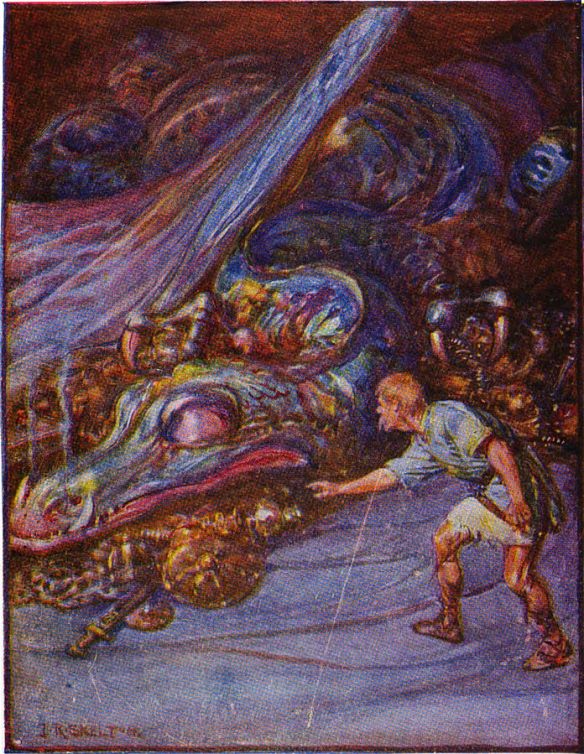
The thief steals the cup from the treasure hoard of the dragon in Beowulf in translation on A Blogger's Beowulf.

The thief has snuck up to the dragon and reaches for the fateful treasure cup. Image from https://commons.wikimedia.org/wiki/File:Stories_of_Beowulf_slave_stealing_golden_cup.jpg


Back To Top
Recap

Last week, the poet completed his explanation of how Beowulf became king of the Geats.


Back To Top
Synopsis

Beowulf gathers together a group of twelve to face the dragon. And he happens to get a thirteenth member when the thief who woke the dragon presents the cup to Beowulf.


Back To Top
The Original Old English

“Swa he niða gehwane genesen hæfde,
sliðra geslyhta, sunu Ecgðiowes,
ellenweorca, oð ðone anne dæg
þe he wið þam wyrme gewegan sceolde.
Gewat þa XIIa sum torne gebolgen
dryhten Geata dracan sceawian.
Hæfde þa gefrunen hwanan sio fæhð aras,
bealonið biorna; him to bearme cwom
maðþumfæt mære þurh ðæs meldan hond.
Se wæs on ðam ðreate þreotteoða secg,
se ðæs orleges or onstealde,
hæft hygegiomor, sceolde hean ðonon
wong wisian. He ofer willan giong
to ðæs ðe he eorðsele anne wisse,
hlæw under hrusan holmwylme neh,
yðgewinne; se wæs innan full
wrætta ond wira. Weard unhiore,
gearo guðfreca, goldmaðmas heold,
eald under eorðan. Næs þæt yðe ceap
to gegangenne gumena ænigum!”
(Beowulf ll.2397-2416)


Back To Top
My Translation

“Thus Beowulf survived strife from all quarters,
savage battles and slaughter, that son of Ecgtheow,
brave doer of good deeds, until that day.
That day on which Beowulf was fated to war with the dragon.
Then it was that the scaled one, maddened with rage, knew the twelve;
the dragon recognized the Geatish lord.
Beowulf soon discovered the reason why that fiend arose,
brought adversity to his people. Into his lap fell the famed cup,
wrought of gold and set with stones, fresh from the finder’s hand.
That man made their party’s number thirteen,
he who had created this dire fate,
a captive of sorrowful heart. He agreed to serve
as guide for Beowulf and his men through the dragon’s place.
Against his will he went to the earthen hall which he alone knew.
The barrow beneath the earth, out by the sea billows,
where wave strove with wave, within, it was full of treasures,
both wrought and wound. The horrible warden,
that eager ancient warrior, was bent on guarding his gold-treasures,
both as old as stones beneath the earth. It would not be easy
for Beowulf to bargain with that dragon for his people’s lives!”
(Beowulf ll.2397-2416)


Back To Top
A Quick Interpretation

How did Beowulf plan to find the dragon before the thief came to him?

Maybe he was just going to go around with his twelve Geats until the dragon swooped down on them.

Or maybe they would’ve gone on a stake out. Sat behind some rocks until the dragon showed up.

As convenient as this meeting is, I think it’s a little shot of realism in this poem.

If you think back to the celebration of Beowulf’s victory over Grendel, you might remember the story of Sigemund the Dragon Slayer. Those events are related as a story even within the world of this story. I would go so far as to argue that the poet’s saying the story was from some far off land is just a fancy way to say “I made this up”.

Anyway, in that story, Sigemund just knew where to go to find the dragon. Why? Because he’s a dragon slayer, I guess. He just has that extra sense built in.

But Beowulf, as something written by an Anglo-Saxon (a person from “Angland” perhaps), has much more immediacy. And the poet must have known that any new, grand story of monsters and mighty heroes needed to have an element of realism to it. So, who could know the way to a treasure hoard that a dragon happens to be guarding? A thief, of course. And so, there’s a thief that joins Beowulf’s party. A thief who is really a guide.

Though maybe Beowulf should strategize to maximize the thief’s “Backstab” ability when fighting the dragon.

Dungeons & Dragons jokes aside, I think that the introduction of the thief as a character of any stature is a way to add complexity to a story that was pretty common. It’s a new twist on the old story of dragon slayers.

What do you think of the inclusion of the thief in Beowulf’s dragon hunting party? What do you think caused the thief to come to Beowulf with the cup? Guilt? The death of his own lord? A desire for glory?

Let me know in the comments!


Back To Top
Closing

Next week, Beowulf sits down on a cliff and tells his group memories of his youth.

And, if you enjoyed this post, please give it a like.

Also, if you want to keep up with my translations, please do follow this blog!

You can find the next part of Beowulf here.
Back To Top

Reluctant king Beowulf and his long-term feud strategy (ll.2367-2396)

Recap
Synopsis
The Original Old English
My Translation
Quick Question
Closing

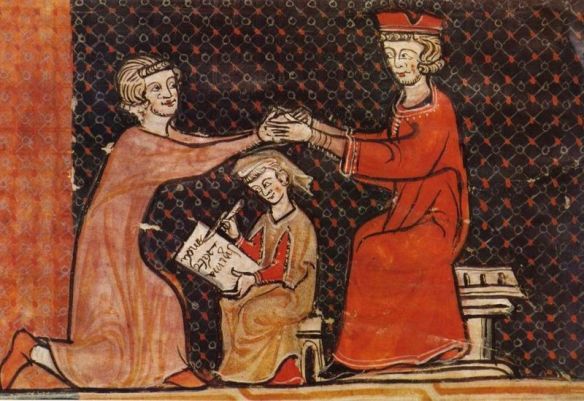
A vassal pledging loyalty to a lord via homage, maybe to quell a feud.

A miniature from a French manuscript depicting the homage ritual. How loyalty was pledged to a superior. Click for source.


Back To Top
Recap

After showing how the dragon devastated Beowulf’s lands and hall, the poet started to share how Beowulf became king.


Back To Top
Synopsis

After some swimming, some fighting, and some turning offers down, Beowulf becomes king of the Geats. He also tries to ensure a lasting peace.


Back To Top
The Original Old English

Oferswam ða sioleða bigong sunu Ecgðeowes,
earm anhaga, eft to leodum;
þær him Hygd gebead hord ond rice,
beagas ond bregostol, bearne ne truwode
þæt he wið ælfylcum eþelstolas
healdan cuðe, ða wæs Hygelac dead.
No ðy ær feasceafte findan meahton
æt ðam æðelinge ænige ðinga,
þæt he Heardrede hlaford wære
oððe þone cynedom ciosan wolde;
hwæðre he him on folce freondlarum heold,
estum mid are, oððæt he yldra wearð,
Wedergeatum weold. Hyne wræcmæcgas
ofer sæ sohtan, suna Ohteres;
hæfdon hy forhealden helm Scylfinga,
þone selestan sæcyninga
þara ðe in Swiorice sinc brytnade,
mærne þeoden. Him þæt to mearce wearð;
he þær for feorme feorhwunde hleat
sweordes swengum, sunu Hygelaces,
ond him eft gewat Ongenðioes bearn
hames niosan, syððan Heardred læg,
let ðone bregostol Biowulf healdan,
Geatum wealdan. þæt wæs god cyning!
Se ðæs leodhryres lean gemunde
uferan dogrum, Eadgilse wearð
feasceaftum freond, folce gestepte
ofer sæ side sunu Ohteres,
wigum ond wæpnum; he gewræc syððan
cealdum cearsiðum, cyning ealdre bineat.
(Beowulf ll.2367-2396)


Back To Top
My Translation

“Thanks to long practice he swam over the sea,
the son of Ecgtheow, a reclusive water treader heading
back to his people. There Hygd urged him to take
the treasure and the throne, rings and the power seat.
She trusted not her son. She doubted that he could hold
the royal seat against foreign foes, for Hygelac was dead.
Yet for nothing could that people find a means
to get Beowulf to accept such power, nothing whatever swayed him,
so long as Heardred was lord,
until the kingdom itself would choose.
Nonetheless, in that time Beowulf proved to be a well
of friendly counsel among the people, freely and with grace,
until he became mature in power, a ruler of the Weder-Geats.
But then miserable men sought for Heardred from over the sea,
Ohthere’s son. Those men had rebelled against the protector
of the Scylfings, the best among sea kings,
he who had dealt out treasure in the Swedish kingdom,
the greatly famed ruler. For Heardred that marked the end.
For his hospitality he gained a terrible wound,
the sting of a swung sword, that unfortunate son of Hygelac.
Afterwards Ongentheow’s son left,
headed for home, after Heardred was slain,
leaving the ruler’s seat for Beowulf to fill,
he was then called to rule the Geats. That was a good king!
Though the fall of the prince made that one mindful,
worried for retribution as days dragged on, he turned to Eadgils,
a man destitute of friends. That people,
those of the sons of Ohthere, he helped
with warriors and weapons. The feud was settled after a chill cold,
a cruel campaign, when old king Onela was bound by death.”
(Beowulf ll.2367-2396)


Back To Top
Quick Questions

To summarize the feud upon feud in this passage:

The son of Ohthere and his gang get vengeance for Ohthere when they kill Heardred. But they’re pretty uneasy about Beowulf. Luckily he soothes their worries by helping them secure their position back in what would become Sweden. But Onela’s probably got some sons. So the cycle of violence is probably going to continue.

Would Beowulf have known this? Do you think he’s expecting an attack from Onela’s son? Is this maybe why he doesn’t fear the dragon – fighting an army of men is more terrifying because they’re not monsters?

If Beowulf knows about how inescapable all these feuds are, is that why he’s so reluctant to be king?

What are your thoughts? Go ahead and share them in the comments!


Back To Top
Closing

Next week, we come back to the present and Beowulf’s preparations for fighting the dragon.

If you enjoyed this post, please give it a like. And feel free to reblog this post to help more people find it.

Also, be sure to follow this blog if you want to keep up with my translations of the poem.

You can find the next part of Beowulf here.
Back To Top

Something the story of Beowulf shares with modern TV (ll.2345-2366)

Recap
Synopsis
The Original Old English
My Translation
A Quick Interpretation
Closing

A Viking Age battle involving, no doubt, a king like Beowulf.

Thorir Hund dressed in a reindeer-hide tunic kills King Olaf at the Battle of Stiklestad. Painting by Peter Nicolai Arbo. Click image for source.


Back To Top
Recap

Last week, Beowulf decided to fight the dragon one-on-one and commissioned an iron shield.


Back To Top
Synopsis

The poet steps away from Beowulf for a second to sing about how his past accomplishments have prepared him to face the dragon.


Back To Top
The Original Old English

“Oferhogode ða hringa fengel
þæt he þone widflogan weorode gesohte,
sidan herge; no he him þa sæcce ondred,
ne him þæs wyrmes wig for wiht dyde,
eafoð ond ellen, forðon he ær fela
nearo neðende niða gedigde,
hildehlemma, syððan he Hroðgares,
sigoreadig secg, sele fælsode
ond æt guðe forgrap Grendeles mægum
laðan cynnes. No þæt læsest wæs
hondgemota, þær mon Hygelac sloh,
syððan Geata cyning guðe ræsum,
freawine folca Freslondum on,
Hreðles eafora hiorodryncum swealt,
bille gebeaten. þonan Biowulf com
sylfes cræfte, sundnytte dreah;
hæfde him on earme ana XXX
hildegeatwa, þa he to holme beag.
Nealles Hetware hremge þorfton
feðewiges, þe him foran ongean
linde bæron; lyt eft becwom
fram þam hildfrecan hames niosan.”
(Beowulf ll.2345-2366)


Back To Top
My Translation

“Further, Beowulf, the prince of rings,
was too proud to attack the far-flier with a band of men,
an overpowering army. Nor did he fear further attack from the drake,
he thought but little of the dragon’s strength and courage, since he
had already risked harsh circumstances, survived countless combats,
endured the crash of battle, since he had done so for Hrothgar.
Beowulf had been blessed with victory, cleansed the Dane’s hall,
in combat he crushed to death the hateful kindred
of Grendel. Not the least of his deeds happened later,
the hand-to-hand encounter where the man slew Hygelac,
after the Geatish king was caught in the battle onslaught,
the lord and friend of the people fell in Friesland.
Hygelac, Hrethel’s son, had died in the blade brew,
struck by the sword. From there Beowulf
put his strength to use, swimming thence.
In his arm he held the battle gear of thirty men
with which he went to sea.
None of the Hetwares had reason to be exultant
in that battle on foot, with Beowulf against them on the front
bearing a shield. Few would later
return home from their meeting with that warrior.”
(Beowulf ll.2345-2366)


Back To Top
A Quick Interpretation

Just in case you were wondering if Beowulf kept fit after he got back to Geatland, here’s your answer. According to this little story from the poet, Beowulf is still a swimming, fighting, load-carrying (?) machine.

So what? Well, from a narrative point of view, it’s neat how the poet uses a flashback to fill in some details during the otherwise lost 50 years of king Beowulf’s life. Actually, flashbacks are still alive and well in our stories.

Granted, it’s not the most recent example, but one show that is full of examples of this trope is Lost. This show set on an apparently empty tropical island was full of mysteries. From things like the hatch in the middle of nowhere, to the polar bear seen loping around now and then. And most of those mysteries were solved through near-episode long flashbacks that filled in details and offered answers (or at least clues).

The Good Place is another great example of flashback being used to reveal story information or demonstrate a character’s traits. It’s also a fairly mysterious show.

Is Beowulf quite so mysterious because of this and other flashbacks?

Potentially.

Take the strangely disagreeing lines 2365-66. These lines stand in defiance of the image of Beowulf as this perfect warrior. They read: “Few would later/return home from their meeting with that warrior” (“lyt eft becwom/fram þam hildfrecan hames niosan.”).

“Few” of the warriors who faced Beowulf survived the battle. Not “none” but “few”. On the face of it, it sounds like the poet is pulling back a bit from Beowulf as this macho force.

But I think that this is just an example of the poem’s sense of humour. It’s a kind of sarcastic understatement, the sort of line delivered from a crooked grin in a cocked face after a little chuckle.

But humour is a tricky thing in print. Especially in poetry. So, what do you think? Is this line a little joke? Or is it pointing to Beowulf going soft on his way to becoming king?

Share your thoughts in the comments!

And if you liked this translation, give this post a like. You might also want to follow this blog so that you can get the rest of this poem as it’s translated.


Back To Top
Closing

Next week, the poet continues the story of Beowulf’s life after the death of Hygelac.

You can find the next part of Beowulf here.

Back To Top

A shield by Beowulf, against the dragon (ll.2333–2344)

Recap
Synopsis
The Original Old English
My Translation
A Quick Interpretation
Closing

Beowulf is protected from dragon fire by his shield while treasure awaits.

An illustration of Beowulf fighting the dragon that appears at the end of the epic poem. Illustration in the children’s book Stories of Beowulf (H. E. Marshall). Published in New York in 1908 by E. P. Dutton & Company. Image found at https://commons.wikimedia.org/wiki/File:Beowulf_and_the_dragon.jpg


Back To Top
Recap

The dragon from the treasure hoard has attacked Beowulf’s lands and burned down his hall.


Back To Top
Synopsis

Beowulf comes up with a plan for revenge.


Back To Top
The Original Old English

“Hæfde ligdraca leoda fæsten,
ealond utan, eorðweard ðone
gledum forgrunden; him ðæs guðkyning,
Wedera þioden, wræce leornode.
Heht him þa gewyrcean wigendra hleo
eallirenne, eorla dryhten,
wigbord wrætlic; wisse he gearwe
þæt him holtwudu helpan ne meahte,
lind wið lige. Sceolde lændaga
æþeling ærgod ende gebidan,
worulde lifes, ond se wyrm somod,
þeah ðe hordwelan heolde lange.”
(Beowulf ll.2333–2344)


Back To Top
My Translation

“The fire dragon had destroyed all the people’s strongholds,
scourged all the land out to the coast, scorched all their earthen work walls
with its flames. For that flying beast the lord of the fray,
prince of the Weders, planned vengeance.
He commanded that a protector of warriors be made,
all of iron, quenched and tempered, so said the lord of earls,
he sought a wondrous war-board from his smiths. Beowulf knew well
that the forest wood warriors so often carried would be no help to him,
that the linden shield would crumble against flames. Beowulf also knew
that he must soon come to the end of his transitory days, the prince of excellence,
his loan of life would soon be due, and so, too, would the dragon’s,
though the wyrm had guarded the hoarded wealth long.”
(Beowulf ll.2333–2344)


Back To Top
A Quick Interpretation

Before the other two fights Beowulf showed great bravery. Before fighting Grendel, he pledged to meet the monster on his own level and eschew weapons and armour. Before fighting Grendel’s mother, Beowulf steeled himself and dove into her lake.

Now we see Beowulf put some thought into his approach. He doesn’t boast or make some sort of brave stand. Instead he thinks about his own mortality. He – the Beowulf – realizes that he’s going to die soon. And he applies some intelligence to his approach rather than rushing in or trying to prove something to someone.

But if that’s all you get out of living for 50 years in the world of Beowulf, then it seems a little underwhelming.

Though Beowulf’s idea to make an iron shield plays perfectly to his strengths.

As was hinted at early and is mentioned later, Beowulf is too strong to use any normal sword. They all end up breaking when he uses them. So hoisting a shield of iron would be no problem for the king of the Geats. Which is neat; it took a bit, but Beowulf seems to have become quite the strategist over his tenure as ruler!

If you had to come up with a scheme to fight a dragon, what would your scheme be?

I think it’d be pretty cool to fight the dragon in the air, so I’d want to create some sort of flying machine (think medieval dragon mech).

Share your own answers in the comments!


Back To Top
Closing

Next week, the poet reassures us of Beowulf’s courage with a little story of his bravery.

You can find the next part of Beowulf here.

Back To Top

Is it fate, god, or a dragon from Beowulf’s past? (ll.2324–2332)

Recap
Synopsis
The Original Old English
My Translation
A Quick Interpretation
Closing

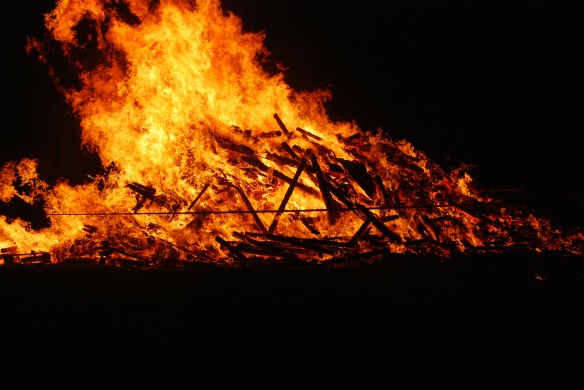
The hall of Beowulf in a flaming ruin because of a dragon as seen in Blogger's Beowulf and decreed by fate and god.

What Beowulf’s hall probably looked like after the dragon attacked. Image from https://pixabay.com/en/funeral-pyre-fire-may-fire-flame-232504/


Back To Top
Recap

Last week, the dragon continued its attack on the countryside. It destroyed people’s homes and towns as it sought vengeance against the thief and his lord.


Back To Top
Synopsis

Beowulf is told about the dragon melting his hall. This leads Beowulf to wonder what he’s done to deserve this.


Back To Top
The Original Old English

“þa wæs Biowulfe broga gecyðed
snude to soðe, þæt his sylfes ham,
bolda selest, brynewylmum mealt,
gifstol Geata. þæt ðam godan wæs
hreow on hreðre, hygesorga mæst;
wende se wisa þæt he wealdende
ofer ealde riht, ecean dryhtne,
bitre gebulge. Breost innan weoll
þeostrum geþoncum, swa him geþywe ne wæs.”
(Beowulf ll.2324–2332)


Back To Top
My Translation

“Then was Beowulf told of that terror,
in a voice trembling with speed and truth, he heard that his own home,
the best of buildings, had been melted in a surge of fire,
the gift seat of the Geats. That good man
was sorrowful at heart, sunken into great grief when he heard that news.
In that moment his thoughts turned to his past,
he wondered if he had acted contrary to the old laws of the Ruler,
the Eternal Lord, severely offended them; within his breast welled up
dark thoughts, as was not customary for him.”
(Beowulf ll.2324–2332)


Back To Top
A Quick Interpretation

This must be the first bad thing that happens to Beowulf. Ever. Why else would he only now wonder how he offended his god?

After all, that’s the only reason anything bad would happen to him.

At least as far as we know. There is a fifty year gap in the story here, so maybe there is something that Beowulf did do that’s knocked him out of god’s favour.

Or, maybe, fate always goes as it must.

If this is the first bad thing to happen to Beowulf, then of course it’s going to cause Beowulf to look into his heart of hearts and search out the darkness. Like anyone else, he probably got comfortable with things always going his way. So when things start to move against him it seems quite natural that he would jump to some sort of supernatural cause.

Actually, this turn and Beowulf’s reaction to it could have come from a lot of incidents in the Old Testament, particularly the Books of Job or of Exodus. In fact, the latter of these was a favourite of Anglo-Saxon writers.

That might seem like a strange book of the Bible to pick as a favourite, but they had a good reason. In the Jews of Egypt the Anglo-Saxons saw people who were exiled from what had become their homeland and were forever searching for a place to call their own. That sums up how a lot of Anglo-Saxon writers and thinkers seemed to have thought of themselves.

The Angles and the Saxons had come over from what is now Germany, after all. And they had settled into and gotten comfortable in Britain. But that’s where the Celts were at home.

Anyway, that’s just a little sidebar on some of the Beowulf poet or scribes’ possible influences.

Getting back to the concept of fate, I like to think that in his long-lived comfort Beowulf has probably not thought much about fate over the last fifty years. Saying something like “fate goes ever as it must” is really cool before a high stakes, low odds fight, but it doesn’t quite have the same impact when you say it before starting a diplomatic meeting.

Another point of interest: When he was young, Beowulf seems to have mentioned god and fate in the same breath quite often. But now he doesn’t hear about his hall being destroyed and think “huh…well, fate goes as it must” but instead he thinks only of god. Maybe this is the poet saying that it’s all well and good to think in terms of fate when young, since it rules over this world, but once you get closer to death and the next world, it’s better to turn to those with power over that.
In any case, how Beowulf reacts to this calamity says a lot about how he’s changed. His first thoughts aren’t about going after the dragon. Instead he worries about himself and his past offenses. Which brings a question to mind.

Throughout the poem Beowulf is made out to be a great guy. What do you think these offenses he mulls over are? What could those dark thoughts that well up from within be about?

My own guess is that he has a troubled past with a woman. The fact that there’s not a single named female character in this part of the poem just seems like too much of an omission to me. The poet could be leaving something out to leave room for Beowulf’s more macho ending.

But those are just my thoughts. Do you agree? Disagree? Have your own theory?

Let me know in the comments!

And if you enjoyed this post, please give it a like. Also, be sure to hit the follow button so that you never miss another part of this poem.


Back To Top
Closing

Next week, we get a glimpse of the old Beowulf as he resolves to go against the dragon. And uses science (…sort of) to do so.

You can find the next part of Beowulf here.
Back To Top

Sometimes a dragon is just a dragon (ll. 2312-2323)

Recap
Synopsis
The Original Old English
My Translation
A Quick Interpretation
Closing

The kind of dragon perfectly at home in Beowulf.

An Anglo-Saxon dragon, complete with treasure hoard. Image from http://brer-powerofbabel.blogspot.ca/2011_09_01_archive.html


Back To Top
Recap

Last week, the dragon started to get furious with the man who stole the golden cup and all his ilk.


Back To Top
Synopsis

The dragon exacts its revenge the only way it knows how. And things really heat up because of it!


Back To Top
The Original Old English

Ða se gæst ongan gledum spiwan,
beorht hofu bærnan; bryneleoma stod
eldum on andan. No ðær aht cwices
lað lyftfloga læfan wolde.
Wæs þæs wyrmes wig wide gesyne,
nearofages nið nean ond feorran,
hu se guðsceaða Geata leode
hatode ond hynde; hord eft gesceat,
dryhtsele dyrnne, ær dæges hwile.
Hæfde landwara lige befangen,
bæle ond bronde, beorges getruwode,
wiges ond wealles; him seo wen geleah.
(Beowulf ll. 2312-2323)


Back To Top
My Translation

“Then the stranger among those lands started to spew forth flames,
it burned down all the bright dwellings thereabouts, the glow of fire
turned men stone still in terror. That hateful sky-flier
left nothing there alive.
The serpent’s onslaught was widely seen,
its cruelly hostile malice was clear to all from near and far.
That war-like ravager of the Geatish people
hated and humiliated them. Afterward it hastened to its hoard,
escaped to the secret splendid hall before the sun summoned daytime.
But with that night of ruin the dragon had encircled the people of the land,
ringed them about in burning fire and [b…] fear. While it was emboldened in
the safety of its barrow, his fighting power, his walls. But by that hope he was deceived.”
(Beowulf ll. 2312-2323)


Back To Top
A Quick Interpretation

Because Beowulf is studied closely by so many people there are a lot of different interpretations out there. And, because monsters were commonly used as stand-ins for various concepts, people, and events in medieval literature this dragon is no exception.

One of the louder interpretations of the dragon that I remember hearing is that it is the Swedes. Yes, those Swedes, the ones that the Geats are in the middle of a feud with.

Before putting this post together, I was never entirely convinced by this interpretation.

Yes, the dragon is the biggest, baddest monster that Beowulf faces. And yes, it does the most damage. But my Catholic-raised brain was busy at work reading the dragon as something demonic or even devilish. Something much bigger than any mere group of people.

After all, how could something as powerful and otherworldly as a dragon represent a country when representing Satan as a dragon has been popular since the middle ages themselves, if not since the conception of the whole Satan/God binary dynamic in Christianity?

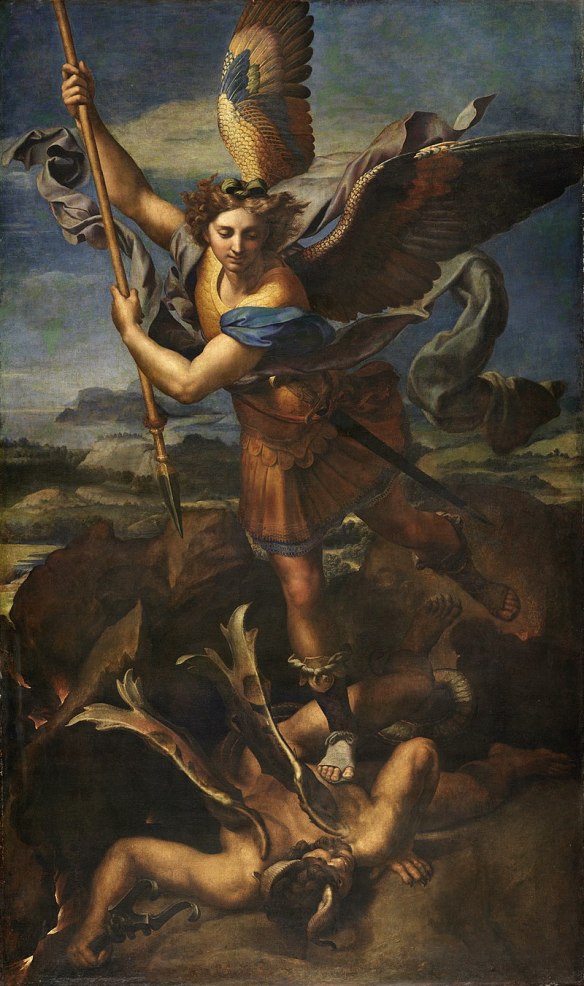
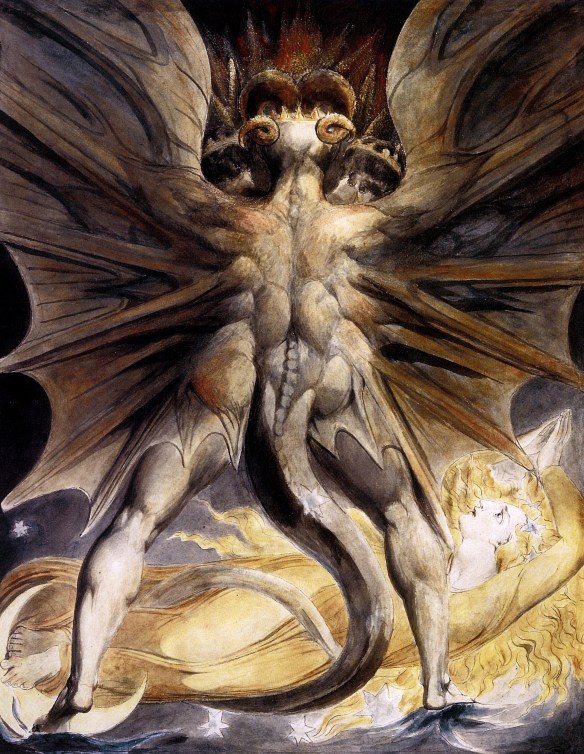
I mean, you’ve got the serpent in the story of the Garden of Eden, St. Michael pinning a rather draconic looking Satan (and the myriad saintly copycats, often with actual dragons), and later examples like William Blake’s painting of the Great Red Dragon of The Book of Revelation.

St. Michael binding Satan just like Beowulf will bind the dragon in death.

St. Michael binding a mostly humanoid, but leathery-winged and horned, Satan. Image from https://commons.wikimedia.org/wiki/File:Le_Grand_Saint_Michel,_by_Raffaello_Sanzio,_from_C2RMF_retouched.jpg

William Blake's Great Red Dragon looming over a woman like the dragon looming over Geatland in Beowulf.

William Blake’s Great Red Dragon standing over the Woman Clothed in the Sun. Image from https://commons.wikimedia.org/wiki/File:Reddragon.jpg

Even today, I think that the conspiracy theories involving lizard people are just the modern version of the Western idea of dragons (lizards with human-like intelligence and power) as inherently evil or dangerous.

So why limit the dragon in Beowulf to being just some tribe of people?

But while I was translating and transcribing this week’s passage that interpretation finally clicked.

The utter destruction that the dragon brings. The fire that it leaves in its wake and has encircled the Geatish people with (l.2322). The fact that it “hated and humiliated” (“hatode ond hynde” (l.2319)) the Geats.

All of this sounds like it could be the work of a bunch of warriors.

Plus, reading the dragon as an enemy group works a bit more widely than the moralistic/allegorical reading that I had in mind.

If Beowulf is the hero of good, what does it mean for him to be an old, somewhat world-weary man? And if Beowulf is the paragon of good and the dragon the ultimate evil, then how does the thief and his lord fit into things? Not to mention dealing with all of the citizens of Geatland the dragon’s attack has affected.

So that dragon could be the Swedes. This part of the poem could be about the first massive attacks that start to weaken the Geats.

Once again, more than anything I’m blown away by how many layers this poem has. It’s simply incredible.

If you had come up with a theory for what the dragon ‘really” represents in this part of the poem what would your theory be?

Share your thoughts in the comments!

And, if you enjoyed this post give it a like and consider reblogging it.


Back To Top
Closing

Next week, Beowulf busts back into the poem! But he’s a changed man.

You can find the next part of Beowulf here.

Back To Top

When the Beowulf dragon wakes, strife wakes with it (ll.2287–2311)

Recap
Synopsis
The Original Old English
My Translation
A Quick Interpretation
Closing

The kind of dragon perfectly at home in Beowulf.

An Anglo-Saxon dragon, complete with treasure hoard. Image from http://brer-powerofbabel.blogspot.ca/2011_09_01_archive.html


Back To Top
Recap

Last week, how the dragon came to be in the barrow was revealed. And we learned that the barrow thief brought the stolen cup to his lord. This man, captured by greed, commanded that the barrow treasure be dug up, and so the dragon’s wrath was woken.


Back To Top
Synopsis

The dragon realizes that his treasure hoard is missing a golden cup. He sulks around his barrow and then decides to attack the countryside.


Back To Top
The Original Old English

“þa se wyrm onwoc, wroht wæs geniwad;
stonc ða æfter stane, stearcheort onfand
feondes fotlast; he to forð gestop
dyrnan cræfte dracan heafde neah.
Swa mæg unfæge eaðe gedigan
wean ond wræcsið, se ðe waldendes
hyldo gehealdeþ! Hordweard sohte
georne æfter grunde, wolde guman findan,
þone þe him on sweofote sare geteode,
hat ond hreohmod hlæw oft ymbehwearf
ealne utanweardne, ne ðær ænig mon
on þære westenne; hwæðre wiges gefeh,
beaduwe weorces, hwilum on beorh æthwearf,
sincfæt sohte. He þæt sona onfand
ðæt hæfde gumena sum goldes gefandod,
heahgestreona. Hordweard onbad
earfoðlice oððæt æfen cwom;
wæs ða gebolgen beorges hyrde,
wolde se laða lige forgyldan
drincfæt dyre. þa wæs dæg sceacen
wyrme on willan; no on wealle læg,
bidan wolde, ac mid bæle for,
fyre gefysed. Wæs se fruma egeslic
leodum on lande, swa hyt lungre wearð
on hyra sincgifan sare geendod.”
(Beowulf ll.22872311)


Back To Top
My Translation

“When the dragon awoke, strife stirred with him.
The drake moved quickly over the stones of his home, fierce-hearted.
He found the enemy’s track, the scent of he who had used stealth
and skill to creep close to his head, where the golden cup
had rested. Thus may he who is unfated to die easily survive
misery and exile, so it goes for the one who keeps
the Ruler’s favour. But the guardian of that hoard
searched eagerly along the ground, its fervent wish was to find
the one who had dealt so grievously with his cup as he slept.
Hot and fierce-hearted he often went all around
the outside of that barrow – yet not any man was there
in that deserted place. All the same, the dragon shook and postured
as if at war, as if he were in the midst of deeds of battle. At times he
took turns about the barrow, seeking that precious vessel. Immediately he
found that a man had tampered with his gold,
had his hands upon that rich treasure. The hoard guardian
waited with difficulty until evening came,
he was enraged and impatient, at last he decided
he would payback the precious drinking vessel
with hateful flames. As the day went by
the serpent seethed with desire; no longer could it
wait within the walls. Amidst its flames the wyrm burst forth,
ready with fire. That was but the beginning the terror the people
of that land suffered, and just so
it spelled a swift end to their quickly grieving treasure-giver.”
(Beowulf ll.2287–2311)


Back To Top
A Quick Interpretation

Hunting down work as a freelancer is sometimes as full-time a job as the jobs you’re hunting. This is one of those times. Which means this week’s post is another poetry only piece. I do have a question, though:

If you had to a slay a dragon how would you do it?

Would you go all out and risk doing more damage to the area than the dragon would? Or would you try to be precise and tactical?

I’d try to be as strategic as possible – a dagger in the dragon’s soft spot is the surest end.

Share your answer in the comments!

And if you like my translation, please like this post. You could also follow this blog to see a new translation pop up in your feed every Thursday.


Back To Top
Closing

Next week, the dragon brings fire to the countryside.

You can find the next part of Beowulf here.
Back To Top

The dragon settles in (and still no Beowulf) (ll.2270b–2286)

Recap
Synopsis
The Original Old English
My Translation
A Quick Interpretation
Closing

The kind of dragon perfectly at home in Beowulf.

An Anglo-Saxon dragon, complete with treasure hoard. Image from http://brer-powerofbabel.blogspot.ca/2011_09_01_archive.html


Back To Top
Recap

In last week’s post we heard about the last survivor and the treasure he hid.


Back To Top
Synopsis

The dragon finds the ancient hoard. Jump back to the present, where the man who stole the cup shows his lord and the hoard is dug up. They wake the dragon.


Back To Top
The Original Old English

“Hordwynne fond
eald uhtsceaða opene standan,
se ðe byrnende biorgas seceð,
nacod niðdraca, nihtes fleogeð
fyre befangen; hyne foldbuend
swiðe ondrædað. He gesecean sceall
hord on hrusan, þær he hæðen gold
warað wintrum frod, ne byð him wihte ðy sel.
Swa se ðeodsceaða þreo hund wintra
heold on hrusan hordærna sum,
eacencræftig, oððæt hyne an abealch
mon on mode; mandryhtne bær
fæted wæge, frioðowære bæd
hlaford sinne. ða wæs hord rasod,
onboren beaga hord, bene getiðad
feasceaftum men. Frea sceawode
fira fyrngeweorc forman siðe.”
(Beowulf ll.2270b2286)


Back To Top
My Translation

“The old ravager by night
later found that delightful hoard left open,
the burning one who seeks out barrows,
the slick, malicious dragon, flew into it by night,
enveloped in flame. The dwellers on the land thereabouts
greatly feared that drake. It delved deep
searching the earth for the depths of that hoard, which it guarded
through countless winters, kept watch over heathen gold,
useless treasure. That ravager of the people occupied the earth
hidden in the barricaded treasure house for three hundred years.
But then a man enraged that fire wyrm, stoked the fury of its heart.
To his lord the thief bore a gold-plated cup,
that man also offered a plea for peace with his lord —
a plea the lord heard as certainly as he saw the cup’s glint.
Then the hoard was ransacked, the piles of rings and trinkets was diminished,
that wretched man’s request was granted. His lord leered at
the ancient work of long dead men for the first time.”
(Beowulf ll.2270b2286)


Back To Top
A Quick Interpretation

I’m short on time this week and busy over the weekend, so it’s just the poem this week. But I will leave you all with a question:

The dragon in Beowulf is just one of many versions of the mythical creature. What’s your favourite dragon from fiction, video games, or TV/Movies?

Mine would have to be Naydra from the Legend of Zelda: Breath of the Wild. She’s just a coolly beautiful creature:

The dragon Naydra from Legend of Zelda Breath of the Wild: not quite like the dragon in Beowulf.

Link stands before the dragon Naydra. Image from http://www.letswitch.eu/en/2017/03/07/botw-journal-5/

Share your favourite dragon in the comments! And give this post a like if you enjoyed the translation.


Back To Top
Closing

Next week, the dragon gets all het up.

You can find the next part of Beowulf here.
Back To Top