Forget Beowulf — what’s the Last Survivor’s story? (ll.2241b-2270a)

Introduction
Recap & Synopsis
The Original Old English
My Translation
A Quick Interpretation
Closing

A long barrow from the time of Beowulf and the Lay of the Last Survivor found in Oxfordshire.

A barrow known as Wayland’s Smithy. Perhaps the Last Survivor stowed his people’s treasures in a similar place. Image from https://commons.wikimedia.org/wiki/File:Wayland_Smithy_Long_barrow.jpg


Back To Top
Recap & Synopsis

Last week we heard about how the dragon was terrorizing the Geats. Why? Because a cup was stolen from its hoard of treasures.

This week, we hear the Lay of the Last Survivor. These are the final words of the last living member of the tribe who lived where the Geats now live and hid their treasures there.


Back To Top
The Original Old English

“Beorh eallgearo
wunode on wonge wæteryðum neah,
niwe be næsse, nearocræftum fæst.
þær on innan bær eorlgestreona
hringa hyrde hordwyrðne dæl,
fættan goldes, fea worda cwæð:
‘Heald þu nu, hruse, nu hæleð ne moston,
eorla æhte! Hwæt, hyt ær on ðe
gode begeaton. Guðdeað fornam,
feorhbealo frecne, fyra gehwylcne
leoda minra, þara ðe þis lif ofgeaf,
gesawon seledream. Ic nah hwa sweord wege
oððe feormie fæted wæge,
dryncfæt deore; duguð ellor sceoc.
Sceal se hearda helm hyrsted golde
fætum befeallen; feormynd swefað,
þa ðe beadogriman bywan sceoldon,
ge swylce seo herepad, sio æt hilde gebad
ofer borda gebræc bite irena,
brosnað æfter beorne. Ne mæg byrnan hring
æfter wigfruman wide feran,
hæleðum be healfe. Næs hearpan wyn,
gomen gleobeames, ne god hafoc
geond sæl swingeð, ne se swifta mearh
burhstede beateð. Bealocwealm hafað
fela feorhcynna forð onsended!’
Swa giomormod giohðo mænde
an æfter eallum, unbliðe hwearf
dæges ond nihtes, oððæt deaðes wylm
hran æt heortan.”
(Beowulf ll.2241b-2270a)


Back To Top
My Translation

“The barrow stood ready
in open ground near the sea-waves.
It was newly made at the headland, made secure with the art of secrecy.
Within there the keeper of the ancient earls’ ringed treasure
carried that share of worthy treasures,
the hoard of plated gold; these few words he spoke:
‘Hold you now, oh earth, that which men and women cannot,
enjoy these warriors’ possessions! Indeed it was
obtained from you at the first, dug up
by worthy men. But death in battle bore those delvers away.
Now that terrible mortal harm has carried off each and every one of my people.
They have left this life where they knew and looked back longingly
at the joy had in the hall. I now have no-one to bear the sword
or bring the plated cup, that precious drinking vessel.
That group of tried warriors has since passed elsewhere.
Their hard helmets with gold adornment shall be bereft of their gold plate;
the burnishers sleep the sleep of death, those who should polish the battle mask.
So too the battle garbs, that had endured in battle
through the clash of shields and cut of swords,
they now decay upon the warriors’ husks; nor may the mailcoats of rings
go with the war-leader on his long journey,
they may not be kept at their bloodied sides. No harp joy,
no delight of musical instruments, nor any good hawk
flies through the hall, nor any swift mare
stops in the flowered courtyard. Destructive death
has sent forth all others of my race, as it has with countless others.’
Just so, sad at heart, this one followed his kin.
He expressed his sorrow, he moved about joyless,
for unlit days and for fevered nights, until death’s surging
reached his heart.”
(Beowulf ll.2241b-2270a)


Back To Top
A Quick Interpretation

This is one of the big deal parts of the poem. Much like Hrothgar’s speeches to Beowulf about being a good king, it delivers the other of the poem’s major messages: riches are useless without others to enjoy them with.

I mean, this Twilight Zone-esque last survivor has no hope of enjoying or using all this treasure. He can’t strum the harp while polishing helmets and swinging a sword as he waits for his hawk to come to rest on his hand. Not because he doesn’t have those things, but because he has no one to do those things in tandem with.

Though it’s kind of strange. I really wonder about this last survivor and the sort of society that he comes from.

How did they amass all these treasures? It doesn’t sound like they were won necessarily. Instead it sounds more like his people dug up the raw materials, and then created the helmets and cups and mail and swords themselves.

So is this some sort of advanced ancient society situation?

Or, since the Geats, this sea-faring people, are anchored in their homeland, is this situation the fantasy of finding a land completely bereft of settlers but still home to their treasures?

Is this a metaphor for the Anglo-Saxons coming to Britain and then just kind of sweeping the Britons under the rug?

And why is this one guy the lone survivor? Did some sort of disease sweep through his group and he was the only one with immunities against it?

Was he the only one who was out hunting when a wild band of raiders slaughtered everyone else?

There aren’t really any answers to these questions unfortunately.

But that’s just what seems to happen when you try to logic through Beowulf.

What’s more important to the poet or their audience is that the theme of this passage fits with the rest of the poem. It has a melancholic tone and really emphasizes the idea that possessions are both incredible and incredibly useless without others to enjoy them with.

Unless, of course, you’re a dragon. But we’ll see more of that in coming weeks.

Tabletop games were big throughout the middle ages, and the Last Survivor reminds me of The Lost Tribes from the game Small World. What’s your favourite tabletop game?

Mine would have to be Time Stories. (I still haven’t played the Beowulf game, after all 😉 )

Share your favourite board game in the comments!


Back To Top
Closing

Next week, we learn what happened to the thief who stole the cup and kicked all this off.

You can find the next part of Beowulf here.

Back To Top

The stories embodied in the Beowulf manuscript (ll.2209-2241a)

Introduction
Synopsis
The Original Old English
My Translation
A Quick Interpretation
Closing

Beowulf is protected from dragon fire by his shield while treasure awaits.

An illustration of Beowulf fighting the dragon that appears at the end of the epic poem. Illustration in the children’s book Stories of Beowulf (H. E. Marshall). Published in New York in 1908 by E. P. Dutton & Company. Image found at https://commons.wikimedia.org/wiki/File:Beowulf_and_the_dragon.jpg


Back To Top
Synopsis

The dragon appears and we hear its story.


Back To Top
The Original Old English

“he geheold tela
fiftig wintra (wæs ða frod cyning,
eald eþelweard), oððæt an ongan
deorcum nihtum draca ricsian,
se ðe on heaum hofe hord beweotode,
stanbeorh steapne; stig under læg,
eldum uncuð. þær on innan giong
niða nathwylc, se ðe neh gefeng
hæðnum horde, hond ……,
since fahne. He þæt syððan ……,
þeah ðe he slæpende besyred wurde
þeofes cræfte; þæt sie ðiod onfand,
bufolc beorna, þæt he gebolgen wæs.
Nealles mid gewealdum wyrmhord abræc
sylfes willum, se ðe him sare gesceod,
ac for þreanedlan þeow nathwylces
hæleða bearna heteswengeas fleah,
ærnes þearfa, ond ðær inne fealh,
secg synbysig, sona onfunde
þæt þær ðam gyste gryrebroga stod;
hwæðre earmsceapen
…sceapen
þa hyne se fær begeat.
Sincfæt ……; þær wæs swylcra fela
in ðam eorðhuse ærgestreona,
swa hy on geardagum gumena nathwylc,
eormenlafe æþelan cynnes,
þanchycgende þær gehydde,
deore maðmas. Ealle hie deað fornam
ærran mælum, ond se an ða gen
leoda duguðe, se ðær lengest hwearf,
weard winegeomor, wende þæs ylcan,
þæt he lytel fæc longgestreona
brucan moste.”
(Beowulf ll.2209-2241a)


Back To Top
My Translation

“He ruled them well for fifty winters,
indeed Beowulf became a wise king,
an aged lord of the realm — until one began to trouble them;
in the dark of night a prowling dragon appeared.
The wyrm held a treasure in his high hall,
all beneath a steep stone roof, led to by a narrow footpath
unknown to men. There into the abyss stumbled
someone or other … who seized by hand from that heathen hoard …
a gleaming treasure that he afterward …
though the dragon slept he had outwitted
it with a thief’s wiles. Soon the people thereabouts,
those under the shield of the local lord, discovered
that the thief’s act unlocked the serpent’s rage. Though
not at all with evil intent did the thief break into the dragon’s hoard,
it was not for his own greedy desire, he had been sorely opressed.
For three nights that slave turned thief
had fled the blows of a prince of men,
he delved into the dragon’s den by need, then entering in
as a man ridden with guilt. Shortly he discovered
that … the man stood terror struck,
which the miserable …
… made … that fed his own fear, treasure piece
… there were many such pieces
of ancient heirlooms in that earthen house.
For there in earlier times some man or other,
had left a huge legacy of noble kin,
thoughtfully buried the treasures there,
those precious pieces of their story. He and all his kin
had since been carried off by death in former times.
But the last one left of that noble people, he who was the eldest,
a barrow guard grieving for lost friends buried them, knowing indeed
that he would little enjoy those grand and
beautiful treasures apart from all his kin.”
(Beowulf ll.2209-2241a)


Back To Top
A Quick Interpretation

Once the dragon comes front and center, the poem itself takes a beating. Every one of the ellipses seen in this week’s passage represents an illegible part of the original text of Beowulf.

I’m not sure what exactly caused this crop of ellipses, but there are a few possibilities. As with all old books, it’s possible that these pages are worm-eaten. Or they may have just decayed because the Nowell Codex was sometimes kept in damp conditions. Or, since the Nowell Codex survived a fire, those missing bits of the poem may have been, appropriately, burned up.

Even setting aside everything that happened to it, it’s impressive that the Nowell Codex (and the copy of Beowulf within) survived for so long. It would be incredible to be able to go see the thing in person, but living on the other side of the Atlantic makes that kind of hard.

Though, what would make seeing the Beowulf manuscript in person special would be the chance to interact with the story’s physical embodiment. I mean, the Beowulf manuscript is a physical copy of a story that’s proliferated like its own species of animal. Going to see it manuscript in person would be like meeting with the first primate that walked upright (though with much less growling, I’d think).

Plus it would give me a new appreciation of all the work that went into bringing the Nowell Codex together.

After all, the poet didn’t just get lucky and find someone willing to publish them, give a fat advance, and send them out on a book tour.

The Beowulf poet got lucky enough to have their work written down on material that would last centuries. And that material came from several sheep and could take days, maybe weeks, to prepare. Beowulf was committed to bound paper at a time when books were truly treasured. So, to see that kind of labour of love up close would be fascinating.

And who knows. Maybe, even through the white gloves I’d need to wear to be in the room with it, contact with the pages of the Nowell Codex would trigger a psychic link to one of its scribes. And through that link I’d gain a greater understanding of why Beowulf was bunched together with letters about far away places and a homily on St. Christopher.

But that fan-fic is for another time. (Is there even such a thing as fanfiction about books?)

I guess for now I’ll just have to check out the digital version on the British Library’s site.

What’s your favourite old book? If you’re a book collector, do you have any first editions? What makes them special to you?

Feel free to share your answers in the comments.


Back To Top
Closing

Next week, the grieving barrow guard gives a speech.

You can find the next part of Beowulf here.
Back To Top

Twin Peaks and Beowulf!?

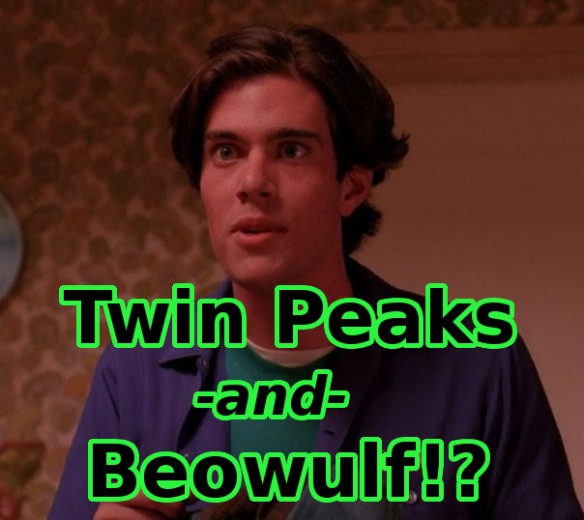
Bobby Briggs from Twin Peaks stunned by Beowulf.

We can all share in Bobby’s shock. Image from http://www.gramunion.com/robotbeowulf.tumblr.com/155345786712

Spoilers abound below. If you’re not done with Twin Peaks The Return (or the entire series) just yet, read on at your own risk.

Introduction

It’s human nature to see patterns where there might not be any. It’s also human nature to want to combine the things you love even if they don’t seem likely to mix. That’s where today’s post is coming from.

Having seen and mostly digested Twin Peaks The Return, and being quite familiar with Beowulf, I noticed a few similarities. Especially when it comes to the monsters featured in both works.

Now, I don’t think that these similarities point to any answers in the Twin Peaks universe. Nor do I think that David Lynch is a secret Beowulf fan who wanted to work through the poem’s themes and motifs in his own art. I just noticed that there are some similarities between the oldest piece of English literature and the newest piece of television art.

And I want to share them with my readers.

This comparison will go through the monsters of Beowulf since that’s where the meat of this is. Though a case could be made that Lynch’s at times directionless-seeming storytelling is quite similar to Beowulf‘s asides and loosely related side stories.

There is one Twin Peaks theory at work in this comparison. This is the idea that the ancient evil force that Gordon Cole calls Judy in part 17 of The Return is the same as The Experiment that we see in parts 1 and 8.

Now, let’s get right into those monsters!

The Monsters in General

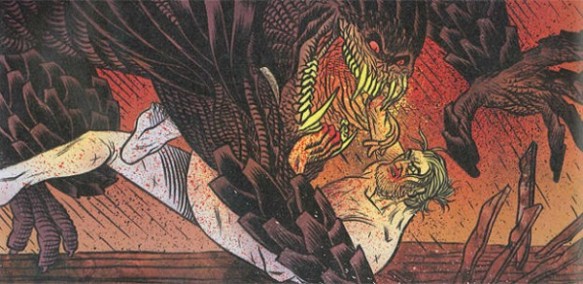
Beowulf fights Grendel as depicted by Santiago Garcia and David Rubin's graphic novel adaptation of Beowulf.

Beowulf battles Grendel in Santiago Garcia and David Rubin’s Beowulf. Image from http://bit.ly/2jVrgOn.

Beowulf features some sort of unidentified troll-like monster, its mother, and a dragon. Twin Peaks has two monsters, essentially: Killer BOB and Judy (Jao De). I’m not sure how evil spirits from other dimensions or outside of time trace their lineage, but I think it’s safe to say that Judy is Killer BOB’s mother. So there’s one parallel.

But there’s more to the BeowulfTwin Peaks monster connection than mere surface similarity.

Like Grendel and his mother, BOB and Judy are encouraged by human action. In the case of the Grendels, the construction of Heorot disturbs them and provokes Grendel to attack. Heorot, however, is no military barracks but a place meant for peaceful gatherings and where new friendships could be forged or old ones strengthened. For BOB and Judy, the human action that gets them into action is the nuclear testing at the Hanford site. A nuclear bomb is not really much like a drinking hall, though it is interesting to think about it in terms of its ultimate goal: to ensure, through either use or mere presence, the continuation of peace. As part of this comparison,

I think it’s also neat to think of the hall, a place of peace, inciting the Grendels in a world rife with everyday conflict, whereas the bomb is a weapon of destruction in a world that enjoys everyday peace.

Grendel/Killer BOB

Beowulf, Grendel, Old English, Anglo-Saxon

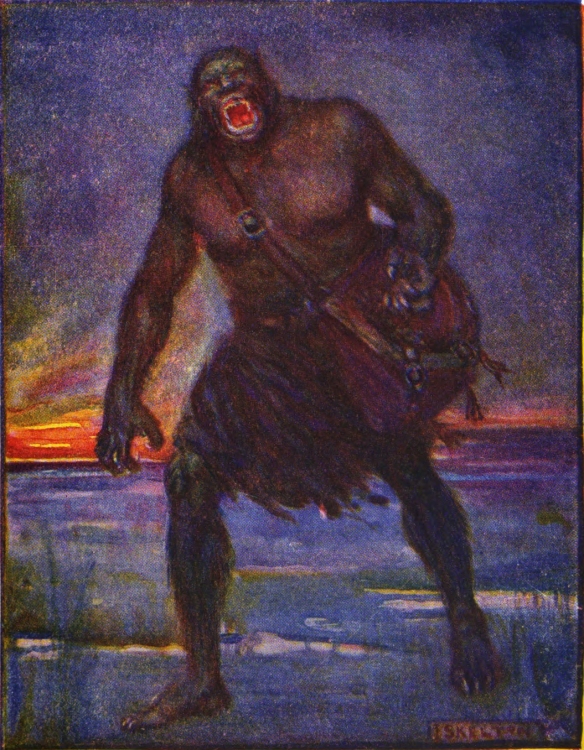
An illustration of Grendel by J.R. Skelton from Stories of Beowulf. Grendel is described as “Very terrible to look upon.” From: https://commons.wikimedia.org/wiki/File:Stories_of_beowulf_grendel.jpg

Moving on from that rabbit hole, though, we come to Grendel as an agent of terror. Likewise, BOB terrorizes those he inhabits and the lives of those around his hosts. Also, how Grendel and how Killer BOB are defeated is similar.

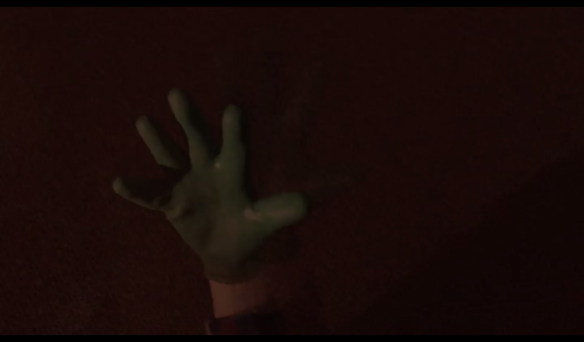
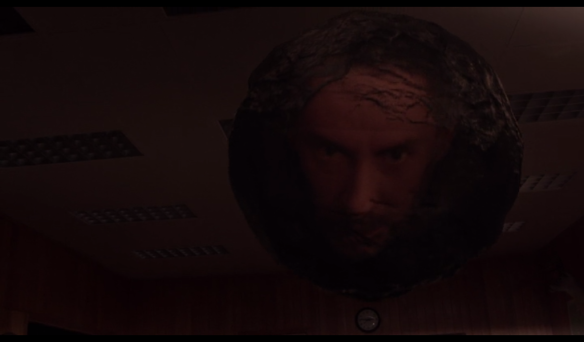
In Beowulf, the poem’s hero wrestles Grendel into submission with his bare hands. He even goes so far as to tear off the monster’s arm with just his hands since his grip has the strength of 30 men. In Twin Peaks something similar happens: Through a strange sequence of events Freddie ends up buying and putting on a green gardening glove that lets him punch with the power of a pile driver. This strength overcomes Killer BOB when he’s in his ball form, shattering him to pieces.

Freddie's Beowulf-like gardening gloved hand, Killer BOB Killer in Twin Peaks.

The arm.

Those pieces, like Grendel in the poem, then run away. And it seems likely that after the events of part 17 of The Return, BOB is as dead as Grendel is by the end of Beowulf.

The BOB Bubble that Freddie beats, Beowulf-like, in Twin Peaks.

The BOB bubble that Freddie bursts.

Grendel’s Mother/Judy

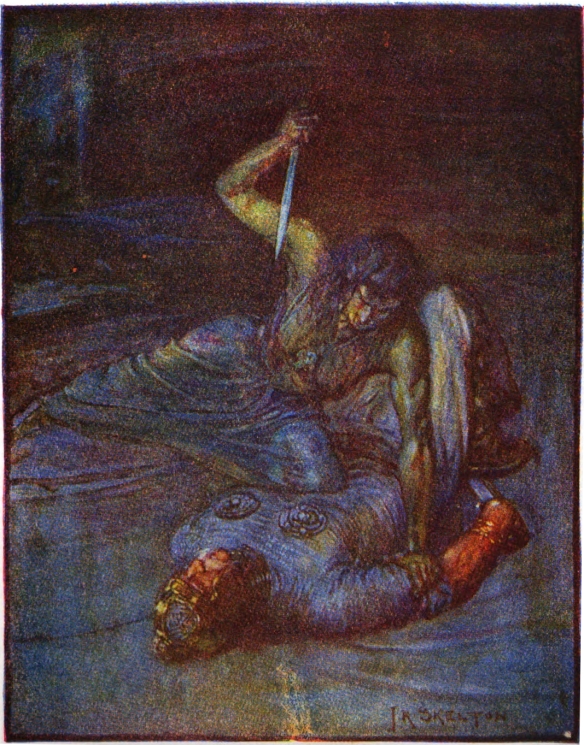
Grendel's mother menaces the pinned Beowulf with a knife.

By J. R. Skelton – Marshall, Henrietta Elizabeth (1908) Stories of Beowulf, T.C. & E.C. Jack, Public Domain, https://commons.wikimedia.org/w/index.php?curid=11001837

Grendel’s mother also shares general traits with how Judy operates. When Grendel is killed Grendel’s mother shows a level of calculated intelligence when she only kills and carries off one of Hrothgar’s men. Not only does this action show that she has a concept of “an eye for an eye”, it suggests that she is aware of the nature of feuds.

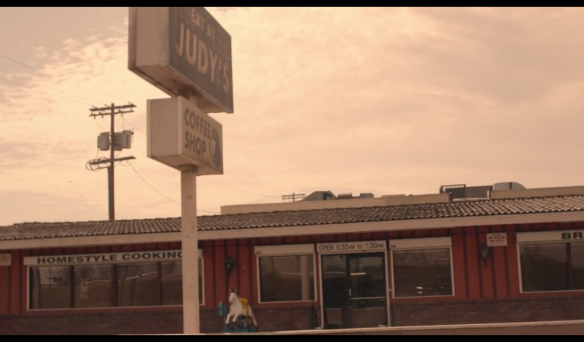
Judy, a being of supreme evil, operates with similar careful calculation. She does not just let Cooper walk Laura to the white lodge when he plucks her from death in the original timeline/dimension of the series. Instead she plucks her away from him and brings her to another timeline/dimension entirely. But Judy doesn’t just hide Laura anyway. She brings the girl to a place where she holds sway (and runs a coffee shop apparently).

Judys Cafe in Twin Peaks The Return, no parallel in Beowulf.

Judy’s has it all — breakfast, homestyle cooking, and a slick white horse ride.

Cooper ventures into the place that Judy has made, where she seems to have some sort of dominion in an effort to get Laura back. Similarly, Beowulf dives into a lake to get to the Grendel’s underwater hall where Grendel’s mother holds power.

Heroes’ journeys to strange places to face powerful foes isn’t anything all that new or rare in stories. But I find it fascinating that both heroes venture into what is essentially enemy territory in similar ways. Beowulf dives until the currents pull him into a strangely lit cavern. Cooper travels down a road until he passes under electrical lines and ends up in this strange, yet familiar, new place.

Further, Beowulf goes into his trial with the sword of the enemy-turned friend Unferth. Cooper goes into it with a friend whom we’ve seen as being untrustworthy and manipulated throughout the season in Diane. In both cases, these helps prove useless in the confrontation with the power that they are fighting. Unferth’s sword does no damage to Grendel’s mother, and Diane forgets who she was as she settles into her new role as Linda in this new timeline/dimension.

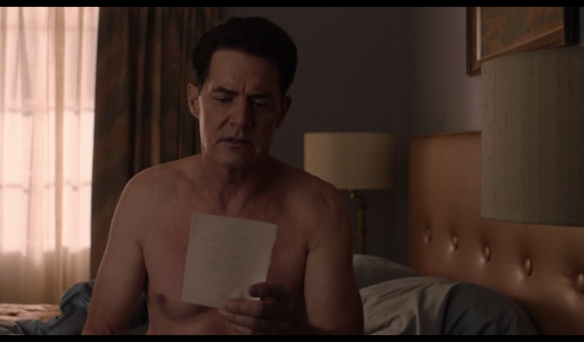
Twin Peaks' Cooper reads a note - a missing page of Beowulf.

Cooper reads Linda’s weird note.

The Dragon/The Experiment/Judy

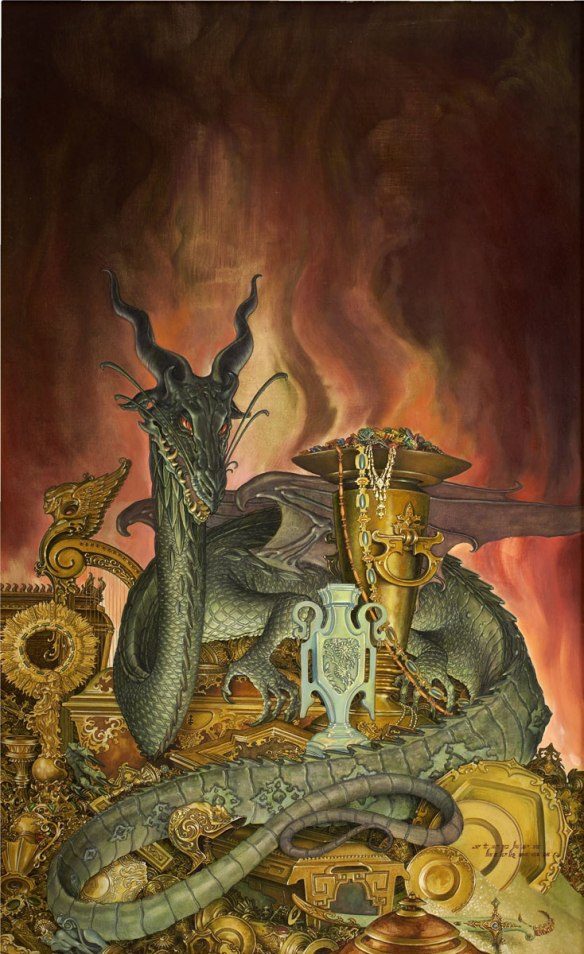
A dragon and its hoard like the one in Beowulf.

A dragon and its hoard.

Now, there is no dragon in Twin Peaks. Something so blatant or obvious just isn’t David Lynch and Marc Frost’s style. But. I think that there are more similarities between Beowulf‘s story and Twin Peaks The Return‘s main conflict. Though they require some mental squinting to see.

Up until the end of The Return, what exactly the vaguely female creature credited as “Experiment” was was unclear. I think it’s fair that this creature fits the role of Grendel’s mother quite perfectly. But. I also think that this creature fills the role of the dragon as well. She doesn’t transform into some sort of giant scaly creature for Cooper to shoot at or anything like that, but what the Experiment comes to be by the end of The Return is on the same level as the dragon in Beowulf.

In the poem, the dragon is not just the final foe that Beowulf faces. It is an ancient thing, greedy and prideful, that starts to terrorize Beowulf’s lands when one of its treasures is stolen. Of course, this dragon doesn’t spend any of its treasures, it merely hoards them. It is the inspiration for the vain and greedy Smaug from the Hobbit. Likewise, Judy seems to hoard whatever those bubbles that she and The Fireman sent out around the mid point of The Return. Once she wins them over to her pile that is. As she does with Laura.

I think that Judy is much more than the vaguely female shape we see in parts 1 and 8. The Experiment, with its ability to blend people’s faces faster than a Blendtec mashes diamonds, is just an embodiment, just a shell. It could be argued that that isn’t even correct, and the Experiment as Judy is merely a perception of the kind of evil force that simply cannot be embodied.

In short, Judy is bad news.

In Beowulf the dragon is bad news.

It burns down Beowulf’s meeting hall, terrorizes his people, and threatens their very existence. Just like Judy in the Twin Peaks universe.

But, just like the dragon, I think that Judy only flexes its true muscle, shows off its true power as an evil force, when its most prized possession is stolen away from it. When Coop saves Laura from ending up in plastic on the beach in Twin Peaks, it’s like someone just stole something from the dragon’s hoard. From that moment on in The Return, I think that Judy transcends (if that makes sense) into its true self and is able to create all new realities (timelines/dimensions) in which to hide Laura.

Meanwhile, having passed through the lodge twice now, Cooper is somehow older, perhaps more wizened. This comes across in the diner scene where he takes down the three cowboys. Yet, he warns the fry cook that the oil he just dropped the cowboys’ guns into may be hot enough to set them off. Like Beowulf when the dragon attacks, this is an older, more tired hero that we’re looking at. Yet he is certain of himself and confident enough to find Carrie Paige (Laura), bring her back to Twin Peaks, and try to remind her of who she really is. Just as Beowulf is confident enough in his own abilities to fight the dragon.

Both stories then end.

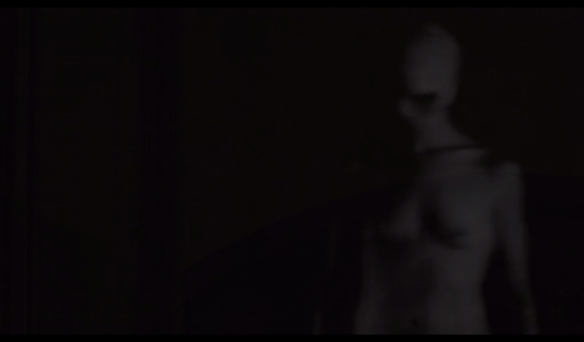
Twin Peaks' experiment, much like Grendel's mother in Beowulf.

The eerie Experiment from the glass box.

Conclusion

With Beowulf, the dragon is defeated but Beowulf is mortally wounded. And the future of the Geatish people, and the whole way of life that the poem portrays, is unclear.

With Twin Peaks, Carrie Paige remembers who she is, and Cooper seems to wake up — which should be a victory. But instead we hear the same scream that filled the woods when Laura was swept away from Cooper earlier in the episode. We then hear a faint ethereal “Laura” and the electricity flickers. The house where Laura lives goes dark. Then the entire screen goes dark.

Thematically, these endings have much in common. Both are bittersweet, yes. But more than that both endings demonstrate the ending of something incredible. Whether the Geats survive without their king, or whether Cooper and Laura triumphed over that wave of evil they were up against are unclear. Both are unwritten. But both are certainly art.

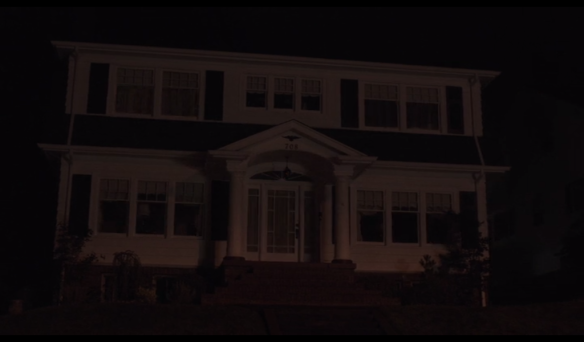
Twin Peaks' Palmer house has its lights go out, like Beowulf's punching Grendel's lights out.

The dimmed Palmer (?) house.

And that’s my attempt to bring these two disparate bits of media together. An early medieval epic poem and a surreal detective/supernatural television show. To me it all makes some kind of sense.

But what do you think about this comparison? Is it even possible to compare two things that are so different in time and place and content? What are your own pet theories about the ending of Twin Peaks?

Share your thoughts in the comments!

Beowulf becomes king after some summarizing (ll.2190-2208)

A Viking Age battle involving, no doubt, a king like Beowulf.

Thorir Hund dressed in a reindeer-hide tunic kills King Olaf at the Battle of Stiklestad. Painting by Peter Nicolai Arbo. Click image for source.

Introduction
Synopsis
The Original Old English
My Translation
A Quick Interpretation
Closing


Back To Top
Synopsis

Hygelac gives Beowulf the greatest gifts of all.


Back To Top
The Original Old English

“Het ða eorla hleo in gefetian,
heaðorof cyning, Hreðles lafe
golde gegyrede; næs mid Geatum ða
sincmaðþum selra on sweordes had;
þæt he on Biowulfes bearm alegde
ond him gesealde seofan þusendo,
bold ond bregostol. Him wæs bam samod
on ðam leodscipe lond gecynde,
eard, eðelriht, oðrum swiðor
side rice þam ðær selra wæs.
Eft þæt geiode ufaran dogrum
hildehlæmmum, syððan Hygelac læg
ond Heardrede hildemeceas
under bordhreoðan to bonan wurdon,
ða hyne gesohtan on sigeþeode
hearde hildefrecan, Heaðoscilfingas,
niða genægdan nefan Hererices,
syððan Beowulfe brade rice
on hand gehwearf;”
(Beowulf ll.2190-2208)


Back To Top
My Translation

“After those gifts were given the protector of the earls,
the battle-famed king, ordered Hrethel’s heirloom be brought in.
It was a wondrous, gold-chased thing, there was no other
amid the whole Geat treasure hold to best that sword.
This Hygelac laid upon Beowulf’s lap,
and to him he gave seven thousand hides of land,
a hall and a throne. Both already owned land
by right of kin, though he of greater
hereditary right had more — lands were ample among
those of high rank — to him the best of the
earth was bequeathed.
After that came many days
full of the fury of battle. Hygelac fell,
Heardred’s protection proved useless,
it collapsed under the phalanx that brought his death
when they, the victorious people of the Heatho-Scylfings,
attacked with seasoned swordsmen.
That brought about fatal strife for his nephew Hereric.
Afterwards those lands turned to Beowulf’s hand.”
(Beowulf ll.2190-2208)


Back To Top
A Quick Interpretation

Here the gift exchange comes to an end. Then, the summaries come.

By their nature, summaries work best when you’re familiar with what’s being talked about.

If these summaries were in plainly written prose, then they would be very informative. But these are poetic summaries. And they’re poetic summaries that refer to things that only Beowulf scholars are familiar with.

Heardred hasn’t been mentioned much at all up to this point in the poem, and Hereric is a brand new ripple all together. So, ultimately, this passage shows how much a part of Beowulf was of some sort of greater body of work or group of stories. The poet is definitely pulling on a wealth of cultural and shared knowledge. Which makes this ancient poem written in a barely familiar form of English the perfect example of how far removed such old things are from us.

An alliterative, compound word-heavy language just isn’t English as we know it. And neither are Heardred or Hereric.

And yet, Beowulf sticks with us.

All that stuff about Beowulf fighting monsters and being a little bit of a monster himself keeps it relevant because it speaks so much to our greatest struggle. Whenever we face a new challenge we come up against some form of change. And we can change in a bad way, perhaps taking the easy way out of a tight spot. Or we can try to do our best and meet those challenges in an honest way, hopefully leading to positive growth. And that’s probably why so many adaptations of Beowulf focus on those first two monsters.

Starting next week, though, I’ll be starting to translate the final part of the poem. We’ll be seeing the poem’s third monster.

What’s your favourite monster from mythology? I’ve always been a fan of dragons. Leave your favourite in the comments!


Back To Top
Closing

Next week, something big, scaly, and flying gets in the way of Beowulf’s happiness.

You can find the next part of Beowulf here.
Back To Top

Just how important Beowulf’s gift of horses is (ll.2163-2176)

Introduction
Synopsis
The Original Old English
My Translation
A Quick Interpretation
Closing

A drawing of an Anglo-Saxon chariot, complete with horses.

A 10th century illustration of a two-horse chariot from Prudentius’ Psychomachia (a poem about a battle between virtues and vices). Click the image for the source.


Back To Top
Synopsis

The poet describes the gifts Beowulf gives to Hygelac and Hygd.


Back To Top
The Original Old English

“Hyrde ic þæt þam frætwum feower mearas
lungre, gelice, last weardode,
æppelfealuwe; he him est geteah
meara ond maðma. Swa sceal mæg don,
nealles inwitnet oðrum bregdon
dyrnum cræfte, deað renian
hondgesteallan. Hygelace wæs,
niða heardum, nefa swyðe hold,
ond gehwæðer oðrum hroþra gemyndig.
Hyrde ic þæt he ðone healsbeah Hygde gesealde,
wrætlicne wundurmaððum, ðone þe him Wealhðeo geaf,
ðeodnes dohtor, þrio wicg somod
swancor ond sadolbeorht; hyre syððan wæs
æfter beahðege breost geweorðod.”
(Beowulf ll.2163-2176)


Back To Top
My Translation

“I heard that next four ornate horses were brought in,
quickly, each of them as beautiful as the last,
bay and brilliant. Beowulf gave unto his lord such gifts
in horses and treasures. And so shall all kinsmen do;
not scheme and lay out nets laced with malice for others
through deceitful craft, not arrange death
for hand-companions. Hygelac proved a grand uncle
to Beowulf, a nephew who held fast to the bond,
and each was mindful of the other’s joy.
I heard that then he gave the gorget to Hygd,
Wealhtheow’s well-wrought wonder treasure, that which
the queen had given him, daughter of the prince, three horses as well,
each supple and with ornamented saddles.
The gorget shone like the sun upon Hygd’s breast.”
(Beowulf ll.2163-2176)


Back To Top
A Quick Interpretation

Ah, horses. Today we admire them for their grace and speed. And, back in the early medieval period, people liked horses for the same reasons. Though these qualities were also tied up with ideas of nobility, virility, divinity, and symbolism.

Elaine Moxon wrote a fantastic post about horses in early medieval Britain over on the English Historical Fiction Authors blog. Definitely check it out for the full story.

But, over and over in that post, Moxon points out that horses are prized because they embody the qualities that warriors wanted. Horses were seen as agile, strong, virile, and a simple comfort. Plus, they made it easy to travel the long distances between towns and kingdoms. But, more than that, having and keeping a horse was a sign of wealth. Paying for all that hay and getting someone to muck the stables wasn’t any easier back then it seems.

So Beowulf’s giving Hygelac and Hygd all of these horses is a truly grand gesture. It implies that they’re worthy of such gifts already and yet having an extra seven horses around makes Hygelac and Hygd that much worthier and wealthier. Also, according to Moxon’s post, bay horses were a symbol of the goddess Freyja and fertility. So Beowulf’s gift shows the depth of his fealty to Hygelac through symbolically boosting his ability to produce an heir.

Personally, I think that horses are indeed magnificent creatures. Speaking as a big fan of The Legend of Zelda: Breath of the Wild, I also really appreciate horses as a means of fast travel — maybe just as much as the Anglo-Saxons and early Britons did.

What do you like most (or least) about horses? Leave your thoughts in the comments!


Back To Top
Closing

Next week: A bit of an intermission in the life of Beowulf.

You can find the next part of Beowulf here.

Back To Top

Beowulf gets brief when talking of the Grendels’ hall (ll.2129-2147)

Introduction

Synopsis

The Original Old English

My Translation

A Quick Interpretation

Closing

Beowulf and his band of Geats carrying Grendel's head.

J. R. Skelton – Marshall, Henrietta Elizabeth (1908) Stories of Beowulf, T.C. & E.C. Jack.
Image found at: http://bit.ly/2frmbiU

Back To Top

Synopsis

Beowulf ends his story with his account of fighting Grendel’s mother and then explains his reward.

Back To Top

The Original Old English

“‘þæt wæs Hroðgare hreowa tornost
þara þe leodfruman lange begeate.
þa se ðeoden mec ðine life
healsode hreohmod, þæt ic on holma geþring
eorlscipe efnde, ealdre geneðde,
mærðo fremede; he me mede gehet.
Ic ða ðæs wælmes, þe is wide cuð,
grimne gryrelicne grundhyrde fond;
þær unc hwile wæs hand gemæne,
holm heolfre weoll, ond ic heafde becearf
in ðam guðsele Grendeles modor
eacnum ecgum, unsofte þonan
feorh oðferede. Næs ic fæge þa gyt,
ac me eorla hleo eft gesealde
maðma menigeo, maga Healfdenes.
Swa se ðeodkyning þeawum lyfde.
Nealles ic ðam leanum forloren hæfde,
mægnes mede, ac he me maðmas geaf,
sunu Healfdenes, on minne sylfes dom.'”
(Beowulf ll.2129-2147)

Back To Top

My Translation

“‘That was Hrothgar’s most grievous of those sorrows
that had long befallen that leader of a people.
Then that prince implored me while troubled in mind
to perform another heroic deed in the tumult
of the darkened waters, to venture my life;
in short, perform a glorious deed. He promised me proper reward.
I found in those surging waters, as it is well-known,
the grim and terrible guardian of the deep.
There we two were locked in hand-to-hand combat.
But soon the water seethed with blood, and I had cut off
the head of Grendel’s mother in her battle hall
with a mighty sword edge. With difficulty
I carried my life from that place, but it was not yet fated
for me to die, and so the protector of warriors gave me
a multitude of treasures, the son of Half-Danes.
Just so, that king of his people acted in accord with custom,
never had I any want for reward while with him,
he gave me great gains, granted me beautiful treasures,
the true Son of Half-Dane, and ever were they of my choosing.'”
(Beowulf ll.2129-2147)

Back To Top

A Quick Interpretation

Beowulf keeps his story very tidy. There’s no crossover between his encounter with Grendel and his encounter with Grendel’s mother. There isn’t any mention of the Grendels’ underwater hall, or their armory full of ancient weapons either. Beowulf doesn’t even note how he saw Grendel’s body on some sort of alter and then chopped off his head.

Of course, his account of these fights is quite a bit more precise than the poet’s version. Though leaving these things out seems like a weird omission. Why not share how he took Grendel’s head and an ancient sword hilt as a prize? Or, for that matter, why not mention nailing Grendel’s arm to the eaves of Heorot?

I think that Beowulf leaves these things out because of Hygelac. The Geats’ king is, after all, supposed to be a giant. So using monstrous body parts as trophies is probably not something Hygelac wants to hear about.

Also, I have no way to confirm it, but it would be fascinating if this is the same reason why Beowulf doesn’t go into detail about the giant’s sword he found.

Which makes me wonder: What would the Anglo-Saxon people have thought of living giants if there are all of these ancient weapons allegedly made by their ancestors? Why aren’t these real life giants celebrated as smiths or designers and hoisted up as the best of artisans?

My only guess is that the idea of the giants (“eoten” in Old English) is somehow influenced by the Biblical account of the Nephilim. According to Genesis 6:2 and 6:4, these creatures were the offspring of human women and angels from the time before the great flood. Which placement only deepens the potential influence on Beowulf‘s creator since the found sword’s hilt tells of the flood.

But, then again, giants are a fairly common creature in European folklore and story. Even in the various versions of the mythical story of Britain’s origins, the Brut, giants make a few appearances.

Why do you think Beowulf cuts out mentions of Grendel’s arm and head being treated like trophies?

Share your thoughts in the comments!

Back To Top

Closing

Next week, Beowulf gives Hygelac his treasures.

You can find the next part of Beowulf here.
Back To Top

The trouble with Beowulf humanizing Grendel’s mother (ll.2115-2128)

Introduction
Synopsis
The Original Old English
My Translation
A Quick Interpretation
Closing

Grendel's mother menaces the pinned Beowulf with a knife.

By J. R. Skelton – Marshall, Henrietta Elizabeth (1908) Stories of Beowulf, T.C. & E.C. Jack, Public Domain, https://commons.wikimedia.org/w/index.php?curid=11001837


Back To Top
Synopsis

Beowulf tells of Grendel’s mother’s late night visit.


Back To Top
The Original Old English

“‘Swa we þær inne ondlangne dæg
niode naman, oððæt niht becwom
oðer to yldum. þa wæs eft hraðe
gearo gyrnwræce Grendeles modor,
siðode sorhfull; sunu deað fornam,
wighete Wedra. Wif unhyre
hyre bearn gewræc, beorn acwealde
ellenlice; þær wæs æschere,
frodan fyrnwitan, feorh uðgenge.
Noðer hy hine ne moston, syððan mergen cwom,
deaðwerigne, Denia leode,
bronde forbærnan, ne on bæl hladan
leofne mannan; hio þæt lic ætbær
feondes fæðmum under firgenstream.'”
(Beowulf ll.2115-2128)


Back To Top
My Translation

“‘So we took pleasure in that place
all the day long until another night came upon men.
Late within that dark Grendel’s mother appeared,
ready for revenge for the injury she suffered;
she made a journey full of grief. Death had carried off her son,
death egged on by grim faced Geats. That monstrous woman
avenged her son, schemed to boldly steal a hall dweller for her loss.
There on the floor was Aeschere for the taking,
the wise old counsellor departed from this life at her touch.
But, when the morning came, none could
burn up the dead of the Danish people by fire,
nor could that dear man be lain upon a pyre —
she bore the body in her fiend’s embrace to her home beneath her mountain stream.'”

(Beowulf ll.2115-2128)


Back To Top
A Quick Interpretation

Whoever the Beowulf poet or poets were one thing is clear. They cared a whole lot more about Grendel’s mother than Beowulf does.

The poet took pains to build her up as this malevolent force that was smaller and perhaps more timid than Grendel but far more fierce and intelligent. Here, though, she just appears.

This retelling makes it very tempting to think that Beowulf simply doesn’t need to explain Grendel’s mother to Hygelac. Beowulf definitely doesn’t need to explain her to the poem’s audience. After all, there’s no need for Beowulf to try to swirl some mystery around her, since that mystery is already solved.

But why would he not need to explain what she is to Hygelac? As we’ll find out next week, it’s because Beowulf’s exploits have already been heard of.

But I think there could be more to it.

As someone who was apparently monstrous himself, Hygelac could no doubt understand a mother’s sympathy for her monstrous child and her seeking revenge for him. I think that’s why Beowulf goes directly to the more human elements of her character.

But Beowulf almost skips over the monstrous elements of Grendel’s mother entirely.

I mean, his description of Grendel’s mother makes her out to just be a mother seeking revenge. Aside from living “beneath her mountain stream” (“under firgenstream” (l.2128)), there’s nothing here that suggests that she’s a monster. Instead, she sounds like she’s just a mother driven to murder by the death of her child. Which is troubling because Beowulf does kind of kill her in the end. Even if, as we’ll see, he shortens that part of his story to just a few lines and skips over a lot of the grisly details of their fight.

But, what do you think is going on with Beowulf’s description of Grendel’s mother? Is she too humanized? Is Beowulf making this easier for Hygelac? Or for himself?

Share your thoughts in the comments!


Back To Top
Closing

Next week, Beowulf shares a very condensed version of his fight with Grendel’s mother.

You can find the next part of Beowulf here.
Back To Top

Beowulf the storyteller’s idea of a great celebration (ll.2101-2114)

Introduction
Synopsis
The Original Old English
My Translation
A Quick Interpretation
Closing

A scop sings his boasts, just like Beowulf does before Hrothgar.

Image found at http://bit.ly/2jumA3j


Back To Top
Synopsis

Beowulf recounts the various conversations going on in Heorot’s post-Grendel celebration.


Back To Top
The Original Old English

“‘Me þone wælræs wine Scildunga
fættan golde fela leanode,
manegum maðmum, syððan mergen com
ond we to symble geseten hæfdon.
þær wæs gidd ond gleo. Gomela Scilding,
felafricgende, feorran rehte;
hwilum hildedeor hearpan wynne,
gomenwudu grette, hwilum gyd awræc
soð ond sarlic, hwilum syllic spell
rehte æfter rihte rumheort cyning.
Hwilum eft ongan, eldo gebunden,
gomel guðwiga gioguðe cwiðan,
hildestrengo; hreðer inne weoll,
þonne he wintrum frod worn gemunde.'”
(Beowulf ll.2101-2114)


Back To Top
My Translation

“‘Golden ornaments were awarded to me then
by the friend of the Scyldings for that mortal conflict,
countless treasures, once the morning had come
and we had sat down to feast.
There was song and sonorous entertainment there,
an elder Scylding recounted tales of things learned long ago,
one brave in battle was in harp joy,
he struck the delightful wood while retelling
tales both true and tragic, the great hearted king
correctly shared strange stories,
and an old warrior bound by age proceeded
to a lament for his youth, of strength in battle.
Within him his heart surged when
he recalled many things from the seasons of his past.'”
(Beowulf ll.2101-2114)


Back To Top
A Quick Interpretation

This passage is really all about how stories and celebration are linked in early medieval Anglo-Saxon culture.

That said, I’m not surprised (but I am a little disappointed) that there aren’t any women telling stories here. I mean, Wealhtheow must have a wealth of stories to share. After all, she grew up elsewhere and probably knows some regional tales that none of the Danes would’ve heard before. Or she could share the story of her upbringing, of some court intrigue back home, or of travelling to Daneland to marry Hrothgar. There’s a lot for her to work with.

But instead this is a very masculine scene. Which is how a party in an early medieval hall would likely be.

Though Beowulf once again shows his sensitive side here. He must have been sitting back and just taking everything in. Otherwise, I’m not sure how he would’ve heard all of these different conversations and stories.

It’s this extra detail once again makes Beowulf’s account of his time in Daneland much more interesting than the poet’s version. Beowulf even includes a detail that proves that his version is probably just a differently told version of the same events.

On line 2109 Beowulf says that the tales of one of the tellers were “both true and tragic” (“soð ond sarlic”).

I think this is probably a reference to the story of Hildeburh and the slaughter of Finn’s house. But what does such a connection matter?

This connection suggests that this poem is really playing with the theme of how people shape their story.

A great example of this comes up at the end of the poem: Beowulf’s dying wish is that he be remembered as one who was always eager for glory. Further, Tolkien’s reading Beowulf as an elegy rather than an heroic epic brings it even more in line with the importance of shaping your story. After all, elegies are tragic remembrances of things now gone and such remembrances are rarely comprehensive.

And that what I think is the crux of this scene. Beowulf is shaping his story as he describes the hall full of stories to Hygelac.

Plus, though there are only male voices sharing stories, there are still several of them. One is a king, another is handy with an instrument, and at least one other is an old man well past his prime. But it’s those several voices that weave together and tell tales, and in so doing contribute to Beowulf’s own tale.

It seems that as much as Beowulf is about daring heroics and gory action, it is also a story, and passages like this one show how much its early tellers and audiences revelled in stories.

What do you think the reason Beowulf includes all of this storytelling in his description of the celebrations in Heorot? Why not just talk about how good the mead was, or how well received the other Geats were?

Share your thoughts in the comments!


Back To Top
Closing

Next week, Grendel’s mother strikes!

You can find the next part of Beowulf here.
Back To Top

Did Beowulf “yes, and…” a glove? (ll.2081-2100)

Introduction
Synopsis
The Original Old English
My Translation
A Quick Interpretation
Closing

Grendel terrifyingly looms with his death bag, screaming at Beowulf.

An illustration of Grendel by J.R. Skelton from Stories of Beowulf. Grendel is described as “Very terrible to look upon.” From: https://commons.wikimedia.org/wiki/File:Stories_of_beowulf_grendel.jpg


Back To Top
Synopsis

Beowulf tells of his fight with Grendel. But just gives Hygelac the SparkNotes summary.


Back To Top
The Original Old English

“‘No ðy ær ut ða gen idelhende
bona blodigtoð, bealewa gemyndig,
of ðam goldsele gongan wolde,
ac he mægnes rof min costode,
grapode gearofolm. Glof hangode
sid ond syllic, searobendum fæst;
sio wæs orðoncum eall gegyrwed
deofles cræftum ond dracan fellum.
He mec þær on innan unsynnigne,
dior dædfruma, gedon wolde
manigra sumne; hyt ne mihte swa,
syððan ic on yrre uppriht astod.
To lang ys to reccenne hu ic ðam leodsceaðan
yfla gehwylces ondlean forgeald;
þær ic, þeoden min, þine leode
weorðode weorcum. He on weg losade,
lytle hwile lifwynna breac;
hwæþre him sio swiðre swaðe weardade
hand on Hiorte, ond he hean ðonan
modes geomor meregrund gefeoll.'”
(Beowulf ll.2081-2100)


Back To Top
My Translation

“‘Not yet eager to leave empty-handed,
that slayer with bloodied teeth, intent upon evil,
pressed on to get further into the hall.
But then he came against my great strength,
as he grabbed me with a readied hand. A grotesque glove hung,
broad and strange, secured with a cunning clasp,
from his hip, it was a thing concocted through ingenuity,
a work of devil’s craft made from dragon’s skin.
He wished to shove blameless me
into that sack, press me in among the many,
that fierce perpetrator of vile deeds. But it would not be so.
Not after I stood upright, completely enraged.
It would be too long to tell how I repaid that rapacious evil
for each of his crimes, each treachery of that ravager of a people.
Let it simply be known, my lord, that there I brought honour
to our people through my deeds. Yet he managed to squirm away,
he escaped to live a little while longer, to draw the dregs of mirth from his life,
though he left a trail of lifeblood behind and his right hand with me at Heorot
as he ran from the hall, an abject creature. I can only guess that he,
sad at heart, bereft of strength, sank to the bottom of his mere that night.'”
(Beowulf ll.2081-2100)


Back To Top
A Quick Interpretation

The glove that Beowulf says Grendel has is one of the great mysteries of English literature. Where did he get it from? Is it actually big enough for more than one fully grown human man to be stuffed inside? I mean, that’s what’s implied with the line “He wished to shove blameless me/into that sack, press me in among the many” (“He mec þær on innan unsynnigne,/…gedon wolde/manigra sumne” (ll.2089-2091)).

The easy answer here is that Beowulf is just making all of this up. He’s embellishing his story for the sake of his audience. Already, he has Hygelac’s attention since the stakes were raised with the graphic death of the Geat Handscio. And now Beowulf is making Grendel seem even more fiendish in that there’s some level of agency to his menace. The beast doesn’t just kill and devour on the spot, he sometimes has some tasty take out from the Danes’ golden hall. I guess, in a way, that just makes Grendel a pioneer of the relatively recent trend of fast food places having all night drive throughs — he would regularly attack Heorot and drag off a Dane or two at night after all.

But let’s set aside Grendel’s late night appetite for a second though. And let’s get back to that glove.

One of the most interesting things about this item is that it is unmistakably called a “glove” (“glof” (l.2085)). The Old English word used for it is simply “glof”, which would carry into Modern English mostly unchanged as “glove”. The catch being that while the word didn’t change much, it’s meaning did. In Old English “glof” can mean either “glove” or “pouch”. In Modern English, though, “glove” has dropped that second sense and refers exclusively to a closed and fitted piece of cloth that goes over your hand.

Despite this straightforward word use, there could be something more at work here. In last week’s translation we met the tragic Handscio. Like Beowulf, Handscio’s name is a compound noun. Specifically, though, his name is a compound noun that means “glove” quite definitively. After all, what else could a “hand-shoe” be?

With these two things in mind, Grendel’s “glof” and Handscio’s name, I can’t help but wonder if the poet was improvising this bit, saw a glove and just ran with it. Or, maybe, the implication is that Beowulf is improvising his story, having been so hopped up on adrenaline that he doesn’t remember a single second from his fight with the monster. Or, maybe this is just yet another reason why Beowulf was put in a collection with other works about monstrous things: it’s take on the truth and what really happened is just too muddied by all of the differing accounts of past events.

But what do you think about the “glof”/”Handscio” connection? Is it just coincidence at work, or is it the work of a poet thinking on their feet? Share your thoughts in the comments!


Back To Top
Closing

Next week, Beowulf shares how the Danes celebrated his victory over Grendel.

You can find the next part of Beowulf here.
Back To Top

Telling tall tales? Beowulf gives Grendel a greater role (ll.2069b-2080)

Introduction
Synopsis
The Original Old English
My Translation
A Quick Interpretation
Closing

Grendel terrifyingly looms with his death bag, screaming at Beowulf.

An illustration of Grendel by J.R. Skelton from Stories of Beowulf. Grendel is described as “Very terrible to look upon.” From: https://commons.wikimedia.org/wiki/File:Stories_of_beowulf_grendel.jpg


Back To Top
Synopsis

Beowulf restarts the story of the fight with Grendel. And adds a character while he’s at it.


Back To Top
The Original Old English

Ic sceal forð sprecan
gen ymbe Grendel, þæt ðu geare cunne,
sinces brytta, to hwan syððan wearð
hondræs hæleða. Syððan heofones gim
glad ofer grundas, gæst yrre cwom,
eatol, æfengrom, user neosan,
ðær we gesunde sæl weardodon.
þær wæs Hondscio hild onsæge,
feorhbealu fægum; he fyrmest læg,
gyrded cempa; him Grendel wearð,
mærum maguþegne to muðbonan,
leofes mannes lic eall forswealg.”
(Beowulf ll.2069b-2080)


Back To Top
My Translation

“I shall now speak
further about Grendel, so that you may know the matter well,
bestower of treasures, and of what happened after
the hand to hand struggle between warriors. After heaven’s gem
had glided out beyond the earth’s rim the enraged creature came,
that dreadful one sought us out for its evening hostilities,
while we stood guard, still unharmed, in the hall.
There battle proved fatal for Hondscio,
he had been fated to die by the deadly evil; he was the first laid low,
that girded warrior. Grendel swallowed him up,
took his whole body into his mouth and snapped
through mail and bone and sinew until that renowned thane was gone.”
(Beowulf ll.2069b-2080)


Back To Top
A Quick Interpretation

Either Beowulf or the poet recording his life in this poem is a terrible journalist. But one (maybe both) are fantastic storytellers.

After all, the poet left out Hondscio and his being eaten whole while the Geats looked on and Beowulf thought it best to include that detail.

Though why would anyone want to add such a gruesome thing in?

Perhaps Beowulf wanted to punch the story up a little bit. He hadn’t been sent out after a nest of monsters, and so couldn’t say he beat all of them up. Nor had he been out swimming alone for hours so he couldn’t exactly say that he defeated a bunch of water beasts. So he includes a demonstration of Grendel’s terrifying strength and appetite.

But then, shouldn’t Hygelac say “Hondscio? Who’s Hondscio?” Or “Oh, poor Hondscio!”

Beowulf names one of his otherwise nameless retinue here. And Hygelac says nothing. Which just confuses things further.

But maybe I’m demanding too much realism from such an old poem. Maybe this is why Beowulf was included along with the other strange and monstrous writings in the Nowell Codex. The events and characters of the poem are monstrous, but the things left out are even more so. In other words, even medieval monks thought it terrifying that characters lacked awareness and their interactions were so formulaic that they couldn’t speak up in the middle of them.

I mean, Beowulf is reporting to the man who is his social superior. If Hygelac had some questions, Beowulf would be silenced while those questions were asked and addressed.

Beyond those questions, though, is the poet’s word choice on line 2072. It’s here that the word “hæleða,” appears. This word means “fighter” or “man” or “hero”. Because of English’s quirks, just about any of those definitions could work in this passage since Beowulf could be talking about his and his troop’s struggles rather than the collective struggles of them and Grendel.

Even so, the use of this word as a plural makes me think. Is the poet humanizing Grendel again? At the very least, he is acknowledged as another warrior, rather than just as some crazed beast.

Journalist or storyteller or both, I think that it’s this consistent ambiguity that makes Beowulf and Grendel’s struggle so timeless.

Just like the struggle of someone against the crueller side of their nature, it could be read as a person fighting a monster. Or it could be read as a more intimate struggle, one between a person and some ugly aspect of themselves.

Actually, I think this fight does one better than Nietzsche’s warning about becoming a monster when you battle them. Because this fight really shows how close the monster and the human are to one another. There is no becoming the monster, only acknowledging it, accepting it, and moving beyond it. Or, perhaps, acquiescing to it.

What do you think of Beowulf’s addition of Hondscio to his story? Is he trying to make it more interesting for Hygelac? To demonstrate how terrifying Grendel is? Or is Beowulf just trying to make himself sound greater for destroying such a monster? Do you think this addition makes the fight and its participants even more frightening and monstrous?

As always, add your thoughts in the comments!


Back To Top
Closing

Next week, Beowulf’s one man show “The Terrors of Grendel” continues!

You can find the next part of Beowulf here.
Back To Top