Treasuring Words and Admiring Their Weave [ll.2756-2771a] (Old English)

Abstract
Translation
Recordings
Finding Use for Treasure
A Shining Standard
Closing
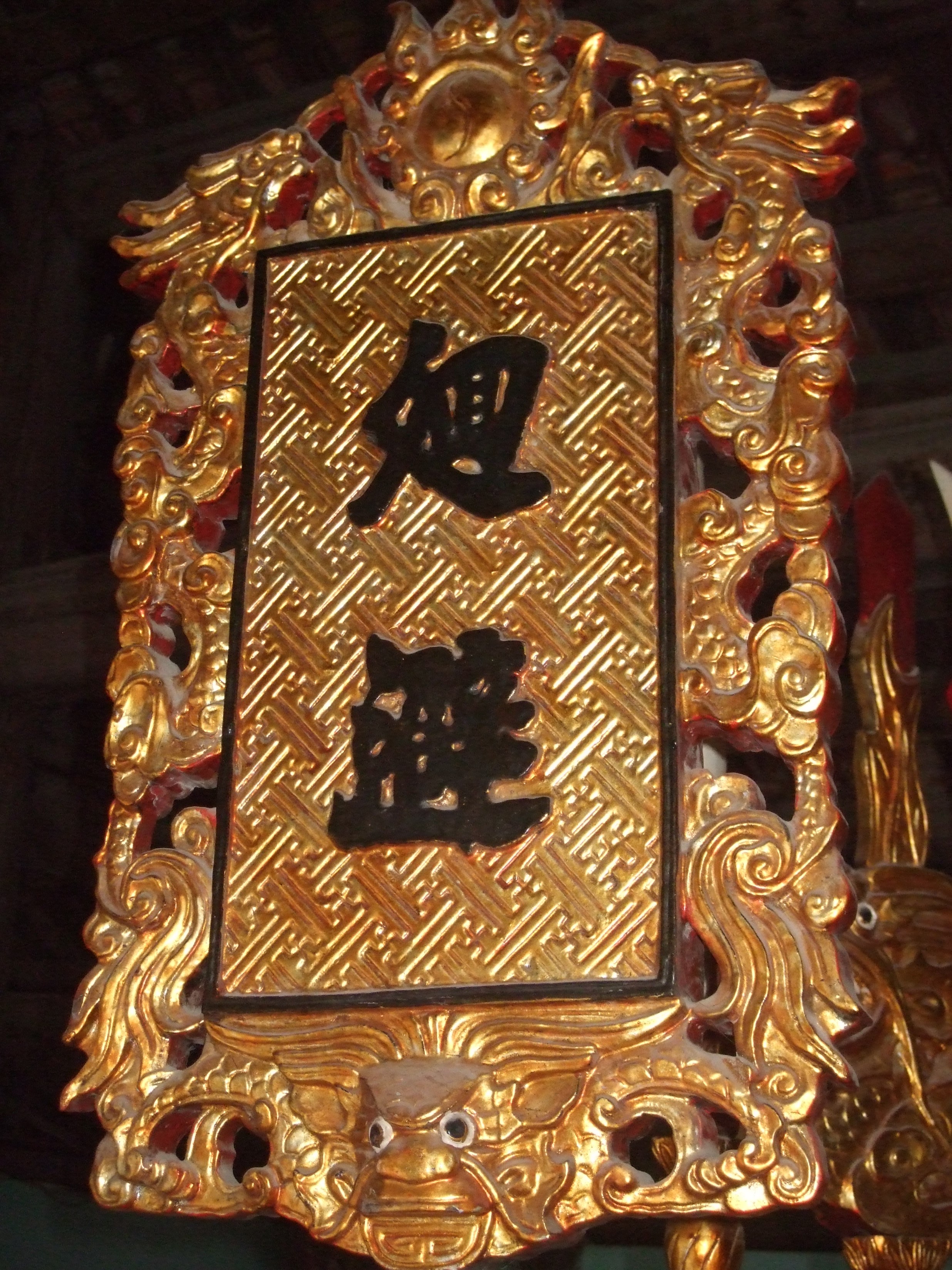
{Shy of the characters, Wiglaf may have seen a standard just like this one. Image found on Wikipedia.}
 

Back To Top
Abstract

Wiglaf hurries to the hoard, where he is mesmerized by the treasure that he finds.

Back To Top
Translation

“He, the triumphant in victory, when he beyond the seat
went, the young brave thane, saw many precious jewels,
glittering gold lay on the ground,
wondrous objects on the wall, and in that dragon’s lair,
daybreak flier of old, cups stood,
vessels of men of old, now lacking a burnisher,
deprived of adornment.* There were many a helmet,
old and rusty, a multitude of arm-rings
skillfully twisted. Treasure easily may,
gold in ground, overpower each one of
mankind, though one may hide it.
Also hanging he saw a standard all of gold
high over the hoard, greatest of marvels made by hand,
woven by skill of craft; from there light
shone out, so that he might see the surface of the floor,
could look at every part of those ornate objects.”
(Beowulf ll.2756-2771a)

Back To Top
Recordings

Old English:

{Forthcoming}

Modern English:

{Forthcoming}

Back To Top
Finding Use for Treasure

After the excitement of the battle with the dragon, and Beowulf’s heartfelt summary of his kingship, this passage is definitely something of a rest. But that doesn’t mean that it’s entirely silent, a point in the story where the poem’s original audiences could entirely rest.

For there is treasure about.

And, along with the treasure comes a very interesting passage: “cups stood,/vessels of men of old,now lacking a burnisher,/deprived of adornment” (“orcas stondan,/fyrnmanna fatu feormendlease,/hyrstum behrorene” (ll.2760-2762)).

What makes this passage more than what it seems is it’s implication about treasure and people’s relationship to it. Because “deprived of adornment” follows “now lacking a burnisher” it sounds as if the burnishing, the polishing, was these cups’ adornment. This makes sense since whatever precious metal they were made of would require maintenance of some sort to keep its shine.

But what’s more is that as this treasure was in the care of a characteristically miserly dragon, it didn’t receive that care that people would have given it. But add to this why people would care to preserve their treasure, especially the sorts of things described here. My own theory is that they would use these things and they would need them to be in their top shape.

Putting this all together you come out with the impression that the passage implies that treasure is ostensibly valuable only when it’s being used by people. And treasure can’t be used by the same person indefinitely, so the best way to keep treasure in use is to give it away. It’s given away to be used by the young, who can then maintain it and then give it away again, thus keeping the cycle going indefinitely.

Not to mention keeping the preciousness of the treasure in tact indefinitely.

However, this reading of treasure as the fuel in a perpetual motion machine of gifting and receiving is troubled by what happens to the treasure hoard that Beowulf and Wiglaf won. It all gets buried with Beowulf.

To be fair, the treasure may well have been buried for a strategic purpose. After all, having great wealth would likely bring down the Geats’ old enemies upon them much more quickly than the news of their loss alone.

Back To Top
A Shining Standard

Another illuminating part of this passage comes at it’s end. The standard that lights the cave in which Wiglaf finds the hoard is clearly very shiny (being described as “all of gold” (“eallgylden” (ll.2767))), and must have sunlight striking it. But this sparkling standard is also significant because it echoes an earlier light in a cave: That which appears when Beowulf kills Grendel’s Mother in her den (ll.1570-1572).

Because of the parallels – the light appears in a cave, comes from a fantastical source, flares up only after the defeat of a powerful monster of one sort or other – it’s tempting to say that Wiglaf’s assist in slaying the dragon is his own killing of Grendel’s Mother. This reading is also bolstered by Wiglaf’s taking treasures back with him to Beowulf just as Beowulf bore the hilt of the giants’ sword and Grendel’s head back to Hrothgar.

Yet, then, we run into the question: Is that where the parallels end? After the treasure is brought back to Beowulf and Wiglaf is cemented as the new leader of the Geats is he not still on the same trajectory as Beowulf?

Maybe he is, but because he isn’t Beowulf (even if he is, for now, nameless) it’s not his fate for a similar trajectory to land him in the same place as the poem’s lead character.

Back To Top
Closing

Next week, the third and final stanza of “O Fortuna” gets translated (and the whole thing gets posted as a recording), and Wiglaf takes as much treasure as he can back to the waiting Beowulf.

You can find the next part of Beowulf here.
Back To Top

Fortune Bemoaned ["O Fortuna," Second Stanza] (Latin)

Abstract
Translation
Quick Notes
Fortuna’s Subtlety
Translating Poetry can be Torturous
Closing

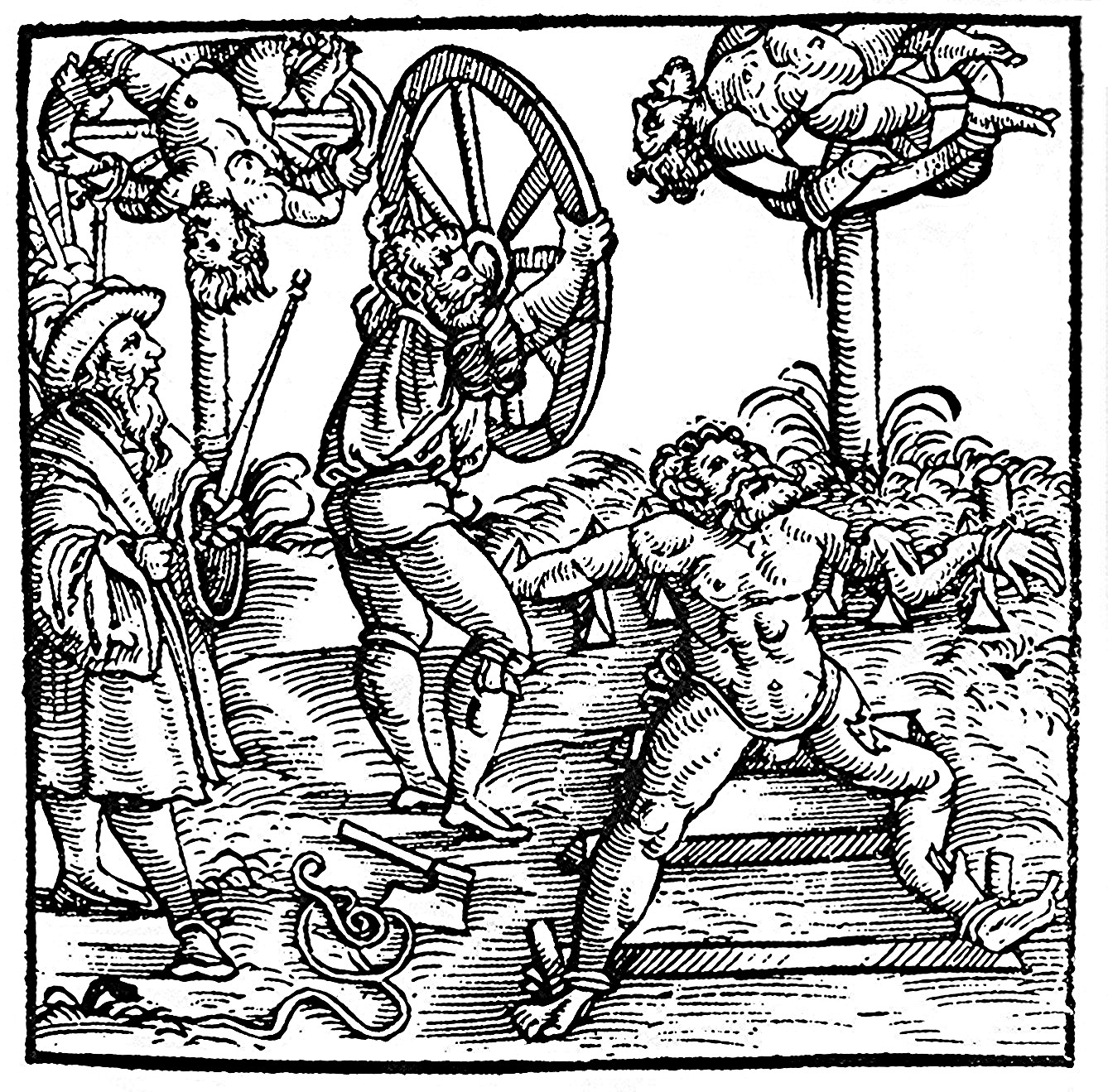
{Another of Fortune’s wheels? Image found on Wikipedia.}

Back To Top
Abstract

The speaker further builds on his complaint against Fortune.

Back To Top
Translation

“Ah, Fortune, vast and void,
On your spinning wheel idle health ay turns to bad standing;
Both ever dissoluble, viewed but darkly,
Yet always to me seeming vainly lovely
As you bring your laughing, desecrating lash
To my naked back.”
(“O Fortuna”, 2nd stanza)

Back To Top
Quick Notes

If you look at the translation offered on Wikipedia, and then at the one that I present here you’ll probably notice some differences. Once more, they’ve been made to keep the medieval flavor of the poem more or less intact.

Line 4 might be going a bit too far with its phrasing, but nothing was ever said about the poem’s original flavor being mild.

Back To Top
Fortuna’s Subtlety

In fact, torture is clearly at play here. The wheel as a torture device was used in the middle ages, and the poem was written right in the middle of this period, sometime in the thirteenth century. But even then, there’re the final two lines of the stanza that explicitly mention a “laughing, desecrating lash” (ludum, ) that is brought to the speaker’s “naked back.”

There’s really no question that torture imagery is at play here. This might even be building on the subtle dominance of women peeked at in the first stanza of the poem.

Though they lacked prominence in places of power, their influence, however subtle and unseen in history books, cannot be overlooked. Even through to today, women who are villains (and even heroines) more often than not work their schemes through wit and wiles rather that brawn and brawling.

The binary stereotype that men are strong and women are smart (though usually not book smart) has persisted for a long time, and “O Fortuna” definitely looks like a medieval manifestation.

Back To Top
Translating Poetry can be Torturous

Although it might be a unique variation, what does it mean for the sort of torture imagery here (variably the breaking wheel, and fortune’s laughingly lashing a person’s back or taking her “pleasure” (“ludum”) on a naked back (“dorsum nudum”))?

The Latin word used for “laughter” or “pleasure” is “ludum.” This word refers to things like laughter, play, jests, or just a generally fun, interactive time. So how does that relate to being whipped?

On the one hand it could be a bit of the repressed seeping through. In the middle ages those who could write and had the means to do so were trained by the Church. So, it could be that the whip is “laughing” as well as “desecrating” because it injures the body that god created while also relieving the pent up desires that that body has through taking on pain: a feeling as extreme as pleasure.

On the other hand, the above translation does take some license in coming out with “As you bring your laughing, desecrating lash/to my naked back.” The poem in Latin reads “…ludum dorsum nudum…,” all three of those words are together, but it’s not entirely clear what’s doing what.

If they all create a single direct object phrase (since they are in the accusative case), then any order could be used. “Laughing naked back,” “back laughing naked,” “naked back laughing.” Even if any of these are used, the element of fun remains in the act of torture.

The only real change in meaning that results from these variations is that the laughter’s moved from the whip to the speaker’s back: the gashes opened by the whip being likened to the open mouth of someone laughing.

In either case, this is definitely a poem that has more going on than another, more pious piece translated earlier.

Back To Top
Closing

Check back here on Thursday when Wiglaf views the hoard for the first time, helped by the luminescence of a battle standard.

Back To Top

On Requests and Namelessness [ll.2743b-2755] (Old English)

Abstract
Translation
Recordings
Digging Deeper into Beowulf’s Request
Going Nameless
Closing

{J.R.R. Tolkien: Believer in Beowulf‘s being an elegy. Image found on The-HobbitMovie.com.}
 

Back To Top
Abstract

Beowulf instructs Wiglaf to get some gold from the hoard to show him what he fought for, and Wiglaf runs off to oblige him.

Back To Top
Translation

&nbsp&nbsp&nbsp&nbsp&nbsp&nbsp&nbsp”Now go you quickly
to see the hoard under the grey stone,
dear Wiglaf, now the serpent lay dead,
sleeping in death sorely wounded, deprived of treasure.
Be now in haste that I ancient riches,
the store of gold may see, clearly look at
the bright finely worked jewels, so that I may the more
peacefully after the wealth of treasure leave my
life and lordship; that which I have long held.’
I have heard that then the son of Weohstan quickly obeyed
after the spoken word of his lord in wounds and
in war weariness, bearing mailcoat
the broad ring-shirt, under the barrow’s roof.”
(Beowulf ll.2743b-2755)

Back To Top
Recordings

Old English:

{Forthcoming}

Modern English:

{Forthcoming}

Back To Top
Digging Deeper into Beowulf’s Request

On the surface, Beowulf’s request seems simple enough. ‘Go and grab some gold, that I may be able to see it,’ but there’s more to it then a validation of his final battle. Within this request lay the very stuff of revenge.

Beowulf acknowledges that now the serpent is dead and thus “deprived of treasure” (“since bereafod” (l.2746)). Thus, were he to die without seeing what he had fought for then, he would, in a way, not have won at all.

For Beowulf would then not have been able to say that he had laid eyes on that for which he fought, while the dragon enjoyed the sight of it constantly. Further, he also wouldn’t have experienced it, and wouldn’t therefore have fulifilled the treasure’s basic purpose: to be used by being enjoyed through sight (just as a grammatical object is used simply by being linked to a grammatical subject).

However, the act of seeing it, of using it, also puts Beowulf on par with the dragon on the level of greed, since he is not able to dole out the treasure to his people, as any good king must, in person.

Back To Top
Going Nameless

But, what’s curious about this passage is Wiglaf’s lacking reference by name. First he is the “son of Weohstan” and then he is referred to with a bit of metonymy when the poet simply says that he bore a mailcoat into the barrow (“hringnet beran/…under beorges hrof” (ll.2754-2755)).

So why does Wiglaf, the one who was instrumental in Beowulf’s victory, suddenly lose his name? Perhaps to keep the focus on Beowulf, rather than Wiglaf so that it truly does become an elegy rather than a story of succession, of hope.

It’s also possible that this is merely poetic license, but the fact is that Wiglaf is not referred to by name again until line 2852. That’s over one hundred lines later, and the point at which his fellow Geats recognize him as the new leader for the first time.

That Wiglaf is named for the occasion of recognition as the new authority strongly suggests that indeed he is occluded for the next 100 lines to keep Beowulf in the spotlight. Going out at Beowulf’s behest, Wiglaf isn’t really Wiglaf anymore, but he is made into Beowulf’s double, at least for the brief time that he scrambles out to the hoard, through it, and back.

It could even be argued, that Wiglaf’s washing Beowulf clean and then undoing his helmet are both acts that signify a complete rescindment of the will, perhaps as an acknowledgement of the end of a life. In doing these things Wiglaf drops his own desires and takes up Beowulf’s request entirely so that he can be a comfort to the old lord in his final moments.

Back To Top
Closing

Next week, the second stanza of “O Fortuna” will be posted, and Wiglaf, though nameless, finds himself immersed in a fabulous treasure room.

You can find the next part of Beowulf here.

Back To Top

Fortune Bewailed ["O Fortuna," First Stanza] (Latin)

Introduction
Abstract
Translation
Translation Notes
A Few Words on the Moon
Closing

{A picture of the page of the Carmina Burana manuscript, where “O Fortuna” first appears. Image found on Wikipedia.}

Back To Top
Introduction

I’ve chosen to spend the next three weeks with “O Fortuna” because of it’s wide popularity, because of my own curiousity, and because I wanted to be clear on just what the lyrics are.

Although in the coming weeks I’ll be back to my trusty pocket Latin dictionary, today’s translation was done with the help of Google Translate and InterTran. Rather than just presenting a literal translation though, some parts have been embellished in an effort to keep something of a medieval feel.

Recordings of this poem will be posted, but not until all three stanzas have been translated and posted.

Back To Top
Abstract

Fortune’s instability is bemoaned, and the extremity of bad fortune rather than that of good fortune is dwelt upon.

Back To Top
Translation

“Oh Dame Fortune, as variable of state as the &nbsp&nbsp&nbsp&nbsp&nbsp&nbspmoon,
Ever waxing, ever waning –
Ah execrable life – now firm, now full of cares,
A game for the sharp-minded,
Down in the depths of poverty –
As does ice you too often melt away.”
(“O Fortuna,” 1st stanza)

Back To Top
Translation Notes

Along with moving the words of the poem from Medieval Latin to Modern English, I’ve also made some other changes to it as part of the translation. Some of these changes involve leaving things just as they are, while others involve me taking some poetic license with words or phrases. What follows is a general overview of these changes.

Literally, the second line reads “ever rising, or ever falling” (“semper crescis aut decrescis”). This literal translation captures the sense of a person’s fortune rising or falling, using senses of those two verbs that are still commonly understood.

However, the above translation makes the case that the second line is supposed to describe the first line’s simile further. The words “waxing” and “waning” are still used of the moon specifically, but their otherwise medieval flavour is one of the things done to keep the original medieval feel of the poem.

Punctuation is another thing that was altered.

In the version from Wikipedia, there’s a comma after the first line, a semi-colon after the second, and a comma after the fourth and fifth. However, because the last line refers back to Fortune herself, everything from line three to line five has been put between em-dashes.

These em-dashes mark lines three to five as the diversion that they are. For these lines aren’t about Fortune directly, but are about the wretched uncertainty of life under such a constantly shifting power.

Back To Top
A Few Words on the Moon

That the power of Fortune is represented by the moon shows that the poem’s original composer had a sense being under such consistent inconsistency. Yet, although much of this stanza focuses on the ills of Fortune and of being on the bottom of her wheel, the fact that she uses a wheel does instill some hope; just as the moon will grow full and light the night after being absent.

Moreover, in addition to being linked with shifting Fortune, the moon was also associated with virginity in the medieval world. The two are connected in medieval thought because of the moon’s classical association with the ever-virgin Roman goddess Diana.

This association with virginity may be working in “O Fortuna” to imply that Fortune is not only fickle and ever-changing, but also impossible to impregnate. That is, you cannot change Fortune from outside of Fortune, if you wanted to somehow alter your Fortune you would need to have some sort of “in” with Dame Fortune.

Back To Top
Closing

Come Thursday, Beowulf will give Wiglaf his penultimate command, and the young thane will run to the hoard to fulfil it.

Back To Top

Beowulf: Mighty in Arms, Loose in Words? [ll.2732b-2743a] (Old English)

Abstract
Translation
Recordings
Peering in, But Just Dipping Toes
Not Many Oaths Sworn “in Unrighteousness”
Kinds of Kin-Slaying
Closing

{Words spoken and frozen in wood, just as bad oaths are remembered. Image found on documentarystorm.com.}
 

Back To Top
Abstract

Beowulf says that he’s come to terms with his death because he was a good king and can stand blameless before the final judgment.

Back To Top
Translation

&nbsp&nbsp&nbsp&nbsp&nbsp&nbsp&nbsp&nbsp&nbsp&nbsp”‘I this people have ruled
for fifty winters; never was there a king of the people,
any of the neighbouring folks
would dare attack with war-friends,
threaten terror. I in my homeland awaited
destiny, it guarded me well,
I did not seek contrived hostility, nor swore I many
oaths in unrighteousness. In all of this
infirmity of a mortal wound I have joy;
because the Lord of men has no cause to accuse me
of murderous killing of kinsmen, when my
life passes from my body.'”
(Beowulf ll.2732b-2743a)

Back To Top
Recordings

Old English:

{Forthcoming}

Modern English:

{Forthcoming}

Back To Top
Peering in, But Just Dipping Toes

For such a short passage, there’s a fair bit going on here.

It’s revealed that Beowulf has ruled as long as Hrothgar and Grendel’s Mother did; that Beowulf was the sort of king that defended his lands on reputation or by some other passive means; that he had a fairly Taoist, go-with-the-flow life philosophy that kept him out of trouble; that he has been mostly true to his word; and that he is guiltless when it comes to murdering kinsmen.

Though there’s quite a bit of depth here, this entry is just going to focus on the last two in that list.

Back To Top
Not Many Oaths Sworn “in Unrighteousness”

What does Beowulf mean when he says “nor swore I many/oaths in unrighteousness” (“ne me swor fela/aða on unriht.” (ll.2738-2739), emphasis my own)? Is it an accepted part of Anglo-Saxon life (perhaps especially or only in positions of power) that some oaths are not sworn in the best of circumstances?

What exactly does it mean to swear an oath in “unrighteousness”?

Did Beowulf swear some oaths to do some unsavory things? Did he swear some oaths to escape others? Did he make pacts with spirits?

The wording itself aside, what can be looked at here is the word “fela,” which I translated as “many.” So there haven’t been a lot of oaths sworn poorly. is this just a matter of practice?

Though we don’t see Beowulf swearing oaths unrighteously, it is curious that Beowulf plays fast and loose with his retelling of the fights with Grendel and with Grendel’s Mother to Hrothgar. Specifically, Beowulf adds Grendel’s terrible glove to his story (ll.2085-2088), and greatly shortens his encounter with Grendel’s mother (ll.2135-2141).

Words were considered incredibly important to Anglo-Saxons, especially when it came to the valuation of people. So, could this alteration of words mean that Beowulf didn’t always take words so seriously?

Perhaps the answer can be found in the next part.

Back To Top
Kinds of Kin-Slaying

Within the poem itself, there have been several instances of kin-slaying.

Most recently is Beowulf’s story of Hæðcyn killing Herebeald, but there is also the story of the Battle of Finnburgh, and, of course, Beowulf’s implication that Unferth killed his brother. Though it’s the most distant to this point in the poem, the Unferth instance might actually be the most relevant here.

According to some, the first half of Beowulf represents Beowulf’s destroying his shadow self, in so far as Grendel and Grendel’s Mother are embodiments of Beowulf’s animalistic nature.

In fact, others also suggest that Beowulf and Grendel are somehow related, making Beowulf a kin-killer.

On one hand this seems like an unstable interpretation, but, on the other, every statement in the section of Beowulf’s speech translated for this entry gives further information about his life through implication. Thus, either Beowulf is suggesting that accusations of kin-killing have been made against him, or that kin-killing is a common crime among kings, but he is innocent of it.

Back To Top
Closing

Next week, as a relief from the animal, the first verse of the thirteenth century Latin poem “O Fortuna” will be translated. Plus, Beowulf makes his penultimate request of Wiglaf, and the plucky young thane goes darting off to fulfill it.

You can find the next part of Beowulf here.

Back To Top

Extending Lore on Love and Passion [12:60] (Latin)

Abstract
Translation
Recordings
Repetition Leading to Implication
Word Woes: Overcome?
Closing

{Words upon words – some to be lost between languages. Image found on the blog Thoughts on Books.”}

Back To Top
Abstract

Isidore further expounds on the theory and lore of good animal husbandry.

Back To Top
Translation

[60] “Then are those which have the heavy mares look at no animal of deformed appearance, such as dog-headed apes and gorillas, such faces are not made visible to those looking like they are pregnant. Truly this is natural for females that is if such is seen or if the mind conceives of it in the extreme heat of passion, that is conception, such will be in the children that they create. As a matter of fact, animals in the enjoyment of Venus transfer their outside to the inside, and they seize their fill of such a figure of their types in appropriate quality. Among animals those born of diverse kind are called two-kinded/mutts such as mules from mares and donkeys; hinny from horses and female donkeys; mongrels/half-breeds from boars and pigs; sheep-goat (tityrus) from ewes and he-goats; raidos [from ram + IE *ghaidos] (musmo) from she-goats and rams. On the other hand, these are truly the leaders of the herds.”
(St. Isidore of Seville, Etymologiae 12:60)

Back To Top
Recordings

Latin:

{Forthcoming}

Modern English:

{Forthcoming}

Back To Top
Repetition Leading to Implication

While he repeats much of what was written in paragraphs 58 and 59 here, Isidore seems to be expanding to all women the reproductive lore from those paragraphs. Otherwise he would have gone with a different phrase than “…this is natural for females” (“Hanc enim feminarum esse naturam”) to describe the practice of keeping ugly things away from pregnant women.

Unfortunately, this is just a matter of implication, since Isidore jumps right back to the animal after he has finished getting into some titillating descriptors (the “extreme heat of passion” (“in extremo voluptatis aestu”) and the “enjoyment of Venus” (in usu Venerio) both being polite euphemisms for orgasm and sex respectively).

Back To Top
Word Woes: Overcome?

When he settles back on animals, Isidore rounds off the first part of his book about animals with some of the different two-kinded and hybrid mixtures that people have come up with.

Now, either English breeders have been put to shame here, or Latin simply has a far greater depth of expression, since “burdo” translates easily enough into hinny, but “tityrus” and “musmo” remain untranslatable to varying degrees (as far as I can tell).

It’s not as satisfying as a portmanteau of the two, but sheep-goat is the result of a sheep/goat cross-breeding, though these are apparently rare in nature (and referred to as geeps when created in labs). So sheep-goat is the closest translation of “tityrus” that English has to offer.

On the other hand, “musmo” is apparently entirely untranslatable, since even a satisfactory compound English name isn’t available. Yet, if mules and hinnies are different based on the gender of the horse or donkey in the pairing, so too should the result of a she-goat and a ram and a ewe and a he-goat be different.

So, to remedy the untranslatable malady of “musmo,” a little digging was done and the word “raidos” was created. It’s a combination of “ram” and the reconstruction of the Proto-Indo-European word for sheep – *ghaidos. It sounds kind of like “Raiden,” and so is appropriate, given the sentence that Isidore ends with: “…these are truly the leaders of the herds” (“Est autem dux gregis”).

Back To Top
Closing

This Thursday, Beowulf continues his speech, talking about his time as king and making a very curious statement.

Back To Top

On Water and Words [ll.2720-2732a] (Old English)

Abstract
Translation
Recordings
A Good Washing
Passing (Things) On
Closing

{Wiglaf raising the washing water to Beowulf. Image found at the Tolkien Library}
 

Back To Top
Abstract

Wiglaf tends to Beowulf and Beowulf begins to speak to Wiglaf, signalling that his death is imminent.

Back To Top
Translation

“Then he with hand, blood-stained,
the famed lord, a man unmatched for good,
washed his dear lord with water,
battle-worn, and unclasped his helm.
Beowulf spoke – he spoke through the pain,
the ache, of his miserably vexatious wound; well he knew,
that he had fulfilled the days of his life,
of earthen joy; that all of his life-time had
fled, death was immeasurably near:
‘Now I to the son of mine would give
the war garments, if it had been so granted
by fate that I any heir had,
flesh of my flesh.'”
(Beowulf ll.2720-32a)

Back To Top
Recordings

Old English:

{Forthcoming}

Modern English:

{Forthcoming}

Back To Top
A Good Washing

The washing of Beowulf requires some note here.

First, there’s the general importance of the act as a means of humbling yourself before someone whom you respect.

Then there’s the fact that it’s a simple act of subservience, the sort of thing that is an active display of obedience and respect.

And that interpretation of the act leads into the Christian significance. However, if this death is meant to mirror that of Christ in the New Testament, then there’s something interesting going on here.

In the NT and in the Catholic ritual recreating the Last Supper, it’s Christ who washes his disciples’ feet.

Wiglaf’s washing is more general, but if the parallels between these stories are followed, then Wiglaf is effectively becoming the Christ figure of the story, possibly in a more meaningful way than Beowulf.

Yes, Beowulf defeated the dragon, but that cost him his life, and Beowulf would never be characteristically elegiac if he came back to life afterwards (nor would the Anglo-Saxons have told it like that, regardless of whatever their source material may have been).

This transference of Christ-ness might even have been one of the original purposes of the poem as a conversion tool, since it’s the sort of succession that Anglo-Saxon’s would have understood. After all, it’s the exact same way that kingship would be transferred when no heir was available: through a ritualistic act and acknowledgement.

Back To Top
Passing (Things) On

The opening of Beowulf’s speech also says a lot about the Christian intent of the written version of the poem.

If Beowulf is taken as a heroic heathen, someone who is Christian in all ways but name (ignore for a moment, his constant references to a single ‘Lord of Men’/’Ruler’/’King of Glory’), then he simply can’t have an heir. There can be no continuation of the virtuous heathens, since there is no further need for such people, the virtuous will, of course, be Christians. And so enter the transitional figure of Wiglaf, the one who reprimands the cowardly thanes and does his best to guide Geatland gently into the good night awaiting it after Beowulf’s death.

Beowulf signals his death not by saying that he has reached the end, as the poet/scribe does before we get his dialogue, but by saying that he has no heir to give his weapons to.

He has no offspring that he could call “flesh of my flesh” (or “belonging to my body” for a curiously medieval Christian rendering of “lice gelenge” (l.2732)) that can continue his line directly. And so, it passes to one who’s proven himself to be worthy: Wiglaf.

However, it’s important that Beowulf opens his speech with talk of handing down his war garb. Because Wiglaf is not his son, the war garb will not be touching the same flesh (more practically, it may also be less of a snug fit than on any son of Beowulf). As a result, Wiglaf is not going to be able to do the same things that Beowulf did with his gear, in both the literal and figurative senses.

And that a body patently different from Beowulf’s carries forward the symbols of the old way embodied by Beowulf’s war garb (arguably, his most precious possession) is a great metaphor for the spread of Christianity throughout Early Medieval Europe.

Back To Top
Closing

Check back here next week, for Isidore’s finishing off the first section of book 12 with further discussion of fertility lore, and for Beowulf’s quick review of his kingship and current predicament.

You can find the next part of Beowulf here.

Back To Top

Sex, Horses, and Reproductive Lore [12:58-59] (Latin)

Abstract
Translation
Recordings
The Galen Connection
Beautiful Thoughts, Beautiful Offspring
Closing

{Jacob, showing the sheep the peeled rods. Image found in the National Library of the Netherlands’ Medieval Illuminated Manuscripts Collection.}

Back To Top
Abstract

Isidore gets into the details of managing the conception and birthing of animal offspring for desired results.

Back To Top
Translation

[58] “Certainly human diligence has paired many diverse animals together in sex, so too are discovered other types mingling in forged embraces; just as Jacob was able to get animals of unnatural color and likeness. For the rod was absorbed by those fertile sheep, which they would see by the water as the shadow of a ram looming over them.

[59] “Further, this itsef is done with the fertile mares of a herd, so that the birth of horses is affected by what is thrown before them while they conceive, which are able to conceive and create their likeness. For on their collars are painted in a beautiful way and placed in their presence, those that they respect, which leads to quick births of animals like those that they see.”
(St. Isidore of Seville, Etymologiae 12:58-59)

Back To Top
Recordings

Latin:

{Forthcoming}

Modern English:

{Forthcoming}

Back To Top
The Galen Connection

The ideas that Isidore writes about here might just be pulled from the works of the famed second century physician and philosopher, Galen. His theory of conception was that it was necessary for both a man and a woman who wanted to have a child to orgasm at the same time, thereby having their contributions to the child line up.

A failure to impregnate a woman or to become impregnated was a failure to climax at the same time in other words, and not necessarily chalked up to either partner’s having something wrong with their equipment.

Further, though, Galen also wrote about how it was important for the parents-to-be to imagine beautiful things during intercourse.

This was especially true for women, since there was a vague sense that they carried the human essence that would become a child and that men merely helped to shape and quicken this essence. So, if a man was thinking of a lovely thing, and the woman he was with was thinking of some sort of “dog-headed ape” (to borrow Isidore’s “cynocephalus” (12:60)), it was believed that her conception would result in the child being somehow deficient.

Unfortunately, the emphasis on simultaneous orgasm didn’t last too far into the medieval period since the re-discovery of Aristotle led to the adoption of his ideas on the matter. According to old Ari, only the man had to orgasm during sex; it was merely the woman’s job to catch his ejaculation properly.

Back To Top
Beautiful Thoughts, Beautiful Offspring

As far as the animals that Isidore writes about here are concerned, the same principles are in play. Plus, he wisely refers to the greatest auctoritee of them all in the medieval world – Scripture.

Jacob used his own sort of animal engineering, and that lead to his prosperity, so why can’t contemporary people do the same, the reference implies.

In fact, paragraph 59, though only about mares, talks about presenting those that are fertile with beautiful things so matter of factly that the lore presented is definitely taken as pure fact.

Perhaps there is some truth to it, since a birth might not go so smoothly if a mare gets spooked in the middle of it, or is under extra duress because she’s being stared down by some cynocephalus or other.

Back To Top
Closing

Check back here Thursday for Wiglaf’s washing, and the beginning of Beowulf’s rather telling speech.

Back To Top

Silent Sorrow Following Frabjous Joy [ll.2706-2719] (Old English)

Abstract
Translation
Recordings
Strengthened by Juxtaposition
Who’s Heart-Wise?
Closing

{Wiglaf tends to Beowulf. Image found on Wikipedia.}
 

Back To Top
Abstract

The poet revels over the victory of Beowulf and Wiglaf, but their joy is short lived as Beowulf’s wound is shown to be dire.

Back To Top
Translation

“The fiend had fallen – courage punished his life –
and those two both had killed it,
brother nobles. So should every man be,
loyal thanes ready for the need! Yet for that king it was
the final hour of victory for his own deeds,
his works in the world. Then that wound began,
the one the earth-drake had earlier dealt him,
to sear and swell; soon he discovered that
poison welled forth from within the wickedness that
marred his chest. Then the prince went
to him that was by the wall, wise at heart,
he sat on the stone; looked upon the work of giants,
how the stone arches were secured with columns,
beheld what the cave-dwelling held within.”
(Beowulf ll.2706-2719)

Back To Top
Recordings

Old English:

{Forthcoming}

Modern English:

{Forthcoming}

Back To Top
Strengthened by Juxtaposition

The juxtaposition of the opening lines of this passage is perfectly suited to Anglo-Saxon thought.

Placing a bit of gnomic wisdom aside the revelation that Beowulf is indeed dying only strengthens that wisdom. After all, Wiglaf now proves himself to truly be one of the “loyal thanes” (“þegn” l.2709).

Within this passage we see him run over to his dying liege lord and take a seat beside him. For now, there is no dialogue, but instead Wiglaf looks over what they’ve won together. Without words of any sort he takes up the role of world interpreter for Beowulf as he lies against the wall, his wound festering in fast forward.

Back To Top
Who’s Heart-Wise?

In the above translation the person being desribed as “wise at heart” (“wīs-hycgende” l.2716) is unclear, and so too is it in the original: “Ðā se æðeling giong/þæt hē bī wealle wīs-hycgende/gesæt on sesse” (ll.2715-2717).

This ambiguity shows not only the shared wisdom of these two, but it also works to further the idea that Beowulf has successfully passed on the role of Geatish ruler to the best candidate. Though his death and the cowardice of the other 11 thanes does prophesy that tribe’s beginning decline.

Turning to what either case might mean more specifically, if the phrase refers to Wiglaf, then it simply means that he is doing what he feels is right and the poet is validating this.

On the other hand, if this phrase refers to Beowulf, then it may be a bit of foreshadowing of a phrase that comes up in a passage nearly 100 lines away, or it may simply refer to the inborn wisdom that a fifty winters as a successful king brings.

Back To Top
Closing

Next week, Isidore writes of the ways in which animals are manipulated while conceiving, and Beowulf finally comes to terms with his end.

You can find the next part of Beowulf here.

Back To Top

Moving from Horses to Mules [12:56-57] (Latin)

Abstract
Translation
Recordings
Moving Mules from Language to Language
The Power of the Bigenerum?
Closing

{Simply grey, but what a worker. Image from the National Library of the Netherlands’ Medieval Illuminated Manuscripts collection.}

Back To Top
Abstract

Isidore’s generalization about the three kinds of horses moves into a piece about mules, their uses, origins, and habits.

Back To Top
Translation

[56] “There are three kinds of horses: those apt for war and work, others to drive the commons and the herd, but are not apt to ride, the third arises from a mixture of the diverse kinds, that are truly called two-kinded (bigenerum) which from diverse sorts are born, like mules.

[57] “Moreover, the word mule is had from the Greek for “drive” (tractum). Among the Greeks, millers truly use this mule to turn the mechanism of their mills. The Jews freed those flocks when Jacob made them conceive mules in the desert by himself, made of the first born, so that the mules from there were newly and against nature born among natural animals. Wild asses to this also are added as well as donkeys: and they themselves by the same method are found in intercourse, so that very quickly are donkeys born.”
(St. Isidore of Seville, Etymologiae 12:56-57)

Back To Top
Recordings

Latin:

{Forthcoming}

Modern English:

{Forthcoming}

Back To Top
Moving Mules from Language to Language

Although mules are well suited to menial tasks, like powering mills, Isidore did not make them easy to translate into English. Much of paragraph 57 is understandable with some tweaks and some twists, but it all runs on contemporary shared knowledge more than anything else save for its opening sentence.

The relationship between whatever Greek word is in question and the Latin tractum is not entirely clear. The sentence could mean that the Greek is derived from the Latin, or that the Latin term and the Greek are the same, and so there’s no need for the differentiation that including both terms brings.

The quick retelling of the story of Jacob and Laban’s flocks is also altered in the original Latin. The crux of this is the phrase “Ana abnepos Esau” (12:57) Esau is a familiar name, but Ana looks off, and the combination of the two with the word for “great great grandson” makes it even more bizarre. Perhaps there’s some esoteric bit of lore about a grandson that’s at work here, but that has since been forgotten about.

Other interpretations of these passages are possible, but these are the ones that seem most likely to me, given my limited knowledge of Latin’s complexities.

Back To Top
The Power of the Bigenerum?

To sum up the entirey of paragraph 57, mules are work animals.

But the question that arises from these two paragraphs is: Does this designation as a work animal come from mules’ being a perfect mixture of two types of horse – as seems to be implied by a Latin adjective describing mules – “bigenerum” (12:56)?

Given the description of mules thus far, it seems that the answer must be yes, resoundingly. After all, combine horses that can be ridden into war, and those that can be used to herd animals, and the natural result would be something hardy and used for strenuous activity.

But then, if Esau is being credited with the creation of mules, then does that mean that he did it intentionally?

According to the story in the KJV (Genesis 30:25-43), Jacob creates these mules in order to steal away Laban’s flock after he has worked for him for seven years in exchange for Laban’s daughter Rachel.

Since the idea to use the rod to scare the females into giving birth while they were drinking, resulting in mules, was his own, Isidore is definitely in the right to say that these mules were “were newly and against nature born among natural animals,” (“nova contra naturam animalia nascerentur” 12:57).

Truly intriguing in the KJV though is the mention in verse 41 of chapter 30 of Genesis that Jacob only used his trick when the strong ones among Laban’s flocks and cattle were pregnant. In other words, they weren’t just bred for necessity, they were bred for strength – something that Isidore nails here.

Back To Top
Closing

Check back here on Thursday for Beowulf and Wiglaf’s brief revel, and a tragic realization.

Back To Top