Wealhtheow notes her nephew, uses two crystalline compounds (1180b-1191)

Abstract
Translation
Recordings
Wealhtheow’s Nephew and Sons
Two Compounds in a Crystalline Speech
Closing
Back To Top
Abstract

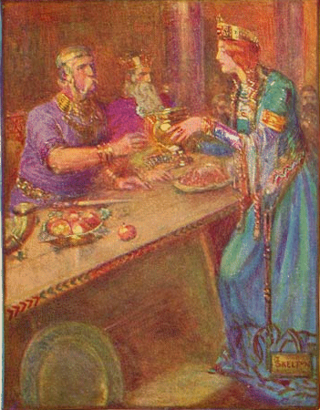
Wealhtheow brings up Hrothulf in her speech to Hrothgar before she turns to her sons and Beowulf.

Back To Top
Translation

“‘I myself know
how gracious Hrothulf is, that he will defend
the honour of the youth, if you before him,
friend of the Scyldings, leave this world;
I believe that he will liberally repay
our two sons, if he recalls all the care we’ve given him,
the favour and honour* that we showed him
while he was a child** and still growing up.’
She turned then from the bench, there to where her sons were,
Hreðric and Hroðmund, and to the hero’s son,
all the youths together; for there the good man sat,
Beowulf the Geat, there between the two brothers.”
(Beowulf ll.1180b-1191)

Back To Top
Recordings

Old English:

{Forthcoming}

Modern English:

{Forthcoming}

Back To Top
Wealhtheow’s Nephew and Sons

Wealhtheow’s speech to Hrothgar ends here, and as such she turns towards the subjects of her next few words. This is a very obvious part of this passage, but I think it’s important to note because the connotation of her very properly keeping eye contact with Hrothgar while she addresses him underlines just how controlled and prim Wealhtheow’s speech here is (despite the revelry that’s just got to be continuing on around her).

But what’s here in her mentioning Hrothulf to Hrothgar is the acknowledgement that he is not directly related to either of them. I think that’s why she points him out as she does. Not to mention, it sounds like he’s probably a little older than the sons that she turns to at the end of this passage.

So how, exactly, is Hrothulf related to Hrothgar or Wealhtheow? He’s Hrothgar’s nephew by his sister Halga. Undoubtedly Hrothulf’s at Heorot to learn the ropes of being a member of the ruling part of society away from home. And, as such, Wealhtheow doesn’t need to give much detail when she says that he’s likely to protect her children as a away of repaying them for the care and honour they showed to him while he was growing up (and presumably still is). But so much hangs on his repaying this debt.

If Hrothulf was, in fact, raised well by these foster parents of his, then repaying them by taking care to teach their children will go without saying, and the two of them will be in good care, raised the way that Hrothgar himself and Wealhtheow herself would raise them, should either of them perish before the boys are grown.

As to why Beowulf is seated between Hrothgar and Wealhtheow’s sons, I’m not entirely sure.

On the one hand, I imagine it’s a seat of honour, definitely up near the front of the room.

But at the same time, I can’t help but wonder if it’s kind of like putting an esteemed guest at the kiddie table.

Not that that’s likely to keep Wealhtheow’s sons from sampling some of the wonderful brew that’s being spread around the hall as she speaks.

The best I can come up with for Beowulf’s placement in the hall is that his status as hero is assured and as ally is almost entirely certain, but not yet entirely locked down. Maybe it even shows how great the gulf was between those who had lived at a hall for much of their lives (Unferth, presumably) but hadn’t done many great deeds, and those who showed up, performed amazing feats of strength, and then are bound to head out again. After all, it wouldn’t do to give a seat of high honour or make them a councillor if they’re basically just passing through.

Getting back to the matter of Wealhtheow and Hrothgar’s sons, I think that Wealhtheow’s talking of Hrothulf and the poet’s mention of Beowulf being seated between the two boys, is supposed to emphasize that her sons are surrounded by positive models of masculinity. These boys have their father, their cousin, and this socially productive wayfarer. There could even be some subtext here about the heirs of Heorot being so well prepared that there’s absolutely be no way for them to screw it up and wind up with the hall destroyed because of betrayal and in-fighting.

Do you think there’s supposed to be some sort of joke in Beowulf’s being seated between Wealhtheow and Hrothgar’s sons?

Back To Top
Two Compounds in a Crystalline Speech

Because this part of Wealhtheow’s speech is so straightforward and plain spoken, there are just two compound words in it. It really does seem like they’re just part of bombastic speech — maybe even male speech — rather than the kind of clear-eyed toasting that Wealhtheow’s doing.

Likewise, the compounds that are used are fairly clear. Almost, in fact, to the point of having a kind of crystalline quality.

The first of these two compounds is from line 1186, “weorð-mynd.” This word means “honour,” “dignity,” “glory,” or “mark of distinction,” thanks to the compounding of “weorð” (“worth,” “value,” “amount,” “price,” “purchase-money,” “ransom,” “worth,” “worthy,” “honoured,” “noble,” “honourable,” “of high rank,” “valued,” “dear,” “precious,” “fit,” or “capable”) and “mynd” (“memory,” “remembrance,” “memorial,” “record,” “act of commemoration,” “thought,” “purpose,” “consciousness,” “mind,” or “intellect”).

Literally translated, “weorð-mynd” means “worth remembering,” an idea that transitions pretty easily into any of the compound’s meanings. But a literal definition that helps define “honour” a little bit. Those things that bring you honour being things that are worth remembering.

Which is a simple enough definition, though also very neutral since there can sometimes be horrible events or actions that are worth remembering so that they can be avoided or prepared against. But maybe this general sense of what’s honourable encapsulated in “weorð-mynd” feeds into a medieval way of thinking about memory and its effect on behaviour.

The basic principle I’m referring to here is the idea that what you memorized or filled your brain with — be it poetry, scripture, history, whatever — would influence how you thought and acted in your day to day life. So, memorize beautiful, god-fearing things and you’ll have an easy time enjoying the positives in life, but fill your memory with hatred and darkness and your life will be miserable, your actions terrifying. So, maybe “weorð-mynd” isn’t so neutral. Maybe, baked into the idea of honourable things being those things which are worth remembering is the idea that the best things to remember are those that are good and positive. In other words, it is best to remember honourable things.

The second compound word in this part of Wealhtheow’s speech isn’t quite as exciting. It’s the compound “umbor-wesende” and is found on line 1187.

This compound, quite enticingly given its weird verbiage, means “being a child.” But, its parts offer up only an anti-climax: the Old English word “umbor” means “infant”; and the Old English word “wesende” is a form of the verb “to be.”

So.

Entirely literally, “umbor-wesende” means “being a child” or “to be a child,” or maybe, in the right context, “having been a child.” There is, after all, a sense in the word that what you’re applying it to is no longer a child — their childhood has effectively ended and is behind them. Such must be the case with Hrothulf, not necessarily because of his age, but because he’s been raised with care and honour and is now expected to help do the same with his cousins.

Do you think that there’s anything to the idea that what you memorize or fill your brain with actually has an effect on your day to day life and behaviour?

Back To Top
Closing

Next week, Wealhtheow brings Beowulf a gift of gold.

You can find the next part of Beowulf here.

Back To Top

Wealhtheow addresses the hall of men, the words she uses (1169-1180a)

Abstract
Translation
Recordings
Wealhtheow in a World of Men
The First few Compound Words in Wealhtheow’s Speech
Closing

Back To Top
Abstract

Wealhtheow formally addresses Hrothgar, tells him to follow his joys, respect his kin and the Geats.

Back To Top
Translation

“‘Take of this fullness, my noble lord,
treasure bestower; you in joy are,
gold giving friend of men, and to the Geats
speak mild words, as anyone shall do;
be with the Geats glad, be mindful of their gift
from near and far that you now have.
My man has said, that you for a son this
warrior would have. Heorot is cleansed,
the bright ring-hall; use, while you will,
your many joys, and to your kin leave
the folk and kingdom, when you shall go forth,
as fate* foresees.'”
(Beowulf ll.1169-1180a)

Back To Top
Recordings

Old English:

{Forthcoming}

Modern English:

{Forthcoming}

Back To Top
Wealhtheow in a World of Men

This passage sounds like a return to the highly formulaic speeches that Hrothgar and Beowulf exchanged when the Geat first arrived at Heorot. And it basically is.

Shot through with epithets tucked into subordinate clauses and a direct address to Hrothgar without actually naming him, this passage just has the ring of a very formal toast. As such, it’s a passage in which we see Wealhtheow’s public persona. This is very much the person that she is when she’s out amongst the mead benches, either offering mead or ale, or simply making an appearance to give her blessing and advice as she does here.

Though the world of Heorot remains staunchly a world of men.

Maybe there are a few women serving the men who are so raucous after the poet’s story, but there’s no way to know if there are any women joining in on the festivities. All we have is our impression of the scene, and mine is that Wealhtheow is probably the only woman on the floor right now. What’s more, it sounds like she’s well aware of this since, when she reports the rumour she’s heard of Hrothgar adopting Beowulf (as he had done with the boy’s father, Ecgtheow), Wealhtheow says that “My man said” (“Me man sægde” (l.1175)), suggesting a servant who, perhaps, is her go-to for gossip or information. But, I think it’s intentionally a male servant she refers to, since she knows that male authority is essential for being taken seriously in the hyper masculine realm she’s stepped into.

Plus, there’s no mistaking the Old English of “me man saegde,” since it’s practically identical to the Modern English “my man said” in its words and, probably, its idiomatic meaning of “my man on the inside” or, put another way, “my reliable source.”

As formal and as masculine as all of that is, though, Wealhtheow maintains her feminine grace at the end of this part of her speech when she caps off her toast with the wish that Hrothgar enjoy himself until the end of his days.

Of course, this line doesn’t sound quite so mysterious when summarized like that, but the reference to “fate” definitely feels like something enigmatic. Much more so than simply saying “the end of your life,” since at the least, that’s something definite — you’ll stop being able to enjoy yourself once you’re dead. But simply being able to indulge in joys “when you shall go forth,/as fate foresees” (“þonne ðu forð scyle/metodsceaft seon” (ll.1179-1180)), sounds like there could be something else that Wealhtheow foresees getting in the way of Hrothgar’s enjoying his wealth.

Now, she hasn’t turned to speak to Beowulf yet in this scene, but I think that this line is a great candidate for the spark that lights the flame of suspicion that Wealhtheow has the hots for Beowulf. Maybe, with the poet’s removed sense of history, her mention of fate is actually an intentional reference back to the hints that the poet’s dropped about Heorot’s own doom and demise – Wealhtheow’s been granted some sort of meta-story foresight and has seen Hrothgar’s fall from power and she hopes that Beowulf will step into the vacuum and be with her.

What do you think? Does it seem like Wealhtheow has some sort of plot for or hope that Hrothgar will fall to the side so that someone like Beowulf can step up? Or is it too early in the poem to tell?

Back To Top
The First few Compound Words in Wealhtheow’s Speech

This week’s passage doesn’t contain too many surprising compound words. There are a few – sure – but they’re all what you’d expect from a very buttoned down, formal speech like the one Wealhtheow is giving here. She’s not talking of any battles or any extreme sorrow, she’s just making a formal address.

To whom is she making this address? Well – we just need to turn to line 1171 to find out. Here, in a little epithet, she refers to Hrothgar as her “gold-wine,” which means “liberal prince, lord, or king.” The word combines the Old English “gold” (“gold”) with “wine” (“friend,” “protector,” “lord,” or “retainer”). Of course, a liberal ruler is going to be one who seems to be made out of gold, he has so much to give away. So “gold-wine” seems a very functional, if not somewhat glittery in itself, word.

Next, on line 1176, Wealhtheow uses the word “here-rinc.” This word means “warrior” and comes from a combination of “here” (“predatory band,” “troop,” “army,” “host,” “multitude”) and “rinc” (“man,” “warrior,” “hero”). So, a man or warrior from a troop – someone with decent enough social standing to be in a troop rather than just some lone wolf or exile. The latter of which having been one of the coast guard’s worries about Beowulf when the Geats first arrived in Daneland.

Then, closing off the list of compound words we’ve never seen before, is “beah-sele” (found on line 1177). This compound offers a little more wiggle room than the previous two when it comes to interpreting it. There’s not much secret meaning in it, but there is a possible implication that runs against “beah-sele”‘s general meaning of “hall in which rings are distributed.”

This implication comes from the meaning of “sele” on its own: “hall,” “house,” “dwelling,” or “prison.”

If you pick out “prison” and combine it with any of “beag”‘s meanings (so any of “ring (ornament or money),” “coil,” “bracelet,” “collar,” “crown,” or “garland”), you get the impression that a “beah-sele” isn’t necessarily just a place of wealth distribution and the joy that comes with that, but that there’s also the possibility that a person using “beah-sele” sees such a place as a prison, as a thing that impinges on their freedom because of the societal expectation that rulers distribute their wealth, and so wealth brings no true freedom, only the burden of doling it out and of ruling well with it.

I didn’t mention it here, but how much do you think using these compound words is a matter of intent and how much do you think it’s a matter of choosing a word for the alliteration or meter?

You can find the next part of Beowulf here.

Back To Top
Closing

Next week, we’ll hear Wealhtheow’s further words on the succession in Heorot.

Back To Top

Unferth the reason for Grendel? A very German compound word (ll.1159b-1168)

Abstract
Translation
Recordings
Unferth the Cause of Heorot’s Woes?
A Collection of Compounds
Closing

Back To Top
Abstract

As we return to the hall after the story of Hildeburh, Finn, and Hengest, we’re given a brief tour of the social hierarchy in Heorot before Wealhtheow takes centre stage.

Back To Top
Translation

“Then the song was sung,
the entertainer’s tale. Revelry again arose,
the noise among the benches flashed as the cup bearer brought
joy from/the joy of the wondrous vessel. Then Wealhtheow came forth,
going under the weight of golden rings, over to where
the two sat, nephew and uncle; there yet were those kin together,
each to the other true. Also there sat spokesman Unferth
at the foot of the Scylding lord’s seat; each of them to his spirit trusted,
that he had great courage, though he to his own kin was not
merciful at the swordplay. Spoke then the Scylding lady:”
(Beowulf ll.1159b-1168)

Back To Top
Recordings

Old English:

{Forthcoming}

Modern English:

{Forthcoming}

Back To Top
Unferth the Cause of Heorot’s Woes?

And just like that the story of Hildeburh, Hengest, and Finn is over and it’s back to the meadhall Heorot. Though I think it’s worth a quick noting that the Beowulf poet implies that everyone was quiet while his in-story counterpart sang of the Danes’ patient revenge on the slayer of their lord. The Beowulf poet (or the person who wrote it down) likely wanted to imagine a place and time when their art was more respected. Or, maybe having a quiet crowd is a way of showing how important what’s being recounted is.

Though however quiet the revellers of Heorot were while the poet sang of Hengest and Finn rekindling the age-old feud of their peoples, they’re right back to it once the poem’s over. I mean, the benches are simply flashing with the noise of it all — that’s just how close the motion of the people on the benches and the noise coming from them is. That’s really something!

But after we return to the partying atmosphere of Heorot in celebration of Beowulf’s deed and the greatness that he’s helped restore, we’re given a bit of a sombre note to carry through the procession. And, just as Hildeburh was the bearer of sorrow in the story we just heard, Wealhtheow, Hrothgar’s lady, now seems to be carrying the same. As she goes through the hall to the high seat, the poet follows her, describing along the way the relationship of Hrothgar and his nephew and how Unferth, the doubter of Beowulf, fits into the hierarchy at Heorot.

And that’s where that note of sorrow is hit the hardest.

It seems that Unferth is quite an esteemed counsellor in Heorot, “each of them to his spirit trusted” (“gehwylc hiora his ferhþe treowde” (l.1166)). And yet, the poet makes it clear that this is the case “though he to his own kin was not/merciful at the swordplay” (“þeah þe he his magum nære/arfæst æt ecga gelacum” (ll.1167-1168)).

So Unferth has committed one of the harshest crimes of all in the Anglo-Saxon world — kin-killing. We’re never given any more detail than this about the incident that the poet’s referring to, but it continues to be a constant black mark on Unferth’s reputation for as long as he plays a role in the poem. In fact, Beowulf has even heard of this, since he mentions it in his witty riposte to Unferth’s doubting his stories of valour when he first comes to help Hrothgar with his monster problem (l.587).

So that makes me wonder.

If Unferth’s killed his own kin, a crime that really has no means of punishment (who do you ask for wergild — the monetary punishment for murder meant to cut feuds off before they can start — especially in a situation where the price was often paid by a group rather than an individual, and how could a single person’s paying into the group that he lives in be a punishment, if Anglo-Saxon society is all about distribution of wealth based on success on the battlefield?), how is he able to be such a trusted advisor?

Is he allowed this position because he’s been through the hell of having killed a relative and was left to live with the infamy?

And, in terms of the wider story of Heorot, could Unferth’s killing his kin and then Hrothgar’s bringing him on as an advisor been the thing that sparked Grendel’s feud with Heorot? After all, Grendel is “the kin of Cain” (“Caines cynne” (l.107)), and Cain was damned for killing his own brother. So is Grendel an ironic punishment in the grand tradition of ironic Christian punishments — a monster born of kin-killing that’s come to destroy a place that supports someone who killed his kin but has yet to be perceived as fully monstrous (that is, exiled or ostracized) for it?

So many questions. If you’ve got some opinions or hypotheses to share, please feel free to do so in the comments.

Back To Top
A Collection of Compounds

This week’s batch of compounds covers the range of the straightforward to the much less obvious. Let’s get right into it.

First is line 1160’s “gleo-mann,” meaning “gleeman,” “minstrel,” “player,” “jester,” or “parasite.” This word comes from the compounding of “gliw” (“glee,” “pleasure,” “mirth,” “play,” “sport,” “music,” or “mockery”) and — surprise, surprise — “man” (“person,” “man,” “mankind,” “brave man,” “hero,” “vassal,” “servant,” “name of the rune for ‘m,'” or “used indefinitely like Modern English ‘one'”).

This is a pretty clear compound that, although archaic today, remained in English for quite a while as “gleeman.” Though by the time it got to us, the word’s connotations depreciated (it became pejorated, as linguists say), as “gleo-mann” started to carry a connotation less of a poet who brought joy to people and more of a connotation of someone closer to a court jester rattling off bad rhymes and worse jokes, perhaps giving people glee more through the idiocy of his performance than what he was performing.

Then we get line 1161’s “benc-sweg.” This one brings together the near cognate “benc” (“bench”) with the word “sweg” (“sound,” “noise,” “clamour,” “tumult,” “melody,” “harmony,” “tone,” “voice,” “musical instrument,” or “persona”), to mean “bench-rejoicing,” or “sound of revelry.”

It’s not too terribly surprising a compound once you get over the Old English word for “sound” being “sweg,” but it’s still kind of neat because if you were to tell someone about the “bench sound” today, they’d probably think of a wooden bench scraping across a floor, not the sound of lively conversation, mugs clinking, and drunken singing. Oh how times have changed.

Then, as if lined up nice and neatly, on line 1162 we get the last of this week’s plainer compounds with “wunder-fatum.” The Old English word “wunder” means almost what our “wonder” does, but more in the UK English noun sense (which we don’t really hear much in North America), since “wunder” means “wonder,” “miracle,” “marvel,” “portent,” “horror,” “wondrous thing,” or “monster.” And “fatum,” since the letter “f” when it’s surrounded by vowels in Old English sounds like a “v” is the ancestor of our “vat,” though it’s got a more general meaning of “vat,” “vessel,” “jar,” “cup,” “casket,” or “division.”

Combine these two words and you get the Old English “wunder-fatum,” which means “wondrous vessel.” A little nickname for the ale pitcher or mead jug, since that’s definitely what its bearer is pouring out.

Hopefully those simpler three have you warmed up, because the next compound we come across in this passage is line 1164’s very German-seeming “suhterge-faederan.” Since this word compounds “suhterge” (“brother’s son,” “nephew,” “uncle’s son,” or “cousin”) with “faederan” (“paternal uncle”), “suhterge-faederan” itself means “uncle and nephew.”

It’s definitely not a word that we have in Modern English. And my guess is that the reason we don’t is because of family dynamics. Uncles are no longer a go-to mentor figure for children. In fact, “the creepy uncle” is a way more common trope than the informative or wise uncle, something that’s almost solely concentrated in grandparent figures in pop culture now. So here’s another sign that times have changed quite a bit from the days in which Beowulf was sung.

My guess as to why this happened (a very quick and dirty guess) is that people started to raise their own kids rather than sending them out to learn a trade or how the hierarchy within a house or hall worked, so uncles and aunts came to play less and less of a role while grandparents (perhaps because they’d actually be visited or lived with?) continued to play a role in children’s growing up. Not a perfect hypothesis, but I’m not looking for something air tight.

Or water-tight for that matter.

Which brings me around to the word “aerfaest” from line 1168 meaning “respected,” “honest,” “pious,” “virtuous,” “merciful,” “gracious,” “compassionate,” or “respectful.”

I mention water-tightness here, though because that’s one of the meanings of “faest,” along with “fast,” “fixed,” “firm,” “secure,” “constant,” “steadfast,” “stiff,” “heavy,” “dense,” “obstinate,” “bound,” “costive,” “enclosed,” “closed,” “strong,” “fortified,” “reputable,” or “standard”; while “aer” means “ere,” “before that,” “soon,” “formerly,” “beforehand,” “previously,” “already,” “lately,” or “till.”

Given what we’re told about Unferth being trustworthy because of some sort of past loyalty (a more literal interpretation of “aerfaest,” I think (maybe too literal?)) seems pretty suspect. Unless, maybe the relative that Unferth killed was in opposition to Hrothgar, and so, as unforgivable an act as it is, Unferth was brought in because his actions suggested that his loyalty to Hrothgar was greater than that between relatives (perhaps Unferth killed a nephew, or an uncle? Maybe not too far-fetched if the uncle-nephew relationship was prominent enough in Anglo-Saxon society to get its own compound).

Maybe that’s the key to all of this, Unferth, as unsavoury as his behaviour is to the rest of the world, is trusted within the realm of Heorot because of that loyalty to Hrothgar — he’s successfully and seriously set his lord over his family in an age when family was important, but not necessarily the top priority.

Though that Hrothgar would keep such a person around, one who, according to the conventions of the time was a little monstrous himself — what does that say about Hrothgar? Perhaps Hrothgar’s making Unferth a counsellor is what brought Grendel on him in the first place, not because Hrothgar harboured one who failed to fall into the binary of monster/not-monster, but because Hrothgar himself was an even greater monster in disguise.

Do you think that Unferth’s killing his kin relates to why Grendel attacked Heorot in the first place? Or was it something else that kicked off all of Hrothgar’s troubles?

Back To Top
Closing

Next week, Wealhtheow gives Hrothgar her two cents on everything that’s happened since Beowulf arrived and what the lord of the hall should do.

You can find the next part of Beowulf here.

Back To Top

A Blogger’s Beowulf in 2016

This quiet, joyous, community-centric holiday part of the year really isn’t suited to stories of kin-slaying and monster thrashing, so I took last week off from A Blogger’s Beowulf (sorry for the late notice!) and am doing the same this week.

So, watch for the next entry in the new year on January 7, 2016.

This entry will mostly be like those that came before it.

Mostly.

Thanks to a semi-reliable Google Alert, I’m planning to start posting news stories that I come across that are related to Beowulf every now and then (expect two per month).

Also, since I’ve picked up a better mic for a podcast I work on, I’m planning to catch up on the “Recordings” section of the posts. Though, this isn’t going to happen right away, it’s just something that’s on the slate for 2016.

As to what’s not on the slate for 2016, there’s finishing translating Beowulf. Even with another 50 or so weeks (factoring in a couple of weeks off), I’ll still be about 900 lines away from finishing the poem. In fact, at my current average of 10 lines per week, I’ll be finished this blog’s titular project in about three years.

I hope you’ll stick with me along the way.

Much more immediately, though, enjoy the rest of the holidays!
Happy New Year!
Be back in 2016!

Waes hael!

A case for Danish sympathy and a sword’s name along with other words (ll.1142-1150a)

Abstract
Translation
Recordings
Hengest Gets Pushed over the Edge
A Sword’s Name and a few Other Compound Words
Closing

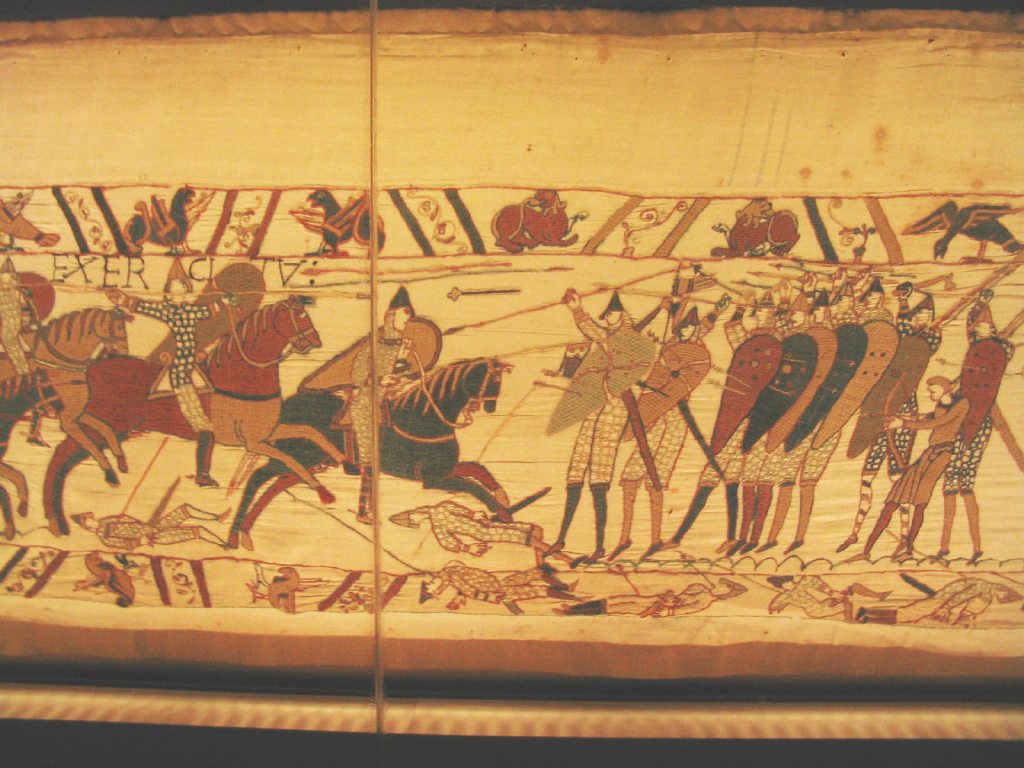
A section of the Bayeux Tapestry showing Anglo-Saxon warfare

Image found here: “Bayeux Tapestry 4” by photo by Gabriel Seah – gssq.blogspot.com. Licensed under Public Domain via Commons.

Back To Top
Abstract

After some cajoling from his fellow Danes, Hengest kills Finn before leaving Frisia in the spring.

Back To Top
Translation

“So he could not refuse the law of the world,
when to him Hunlafing gave War-Radiance,
the best of swords, placed it into his lap,
that was amidst the Jutes a known weapon.
Just so, it later befell Finn, the bold in spirit,
that he was cruelly killed in his own home,
suffered the dire attack after Guðlaf and Oslaf
spoke of the sorrow of their sea voyage,
all blamed their share of woe on Finn.”
(Beowulf ll.1142-1150a)

Back To Top
Recordings

Old English:

{Forthcoming}

Modern English:

{Forthcoming}

Back To Top
Hengest Gets Pushed over the Edge

I feel like finding sympathy for villains in this poem is something that I do a bit much of (see this entry in particular), but I can’t help but feel like there’s something in here regarding Finn’s feelings.

I mean, from the sounds of it, Hengest almost left without exacting revenge.

It’s not until Hunlafing gives him the famed sword, “War Radiance” (l.1143) and “Guðlaf and Oslaf/spoke of the sorrow of their sea voyage” (ll.1148-1149) that he acts. Or so it seems. These two actions turn Hengest towards killing Finn before leaving.

And rightly so, right? Finn is one of the Danes’ sworn enemies – a Frisian – and so his wreaking vengeance makes sense.

But what does it say about Hengest that he needed so much convincing?

If Hunlafing hadn’t given him the sword famed from fights with the Jutes or Guðlaf and Oslaf hadn’t complained about how sorry they’d be coming back to Daneland lord-less and leaving his slayer alive, would he have killed Finn?

I honestly don’t think so. I think Hengest, bitter as he was all winter, had started to like Finn, or at least respect him.

The Danes, after all, had been at Finn’s mercy, and yet he respected the pact that his marriage to Hildeburh represented. Finn extended a hand of friendship to the Danes, even if only out of obligation, and he did not go back on any of his terms. Hnæf and Finn’s own son were burned together, a funeral was held for all who perished in the battle we never see, and the Danes go unharassed all winter.

So it seems likely that Hengest, who must have been the second in command while Hnæf was alive (or at least shows the level headedness required of a leader), gradually had his grudge against Finn worn away through exposure. The ember of his hatred for the man and for his people would likely remain since this is a feud we’re talking about, but if Hunlafing, Guðlaf and Oslaf hadn’t fanned that ember back to life, I think the Danes would’ve left without incident.

But instead they kill Finn and run off – but not before committing another act to perpetuate the feud. Though that act is mentioned in the next part of the poem.

So let’s pull back for a second.

As a sword guy I just want to point out the significance of the sword Hunlafing shows Hengest. Because I think that’s probably more of a factor in what Hengest did than Guðlaf and Oslaf’s needling. After all, as a sword that “the Jutes knew well,” it’s safe to say that it was a battle-hardened sword.

Since this is a sword that seems to have been wrapped up or tucked away, it was probably Hnæf’s own weapon. As such, it probably rampaged through the battle that came before we see Hildeburh mourning on the battlefield, and so the memory of it would be fresh in Finn and the Frisian’s minds.

Or maybe they actually wouldn’t remember it at all.

What makes the reputation of the sword “War-Radiance” important is that the Danes perceive it has such a thing. Because more than idle talk of people back home thinking them dishonourable cowards for not killing Finn, showing a concrete artifact that represented the feud between Danes and Frisians, I think, would really get Hengest thinking about revenge.

Why?

Because it would remind him of all the conflict between the two in the past, such a reputed sword would stand as a testimony and representation of their feud and its enduring nature in steel. Plus, if “War-Radiance” was Hnæf’s, there’d be the twinge of duty Hengest would no doubt feel, the duty to avenge his lord at last, perhaps long since his initial feelings of frustration and anger had cooled.

Which do you think pushed Hengest toward killing Finn – the sword or Guðlaf and Orlaf’s telling him they’d be dishonoured back home?

Back To Top
A Sword’s Name and a few Other Compound Words

This passage’s compounds are pretty clear-headed. Perhaps because of the dire nature of the act the poet sings of here. After all, it’s not a battle in which you could become ecstatic in the telling, swinging compounds about like tree trunks, it’s a revenge killing of a lord in his own hall after having been his guests for the winter. It brings a chill into springtime. So the compounds are just as cold – but not less interesting.

Especially line 1143’s “hilde-leoman.” This technically isn’t a compound word since it’s the name of a sword, but that name is two other words smashed together, so here we go!

The word “hilde-leoman” comes from the compounding of “hilde” (“war,” or “combat”) and “leoman” (“ray of light,” “beam,” “radiance,” “gleam,” “glare,” or “lighting”), and I’ve chosen to translate it as “War-Radiance” (Seamus Heaney went with “Dazzle-the-Duel”) I think both have their merits.

But what’s interesting about this compound is that it’s a sword’s name.

Let me back up.

We see other named swords in this poem. There’s Hrunting and Nægling later on, for instance. But these are actual names, not just two words a poet (or someone) slammed together.

Sure, the usual alliteration comes to play with “hilde-leoman” (“Hunlafing hilde-leoman,” with the line’s cæsura right in the middle, perfectly bridges the gap), but it’s still neat that the name is just two words combined.

Plus, naming a sword something like “War-Radiance” makes sense. As a sword’s raised over and over again in a battle it’s going to catch whatever light there is on the field, especially if it’s constantly being swung but also being kept constantly clean either with quick wipes or jerky swings that shake any blood or gore free from the blade. So “War Radiance” (or the more personable” Dazzle-the-Duel”) makes an almost onomatopoeic sense (at least in Modern English).

The word “world-rædenne” (l.1142), meaning “way of the world,” is also kind of neat. Though more for its concept than anything to do with the word’s parts, those being “worold” (“world,” “age,” “men,” “humanity,” “way of life,” “life,” “long period of time,” “cycle,” or “eternity”) and “ræd” (“advice,” “counsel,” “resolution,” “deliberation,” “plan,” “way,” “design,” “council,” “conspiracy,” “decree,” “ordinance,” “wisdom,” “sense,” “reason,” “intelligence,” “gain,” “profit,” “benefit,” “good fortune,” “remedy,” “help,” “power,” or “might”).

I mean, no matter how you slice it, it basically comes back to meaning something pertaining to life and its order. The implication being, though, that killing Finn is just the way to go, it’s just what Hengest has to do as a rule of the world.

But I wonder if part of this editorializing on the part of Hrothgar’s poet sheds some light on the Anglo-Saxons’ view of history. Namely that history wasn’t something fluid that changes with every teller, but that it was something solid, and that since history was solid and fixed, so too what was to come. Though, obviously, what was to come couldn’t be read by people. So maybe there’s some determinism in that word, Hengest not being able to resist killing Finn simply because Danes and Frisians feud, and Finn’s murder would keep that going. It offers some insight into how a deterministic view of the past can lead to a deterministic view of the present and future, too, I think.

The next two compounds, “sweord-bealo” (l.1147) and “sæ-sið” (l.1149), just aren’t as interesting as “world-rædenne” and “hilde-leoman.”

Nonetheless, “sweord-bealo” brings together the unmistakable “sword” (“sword”) and “bealu” (“bale,” “harm,” “injury,” “destruction,” “rain,” “evil,” “mischief,” “wickedness,” “malice,” “a noxious thing” “baleful,” “deadly,” “dangerous,” “wicked,” or “evil”) to make a word that unmistakingly means “sword injury” or even more literally, “a grievous injury inflicted by a sword.”

And “sæ-sið” combines the nearly Modern English “sæ” (“sheet of water,” “sea,” “lake,” or “pool”) and “sið” (“going,” “motion,” “journey,” “errand,” “departure,” “death,” “expedition,” “undertaking,” “enterprise,” “road,” “way,” “time,” “turn,” “occasion,” “late,” “afterwards”) to give us “sea voyage” and almost nothing else. Though there is an implication that any kind of “sið” could be a euphemism for death since that is one of the word’s definitions according to Clark Hall and Meritt.

Do you think that the sword’s name, “hilde-leoman,” is something the poet came up with entirely for alliteration or because it was actually a sword’s name? Maybe both?

Back To Top
Closing

Next week we hear the rest of the story of Hengest and Finn, and see what the Danes do before they leave Frisia.

You can find the next part of Beowulf here.

Back To Top

The Danes scheme against Finn, compound words herald spring (ll.1127b-1141)

Abstract
Translation
Recordings
A Feud Defined
Compounds Both Simple and Complex
Closing

The goddess of spring, Ostara, shown with her symbols and beams of light.

“Ostara by Johannes Gehrts” by Eduard Ade – Felix Dahn, Therese Dahn, Therese (von Droste-Hülshoff) Dahn, Frau, Therese von Droste-Hülshoff Dahn (1901). Walhall: Germanische Götter- und Heldensagen. Für Alt und Jung am deutschen Herd. Breitkopf und Härtel.. Licensed under Public Domain via Commons – https://commons.wikimedia.org/wiki/File:Ostara_by_Johannes_Gehrts.jpg#/media/File:Ostara_by_Johannes_Gehrts.jpg

Back To Top
Abstract

The poet tells us that, as much as they’ve been wanting to head home, the Danes have been plotting against Finn all the winter long. And now, with spring in the air, the revenge is about to happen.

Back To Top
Translation

Hengest there yet
dwelt, through the slaughter-stained and all ill-fated winter
with Finn; filled with thoughts of home,
though they might not sail the sea upon
a ring-prowed ship; the sea heaved with storms,
winds fought upon it; the wintry waves were locked
tight with binding ice, and would be until came
another year to the world, as it yet does,
as the seasons are still observed,
bringing gloriously bright weather. Then would winter depart,
leave the earth’s fair bosom; the exiles were eager to go,
the strangers in the hall; but then they thought more
of revenge for their injury than of putting to sea,
if they might bring about a hostile encounter,
that the son of Jutes may have his crime etched in his heart.”
(Beowulf ll.1127b-1141)

Back To Top
Recordings

Old English:

{Forthcoming}

Modern English:

{Forthcoming}

Back To Top
A Feud Defined

In this passage the poet gives us the reason why Hengest and the Danes couldn’t yet leave Finn’s stronghold: the winter held them in place.

A natural phenomenon kept them from sailing home, and so they were held there at Finn’s place. Maybe this should be viewed as an act of god, or maybe that’s just how it was framed when Beowulf was put to paper.

At the very least, we can say that Hengest and his Danes had no choice in the matter. They’re definitely not sticking around because they want to. Indeed, though the poet spends a bit of time decorating this passage with the natural imagery of a storm-laden sea and a new year coming to the world (back when New Years was actually celebrated much closer to the spring equinox), we can also see Hengest an the Danes smouldering.

Hell, maybe they’re smouldering because they can’t leave and if the Danes had been able to just up and head out after the funeral there would be no hard feelings beyond the disgrace of having to submit to their lord’s slayer. But winter is just that cruel.

More than that, though, I think there’s something to be said for the Danes’ hate growing through the winter. It’s a kind of neat time lapse of a feud’s growth if you think about it. Very much in miniature, but nonetheless. Let’s get into the imagery to suss this view of feuds out.

We’re told that the seas are stormy and locked up with ice. But only after the poet tells us that the Danes can’t sail away. And then, before we get back to the Danes, we’re told about how the seas were impassable until a new year came (“as it yet does,” (“swa nu gyt deð” (l.1134)) the poet assures us for some reason), and we’re told about how the new year brings with it “gloriously bright weather” (“wuldortorhtan weder” (l.1136)).

Actually, that kind of light sounds like the sort that could refresh and renew a person — even if we consider this part of the poem to be entirely (or at least mostly) free of the Christian influence that likely came with the writing down of Beowulf.

If even this part of the poem has been Christianized, then that “bright weather” sounds like the sort of thing that redeems the world, that saves it every single spring in a grand cycle of renewal and decay. It packs the season of spring with so much rebirth that the four season cycle becomes a metaphor even for human life itself (though that would be one grand cycle of the seasons of life, starting over again, in Christian thought, with the resurrection at the next, true spring).

So renewal is really highlighted, underlined, and made a big deal of here. Even if only subtly through imagery.

And yet, the Danes’ anger persists. It is powerful enough — dark enough? — to resist this “gloriously bright weather,” which, in a way actually encourages the Danes’ plan. After all, now they can get back at Finn and make their escape, thus fleeing the consequences of their violence.

If that sort of enduring, growing anger doesn’t describe a feud I don’t know what does.

Or, as Blake would write some centuries after Beowulf was put to paper in his poem The Poison Tree:

“I was angry with my friend;
I told my wrath, my wrath did end.
I was angry with my foe:
I told it not, my wrath did grow.

And I waterd it in fears,
Night & morning with my tears:
And I sunned it with smiles,
And with soft deceitful wiles.

And it grew both day and night.
Till it bore an apple bright.
And my foe beheld it shine,
And he knew that it was mine.

And into my garden stole,
When the night had veild the pole;
In the morning glad I see;
My foe outstretched beneath the tree.”

What do you think the point is of telling a story about revenge after a major victory?

Back To Top
Compounds Both Simple and Complex

This week’s passage has quite a few compound words. But let me just barrel through the straightforward ones first.

These are “wael-fag,” (l.1128) “hringed-stefnan,” (l.1131) and “sae-lad” (l.1139).

“Wael-fag” simply means “blood-stained” and comes from the combination of “wael” (“slaughter,” or carnage”) and “faeg” (“variegated,” “spotted,” “dappled,” “stained,” “dyed,” “shining,” or “gleaming”).

Likewise, “hringed-stefnan” just joins the meaning of its parts to create a quicker word. “Hringed” means “made of rings,” and “stefnan” means “prow or stern of a ship.”

And, “sae-lad” is almost close enough to Modern English to figure out with a glance — almost. This word combines “sae” (“sheet of water,” “sea,” “lake,” or “pool”) and “lad” (“course,” “journey,” “way,” “street,” “water-way,” “leading,” “carrying,” “maintenance,” “support,” “clearing from blame or accusation,” “purgation,” or “exculpation”) for its meaning. Though there’s definitely something more in this one. Something about a journey being purging and cleansing, along with the sea itself being seen as something flat, a place welcoming roads.

But now let’s get to the good stuff.

The word “wuldor-torhtan” is a fantastic compounding of “wuldor” (“glory,” “splendour,” “honour,” “praise,” “thanks,” or “heaven”) and “torht” (“clearness,” “brightness,” “bright,” “radiant,” “beautiful,” “splendid,” “noble,” “illustrious,” “brightly,” “clearly,” “beautifully,” “splendidly”) meaning “gloriously bright,” “clear,” “brilliant,” or “illustrious.”

This word is also fairly straightforward, but it’s not quite as cut and dry as just being a mix of two words for fairly concrete things. Any kind of “glorious light” is a little more than just your desk lamp being flicked on, after all.

Then on line 1138 we have “gyrn-wraece” a word based on the combination of “gyrn” (“sorrow,” or “misfortune”) and “wracu” (“revenge,” “vengeance,” “persecution,” “enmity,” “punishment,” “penalty,” “cruelty,” “misery,” “distress,” “torture,” or “pain”) that means “revenge for injury.”

I think that this compound is a little more complex than those at the top of this section because of the nuance that “wracu” brings to it.

This word’s nuances suggest that the revenge isn’t necessarily for some sorrow or misfortune, but it’s maybe a penalty for it. Which brings the perhaps selfish seeming act of revenge the flavour of something cosmic, or, at the least, something social. In that your participation in a society entitles you to lash out at another who has wronged your society.

On the one hand, this is definitely a clear motivation in whatever the Danes are planning in this passage. But on the other, it’s definitely something that can seem petty. But our first reaction to the kind of violence Finn visited upon the Danes even today is the same — to hit back, rather than to try to find the real root of the problem and go after that. As the feud with the Frisians continues after this incident, the Danes didn’t bother to attack the root of their problem with the Frisians either.

And then we come to line 1140’s “torn-gemot,” a word meaning nothing more than “battle.”

But this word combines “torn” (“anger,” “indignation,” “grief,” “misery,” “suffering,” “pain,” “bitter,” “cruel,” or “grievous”) and “gemot” (as a form of “mētan”: “meet,” “find,” “find out,” “fall in with,” “encounter,” or “obtain”) to get there, so there’s definitely more to it than battle.

In fact, I went with the literal translation in this passage because I don’t think the Danes want to initiate another battle with Finn. Sure, all of his forces have dispersed so he likely only has his own personal comitatus around him, but still. What the Danes are scheming is subtler than an all out attack — otherwise it wouldn’t outpace thoughts of homes in their minds, as we see in line 1138-1139’s “but then they thought more/of revenge for their injury than of putting to sea” (“he to gyrnwræce/swiðor þohte þonne to sælade”).

What’s really odd about the second word in this compound, mētan, though, is it’s senses of “find” and of “obtain,” combined with the anger or pain of “torn,” it sounds like the compound doesn’t just refer to “battle” as Clark Hall and Meritt suggest, but to any encounter in which “anger” or “pain” are found — so not just physical fights but also battles of words, or bloodshed-free political clashes.

Basically, then, “torn-gemot” should mean, in its plainest sense, “conflict encounter” or even just “conflict.” Though we can be quite sure that the Danes aren’t just planning to have some choice words with Finn before they sail for home.

What do you think makes the difference between compound words that are straightforward and those that have more nuance? Is it a matter of a word’s newness, or of a word’s popularity?

Back To Top
Closing

In the next passage, all of the Danes’ schemes come to a head.

You can find the next part of Beowulf here.
Back To Top

Danes and Frisians cool the feud, but compound words tell a different story (ll.1095-1106)

Abstract
Translation
Recordings
A Roiling Blood Feud
Compounds Tell a Story
Closing

Back To Top
Abstract

Hrothgar’s poet continues his recital. In this poem within a poem, Finn and Hengest conclude their peace treaty, including a mention of what will happen should the treaty be broken.

Back To Top
Translation

“Then they with trust their two halves together
secured in a peace treaty. Finn to Hengest
with ill-fated courage oaths swore
that he the survivors of the carnage would treat
honourably as his counsellors advised, that no man
there would by word or deed break the treaty,
nor through any artful intrigue complain of it.
All this though they were forced to serve the slayer
of their ring-giver while leaderless, to him necessity bound them;
though if any of those Frisians were to remind them of that
through boldly speaking of the blood feud,
then the sword edge should settle it.”
(Beowulf ll.1095-1106)

Back To Top
Recordings

Old English:

{Forthcoming}

Modern English:

{Forthcoming}

Back To Top
A Roiling Blood Feud

So 11 lines more and then we see the end of the negotiations between Hengest and Finn, between Dane and Frisian. There is some tension here, and it’s pretty clear that the Danes don’t want to have to sit and wait with the Frisians. But it’s still quite a mellow section of the poem as a whole. But perhaps that’s because this part of Beowulf is really reliant on knowing the history behind it.

Actually, without Hildeburh to relate to Grendel’s mother, or something else to relate to the main action of the poem, there’s nothing except history for us to really grab onto. Though we can definitely say with confidence that the “blood feud” (“morþorhetes” (l.1105)) between the Danes and Frisians that this treaty is supposed to quell will probably break out.

But maybe there’s something about the feud between Grendel and the Danes in there.

Without the historical context, but with the trope of the feud that’s gone on so long neither side can remember the reason for it, maybe the poet is telling this story to Hrothgar, Beowulf, and the assembled Danes and Geats as a kind of joke about the situation with Grendel. But to really get a handle on that we’ll need to see the conclusion of the poem first. If Dane and Frisian don’t bloodily clash in the poem’s final lines, but instead amicably part ways then this little diversionary poem is indeed mysterious.

But I don’t think the poet would include lines like 1107’s threat of any disputes with the treaty being settled with “the sword’s edge” (“sweordes ecg”) if this poem didn’t end with some sort of fight.

Anyway, the peace terms themselves (since that is what this passage of the poem is about), offer at least some insight into Anglo-Saxon culture. At least in terms of ideals.

Ideally, counsellors would be listened to, guests/hostages would be treated honourably lest a greater force come seeking to fulfill a renewed blood feud, and, ideally, those who don’t like the treaty are kept in line with the threat of harm or death. Which is kind of a funny way to enforce a peace treaty (I can’t help but visualize a parent snapping a belt as they say “now play nice – or else!” while standing over fuming siblings), but there you go. Though violence may have been the only deterrent, since I get the impression that Danes and Frisians didn’t have much in the way of trade. Plus, this is a treaty between two small sub-groups after all, not an out and out treaty between two entire peoples.

Also, it’s good to see that just who is who is cleared up. The slain ring-giver of lines 1102-1103 was the Dane’s. Even without the historical context for this story, the “them” of line 1104 suggests the Danes since it refers to the people that the Frisians are reminding, and since it’s just Danes and Frisians here, there’s no one else that “them” could refer to. Also, the poet singing this story is himself a Dane, so it makes sense that they’re the underdogs here (just as they were against Grendel, lending some weight to my idea that more than Hildeburh’s mourning relates this little story back to Beowulf at large).

So it sounds like the Danes are without a leader. But if one side’s leader remained, why not just envelop the weakened side while you hold the advantage?

Let me just take a quick look at Wikipedia’ entry on the this part of the poem (under the “Finnsburh Fragment” entry).

Ah. Here we go.

Hildeburh was Finn’s wife, and their marriage was meant to bring harmony between the Danes and the Frisians. So Finn, leader of the Frisians, obviously wanted peace. Hence, he makes a treaty with the Danes rather than just destroying them.

So Finn’s desire for peace is likely genuine (not unlike the well-meaning, but wrong-headed parent from a day dream a few paragraphs back). But that’s obviously not something that’s shared among the other Frisians, since any mention of the Danes serving their lord’s slayer is made punishable by death. And with good reason.

As poems like the Battle of Maldon make clear, loyalty to your lord was paramount in Anglo-Saxon society. So there could be no greater insult than to dishonour your former leader by turning around and working with his killer. Working with your lord’s slayer in any capacity – whether it was simply signing a treaty or running his errands – was the ultimate slander to your fallen leader because it suggests that he inspired no loyalty in those he lead. And, though it might’ve been fuelled by gifts of treasure, a true comitatus (or warrior band) was held together with loyalty. True warriors would stick with their leader no matter what, confident that in the end they would get their reward.

But Finn’s desire for peace doesn’t really clear up why the Danes are hanging around. Are they hostages? Are they trapped by winter’s icy water? Or is there something else keeping them?

I’ve already thrown in my guess that this peace treaty between the Danes and Frisians won’t last. Do you think it’ll make a difference and bring the two groups together, or that it will end in bloodshed?

Back To Top
Compounds Tell a Story

Because of the tension the negotiation between two bitter rivals in this passage, it’s full of compound words.

But what makes these compounds really stick out is that this passage’s compounds tell a story. Here goes.

On line 1096 we find the passage’s first compound word. This is the word “frioðu-wær,” which means “treaty of peace.”

Simply enough it comes from the words “friðo” (“peace,” “safety,” “protection”) and “wær” (“true,” “correct,” “faith,” “fidelity,” “keeping,” “protection,” “agreement,” “treaty,” “compact,” “pledge,” “covenant,” “bond (of friendship)”). So right there in the constituent words you can see the meaning of “peace treaty.” It’s just as straightforward as such a treaty should be.

But things thicken on line 1101. This is where “inwit-searo” is mentioned. This word, meaning “artful intrigue,” comes from the words “inwit” (“evil,” “deceit”; or “wicked,” deceitful) and “searo” (“art,” “skill,” “cleverness,” “cunning,” “device,” “trick,” “snare,” “ambuscade,” “plot,” “treachery”; as well as “work of art,” “cunning device,” “engine (of war),” “armour,” “war-gear,” or “trappings”).

So now we’re faced with a kind of “cunning evil” or “wicked snare,” perhaps the machinations of someone or some group against the peace treaty mentioned above. But what makes these machinations plot-thickening is that they aren’t direct. This isn’t a compound word for “fight” or “sword” but instead comes from a sense of malicious intelligence that has set pieces up only to knock them down in a clever way.

In fact, “inwit-searo” describes just the kind of act that could spark a “morþor-hete,” or “blood feud” like the one on line 1105. This word combines “morþor” (“deed of violence,” “murder,” “homicide,” “manslaughter,” “mortal sin,” “crime,” “injury,” “punishment,” “torment,” or “misery”) and “hete” (“hate,” “envy,” “malice,” “hostility,” “persecution,” or “punishment”).

So at its simplest, aside from “blood feud,” morþor-hete” could simply mean hate-fuelled murder, or any violent act with malicious intent. To my eye at least, the word itself even looks like it could mean the fog that someone gets into when they commit such an act, a “murder-heat” or maybe “murder-haze.”

Without knowing exactly what the big rivalry between Dane and Frisian was, I can’t say if these three compound words tell the probably forgotten origin of the feud between these two peoples. But it is rather neat to see the compounds lined up like this. It might just foreshadow this poem’s own end, but we’ll find that out in four weeks.

Blood feuds were a common problem in Anglo-Saxon society and the early medieval period in general. But, feuds continue to be a super popular idea in TV and movies. Why do you think we still tell stories about feuds?

Back To Top
Closing

Next week, following up on forging this peace, the poet turns to tell of the funeral for all those slain in the tragic combat of Frisian and Dane.

You can find the next part of Beowulf here.

Back To Top

Battlefield mourning and measured compound words (1071-1080a)

Abstract
Translation
Recordings
Two Mothers Mourning
Measured Compound Words
Closing

A section of the Bayeux Tapestry showing Anglo-Saxon warfare

Image found here: “Bayeux Tapestry 4” by photo by Gabriel Seah – gssq.blogspot.com. Licensed under Public Domain via Commons.

Back To Top
Abstract

Hrothgar’s poet begins a recitation of the story of Hildeburh, a woman in mourning.

Back To Top
Translation

“Indeed, Hildeburh had no need to praise
Jutish loyalty; guiltlessly she became bereft
of loved ones at the shield play,
of her son and of her brother; they were burdened
with ruinous spear wounds; she was made a mournful woman.
Not without reason was Hoc’s daughter
then fated to mourn, after morning came,
when she might under the sky see
the violent death of her kin, where they earlier
had held the great joy of the world.”
(Beowulf ll.1071-1080a)

Back To Top
Recordings

Old English:

{Forthcoming}

Modern English:

{Forthcoming}

Back To Top
Two Mothers Mourning

The most remarkable thing about this passage is that it’s coming from a woman’s perspective.

Hildeburh, the mother of a warrior, and sister to another, is, for some reason, near enough to the battlefield to go and see her fallen family the morning after a night battle. Her closeness suggests that this battle was probably a siege of some sort. If this is so, then she, distraught as she’s heard no word about her men, has left the city’s walls to see if she can find them herself.

Though it’s also possible that Hildeburh was along with the war party as some sort of supporter.

But I think that the line about “Jutish loyalty” (“Eotena treowe” (l.1072)) suggests that there’s been some treachery afoot, and so a siege is more likely. Or at least some sort of fortification.

Why?

Because when I think about treachery in what’s obviously some sort of war situation, I think of a betrayal that’s resulted in the fall of a fortification or castle that was hitherto impregnable. But Hildeburh’s exact situation isn’t important.

After all, the poet just launches into the story. This cold open likely comes from Hildeburh’s having been understood as a specific figure to the poem’s original audience. She’s someone who’s known to fit in with the context of the children of Finn and Hnaef Scylding, as mentioned in last week’s passage. So there’d be enough information for the poem’s early audience(s), but there definitely is not enough for us.

So, instead of trying to pull more information about the situation from this I just want to jump ahead a bit in the poem. After I’ve jumped back.

Grendel was defeated the night before the celebration at which this poet is singing. The monster’s arm was torn off, and he was left to wander, bleeding, back to his lair on the fens.

Later in the poem (about 200 lines from now) Grendel’s mother shows up to seek revenge for her son’s death.

I like to imagine that the poet’s giving us this episode from history (or common lore) about a woman going out to find her brother and son dead is supposed to parallel what Grendel’s mother is now doing (or has recently done) in the timeline of the poem.

As the Danes and Geats celebrate, Grendel’s mother is mourning. In the harsh light of dawn she’s found her son mangled and dead, having been dealt “ruinous/…wounds” (“hruron/…wunde” (l.1075-1076)). And so I can’t help but think that this part of the poem, a different version of the story found in the “Finnsburh Fragment,” is supposed to be showing us the other side of Beowulf’s great victory.

Grendel, to the Danes, and to the Geats who came to stop him, was monstrous. But Grendel is nonetheless the “kin of Cain.” He’s monstrous and some sort of abomination in the eyes of god, but he still has a family – a mother. And now that mother is grieving, angry.

But her rage comes out 200 lines down the road. Right now we just have Hildeburh. Who, even on her own, makes a curious statement about all of the war and violence in the poem so far. Showing the mourning side of battle adds the dimension of empathy for the fallen and their living relations that up to now hasn’t really been that big a deal.

But now we get to see just how that empathy plays out as Hildeburh’s part continues.

What do you make of a battle-celebrating poem like Beowulf‘s having a character mourn those freshly lost in battle? Is it a balancing element, just a token inclusion, or something else entirely?

Back To Top
Measured Compound Words

This is definitely a passage about battle. Though it’s coming from the side more familiar to most of us – that of the spectator, the person who doesn’t fight but has to live with what comes of fighting. Nonetheless, there are quite a few compound words used here, considering the length of the passage.

What’s particularly notable about these compound words, though is that their use is fairly measured.

For instance, the poet doesn’t throw down a few compounds for the same thing or concept in short succession, nor do these compounds appear in parenthetical clauses that aren’t really part of the passage’s main ideas.

In fact, in this passage, the compound words generally are the main ideas of the sentences, or at least integral to understanding those ideas. I think this measured use suggests a more focused sort of intensity than that which we’ve seen when the poet is simply slamming down compounds. But let’s take a look at these words.

On line 1073 we’re given “lind-plegan,” an innocent sounding word for “battle” that literally means “shield play” (since it combines “lind” (“shield (of wood)”) and “plegan” (“quick motion,” “movement,” “exercise,” “play,” “festivity,” “drama,” “game,” “sport,” “battle,” “gear for games,” or “applause”)).

This word is used for alliteration, but I think it’s also a reference to the sort of close combat that Beowulf and Grendel engaged in just some 300 lines ago.

Next, on line 1077 “metodsceaft” appears. This one means “decree of fate,” “doom,” or “death” and comes from the mix of “metod” (“Measurer,” “Creator,” “God,” or “Christ”) and “sceaft.”

It’s tempting to read the “sceaft” in “metod-sceaft” as the usually prefix-less “sceaft” meaning “staff,” “pole,” “shaft,” “spear-shaft,” or “spear.” I mean, this reading gives us a word that would mean something like “the spear of God,” an apt sounding metaphor for fate. Not to mention taking this compound to mean “spear of God” sees Hildeburh suffering the same sort of wound that killed her brother and son. But, I don’t think that pre-fix resistant “sceaft” is the word meant here.

Instead, there’s a similarly written word that does take prefixes, “sceaft” (“created being,” “creature,” “origin,” “creation,” “construction,” “existence,” “dispensation,” “destiny,” “fate,” “condition,” or “nature”). When this word combines with “metod,” we get the much clearer “God fate,” or “decree of fate” (extrapolated from “Measurer of fate”). Though I’m not sure what the mixture of a name of god and a word for “creature” or “fate” really implies in Old English.

Finally, the third compound word in this passage goes in for emphasis rather than some sort of new concept. The word “morthor-bealu” is already implicit in the two men dying from spear wounds, as it means “violent death,” or “murder.”

And breaking down “morthor-bealu” doesn’t do much to make the word’s implications less violent. On its own, the word “morthor” means “deed of violence,” “murder,” “homicide,” “manslaughter,” “mortal sin,” “crime,” “injury,” “punishment,” “torment,” or “misery”; while the word “bealu” means “bale,” “harm,” “injury,” “destruction,” “ruin,” “evil,” “mischief,” “wickedness,” “malice,” “a noxious thing,” “baleful,” “deadly,” “dangerous,” “wicked,” or “evil.” So we’re left with a double whammy of “murder” on the one hand and “destruction” on the other. It’s definitely a compound word that connotes inescapable violence.

But, just in case we weren’t sure about the fate of Hildeburh’s kin, we’re told through “morthor-bealu” that they met a “violent death” or “murder,” suggesting that even within the realm of warfare, their deaths were particularly grisly. Unless the poet, along with keeping up with alliterating, also wanted to give us a sense of the shock and horror that Hildeburh is likely feeling when she sees them in the dawn’s light, rather than the stoic male perspective we’ve seen the poem through up to this point.

All three of this week’s compound words alliterate with the major sound in their lines (“lind-plegan” with “l”; “metod-sceaft” with “m”; “morthor-bealu” with “m”). Do you think that’s important at all?

Back To Top
Closing

In the next passage we’ll find out what happens in the aftermath of the battle in which Hildeburh lost her son and brother.

You can find the next part of Beowulf here.

Back To Top

Words to cool a harp solo and excite for history (ll.1063-1070)

Abstract
Translation
Recordings
A Harp Solo Before a History Lesson
Words of War Mingled with Words of Mirth
Closing

Back To Top
Abstract

The poet describes the joy and noise of the hall before diving into a summary of a tale that’s about to be told.

Back To Top
Translation

“There was song and clamour together there
before the Danish commanders.
The harp was played, many tales told,
when the hall joy Hrothgar’s poet
among the mead benches would recite:
He sang of Finn’s children, when calamity struck them,
when the Halfdane hero, Hnæf Scylding,
in the Frisian slaughter found death.”
(Beowulf ll.1063-1070)

Back To Top
Recordings

Old English:

{Forthcoming}

Modern English:

{Forthcoming}

Back To Top
A Harp Solo Before a History Lesson

You know there’s not a lot happening in an old poem when there are bits like this passage. What makes this passage such a red flag for a low ebb of action? The lack of specificity for starters. Until the next part of the poem (another poem within a poem) is described, we’re just told how the Danish commanders are regaled while song and tale telling are happening all around everyone.

It’s also clear that this is a bridge sort of passage because immediately before hand we had some wisdom dropped on us. It wouldn’t surprise me if before this passage was recited there would usually be a little harp solo. It’s just the appropriate time for that sort of thing.

After all, things are going to get heavy again fairly soon, and the end of this passage is the warning for that. I mean, before we even get into the poem that’s about to be recited, the poem itself is telling us that the children of Finn will meet calamity and the Danish hero Hnæf Scylding will meet his end. So a little solo and maybe a re-enactment of the celebration would help.

But the story that follows this passage is definitely something inserted, a kind of gem embedded in the woven metal art piece that is Beowulf.

Perhaps it was a lovely poem that was much admired when Beowulf was being composed, maybe even just a piece of poetry that came to a poet’s mind after having told his audience about the gifts Beowulf and the Geats got. Whatever the case, the coming story is offset explicitly like the story of Sigmund and the dragon told the morning after Beowulf’s victory.

So we can tell that spirits are indeed high since Beowulf’s been fêted before with this kind of embedded story.

Likewise, the tale of Sigmund foreshadows Beowulf’s own fight with a dragon, and we can expect more foreshadowing from this passage. Though it’s not likely to be as clear.

Why?

Because all of the names and roles in Anglo-Saxon society can get a little tricky. And this poem is, if nothing else, historical and political, so it’s trying to exemplify something political and social. If the story of Sigmund is like Shakespeare’s The Tempest, the story of Finn’s children and Hnæf Scylding is like Titus Andronicus or Julius Caesar. It’s a neat yarn, but only really interesting if you’re already familiar with the history or are interested in it.

And, actually, given that this is something with a little more grounding in history than Sigemund’s fight with the dragon, it’s interesting how the poet doesn’t really try to hook us with any special detail about the story.

Before the Sigemund story we’re told that the poet brought stories of Sigemund from far off lands, but here we’re explicitly told that what we’re about to hear tell of calamity and death. But I think that’s just part of mustering authority. The poet’s introduction to what’s about to be recited needs to be simple and clear to set the tone of what’s to come and also to make clear that this isn’t an embellishment or grand story, but a retelling of facts. Plus, most people hearing Beowulf, or even reading it, would probably be familiar with the calamity that befell Finn’s children and Hnæf’s end, so things are primed as being familiar rather than new. What’s to come is history rather than mythology, after all.

Though, maybe that’s why history feels boring to a lot of people. Even if we don’t know the details, the stories within history are familiar because we’ve heard the archetypal historical stories before (stories of people in war, of intrigue, of the ambitious). But works of fiction (or mythology) seem fresh and new because there’s the promise of a story we’re unfamiliar with – including twists and surprises that we aren’t expecting.

What do you think makes a good story? Something unlike anything you’ve ever come across before, a regular story with a twist at the end, or something that’s mostly familiar? Why?

Back To Top
Words of War Mingled with Words of Mirth

Well, because this passage is leading us into history, things get pretty serious by the end of it. But that doesn’t mean they don’t get the poet revved up to use a bunch of compound words.

We get four here, including one that must have been made up specifically for this occasion. However, none of these compounds are particularly deep or complex. So perhaps the excitement the poet feels as he gets ready to launch into a little history isn’t as unbridled as it’s been in the past but is more like the excitement of a professor about to lecture on her favourite subject.

Anyway, the four compounds we come across in this passage are “hilde-wisan” (l.1064), “gomen-wudu” (l.1065), “heal-gamen” (l.1066), and “Fres-wæle” (l.1070).

The word “hilde-wisan” means “commander.” Though I think “veteran” works, too.

After all, “hilde” means “war,” “combat,” “keeping,” “custody,” “guard,” “protection,” “loyalty,” “fidelity,” “observance,” “observation,” “watching,” “secret place,” “protector,” or “guardian”; while the Old English word “wisan” means “leader,” or “director.” So combining the two gives us something like “director of combat,” or “leader of protecting,” which sounds like a veteran or commander to me. Of course, I think that goes without saying since all commanders would likely have been veterans (though not all veterans would be commanders).

Line 1065’s “gomen-wudu” is probably the neatest compound of this bunch, and quite appropriately so.

This word means “harp.” It derives that meaning from “gomen” (“sport,” “joy,” “mirth,” “pastime,” “game,” or “amusement”) and “wudu” (“wood,” “forest,” “grove,” “tree,” “the Cross,” “Rood,” “wood,” “timber,” “ship,” or “spear-shaft”). So literally, this compound for “harp” means “mirth wood.” I rather like how how the mirth is focused in the wood.

Not because it takes the emphasis off of the skill of the person playing the harp. But because it suggests that the musician playing the harp is more of a medium than someone actively creating music, that they’re someone through whom the music flows rather than someone who just plays. Which makes sense since, in a joyous meadhall where its namesake alcohol is freely flowing, I imagine the harp player would get pretty into their playing. And it’s really cool how the compound reflects that.

The word “gamen” comes up again in “heal-gamen.” Though in this case it’s combined with “heal” (as a form of “healh” it could mean “corner,” “nook,” “secret place,” “small hollow in a hillside or slope”; or as “heall” it could mean “hall,” “dwelling,” “house,” “palace,” “temple,” “law court,” or “rock”) to simply mean something like “hall joy.”

Though Clark Hall and Meritt drily define this compound as “social enjoyment.” But I think that definition makes the compound sound like it’d be more comfortable in a piece of Old English sociology rather than Old English poetry.

Then, rounding things out, is a word that the poet must’ve just mashed together to fill the line and fit the alliteration: “Fres-wæle.”

This word must be unique to Beowulf because it’s just the name of a group of people – the Frisians (“Fresan” in Old English) – and “wæle,” which we’ve encountered before (which means “slaughter” or “carnage”). Hence, “the Frisian slaughter.” It’s not a very complex compound word, nor is it one that allows for a lot of misinterpretation, but it’s definitely something I take as a sign of the poet’s transcendent sort of state at this point in the poem.

What’s your take on “Fres-waele”? Is it used just because it’s a word? To alliterate? Or to show how the poet’s beside himself with excitement?

Back To Top
Closing

In the next passage we’ll start to get a sense of what this Frisian slaughter, and the matter of Hnæf Scylding are really all about.

You can find the next part of Beowulf here.

Back To Top

Payment for the dead and weird words with clear covers (ll.1050-1062)

Abstract
Translation
Recordings
Obligatory Gifts for the Living and the Dead
Sailing through a Batch of Inherited Words
Closing

Back To Top
Abstract

The poet fills us in on how Hrothgar rewarded the other Geats before telling us about “the fore-thinking mind.”

Back To Top
Translation

“Yet then the lord to each man
who had with Beowulf undertaken the sea-way,
there at the ale bench gave treasure,
bequested booty, and then commanded that immediately
gold be paid up, for to cover the one whom
Grendel earlier killed, as he surely would have killed more,
had not wise God and a single man’s
daring prevented that fate. The Measurer ruled
over all human kings then, as it now yet does.
Thus understanding is always best,
the fore-thinking mind. Much shall it endure
of love and of hate, so long as it partakes of
this world’s days of strife.”
(Beowulf ll.1050-1062)

Back To Top
Recordings

Old English:

{Forthcoming}

Modern English:

{Forthcoming}

Back To Top
Obligatory Gifts for the Living and the Dead

What is there to say about this passage? The other Geats get rewarded, the poet shares a bit of Christian-tinged gnomic wisdom and the way is made clear for more partying.

But. I’m just gonna hold us up on our way to that with a few small things.

First, on line 1152, the word for “gave” (“gesealan”) doesn’t really come off as nicely as line 1044’s “confer” (or “onweald geteah”) in last week’s passage. That is the word used for Hrothgar’s formally giving Beowulf those great gifts we’re told all about. But the treasures given to his fellow Geats seem to be given over a greater sense of obligation.

After all, “sellan” includes such senses as “furnish,” “supply,” and “allot.” It sounds like there’s much more of a need motivating Hrothgar’s giving treasure to the Geats who were either asleep or useless in the fight with Grendel. Social custom just says that you need to pay those who come in to help you, so Hrothgar’s paying up. And I guess they all get paid the same.

Even if they die in the line of duty.

On lines 1053-1055 we’re told that after he gave the other Geats gifts, Hrothgar then “commanded that immediately/gold be paid up, for to cover the one whom/Grendel earlier killed” (“ænne heht/golde forgyldan, þone ðe Grendel ær/mane acwealde”)

This makes Hrothgar sound like a very upstanding guy. Someone who really sticks to what had been offered, what had been promised. But there’s more to this exchange than a ruler simply paying everyone who came to his rescue.

Grendel had been feuding with the Danes, at least in a sense. The reason for the feud is unclear, but earlier in the poem reference is made to Grendel acting as if he had some sort of feud with them.

I’m not sure of all the laws involved, but one of the major ones in Anglo-Saxon Britain was the concept of “wergild.” I’ve mentioned this before when talking about the word itself and when talking about Hrothgar handling Beowulf’s father. But, as a quick refresher, “wergild” was the money paid out to a rival group if your group happened to kill one of their members. The purpose of this payment was to keep a feud from breaking out so that violence between familial or clan groups could be quelled in the interest of organizing these smaller groups into something bigger.

But back to the poem.

In this mention of payment for the dead Geat we might be seeing wergild paid out. Not because the Geat was killed in some sort of feud they had with the Danes. No such feud exists in the poem. Instead, this payment’s made, I think because when Beowulf was legal owner of Heorot for that night, he also took on Grendel’s feud (or, by virtue of Heorot being the Dane’s base of operations, legal ownership of it enveloped him in the relations surrounding the building). As such, since it was the Danes that got them involved in the feud with Grendel, and Grendel can’t pay any wergild, Hrothgar takes it on himself to make up for the death of the Geat that Grendel snacked on when he first arrived at Heorot that fateful night.

Plus, paying the wergild for a man killed in a battle not his own, would help to make the message of alliance and peace between Geats and Danes deafeningly clear. So there’s another reason to pay for the fallen Geat.

What do you think of the concept of attaching a monetary value to a life? Do you think such a payment was satisfying to the Anglo-Saxons?

Back To Top
Sailing through a Batch of Inherited Words

Since this is another meditative, kind of serious and slow paced passage we don’t get much in the way of wild compounds. There are few though. At the least, I’ll point them out.

First, on line 1051, we have “brim-lade,” a word for “flood-way” or “sea-way.” This word mixes “brim” (“surf,” “flood,” “wave,” “sea,” “ocean,” “water,” “sea-edge,” or “shore”) and “lade” (“course,” “journey,” “way,” “street,” “water-way,” “leading,” “carrying,” “maintenance,” “support,” “clearing from blame or accusation,” “purgation,” or “exculpation.”) for its aquatic meaning. The senses of “lade” involved blame aren’t likely related to this compound, but it’s kind of fun to wonder if such a seafaring people as the Anglo-Saxons saw sailing or going along the “sea-way” as somehow purgative. Maybe, because of the time for all parties involved to think things over and perhaps forgive, a sea voyage was seen as a good way to ultimately have people clear each other of blame.

Though even I think that’s a bit of a stretch.

For all of its simplicity, “yrfe-lafe” (1053) is a weird word.

Combining “yrfan” (“inherit,” “leave (by will),” or “honour with a funeral feast”) and “lafe” (“what is left,” “remnant,” “legacy,” “relic,” “remains,” “rest,” “relict,” or “widow”) to leave us with a word meaning “bequest, inheritance, heir,” it’s clear where the meaning of “yrfe-lafe” comes from. Though, in its use in this passage, it seems like its context skews its meaning.

On line 1053 we’re told that the other Geats are “bequested booty,” though I’ve translated that from a simple “yrfe-lafe.” The thing here is, as mentioned above, I think that Hrothgar’s giving gifts to the rest of the Geats more out of obligation than genuine gratefulness. It’s as if they’re inheriting them as a matter of fact rather than being rewarded with them.

Line 1060’s “fore-þanc” is quite a bit more straightforward, given its place in the philosophical part of this passage.

Meaning “forethought,” “providence,” “consideration,” or “deliberation,” this word is a combination of “fore” (“before,” “in the sight of,” “in presence of,” “because of,” “for the sake of,” “through,” “on account of,” “by reason of,” “from,” or “before”) and “þanc” (“thought,” “reflection,” “sentiment,” “idea,” “mind,” “will,” “purpose,” “grace,” “mercy,” “favour,” “pardon,” “thanks,” “gratitude,” “pleasure,” “satisfaction,” “reward,” or “recompense”). So “fore-þanc” very literally means “before thought” or several variations of the same that all boil down to consideration being made before things either temporally or pseudo-physically (in that the action is given because of, or in the presence of something.

Which brings us down to the last line’s “windagum,” or “days of strife.” The “dagum” part of this word is Old English for “day” (though it could also mean “lifetime,” “Last Day,” or just be used as name of the rune for “d”), while “win” is a word for “toil,” “labour,” “trouble,” “hardship,” “profit,” “gain,” “conflict,” “strife,” or “war.” So, since “dagum” is the plural form of “daeg,” we get “days of toil.” Pretty neat, huh?

But, that’s not all. Because as terrible as “days of toil” sounds, it seems like there’s a bit of a silver lining. Possibly, anyway. The non-toil or labour-intensive definitions of “win” are “profit” and “gain.” It’s unclear if we’re supposed to understand these gains as coming from toil and labour or if it’s just a different take on what makes days full of strife. Maybe instead of battling sin, for example, “days of profit” are those in which you can embrace virtue.

In either case it’s neat to know that an alternative perspective (or even meaning) is contained in a word like “win.” Though, given modern English’s “win” it’s pretty clear which senses of the word won out. Though, again, winning can take a lot of strife and toil, so maybe this struggle of the senses isn’t over yet.

How closely can you look at a word (like “win,” for example) before it starts to temporarily lose all meaning to you?

Back To Top
Closing

After all of this talk of gifts and understanding, we’re told of how high times finally return to Heorot.

You can find the next part of Beowulf here.

Back To Top