Silent Sorrow Following Frabjous Joy [ll.2706-2719] (Old English)

Abstract
Translation
Recordings
Strengthened by Juxtaposition
Who’s Heart-Wise?
Closing

{Wiglaf tends to Beowulf. Image found on Wikipedia.}
 

Back To Top
Abstract

The poet revels over the victory of Beowulf and Wiglaf, but their joy is short lived as Beowulf’s wound is shown to be dire.

Back To Top
Translation

“The fiend had fallen – courage punished his life –
and those two both had killed it,
brother nobles. So should every man be,
loyal thanes ready for the need! Yet for that king it was
the final hour of victory for his own deeds,
his works in the world. Then that wound began,
the one the earth-drake had earlier dealt him,
to sear and swell; soon he discovered that
poison welled forth from within the wickedness that
marred his chest. Then the prince went
to him that was by the wall, wise at heart,
he sat on the stone; looked upon the work of giants,
how the stone arches were secured with columns,
beheld what the cave-dwelling held within.”
(Beowulf ll.2706-2719)

Back To Top
Recordings

Old English:

{Forthcoming}

Modern English:

{Forthcoming}

Back To Top
Strengthened by Juxtaposition

The juxtaposition of the opening lines of this passage is perfectly suited to Anglo-Saxon thought.

Placing a bit of gnomic wisdom aside the revelation that Beowulf is indeed dying only strengthens that wisdom. After all, Wiglaf now proves himself to truly be one of the “loyal thanes” (“þegn” l.2709).

Within this passage we see him run over to his dying liege lord and take a seat beside him. For now, there is no dialogue, but instead Wiglaf looks over what they’ve won together. Without words of any sort he takes up the role of world interpreter for Beowulf as he lies against the wall, his wound festering in fast forward.

Back To Top
Who’s Heart-Wise?

In the above translation the person being desribed as “wise at heart” (“wīs-hycgende” l.2716) is unclear, and so too is it in the original: “Ðā se æðeling giong/þæt hē bī wealle wīs-hycgende/gesæt on sesse” (ll.2715-2717).

This ambiguity shows not only the shared wisdom of these two, but it also works to further the idea that Beowulf has successfully passed on the role of Geatish ruler to the best candidate. Though his death and the cowardice of the other 11 thanes does prophesy that tribe’s beginning decline.

Turning to what either case might mean more specifically, if the phrase refers to Wiglaf, then it simply means that he is doing what he feels is right and the poet is validating this.

On the other hand, if this phrase refers to Beowulf, then it may be a bit of foreshadowing of a phrase that comes up in a passage nearly 100 lines away, or it may simply refer to the inborn wisdom that a fifty winters as a successful king brings.

Back To Top
Closing

Next week, Isidore writes of the ways in which animals are manipulated while conceiving, and Beowulf finally comes to terms with his end.

You can find the next part of Beowulf here.

Back To Top

Moving from Horses to Mules [12:56-57] (Latin)

Abstract
Translation
Recordings
Moving Mules from Language to Language
The Power of the Bigenerum?
Closing

{Simply grey, but what a worker. Image from the National Library of the Netherlands’ Medieval Illuminated Manuscripts collection.}

Back To Top
Abstract

Isidore’s generalization about the three kinds of horses moves into a piece about mules, their uses, origins, and habits.

Back To Top
Translation

[56] “There are three kinds of horses: those apt for war and work, others to drive the commons and the herd, but are not apt to ride, the third arises from a mixture of the diverse kinds, that are truly called two-kinded (bigenerum) which from diverse sorts are born, like mules.

[57] “Moreover, the word mule is had from the Greek for “drive” (tractum). Among the Greeks, millers truly use this mule to turn the mechanism of their mills. The Jews freed those flocks when Jacob made them conceive mules in the desert by himself, made of the first born, so that the mules from there were newly and against nature born among natural animals. Wild asses to this also are added as well as donkeys: and they themselves by the same method are found in intercourse, so that very quickly are donkeys born.”
(St. Isidore of Seville, Etymologiae 12:56-57)

Back To Top
Recordings

Latin:

{Forthcoming}

Modern English:

{Forthcoming}

Back To Top
Moving Mules from Language to Language

Although mules are well suited to menial tasks, like powering mills, Isidore did not make them easy to translate into English. Much of paragraph 57 is understandable with some tweaks and some twists, but it all runs on contemporary shared knowledge more than anything else save for its opening sentence.

The relationship between whatever Greek word is in question and the Latin tractum is not entirely clear. The sentence could mean that the Greek is derived from the Latin, or that the Latin term and the Greek are the same, and so there’s no need for the differentiation that including both terms brings.

The quick retelling of the story of Jacob and Laban’s flocks is also altered in the original Latin. The crux of this is the phrase “Ana abnepos Esau” (12:57) Esau is a familiar name, but Ana looks off, and the combination of the two with the word for “great great grandson” makes it even more bizarre. Perhaps there’s some esoteric bit of lore about a grandson that’s at work here, but that has since been forgotten about.

Other interpretations of these passages are possible, but these are the ones that seem most likely to me, given my limited knowledge of Latin’s complexities.

Back To Top
The Power of the Bigenerum?

To sum up the entirey of paragraph 57, mules are work animals.

But the question that arises from these two paragraphs is: Does this designation as a work animal come from mules’ being a perfect mixture of two types of horse – as seems to be implied by a Latin adjective describing mules – “bigenerum” (12:56)?

Given the description of mules thus far, it seems that the answer must be yes, resoundingly. After all, combine horses that can be ridden into war, and those that can be used to herd animals, and the natural result would be something hardy and used for strenuous activity.

But then, if Esau is being credited with the creation of mules, then does that mean that he did it intentionally?

According to the story in the KJV (Genesis 30:25-43), Jacob creates these mules in order to steal away Laban’s flock after he has worked for him for seven years in exchange for Laban’s daughter Rachel.

Since the idea to use the rod to scare the females into giving birth while they were drinking, resulting in mules, was his own, Isidore is definitely in the right to say that these mules were “were newly and against nature born among natural animals,” (“nova contra naturam animalia nascerentur” 12:57).

Truly intriguing in the KJV though is the mention in verse 41 of chapter 30 of Genesis that Jacob only used his trick when the strong ones among Laban’s flocks and cattle were pregnant. In other words, they weren’t just bred for necessity, they were bred for strength – something that Isidore nails here.

Back To Top
Closing

Check back here on Thursday for Beowulf and Wiglaf’s brief revel, and a tragic realization.

Back To Top

Beowulf Strikes the Dragon’s Head, and the Poet/Scribe Strikes at the Poem’s Heart [ll.2672b-2687] (Old English)

Abstract
Translation
Recordings
Beowulf’s Flaw, and an Old Dichotomy
Striking at the Heart of the Poem
Closing

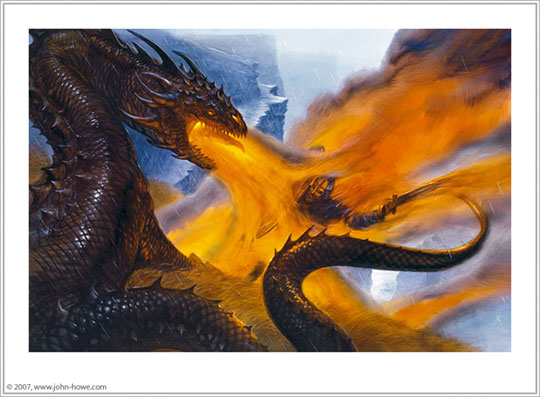
{A good example of how flame might advance in a wave. Image by John Howe, and found on john-howe.com.}

Back To Top
Abstract

Wiglaf’s valor inspires Beowulf, but this leads to the revelation of the truth about Beowulf and his swords.

Back To Top
Translation

“Flame in a wave advanced,
burned the shield up to the boss; mail coat could not
for the young spear-warrior provide help,
but the man of youth under his kinsman’s shield
valiantly went on, when his own was
by flame destroyed. Then the war king again set
his mind on glory, struck with great strength
with the war sword, so that it in the dragon’s head stuck
and impelled hostility; Naegling broke,
failed at battle the sword of Beowulf, ancient
and grey-coloured. To him it was not granted by
fate that his sword’s edge may be a help at battle;
it was in his too strong hand, he who did so with
every sword, as I have heard, the stroke overtaxed
it, when he to battle bore any weapon wondrously
hard; it was not for him at all the better.”
(Beowulf ll.2672b-2687)

Back To Top
Recordings

Old English:

Modern English:

Back To Top
Beowulf’s Flaw, and an Old Dichotomy

All heroes need a flaw.

Eddard Stark in the Song of Ice and Fire was simply too noble, Link in the Legend of Zelda games is always inexperienced, and Beowulf can’t effectively wield swords. Beowulf’s particular weakness is especially interesting in relation to the rest of the poem.

On the one hand, it’s potentially a great reflection of Beowulf’s name, whether it means “bear” (bee-wolf), or is simply “wolf.” His being unable to use swords effectively (almost pervasively a symbol of cultivated, human nobility) plays well to his animalistic aspect.

Rather than fighting like a civilized man with sword and shield, Beowulf instead fights bare handed, and is indeed the better for it. After all, defeating Grendel empty-handed is a much more boast-worthy feat than defeating him with a sword, not necessarily because of the strength that it requires, but because it plays so well into the mythology around Grendel as a monster who resists iron weapons.

However, it also implies that Beowulf is somehow on a level with Grendel, who, as it is noted, “scorns/in his reckless way to use weapons” (“þæt se ǣglǣca/for his won-hȳdum wǣpna ne recceð”(ll.433-434)).

In this way, Beowulf’s prowess in unarmed combat speaks to something uncivilized in him that he’s note entirely capable of controlling. After his fight with Grendel, he doesn’t seem to take up sword and shield to the same effect again (after Grendel we hear no more of “sea-brutes” (“niceras” (l.422)) or trolls (“eotena” (l.421))). Except of course, in his final, fatal battle with the dragon.

Back To Top
Striking at the Heart of the Poem

The fact that the whole poem is essentially an elegy to Beowulf and the Geatish (probably, by proxy, Anglo-Saxon) culture that he is so much a part of, while also presenting Beowulf as uncivilized in war (something uncivilized in itself) might just be the strongest argument for Beowulf’s really being about the Anglo-Saxons transitioning from their own traditions to something more Christian. The brutality of empty-handed combat gives way to something regarded as more civil.

The way of the sword (very obviously a cross, if the blade is stuck into the ground), is left in the absence of the way of the brutal fist. But even the way of the sword fades, if you look beyond the far end of the poem, as the Geats are prophesied to soon meet their end as a nation (ll.3010-3030).

So in addition to elegy, the poem is also apocalyptic, indicating the end of warfare, the way of the sword, for one of the many groups in early medieval Europe. Perhaps, from a Christian perspective, this is meant to point towards a Utopian future, or Second Coming, that is inevitable if the old ways are left behind and new ones are adapted.

Back To Top
Closing

Check back next week for more of Isidore’s colorful explanations, and for the climax of the battle between team Beowulf and the dragon.

You can find the next part of Beowulf here.
Back To Top

Isidore of Seville on Color (Pt.1) [12:50-52] (Latin)

Abstract
Translation
Recordings
The Trickiness of Translating Color
Varieties of White: Something From Nothing?
Closing

{A simple color wheel, yet complexities hide in what it depicts. Image from the Association for Anthroposophic Medicine & Therapies in America.}

Back To Top
Abstract

Although it “is especially visible,” Isidore expands on the meaning of the various colours he cited in last week’s translation.

Back To Top
Translation

[50] “Bluish-gray is in fact just as painted eyes and those which are brightly dyed. On the other hand, grayish is a better color than pale yellow. Speckled it is, white dotted throughout with black.

[51] “Moreover, brilliant white and white are in turn differed from each other. For white is that which is pale, while brilliant white is in fact filled with brightness like snow and pure light. White gray it is called which comes from the colors brilliant white and black. Checked it is called because of rings which have brilliant white among purple.

[52] “Horses that are spotted have inferior colors in some ways. Those that have only hooves of true white, known as petili, and whose forehead is white, warm.”
(St. Isidore of Seville, Etymologiae 12:50-52)

Back To Top
Recordings

Latin:

Modern English:

Back To Top
The Trickiness of Translating Color

Just as the way in which Anglo-Saxon’s differentiated colors based on brightness, the sense of the colors that Isidore expounds upon this week isn’t entirely clear in translation.

Obviously, in paragraph 52, spotted is pointed out as an inferior color, but even then the why isn’t entirely explicit.

On the one hand it could be because spotted horses don’t live as long as solid colored horses, or it could hearken back to the appearance based judgments that went into relating rippling muscles and certain sorts of ears to a great power and speed respectively.

Back To Top
Varieties of White: Something From Nothing?

Yet, the differentiation between white and brilliant white is interesting. Rather than being defined by the lack that “white” is (since paleness generally means the absence of color), brilliant white is defined simply as the presence of brilliance (new fallen snow or bright light).

Again, returning to the idea that the outside reflects the inside, it goes unsaid, but chances are a brilliant white horse would be more valued than one that is merely “white.” Projecting whiteness must have been more impressive than simply being white.

Of course, if that line of reasoning is followed, you might just find yourself with an old explanation for why some people thought that Caucasians with skin that’s white-as-a-sheet are better than everyone else. Rather than being white because of lack, they’re white because of excess. A curious reversal of the spectrum, in a way.

Back To Top
Closing

Check back here Thursday to see what happens when Beowulf and Wiglaf launch their counterattack on the dragon.

Back To Top

Part 2 of the Guide to a Good Horse [12:47-49] (Latin)

Abstract
Translation
Recordings
Two Notes on the Translation
Guide to a Good Horse (Part 2)
Closing

{Those are some formidable limbs, and it almost looks like they’re trembling. Image from FreeFoto.com.}

Back To Top
Abstract

‎Isidore concludes the medieval guide to a good horse and discusses the Latin word for reddish/chestnut brown (“badius” 12:47).

Back To Top
Translation

‎[‏47‎] “M‏erit,‭ ‬that is a bold spirit,‭ ‬brisk hooves,‭ ‬trembling limbs,‭ ‬which indicate strength:‭ ‬those who are easily roused from their stillness to their maximum speed,‭ ‬or that are not difficult to be held in their excited hurry.‭ ‬On the other hand a horse’s motion can be perceived in their ears,‭ ‬their power in the tremors of their limbs.

‎[‏48‎] ‏”Color is especially visible:‭ ‬reddish,‭ ‬golden,‭ ‬rosy,‭ ‬myrtle,‭ ‬deer brown,‭ ‬pale yellow,‭ ‬bluish gray,‭ ‬checkered,‭ ‬gray,‭ ‬white,‭ ‬speckled,‭ ‬black.‭ ‬Moreover the sequence must be ordered,‭ ‬black from reddish distinguished,‭ ‬leaving behind varied color or preventing ash gray.

‎[‏49‎] ‏”Moreover reddish was called bay (vadium) of old,‭ ‬which among the other animals made its way (vadat) through strength.‭ ‬Itself is chestnut brown (spadicus),‭ ‬as it is called by the Phoenicians, and was called the color of glory,‭ ‬which the Sicilians called spadicus.‭”
(St. Isidore of Seville, Etymologiae 12:47-49)

Back To Top
Recordings

Latin:

{Forthcoming}

Modern English:

{Forthcoming}

Back To Top
Two Notes on the Translation

First, there is one marked difference between last week’s translation of the guide to a good horse and this week’s.

Last week, the word “meritum” (12:45) was translated as “kindness,” but this week it was translated as “merit.” The reason for the difference is context. Initially, it seemed that translating “meritum” as “kindness” would work best since it makes sense that a horse with a generous spirit is better than one with a mean spirit.

However, the list of qualities mentioned in this week’s translation makes it clear that “meritum” should be translated as “merit.”

Second, the final paragraph is an odd tangle of nouns.

Originally, “Phoenicians” was translated simply as “phoenix” and the second clause of the second sentence read “or called phoenix,” which doesn’t make as much sense. Yet, even changing “phoenicatum” (12:49) to “Phoenician” is not entirely satisfactory, since the sentence seems to be about different names for the same colour, though both are given the same.

Of course, it is possible that this paragraph is supposed to point out some sort of weird parallel between the words that two diverse cultures use, but I don’t know enough about the early medieval Sicilians and Phoenicians to make such a call.

Back To Top
Guide to a Good Horse (Part 2)

Color’s a given here, but there is a curious idea presented in the description of merit.

This is that the trembling of a horse’s limbs (when idle, it seems) suggests the horse’s power – as if the muscles are so powerful that they tremble and quaver, are simply overflowing with energy, when not in use.

This diagnostic technique for detecting a horse’s power is interesting because it feeds directly into the then popular field of deducing what’s going on inside a body from what’s going on outside of it. This way of looking at things also explains why there’s an order to the colors that are listed, but the meaning of that list is not clear.

Nonetheless, the same principle of externals pointing to internals goes for using the ears as a guide to a horse’s speed.

In a way these two things are perhaps the most secret of ways to tell if a horse is good or not – and thus the most effective – since they’re given such vague descriptions.

Should the muscles tremble when the horse is idle? When it’s just at a trot? Or a when it’s at a full gallop? And what about the ears indicates speed? If they’re kind of pulled back, as they might be when a horse runs so fast that the wind (or the horse itself) pulls them back? Maybe the ear thing is a matter of an early understanding of aerodynamics. And why not?

Though, back then, explanations of how air moves and interacts with other things would have been called something like “aerodynamikos” rather than “aerodynamics.” Ah, well.

Back To Top
Closing

Check back here Thursday for the next installment of Beowulf. This time, Wiglaf has rushed to Beowulf’s aid, and shares words of support as the dragon draws in for another attack.

Back To Top

The Second Half of Wiglaf’s Speech to the Thanes: Rhetoric [ll.2646b-2660] (Old English)

Abstract
Translation
Recordings
Anglo-Saxon Understatement
On Fate and Rhetoric
Closing

{The sort of sheild that Wiglaf brings to the fight – hopefully his sword proves sturdier! Image from the blog Beowulfian, hosted by wikimedia.org.}

Back to Top
Abstract

Wiglaf completes his speech, and in doing so presents himself as the shining example that the other thanes should follow.

Back to Top
Translation

Now is the day come
that our liege lord strength needs
good warriors. Let us go to,
to help the leader in battle while it is possible,
against the fierce terror from fire. God knows
that it is much dearer to me that my body
be with my gold-giving lord while fire should enfold him.
Nor does it seem to me fitting that we shields
bear back to home unless we first may
the foe kill, by life defend
the Weder’s prince. I know well
that it is not merited by past deeds, that he alone must
without the Geatish host affliction suffer,
fall at the battle; both of us shall sword and helm,
mail coat and battle garment together share.”
(Beowulf ll.2646b-2660)

Back to Top
Recordings

Old English:

Modern English:

Back to Top
Anglo-Saxon Understatement

Wiglaf really gives it to his fellow thanes in this part of his speech. How can you tell such a thing? Because he uses token Anglo-Saxon sense of understatement. Not very liberally, but in such a way that it remains obvious even to this day.

So, we hear Wiglaf start a sentence with “God knows,” (“God wāt” (l.2650)), and it’s quite clear that he’s either being incredibly genuine or relying on a higher power to embolden himself. The understatement comes next when he moves from citing god to state that it wouldn’t be fitting to go home as warriors if they didn’t even fight.

The understatement in this sentence is clear from Wiglaf’s beginning it with “nor” (“ne”(l.2653)). This negative start undercuts his own position (“…seem to me…” ( “…þynceð me…”(l.2653))) and puts it squarely in contrast with his previous reference to god. And so the young warrior cunningly sets himself up for a verbal finger wagging as he calls his fellow warriors on even thinking about calling themselves warriors without even fighting the dragon.

Back to Top
On Fate and Rhetoric

Wiglaf’s statement “I know well/that it is not merited by past deeds” (“Ic wāt geare,/þæt nǣron eald-gewyrht”(ll.2656-2657)) that Beowulf should suffer alone sets human knowledge and the unknowable power of fate at an incredible contrast.

Earlier in the poem we’ve been told that fate has left Beowulf’s side (ll.2574-2575), that it is indeed his fate to die, but Wiglaf, because of his dedication to kin, is not deterred by this, however obvious it might be given the state of the fight.

As the one who is set up to succeed Beowulf as king of the Geats, it seems that Wiglaf has an uncanny way of seeing how to make the best of fate, since he does indirectly acknowledge the fact that Beowulf is doomed while at the same time he calls for all the Geats to rally around him so that Beowulf will not be alone when he falls. It’s a nice emphasis of the importance of community to Anglo-Saxon life and culture.

However, where all of Wiglaf’s rhetoric falls flat is in his final sentence. Old English pronouns included some that were just for two people, but the one used here, “bām,” is definitely of the dual sense. So, just as Wiglaf is acutely aware of the fact that Beowulf should be attended because of his great stature as a warrior, it also seems that by the speech’s end he’s acutely aware of the fact that he is the only one about to rush off to help.

Back to Top
Closing

Next week, St. Isidore starts to wrap up coverage of horses, and concludes the overview of the last two characteristics of a great horse. In Beowulf, Wiglaf rushes to Beowulf and says some more words before we’re all reminded that the dragon’s still about.

You can find the next part of Beowulf here.

Back to Top

Wiglaf Speaks – But Will The Others Listen? [ll.2631-2646a] (Old English)


{An ideal warrior, indeed. Image from Geograph.co.uk.}
 

Abstract
Translation
Recordings
Getting Grammatical
Geatland’s Next Top Warrior
Closing

Back to Top
Abstract

Wiglaf speaks to his fellow thanes, making his intentions to fulfill their pledges to Beowulf made in the mead hall and trying – indirectly – to stir his fellows to do the same.

Back to Top
Translation

“Wiglaf spoke, many true words were
said by the companion (though at heart he was sad):
“I that time remember, when we mead drank,
when we pledged ourselves to our lord
in the beer hall, he who to us these rings gave,
promised that we the war-equipment would repay
if such need to him befell, [fend for him] with
helms and hard swords. For that reason he us from
the army chose, for this expedition by his own will,
considered us worthy for glory, and to me this
treasure gave, because he us good spear-fighters
judged,valiant warriors in helmets — though the
lord this courageous deed alone intended to
perform, herder of the people, because he
among men a glorious deed would accomplish,
do that deed audaciously.”
(Beowulf ll.2631-2646a)

Back to Top
Recordings

Old English:

Modern English:

Back to Top
Getting Grammatical

The most characteristic thing about this passage of Beowulf is the placement of its pronouns. Clauses like “he who to us these rings gave” (“ðe ūs ðās bēagas geaf” l.2635) sound pretty unnatural to modern ears since. It sounds off since in modern English this statement would be written “he who gave these rings to us.” Yet, throughout this passage the pronouns for the Subject and Direct Object (the thing directly acted on by the Subject) are constantly side by side (or closer than they are in Modern English).

This placement definitely emphasizes the connection between Beowulf and the thanes on the level of straightforward meaning, but it also works on a grammatical level. For there is almost no verbal distance between the Subject and the Direct Object, and this close proximity shows just how closely related the two are. Each one of Wiglaf’s statements underlines this fact, and it is this idea of their closeness that he uses to try to rouse his fellow thanes so that they all go and help Beowulf together.

However, at first glance there is something in this passage that works against Wiglaf’s rhetorical emphasis of his and the other thanes’ reliance on Beowulf.

The last five lines of this section of the poem are entirely about Beowulf’s desire to fight the dragon alone.

The line “though the lord/this courageous deed alone intended to perform” (“þēah ðe hlāford ūs/þis ellen-weorc āna āðōhte/tō gefremmanne”) sounds like it could be referring to Beowulf’s telling the thanes to stay out of the fight because he wanted to handle it himself, but it also suggests that Beowulf intended to fight alone from the start – which makes you wonder why he bothered to bring along the twelve thanes in the first place.

Back to Top
Geatland’s Next Top Warrior

Whether fighting solo was something premeditated or not, bringing along the best of the best for this fight might have been Beowulf’s way of finding a successor.

The dragon is indeed the ultimate foe, and Beowulf may’ve guessed that even most of the cream of the martial crop would fear it. If that’s the case, then bringing this cream along would make it easy to find out who could possibly rule the Geats after his death – Beowulf was, after all, having dark premonitions after the dragon came and before the fight.

Though, this raises the question of why Beowulf never had any children. Whether he married Hygd after Hygelac’s death or not, fifty years is a long time to go without fathering any children. It stretches the belief, though maybe remaining unwedded and childless are characteristics of the hero that the scops were aiming for when Beowulf was being told and retold, molded into what was written down and what we have today.

Some bits of the manuscript were eaten by rats, or destroyed by a fire, but even those that remain still hold much mystery.

Back to Top
Closing

Next week, come back for more early medieval thoughts on horses with St. Isidore of Seville, and to get the second half of Wiglaf’s stirring speech.

You can find the next part of Beowulf here.

Back to Top

On Wiglaf’s Weapons (Pt.1) [ll.2606-2619] (Old English)

{What Weohstan may as well have done in returning Eanmunde’s armor to his kin. Image from the National Library of the Netherlands Medieval Illuminated Manuscripts Collection.}

Abstract
Translation
Recordings
Wound Around Vague Pronouns
No Fuel for a Feud?
Closing

Back To Top
Abstract

Wiglaf remembers all the things that Beowulf has done for him. While Wiglaf wanders the corridors of memory, the narrator tells us the origin of the young warrior’s equipment.

Back To Top
Translation

“Then he remembered that property which Beowulf had
earlier given, the rich dwelling place of the
Waegmundings, how he granted each the common rights,
as his father possessed. Then he could not restrain
himself, he grasped his shield in hand, a yellow shield;
the ancient sword he drew, that was, according to men,
Eanmunde’s heirloom, son of Ohthere. It came to Weohstan
while he was exiled, friendless, the slayer by blade’s
edge of Ohthere’s son, yet he still bore to his kinsman
the spoils of a shiny helm, a ringed mail shirt,
the ancient sword of giant’s craft. Onela gave
them to him, his kinsman’s war garments,
the war-ready garb; no feud was there to speak of,
though Weohstan had slain Onela’s nephew.”
(Beowulf ll.2606-2619)

Back To Top
Recordings

Old English:

Modern English:

Back To Top
Wound Around Vague Pronouns

Although it’s mostly been cleared up, this passage is lousy with vague pronouns.

Lines 2606, 2614, and 2619 originally contain no proper names. Even so, it might seem that there are a few too many pronouns in this section of the poem, possibly because of the intense weaving that the poet/scribe is attempting. In fact, this use of vague pronouns could be a way of verbally showing how the characters involved in this digression are connected to each other.

Actually, if ever a case was to be made that Beowulf really is the product of a long oral tradition finally being written down by someone, this passage should be used as a prime piece of evidence.

Medieval writing is littered with abbreviations, but it’s usually not skimpy on clear pronouns – even if it’s common for some Old English to have been written with the remnants of grammatical gender in effect, meaning that inanimate objects are referred to as “he” and “she” rather than “it.”

Matters of poetry and writing aside, this section presents a curious case.

Back To Top
No Fuel for a Feud?

In Anglo-Saxon culture, the feud was the central means to conflict resolution before there was any kind of central authority figure (ie: a king). Since the events of Beowulf happened before there were really tightly controlled kingdoms (think Charlemagne’s or Alfred the Great’s) feuds were still common and are often at the middle of ballads and poems and stories from the early medieval era (c.400 – c.1066).

So what happened with Weohstan and Eanmunde’s family? Why is it that Weohstan doesn’t get an axe lodged in his skull when he returns Eanmunde’s sword, helmet, and chainmail to his uncle?

Is it possible that Eanmunde’s family took pity on Weohstan because he was an exile? That is, could there have been some sense that a feud against a man without a country is pointless and therefore not worth taking up? Or, is it possible that the act of returning the arms to his family erases any kind of bad blood between that family and Weohstan?

We’re only told that Weohstan kills Eanmunde “at battle” (“æt sæcce” l.2612). Since he is also in exile at the time (“wræccan wine-lēasum” l.2613), maybe Weohstan is fighting as a mercenary and therefore as someone without connections. Or, maybe he and Eanmunde just fought in single combat; they met up while Weohstan wandered, fought, and Eanmunde was killed.

Given what’s present in this part of the poem, it seems that they must have met on the battle field. The strongest piece of evidence for this is the echo of Beowulf’s asking Hrothgar to send his armor back to Hygelac if he gets eaten by Grendel (ll.450-55) in Weohstan’s returning Eanmunde’s equipment to his kin.

Further, Eanmunde’s father (Ohthere) and uncle (Onela) both being referred to must mean that this family was quite famed. So, maybe, as one currently in exile, Weohstan’s beating Eanmunde was viewed by his family not as something that couldn’t be properly repaid with a feud. Why? Perhaps feuding against just one man for the murder of someone from a family of people who are famous or worth many men could make the family appear petty.

Such an appearance might make them seem overly wrathful – something that might not be so bad in strictly Anglo-Saxon terms, but having already told stories of cruel Heremod (ll.1709-1722) and wicked Modthryth (ll.1931-1943), one of the poet/scribe’s purposes in telling/writing Beowulf must be to show that cruelty and wickedness are not good qualities. It’s not a stretch to add wrathfulness to that list of qualities frowned upon in the work.

Possibly, then, Eanmunde’s family’s not taking up a feud with Weohstan to wreak vengeance for their lost kinsman could be the result of that aim to teach.

This part of Beowulf definitely lays down some mysterious circumstances, but at the least it also shows that there’s more to Beowulf than a bunch of guys clubbing each other with pointy sticks.

Back To Top
Closing

Check back next week for Isidore’s take on various horses, and for part two of the history of Wiglaf’s equipment.

Why is the origin of his equipment so long in the telling? Well, in old oral traditions, you’ve got to build up to that sword with +3 attack and chain mail with +2 resistance to dragon’s fire.

Back To Top

Mostly About Lovely Camel Lumps [12:34-36] (Latin)

Abstract
Translation
Recordings
Two Theories on and One Reason Why Camels are so Special
Closing

{A humble looking animal, indeed. Image from the National Library of the Netherlands Illuminated Manuscript Collection.}

Back To Top
Abstract

This week Isidore moves hastily from buffalo to camels by way of a certain kind of wild cow.

Back To Top
Translation

[34] “These are from Africa. Uri, a breed of wild cattle, are in Germania, they have horns that extend so that they signify a royal capacity able to carry their load. They call uri apoton oreon, that is, a mountain.

[35] “Camels are given the name either because when loaded, they are made to be low and humble in their laying down, which the Greeks call chamai, humble and low, or those which are of curved backs. For truly the Greek word kamour denotes a curve. These they sell and send to other regions, but mostly to Arabia. On the other hand, these are different; for Arabian camels have two lumps on their backs, those that remain in home regions have one.

[36] “Dromedary is a kind of camel, which has a smaller stature, but is faster. From whence it has its name, for dromos is what the Greeks call curved and fast. Truly, they can usually go for one hundred and more miles in a day. The which animal, like the cattle and the sheep and the other camels, chews the cud.”
(St Isidore of Seville Etymologiae 12:34-36)

Back To Top
Recordings

Latin:

Modern English:

Back To Top
Two Theories on and One Reason Why Camels are so Special

What makes the camel so great that not only does Isidore just run right through a section on cattle with super long horns but he also uses it to segue into a section all about the cud and its purpose?

Perhaps camels were so much more impressive than horses because of their ability to be so laden with stuff – they were perhaps seen as a pack animal that’s more agreeable than a mule.

Or maybe it’s that they, like cattle and lambs before them, display a trait that humanity is meant to relate to: their humility and lowness when put into service and quite literally have an “onus” (related to the verb used in paragraph 35 for “loaded” – “onerantur” from “onerare”) put upon them.

Though, maybe these two reasons are just excuses, and the real reason that St. Isidore spends so much time on camels is because they’re the Ferraris of the seventh century. Clocking “one hundred miles and more a day,” (“centum enim et amplius milia uno die” 12:36) they can probably rev from Seville to Toledo (about 250 miles) in less than three days when the average might be 8-14.

Even a bishop has a need for speed, right?

In fact, perhaps that’s why bishops can move diagonally on chess boards – one of the fastest ways to aggravate an unwary opponent.

Back To Top
Closing

Check back here on Thursday for the shift from Beowulf to his thanes and what ensues.

Back To Top

Beowulf’s Battle Flame…Fading? [ll.2580b-2592] (Old English)

Introduction
Translation
Recordings
With a Sword and a Will
Foreshadowing a Shift in Perspective
Closing

{Inaccuracies aside, a depiction of The Battle of Maldon, a poem concerning another failing battle–could the Beowulf poet/scribe be alluding to this battle in this section of the epic? Image from A Cunning Plan.}

Back To Top
Introduction

This week, in Beowulf, our hero reaps the results of last week’s blow against the dragon. Sadly they aren’t quite what he had hoped for.

Back To Top
Translation

          Then was the barrow guard
after that battle stroke feeling fierce at heart;
casted about deadly fire; wildly leapt
those battle lights. Of glorious victory the gold-giving
friend of the Geats could not boast then; the
war sword failed unsheathed at the battle, as it
should not have, iron formerly excellent. That was
no easy journey, when the renowned kin of Ecgtheow
wanted to give up that ground;
should against his will inhabit a dwelling place
elsewhere, so shall each man
leave off his loaned days. Then not long was it
before the fierce warriors met each other again.
(Beowulf ll.2580b-2592)

Back To Top
Recordings

Old English:

Modern English:

Back To Top
With a Sword and a Will

So, the fight with the dragon sounds like it’s going south rather quickly.

An obvious connection to make in the passage is between Beowulf’s will and his failing sword. The fact that it failed him and as a result he must give ground when before he’d never have done so gives strong ground to relate the two.

What’s curious about the connection between Beowulf’s will and his sword though is, if you take the sword as an external marker of his will, it is that external marker which needs to flag before his internal one wanes.

Now, does he become discouraged at the failure of his sword because that’s the method that he’s set for himself? Does he fail some sort of self-appointed test because he can’t kill the dragon with the sword? This is a troubling point, but with what’s come before – namely Beowulf’s telling his thanes to leave this fight to him – it sounds as if it is indeed a self-appointed test. So what’s it mean that he’s failed it?

The poet/scribe’s reflection on the idea of the loan of days being up suggests that Beowulf has faced the fact that he is going to die and that his feeling heavy-hearted earlier is indeed something palpable.

Back To Top
Foreshadowing a Shift in Perspective

What makes Beowulf’s realization absolutely clear is the fact that instead of getting a line about the two combatants meeting again we get the neutral “Then not long was it/before the fierce warriors met each other again” ((2591-2592)).

What this line suggests is that Beowulf, though still very much the center of the story, is no longer the focus of the story as far as perspective is concerned. The poet/scribe has never really written from Beowulf’s perspective ala George R.R. Martin in his A Song of Ice and Fire series, but instead used a kind of third person (or top-down, in video game terms) limited perspective throughout. However, from this point onward another character comes to the fore, one revealed over the coming weeks.

And, as one branch may support another, so too does this new entrant into the poet/scribe’s limited third person perspective hoist up Beowulf’s actions and deeds over the next 500+ lines of the poem before, as it began, it ends with the poet/scribe narrator firmly in control.

Back To Top
Closing

Next week check back for Isidore’s take on other kinds of buffalo, camel, and cud. And, on Thursday there’ll come a shift in focus in the Old English epic from Beowulf to his thanes.

Back To Top