Hrothgar’s gloom and Heorot’s hall cup (ll.607-619)

Abstract
Translation
Recordings
Hall joy and Hrothgar’s mood swing
Straightforward compounds and the “hall cup”
Closing

The lady of Heorot serving Hrothgar. It looks genial enough.

The lady of Heorot serving Hrothgar. It looks genial enough.

Back To Top
Abstract

Heorot revels in Beowulf’s promise. The beer-drinking commences!

Back To Top
Translation

“Then in the hall was the treasure-giver joyed,
grey-haired and battle strong; consolation lived
for the ruler of the bright Danes, he heard in Beowulf
the guardian of the people’s steadfast hope.
There was the laughter of men, the roar of singing,
words were joyful. Then came forth Wealhtheow,
Hrothgar’s queen, mindful of her king;
she greeted the gold-ornamented warriors in the hall,
and the freeborn woman dearly/quickly gave
first to the lord of the East-Danes’ realm;
told him to be blithe at the beer-drinking,
dear to the people; he then turned more to
the feast and the hall-goblet, a victorious king.”
(Beowulf ll.607-619)

Back To Top
Recordings

Old English:

{Forthcoming}

Modern English:

{Forthcoming}

Back To Top
Hall joy and Hrothgar’s mood swing

In this week’s passage of Beowulf we take a break from all that dialogue and get some good old fashioned descriptive narrative. Hoo yeah!

So, in the passage Hrothgar responds incredibly positively to Beowulf and his boastful promise to destroy Grendel. I use “boastful” because, well, that’s still what his promise is.

Beowulf has shared stories of past victories with the Danes, but none of his fellow Geats have stepped up to back him nor has he shown any proof of these past victories. So far, Beowulf has just boasted expertly and looked the part of a warlike leader.

And that’s enough for Hrothgar. At the beginning of this passage he seems to be smiling benevolently at Beowulf. The poet even goes so far to say that Hrothgar saw in Beowulf “the guardian of the people’s steadfast hope” (“folces hyrde fæstrædne geþoht” (l.610)). It seems that after months, probably even years, of feeling utterly defeated at the hands of Grendel, this monster that listens neither to reason nor responds to human valour, he will finally find relief in this Geat.

This sense of joy and happiness then disperses itself throughout the hall and washes over the poet.

I’m not sure if the poem’s suddenly simple sentences (ex 1; ex 2) are a reflection of this joy or not, but I can see how they could be. In extreme happiness (especially that of the drunken variety that seems likely in the hall once the festivities start) it’s probable that the Anglo-Saxons abandoned their usual poetic wordiness in favour of more straightforward three word statements.

But then Wealhtheow, queen of the Danes, comes into the poem.

And for a brief second, for the space of maybe a line at most, it seems like that joy drains out of Hrothgar.

Already, unless I’m missing something, he seemed to be blithe and happy as he recognized in Beowulf the hero on which his people had waited. Yet Wealhtheow, when she serves him first from the beer jug, tells him “to be blithe at the beer-drinking” (“bæd hine bliðne æt þære beorþege,” (l.617)). Did Hrothgar slip back into his depression while the poet went off and described the general feeling in the hall?

I’ll cut right to it. I think he did.

But I don’t think gloomy thoughts stormed back in on him once the poet turned from him to the hall at large. I think the renewed furrow in Hrothgar’s brow is the result of Wealhtheow’s appearing. I think that she and Hrothgar are in the middle of some sort of spat.

I can’t say that the particulars can be sussed out from such a short appearance, but the poet (for reasons of alliteration, mind) mentions that she is a “freeborn woman” (“freolic wif”). Such a description directly contradicts Wealhtheow’s name, both parts of which (“wealh” and “theow”) translate as “slave”.

Interestingly, though, the first part of her name could also translate as “Welsh,” or “Briton.”

In the context of Beowulf‘s being an Anglo-Saxon poem it could just be that she represents the people of the British Isles that the Anglo-Saxons subjugated. So as pleasant as Wealhtheow appears at this point, I can’t help but wonder if she harbours some sort of resentment for Hrothgar. That is, of course, if the Danes represent the ruling Anglo-Saxons.

Whether representatives of something larger, or simply husband and wife, there’s definitely a tension between Hrothgar and Wealhtheow in this scene. But, that said, it wouldn’t surprise me if the poet/scribe created Wealhtheow and the tension based on the plight of the Britons who were under Anglo-Saxon rule.

Of course, there wouldn’t even need to be marital difficulties or any deeper meaning behind the tension I feel in this scene. Wealhtheow is, after all, in the position of being a sort of peace offering between the Danes and another tribe. That could be reason enough for tension, I think.

But what does it mean, though, having the ostensibly only actually British character in a poem from Britain be a woman and a wife to the king of a fading people who hold a grand old palace of a hall?

Back To Top
Straightforward compounds and the “hall cup”

Because so much of this passage is straightforward, there aren’t too many words of great interest.

Of the few compounds that are used, gamolfeax and guðrof seem like they should stick out. But the former literally means old hair or old head of hair. The latter compound, likewise has a straightforward translation as war renowned or strong in battle. There’s not really much room to wiggle around in either of these cases.

In the last part of the passage that describes Hrothgar’s reaction to Beowulf’s pledge (line 610, specifically), we’re given one compound that’s kind of neat.

The word “faest-raedne” means “steadfast.” Taken apart, translators got to this meaning by combining the security of “faest” with a word that generally means “counsel.”

That is, the word “raedne” means (aside from counsel) things like “resolution,” “deliberation,” “plan,” “way,” “design;” “decree,” “ordinance;” “wisdom,” “reason,” “intelligence;” “gain,” “profit,” “benefit,” “good fortune,” “remedy;” “help,” “power,” “might.” All of those concepts do sort of relate back to advice and advisers to some extent, but there are nuances. None of them are so far out of step as past parts of compounds, however.

Taken as a part of the larger sentence, though, “faest-raedne” as “steadfast” works with “geþoht” to shift the meaning of the clause away from simply “the people’s fervent thought” to the “people’s steadfast hope.” It’s a slight difference, but it’s still a curious one considering the elements that the poet put into place to achieve it (or, more large scale, considering how Anglo-Saxon developed to where it could express such things with this sort of nuance).

Oh, and there’s one more word that defies a simple breakdown but is still fun to speculate about. It’s the word “hall goblet” (“seleful”) on line 619.

The word “sele” is taken to mean “hall,” “house,” “dwelling, “prison,” or “tabernacle.” Given the importance placed on Heorot, this part of “hall goblet” fits most of those definitions quite nicely.

But add in “prison,” and the word fits Heorot almost like a glove. Since Grendel’s imposition, it’s a place that, for the Danes at least, is definitely prison-like.

The word “ful” is also pretty clear, meaning only “beaker, cup.”

So, taken together, “hall goblet” is just one sense of the word, the more general expression of which would be something like “sacred cup” or “exalted cup.” Basically, the sense that I get of the cup referred to with “seleful” is that it’s the one that the lord of the hall gets to use.

This cup may well have a ceremonial function, too, it being necessary for the lord of the hall to drink from this cup before any festivity or celebration really gets under way. There could also be a belief that any invited to drink from that cup shares in that lord’s glory.

More relevant to the poem, though, is the wondering that I got up to about the cup that’s stolen from the dragon in the latter half of the poem.

It’s just one cup, and it’s rust covered, but maybe it’s the hall cup of the forgotten people who used to live where the dragon took up residence. And maybe, since halls were generally places to go to be social and to drink, the hall cup represents the spirit of its hall.

As such, when the thief steals what could be the same cup from the dragon’s hoard, it recognizes the loss of this object with value beyond its physical worth and attempts to retrieve it to restore order to its hoard.

Or, when Wealhtheow fills Heorot’s “hall goblet” for Hrothgar maybe the act signifies the reinvigoration of Heorot and the Danes.

What do you think of a steadfast thought being a hope? Or of the hall cup having so much significance?

Back To Top
Closing

Next week we watch as Wealhtheow travels around the assembled host, doling out beer until she gets to Beowulf.

You can find the next part of Beowulf here.
Back To Top

Beowulf gets mytho-poetic and words reveal more than meanings (feat. Robert Graves) (ll.598-606)

Abstract
Translation
Recordings
Finding the goddess in Beowulf
Words with mythical connotations
Closing

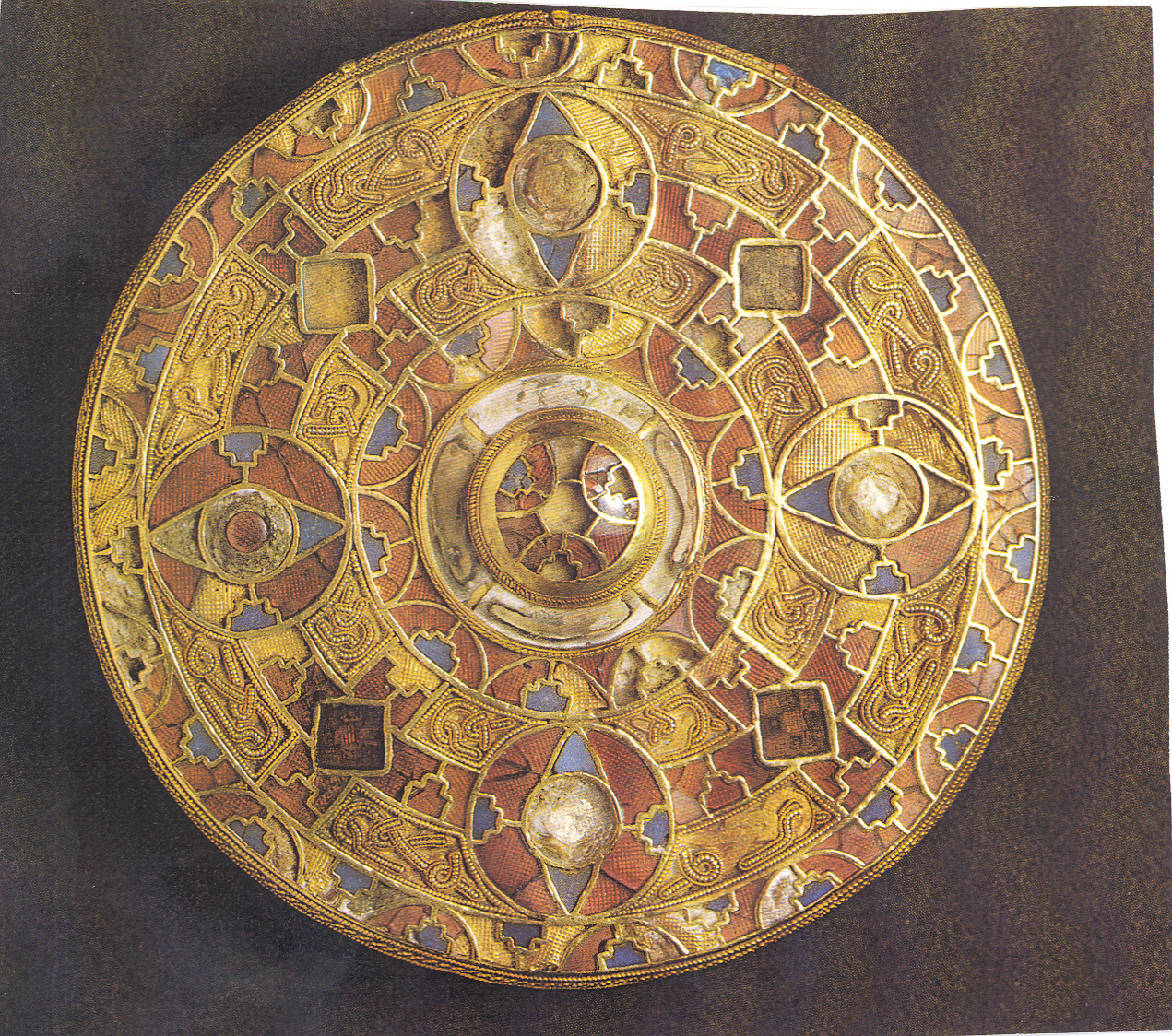
A piece of Anglo-Saxon ornamentation. Image from http://research.uvu.edu/mcdonald/Anglo-Saxon/Art.html.

A piece of Anglo-Saxon ornamentation. Image from http://research.uvu.edu/mcdonald/Anglo-Saxon/Art.html.

Back To Top
Abstract

Beowulf finishes off his reply to Unferth with another boast.

Back To Top
Translation

“‘After all, against that apostle of violence none arise
from among the Danish people, so he wars as he likes,
killing and feasting, prosecution he knows comes not
from the spear-Danes. But I shall now surprise
him with the might and strength of the Geats,
bringing him battle. Afterward whomever wants to
go to mead shall and heartily, once the morning light
brings another day to humanity,
when the light-clad sun shall shine once more from the south.'”
(Beowulf ll.598-606)

Back To Top
Recordings

Old English:

{Forthcoming}

Modern English:

{Forthcoming}

Back To Top
Finding the goddess in Beowulf

Since I’m reading Robert Graves’ The White Goddess over on my reading and gaming log Going Box by Box, I feel like I might have some insight into the meaning of Beowulf’s language here.

After all, this is the end of his speech to Unferth and the Danes. As such, he’d not want to waste any words getting his point across. He will defeat Grendel because he will do things in a way that the Danes never yet have. Such a statement is impressively logical.

But impressive enough to complete steam roll all of the Danes and get away with it? Well. Apparently. I still think he says things like “none arise/from among the Danish people” (“nænegum arað/leode Deniga” (l.598-599)) to stir them up to some extent. And to show that where they failed, he will not.

Though, using what I’ve gleaned from The White Goddess, I think that Beowulf isn’t just boasting about strength and power and the ever important element of surprise. I think he’s also speaking in a poetic language. Since I’ve not absorbed everything from The White Goddess like some sort of giant sponge, I won’t be covering all of the poetically sealed things that Beowulf has to say in this passage, but I will be speculating about the two that are the most apparent to me.

In line 602 when Beowulf speaks of the “power and might” (“eafoð ond ellen”) of the Geats, the second word he uses in his alliteration stands out. This word is fairly commonly used in the poem Beowulf, and, although my reading’s limited, probably other Old English writing as well. It stands out here, though, because one of the definitions that my Clark Hall & Meritt dictionary offers is “elder-tree; elder-wood.” A large part of The White Goddess is about Graves deciphering the Druidic tree alphabet, and elder is amidst its letters.

I think that there might be a connection between that alphabet and Beowulf’s speech here.

According to Graves, the elder tree is the one that stands for the last month of the Druidic calendar. It signifies death and is said to have been the crucifixion tree. Graves backs this connection up with the mention of elder-leaf shaped funerary flints found in megalithic long-barrows.

In short, the elder tree is deeply associated with death.

It’s also quite deeply connected with witches and the devil itself. Though, because of its white flowers that are “at their best at midsummer” (185), the elder is also an aspect of the white goddess herself, the ruling triple deity of Graves’ Indo-European religion.

Setting this into the context of Beowulf’s speech, specifically his boasting that Geatish “might and strength” ((“eafoð ond ellen”) l.60) will prevail, does actually make sense.

The word “eafoð” specifically means “power,” “strength,” or “might,” and “ellen” means “zeal,” “strength,” “courage;” “strife,” “contention.” As a noun or adjective “ellen” means “elder-tree” or “elder-wood” respectively.

Pairing both words up is, thus, a little redundant. Though this apparent redundancy could be emphasizing the power of which Beowulf speaks. Combining the strength of eafoð with the death connotations of ellen as “elder wood,” though, I think that Beowulf is pushing his claim that he’ll beat Grendel with brand new tactics even further. He’s really saying that with the strength of death he will overcome the fiend that has been terrorizing the Danes for years.

Maybe that sounds a little far-fetched, even for something on the blog of someone who studied literature up to the graduate level. But hear me out.

The Geats have so far been characterized as a warlike people. Anyone who is so warlike will likely invest a lot of importance in their armour and arms.

The Anglo-Saxons clearly do this, as a good portion of the poem to this point has been about this or that bit of armour. Beowulf even gives Hrothgar explicit instructions to send his armour back to Hygelac should he fail.

In a sense, then, Beowulf identifies with his armour, as any culture that puts hereditary significance onto arms will. (Passing a sword down from father to son, I think, signifies a passing of a sort of family spirit, something that identifies the rightful wielder as a true member of the tradition and therefore of the family.)

When push comes to shove, Beowulf’s tactic for defeating Grendel is to fight him at his own game. Beowulf knows that conventional weapons have no effect on the fiend and so he strips away his armour and wrestles with him. Removing his armour signifies a death of sorts, and I think that (along, of course with alliteration), that’s why Beowulf refers to the might of the Geats with eafoð and ellen. I think that he’s definitely pulling on the alternate interpretation of “ellen” as “elder” and all that the tree connotes.

Jumping down to the bottom of the excerpt, I think that Beowulf completes very intentionally ends his speech about defeating Grendel and restoring Heorot with a reference to the sun rising and shining from the south.

Again, turning to Graves, he gathers quite a bit of evidence for the conception of the most terrible place on earth in many European myths being the far reaches of the north (it’s basically the whole point of chapter six). Thus, the sun’s shining from the south signifies a complete turn around in which the Danes’ troubles are over and the light of the sun (already equated to the light of god elsewhere in Beowulf) will shine down on them with all of its might.

Ultimately, then, I think that Beowulf’s not just boasting about taking a new tack against Grendel to beat him, I think he’s making the extreme claim (at least in the connotation of his full boast from lines 601 to 606) that he will defeat Grendel by dying and resurrecting.

If this is the case, then I have no idea what to make of the reference to one of the most important events in the pre-Christian year (the festival celebrating the death and rebirth of the year) in a poem that was very clearly written in its current form in a post-Christian time. The reference’s not being a direct one does suggest the sort of subterfuge that Graves writes about poets using to avoid church persecution, but I’m not entirely sure that’s at work here.

Though I could push my analyses of these references further by pulling one more thing from Graves.

In chapter three he writes that in the old poetic language, the roebuck signifies something hiding. A hart (the animal on whose name “Heorot” puns) isn’t exactly a roebuck, but again, maybe the poet/scribe was just covering himself.

Back To Top
Words with mythical connotations

Unsurprisingly for a passage that contains the sort of arcana that I pointed out in the first part of this entry, this one has some doozies so far as words go.

In its first line, for example, is the mysterious word “nyd-bade.”

The Clark Hall & Meritt dictionary I have defines it as “messenger of evil?[sic]” and grabs this definition from the word’s context in the Old English Exodus. Breaking down the word doesn’t give us a clear definition, but it might shed some light on just what it means.

The word “nyd” is an alternate spelling of “neod” meaning any one of “desire,” “longing,” “zeal,” “earnestness,” “pleasure,” or “delight” or of “nied” meaning “need,” “necessity,” “compulsion,” “duty,” “errand,” “business;” “emergency,” “hardship,” “distress,” “difficulty,” “trouble,” “pain;” “force,” “violence,” “what is necessary;” “inevitableness,” or “fetter.” This word could also signify the name for the rune “n.”

Notwithstanding the possible rune reference, the common denominator in the various meanings of “nyd” is urgency. Drawing urgency out of “fetter” might be a stretch, but something that’s fettered is usually so bound quickly to prevent it from doing any unnecessary harm.

Thankfully, “boda” is much more straightforward; it means “messenger, herald, apostle, angel; prophet”

Taken together, then, these words seem to refer to someone who brings something urgent.

In that general sense, they don’t need to bring something evil.

It could even be interpreted as referring to someone who is a forerunner for some important piece of information. Actually, following that interpretation could lead to reading Grendel not as some godless monster, but perhaps as a pagan priest who continually visits the freshly converted Heorot in an effort to bring them back to the old beliefs.

Grendel’s only known relation being his mother makes this a very curious interpretation indeed, since that could make Grendel the final, faded champion of a now perverted great goddess. Or perhaps even the champion only of the death aspect of Graves’ triple goddess.

Looking at it that way really casts the whole poem into a new light – it’s not just about a vaguely Christian warrior claiming victories over monsters in god’s name and ruling his people well, but about the decay of the old religion and the revitalizing force of this new one. As well as how the new one is integrating aspects of the old.

A comparative study of Grendel’s mom and the as yet unintroduced Wealhtheow of Heorot could be quite curious in this light. But that’s a project for another day.

Another word worthy of note (and another compound!) is “sweglwered.” This word’s parts are much clearer than those of “nyd-boda.”

The word “swegl” means “sky,” “heavens,” “ether,” “the sun;” or possibly “music” while “wered” means “throng,” “company,” “band,” “multitude;” “host,” “army,” “troop,” or “legion.”

The combination of these two words creates a fairly vivid picture of the other things in the sky forming a sort of comitatus with the sun at its head.

Closing on this reference of a bright and shining lord and retinue really brings out the hope in Beowulf’s claim. He’s not just claiming that a new day will dawn on Heorot, bringing them all their old happiness, but that the sun will be out in all its grand array to herald this day, truly an omen of great things ahead.

Now, one more thing.

Something that’s clear to me from my reading of Graves is that the goddess of whom he writes is associated with the moon. The rising of the sun from its poetically strongest quarter, and with its full retinue then suggests something opposing the goddess.

In a general sense it could be the more aggressive, patriarchal religion that Graves believes overtook an older matriarchal one. This would make Beowulf’s claim all the grander, but it’s not as if his wrestling a terrible monster to death and then later facing a dragon were stories told with mind numbing regularity when one Anglo-Saxon asked another “how was your day?”

Back To Top
Closing

Next week there’s an interlude in the dialogue. Hrothgar takes in what Beowulf says and Wealhtheow, his queen, appears.

You can find the next part of Beowulf here.

Back To Top

Beowulf gets into puns and two regular words aren’t so regular (ll.590-597)

Abstract
Translation
Recordings
Beowulf gets into the puns
Regular words that aren’t that regular
Closing

A young man makes a mead hall stand.

A young man makes a mead hall stand.

Back To Top
Abstract

In a rather round about way, Beowulf attacks Unferth for his cowardice.

Back To Top
Translation

“‘I tell to you the truth, son of Ecglaf,
that Grendel never could such a horror perpetuate,
that dire demon, over your people,
the humiliation of Heorot, were thy courage,
your heart, so fierce as thou thyself sayest it is;
but he has discovered that he need not the vendetta,
the terrible thronging swords of your people,
greatly fear, the Victory-Scyldings.'”
(Beowulf ll.590-597)

Back To Top
Recordings

Old English:

{Forthcoming}

Modern English:

{Forthcoming}

Back To Top
Beowulf gets into the puns

All neat and tidy, Beowulf really covers it up here. He gets to the meat of the issue and makes his point very succinctly:

“Unferth, because of your cowardice, Grendel is terrorizing Heorot.”

Bang. Boom. Oof.

Though the actual poetry isn’t quite so straightforward.

However, I really think that Beowulf’s scattered sentence structure is the result of his being livid while he speaks. This emotional state would explain to some extent why he dives into apposition as often as he does, and why things are quite so lively. He’s just tearing into Unferth at this point.

But does Beowulf maybe lose control at the end of this rant? Is his referring to the Danes as a whole (the “Victory-Scyldings” (“Sige-Scyldinga” (l.597))) pushing things too far, and unfairly spreading the blame that Unferth must bear to the rest of Hrothgar’s people?

I’d say that he’s definitely going a bit far. But I think that it’s necessary for Beowulf to sort of gently call out all of Hrothgar’s men in this instance. After all, Beowulf will be doing things differently. Spreading the blame to all of them is no doubt a keen way to show that their approach simply isn’t working and so an outsider’s approach is necessary.

Beowulf’s upending the mead benches, as it were.

Though taking a look at his epithet for Unferth and Hrothgar’s Danes, the “Victory-Scyldings,” suggests that a little bit more than merely spreading the blame might be at work.

The latter part of this compound name means, simply refers to a group of people. But the word used before it, “sige” can mean “victory,” “success,” “triumph” or “sinking,” or the “setting of the sun.”

Is Beowulf playing the prophet here, sarcastically referring to the Danes as the “Victory-Scyldings” while implying that their power is waning?

Maybe it’s not all that prophetic to say so, since for the last seven years Grendel has been tormenting them and has made their house of joy into the home of sorrow.

Yet, I think the wordplay to be found in “Sige-Scylding” is definitely intentional. The Anglo-Saxons liked a bit of sarcasm in their writing, and puns have been around since the Epic of Gligamesh.

Plus, a word for something like “victory” would likely be one well-travelled over the tongues of Anglo-Saxon audiences. It stands to reason then, that the wise among them would also be well aware of the words referring to things that are waning in some way.

Beowulf may pun earlier in this passage, as well, when he uses the compound word “searo-grim” to describe Unferth’s heart and spirit. The first part of the compound is straightforward enough, it usually means something like “art,” skill, or cleverness. But the word “grim” is rather ambiguous. (Ain’t that always the way?)

This word can be interpreted as grimman: terrible sin, along with the more literal, “grimm” meaning “fierce,” “savage,” or “severe.”

Beowulf mentioned Unferth’s killing his own kin in last week’s passage. Such a deed is truly a terrible sin, so I think it’s entirely possible that (aside form reasons of alliteration) the poet/scribe went with “searo-grim” for the little punning wink it puts on Beowulf’s sarcastic burn against Unferth’s frosty courage.

What do you think – is Beowulf making puns along with pointing out Unferth’s failings? Why would he throw such things into so serious a part of his speech?

Back To Top
Regular words that aren’t that regular

To mix things up further this week, this part will still deal with words, but will entirely avoid discussing compounds.

Instead, there’re two regular, old words in this week’s passage that I think are worthy of discussion.

First up is the verb “onsittan” (from line 597). This one means “to seat oneself in,” “occupy,” “oppress,” “fear,” “dread.” Though sharing verbal real estate might not necessarily mean that those doing the sharing have much in common, “onsittan” offers a curious combination. The sort of combination that I like to read into. So read into it I shall!

Since the concepts of occupation and fear are paired together in this verb, I wonder if it implies a certain variety of fear. Not necessarily a sort of intensity of fear, but rather a certain quality of fear. One that doesn’t envelop you or creep up on you, but instead one that you set yourself into, like laying back on a nice massage bed – only to realize that the massaging fingers are thousands of squirming cockroaches.

Such a conception of fear, as something that you occupy rather than something that comes over you, may seem strange, but if you think about the larger implications it starts to make sense.

The Anglo-Saxons weren’t the most optimistic of people and so perhaps the more negative, primal emotions (such as fear) were conceptualized not as things that came from you but things that you encountered and entered into. Hence, you could come to occupy fear or dread just as you could occupy a room.

On the topic of different conceptions of things that we might take for granted, the Anglo-Saxons had a curious idea about colour.

Rather than defining it by hue, they had a tendency to define colour by its lustre. The brighter the colour, the better and more favourable it was. The darker, the more dim and drear. This might not sound too strange, but when you run into a bunch of colour descriptions only to find that they continually include light, it’s hard not to see how it differs from our modern ideas of colour.

With the word “atol” (from line 592), meaning “dire,” “terrible,” “ugly,” “deformed,” “repulsive,” “unchaste” “horror,” “evil,” I think something similar is happening. I don’t think appearance is necessarily being equated with moral uprightness as we might understand the old trope.

Instead, I think that ugliness is being related to evil simply because it lacks symmetry, it lacks the brightness that might define beauty or an incredibly valuable item or colour (like gold, for instance).

Further, I think that it’s possible that this is at the root of the old appearance/morality trope, or at least why it persisted in so much British culture and English literature.

What do you think about the Anglo-Saxons’ differing conceptions of things like fear and appearance? Are they so different from our own?

Back To Top
Closing

Next week, Beowulf finishes haranguing Unferth and confidently assures that Danes that he will kill their monster.

You can find the next part of Beowulf here.

Back To Top

Beowulf’s return to civility and just what “foreign land” means (ll.569b-581a)

Abstract
Translation
Recordings
Beowulf’s come down
A land of something
Closing

An Anglo-Saxon world map known as the "Cotton" world map (c.1040). (Looks like I'm not the only one with a sketchy sense of geography.) Image found at http://en.wikipedia.org/wiki/Early_world_maps#mediaviewer/File:Anglo-Saxon_World_Map_Corrected.png.

An Anglo-Saxon world map known as the “Cotton” world map (c.1040). (Looks like I’m not the only one with a sketchy sense of geography.) Image found at http://en.wikipedia.org/wiki/Early_world_maps#mediaviewer/File:Anglo-Saxon_World_Map_Corrected.png.

Back To Top
Abstract

Beowulf brings his version of the events of his swimming contest with Breca to a close.

Back To Top
Translation

“‘Light of the east came,
God’s bright beacon; the sea abated
so that I the sea-cliff might see,
upon the windy shore. Wyrd oft saves
the unmarked man, when his strength thrives.
However they me confined, I with the sword slew
nine seabeasts. Never have I heard of any
through inquiry to fight so hard beneath heaven’s vault by night,
nor any man so miserable on the sea.
Yet I continued to survive the hostile distance,
weary of the journey. Then the sea bore me up,
the waters brought me to Finland,
the sea of a foreign land.'”
(Beowulf ll.569b-581a)

Back To Top
Recordings

Old English:

{Forthcoming}

Modern English:

{Forthcoming}

Back To Top
Beowulf’s come down

At long last, after three entries, Beowulf wraps up his account of the swimming contest. In this version, it’s unclear what exactly happened to Breca, save that he didn’t win. But it’s also clear that Beowulf’s not content to limit his tale of glory to some contest. He has to boast about how badass he was in beating up nine sea beasts!

Actually, given this information, It’s safe to say that he probably didn’t rout the sea beasts in the area, only put the fear of Beowulf (and the god that he keeps invoking?) into them.

Actually, Beowulf’s return to simple, straightforward language signals the audience rather nicely that his battle is over. I don’t think Beowulf is necessarily a berserker, but were he, this part of his story would show his ability to come down from his battle fury (and mescalin trip) so that he can re-enter normal society.

Sidebar: Beowulf could be a berserker, though. It’s thought that his name means “bear” since it’s a combination of “bee” and “wolf” – implying a wolf that hunts out bees. Berserkers wore bear hair shirts (or just plain bear skins). If someone was called a bear straight up, then maybe it was because that person was hoped to have the potential to go fight as berserkers did.

Beowulf’s showing that he so readily came down from his battle fury, along with being the denouement to his story, also might put the Danes at ease. As shown in the simplification of his diction the morning after his kill, once he’s defended himself he becomes relaxed and fully reasonable. Almost like the shore being revealed after the fury of the ocean recedes from it with the lowering tide.

Now, this isn’t to say that the Danes looked at this young Geat and worried that his monstrosity would replace Grendel’s should he defeat him, but I think that the Anglo-Saxons and other early medieval people were well aware of how people who became monstrous in battle (ie: berserkers) could sometimes carry that monstrosity over to times of non-battle. Because of that I think it’s safe to say that rhetorically Beowulf’s conclusion of the swimming episode is meant to show his ability to return to society despite doing something as incredible, and well, mad, as beating up nine sea monsters in one night.

But Beowulf doesn’t finish selling his ability to do what he Danes need done. In this conclusion, Beowulf also quips about wyrd. In doing so, I think that Beowulf is trying to suggest that he is favoured by this mysterious force.

For, being thrown around by the sea and attacked by so many mysterious monsters definitely suggests that he is a marked man (as in line 572-573). Yet, he’s quick to add that wyrd will spare those (even those marked) when they’re at the height of their strength (l. 573).

If Beowulf’s in his early twenties or late teens when he comes to Daneland, then it’s probable that he’s still at the ‘height of his strength.’ Or even that he’s at the very height of it. Whatever the specifics, wherever he is on the trajectory of his strength over the course of his life, it’s a stat that must still read fairly high (high enough for wyrd to give him some saving throws), and Beowulf, I think, is rhetorically banking on this to show the Danes that he can, indeed deal with their monster problem. He’s won glory against such foes before, so why not one more time, right?

Right?

Do you think the poet had all of these meanings in mind when he/she composed/wrote out Beowulf? Or am I reading way too much into this?

Back To Top
A land of something

Well, in this week’s passage there were quite a few things to do and see word wise.

The most interesting to me and my ever-on-the-back-burner project of sorting out early medieval Anglo-Saxon nationalism and how it relates to the Celts that they displaced/absorbed/wiped out from Britain is the word “wealland.”

This word simply means “foreign land.” However, there’s a loose thread on it to pull at. Why should there be such a thing? Because it’s a compound word.

So the seam between the words of this compound comes between the two l’s. The word “land” means the same thing that it does in modern English; it refers to a country, land, or, in the most clinical sense, a span of physical space. The first word in this compound, “weal” is where things get complicated. And, carrying on with the metaphor of clothing, is where the whole thing’s aesthetic appeal comes from.

The word “weal” can mean a few things. As “wiel” it can mean “slave,” “servant.” As “wael” it can mean “slaughter,” “carnage” or “dead bodies.” As “weall” it can mean “wall,” “dike,” “earthwork,” “rampart,” “dam,” “rocky shore,” or “cliff.”

Although, as with most of the compound words I dissect in this part of these entries, “wealland” was probably in such common use when Beowulf was written down as to simply mean “foreign country,” the two words that come together to make it wouldn’t have been put together without reason in the first place. So what could any of these combinations mean, and what might each say about the Anglo-Saxon world view?

Well, if the original first part of the compound was “wiel,” then “wealland” implies that the Anglo-Saxons viewed foreign lands as things to be conquered.

These lands were places that were ripe for plunder and invasion, places that, of course, would become subject to the Anglo-Saxons Germanic might and superiority. If this really was the original combination, then it suggests, in my mind anyway, that the word probably came together around the height of the Anglo-Saxons’ power.

Argument could be made in favour of “wiel” and “land” being the original combination since the country that eventually formed beside what eventually became England is known, in English, as Wales, implying that its people (the Celts on the British mainland) were slaves or servants to their Anglo-Saxon neighbours.

Though, come to think of it, the basis of this analysis means that “Wales” could also have been so named in reference to its being a place of great carnage, a field of constant battle.

More generally, if this gorier meaning of “weal” is what combined with “land” originally, then the Anglo-Saxons perhaps took a more sober view of foreign lands and their potential for conquest.

Instead of being unceasing optimists, they realized, somewhat philosophically (probably after having landed in Britain and growing fond of the place), that the conquest of foreign lands would lead to nothing but slaughter. Though on whose side exactly is unclear. The implication, nonetheless being that foreign lands were places of great and terrible conflicts.

The third possibility for the subtext of “wealland” is simply that it’s used to refer to foreign lands that are fortified. These fortifications could be from either sea-cliffs and promontories or from walls that these lands’ people built.

Since I’m not so sure about the Danes’ or Geats’ relationship with Finland (Sweden was their mutual big bad, at least in the world of Beowulf), I can’t say how the Danes are supposed to take Beowulf’s landing there. But specific to this passage, I think it’s entirely possible that this “walled land” or “sea-cliff-protected land”) is the subtext, at least in Beowulf’s use of “wealland” here. Beowulf mentions the sea-cliff and the tide receding from it after all. Plus, if he swam to Finland from the spot where he fought the nine sea-monsters its sea-side topography couldn’t be too different, right?

But I feel like bringing geography into this is a bad idea. My languages and history might be all right, but my geography gets pretty terrible pretty quickly – let alone historical geography.

There is also, actually, a fourth possibility for “wealland.” It’s totally possible that all three meanings could be taken from the word depending on context. I mean, if there’s one thing that I’ve often assumed in this part of these Beowulf entries it’s that one compound word with varying elements can have multiple meanings. So why wouldn’t that be the case with one used to refer to foreign lands, something that I imagine came up quite a bit in the Anglo-Saxons’ literature, poetry, and day to day dealings.

Which combination do you think makes this most sense in general? What about in the context in which Beowulf uses “wealland”?

Back To Top
Closing

Next week Beowulf starts to lay down a sick burn on Unferth.

You can find the next part of Beowulf here.
Back To Top

Beowulf versus the sea-deer, and, about those sea-deer (ll.550-558)

Abstract
Translation
Recordings
Beowulf (and Anglo-Saxons?) on armour
“Mere-deor” and other weird words
Closing

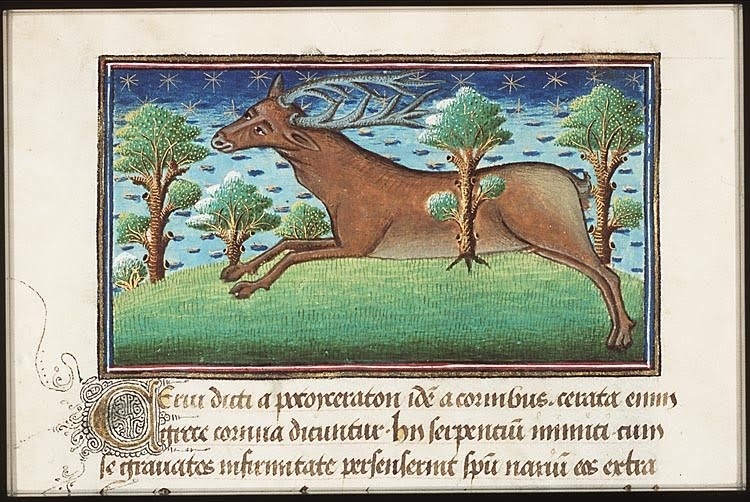
The medieval depiction of a kind of deer. Just picture this creature in the water and you may have a "mere-deor."

The medieval depiction of a kind of deer. Just picture this creature in the water and you may have a “mere-deor.”

Back To Top
Abstract

Beowulf relates his struggle with one of the sea-beasts.

Back To Top
Translation

“‘Then against the loathed my corslet,
hard, hand-woven, was of great help,
the broad coat of mail that on my breast lay
gold adorned. Me to the bottom pulled
the hostile enemy, held fast
in its grim grip; however I was yet given mercy,
that I the fiend could reach with sword-point,
my battle blade; in the war rush was taken the life
of the stalwart sea-deer by my hand'”
(Beowulf ll.550-558)

Back To Top
Recordings

Old English:

{Forthcoming}

Modern English:

{Forthcoming}

Back To Top
Beowulf (and Anglo-Saxons?) on armour

Beowulf goes on about his wondrous deeds here. And he includes a great deal of detail about how his armour saved him.

Actually, there seems to be a lot of emphasis on armour in Beowulf’s speeches.

Well, it’s not like that’s all that he talks of, but it does seem kind of strange how often he mentions armour.

In this extract, he spends just over three lines on it, and earlier, when speaking to Hrothgar he instructs him to send Hygelac his armour as a memento if he should die.

On the one hand, this armour focus could be ascribed to Beowulf and Beowulf alone. In that case, I’d say that it shows just how aware of the machinations of combat Beowulf is. He may know well the importance of the war rush, or having your opponent’s within reach of sword point, but more than that he realizes the importance of a good coat of mail.

Because sometimes you just can’t be sure.

If, on the other hand, this emphasis on armour is the poet’s doing (rather than just characterization), then it says something about the Anglo-Saxons.

Actually, it says just about the same thing, really. Though I’d add that if it is a general thing, then maybe armour has a special importance to memory.

Perhaps it’s sort of how things might be in a particularly sentimental cicada’s brain: its shell, as the armour of its youth, holds within it all of the memories that it made while wearing it. Likewise, just as a sword was regarded as imbued with special power if it’d been wielded by a male relative or great hero, a person’s armour could hold a memorial significance.

Or, more specifically, maybe these mentions of armour are part of a lost mnemonic, some sort of arcane technique for remembering not only heroes (as Beowulf would be remembered by his armour when it got to Hygelac in the event of his death), but their stories as well. It could be that the armour, after enduring with its wearer the great feat of facing Grendel (or the crash of the ocean waves), becomes a metonymy for its wearer. Not just in a metaphorical sense, but in the same sense as the shed carapace to the sentimental beetle, that armour becomes a shed part of that hero, that fighter.

Practically, speaking though, swimming in a mail shirt makes Beowulf’s bet with Breca all the wilder.

Those rings wouldn’t be made of fancy ultralight bicycle aluminium, they’d likely be made of iron. Swimming can get difficult if you’re weighed down by a particularly thick, wet shirt. It’s hard to imagine the struggle that both of them would endure wearing that sort of armour to sea.

Though it’s quite easy to imagine that weight working against Beowulf as the sea-beast he encounters in this passage drags him down.

But then, in his retelling the instance, he puts on the armour of the storyteller, shielding his tale in words reserved for warfare.

Terms like “war-rush” (“heaþoræs”) and “battle-blade” (“hildebille” (l.557)). But you know that the struggle was truly mortal when Beowulf doesn’t just say “I could just reach the fiend with the tip of my battle-blade” or “yet, I managed to wrench my sword into the beast’s gullet” but instead that he was “given mercy.”

By whom?

Well, no doubt by something between the Christian god and the Anglo-Saxon idea of “wyrd,” a kind of fate.

Invoking such a force, even indirectly, really shows how hard Beowulf was struggling because it places the battle on a cosmic level. This wasn’t just a wee brawl, it was a struggle that the cosmos had a hand in!

What do you think of the idea of a warrior’s armour being a container for the memory of his experiences while wearing it? Or of a warrior’s armour becoming metonymous for the warrior?

Back To Top
“Mere-deor” and other weird words

After last week’s “whale-fish,” this week we’re faced with what could literally be a “sea-deer.”

Tee word “mere-deor” (l.558) literally translates into that. And it creates a very simple image: A fish with horns, possibly a narwhal. Why exactly Beowulf would be fending off a narwhal isn’t clear, but that’s clearly not the point of his story. What it’s all about is his strength in overcoming the power of nature.

And what a terrible power that is.

In line 553 we’re told that Beowulf was being drug down to the “grunde.” Since he’s in the sea, this word generally gets translated as “bottom.” In fact, both Heaney and Gummere use this translation.

But “grunde” could also mean “foundation,” “abyss,” “hell.” These words might not be as accurate as “bottom,” but they all have a much deeper connotation to them; “abyss” and “hell” coming neatly packaged with implications of damnation and the impossibility of escape.

Given what Beowulf has to go through when he fights Grendel’s mother, this perception and conception of the bottom of the sea becomes very curious indeed.

Just as curious as some of this week’s compounds.

There’s “lic-syrc,” combining “body” with “shirt,” or “coat of mail,” to give us “mail coat” (specifically a mail shirt that would run down to its wearer’s thighs or knees). Then we get “hond-locen,” for “hand-made” from “hand” and the verb for “to lock,” “enclose,” “fasten,” or “intertwine.” And “beado-hraegl,” or, literally, “battle dress.”

The word “feond-sceatha” makes another appearance, too. And we’re joined by the dully straightforward “headthu-raes,” a combination of the words for “battle” and “rush” that gives us: “battle rush,” or “war press.”

So what does all this mean?

Well, to be completely honest, it’s hard to say. It’s possible that the use of all of these clear, literally translatable compound words is just due to Anglo-Saxon’s being short on words for these things that were more obscure or poetic.

Or maybe they’re the best choices for each line’s alliteration (they are).

But both of those possibilities wouldn’t really shed much light on Beowulf and his dramatic retelling of his adventure on the seas.

As such, I like to think that Beowulf is shifting his energies from using obscure words and forms to shaping his sentences to reflect the action he’s describing.

What then, does the straightforward and literally translatable, but still odd “mere-deor” mean (outside of being alliteratively convenient)?

Well, I think it, and the compounds with “hrone” and “fixas” from last week, are present in Anglo-Saxon because the sea was regarded as a mysterious place.

Who knows what goes on in there, right?

The Anglo-Saxons sailed it regularly, too, and so probably had a sort of reverent fear for things like the tides and the speed at which storms could come upon those ships that were unwary. As such, they probably had only words for the things that they saw most often.

Whales and fish definitely fit this bill because both are prevalent along the Northern coasts of Europe, as deer are on the land there.

But some sort of strange creature that was a tusked or horned thing in the sea was probably a rare sight indeed, and so to express the idea of that creature the Anglo-Saxons just took two of their existing words and ideas and mashed them together. Adding, in a way, to that creature’s mystery.

Do you think that the animal referred to as a “mere-deor” is just a narwhal, or could it be something rarer?

Back To Top
Closing

Next week Beowulf continues his tale with an account of the rest of the night and the next morning.

You can find the next part of Beowulf here.
Back To Top

Beowulf finds his footing in public speaking and thoughts on a “whale” of a word (ll.539-549)

Abstract
Translation
Recordings
Understanding Beowulf’s interjections
A word on “whale”
Closing

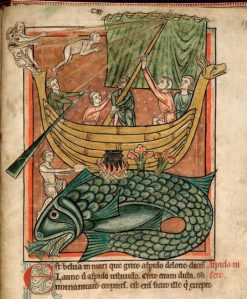
St. Brendan and his crew celebrating Easter on the back of a whale. Found at http://saintsbridge.wordpress.com/2013/12/20/celts-to-the-creche-st-brendan-the-navigator/.

St. Brendan and his crew celebrating Easter on the back of a whale.
Found at http://saintsbridge.wordpress.com/2013/12/20/celts-to-the-creche-st-brendan-the-navigator/.

Back To Top
Abstract

Beowulf tells a more detailed version of his swimming contest with Breca.

Back To Top
Translation

“‘We had swords naked, as we two rowed over the waves,
hardiness in hand; we two against the whales
thought to protect ourselves; he not at all far from me
could float on the ocean-waves,
the swifter on the swell, I would not float from him.
When we two together had been on the sea
for five nights’ time, then we two drifted apart on the flood,
wading on the raging waves, in the coldest of weather,
the night darkened, and the north wind
battle-grim blew against us. Wild were the waves,
enraging the hearts of the sea-fish.'”
(Beowulf ll.539-549)

Back To Top
Recordings

Old English:

{Forthcoming}

Modern English:

{Forthcoming}

Back To Top
Understanding Beowulf’s interjections

In this part of Beowulf’s version of the swimming contest story, we see a return to an old form.

Once more Beowulf is setting descriptions within his narrative, dropping short descriptive phrases between points of action. And he’s doing it an awful lot. So much so that I can’t help but wonder if the poet is deliberately having Beowulf chew the scenery.

Or maybe this is just what Beowulf, brash and bold, is like when he tells a story. Perhaps working through each of his little description digressions will help shed some light on what exactly is going on.

The first one comes in line 540: “hardiness in hand” (“heard on handa”). In reference to the swords that they held in their hands as they swam, this line seems like it’s mostly a space-filler.

It reiterates that the swords they held to guard themselves are hard, and therefore useful weapons. Not to mention, within the alliterative scheme of the line, the original Old English alliterates entirely with itself.

This alliterative scheme separates the first half of line 540 from the second, which in turn suggests the semi-colon that divides the line in Heaney’s text, and the comma that does something similar in the text found on the McMaster University site I link to beneath the extract.

So would Beowulf the speaker run one of his sentiments into another line like this, overflowing his expression in such a way?

Maybe.

I mean it is the beginning of the passage, and it’s not unlikely that he’d feel impassioned as he told of yet more of his wondrous feats.

So, maybe in putting this half line here and having it link directly with the previous one the poet is showing Beowulf’s near loss of control over his own story and his own boasting. Or, maybe at this point Beowulf’s starting to feel all that ale he’s no doubt been drinking.

The next among Beowulf’s additional phrases is line 543’s “the swifter on the swell” (“hraþor on holme”).

Definitely Beowulf’s way of making sure that everyone knows that he’s the stronger swimmer between he and Breca, this half line fits perfectly with its surroundings. It doesn’t seem to be overflow or anything like that.

So what’s it mean for it to be compartmentalized like it is?

I think, if anything, because this statement is a boast. Beowulf’s been boasting since he was a child, he knows his way around such things and is able to smoothly fit it into his description of their swimming. It almost naturally flows with what’s around it, too.

It’s sort of difficult to pin down the next extraneous descriptive phrase, because after line 543 they all become necessary.

Beowulf’s description of his and Breca’s “wading on the raging waves,” how the atmosphere shifted to “the coldest of weather,” how “the night darkened” and the storm winds picked up around them, all feed into each other.

This part of the extract practically imitates the storm it describes. The shuffling of four distinct and independent half-lines simulates the way in which everything around Beowulf and Breca at this point came crashing into them.

This analysis runs a bit short of something you’d find in an academic journal, but I think the main thing to take away from it is that Beowulf, for all his prowess on the battle field, is not so great in front of a crowd. He’s only truly comfortable speaking about the battles in which he fares so well.

We can see this as his interjections move from the strangely extraneous feeling, through to a boast, and ending with a series of short clauses that themselves descriptively crash against themselves.

Before he starts into the threat of the “sea-fishes.”

But that’s in next week’s extract.

What do you think of Beowulf’s speechifying? Is this part of his reply to Unferth perfectly smooth or is it as craggy as I seem to think? In either case, what do you make of it?

Back To Top
A word on “whale”

Okay everyone. There are, as always, more words than one that are notable for one weirdness or another in this week’s passage.

However.

One stands out from the rest. Technically two. (They both carry one word that could unlock them both.)

This word is “fiscas,” as it’s found in the compounds “hron-fixas” and “mere-fixas.”

The first of these combines the word for “whale” and for “fish” to make the word “whale.” Seamus Heaney translates the instance of “hron-fixas” on line 540 as “whale-beasts;” Francis Gummere translates it as “whales;” and C.L. Wrenn offers “whale.” So it sounds like there’s agreement across the board.

But why append “fixas” to the word for whale? Well, if you guess “for alliteration” you would be sort of right.

As I mention above, line 540 is neatly divided by its caesura. On the left side of the line “h” is definitely the alliterative sound. But on the right side of that caesura, where “hron-fixas” is found, the alliterative sound is “w.”

So another alliterative pair stands between it and its alliterating brethren. It’s safe, then, I think, to say that “hron-fixas” isn’t there to add music to the poetry of Beowulf’s speech.

Maybe, then, the dictionary will have some answers.

Looking at the definition of “fixas” in Clark Hall and Meritt only yields up “fish” (after pointing us to “fisc”).

So that doesn’t really tell us much about why the poet didn’t just use “hron” either.

Perhaps, then, looking at “mere-fixas” will shed some light on why “hron-fixas” has that extra “fixas.”

In Seamus Heaney’s translation, the “mere-fixas” of line 549 is translated as “sea-brutes.” Gummere gives us “sea-fish.” C.L. Wrenn gives us the straightforward variation “fish of the sea.”

What other sort of “fish” were the Anglo-Saxons writing about?

But that brings up a good point. Especially with “mere-fixas,” both of these compounds are redundant. That is, “hron-fixas” and “mere-fixas,” combine words that are so alike that they easily reduce into one word when translated. But why compound them in the first place?

Well, since both involve “fixas,” which we’ve already established means “fish,” maybe it’s to emphasize their being in the sea. These aren’t land or sky beasts or brutes – they’re “sea-beasts” and “sea-brutes.” At least according to Seamus Heaney.

But, then why does Beowulf even bother calling these beasts “whales”?

My guess is that “whale” was just the Anglo-Saxon word for any enormous sea creature, whether it was actually what we know today as a whale or something else entirely (a giant squid or now extinct dinosaur-like creature).

Some have theorized, based on x-rays, that whales carry vestigial legs. It’s possible (though unlikely?) that the whales that Beowulf fought still had these legs and they were recognizable as legs. If that’s the case, then maybe these legs lead the Anglo-Saxons to seeing them as the sea’s guardians just as dragons were the guardians of caves and hoards.

Of course, because we don’t have Anglo-Saxons to pull aside and ask just what was meant by “hron-fixas” specifically, we may never know exactly what Beowulf means when he uses the word.

It could, after all, just be a general word for a general application that the poet felt was the best fit.

It should also be said that two men swimming in stormy waters aren’t likely to get a good look at such creatures. That they were swimming armed suggests that they weren’t worried about getting a good look, either.

How do you understand Beowulf’s use of “whale” and “sea-fishes”? Do you think he’s referring to things that we would refer to with these words, or some other class of animal entirely?

Back To Top
Closing

Next week, the action continues as Beowulf recounts his bout with one of these mysterious sea creatures.

You can find the next part of Beowulf here.
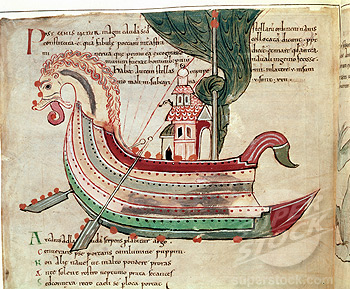
Back To Top

Unferth blasts boasts, and I wonder about boats (ll.506-519)

Abstract
Translation
Recordings
Unferth blasts boasts
Did Beowulf and Breca row or swim for their row?
Closing

Back To Top
Abstract

Unferth sets up his eventual accusation of Beowulf.

Back To Top
Translation

“‘Art thou the Beowulf, he who contended against Breca,
on the wide sea in a swimming contest,
where you two for pride moved as you could
and for a foolish boast in the deep water
ventured your lives? No man whatever,
neither loved nor loathed, could dissuade you two
from that distressing journey, as you rowed out to sea;
there you two eagerly covered the waters with your arms,
traversing the sea-street, moving more quickly with your hands,
gliding over spear-like waves. Ocean ripples roiled,
the winter’s surge; you two on the waters
had toil for seven nights; he who the flood overcame,
it had greater strength; so that come the morning
the sea had carried him to the land of the Heatho-Reams.'”
(Beowulf ll.506-519)

Back To Top
Recordings

Old English:

{Forthcoming}

Modern English:

{Forthcoming}

Back To Top
Unferth blasts boasts

Unferth addresses Beowulf like any one wishing to talk to someone contemptuously would: in the third person.

But what’s weird about how Unferth speaks to Beowulf in this part of his counter-boast is that he continues to talk about Beowulf in the third person after starting with “[a]rt thou the Beowulf[?]” (“[e]art þu se Beowulf[?]” (l.506))

The distancing that’s going on in this continued use of “he” definitely makes it clear that Unferth wants as little to do with the Geat as possible.

It also makes it clear that he’s holding himself aloft from Beowulf’s heroic persona.

Unferth’s relation of the swimming contest definitely doesn’t confirm Beowulf as some sort of grandiose figure. Instead it portrays him as nothing more than an idle-boaster (think of a drunk challenging all comers to whatever contest they might cook up), someone who tries to aggrandize himself through pointless challenges. Not entirely unlike a lot of modern day reality TV.

Actually, I think the implication of Unferth’s claim and that sort of TV are the same.

He’s implying that Beowulf has nothing better to do than to engage in such contests, just as a lot of reality TV’s audience probably has nothing better to do than watch (and/or participate). Unferth’s point in making this implication is to show that Beowulf isn’t nearly as worthy as a champion as he’s made himself out to be.

In fact, Unferth suggests that Beowulf not only lost the swimming contest, but in fact wound up washed ashore – the sea overcame him!

Him, the one with the power of thirty men in his grip!

Him, the one who has so pompously boasted that he will kill Grendel (if god so allows)!

On the one hand it’s easy to see how Unferth’s bringing up an old challenge is a direct attack on Beowulf’s integrity. Maybe the story of this swimming match is something that Beowulf would rather keep under wraps, and Unferth, in revealing it to all of Heorot’s gathered elite, has destroyed Beowulf’s posture of perfect warrior-hood. Or maybe it’s something ambiguous that Beowulf’s had to explain away before.

On the other hand, is there really any shame in being overcome by the sea? Especially after, as Unferth puts it, having “had toil for seven nights” (“æht/seofon niht swuncon” (ll.516-517)) on its waters?

It’s easy to see how Unferth’s sudden accusation would probably turn heads and gather all of the crowd’s attention onto Beowulf – the one who, until Unferth opened his mouth – was very clearly the focus of the Danes’ hopes for relief from Grendel.

But, I think, Unferth’s broad and accusatory tone, combined with his distancing Beowulf through the use of the third person in his accusation, also signalled to the poem’s listeners that Unferth’s threat to Beowulf’s heroic image is fiery but unfounded. His appeal to the rhetorical tactic of immediately seizing upon some hitherto unknown weakness of his target probably sounded as desperate to that early audience as it does to us, familiar as we are with political debates.

In fact, we can, I think, almost see Beowulf slowly nodding and grinning slightly as Unferth speaks, knowing full well that he can either twist the man’s version of the story to maintain his heroic image or correct it with his own version of what happened – the truth.

Do you think Unferth is just a strawman the poet set up for Beowulf to knock down? Or does he pose a real threat? Write your take in the comments.

Back To Top
Did Beowulf and Breca row or swim for their row?

The exact word that Unferth uses to describe the challenge between Beowulf and Breca is “dol-gilpe.” This word, when translated as a whole comes out as “idle-boasting.” Taken as the words “dol” and “gilpe” we get “foolish,” “silly,” and “presumptuous,” and “boasting,” “pride,” “arrogance,” “fame,” and “glory” respectively.

Cultural differences between the Anglo-Saxons and ourselves aside, the first half of the word is none too flattering, and being able to interpret “gilpe” as “arrogance” doesn’t do much for the second half. So this word’s pejorative connotation, at least in Unferth’s usage, is pretty clear to see.

Even combining one of the more upstanding interpretations of “gilpe” with any of those for “dol” gives us something like “silly glory” or “presumptuous glory.” In other words, a sort of glory that is as valuable as the sands on which Beowulf washed up. This quality of “dol-gilpe” shows that there is some meat to Unferth’s calling Beowulf out on his boastful ways.

In a way, Unferth’s even trying to get under the skin of boasting words in that using the word “dol-gilpe” could well imply that all boasts are nothing more than words.

Although the parallel isn’t perfect, it could even be that Unferth is trying to make the swimming contest and Beowulf’s challenging Grendel parallel events. Both start with idle boasting, nothing more than words, and then deeds are quickly shown to run contrary to all those words. Actually, on the level of words, Unferth could also use this compound (matters of the poet’s concern with alliteration aside) to call attention to Beowulf’s affected way of speaking, his use of stiff forms of address and of formalized rhetoric.

On the topic of words and their being void of meaning, Unferth’s “reon” in line 512 may as well mean nothing.

This word, as it appears, means “rowing.” It could also, however, mean “go by water, sail, swim.”

In the context of Unferth’s telling of the swimming contest between Breca and Beowulf this brings up a small, but niggling question: Did they row out to sea and then start swimming? Or did the two start from the shore?

As I said, it’s a very minor thing, but it is an important detail. If they did row out to sea in a boat, then it’s likely that some sort of third party was involved – otherwise that boat would have to be abandoned.

If there was a third party, he could have stopped the two, or he could have been the contests’ judge. Also, if they did go out in a boat, then maybe the race was merely from the boat to the shore. In that case it’s possible that Beowulf wound up ashore elsewhere because he tripped on the boat’s edge, fell into the sea rather than heroically leaping into it, and was washed away.

If “reon” is meant to be “swim” or “go by water,” though, and Beowulf and Breca swam for the entirety of their challenge, then it could well have been nothing more than a contest between two drunks who jumped in the ocean late at night and wound up ashore elsewhere some time later.

Without clarity about the boat – not to mention clarity about the rules of the race – it’s entirely unclear just what happened. We only have Unferth’s (and later Beowulf’s) version of events to go by.

There may be some clue as to how deep the waters were, though, in the word “gar-secg.”

Literally translated as “spear-sea,” this word implies that the waters were choppy, the tiny waves atop it looking like spear blades pointing skyward (or, feeling like the points of hundreds of spears because of the intense chill). If the waters were that choppy, the race must’ve been a ways out to sea, and a boat was probably present. Probably. Maybe the boatman was among the “neither loved nor loathed” (“ne leof ne lað” (l.511)) who couldn’t dissuade Beowulf and Breca from their fool’s errand.

Do you think the two “rowed” out to sea, or “swam”? Leave your take on this in the comments.

Back To Top
Closing

Next week, Unferth’s attack on Beowulf continues. Can it get much nastier?

You can find the next part of Beowulf here.
Back To Top

Tolkien’s influence on Unferth? And unbinding battle runes. (ll.499-505)

Abstract
Translation
Recordings
Unferth’s first impression – a success?
Unpacking the battle runes
Closing

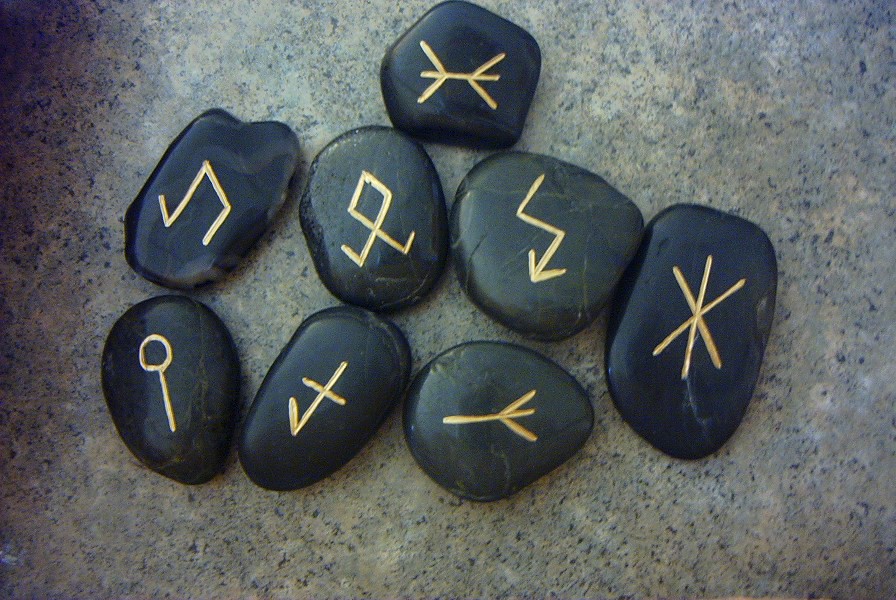
What they are: Runestones. What they mean: ...I'm not entirely sure.

What they are: Runestones. What they mean: …I’m not entirely sure.

Back To Top
Abstract

Unferth is brought onto the stage and introduced as a self-important toady who can’t stand the greatness of others.

Back To Top
Translation

“Unferth spoke, son of Ecglaf*
he who sat at the foot of the Scylding lord,
unbound battle words**, that venture of Beowulf’s,
the courageous sea-farer, a great grudge***,
for he would not allow that any other man
over all the earth and under heaven
could ever achieve fame to match his own:****”
(Beowulf ll.499-505)

Back To Top
Recordings

Old English:

{Forthcoming}

Modern English:

{Forthcoming}

*”Ecglaf” – “sword-leaving/Sword-heirloom” Hm. So he’s a child of war? Or is this a ref to penis?
**onband beadu-rune: unbound his ‘secret of a quarrel’ [HALL, MERRIT]//battle words/hostile words [CL WRENN] = unbound + war/battle/fighting/strife + mystery/secrecy/secret/counsel,consultation;council;runic character, letter;writing – Is this meant to be a foil to beowulf’s “unlocked his word hoard”? Hm…
***interweaving structure starts up here. This clause refers back to the battle words.
****Gets really, really tangled in terms of regular ModE syntax here. A literal translation is
“|that any other man//ever fame compared to greater|in earth//care for under heaven| than he himself:”
-Unferth introduced as one who sits at the feet of Hrothgar, a close councilor, a coward who is close to Hrothgar to avoid fighting. Does this relate to his father’s name? Is my impression of him as wormtongue because he could be the template for wormtongue or because I encountered wormtongue first? Hm…little help, Tolkien?

Back To Top
Unferth’s first impression – a success?

Beowulf is not a poem that’s full of characters or character introductions. Many of those that do appear in it are just dropped into place. Wulfgar, Hrothgar’s trusted councillor and herald is a great example of this class of character. Major characters like Hrothgar and Beowulf, on the other hand, get more of an introduction.

And then there’s Unferth.

This guy, whom I’ll forever remember as being well-played by John Malkovich in the mostly terrible Zemeckis Beowulf of 2007, is a character of a third sort.

Unferth occupies a grey middle ground between protagonist and antagonist. In this position he’s able to become a much more interesting character than most of the others in the poem. Yet these seven lines are his introduction, and set the tone for his character going forward.

So what can we say about him?

Being told that he comes from the foot of Hrothgar, tells us that he’s very close to the elder Dane. He’s probably a councillor in a similar capacity to Wulfgar.

However, his breaking into the poem with the line “Unferth spoke, son of Ecglaf,” (“Unferð maþelode, Ecglafes bearn” (l.499)) gives the impression that he’s been holding his tongue until this very moment, at which, like a coiled cobra, he strikes into the din of the partying troop.

Nonetheless, he’s saved from being entirely maligned in the reference to his father that the poet adds in for alliterative reasons.

Though what kind of a father a man named “sword heirloom” was is up for debate. Maybe he was the son of some sort of illicit, war-time love affair. Or, maybe more crudely, his name’s a play on simply being a “sword’s leavings.” Either way, it’s not him but his son (whose name in the manuscript is reported as “Hunferth”) that we’re concerned with here.

After the next line in which we’re told that he was sitting at Hrothgar’s foot the poet decides to shuffle the syntax of his line halves around. This means that, as had happened in some of Hrothgar’s dialogue, one line contains two halves that combine with the next line’s opposite halves to create full thoughts.

Making this change in descriptive poetry rather than dialogue, where we’ve mostly seen it before, leaves me with the impression that these lines are made to endure. They’re given extra care in their making, and so are meant to stand as important. Of course, the single phrase “unbound his battle words” (“onband beadu-rune” (l.501)) also marks this as important. For the poet earlier used a similar phrase to set off the first speech of the poem’s hero himself.

As a gamer immersed in the lore of The Legend of Zelda, I can’t help but take this parallel sort of setup as a cue to view Unferth as Shadow Beowulf.

This man is a reflection of Beowulf’s darker side and what he could become were he to use his powers for ill.

The poet doesn’t give much leeway for such an interpretation after this echoing phrase, though, since we’re told in some of the most tangled Old English I’ve ever read, that Unferth can’t stand the thought that anyone is considered more famous than himself.

Nonetheless, Beowulf’s key characteristic up to this point is his optimism. His boasts are claims of great power and the ability to defeat Grendel despite the odds. He willingly faces death with high hopes for glory.

Here, though, we’re shown that Unferth’s outlook is inherently pessimistic since he refuses to acknowledge anything great from outside of himself. To some extent, this portrayal makes him Beowulf’s foil. It also makes him a character that forces Beowulf to reflect on his own goals and aspirations. This gives Beowulf some room to grow spiritually, perhaps something that’s required of him to overcome Grendel.

It’s also got to be said of Unferth that I can’t decide if I view him as a slimy toady sort of character because I first encountered a similar type in Tolkien’s Wormtongue or if I see him as such because Tolkien used him as a template for Wormtongue.

What do you think is more likely? What came first in terms of impressions – the slimy underling Wormtongue or the shady and suspect Unferth?

Back To Top
Unpacking the battle runes

Carrying on from something mentioned above, let’s take a look at the phrase “onband beadu-rune” (“onband beadu-rune” (l.501)) Starting, of course, with the definitions of each word.

The verb here, “onband,” is quite close to its Modern English equivalent: “unbound.” It could also mean “untie,” “loosen,” “release,” or “disclose.”

The word “beadu” translates as “war,” “battle,” “fighting,” “strife.”

And, finally, the word “rune,” along with its less than helpful translation to the Modern English “rune” could also mean “mystery,” “secrecy,” “secret,” “counsel,” “consultation;” “secret council;” “runic character,” “letter,” or “writing.” Translating it as “words” is kind of a stretch, but it’s one that fits well and makes clear sense of the phrase.

But those first four definitions of the word are tempting. The word “rune” is clearly one that’s quite coloured by things unknown, unseen.

Perhaps it’s the poet’s use of this word rather than something more straightforward like, well, “word” that puts me in mind of Tolkien’s Wormtongue as I read this passage.

The word “rune” is definitely not used for reasons of alliteration, since it’s the only word that starts with “r” in the line. In fact, people who know more about Old English prosody than I could probably argue that “rune” could be substituted for with “word” with only a small change to the quality of the line.

So then why is it there? Why choose the word “rune” if it has these associations with the mysterious rather than a straightforward word?

I think it’s used here because it suggests that Unferth is about to say things that Beowulf would rather have hidden. He is about to challenge Beowulf not with swords but with facts to undercut his boasts.

In a metaphorical sense, this makes Unferth a representation of Beowulf’s doubt.

A hero of so clear a purpose and one-track a mind can’t be clouded by complex internal strife, and so the self-doubt that a normal person would feel in Beowulf’s position is placed in another character all together. Personifying Beowulf’s doubts like this allows him to overcome and disprove them, basically to work through them, in the forum that Heorot provides. It gives Beowulf a chance to speak through the secrets and possibly less-than-heroic facts of his past.

That Unferth would utter such secrets does nothing for his character, though. The idea that he can’t stand the existence or idea of there being people more famous than himself around boldly paints him as a schemer and underhanded coward. He’s a cad who would sooner undercut a boaster than suffer him to try to actually fulfil his boasts.

I think that quality in his character – an apparent desire to impose his own limits on other people – is what gives the lasting impression of Unferth’s villainy. He is made to personify the antithesis of the idea of grasping beyond what you expect is your reach.

As a people interested in treasure and in venturing off to new locales, I think it goes without saying that the Anglo-Saxons prized such a characteristic in people. It’s definitely a strong one in Beowulf and he’s the poem’s hero after all.

So maybe my reaction to Unferth is less learned and more cultural.

Back To Top
Closing

But just what are the secrets that Unferth lets out of the bag? Well, find out in next week’s extract!

You can find the next part of Beowulf here.

Back To Top

Taking a break for a brew and some nuanced words (ll.491-498)

Abstract
Translation
Recordings
Breaking for a brew
Words of nuance
Closing

Interlaced men motif. Image from http://public.wsu.edu/~hanly/oe/503.html.

Interlaced men motif. Image from http://public.wsu.edu/~hanly/oe/503.html.

Back To Top
Abstract

Space is cleared for the Geats to sit, ale is poured, and songs are sung in Heorot hall.

Back To Top
Translation

“Then for the Geat men together at once
a space was cleared on a beer hall bench;
there the bold went to sit,
exulting in their strength; a thane acted on that office,
he who in hand bore the adorned ale cup,
poured out the sweet brightness; the poet meanwhile sang
clear in Heorot; there were songs of heroic joy,
among the none too few noble warrior Danes and Geats.”
(Beowulf ll.491-498)

Back To Top
Recordings

Old English:

{Forthcoming}

Modern English:

{Forthcoming}

Back To Top
Breaking for a brew

It’s no secret that the Anglo-Saxons enjoyed their beer. Such could be said for all Germanic peoples, really. But, they weren’t swillers of whatever they could get their hands on. At least, one would hope so after reading such a vivid description of a perfect presentation and pour as that found on lines 494-496.

The best way to approach this description is line by line, since each has a singular focus.

First, the second half of line 494 is about the person doing the pouring. Notice that this is the shortest part of the description. Also, that pouring the ale isn’t just some act or event that stands in the way of drinking it – it’s an “office.”

The Old English word used is “nytt,” which could translate as “use,” “utility,” “advantage;” “duty,” “office,” “employment,” “supervision,” “care;” “useful,” “beneficial,” “helpful,” “profitable.”

The word “office” best captures the sense that I think is implied here, a combination of officialdom with importance.

It goes unsaid throughout these three lines, but aside from the enjoyment of a good brew, ale-pouring would have been one of the major ways in which a host could make an impression upon his guests. Just as various modern cultures have various drinking etiquettes, the Anglo-Saxons surely had their own. As such, knowing how to properly pour was likely included in this and something that was learned early and learned well.

There’s some room for interpretation in the word “þegn,” since it could mean “servant” or “retainer.” But, whether it’s someone who is only a servant in Heorot or who is one of Hrothgar’s remaining retainers, I think that the act of pouring ale in Anglo-Saxon culture confers a great deal of importance on the pourer. Just like a bartender who knows how best to get that stout from the tap to your glass, anyone who could pour ale well no doubt commanded some respect.

After all, it is that servant who bears the ornamented drinking cup (as read on line 495). Probably a large pitcher-sized thing from which the smaller cups were filled, this cup’s exact decoration remains unmentioned. Likely with good reason.

The recitation of poetry in Anglo-Saxon Britain happened in social settings. In such settings just the same sort of pouring and drinking would be going on, so leaving out any fine details that would make this “adorned ale-cup” a specific item allows hearers of the poem to step into the fiction of Beowulf through this detail (or lack thereof).

Perhaps some hearers may even have thought, “maybe this ale-cup that poet’s caterwauling about is just like this one?” as they admired the design carved around their own cup, fingering over its design as much as looking at it.

But the bearer and the cup are just vehicles for the ale itself. That’s why the most vivid brief description of all is saved for the ale (or mead?) itself – that “sweet brightness” of line 496. It doesn’t contain so much detail as to become self-parodying, but the original Old English, “,” is, nonetheless open to interpretation.

Heaney translates the phrase as “bright/helpings of mead.” Wren would render it “bright [or “glorious”] sweet drink.” And Francis Gummere went with “clear mead.” These are all fairly similar, and mead is definitely implied (if not outright stated).

Yet, it’s curious that the word for the drink is not “medu” meaning “mead” or “ealu” meaning “ale.” It’s possible that the poet declined the use of either because it was obvious enough to contemporary audiences what the drink was. Though to us (and to me) it’s rather vague. There’s mention of the ale cup, and yet this is a sweet drink that’s being poured out. So is it mead or is it ale?

A meaning taken for granted is lost to us.

Or maybe I just need to get a little of either in me to work this one out.

Back To Top
Words of nuance

One of the things that drew me to the study of words when I was younger is their power to reflect the values and ideas of the people and cultures who use them.

One of the words that stands out in this week’s extract is “swiðferhð.” Taken together, the word means “bold, brave, rash.”

Curiously, there’s a kind of gradient present in these definitions: to be called “bold” is generally a compliment, calling someone “brave” could go either way, and then calling someone “rash” sounds like a downright insult. Coming from a society that seems steeped in physical conflict and warfare, such nuance to a word that sounds like it should bear only positive connotations is curious. But, of course, contemplation and wisdom were highly valued in that society, too.

Taken apart, the word’s halves, “swið” and “ferð,” mean, respectively: “very,” “much,” “exceedingly,” “severely,” “violently,” “fiercely;” and “mind,” “intellect,” “soul,” “spirit,” “life,” “person.”

All of the definitions of “ferð are benign enough. But, the last four interpretations of “swið” sound like adverbs for something taken too far. Yet someone who is “severely spirited,” for example, could well be an asset or a liability on the battlefield. He’d be a powder keg, as likely to do much good as he would be to do much ill. So characterized are the Geats as they sit amongst the Danes for their entertainment.

I don’t think the poet means this as a backhanded compliment, though. I read the use of “swiðferð (aside from its use for alliteration’s sake) as the poet’s take on the Dane’s feeling about the Geats at this point. They don’t know if Beowulf will be successful against Grendel, or if he and his band will be smeared around their precious Heorot come morning.

Such an atmosphere is perfect for songs of man rejoicing, though. Or are they songs of hero gladness?

Line 497’s “hæleða dream” isn’t exactly a compound word, but its interpretation is still something of a crux.

The words “warrior,” “hero,” and “man” cover “hæleða” well enough. But that leaves the strangely familiar “dream,” a word that has a meaning that’s almost analogous to its Modern English cognate: “joy,” “gladness,” “delight,” “ecstasy,” “mirth,” “rejoicing;” “melody,” “music,” “song,” “singing.”

All of these words are close enough to one another, but the question is: which shade of meaning should someone translating Beowulf go with?

Songs of a warrior’s ecstasy are likely different from those of a warrior’s rejoicing. He might rejoice after a hard-won battle, but he may well be ecstatic right in the middle of it.

That’s kind of a problem of translation, though. Too often, in the process of moving words from one language to another, the original needs to be unpacked since all together it just won’t fit into its target language. It doesn’t help when one such word is attached to another (a man’s ecstasy is likely to be different from a man’s rejoicing, just as a warrior’s ecstasy is different from his rejoicing).

This sort of nuance might not be as wild as that of swiðferð or of other words I’ve covered in previous entries, but it’s still something that makes translating a fascinating task.

Back To Top
Closing

Next week, one of Hrothgar’s closest thanes calls Beowulf out on his boasting.

You can find the next part of Beowulf here.

Back To Top

Beowulf’s slip of the tongue and linden wood’s importance? (ll.429-441)

Abstract
Translation
Recordings
Beowulf’s ego between the lines?
A balance of compound words
Closing

Back To Top
Abstract

Standing before Hrothgar himself, Beowulf states that he will face Grendel unarmed.

Back To Top
Translation

“‘That you do not refuse me, protector of warriors,
close friend of the people, that for which I have now come from afar,
that I might alone and my band of warriors,
this hardy heap, to cleanse Heorot.
I have also learned, by asking, that this demon
in his recklessness does not care for weapons.
I the same shall scorn, that Hygelac may be for me,
my liege-lord, blithe of heart,
that I neither sword nor the broad shield shall bear,
the linden-bound battle buckler; and I shall grapple
against the fiend with my grasp and struggle for life,
hater against hated; in that I shall trust
in god’s judgement to take whom he will in death.'”
(Beowulf ll.429-441)

Back To Top
Recordings

Old English:

{Forthcoming}

Modern English:

{Forthcoming}

Back To Top
Beowulf’s ego between the lines?

As has been the case since Beowulf opened his mouth a few weeks ago, he says some curious things in this week’s passage. Either that, or the space of centuries has changed English so much that (my) modern interpretations are mismatched with his intentions.

Also, as has been the case with past posts, this week’s most curious passage could be the result of poetic conventions.

In lines 431-432 Beowulf states that he and his crew are here to cleanse Heorot. But in line 432 there’s a curious division between him and the rest of the Geats.

In Old English poetry, each line consists of two parts separated by a medial caesura. The medial caesura is a full stop used to give poetry a set meter and rhythm. On line 431, however, the caesura happens to fall at a crucial point in Beowulf’s statement.

The first part of this line ends with the nearly complete thought “that I might alone” (“þæt ic mote ana” (431)). At first glance such a statement seems perfectly normal. But then the audience/readers are reminded of the other Geats in the second part of the line “and my band of warriors” (“ond minra eorla gedryht”).

The caesura’s separating these two thoughts so cleanly leads me to believe that Beowulf, for a second, forgot about his fellow Geats.

He may have became so inflated with thoughts of the personal glory to be won that his focus was entirely on himself. But then something must have twinged in his memory and he snapped back to his senses, just in time to realize that there were other Geats – his “band of warriors” – with him.

Because the break in the line occurs in such a perfect place I find it hard to write off this apparent mental slip as merely the result of Old English poetic convention. Using a multifaceted word rather than a definite one to fill in alliteration is one thing. Splitting the line between clauses like this is entirely another.

But does such a slip necessarily mean that Beowulf is temporarily blinded by an egotistical drive for glory? Or could it be that his continuing use of interlacing clauses is starting to confuse him, showing that his forceful use of rhetorical speech is nearly too much for even him to handle?

Or, again, if you want to approach things on the meta level, is having the hero become so tongue-tied the poet’s way of stepping in to say, in a small way, “this poetry stuff is so hard even Beowulf here can’t fully handle it!”?

It’s this poem’s ability to generate these sorts of questions that makes it so fascinating. That’s why I keep coming back to it time and again and why I run this blog in the first place. What are your thoughts on Beowulf’s mental slip?

If Beowulf has tied himself into a bit of a rhetorical knot here, by the end of this part of his speech he’s pretty much recovered.

The phrase “lað wið laþum” is a linguistic gem. A near literal translation of this phrase is “the hater against the hated.” In the context of Beowulf’s fight with Grendel it works wondrously well no matter who its subject and object are between the two.

Back To Top
A balance of compound words

Unlike the other parts of his speech that we’ve seen so far, Beowulf’s boast is rather short on strange compound words. The word “wonhydum” (a variation of “wanhygd”) is kind of neat, but it’s one of those compounds that makes perfect sense.

The first part, “wan” means “wanting,” “deficient,” “lacking,” or “absent,” and the second means “mind,” thought,” “reflection,” or “forethought.” So “wanhygd” translates into “reckless” quite nicely.

However, “gealobord,” meaning “buckler covered with yellow linden bark,” is something of a find.

Why should it matter that a shield is covered within yellow? And why is it linden bark?

Maybe it’s just because linden bark is the best bark suited to covering a shield and it happens to be yellow? Maybe one or both have special significance outside of practicality?

From what I’ve been able to turn up online the reason that linden bark (or more likely just plain old linden wood – unless there’s a ship metaphor in there somewhere (“bark” could mean “ship”) – was used for shields is because it’s soft and light. It didn’t tend to split like harder woods such as oak, and could even catch and hold spear blades.

Such is the explanation that this page about arms and armour on Regia Anglorum has to offer anyway.

Also, Della Hook notes on page 215 of Trees in Anglo-Saxon England: Literature, Lore and Landscape that linden wood was so commonly used for shields that the word “lind” came to be used as a metonymy for shields in poetry.

Perhaps there was also some mythic or folkloric understanding of why linden wood was so well-suited to shields, but I’d need to dig deeper to find it. If you happen to know of such a thing though, please drop a link (or a line) in the comments.

Back To Top
Closing

Next week Beowulf balances his boasting with a description of his gruesome defeat and outlines what the Danes should do with his remains. If he happens to lose, that is.

You can find the next part of Beowulf here.

Back To Top