What Grendel’s mother did with Aeschere’s head, a monstrous real estate listing (ll.1408-1421)

Synopsis
Translation
Recordings
A Grisly Joke
A Monstrous Listing
Closing

Back To Top
Synopsis

Hrothgar and his wisest thanes see a grisly sight at the Grendels’ doorstep.

Back To Top
Translation

“The prince’s thanes then rode on
over steep rocky slopes, around narrowly winding paths,
through ways that fit just single file soldiers, up trails unknown,
precipitous headlands, lined with homes of water monsters.
He went on ahead with a handful of the wise,
to see that strange place; they looked about
until suddenly they found a patch of mountain trees
all growing out over grey stones,
a joy-less forest; waters stood beneath them,
blood-stained and turbid. To all the Danes gathered there,
friends of the Scyldings, the sight caused harsh suffering
at heart, bringing the same heaviness to each of the many thanes,
striking each of them with grief, once they found
the head of Æschere on the cliff by the water’s side.”
(Beowulf ll.1408-1421)

Back To Top
Recordings

Old English:

{Forthcoming}

Modern English:

{Forthcoming}

Back To Top
A Grisly Joke

Hrothgar’s ride up to the mere is quite vivid — in a King James Version of the Bible sort of way.

The first few lines of this passage (and the last few of last week’s) are sparse in their description. And yet, somehow these lines say a lot in their handful of words. It certainly sounds like the mere is incredibly isolated, almost as if the journey there (though it’s “not many miles” away (“Nis þæt feor heonon/milgemearces” (l.1361-1362)), as Hrothgar’s said earlier in the poem) has taken them to an entirely new world. A world of crooked trees growing over stony ground that’s also swampy and saturated with ever-churning waters. It does indeed sound like a grim place. But topping it all off is the discovery of Æschere’s head.

As we’ll find out once the poem gets to Beowulf’s pursuing Grendel’s mother, the Grendels’ home is in this water. And so, since this cliff is at the water’s side, I can’t help but think that it is the Grendels’ equivalent of Heorot’s gables.

After Beowulf defeated Grendel he hoisted his opponent’s arm up into those gables as a prize and a sign of triumph. Of course, taking that trophy was fatal for our 12-year terror, Grendel. Likewise, taking off Æschere’s head would have been fatal for him. Also likewise, his head is being similarly displayed as a trophy and as a sign of triumph in the feud.

But now, since it’s Æschere’s head and not the limb of some miscellaneous monster, we’re meant to feel just as sad at heart as the Danes who look upon the grim sight with Hrothgar. And it’s easy to feel it. I mean, from the time that Grendel’s mother takes him it’s pretty clear that Æschere is dead. But even so, seeing such grisly proof that he is indeed gone is still pretty devastating.

And yet, the parallel to Grendel’s arm makes me wonder what the poet was trying to say here.

Maybe the poet’s driving home what I’ve pointed out before, that Grendel and Grendel’s mother, for all of their monstrousness, are still beings with reason and with a capacity for empathy and a strong sense of family. A sense strong enough to inspire Grendel’s mother to barge in on a hall full of armed warriors with nothing but the fear of her they feel for protection.

Maybe giving such a quality to monsters was meant to show how much the idea of family, an often elevated and ennobled feeling, is really just an animalistic instinct. And that the preyed upon and the hated feel it just as much as those who are in an elevated position of privilege.

Maybe the poet is exercising some dark humour. Æschere’s head being on display is a little elbow in the ribs, a little flip of the bird from monster kind.

What do you make of this scene? Is it just a grisly display of how low the Grendels will go or is it a little wink from the poet in some way?

Back To Top
A Monstrous Listing

Speaking of Old English humour, I think you could probably find a joke real estate listing like this if real estate listings were a thing in the days of Beowulf and Hrothgar:

Make your way along the “an-pað”1, up the “stan-hlið”2, and you’ll find a terrible “nicor-husa”3. This “nicor-husa” comes complete with a “wyn-leas”4 “fyrgen-beam”5 out front and an abysmal “holm-clif”6 view. Starting at three severed thanes’ heads or best offer.

Or, in Modern English:

Make your way along the narrow path, up the rocky slope and you’ll find a terrible sea-monster’s dwelling. This sea-monster’s dwelling comes with a joyless mountain-tree out front and an abysmal sea-cliff view. Starting at three severed thanes’ heads or best offer.

1an-pað: narrow path. an (one, each, every one, all) + pað (path, track)
2stan-hlið: rocky slope, cliff, rock. stan (stone, rock, gem, calculus, milestone) + hlið (cliff, precipice, slope, hill-side, hill)
3nicor-husa: sea monster’s dwelling. nicor (water-sprite, sea-monster, hippopotamus, walrus) + husa (house, temple, tabernacle, dwelling-place, inn, household, race)
4wyn-leas: joyless. wyn (friend, protector, lord, retainer) + leas (without, free from, devoid of, bereft of, false, faithless, untruthful, deceitful, lax, vain, worthless, falsehood, lying, untruth, mistake)
5fyrgen-beam: mountain tree. fyrgen (mountain) + beam (tree, beam, rafter, piece of wood, cross, gallows, ship, column, pillar, sunbeam, metal girder)
6holm-clif: sea-cliff, rocky shore. holm (wave, sea, ocean, water) + clif (cliff, rock, promontory, steep slope)

Back To Top
Closing

Next week, everyone in the party is entranced by the beasts in the water.

You can find the next part of Beowulf here.
Back To Top

Hrothgar’s motives, wolves and ancient treasure (ll. 1368-1382)

Synopsis
Translation
Recordings
Hrothgar Holding Out?
Of Wolves and Ancient Treasure
Closing

Beowulf, Grendel, Old English, Anglo-Saxon

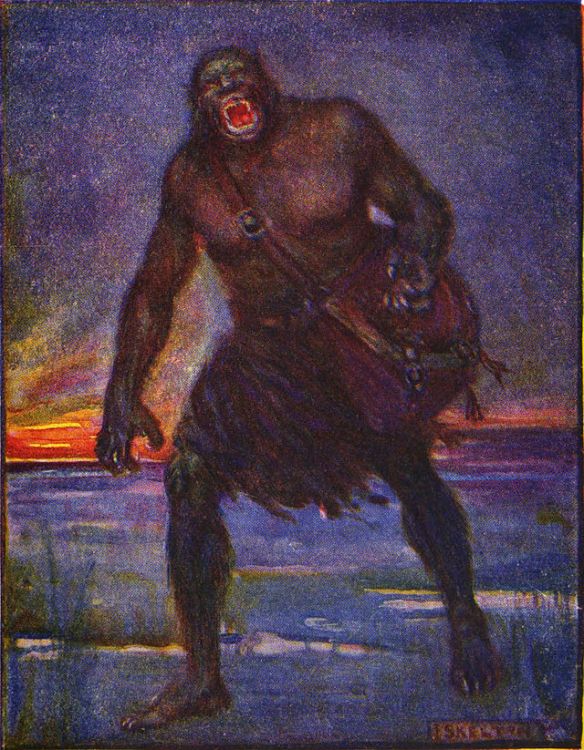
An illustration of Grendel by J.R. Skelton from Stories of Beowulf. Grendel is described as “Very terrible to look upon.”Stories of beowulf grendel” by J. R. Skelton – Marshall, Henrietta Elizabeth (1908) Stories of Beowulf, T.C. & E.C. Jack. Licensed under Public Domain via Wikimedia Commons.

Back To Top
Synopsis

Hrothgar tells Beowulf more about the terrifying surroundings of the Grendels’ home, and offers a generous reward.

Back To Top
Translation

“Even the stag harassed by wolves,
that hart strong of horn would seek security in the wood,
even if it was far off, would turn to offer its horns,
lose its life on the bank, before it would enter that water,
conceal his head. That is no pleasant place;
thence rise up surging waves
to a darkened sky, there the winds stir
hateful storms, so much so that the air becomes gloomy,
and the sky weeps. Now as before we depend
upon you alone for help. That region is not yet known,
a perilous place, there thou mayst find
the very guilty creature; seek it out if thou darest.
I will reward you with great wealth for ending this feud,
award you with ancient treasures, as I did already,
works of twisted gold, if thou goest on this way.”
(Beowulf ll.1368-1382)

Back To Top
Recordings

Old English:

{Forthcoming}

Modern English:

{Forthcoming}

Back To Top
Hrothgar Holding Out?

In the moment, Beowulf probably didn’t think twice about Hrothgar’s offer. “More treasure? For just killing another monster? Sure!” could very well be his internal monologue.

But does Hrothgar know more than he lets on?

Considering the fact that he’s able to go on for lines about the characteristics of the mere, and yet he says “that region is not yet known” (“[e]ard git ne const” (l.1377)) really makes me wonder. Plus, I don’t think that anyone who knew nothing about a place could paint as rich a picture as Hrothgar does when he uses the example of the buck who would rather die than escape the wolves by swimming away through the mysterious burning waters.

Sure, fear could be a factor here.

Maybe Hrothgar is speaking as someone who is terrified of this place, and so his description of it is tinged with the fear of the unknown; he has released his doubts about the place in exchange for grasping whatever slivers of information there are available to him as tightly as possible. And then he’s blown them out of proportion.

Though, perhaps this description isn’t coming from a frightened old man.

As a warrior himself, and someone who had to prove himself in his earlier days just as Beowulf is doing now, maybe Hrothgar is being quite shrewd here. The description he gives, with all of its extreme dangers and air of mystery despite the details would definitely appeal to Beowulf’s sense of hunting down glory. Though, really, even if Hrothgar said that Grendel’s mother could be found in the bread wall at the local grocery store, I’m sure Beowulf would go after her. He is that kind of fighter after all.

What’s more troubling anyway is that Hrothgar’s marking the end of this feud with the death of Grendel’s mother suggests something other than rhetoric. I think that it’s the poet’s way of suggesting that gaining a reputation for fighting and slaying monsters as Beowulf did when he beat Grendel (and even before if his boasts are to be believed) leads not to an end of your struggles with the unknown but to their continuation.

In fact, if you become known as an expert monster slayer, you’ll do it until the thing fighting as the supernatural’s representative naturally overcomes you, the natural. After all, as the stakes are raised more and more the best a mere mortal can do is take down the monstrous with them.

What do you think Hrothgar knows about the Grendels that he’s not telling Beowulf?

Back To Top
Of Wolves and Ancient Treasure

I feel like it’s a bit judgy, from the perspective of a people relying on crops and livestock for sustenance and trade a “hæð-stapa” would be very bad news. At least in some cases.

The word “hæð-stapa” is kind of an odd one since it can mean either “wolf” or “hart.” As strange as that sounds, it makes sense since the word’s literal translation is simply “heath-stalker.”

In fact, since “hæð-stapa is a combination of “hæð” (“heath,” “untilled land,” “waste,” or “heather”) and “stapa” (“going,” “gait,” “step,” “pace,” “spoor,” “power of locomotion,” “short distance,” or “measure of length”), it could be taken to mean just about anything that is known to wander land that is unused by humans. Perhaps that’s why adding “fela-sinnigne” to “hæð-stapa” points it towards “wolf”.

After all, I haven’t met many deer that I would call “very guilty,” the very literal meaning of “fela-sinnigne” (fela (“many,” or “much”) + sinnigne (“guilty,” “punishable,” “criminal,” or “sinful”)).

But whatever judgments are passed, such a “fela-sinnigne” “hæð-stapa” is right at home in a “holt-wudu.”

That word combines “holt” (“forest,” “wood,” “grove,” “thicket,” “wood,” or “timber”) and “wudu” (“wood,” “forest,” “grove,” “tree,” “the Cross,” “Rood,” “wood,” “timber,” “ship,” or “spear shaft”) to mean simply “forest,” “grove,” or “wood,” though I’m sure that the doubling of a similar meaning in both words means that this is the deepest of forests.

Just as “yð-geblond” could refer to the mysterious waters of casa Grendel or to the roiling waves of the open sea. I mean, this compound does literally mean “wave” (“yð”) “mix” (“blandan”) after all.

But wolves (guilty or otherwise) are in short supply on the open sea, while something much more valuable is there for the taking thanks to shipwrecks and Viking burials. Yes, the ocean is home to much “eald-gestreon.”

Once again (seems there’s a trend in this passage’s compound words) the word “eald-gestreon” literally means “ancient treasure” (being a mix of “eald” (“aged,” “ancient,” “antique,” “primeval,” “elder,” “experienced,” “tried,” “honoured,” “eminent,” or “great”) and “streon” (“gain,” “acquisition,” “property,” “treasure,” “traffic,” “usury,” or “procreation”)).

So, in a sense you could say that the “fela-sinnigne hæð-stapa” is to the “holt-wudu” as the “eald-gestreona” is to the “yð-geblond.”

Back To Top
Closing

Next week: Beowulf’s reply!

You can find the next part of Beowulf here.
Back To Top

Flaming waters and who measures out miles anyway? (ll.1357b-1367)

Synopsis
Translation
Recordings
A Weird Home with Flaming Water
The Wondrous Life of a Mile Measurer
Closing

Beowulf, Grendel, Old English, Anglo-Saxon

An illustration of Grendel by J.R. Skelton from Stories of Beowulf. Grendel is described as “Very terrible to look upon.”Stories of beowulf grendel” by J. R. Skelton – Marshall, Henrietta Elizabeth (1908) Stories of Beowulf, T.C. & E.C. Jack. Licensed under Public Domain via Wikimedia Commons.

Back To Top
Synopsis

Hrothgar tells Beowulf (and us) about where the Grendels live.

Back To Top
Translation

&nbsp:&nbsp:&nbsp:&nbsp:&nbsp:&nbsp:&nbsp:&nbsp:&nbsp:&nbsp:&nbsp:&nbsp:&nbsp:”They occupy that
strange land, along wolf-inhabited slopes, near wind-wracked cliffs,
up the perilous fen-path, where mountain streams
fall through mists from the headlands,
water creeping from underground. It is not many miles
hence that their mere can be found,
with frost-covered groves overhanging it;
tree roots overshadow those waters with their interlocking embrace.
Each night there you can see the oddest of wonders,
the water catches fire; none among the dear wise
children of humanity know of those waters’ bottom.”
(Beowulf ll.1357b-1367)

Back To Top
Recordings

Old English:

{Forthcoming}

Modern English:

{Forthcoming}

Back To Top
A Weird Home with Flaming Water

Wonder upon wonder! After telling us that Grendel and Grendel’s mother were known to the people living on his lands, Hrothgar goes on to describe where the two live. And it doesn’t sound very hospitable.

Wolves on the slopes (“wulfhleoþu” l.1358), paths that cut through the marsh (“fengelad” l.1359), and everything is covered in mist (“genipu” l.1360). It sounds downright swampy.

Given this description of the monstrous Grendels’ home it’s no wonder it’s the Anglo-Saxon (read British) default to ascribe brutality and low intelligence to people who live in the backwoods and hills. If the presentation of Grendel and Grendel’s mother are anything to go on, making these people monsters (as we still do in horror movies to this day), is one of the oldest stereotypes carried down by speakers of English.

But that’s not the worst of it.

Along with being in such a perilous place, the water there burns by night. Water’s not supposed to burn. And especially not at night. And yet this stuff does.

Maybe it’s marsh gas (viewers of the Jon Pertwee Doctor Who story “Carnival of Monsters” might know how flammable the stuff can be).

Or maybe it’s just the light of the moon rippling off the water between tree branches in such a way that it looks like the water is glowing.

Or, weirdest of all, maybe the fires that dance upon the lake’s surface at night are lights for those below. Maybe this is the site of an anti-Heorot, a place where monsters kick back, drink their malts and eat strictly vegetarian meals.

It sounds crazy, but, as we’ll learn later on, the Grendels do have a rather mysterious cave/hall to call their own.

And why not introduce an anti-Heorot here?

So few people adapt the poem beyond the confrontation with Grendel’s mother. But, if you look at the poem as a thing divided into thirds based on the three major fights something interesting appears. Along with three monsters (Grendel, Grendel’s mother, and the dragon) there are three halls that are featured (Heorot, the Grendel’s, and Beowulf’s). So why shouldn’t the water on fire be lights coming up from the deep, where monsters play and frolic, while one of them plays an old rib cage like a xylophone?

What do you think is causing the water of this strange lair to look like it’s burning by night?

Back To Top
The Wondrous Life of a Mile Measurer

The area that Hrothgar talks about in this passage seems quite remote. It contrasts quite a bit with the tame paths and meadows around Heorot. At some point though, he must have asked someone to “mil-gemearc” the distance between Heorot and this place.

Literally, such a request would have been to “mark the miles” between the two, though “measure by miles” is far less imperative. Not that it’d be difficult to make these two words sound like a command when put together. They’re quite straightforward. “Mil” means “mile” and “gemearc” means “mark,” “sign,” “line of division,” “standard,” “boundary,” “limit,” “term,” “border,” “defined area,” “district,” or “province.”

What I wonder, though, is whether or not Hrothgar sent the same person or another to measure out the “fen-gelad.” Measuring out a “marsh-path” would be a bit more treacherous, since I doubt the ground would be very solid. I mean the two words “fen” (“mud,” “mire,” “dirt,” “fen,” “marsh,” “moor,” or “the fen country”) and “gelad” (“course,” “journey,” “way,” “street,” “water-way,” “leading,” “carrying,” “maintenance,” or “support”) going together don’t really give the sense of a path around the marsh, but rather directly through it. “Fen-gelad” sounds like it describes a path that is itself marshy.

It’d be all the worse for our measurer if they were told to go all the way to where the “fyrgen-stream” drop down into the marsh. Those “mountain streams” would be pretty deep into the fen, I’d wager. After all, the only interpretation for “fyrgen” in this context is “mountain,” so whatever sense of “stream” you went with (“stream,” “flood,” “current,” “river,” or “sea”), would need to be coming off of a mountain. And it sounds like Heorot is quite far from most mountains.

As hard a task as all this measuring out would be, I imagine that the person doing it would see some “nið-wundor.” How could they not see a “dire wonder” or “portent” along such a path? Though seeing such a thing wouldn’t necessarily uplift their spirits. “Wundor” is at least neutral, meaning simply “wonder,” “miracle,” “marvel,” “portent,” “horror,” “wondrous thing,” or “monster”. But “nið” refers to “abyss,” “strife,” “enmity,” “attack,” “war,” “evil hatred,” “spite,” “oppression,” “affliction,” “trouble,” or “grief.” So these sights may leave whatever measurer of miles that sees them with grief.

Indeed, such “nið-wundor” likely include sights like a “wulf-hleothu.” I’d be pretty distressed if I had to pass by a hillside where wolves lived after all. They’d have the higher ground and all sorts of advantages. Though, they might also be devils in disguise since “wulf” can translate as “wolf,” “wolfish person,” or “devil”. They’d definitely be on a hillside, though: “hleoþu” only means “cliff,” “precipice,” “slope,” “hillside,” or “hill”.

Back To Top
Closing

Next week, Hrothgar further describes this strange place and promises Beowulf a great reward.

You can find the next part of Beowulf here.

Back To Top

Hrothgar tells tales of the Grendels, idyllic country-dwellers risk exile (ll.1345-1357a)

Synopsis
Translation
Recordings
Hrothgar Lays his Land Claims
The Rise and Fall of a Country-Dweller
Closing

Beowulf, Grendel, Old English, Anglo-Saxon

An illustration of Grendel by J.R. Skelton from Stories of Beowulf. Grendel is described as “Very terrible to look upon.”Stories of beowulf grendel” by J. R. Skelton – Marshall, Henrietta Elizabeth (1908) Stories of Beowulf, T.C. & E.C. Jack. Licensed under Public Domain via Wikimedia Commons.

Back To Top
Synopsis

Hrothgar shares what his people have told him about Grendel and his mother.

Back To Top
Translation

“I have heard the dwellers in the land, my people,
and my hall counsellors say,
that they have seen two such
mighty prowlers of the murky moors protecting them,
alien creatures; there one of them,
they all can say with great certainty,
has a woman’s likeness; the other unfortunate
in a man’s form treads the path of exile,
but never had they seen a bigger man;
in earlier times the dwellers in the land named
him Grendel; they knew not their lineage,
their parentage was said to be hidden among
mysterious spirits.”
(Beowulf ll.1345-1357a)

Back To Top
Recordings

Old English:

{Forthcoming}

Modern English:

{Forthcoming}

Back To Top
Hrothgar Lays his Land Claims

After Hrothgar has questioned Beowulf’s effectiveness, the hall ruler changes his approach. He starts to finally tell us more about Grendel and Grendel’s mother. And it sounds like there are things that Hrothgar can tell us — even if they are just hearsay.

It’s definitely important that there are only two of these creatures. Though it’s curious that the way that all of Hrothgar’s people go when wondering about their origins is down the road of “mysterious spirits” (“dyrnra gasta” (l.1357)). None of Hrothgar’s people say that these two are just two exiles from long ago.

In fact, since in earlier times people would often cast out children who were born with physical defects, maybe that’s what Grendel is: a person with a physical disability of some kind. His mother, then, is indeed a woman but, since Grendel’s as big as he is, in this scenario she probably went out into the wilderness with him. Then the two were away from human society for so long that they’ve forgotten how to talk and express themselves in a recognizable way.

Whatever the case is, Hrothgar’s sharing these mysterious stories of Grendel sightings call into question just how objectively the two are monsters after all. As I’ve said before, maybe the “monster” label is just Hrothgar’s label for two people that were exiled so long ago that all they share with his people are their shapes and likenesses.

I also really wonder about the use of “land-buend” (l.1345) and “fold-buend” (l.1355) in this passage.

Both words basically mean “someone living in the land” as opposed to someone living in a more populated settlement like the one that’s undoubtedly around Heorot. So not only does Hrothgar not recognize these two monsters as long exiled and unfamiliar people, it also sounds like he’s asserting his ownership of the land via possession pretty hard here. Almost as if he (or maybe just the poet) is well aware of how he encroached on the land that Grendel and his mother once had to themselves.

The matter of land ownership and identifying yourself with the land and the people living on it with the land is the angle that hooks me to tightest when I’m reading through Beowulf. It’s so interesting to me because I’m thoroughly convinced that politics of land ownership and identification as a singular people are major themes in Beowulf. And here Hrothgar’s pushing pretty hard to put the beings that he’s feuding with in the “not us” category otherwise known as “monsters” dwelling on the borders of his territory while also working to convince Beowulf that the people living on the land are indeed his people.

What do you think Hrothgar’s history with Grendel and Grendel’s mother is? Are the two creatures exiles or monsters? Could Grendel be an illegitimate son of Hrothgar whom he threw out to secure his power?

Back To Top
The Rise and Fall of a Country-Dweller

Being a person who “lives on the land” sounds like a rough life. But, I think even when Beowulf was being dreamed up there was a sense that such a life was simpler. After all, if you were a “land-buend,” you literally were a “dweller” or “inhabitant” (buend) on the “land” (the Old English word “land” meaning “earth,” “land,” “soil,” “territory,” “realm,” “province,” “district,” “landed property,” “country (not town),” or “ridge in a ploughed field”).

That there’s an almost identical word with similar meaning convinces me that country life was idealized even more.

“Fold-buend” after all, just means “earth-dweller” or “man” or “inhabitant of a country” — it’s the more concrete cousin of “land-buend” no doubt because the one word that makes the difference between the two, “fold” means “earth,” “ground,” “soil,” “terra firma,” “land,” “country,” “region,” or “world”. But really, it’s just a difference of degrees. “Land” is somehow more abstract (with its meanings of “territory,” or “province” or “country (as opposed to town)”), while “fold” is more about the dirt and soil themselves.

But aside from understanding those who lived on the land as country-dwellers and also as people living somehow more in tune with the earth (living capital “o” “On it”), country people might’ve been regarded as more fortunate because they had the protection of a “sele-raedend” without having much to do with them.

Sure farmers would have to go to war with their “sele-raedend,” he is the “hall ruler or possessor” after all, but they wouldn’t have been expected to perform great deeds or distinguish themselves in battle. That would be the duty of the hall ruler’s closest posse (the “comitatus”).

Although, since “sele-raedend” breaks down into “sele” (“hall,” “house,” “dwelling,” or “prison”) and “raedend” (“controller,” “disposer,” “ruler,” or “diviner”) it’s quite possible that simple household owners or heads of families would regard themselves as the “sele-raedend” of their own dwelling.

Which is all fine and good until one of these heads of an outlying family got it into their heads that they could do a better job of ruling the people. If their plot succeeded, great! But if it failed, they’d either be killed on the spot or forced onto the “wraec-lastas” or “path of exile.”

The word comes from the mix of “wraec” (“misery,” “vengeance,” “persecution,” “enmity,” “punishment,” “penalty,” “cruelty,” “misery,” “distress,” “torture,” or “pain”) and “lastas” (“sole of foot,” “spoor,” “footprint,” “track,” “trace,” “gait,” or “step”), which outlines quite nicely what exile is all about: a path of punishment, torture, and misery.

I mean, in a time when everyone in a community relied on each other not just for niceties and a sense of connectedness but for food and protection, being forced out on your own would indeed make you “earm-sceapan.” You would be left “unfortunate” or “miserable.”

Such is the outcome of failed rebellion and such is the meaning of that mix of “earm” (“arm,” “foreleg,” “power,” “poor,” “wretched,” “pitiful,” “destitute,” or “miserable”) and “sceapan” (“shape,” “form,” “created being,” “creature,” “creation,” “dispensation,” “fate,” “condition,” “sex,” or “genitalia”).

Although, perhaps all hope would not be lost. If you managed to survive long enough to say that your being forced into exile happened in “gear-dagum” you could then call yourself (perhaps with pride) a “mearc-stapa.”

Although, if you were living outside of society for so long that you’d think of your exile as having happened in “the days of yore,” then maybe you’d have lost touch with reality enough to come up with the combination of “mearc” (“mark,” “sign,” “line of division,” “standard,” “boundary,” “limit,” “term,” “border,” “defined area,” “district,” or “province”) and “stapa” (“going,” “gait,” “step,” “pace,” “spoor,” “power of locomotion,” “short distance,” “measure of length,” “step,” “stair,” “pedestal,” “socket,” “grade,” or “degree”) to mean “march-haunter.”

Perhaps, if he or his mother were given any dialogue, that’s what Grendel or Grendel’s mother would be calling themselves.

Back To Top
Closing

Next week, Hrothgar tells us more about Grendel and his mother, and about where the duo live.

You can find the next part of Beowulf here.
Back To Top

Wondering about the central feud, a treasure-giver’s compassion (ll.1333b-1344)

Synopsis
Translation
Recordings
Who’s Feud is it Anyway?
A Treasure-Giver’s Potentially Life-Changing Compassion
Closing

Beowulf, Grendel, Old English, Anglo-Saxon

An illustration of Grendel by J.R. Skelton from Stories of Beowulf. Grendel is described as “Very terrible to look upon.”Stories of beowulf grendel” by J. R. Skelton – Marshall, Henrietta Elizabeth (1908) Stories of Beowulf, T.C. & E.C. Jack. Licensed under Public Domain via Wikimedia Commons.

Back To Top
Synopsis

Hrothgar laments the continuation of his feud with the Grendels.

Back To Top
Translation

“‘She carried on that feud,
that you the other night enflamed by killing Grendel
in your violent manner with the might of your grip,
since he had for so long a time terrified my people,
rended and grieved them. He fell in the fight
and forfeited his life; and now another
wicked ravager has come, looking to avenge her kin,
she who has already done much for her vengeance,
so it may seem to many thanes,
after they have seen their ring-giver weeping from the heart,
his dire distress; now that the hand lay still,
the hand that proved generous to every desire.'”
(Beowulf ll.1333b-1344)

Back To Top
Recordings

Old English:

{Forthcoming}

Modern English:

{Forthcoming}

Back To Top
Who’s Feud is it Anyway?

This time around Hrothgar calls out Beowulf not for doing well in killing Grendel, but for calling a second, unexpected, wicked ravager down upon Heorot.

It’s not like Beowulf could know that this would happen of course. In fact, although feud terminology had been used before, since it’s only after Grendel’s killed that we hear about his kin at all really makes me wonder how apt the word “feud” (“fæhðe” l.1333) is here. I mean, a feud in Anglo-Saxon Britain consisted of two groups clashing over and over again because of a single grievance or a string of grievances.

So, is the only grievance that Grendel and his kind had with Heorot that Hrothgar put a noisy party hall up so close to their quiet and simple fen? And if this did actually cause something that could be called a feud, then why was Grendel the sole ravager of Heorot? Why did Grendel care so much to lash out against the Danes while his mother only came on the scene once Grendel was killed?

Basically, what is this feud that Beowulf “enflamed” (l.1334)?

Weren’t Hrothgar’s danes only feuding against Grendel? Or were they actually feuding against all of monsterkind and Grendel was just that side’s representative, while the Danes had no single entity to represent them?

This is a very weird moment in the poem for these reasons. Although the poet doesn’t explicitly make the situation all that more complicated by adding in the mother character and renewing the feud that Hrothgar has with the Grendels, the concept of a feud passing from one family member who is incredibly invested to another who seems unable to care any less about it is baffling. I mean, I know she lost her son to the feud, but can it really be considered the same feud if Grendel was attacking Heorot because they barged into his home while his mother attacks for vengeance? Or did Hrothgar, Dorothy Gale-like, drop Heorot on Grendel’s dad?

Maybe this is so baffling because it’s supposed to illustrate the human misunderstanding of the natural world of which it is a part. Hrothgar calls Grendel’s apparent grudge a feud only because that’s the closest thing he knows to describe the way that Grendel is acting. But maybe the reality of the situation is entirely different; there is no feud, only one creature fighting for his land and another fighting to gain vengeance for her son.

Who do you think the feud is against? Hrothgar and the Grendels? Humans and monsters?

Back To Top
A Treasure-Giver’s Potentially Life-Changing Compassion

If there were ever an ideally compassionate “sinc-giefa” they would feel a great “hreþer-bealo” for “wel-hwylcra” “man-scaða.”

After all, it is the “sinc-giefa”‘s role in Anglo-Saxon society to distribute treasure. It’s right there in the name — a mix of “sinc” (“treasure,” “riches,” “gold,” “valuables,” or “jewel”) and “giefa” (“donor”).

And so an ideal “sinc-giefa” would feel a deep sadness, a heart sorrow for those they cannot given to, that their tremendous gifts cannot extend bonds of loyalty and friendship to. A good Old English name for that feeling is “hrether-bealo,” a combo of “hrether” (“breast,” “bosom,” “heart,” “mind,” “thought,” or “womb”) and “bealo” (“bale,” “harm,” “injury,” “destruction,” “ruin,” “evil,” “mischief,” “wickedness,” “malice,” “noxious thing,” “baleful,” “deadly,” “dangerous,” “wicked,” or “evil”). A “poison thought” could be another way to look at that. Though what would that mean?

Whatever it meant, I’m sure that all those who declared themselves that giver’s enemy would leave such a giver of treasure feeling treacherously sad. Yes, “wel-hwylc” of those self-declared enemies would have that effect. And you can’t get much more all encompassing than “wel-hwylcra” since “wel” means “well,” “abundantly,” “very,” “very easily,” “very much,” “fully,” “quite,” or “nearly”; and “hwylc” means “each,” “any,” “every (one),” “all,” “some,” “many,” “whoever,” or “whatever”. Put them together and you have a “fully all” situation on your hands (“nearly some” notwithstanding).

Though, if all of those “mān-scaða” were to turn away from being enemies, if they were to repent as “sinners” might, then our all-compassionate treasure giver could offer quite lovely rewards. Though it would take a lot for a “mān-scaða” to turn around on their path — each word in that compound has heavy negative connotations,after all.

I mean, we’ve got “mān” (evil deed, crime, wickedness, guilt, sin; false oath; bad, criminal, false) and “sceaða” (“injurious person,” “criminal,” “thief,” “assassin,” “warrior,” “atagonist,” “fiend,” “devil,” or “injury”), so you know that such an enemy or sinner is pretty steeped in their opposition of our hypothetical compassionate ring giver.

And, unfortunately, that’s just about that. All of the “hreþer-bealo” our compassionate “sinc-giefa” feels won’t turn “wel-hwylcra” “mān-scaða” from foe to friend. Though their compassion might get a few to switch over if that compassion is truly irresistible.

Back To Top
Closing

Hrothgar reveals some local lore about the Grendels, next week at A Blogger’s Beowulf.

You can find the next part of Beowulf here.

Back To Top

Beowulf’s effectiveness questioned, words for advisers (ll.1321-1333a)

Synopsis
Translation
Recordings
Beowulf: a Half-Assing Hero?
Seeking Advice when faced with a Murderous Sprite
Closing

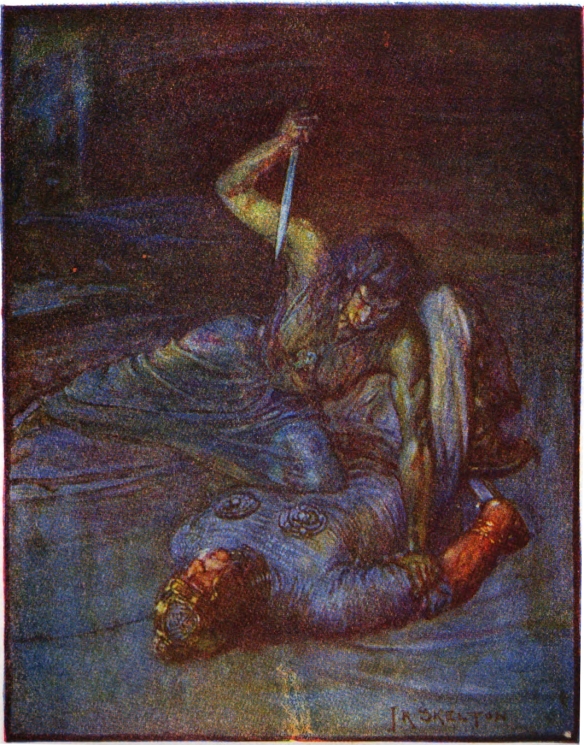
Grendel's mother menaces a pinned Beowulf with a knife.

By J. R. Skelton – Marshall, Henrietta Elizabeth (1908) Stories of Beowulf, T.C. & E.C. Jack, Public Domain, https://commons.wikimedia.org/w/index.php?curid=11001837

Back To Top
Synopsis

Hrothgar explains why Æschere was so dear, and faces the reality that now confronts his taken friend.

Back To Top
Translation

“Hrothgar spoke, protector of the Scyldings:
‘Ask ye not about the night’s joy; sorrow is renewed
to the Danish people. Æschere is dead,
Yrmenlaf’s elder brother,
my counsellor and confidant, my adviser,
my shoulder companion, when we at battle
were both at the fore, when we clashed with foes,
when the boar figures were struck. So should a man be,
a warrior who has proven his worth, so Æschere was!
This deadly creature came wandering to Heorot
to kill him by hand; I know not to what secret place
that terrible one slunk to turn him to carrion,
to make of him a gladdening feast.'”
(Beowulf ll.1321-1333a)

Back To Top
Recordings

Old English:

{Forthcoming}

Modern English:

{Forthcoming}

Back To Top
Beowulf: a Half-Assing Hero?

Hrothgar is laying it all out there. The warrior that Grendel’s mother carried off wasn’t just some thane or some hall dweller, but his dearest companion and, from the sound of it, his trusted long-time adviser. Of course, all of this comes across in Hrothgar’s relating how he and the man fought side by side in the heat of battle, as well as the statement that he “had proven his worth” (“ærgod” (l.1329)). This line is a bit difficult to swallow for me, though.

It sounds like Hrothgar might be calling Beowulf out here, only lightly and through implication, but still. Yet, hasn’t Beowulf also proven himself as a warrior in defeating Grendel? It sounds like the difference is that the foes that Hrothgar and Æschere beat in their heyday didn’t retaliate after a sound thrashing. But, being monsters (and yet, very human since she is motivated by grief for family), Grendel’s mother does so. I definitely get a strong sense that along with Hrothgar’s woe in losing Æschere there’s a sense that Beowulf did not entirely complete the job.

Sure, the Geat killed Grendel, but he didn’t manage to rid Heorot of its monster problem. Though, of course Beowulf and everyone else had no idea that Grendel had a mother, or a family.

In fact, leading up to his appearance, Grendel is only ever referred to as the “kin of Cain.” We’re never really told anything else about his other relations. It’s almost as if Grendel wasn’t born through sex and conception, but instead sprang fully formed from Cain’s murdering Abel; as if he himself is a physical manifestation of a terrible sin. One that would have a lot of resonance with people like the Anglo-Saxons because of their familiarity with stories like Hod’s killing his brother Balder. Though that is a story of accidental fratricide.

What do you think? Is Hrothgar about to lay into Beowulf for not realizing that Grendel’s mother would come crashing in on Heorot’s new “peace”? Or was Grendel’s mother a surprise to everyone and Hrothgar is struggling through his grief and shock to try to say “Beowulf, do it again!”?

Back To Top
Seeking Advice when faced with a Murderous Sprite

If you’re ever about to encounter a “wæl-gæst,” you’d likely want to get some advice. Why? Because running into a “murderous sprite” (from “wæl” (“slaughter,” or “carnage”) and “gæst” (“breath,” “soul,” “spirit,” “life,” “good or bad spirit,” “angel,” “demon,” “Holy Ghost,” “man,” or “human being”)) is no small thing.

You’d definitely want to go and seek a “run-wita.”

Such a person is someone who could be considered an adviser. After all, “wita” means “sage,” “philosopher,” “wise man,” “adviser,” “councillor,” “elder,” “senator,” “witness,” or “accomplice”); and run means “mystery,” “secrecy,” “secret,” “counsel,” “consultation,” “council,” “runic character,” “letter,” or “writing”. So such a person would be able to tell you much that is mysterious or secret.

Though your adviser should also be someone whom you could trust indefinitely because of the mysteriousness of your situation (how else can you be sure of their secretive information?).

So you’d want someone whom you could (or, hopefully already do) consider a person that you’ve been to shoulder to shoulder with before – whether it was in a tight shield wall formation on the battle field or it was waiting together in a packed line at some government office. The kind of person whom you could call an “eaxl-gestealla” with confidence, a person who indeed was a “shoulder-companion” (from the combination of “eaxl” (“shoulder”) and “steall” (“standing,” “place,” “position,” “state,” “stall (for cattle),” “stable,” or “fishing ground”)).

This sort of adviser would, in that way, be more than just someone giving you some pointers, they would be a veritable “ræd-bora.” That is, someone whom you consider a ruler (bora, or “ruler”) of wisdom (ræd (that is: “advice,” “counsel,” “resolution,” “deliberation,” “plan,” “way,” “design,” “council,” “conspiracy,” “decree,” “ordinance,” “wisdom,” “sense,” “reason,” “intelligence,” “gain,” “profit,” “benefit,” “good fortune,” “remedy,” “help,” “power,” or “might”)).

And, of course, given the fact that people might think you’re crazy if you come to them asking for help with a murderous sprite problem, your chosen adviser should be someone whom you knew was good at sharing tips from way back, or, as the Anglo-Saxons would say, was “ær-god.” This word comes from the combination of “ær” (“ere,” “before that,” “soon,” “formerly,” “beforehand,” “previously,” “already,” “lately,” or “’til”) and “god” (“good (of persons or things),” “virtuous,” “desirable,” “favourable,” “salutary,” “pleasant,” “valid,” “efficient,” “suitable,” “considerable,” “sufficiently great,” “good thing,” “advantage,” “benefit,” or “gift”) to mean “good from old times.”

With such an “ær-god” person on your team, you could definitely survive the quest to the murderous sprite and the “eft-sið,” or “journey back” (from “eft” (“again,’ “anew,” “a second time,” “then,” “thereupon,” “afterwards,” “hereafter,” “thereafter,” “back,” “likewise,” or “moreover”) combined with “sið” (“going,” “motion,” “journey,” “errand,” “departure,” “death,” “expedition,” “undertaking,” “enterprise,” “road,” “way,” “time,” “turn,” or “occasion”)).

Back To Top
Closing

Next week Hrothgar talks Beowulf.

You can find the next part of Beowulf here.

Back To Top

Wondering what makes Grendel’s mother special, compound words to put to work in the afterlife (ll.1269-1278)

Abstract
Translation
Recordings
What’s the Defining Trait of Grendel’s Mother?
Important Compounds for a Visit to Death’s Dwelling
Closing

Grendel's mother menaces a pinned Beowulf with a knife.

By J. R. Skelton – Marshall, Henrietta Elizabeth (1908) Stories of Beowulf, T.C. & E.C. Jack, Public Domain, https://commons.wikimedia.org/w/index.php?curid=11001837

Back To Top
Abstract

The poet wraps his retelling of when Grendel met Beowulf and gets to the monster’s mother.

Back To Top
Translation

“There that man seized the monster;
nevertheless he was mindful of his great might,
an ample allotment of strength, that which God granted him,
and he trusted in the Ruler’s favour,
comfort and support; through that he overcame the fiend,
laid the hell beast low. Then he humiliated went,
deprived of joy and seeking the dwelling of death,
thus went the enemy of men. And his mother would yet
come, gluttonous and gloomy in mind,
on her joyless journey, all to avenge the death of her son.”
(Beowulf ll.1269-1278)

Back To Top
Recordings

Old English:

{Forthcoming}

Modern English:

{Forthcoming}

Back To Top
What’s the Defining Trait of Grendel’s Mother?

Here we see the third retelling of Beowulf’s fight with Grendel come to an end. Blech. After hearing about it twice in under 500 lines you’d think the poet would be sick of telling it, right?

Well, maybe. But each time that it’s been retold so far, the story of Grendel being beaten is told with a distinct purpose.

The first time, when the poet gives us the play-by-play, the fight is purely an action sequence and a display of the incredible strength that both combatants are using.

When Beowulf retells the fight, he does so to recount fresh glory and to bolster his reputation through boasting. Here, the poet retells it as a way of giving us information about Grendel’s mother. He does this by starting and ending the story with a mention of her, and he uses this story to show us what’s motivating her attack.

So Grendel fought Heorot because he was the kin of Cain and the noise of the joyous partying inside disturbed him. But Grendel’s mother is fighting for vengeance.

Even so, information about just what makes Grendel’s mother a threat is still scant.

Grendel’s reputation as a terrible monster who was immune to weapons was established well before Beowulf encountered him. But, so far all we know of Grendel’s mother is that she’s been pushed to vengeance because of her son’s death, otherwise we know nothing about her specifically. Really, the one thing the poet’s been emphasizing is that she has a “woman’s misery” (” yrmþe gemunde” (l.1259)) in mind and comes in off the moors “gloomy in mind” (“galgmod” (l.1277)). So Grendel’s mother’s major characteristic appears to be that she’s a woman. What’s up with that?

So far the only other women that have been mentioned are mothers and sisters, women defined by their familial roles and civil duty. Of these women we saw Hildeburh weeping over her dead brother and son (ll.1076-1080), and throughout the “Heorot freed?” part of the poem we see Wealhtheow ruling with her son’s protection and advancement in mind. Those are the only named women so far, and they’ve been ladies of the court. We really know nothing about other women in this world. Though, if Hildeburh and Wealhtheow are ladies of the court, and behave in a way that’s civil within the patriarchal society of the poem, what’s that say about Grendel’s mother?

It definitely suggests that she’s a savage by comparison, but that goes without saying right? She’s some sort of wild creature living on the fen, so of course she’ll be savage. Though, the poet’s emphasizing her living amongst wild things does mark her as an outsider. This also doesn’t come as any surprise. But, really, how can you be surprised when you’ve been told so little?

Why do you think it’s such a big deal that Grendel’s mother is a woman? Is this a point in the poem that’s just plain misogynistic? Leave your thoughts in the comments.

Back To Top
Important Compounds for a Visit to Death’s Dwelling

This week’s small tale told with the passage’s compound words is pretty straightforward. So I’ll get right to it.

At one time or another, we all come to the “deaþ-wic,” or “dwelling of death.” This strangely fun euphemism for death comes to us from the combination of “deaþ” (“death,” “dying,” or “cause of death”) and “wic,” (“dwelling place,” “lodging,” “habitation,” “house,” “mansion,” “village,” “town,” “entrenchments,” “camp,” “castle,” “fotress,” “street,” “lane,” “bay,” or “creek”) making the literal translation stand up pretty well. Actually, I can’t help but wonder if the definitions of “wic” are so broad because death can be found “living” just about anywhere.

Anyway, once we’ve been welcomed in it’s possible that we’ll meet a “helle-gast” or two. As you might’ve guessed, this wouldn’t be the best of meetings, since a “helle-gast” is literally a “spirit of hell.” This straight-to-the-point compound sees “helle” (“hell”) and “gæst” (“breath,” “soul,” “spirit,” “life,” “good or bad spirit,” “angel,” “demon,” “Holy Ghost,” “man,” or “human being”) combined into something that’s unmistakable. Just as unmistakable as the fact that meeting a “helle-gast” would probably make you “galg-mod.”

At least, I imagine meeting a “spirit of hell” would make you “sad,” “gloomy,” or “angry.”

The compound “galg-mod” itself is made up of “galg” (“gallows,” “cross,” or “melancholy”) and “mod” (“heart,” “mind,” “spirit,” “mood,” “temper,” “courage,” “arrogance,” “pride,” “power,” or “violence”). The mix of “melancholy” and almost any of the definitions of “mod” (which I’d broadly define as “spirit” in both the ethereal sense and the will power sense) is pretty clear, but I quite like the reference to Christ in the definition of the word as “cross.” Despite the definition of “galg” as “gallows” I can’t help but feel that “galg” is weirdly uplifting, likely because it tempts me to try to translate “galg-mod” as “gallows humour.”

Though, if instead of a “helle-gast” you met the “an-walda” when Death ushered you through its dwelling, you’d likely be filled with straight up humour (maybe, depending on how many harps and angels are involved, it could be a kind of super syrupy “vanilla” humour, though). After all, “an-walda” is one of many Old English terms for “god,” though it’s usually translated simply as “Ruler.”

I think we all know where it’s coming from, though.

Especially if you look at the meanings of “an” (“one”) and “walda” (“might,” “power,” “possession,” “control,” “command,” “dominion,” “bridle,” “protection,” “subjection,” “groin,” or “pudenda”). It could be a bit of Christianization, but there’s definitely one deity here who’s trying to come out on top – in both the poet’s and Beowulf’s estimation.

But why not go with this “an-walda”? I mean, if it’s the thing that’s giving Beowulf his strength, then it’s an entity that’s quite “gim-fæst.” That is to say, it’s quite “liberal” or “ample” in its gift giving. Which makes sense since “gim” is a form of “ginn,” a word meaning “spacious,” “wide,” or “ample” and “fæst” which means “fast,” “fixed,” “firm,” “secure,” “constant,” “steadfast,” “stiff,” “heavy,” “dense,” “obstinate,” “bound,” “costive,” “enclosed,” “closed,” “watertight,” “strong,” “fortified.”

Why do you think that Old English has more than one word for god (Anwalda, Metod, Drihten, etc.)?

Back To Top
Closing

Next week, Grendel’s mother arrives in Heorot.

You can find the next part of Beowulf here.

Back To Top

Grendel’s mother teased, monstrous and criminal words (ll.1251-1268)

Abstract
Translation
Recordings
The Slow Reveal of Grendel’s Mother
Lady Monsters, Criminals, and Festive Bedtime Stories
Closing

Grendel's mother menaces a pinned Beowulf with a knife.

By J. R. Skelton — Marshall, Henrietta Elizabeth (1908) Stories of Beowulf, T.C. & E.C. Jack, Public Domain, https://commons.wikimedia.org/w/index.php?curid=11001837

Back To Top
Abstract

The poet lingers on Grendel as he starts to introduce the next threat: Grendel’s mother.

Back To Top
Translations

“Sank they then to sleep. One man paid a dear price
for that evening’s rest, as they went to it as they would
in the gold hall before Grendel occupied it,
ruled with terror, until his end came,
death after such dire crimes. They then became manifest,
those deeds of the widely known man, that avenger then yet
lived after that hateful one, for a long time,
while he wallowed in war wounds. Grendel’s mother,
that hag, the one with a woman’s misery in mind,
who was made to inhabit fearsome waters,
who lives in cold streams, after Cain became
the slayer by the sword of his own brother,
kin by the same father; he fled as an outlaw for that,
marked with murder, fled from the joy of companionship,
occupied the wilderness. Thence was born
that terrible fate; that was hateful Grendel,
the savage outcast, then at Heorot he found
a watchful man waiting for war.”
(Beowulf ll.1251-1268)

Back To Top
Recordings

Old English:

{Forthcoming}

Modern English:

{Forthcoming}

Back To Top
The Slow Reveal of Grendel’s Mother

This passage is quite a bit longer than previous weeks’. I think the poet lengthens things here to draw out the suspense. Though he might go a little too far, teasing us with talk of Grendel’s mother only to fall back to recounting Grendel’s visits to Heorot and the night that he found Beowulf there, “waiting for war” (“wer wiges bidan” (l.1268)).

I mean, this is now the third time or so that we’ve heard tell of Beowulf’s beating Grendel. The first time being when we witnessed it through the poet’s interpretation, then through Beowulf’s retelling of the story, and now, again, we have the poet giving us a précis. What makes this regular retelling strange is that there’s at least one more: when Beowulf tells the tale again (with some embellishments) to his liege lord Hygelac.

What really confounds me here, though, isn’t that the story of Grendel’s being told yet again just a few hundred lines after he was mortally wounded (which comes on lines 814-818, and which Beowulf retells on lines 960 to 979), but that the poet feels the need to refresh us on who Grendel was while he also introduces a new character: Grendel’s mother.

And that in particular bugs me because we get so little detail about Grendel’s mother. She seems to be a dweller in the fen as her son was, but then where’s she been since the Danes built Heorot and moved in? Was Grendel sneaking out to wreak havoc by simply telling her he was “going out for a bit”? Why wasn’t she there with him?

Her absence from Grendel’s raids really makes me wonder if Grendel’s mother wasn’t somehow summoned up by his defeat. Unless she just got back from some very important business on the far side of the fen to find her son lying dead and so lashes out as she does.

But then, is she sophisticated or as beastly as Grendel himself? More modern depictions vary from the seductress of Beowulf the Musical Epic and Angelina Jolie’s portrayal of her in Robert Zemeckis’ Beowulf of 2007 to the hag in Sturla Gunnarsson’s Beowulf & Grendel (2005).

But I suppose that’s what makes Grendel’s mother such a mysterious figure. The poet tells us that she “inhabits fearsome waters” (“wæteregesan wunian” (l.1260)), and that she has a “woman’s misery in mind,” (“yrmþe gemunde” (l.1259)), both of which are supposed to tell us what she’s all about. Though the latter is far less than helpful.

Is this “woman’s misery” the grief that a mother feels for the death of her son? Or is it the sort of superhuman vengeance a woman wronged can direct towards the one who wronged her?

What do you think? Leave your thoughts in the comments.

Back To Top
Lady Monsters, Criminals, and Festive Bedtime Stories

During a “man-dream” many stories would be told. And, no, those stories wouldn’t necessarily end with “and it was all a dream!” That’s because “dream” in Old English means: “joy,” “gladness,” “delight,” “ecstasy,” “mirth,” “rejoicing,” “melody,” “music,” “song,” or “singing.” Combine that with “man” (“one,” “people,” “they”), and you wind up with “man-dream” (“revelry, festivity”).

Then, as now, stories told during such a festive atmosphere, would vary from the heroic (the bread and butter of Beowulf and his poet) to the comical or frightening. A frightening story (or perhaps a heroic one if the ending’s different) might just involve an “aglæc-wif.”

This “aglæc-wif” would be a fresh twist on an old classic (and maybe extra chilling because of it), since “aglæc-wif” means “female monster.” As a compounding of “aglæc” (“wretch,” “monster,” “demon,” or “fierce enemy”) and “wif” (“woman,” “female,” or “lady”; or, as a suffix, “-wif” could mean “fate,” “fortune,” or “a disease of the eye.”), this meaning is pretty clear. Though why the sex or gender of a monster should matter, is a bit of a mystery to me. Whatever the impact, the way that the poet is slowly introducing Grendel’s mother, it seems like this kind of female monster was “wid-cuþ” among storytellers and listeners of the age.

If such tales were “widely known” (that is, wid-cuþ, literally a mix of “wid” (“wide,” “vast,” “broad,” or “long”) and “cuþ” (“known,” “plain,” “manifest,” “certain,” “well known,” “usual,” “noted,” “excellent,” “famous,” “intimate,” “familiar,” “friendly,” or “related”) to bring us here), then there’s very little mystery as to why the poet leaves so much about Grendel’s mother to his audiences’ imaginations. Though it is telling that she is referred to as a “wæter-egesan.”

As a “wæter-egesan,” perhaps she, or her kind in general, is specifically well-known as a “water terror,” that word’s translation. Just like its Modern English counterpart, this compound’s “wæter” means “water,” while “egesan” could mean “awe,” “fear,” “horror,” “peril,” “monstrous thing,” “monster,” or “horrible deed.” But put them together and you’ve got a quick way to refer to creatures strange and odd that hunt in the water.

Despite all of this vagueness around Grendel’s mother and how frustrating it might be, it’s not surprising that we know more about her than we do about Grendel’s father. After all, Beowulf comes from a cultural context in which the prevailing Christian idea of sin was that you bore the sins of your father.

So, as kin of Cain, Grendel is still marked by the sin of the first murderer. That’s what he gets as a paternal kinsmen of Cain, one of his “fæderen-mæge”; Grendel is Cain’s son, since of all murderers, the first ever would have a very hard time being redeemed.

That makes “fæderen-mæge” quite potent when referring to Grendel’s paternal lineage. Which makes sense, since, as a combination of “fæderen” (“father,” “male ancestor,” “the Father,” or “God”) and “mæge” (“male kinsmen,” “parent,” “son,” “brother,” “nephew,” “cousin,” “compatriot,” “female relation,” “wife,” “woman,” or “maiden”) the word means “paternal kinsmen.”

Because of Grendel’s particular paternal lineage, he is a “geosceaft-gasta,” or a “doomed spirit” This compound’s neat because it contains a compound itself since “geo-sceaft” is a combination of “geo” and “sceaft” (which I discuss here). It’s also quite straightforward since there’s no escaping that “geosceaft-gasta” means “doomed monster,” or “doomed person.” Which is pretty much perfect since “gasta” means “breath,” “soul,” “spirit,” “life,” “good or bad spirit,” “angel,” “demon,” “Holy Ghost,” “man,” or “human being.”

Such a creature could be described as a “heoru-wearh.”

A “heoru-wearh” is a “bloodthirsty wolf.” Though you wouldn’t necessarily get that sense from this compounding of heoru (sword) and wearg (“wolf,” “accursed one,” “outlaw,” “felon,” “criminal,” “wicked cursed,” or “wretched”). The word leaves me with more a sense of a someone in power (hence their possessing a sword) who is corrupt or criminal, someone who really can’t be trusted with that power since they’ll likely use it against the greater good — solely for their own gain.

A much simpler sort of criminal is contained in the word “ecg-banan.” This compound means “slayer with the sword” and comes from the mix of “ecg” (“edge,” “point,” “weapon,” “sword,” or “battle axe”) and “banan” (“killer,” “slayer,” “murderer,” “the devil,” or “murderess”). So it’s much less metaphorical than “heoru-wearh.” Though either of these beings could cause you “guþ-cear.”

“Guþ-cear” refers to “war-trouble.” As a compound of “guþ” (“combat,” “battle,” or “war”) and “cearu” (“care,” “concern,” “anxiety,” or “sorrow”) that makes good sense. “War-care” is a great way to say “wound” since it’s something you’re likely pretty concerned about in the midst of war, and well afterwards you might still make a fuss about it. Though hopefully not enough of a fuss (whether fresh or long since healed) to let yourself and others enjoy a nice “æfen-ræst.”

This word means “evening rest,” thanks to the combination of “æfen” (“even,” “evening,” or “eventide”) and “ræst” (“rest,” “quiet,” “repose,” “sleep,” “resting-place,” “bed,” “couch,” or “grave”).

Yes, a good “evening rest” after all the tales during a “man-dream” could indeed help refresh you after receiving some “gudth-cear.” Though, with “ræst”‘s meaning (quite similar to our own modern euphemism) “the grave,” your “gudth-cear” could also send you to a lengthy “æfen-ræst” indeed.

Why do you think gender gets specified in the compound “aglæc-wif”?

Back To Top
Closing

Next week the poet spills more about Grendel’s mother.

You can find the next part of Beowulf here.

Back To Top

Unferth the reason for Grendel? A very German compound word (ll.1159b-1168)

Abstract
Translation
Recordings
Unferth the Cause of Heorot’s Woes?
A Collection of Compounds
Closing

Back To Top
Abstract

As we return to the hall after the story of Hildeburh, Finn, and Hengest, we’re given a brief tour of the social hierarchy in Heorot before Wealhtheow takes centre stage.

Back To Top
Translation

“Then the song was sung,
the entertainer’s tale. Revelry again arose,
the noise among the benches flashed as the cup bearer brought
joy from/the joy of the wondrous vessel. Then Wealhtheow came forth,
going under the weight of golden rings, over to where
the two sat, nephew and uncle; there yet were those kin together,
each to the other true. Also there sat spokesman Unferth
at the foot of the Scylding lord’s seat; each of them to his spirit trusted,
that he had great courage, though he to his own kin was not
merciful at the swordplay. Spoke then the Scylding lady:”
(Beowulf ll.1159b-1168)

Back To Top
Recordings

Old English:

{Forthcoming}

Modern English:

{Forthcoming}

Back To Top
Unferth the Cause of Heorot’s Woes?

And just like that the story of Hildeburh, Hengest, and Finn is over and it’s back to the meadhall Heorot. Though I think it’s worth a quick noting that the Beowulf poet implies that everyone was quiet while his in-story counterpart sang of the Danes’ patient revenge on the slayer of their lord. The Beowulf poet (or the person who wrote it down) likely wanted to imagine a place and time when their art was more respected. Or, maybe having a quiet crowd is a way of showing how important what’s being recounted is.

Though however quiet the revellers of Heorot were while the poet sang of Hengest and Finn rekindling the age-old feud of their peoples, they’re right back to it once the poem’s over. I mean, the benches are simply flashing with the noise of it all — that’s just how close the motion of the people on the benches and the noise coming from them is. That’s really something!

But after we return to the partying atmosphere of Heorot in celebration of Beowulf’s deed and the greatness that he’s helped restore, we’re given a bit of a sombre note to carry through the procession. And, just as Hildeburh was the bearer of sorrow in the story we just heard, Wealhtheow, Hrothgar’s lady, now seems to be carrying the same. As she goes through the hall to the high seat, the poet follows her, describing along the way the relationship of Hrothgar and his nephew and how Unferth, the doubter of Beowulf, fits into the hierarchy at Heorot.

And that’s where that note of sorrow is hit the hardest.

It seems that Unferth is quite an esteemed counsellor in Heorot, “each of them to his spirit trusted” (“gehwylc hiora his ferhþe treowde” (l.1166)). And yet, the poet makes it clear that this is the case “though he to his own kin was not/merciful at the swordplay” (“þeah þe he his magum nære/arfæst æt ecga gelacum” (ll.1167-1168)).

So Unferth has committed one of the harshest crimes of all in the Anglo-Saxon world — kin-killing. We’re never given any more detail than this about the incident that the poet’s referring to, but it continues to be a constant black mark on Unferth’s reputation for as long as he plays a role in the poem. In fact, Beowulf has even heard of this, since he mentions it in his witty riposte to Unferth’s doubting his stories of valour when he first comes to help Hrothgar with his monster problem (l.587).

So that makes me wonder.

If Unferth’s killed his own kin, a crime that really has no means of punishment (who do you ask for wergild — the monetary punishment for murder meant to cut feuds off before they can start — especially in a situation where the price was often paid by a group rather than an individual, and how could a single person’s paying into the group that he lives in be a punishment, if Anglo-Saxon society is all about distribution of wealth based on success on the battlefield?), how is he able to be such a trusted advisor?

Is he allowed this position because he’s been through the hell of having killed a relative and was left to live with the infamy?

And, in terms of the wider story of Heorot, could Unferth’s killing his kin and then Hrothgar’s bringing him on as an advisor been the thing that sparked Grendel’s feud with Heorot? After all, Grendel is “the kin of Cain” (“Caines cynne” (l.107)), and Cain was damned for killing his own brother. So is Grendel an ironic punishment in the grand tradition of ironic Christian punishments — a monster born of kin-killing that’s come to destroy a place that supports someone who killed his kin but has yet to be perceived as fully monstrous (that is, exiled or ostracized) for it?

So many questions. If you’ve got some opinions or hypotheses to share, please feel free to do so in the comments.

Back To Top
A Collection of Compounds

This week’s batch of compounds covers the range of the straightforward to the much less obvious. Let’s get right into it.

First is line 1160’s “gleo-mann,” meaning “gleeman,” “minstrel,” “player,” “jester,” or “parasite.” This word comes from the compounding of “gliw” (“glee,” “pleasure,” “mirth,” “play,” “sport,” “music,” or “mockery”) and — surprise, surprise — “man” (“person,” “man,” “mankind,” “brave man,” “hero,” “vassal,” “servant,” “name of the rune for ‘m,'” or “used indefinitely like Modern English ‘one'”).

This is a pretty clear compound that, although archaic today, remained in English for quite a while as “gleeman.” Though by the time it got to us, the word’s connotations depreciated (it became pejorated, as linguists say), as “gleo-mann” started to carry a connotation less of a poet who brought joy to people and more of a connotation of someone closer to a court jester rattling off bad rhymes and worse jokes, perhaps giving people glee more through the idiocy of his performance than what he was performing.

Then we get line 1161’s “benc-sweg.” This one brings together the near cognate “benc” (“bench”) with the word “sweg” (“sound,” “noise,” “clamour,” “tumult,” “melody,” “harmony,” “tone,” “voice,” “musical instrument,” or “persona”), to mean “bench-rejoicing,” or “sound of revelry.”

It’s not too terribly surprising a compound once you get over the Old English word for “sound” being “sweg,” but it’s still kind of neat because if you were to tell someone about the “bench sound” today, they’d probably think of a wooden bench scraping across a floor, not the sound of lively conversation, mugs clinking, and drunken singing. Oh how times have changed.

Then, as if lined up nice and neatly, on line 1162 we get the last of this week’s plainer compounds with “wunder-fatum.” The Old English word “wunder” means almost what our “wonder” does, but more in the UK English noun sense (which we don’t really hear much in North America), since “wunder” means “wonder,” “miracle,” “marvel,” “portent,” “horror,” “wondrous thing,” or “monster.” And “fatum,” since the letter “f” when it’s surrounded by vowels in Old English sounds like a “v” is the ancestor of our “vat,” though it’s got a more general meaning of “vat,” “vessel,” “jar,” “cup,” “casket,” or “division.”

Combine these two words and you get the Old English “wunder-fatum,” which means “wondrous vessel.” A little nickname for the ale pitcher or mead jug, since that’s definitely what its bearer is pouring out.

Hopefully those simpler three have you warmed up, because the next compound we come across in this passage is line 1164’s very German-seeming “suhterge-faederan.” Since this word compounds “suhterge” (“brother’s son,” “nephew,” “uncle’s son,” or “cousin”) with “faederan” (“paternal uncle”), “suhterge-faederan” itself means “uncle and nephew.”

It’s definitely not a word that we have in Modern English. And my guess is that the reason we don’t is because of family dynamics. Uncles are no longer a go-to mentor figure for children. In fact, “the creepy uncle” is a way more common trope than the informative or wise uncle, something that’s almost solely concentrated in grandparent figures in pop culture now. So here’s another sign that times have changed quite a bit from the days in which Beowulf was sung.

My guess as to why this happened (a very quick and dirty guess) is that people started to raise their own kids rather than sending them out to learn a trade or how the hierarchy within a house or hall worked, so uncles and aunts came to play less and less of a role while grandparents (perhaps because they’d actually be visited or lived with?) continued to play a role in children’s growing up. Not a perfect hypothesis, but I’m not looking for something air tight.

Or water-tight for that matter.

Which brings me around to the word “aerfaest” from line 1168 meaning “respected,” “honest,” “pious,” “virtuous,” “merciful,” “gracious,” “compassionate,” or “respectful.”

I mention water-tightness here, though because that’s one of the meanings of “faest,” along with “fast,” “fixed,” “firm,” “secure,” “constant,” “steadfast,” “stiff,” “heavy,” “dense,” “obstinate,” “bound,” “costive,” “enclosed,” “closed,” “strong,” “fortified,” “reputable,” or “standard”; while “aer” means “ere,” “before that,” “soon,” “formerly,” “beforehand,” “previously,” “already,” “lately,” or “till.”

Given what we’re told about Unferth being trustworthy because of some sort of past loyalty (a more literal interpretation of “aerfaest,” I think (maybe too literal?)) seems pretty suspect. Unless, maybe the relative that Unferth killed was in opposition to Hrothgar, and so, as unforgivable an act as it is, Unferth was brought in because his actions suggested that his loyalty to Hrothgar was greater than that between relatives (perhaps Unferth killed a nephew, or an uncle? Maybe not too far-fetched if the uncle-nephew relationship was prominent enough in Anglo-Saxon society to get its own compound).

Maybe that’s the key to all of this, Unferth, as unsavoury as his behaviour is to the rest of the world, is trusted within the realm of Heorot because of that loyalty to Hrothgar — he’s successfully and seriously set his lord over his family in an age when family was important, but not necessarily the top priority.

Though that Hrothgar would keep such a person around, one who, according to the conventions of the time was a little monstrous himself — what does that say about Hrothgar? Perhaps Hrothgar’s making Unferth a counsellor is what brought Grendel on him in the first place, not because Hrothgar harboured one who failed to fall into the binary of monster/not-monster, but because Hrothgar himself was an even greater monster in disguise.

Do you think that Unferth’s killing his kin relates to why Grendel attacked Heorot in the first place? Or was it something else that kicked off all of Hrothgar’s troubles?

Back To Top
Closing

Next week, Wealhtheow gives Hrothgar her two cents on everything that’s happened since Beowulf arrived and what the lord of the hall should do.

You can find the next part of Beowulf here.

Back To Top

The poem returns to the status quo, words of war and of hall life (ll.1080b-1094)

Abstract
Translation
Recordings
Battleground just a Board Game?
Battle Words and Hall Words
Closing

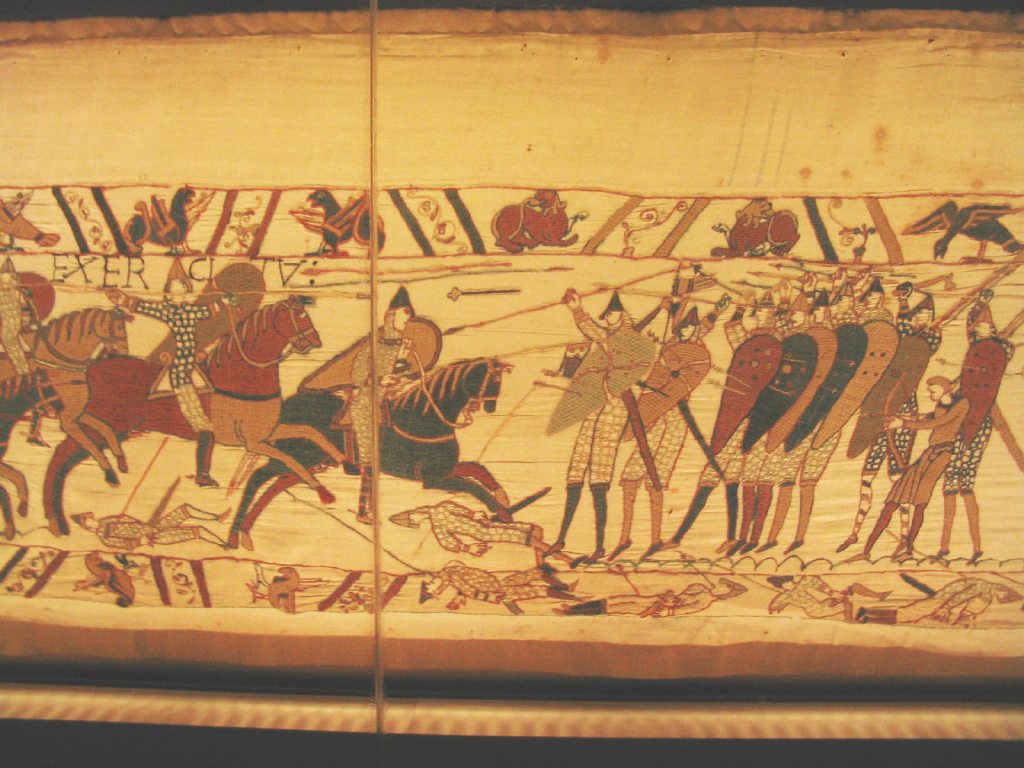
A section of the Bayeux Tapestry showing Anglo-Saxon warfare

Image found here: “Bayeux Tapestry 4” by photo by Gabriel Seah – gssq.blogspot.com. Licensed under Public Domain via Commons.

Back To Top
Abstract

Hrothgar’s poet continues his story, as he shifts from Hildeburh to what’s happening between the battle’s commanders, Finn and Hengest.

Back To Top
Translation

“War had borne away
all of Finn’s warriors, save for a few alone,
so that he might not take to the field
to wage war against Hengest,
nor could the wretched remnant defend against hostility,
that lord’s man; but he to him offered terms,
that they for him clear the other side of the floor,
of the hall and high seat, so that he could control half
of what the sons of the Jutes possessed,
and that at the giving of gifts the son of Folcwalda
daily do honour to each Dane,
that even as generously to Hengest’s kin
he would grant those things, treasure rings
of twisted gold, as to his Frisian kin
during the giving in the beer hall.”
(Beowulf ll.1080b-1094)

Back To Top
Recordings

Old English:

{Forthcoming}

Modern English:

{Forthcoming}

Back To Top
Battleground just a Board Game?

Well, by now Hildeburh has fallen by the wayside, unfortunately, as the men debate and discuss what’s to be done. So the poem’s subject has returned to the status quo.

So what was even the point of showing Hildeburh mourning her fallen family?

I still think it’s supposed to mirror Grendel’s mother’s reaction to the death of Grendel. And I think it’s supposed to bring a bit of humanity to what might otherwise be simply expressed in lines 1080-1081’s “war had borne away/all of Finn’s warriors, save for a few alone” (“Wig ealle fornam/Finnes þegnas nemne feaum anum”).

I mean, starting with Hildeburh in mourning immediately establishes the tone of this war scene as sorrow and devastation rather than glory or action or excitement. And even though it’s not really clear who has the upper hand between Finn and Hengest in this situation, I think the poet at the least wanted to get across the direness of the battle between Finn and Hengest before it turned into just another war story.

But, who is in the position of power here? Finn’s forces are apparently nearly wiped out, but from line 1090’s alliteration with “d” on “daily” and “do” and “Danes” (in the original, it’s on “dogra” and “Dene” and “weorþode”) to the end of this passage it sounds like Hengest and his Danes are at the disadvantage. They’re the ones that need to be honoured and gifted to the same degree as Finn and his Frisians.

Running with that arrangement, it seems that Finn’s forces were nearly wiped out by Hengest’s, and yet Finn is the one who’s being called on to split up his wealth evenly for the time being. If Finn’s unable to take the field, but isn’t willing to admit defeat, then maybe this part of the passage shows the Danes being good sports, settling instead for hospitality rather than utter dominance.

If such is the case, then it makes you wonder why the Danes are willing to negotiate in the first place. The poem in general sets up the Frisians as great enemies of the Danes, so maybe, in an effort to keep that rivalry alive, this negotiation is the Danes’ letting Finn go this time so that he and his Frisians can shore up their numbers and try fighting them again.

But that makes it sound like a game. And the part of the passage about dividing the floor in half between the two groups makes it sound like it could be nothing more than a reference to a board game of some kind. Maybe something like chess or checkers. Though it would have to be a game with rules that include daily ring-giving (every turn, maybe?) and different movement rules and strategies than either of those games. Especially if dividing the board in half is some sort of special condition rather than the normal starting point of the game.

But if this conflict between Finn and Hengest is just a board game memorialized in poetry, why does it begin with Hildeburh mourning her fallen son and brother? Is the poet making a joke at the expense of her grief, implying that she’s a spectator who got so involved in the game she weeps over the loss of two pieces in particular? Or is it that Hildeburh’s grieving by the morning light is another of the game’s forgotten rules? Has Hengest activated the “mourning woman” card that entitles him to these negotiations in the first place?

As you’ve probably guessed this hard turn into peace negotiations with unclear sides is where this passage becomes truly mysterious, even laying aside its starting out with Hildeburh surveying the battlefield.

So what do you think? Is this poem that Hrothgar’s poet is reciting about an actual conflict or just some board game match?

Back To Top
Battle Words and Hall Words

The compound words in this passage are evenly split between matters of battle and matters of hall etiquette.

In the first category we’ve got “meðel-stede” and “weal-laf.”

Line 1082’s “meðel-stede” means “place of assembly,” or “battlefield.” It comes from the combination of “meðel” (“council,” “meeting,” “popular assembly,” “speech,” or “interview”) and “stede” (“place,” “site,” “position,” “station,” “firmness,” “standing,” “stability,” “steadfastness,” “fixity,” or “strangury”). As such, it’s pretty clear that it refers to a place where lots of people meet (or where lots of urine collects before leaving the body drop by drop, if we go with “strangury”).

The jump from “place of assembly” to the specific “battlefield” seems a bit of a leap, though. Neither of the words that make up “meðel-stede” are directly related to battle, so the meaning of the compound as “battlefield” implies that the Anglo-Saxons just regarded warfare as a different kind of council or meeting.

Maybe, like the ancient Greeks, and some early African peoples, war to the Anglo-Saxons wasn’t necessarily about killing but more about a kind of dramatic enactment of conflict, a kind of play with very real stakes (and very real injuries and deaths every now and then).

Or, maybe the use of this compound (beyond its alliterating with the line’s “m” sounds) feeds into the interpretation of this whole conflict between Finn and Hengest being some kind of board game. Maybe the two had some petty squabble so instead of putting actual people into the midst of it, they just played a round or two of whatever strategy game was popular at the time.

The other word that falls into the “war” category, line 1084’s “wea-laf,” is much more easily relatable to battle. After all, “wea” means “misfortune,” “evil,” “harm,” “trouble,” “grief,” “woe,” “misery,” “sin,” or “wickedness” and “laf” means “what is left,” “remnant,” “legacy,” “relic,” “remains,” “rest,” “relict,” or “widow.”

So the first word in “wea-laf” is a judgment of war that probably comes from the losing side rather than the winning one and the second word refers to those left behind (including the sense of a “widow,” which suits Hildeburh perfectly, and expands the meaning of the compound beyond merely those directly involved in the conflict).

Together, then, “wea-laf” implies that a small group was left over after the wickedness of war swept the rest away. So there is some small, beat up group left on the losing side of this conflict. Literally, they’re those that the battle left behind.

Then we move into the confines and mores of the hall.

The first of the hall compounds is line 1087’s “heah-setl.” Out of context it’s a bit trickier to just see the meaning of this word, but given that “heah” means “high,” “tall,” “lofty,” “high class,” “exalted,” “sublime,” “illustrious,” “important,” “proud,” “haughty,” “deep,” “right hand” and “setl” means “seat,” “stall,” “sitting place,” “residence,” “throne,” “see,” “siege,” this compound’s senses of “exalted seat,” “throne,” or “judgment seat” are quite clear.

As a “high seat,” “heah-setl” refers to the place of honour in a hall, that which the hall’s master occupies. It’s from this high seat that he would give treasure and hold audiences with guests and visitors. So splitting this power seems like a tall order, but if Hengest had really battered Finn’s forces, it might be seen as a valid request in exchange for mercy. Or as a clever stall tactic on Finn’s part.

Then comes “feoh-gyftum” on line 1089. This word means “bounty giving,” or “largesse” and comes from the combination of “feoh” (“cattle,” “herd,” “moveable goods,” “property,” “money,” “riches,” or “treasure”) and “giefan” (“give,” “bestow,” “allot,” “grant,” “commit,” “devote,” “entrust,” or “give in marriage”).

As a word that refers to the sharing of bounty and largesse, the intentions of “feoh-gyftum” are clear. So what can even be said about this word, really?

Well, I don’t think there was a treasure that an Anglo-Saxon (Beowulf‘s main audience) loved more than one given by a great figure. It’s kind of like the change of owner wasn’t a complete action in their minds, but rather the act of transferring ownership inherently shared not just the object being given but the giver’s very essence (though perhaps “residue” is more apt).

Actually, I think this sense that an object has more inherent value if it comes from someone great survived the rest of the medieval period in the veneration of saints’ relics and continues today in the high value people attach to things that celebrities have signed, used, or worn.

Why do you think an item that someone great or famous has used/signed is usually seen as more valuable than the same item that’s unused or that was just used by an average person?

Back To Top
Closing

The oath between Hengest and Finn is sealed in the next part of Beowulf. And we finally get clarification as to who’s got advantage over whom.

You can find the next part of Beowulf here.

Back To Top