Two Fallen Greats [ll.2821-2835] (Old English)

Abstract
Translation
Recordings
Showing Mourning
Seeking Meaning
Closing
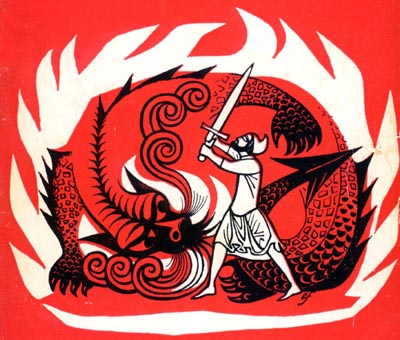
{A dramatic rendition of the dragon battle that gives it an intense, resonant scope. Image found on Zouch Magazine & Miscellany.}
 

Back To Top
Abstract

A reflection on Beowulf’s death dwells on the dragon.

Back To Top
Translation

“That which had happened was painfully felt
by the young man, when he on the ground saw
that dearest one pitiably suffering
at his life’s end. The slayer also lay so,
the terrible earth dragon was bereaved of life,
by ruin overwhelmed. In the hoard of rings no
longer could the coiled serpent be on guard,
once he by sword edge was carried off,
hard, battle-sharp remnant of hammers,so
that the wide flier by wounds was still and
fallen on earth near the treasure house. Never
after did he move about through the air by flight
in the middle of the night, in his rich possession
glorying, never could he make more appearances,
since he fell to earth at the war leader’s deed of the
&nbsp&nbsp&nbsp&nbsp&nbsp&nbsp&nbsphand.”
(Beowulf ll.2821-2835)

Back To Top
Recordings

Old English:

Modern English:

Back To Top
Showing Mourning

The first question to surface here, like the hideous sea beasts pulled from Grendel’s Mother’s mire, is why a section of the poem that’s showing Wiglaf’s grief for Beowulf immediately after his death dwells so long on the dragon rather than Beowulf.

It could be that the poet/scribe went this way because so much of the rest of the poem is given over to Beowulf. Or it could be that Wiglaf’s attention is simply drawn to the dragon because of the sheer spectacle of the sight. Though, it could also be that Wiglaf looks over to the dragon for the sake of contrast, to put off the reality of Beowulf’s death for just a short time so that he, as all but Beowulf’s named successor, can have a brief respite before he must coldly go forth and fulfil his duty as the new Geatish leader.

Of course, it could also be the poet’s own voice that pulls away from Wiglaf at this point, leaving his perspective behind for a time to turn a little more omniscient, and to give us, the listers/readers a view of the dragon as it lay dead so that we can contrast it with Beowulf.

Back To Top
Seeking Meaning

Germanic culture widely held that dragons were symbols of the greed that would undermine the gift-centric Germanic society. So perhaps the focus on the dragon and the recounting of how it can no longer do anyone any harm suggests that greed itself has been defeated, and by one so noble as to sacrifice his own good for going against the advice of his counsel and fighting the dragon.

Maybe even the defeat of greed and the destruction of the Geats themselves that is an almost inevitable result (since they’re now kingless and sitting on all of this gold) are related.

If this version of the poem is as Christian as some believe, then this shift over to the dragon shouldn’t be read as Wiglaf’s or the poet/scribe’s attempt to contrast a death with a death, but instead as a way to show that the perfection of a society through the defeat of its greatest evil leaves that society at its end.

If Beowulf was ever used as a missionary tale, then this part of the poem could well be that which attempts to sooth potential converts into the belief that in becoming Christian their previous beliefs die off and they enter into something more perfect.

Or, again, their physical being ends, but just as Beowulf persisted up until he defeats his society’s major evil, so too would the spirit of the assimilated society persist in its people. Plus, missionaries would probably say the new converts were all imbued with the spark of life that, in the Christian tradition, is generally regarded as a spoken thing – just as this story itself would’ve been at the time, even after having been written out.

Back To Top
Closing

So could this episode in the Beowulf saga be another key moment in the use of the poem as missionary propaganda, or is it just the poet/scribe’s representation of Wiglaf’s mourning? Leave a comment in the box to let me know your thoughts!

Next week, stanza three of “Dum Diane vitrea” will drop, and Wiglaf meets the cowardly thanes as they slink onto the scene.

And you can find the next part of Beowulf here.
Back To Top

Beowulf’s Death, and his Soul’s Departure [ll.2809-2820] (Old English)

Abstract
Translation
Recordings
Ambiguity in Beowulf’s Death
Beowulf Doomed?
Closing

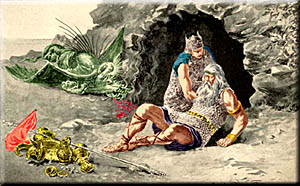
{Wiglaf listens to Beowulf’s final words. Image found on “Outpost 10F” of The Poetry Guild.}
 

Back To Top
Abstract

Beowulf bestows his war garb unto Wiglaf, and then gives up the ghost.

Back To Top
Translation

He did off the golden ring about his neck,
the brave hearted prince, gave it to the thane,
the young spear warrior, his gold adorned helmet,
ring and mail shirt, commanded him to use them well:
“You are the last remaining of our kin,
of the Waegmundings; fate has swept away all
of my line as per the decree of destiny,
warriors in valour; I after them now shall go.”
That was the old one’s last word
of thoughts of the heart before he chose the pyre,
the hot battle flame; from his breast went
his soul to seek the judgment of the righteous.
(Beowulf ll.2809-2820)

Back To Top
Recordings

Old English:

Modern English:

Back To Top
Ambiguity in Beowulf’s Death

As will be the case with the death of any great literary figure, this passage is one that’s often studied. Beyond its importance to the story, we’re also once more confronted with some ambiguity around Beowulf’s deeds. Yet, rather than being confronted with ambiguity by the words of Beowulf himself, we’re confronted with ambiguity in the poet/scribe’s own phrasing.

At the passage’s end we’re told that Beowulf’s soul leaves to “seek the judgement of the righteous.” Just as the phrase “judgement of the righteous” is ambiguous in Modern English, since the litigous could defend its meaning either ‘the judgement handed down by the righteous,’ or ‘the judgement that is passed on the righteous,’ it’s the same in Old English. There it simply reads: “soðfæstra dom” (l.2820).

The problem here is that there’s no clarifying word or phrase either in the original or in most translations that strive to be accurate. As a result we’re left with something that leaves the interpretation up to the listener/reader.

But could this maybe be the point here? Could the poet/scribe who created the version of the poem that we have today have been going for ambiguity at this part of the poem?

Just as either side of the phrase’s meaning could be argued, so too could either side of the interpretation debate.

In brief, if it’s understood to mean that Beowulf is a righteous one going to the judgment that awaits him it sets him among the holy heathens whom Christ pulled from the upper levels of hell during its harrowing.

Alternately, if the phrase is interpreted as meaning that the righteous are passing judgment, there’s a strong implication that either righteousness is something a person earns after being judged worthy by those who have it (thereby becoming one of their peers).

Or, taking this meaning could mean that Beowulf really isn’t righteous at all, and that his being judged by them means that there will be a great deal of hardship in his afterlife.

Back To Top
Beowulf Doomed?

Of these three possibilities, the most interesting is that Beowulf might be doomed in the end since he’s being judged by the righteous.

A truly puritanical Christian audience might be expecting as much from such a violent, alcoholic figure, but at the same time, that would seriously undermine any missionary value that this story had. After all, the Christian monks who recorded stories such as this from oral traditions would definitely have given them a spin that could be useful for bringing around the unconverted.

Of course, that gives the idea that this moment of ambiguity is intentional even more steam.

Yes, it could maybe spark debate among those who differ in their interpretations, but as long as this version was being told by a priest or religious, they would be there to point the way to their own version of the truth. If monks or religious actually went around reciting this poem, then this moment in particular would be the perfect one to serve as a crisis moment that could be turned around and explained so as to make Christ seem super appealing.

Unfortunately, the only way we’ll ever know for sure if any of this speculation about the ambiguity of the phrase “soðfæstra dom” is accurate is if another version of the poem shows up or the scribe of our version is definitively identified.

Until then, feel free to leave your thoughts on the phrase in the comments!

Back To Top
Closing

Next week, the second verse of “Dum Diane vitrea” will be up, along with what Wiglaf does next after Beowulf’s demise.

You can find the next part of Beowulf here.

Back To Top

On Wiglaf’s Rushing Back [ll.2783-2793] (Old English)

Abstract
Translation
Recordings
Loyal Wiglaf
As Beowulf Lay Bleeding
Closing

Back To Top
Abstract

Wiglaf remains nameless, as he rushes back to show Beowulf the gold from the hoard.

Back To Top
Translation

“The messenger was in haste, eager in the journey back
By precious things he was urged on; anxiety oppressed him,
whether he would meet bold in spirit and alive
in that place the prince of the Weders,
deprived of strength, where he had earlier left him.
He then with the treasure the renowned prince,
his lord bleeding, found,
his life at an end; he then again began the
sprinkling of water, until the beginning of words
broke through his heart. The warrior king spoke,
old in sorrow – looked at the gold:”
(Beowulf ll.2783-2793)

Back To Top
Recordings

Old English:

Modern English:

Back To Top
Loyal Wiglaf

There’s a lot about loyalty in this passage. Wiglaf’s rushing back with gold in tow to show Beowulf, as per his final request, really highlights it.

In fact, that’s really all we’re treated to here, which is quite remarkable given all of the information we’ve been given in previous passages of the same length. When Wiglaf is in the hoard, the treasure is described and listed, when he and Beowulf are fighting the dragon, almost every lines shows us their manoeuvre or the dragon’s. But here, we just have Wiglaf rushing to show Beowulf the treasure.

It’s quite a distinct split from what’s come before. But it’s also a great way to signal that the big shift from being primarily about Beowulf to being about his death and the future of the Geats is finally about to come.

Back To Top
As Beowulf Lay Bleeding

One word in particular stands out, though. When Wiglaf returns to Beowulf we’re immediately told that he’s found bleeding (“driorigne” l.2789). To note this with this word in particular is strange, since it suggests that before he left for the hoard Beowulf’s wound had somehow stopped bleeding, been stopped bleeding, or Wiglaf expected it to stop before he got back.

Regardless of what the case may be with the wound itself, that we’re given this detail really drives home the fact that this is it for Beowulf. Just as he is found bleeding his very life away, so too will the words that he next speaks be his last, as he releases the last of those two – effectively closing the word hoard.

Curiously, I imagine that his body will continue to bleed beyond his actual time of death, which, though maybe not apparent to a listening audience, acknowledges an idea that words are themselves a kind of adornment for life, something that can be woven and worn over something more plain like a brooch binding the collar of a simple cloak.

At the same time, Beowulf doesn’t mention anything about grand words that he’s spoken in the past when he tells Wiglaf that he has joy in his wound, but rather the hero says this because he has done nothing to incriminate himself. Perhaps then, even a listening audience would notice the warp and woof of the scop’s words as he sang the song of Beowulf.

Back To Top
Closing

Next week, Old English will return, but the return of Latin is still uncertain.

You can find the next part of Beowulf here.

Back To Top

On Requests and Namelessness [ll.2743b-2755] (Old English)

Abstract
Translation
Recordings
Digging Deeper into Beowulf’s Request
Going Nameless
Closing

{J.R.R. Tolkien: Believer in Beowulf‘s being an elegy. Image found on The-HobbitMovie.com.}
 

Back To Top
Abstract

Beowulf instructs Wiglaf to get some gold from the hoard to show him what he fought for, and Wiglaf runs off to oblige him.

Back To Top
Translation

&nbsp&nbsp&nbsp&nbsp&nbsp&nbsp&nbsp”Now go you quickly
to see the hoard under the grey stone,
dear Wiglaf, now the serpent lay dead,
sleeping in death sorely wounded, deprived of treasure.
Be now in haste that I ancient riches,
the store of gold may see, clearly look at
the bright finely worked jewels, so that I may the more
peacefully after the wealth of treasure leave my
life and lordship; that which I have long held.’
I have heard that then the son of Weohstan quickly obeyed
after the spoken word of his lord in wounds and
in war weariness, bearing mailcoat
the broad ring-shirt, under the barrow’s roof.”
(Beowulf ll.2743b-2755)

Back To Top
Recordings

Old English:

{Forthcoming}

Modern English:

{Forthcoming}

Back To Top
Digging Deeper into Beowulf’s Request

On the surface, Beowulf’s request seems simple enough. ‘Go and grab some gold, that I may be able to see it,’ but there’s more to it then a validation of his final battle. Within this request lay the very stuff of revenge.

Beowulf acknowledges that now the serpent is dead and thus “deprived of treasure” (“since bereafod” (l.2746)). Thus, were he to die without seeing what he had fought for then, he would, in a way, not have won at all.

For Beowulf would then not have been able to say that he had laid eyes on that for which he fought, while the dragon enjoyed the sight of it constantly. Further, he also wouldn’t have experienced it, and wouldn’t therefore have fulifilled the treasure’s basic purpose: to be used by being enjoyed through sight (just as a grammatical object is used simply by being linked to a grammatical subject).

However, the act of seeing it, of using it, also puts Beowulf on par with the dragon on the level of greed, since he is not able to dole out the treasure to his people, as any good king must, in person.

Back To Top
Going Nameless

But, what’s curious about this passage is Wiglaf’s lacking reference by name. First he is the “son of Weohstan” and then he is referred to with a bit of metonymy when the poet simply says that he bore a mailcoat into the barrow (“hringnet beran/…under beorges hrof” (ll.2754-2755)).

So why does Wiglaf, the one who was instrumental in Beowulf’s victory, suddenly lose his name? Perhaps to keep the focus on Beowulf, rather than Wiglaf so that it truly does become an elegy rather than a story of succession, of hope.

It’s also possible that this is merely poetic license, but the fact is that Wiglaf is not referred to by name again until line 2852. That’s over one hundred lines later, and the point at which his fellow Geats recognize him as the new leader for the first time.

That Wiglaf is named for the occasion of recognition as the new authority strongly suggests that indeed he is occluded for the next 100 lines to keep Beowulf in the spotlight. Going out at Beowulf’s behest, Wiglaf isn’t really Wiglaf anymore, but he is made into Beowulf’s double, at least for the brief time that he scrambles out to the hoard, through it, and back.

It could even be argued, that Wiglaf’s washing Beowulf clean and then undoing his helmet are both acts that signify a complete rescindment of the will, perhaps as an acknowledgement of the end of a life. In doing these things Wiglaf drops his own desires and takes up Beowulf’s request entirely so that he can be a comfort to the old lord in his final moments.

Back To Top
Closing

Next week, the second stanza of “O Fortuna” will be posted, and Wiglaf, though nameless, finds himself immersed in a fabulous treasure room.

You can find the next part of Beowulf here.
Back To Top

Beowulf: Mighty in Arms, Loose in Words? [ll.2732b-2743a] (Old English)

Abstract
Translation
Recordings
Peering in, But Just Dipping Toes
Not Many Oaths Sworn “in Unrighteousness”
Kinds of Kin-Slaying
Closing

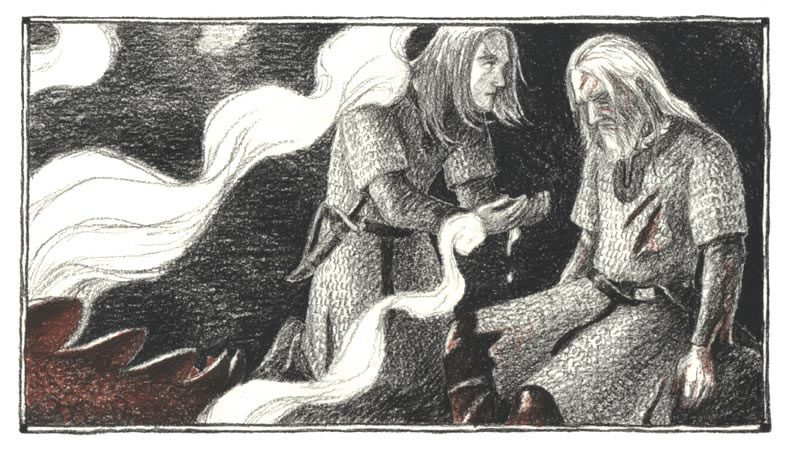
{Words spoken and frozen in wood, just as bad oaths are remembered. Image found on documentarystorm.com.}
 

Back To Top
Abstract

Beowulf says that he’s come to terms with his death because he was a good king and can stand blameless before the final judgment.

Back To Top
Translation

&nbsp&nbsp&nbsp&nbsp&nbsp&nbsp&nbsp&nbsp&nbsp&nbsp”‘I this people have ruled
for fifty winters; never was there a king of the people,
any of the neighbouring folks
would dare attack with war-friends,
threaten terror. I in my homeland awaited
destiny, it guarded me well,
I did not seek contrived hostility, nor swore I many
oaths in unrighteousness. In all of this
infirmity of a mortal wound I have joy;
because the Lord of men has no cause to accuse me
of murderous killing of kinsmen, when my
life passes from my body.'”
(Beowulf ll.2732b-2743a)

Back To Top
Recordings

Old English:

{Forthcoming}

Modern English:

{Forthcoming}

Back To Top
Peering in, But Just Dipping Toes

For such a short passage, there’s a fair bit going on here.

It’s revealed that Beowulf has ruled as long as Hrothgar and Grendel’s Mother did; that Beowulf was the sort of king that defended his lands on reputation or by some other passive means; that he had a fairly Taoist, go-with-the-flow life philosophy that kept him out of trouble; that he has been mostly true to his word; and that he is guiltless when it comes to murdering kinsmen.

Though there’s quite a bit of depth here, this entry is just going to focus on the last two in that list.

Back To Top
Not Many Oaths Sworn “in Unrighteousness”

What does Beowulf mean when he says “nor swore I many/oaths in unrighteousness” (“ne me swor fela/aða on unriht.” (ll.2738-2739), emphasis my own)? Is it an accepted part of Anglo-Saxon life (perhaps especially or only in positions of power) that some oaths are not sworn in the best of circumstances?

What exactly does it mean to swear an oath in “unrighteousness”?

Did Beowulf swear some oaths to do some unsavory things? Did he swear some oaths to escape others? Did he make pacts with spirits?

The wording itself aside, what can be looked at here is the word “fela,” which I translated as “many.” So there haven’t been a lot of oaths sworn poorly. is this just a matter of practice?

Though we don’t see Beowulf swearing oaths unrighteously, it is curious that Beowulf plays fast and loose with his retelling of the fights with Grendel and with Grendel’s Mother to Hrothgar. Specifically, Beowulf adds Grendel’s terrible glove to his story (ll.2085-2088), and greatly shortens his encounter with Grendel’s mother (ll.2135-2141).

Words were considered incredibly important to Anglo-Saxons, especially when it came to the valuation of people. So, could this alteration of words mean that Beowulf didn’t always take words so seriously?

Perhaps the answer can be found in the next part.

Back To Top
Kinds of Kin-Slaying

Within the poem itself, there have been several instances of kin-slaying.

Most recently is Beowulf’s story of Hæðcyn killing Herebeald, but there is also the story of the Battle of Finnburgh, and, of course, Beowulf’s implication that Unferth killed his brother. Though it’s the most distant to this point in the poem, the Unferth instance might actually be the most relevant here.

According to some, the first half of Beowulf represents Beowulf’s destroying his shadow self, in so far as Grendel and Grendel’s Mother are embodiments of Beowulf’s animalistic nature.

In fact, others also suggest that Beowulf and Grendel are somehow related, making Beowulf a kin-killer.

On one hand this seems like an unstable interpretation, but, on the other, every statement in the section of Beowulf’s speech translated for this entry gives further information about his life through implication. Thus, either Beowulf is suggesting that accusations of kin-killing have been made against him, or that kin-killing is a common crime among kings, but he is innocent of it.

Back To Top
Closing

Next week, as a relief from the animal, the first verse of the thirteenth century Latin poem “O Fortuna” will be translated. Plus, Beowulf makes his penultimate request of Wiglaf, and the plucky young thane goes darting off to fulfill it.

You can find the next part of Beowulf here.

Back To Top

On Water and Words [ll.2720-2732a] (Old English)

Abstract
Translation
Recordings
A Good Washing
Passing (Things) On
Closing

{Wiglaf raising the washing water to Beowulf. Image found at the Tolkien Library}
 

Back To Top
Abstract

Wiglaf tends to Beowulf and Beowulf begins to speak to Wiglaf, signalling that his death is imminent.

Back To Top
Translation

“Then he with hand, blood-stained,
the famed lord, a man unmatched for good,
washed his dear lord with water,
battle-worn, and unclasped his helm.
Beowulf spoke – he spoke through the pain,
the ache, of his miserably vexatious wound; well he knew,
that he had fulfilled the days of his life,
of earthen joy; that all of his life-time had
fled, death was immeasurably near:
‘Now I to the son of mine would give
the war garments, if it had been so granted
by fate that I any heir had,
flesh of my flesh.'”
(Beowulf ll.2720-32a)

Back To Top
Recordings

Old English:

{Forthcoming}

Modern English:

{Forthcoming}

Back To Top
A Good Washing

The washing of Beowulf requires some note here.

First, there’s the general importance of the act as a means of humbling yourself before someone whom you respect.

Then there’s the fact that it’s a simple act of subservience, the sort of thing that is an active display of obedience and respect.

And that interpretation of the act leads into the Christian significance. However, if this death is meant to mirror that of Christ in the New Testament, then there’s something interesting going on here.

In the NT and in the Catholic ritual recreating the Last Supper, it’s Christ who washes his disciples’ feet.

Wiglaf’s washing is more general, but if the parallels between these stories are followed, then Wiglaf is effectively becoming the Christ figure of the story, possibly in a more meaningful way than Beowulf.

Yes, Beowulf defeated the dragon, but that cost him his life, and Beowulf would never be characteristically elegiac if he came back to life afterwards (nor would the Anglo-Saxons have told it like that, regardless of whatever their source material may have been).

This transference of Christ-ness might even have been one of the original purposes of the poem as a conversion tool, since it’s the sort of succession that Anglo-Saxon’s would have understood. After all, it’s the exact same way that kingship would be transferred when no heir was available: through a ritualistic act and acknowledgement.

Back To Top
Passing (Things) On

The opening of Beowulf’s speech also says a lot about the Christian intent of the written version of the poem.

If Beowulf is taken as a heroic heathen, someone who is Christian in all ways but name (ignore for a moment, his constant references to a single ‘Lord of Men’/’Ruler’/’King of Glory’), then he simply can’t have an heir. There can be no continuation of the virtuous heathens, since there is no further need for such people, the virtuous will, of course, be Christians. And so enter the transitional figure of Wiglaf, the one who reprimands the cowardly thanes and does his best to guide Geatland gently into the good night awaiting it after Beowulf’s death.

Beowulf signals his death not by saying that he has reached the end, as the poet/scribe does before we get his dialogue, but by saying that he has no heir to give his weapons to.

He has no offspring that he could call “flesh of my flesh” (or “belonging to my body” for a curiously medieval Christian rendering of “lice gelenge” (l.2732)) that can continue his line directly. And so, it passes to one who’s proven himself to be worthy: Wiglaf.

However, it’s important that Beowulf opens his speech with talk of handing down his war garb. Because Wiglaf is not his son, the war garb will not be touching the same flesh (more practically, it may also be less of a snug fit than on any son of Beowulf). As a result, Wiglaf is not going to be able to do the same things that Beowulf did with his gear, in both the literal and figurative senses.

And that a body patently different from Beowulf’s carries forward the symbols of the old way embodied by Beowulf’s war garb (arguably, his most precious possession) is a great metaphor for the spread of Christianity throughout Early Medieval Europe.

Back To Top
Closing

Check back here next week, for Isidore’s finishing off the first section of book 12 with further discussion of fertility lore, and for Beowulf’s quick review of his kingship and current predicament.

You can find the next part of Beowulf here.

Back To Top

Swedish Retribution "from over wide water" [ll.2472-2483] (Old English)

Abstract
Translation
On Swedes and Geats
Compounding New Words
Closing

Back To Top
Abstract

We get the history hard and fast in this week’s passage of Beowulf (ll.2472-2483, Chapter XXXV).

Back To Top
Translation

“‘Then between Swedes and Geats was war and enmity;
from over wide water causing laments,
wall-hard warfare, after Hrethel had perished,
Ongeonðēow’s sons to them came,
warlike; they would not free
those they held under sorrow’s sway, and near Hrēosnahill
they oft launched voracious ambushes.
My close-kin avenged this,
feud and war-fire, as it is known,
though one of them bought the victory, at a hard price,
with his life; Haethcyn, Geatish lord,
was taken in the war’s assailing.'”
(Beowulf ll.2472-2483)

{Approximation of the Hrēosnahill fight offered by a mural of the Battle of Maldon. From the Braintree collection of murals.}

Back To Top
On Swedes and Geats

Questions bubble up like air in a flagon of ale upon reading this passage. Who was Ongeonðēow? What’s important about Hrēosnahill? What liberties were taken with the translation?

Ongeonðēow [On-g’in-thou] was the king of the Swedes who launched an attack on the Geats to recover his daughter and his gold, both of which had been taken by the Geats on an earlier raid. He was famed as a powerful king, and two Geats (Eofor and Wulf) had to work together to defeat him (read more here). Though, as we’ll see in next week’s entry, Beowulf makes it sound like Hygelac himself lands the deathblow.

Hrēosnahill [Heh-res-na-hill] is where Hæðcyn had taken Ongeonðēow’s daughter, and is apparently a real place (modern Swedish:”Ramshult”), as well as a place that is traditionally within Geatish territory. Go to this Wikipedia page for more info.

So, what’s happening here is a little bit of old fashioned early medieval back and forth. The Geats stole Ongeonðēow’s daughter and gold (according to Wikipedia), and now the Swedes are coming for rescue and revenge – which they (again, from Wikipedia) only half exact. The Swedes recover the woman, but not the gold.

Two liberties were taken in the above translation. In the third line (l.2474) “wall-hard warfare” is altered from the literal “hard warfare” since the alliteration makes it sound more Anglo-Saxon and “hard warfare” isn’t as evocative as the original “here-nīð hearda.”

The phrase “under sorrow’s sway” was also altered from the literal “lamentation holding” since it doesn’t have enough punch in Modern English. It also confuses the metaphor of being held under extreme emotion, which is clarified by “under sorrow’s sway.”

Back To Top
Compounding New Words

The words “here-nīð,” and “inwit-scearo” are both compound words worthy of elaboration.

The first combines the word for “predatory band, troop, army; war, devastation” (“here”) and for “strife, enmity, attack, spite, affliction,” (“nīð”). Literally, then, it could be rendered “war-strife” or “troop-enmity” and so warfare is a clear translation of it. The redundancy of a literal translation also makes the standard translation of the phrase more efficient than a literal rendering.

The word “inwit-scearo” on the other hand, is more worthy. The term is a mix of “inwit,” meaning “evil, deceit, wicked, deceitful,” and “scearo,” a form of “scieran,” meaning “to cleave, hew, cut; receive tonsure; abrupt.”

Literally, the word could be rendered as “evil-cleave” or “abrupt-deceit” which sound like they could still be productive words among modern counterparts. “Evil-cleave” at least sounds like a technique in an RPG, while “abrupt-deceit” could be a spicier way to describe an ambush or surprise attack.

Back To Top
Closing

To let me know what you think about these compound words (or this entry in general) just post a comment below. And feel free to follow this blog, I’ll follow yours back.

Next week, Isidore elaborates on the workings of sheep and rams, and Beowulf tells of Hygelac’s revenge, all the while bolstering his own warrior-like image.

Back To Top

Quoth the Beowulf [ll.2441-2449] (Old English)

Abstract
The Passage in Brief
Ravens and Ruin?
The Passage’s Words and a Modernization
Beowulf and the Raven
The Raven As Symbol of Sacrifice
Closing

Back To Top
Abstract

Things take a turn in this passage (ll.2441-2449). Not from Hæðcyn’s sorrowful act, but from Beowulf’s direct retelling of his tale to his use of a peculiar simile.

Back To Top
The Passage in Brief

On lines 2444-46 he compares Hreðel’s sorrows to those of an old man who sees his young son hanging on the gallows (“‘Swā bið geōmorlīc gomelum ceorle/to gebīdanne, þæt his byre rīde/giong on galgan.”) He goes on to expand this image by explaining that the old man can only look on helplessly while the raven rejoices over his son’s corpse (“hrefne tō hrōðre” l.2448).

Back To Top
Ravens and Ruin?

What makes the image of a raven over Hæðcyn’s corpse so striking is that it not only efficiently brings out Hreðel’s sorrow, but the emotions evoked here resemble those in the “Lay of the Last Survivor.”

This section of the poem (ll.2247-66) details how the one who originally left the dragon’s hoard must have felt, being the last of his people. It describes the futility of treasure without people to use it and with whom it can be shared. But it also emphasizes the importance of community to the Anglo-Saxons.

Back To Top
The Passage’s Words and a Modernization

The language of this passage is fairly straightforward and strangely filled with words that don’t seem to have changed much between then and now. “gefeoht” for “fight, strife,” “linnan” for “to lie,” “rīde” for “ride,” “giong” for “young,” “sārigne” for “sorrowful” “sunu” for “son,” “hangað” for “to hang,” “hrefne” for “raven,” “helpe” for “help,” and so on. As per coolness factor, one word stands out: “hyge-mēðe.”

The last word in that previous paragraph is a combination of the words “hyge” for “heart, breast, mind” and “mēðe” for “tired, worn out, dejected, sad.”

As far as modernizations go, “heart-sad” sounds both poetic and syrupy at the same time, but “mind-worn” could work for a modernization, I think. It could express a feeling of being so overwhelmed by a task or emotion that your mind is sore; just as a muscle feels sore after it’s been worked out. “mind-tired” could also work, there’d be some internal rhyme that way.

Back To Top
Beowulf and the Raven

Although it only gets cursory mention here, a little bit of explanation of the raven in Old English lit is in order since I think it plays a larger role here.

The raven is one of the three “Beasts of Battle” (along with the wolf and the eagle) and held many different meanings (check this site for a good deal of info). Just as they’re regarded as bad luck, or ill omens by some today, so too were ravens regarded before the 11th century. But some also associated the raven with victory or sacrifice, and in Old English another word for raven is wælceasega (“chooser of the slain”) linking the bird to the Valkyrie of Old Norse thought.

Aside from the raven in Beowulf’s speech clearly being an ill-omen (Hreðel becomes despondent and the realm is soon threatened by war), I think that it can also be interpreted as a symbol of sacrifice.

Back To Top
The Raven As Symbol of Sacrifice

Herebeald wasn’t sacrificed in the same way that say, Iphigenia was (by Agamemnon, for a wind to get the Greeks to Troy), but his death could still be regarded as the sacrifice of an eldest son for lasting fame.

Sacrifice is also likely at the fore of Beowulf’s mind at this point – perhaps it is even a cause of his being in such a heavy mood. He knows that he will die if he fights the dragon, but he also knows that doing so will win him fame, save his people, and land them a hefty amount of treasure.

All three of these things are necessary for a good king, as established by Beowulf‘s opening with Scyld Scēfing. He won a great amount of fame, and of treasure and was able to use both to increase his people’s prosperity (ll.4-11).

The treasure also helped his son to forge bonds and obligations with warriors who would fight for his right to succeed his father upon his death (ll.20-24).

Within the situation that Beowulf describes, Herebeald can be read as a sacrifice not just for the fame of Hreðel, but also for the fame of Beowulf.

After all, if Herebeald had lived he may have ruled well and been loved by all, giving Hæðcyn and then Hygelac no reason to rule, and thus leaving Beowulf without a kingship from which to launch his own fame.

So Herebeald’s death is also a sacrifice for the betterment of posterity – even if that eventually leads to the destruction of his people.

Back To Top
Closing

Next time, Beowulf continues to expand his comparison, detailing how the old man regards nothing in the same light again.

If you’ve got a strong argument for “heart-sad,” “mind-worn,” or “mind-tired” as a new word; if there’s anything about Beowulf that you want to ask; or if there’s anything in the poem that you want to see given special attention, then please do leave a comment.

Back To Top

Beowulf [ll.2419-2429] (Old English)

Introduction
Summary
Beowulf’s Greatest Foe?
Beowulf’s Opening Lines
Genæs: Further Analysis
Briefly Autobiographical
Closing

Back To Top
Introduction

When we last left Beowulf, he was sitting on a cliff, looking out to sea. His mind was heavy with thoughts of his impending death, and this week’s section gives us an idea of what those thoughts were like.

Back To Top
Beowulf’s Greatest Foe?

We’re told that Beowulf knows that he would soon “encounter old age,” (“gomelan grētan sceolde,” l. 2421) that it would seek his “hoarded (?) soul,” (“sēcean sāwle hord,” l. 2422). And before Beowulf at last addresses the 12 with him the poet offers the elaborations of Beowulf’s life being rent from his body (“sundur gedǣlan/līf wið līce,” l. 2422-3) and of his “flesh…soon unravel[ing] from his spirit” (“nō þon lange wæs/feorh æþelinges flǣsce bewunden,” l. 2423-4).

Death is definitely violent, but very firmly not the end, and Beowulf knows this well. But all of this is mentioned in the context of Beowulf sitting in “sorrowful mind” (“geōmor sefa,” 2419). There’s definitely a strong sense of the elegy that J.R.R. Tolkien detected in the poem here (see page 14 of this article). And there’s also the sense that Beowulf feels some remorse. But why?

Because his kingdom has been ruined by the dragon and, upon seeing its lair, he realizes that he will die fighting it? Because he feels that those he has taken with him, the leaders of the next generation, surely, are not capable of the glory that he achieved? Perhaps he regrets the conquests and triumphs of his youth? Or is it merely an expression of the extreme anxiety around death?

Back To Top
Beowulf’s Opening Lines

The first line and a half of the section set the atmosphere by telling us that Beowulf was “restless and ready for death,” that he could feel “fate immeasurably near” (“wǣfra ond wæl-fūs, wyrd ungemete nēah,” l. 2420). Then the poet/scribe offers things more concrete.

Beowulf’s ensuing speech is about his youth and accomplishments, but I’ll get more into that next week. This week, I just want to focus on the first two lines (one sentence) of it.

Beowulf opens by saying that he “survived” (genæs) countless battles and war-times in his youth. His choice of words here is curious, since, according to my dictionary, all senses of “genæs” suggest the last-minute removal from a dire situation (survive, escape from, be saved).

Why doesn’t Beowulf (or the scribe/poet) simply use “won glory,” or “succeeded”? Is this a sign that Beowulf is well aware of the horrors of war and that the poem itself can be read not as a document glorifying it, but maybe the first recorded account in English of someone who has experienced Post Traumatic Stress Disorder (PTSD)? Or, is it just the only word that would fit the line’s meter and/or alliteration?

Back To Top
Genæs: Further Analysis

Following the line of reasoning that the poet/scribe could have used another word in place of “genæs,” here’s my analysis.

“Survived” makes it sound as though all of the battles that Beowulf has seen were trials or hardships sent by some greater entity, or merely as a part of life. “Escaped from” makes armed conflict seem like some terrible, impersonal machine or happening.

And, “been saved” makes it seem as though Beowulf got lucky each time he fought and was spared from the sword or arrow by the intervention of his fellow warriors or some sort of supernatural being. This last meaning of “genæs” perhaps gels the best with the laggard that everyone at the Geatish court believed Beowulf to be until he returned from Daneland with stories of slaying Grendel and his mother.

So then did Beowulf actually change from a weakling boy into a fierce warrior, or was his original softness just masked by luck – is this a propagandic Christian twist that suggests that trusting in god will keep you safe in skirmishes and war time?

Beowulf at this point is 50 years old – the same age as Hrothgar and Grendel’s mother when he was in Daneland. Rulers in the world of Beowulf seem to last their 50 winters and then tip off the mortal coil in one way or another. Though in such a world, living to see 50 does seem remarkable.

Whatever the case may be, modern interpretations of “genæs” all come with this connotation of getting through something larger than an individual human’s machination.

At the least, I feel secure in saying that this word suggests that human conflict is something outside of the control of individual people and possibly even groups of people. In fact, the word could be read as the poet/scribe suggesting that war is another kind of natural disaster. The cosmological implications are fascinating.

Back To Top
Briefly Autobiographical

The next sentence of Beowulf’s speech begins his auto-biography. At the age of seven he went to his treasure lord (“sinca baldor,” l. 2428) for fostering at his father’s command. This treasure lord, “leader and friend of the people” (“frēa-wine folca,” l. 2429), seems benevolent enough, and the practice of fostering is evident throughout the middle ages. Even Chaucer was fostered.

The transition from the first sentence of his speech and the second is where these two get interesting.

Beowulf ends his first sentence with the bold statement that he “remembers all of [the conflicts]” (“ic þaet eall gemon,” l. 2427). And from what comes next it seems that he also remembered much of his youth. He specifically recalls a story from his youth that may well be the earliest political strife he encountered. But I’ll get into that next week.

Back To Top
Closing

Think I’m a little too loose with my translations of words or phrases? Or that I dig too deep for meaning? Or do you think that I’m right on and should just write a book about it all already? Let me know in the comments.

Back To Top