Meanderings on Hrothgar and closely watching words (ll.642-651)

Abstract
Translation
Recordings
Meandering through analysis: Hrothgar’s departure
Delving deeply into three words
Closing

Interlaced men motif. Image from http://public.wsu.edu/~hanly/oe/503.html.

Interlaced men motif. Image from http://public.wsu.edu/~hanly/oe/503.html.

Back To Top
Abstract

It’s party time in Heorot until Hrothgar, noticing the imminent falling of darkness, decides it’s time to call it a night.

Back To Top
Translation

“Then it was again as it had been in the hall,
brave words spoken, people milled about beneath its roof,
the sounds of a victorious people, until in a short time
the son of Healfdane’s will turned to seeking his
evening rest. Knew he that the wretch
against that high hall planned attack,
after the sun’s light might be seen,
when grown dark was the night over all,
draped in shade mail the shape would come stalking
under the waning heavens. All the throng arose.”
(Beowulf ll.642-651)

Back To Top
Recordings

Old English:

{Forthcoming}

Modern English:

{Forthcoming}

Back To Top
Meandering through analysis: Hrothgar’s departure

As had been the case the last time we were treated to quite a bit of expositional poetry from the poet/scribe himself, this week’s passage is rich primarily in words. And in one significant detail on which he dwells.

Near the end of this weeks’ passage we’re treated to three and a half lines about the transition from day to night and the shifting from light to darkness. I think it goes without saying that there’s something of importance here. Or at least there could be.

This transition to night begins around the middle of the passage, at which point Hrothgar begins to consider leaving the hall and heading to his evening rest. This is no doubt a reference to the first period of sleep in the usual way people slept before artificial light; he’s heading off to the first shift of sleep from sunset to about midnight. (At that point, people woke up and wrote, composed, met, talked, had sex, etc. before heading back to bed around 2 or so and then rising with the sun.)

Why is this sort of sleep pattern the pre-industrial usual? I can’t rightly say. What significance does it have here? Well, maybe not much, but it’s a fun tidbit to trot out every now and then.

As per stuff actually relevant to what’s going on in the passage, Hrothgar uses a curious word to describe what Grendel’s been doing: “geþinged.” This word comes up on line 647 and means “plan,” broadly. But specifically within the Clark Hall and Meritt dictionary I’m using, it translates as “to beg, pray, ask, intercede, covenant, conciliate, compound with, settle, prescribe; reconcile oneself with; determine, purpose, design, arrange, talk, harangue.”

Some of those words suggest “plan,” some don’t. But just about all of them suggest collaboration rather than singular action. I can’t help but get the impression that, aside from alliterative purposes (geþinged alliterates with þæm from earlier in the line), the poet put this word here to suggest one of two things about Hrothgar’s perception of Grendel.

It could suggest that Hrothgar regards Grendel as a shrewd and potent planner. He sees Grendel as a being that lays out careful plans and then follows through, as if working by committee or with the force of will of several beings.

Or, it suggests that Hrothgar is aware of Grendel’s collaboration with some other being. This doesn’t necessarily need to be Grendel’s mother. It could just as easily be a sense of some sort of spiritual communication amongst the other kin of Cain. Maybe those shunned by god just like to co-ordinate things really well.

Looking further at Hrothgar’s departure from the hall, I wonder why he leaves at all. Is it that he’s running away? Clearing the way for this Geat who’s so eager to gain glory?

Perhaps there was some kind of tradition that involved everyone belonging to a troop or band or peoples would just walk out once their leader did the same. If that’s the case, then Hrothgar could be trying to protect the Danes in this way. Though whether that’s from Grendel or from the menace of Beowulf and his seductive confidence, who can say?

Back To Top
Delving deeply into three words

This week’s passage bucks the pattern that the last few have kept: it’s actually got some compound words!

There is, however, one that I noted in the entry “Beowulf gets into puns and two regular words aren’t so regular (ll.590-597).” Well, the first half of it, anyway. This is “sige-folc.” I don’t really have anything new to say about it, except that in this context it is likely meant sincerely.

After all, it isn’t necessarily calling the Danes a “victorious people,” just comparing the noise that they rose to the sort of noise that a victorious people would raise. The obvious connection is that the poet is saying that they’re celebrating before their problem has been solved.

Though, at this point, I get the impression that the original audience probably already figured out that Beowulf was going to win. But maybe there’s more dramatic tension here than I realize. I mean, we haven’t really seen much of Grendel in action. We’ve heard the aftermath of his attacks described, but we’ve never really seen him in action.

The opposite is also true. We’ve never seen Beowulf do anything. He’s boasted plenty, but done little aside from wearing his armour with a lordly air.

So what’s the conclusion here?

I don’t think the poet is trying for much beyond the surface reading of sige-folc. There’s a subtle reminder that the Danes are pre-empting their victory with a celebration here. Maybe there was an Anglo-Saxon sense of karma or cosmic irony and so this reminder could work as foreshadowing for Grendel’s mother’s attack after Beowulf has defeated Grendel. Though, I really can’t say what the poem’s earliest audiences thought and anticipated.

The other two compounds are unique (so far) to this passage. The first is from line 643: “þryðword.”

This word is a combination of “þryð” (meaning “might,” “power,” “force,” “strength,” “majesty,” “glory,” “splendour;” “multitude,” “troop,” or “host”) and “word” (meaning “word,” “speech,” “sentence,” “statement;” “command,” “order,” “subject of talk;” “story,” “news,” “report;” “fame;” “promise,” or “verb.”)

“Word” can also refer to “rod,” “(possibly) gooseberry bush” or “the word incarnate.” Why that last trio of meanings includes “rod” and possibly “gooseberry bush,” I can’t really say.

Unless, it’s a reference to words relating to Ogham alphabets. But so far in my reading, Graves hasn’t said anything about gooseberry bushes. He has put forth the idea that the burning bush was some loranthus (a kind of mistletoe) growing on a wild acacia, but other than designating this wood to Sunday and equating it with the Celtic broom, he hasn’t said much about it (The White Goddess 264)

Anyway, the thing that makes this combination of words interesting to me is that it could be a reference to armies being stereotyped as talking about manly, powerful things.

The literal translation of the compound is “power words,” and so I suppose it’s aptly applied to a bunch of warriors excitedly talking and drinking. It’s as if their confidence were returning to the Danes. For, even if a boast is empty, a boast is still something spoken from a place of confidence – even if that confidence is just an act.

Now, we come to what I think could be the coolest compound word in the passage. Maybe even up to this point in the poem. “Scadu-helm”

This word combines the Old English word for “shade,” “shadow,” “darkness,” “shady” “place,” “arbour;” “shelter,” or “scene,” “scadu,” and the word for “protection,” “defense,” “covering,” “crown,” “summit,” “top (of trees);” “helmet,” “protector,” “lord;” or “elm,” “helm.”

So the compound’s literal meaning is something like “cover of darkness.” Though that’s a bit plain. I think that something like “shade covering” or “shade mail” is a better fit — something that suggests that Grendel comes clothed in the darkness, not just under it.

I prefer that sort of interpretation because it suggests that he was civilized, but not in the civil ways of man — no — rather in the ways that kin of Cain understand civility.

Now, since elm and arbour are involved, what’s Robert Graves got to say?

(By the way, I’m referring to Robert Graves so much because I’m reading his The White Goddess right now for my blog Going Box by Box.)

On page 190 of that book, graves simply says that the elm became the alma mater (pun intended, I think) of the wine god because it was used to support grape vines. Other than that, there’s not much. So, it’s a supportive tree, and so that may well be why it’s connected to the word “helm” and all of its implications of protection.

Back To Top
Closing

Next week, check back to read about how Hrothgar hands things over to Beowulf on his way out.

You can find the next part of Beowulf here.
Back To Top

Beowulf, Wealhtheow, and the two words that reveal much (ll.631-641)

Abstract
Translation
Recordings
One Word Says much about Beowulf’s Song
Another Word, and More of just What Wealhtheow Is
Closing

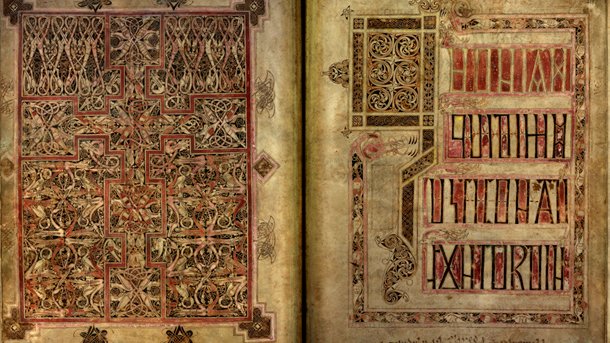
An illuminated Chad Gospel. Image from http://events.nationalgeographic.com/ events/special-events/2011/11/13/saint-spinners/.

An illuminated Chad Gospel, just one place where words matter. Image from http://events.nationalgeographic.com/
events/special-events/2011/11/13/saint-spinners/.

Back To Top
Abstract

Beowulf sings his reply to Wealhtheow’s praises, and she, well-pleased, returns to Hrothgar’s side.

Back To Top
Translation

“Beowulf spoke, son of Ecgtheow:
‘I thought upon that, as I came across the sea,
seated in the sea boat amidst the multitude of my men,
that I completely for your people
would that will work, or die in the slaughter,
held fast in the fiend’s fist. I shall perform
the lordly deed, or my end days
find in this mead hall!’
That woman/lady well liked those words,
the boast-speech of the Geat; then went gold-laden
the stately queen of her people to sit with her lord.”
(Beowulf ll.631-641)

Back To Top
Recordings

Old English:

{Forthcoming}

Modern English:

{Forthcoming}

Back To Top
One Word Says much about Beowulf’s Song

When last week’s passage ended with the poet/scribe possibly saying that Beowulf sang his response to Wealhtheow, I thought I knew what was coming. I figured that we’d get more of the same artful and rhetorical language that we saw when he was talking to Hrothgar. A few ‘thee”s and ‘thou”s, rhetorical separation of related clauses, all of that.

Instead, Beowulf’s dialogue here is some of the most straightforward text I’ve come across in the poem yet.

There aren’t any structural acrobatics. There aren’t any strange combinations of words. Even when it comes to compound words there are only two. These are “feondgrapum,” “endedæg” and “meoduhealle.”

All of these words are straightforwardly translated as “fiend-grip,” “end days,” and “mead hall.” There don’t seem to be any shades of morality hiding in multiple meanings, nor does Beowulf seem to be putting any of them to tricky use here.

It’s almost enough to make me think that when formal speech is delivered to a man it is a thicket, whereas when a formal speech is delivered to a woman it is a bouquet.

Though there are some rare words at play in Beowulf’s dialogue.

In line 634 Beowulf uses the word “anunga” and in line 635 he uses “crunge” (a form of “cringan”). These words aren’t often used, but there’s nothing really special about them aside from their being highly specialized.

The word “anunga” refers to something done quickly and thoroughly if taken as a whole word (my Clark Hall & Meritt dictionary separates these senses). Yet it makes sense that Beowulf use this word here since it alliterates with the word that follows, which just so happens to be on the other side of the line’s caesura: “eowra.”

“Crunge” isn’t used for alliterative purposes, but it is highly specialized, having but three meanings: “yield, fall (in battle), die.” Using any three of these fits the meaning of Beowulf’s punchy ending, but he could have simply used “acwelan” or “sweltan” (both mean “to die”).

It’s telling, then, that Beowulf dresses up his language as he sings his reply to Wealhtheow.

Perhaps this was part of formal speech, though. Perhaps when speaking to a woman the decorum was to avoid innuendo so that there would be no misunderstandings between the genders. So that there would be no young thanes lasciviously speaking to their lord’s wife about sheathing swords or venturing into mystically warm caves.

If that’s the case, though, then Beowulf slips up in being one hundred percent crystal clear. As Robert Graves might put it, he fails in speaking to Wealhtheow in plain prose; some poetry sneaks into his singing.

In line 633 Beowulf refers to his entourage as “minra secg gedriht.” This translates to “the multitude of my men.” The important word here, as far as poetry goes, is “secg.”

Why?

Because this word can mean “reed, rush, flag; sword; ocean.”

We can probably discount “ocean” right away since it’s not likely that Beowulf was thinking about defeating Grendel as he was sailing over and in the midst of ‘his multitude of oceans.’

However, he could be, whether intentionally or unintentionally, referring to his men as reeds, rushes, or flags — things that bend and twist in the wind. Maybe he’s doing this to try to raise his own esteem in Wealhtheow’s eyes. His men look tough, but they’re nothing to him. He could be using this word to add to his boast, then.

Or, Beowulf could be practicing a bit more artistry in his song. He could be referring to his men as swords.

This bit of metonymy is especially fitting since it would mean that Beowulf’s saying he wasn’t just sitting amongst his men thinking about beating Grendel, but he was sitting amongst swords thinking about it. He was having his warlike, tumultuous thoughts surrounded by warlike, tumultuous gents.

If this is the sense that the poet wants us to take away it opens up the possibility that Bewoulf is once more trying to put across the idea that he can switch between war and peace states. That he isn’t just a warrior or some sort of lunkhead, but that he is adaptable — perhaps his most useful characteristic. And perhaps it is his adaptability is what he’s really been boasting about all along.

Perhaps Wealhtheow picks up on this adaptability and can respect it as Hrothgar seems unable to adapt, unable to try a new way to kill Grendel himself and so he must rely on the help of outsiders. Because of his adaptability, however, Beowulf has no need for such help.

What do you think about the idea that a single word could hold so much importance? Is the word “secg” just there to alliterate with “sae-bat” (sea boat) and “gesaet” (“sat”)?

Back To Top
Another Word, and More of just What Wealhtheow Is

This week’s passage is mostly Beowulf’s speech, but the last little bit is just as rich. Thanks in large part (again) to a single word: “freolic.”

This word is used to describe Wealhtheow as she goes back to her seat beside Hrothgar. In the text it’s in the nominative case, so it very clearly goes with “folccwen” (folk queen, also in the nominative case). It’s also one of the three alliterating words in the line along with “folc-cwen and “frean.”

But what does “freolic” mean?

The Clark Hall & Meritt dictionary offers a list of definitions: “free, freeborn, glorious, stately, magnificent, noble, beautiful, charming.”

The dictionary in the back of the C.L. Wrenn edition of Beowulf I have simply gives two definitions: “excellent” and “noble.”

Now, to be totally honest, the C.L. Wrenn definitions are no doubt right on, exactly what is meant. After all, the dictionary included in his edition of Beowulf is specifically for Beowulf. Clark Hall & Meritt’s dictionary is more general, a dictionary for all of Old English.

But. Simply going with C.L. Wrenn’s take on the word wouldn’t be any fun. And besides, as much as a modern reader knows that a “fan” could refer to a fanatic or a device that cools off its target, surely Old English speakers were aware of the same nuance in their language.

As such, let’s speculate a bit.

There’s no doubt that Wealhtheow is merely being described as stately, magnificent, noble, beautiful, and definitely charming. Any of the definitions of “freolic” fit her.

Especially that last one, since she seems to have charmed Beowulf. I mean, he’s never sung in the poem before now. Nor has he spoken so plainly when speaking formally. I’m interpreting that as a sign of his being smitten, the strange decorous informality of his reply.

But then what about the “free” and “freeborn” meanings of the word?

Well, I think that the poet is pointing to the similar word use in last week’s passage. I think that he’s trying to suggest, however subtly, that part of what makes Wealhtheow magnificent and noble is that she resists whatever sort of behaviours one in her position tends to fall into.

It needs to be remembered, after all, that Wealhtheow is very probably the queen of her people by force rather than by birth or (pre)arranged marriage. That’s not to say she’s Hrothgar’s spoils, but rather a peace-weaver, a woman given by one group to another as a means of creating peace between the two.

Yet, despite being away from home and amidst these foreign peoples, Wealhtheow retains the mien and attitude of a freeborn woman. I think it’s this that the poet is getting at and, aside from the ever-present convenience of alliteration, he used “freolic” with the full intention of getting this across.

Going on the fairly thin theory that Wealhtheow is specifically Welsh or more broadly a Celt, I think this is also supposed to meant that she, like her brethren in the British Isles, remain culturally cool under fire. Even when their culture has been overrun (just as, in a way, the Anglo-Saxon culture implied by Beowulf‘s being in Old English has been overrun by its being about Norse peoples), they remain proud and true to that original culture beneath the trappings of the new or imposed.

In this sort of captive situation, the captured culture creates a kind of kernel of true identity around which they weave something more acceptable to the group in which they currently find themselves.

Beowulf’s being young and adventuresome, I think appeals to this kernel of true identity within Wealhtheow and that is why she goes away well pleased from him — not just because he boasts once more about beating the monster. Maybe that’s even why she “well liked his words,/the boast-speech of the Geat” (“þa word wel licodon,/gilpcwide Geates” (ll.639-640)). Wealhtheow recognized in Beowulf’s words the sort of power and mastery of her own people over their own arts and knowledge.

Not to mention, that “secg.”

This interpretation pretty much entirely turns on its being layered in its meaning and Beowulf’s slipping it in there either intentionally to get Wealhtheow’s attention or unintentionally as a reflection of his own true nature of adaptability, his own true identity.

For when an old word has many senses in a modern language, why would that same word not have multiple sense in the old?

Has Modern English just diversified more than Old English ever did, so where they had but the word “freolic” we have the nine that it can be defined as?

Or was it that in older languages words just pulled double (triple, quadruple, etc.) duty more often, coming to be used in multiple senses, the one intended being suggested by delivery or gesture or tone — something that is, unfortunately, lost when written out?

We’ll probably never know any of those answers. But that’s what makes this Old English stuff fun to me. We’ll never really know about it, but at the same time, we know enough for there to be a structure from within which we can look out and speculate about that which is unknown.

What do you think of the idea that Wealhtheow represents the Briton Celts as they were under Anglo-Saxon rule? Am I putting way too much stress on just one word?

Back To Top
Closing

Though Beowulf’s undoubtedly left an impression on Wealhtheow we won’t see it manifest again right away. Instead, we get a glimpse of things as they were before the night of revelry comes to an end in next week’s passage.

You can find the next part of Beowulf here.

Back To Top

Further thoughts on Wealhtheow, Beowulf tries to pick her up? (ll.620-630)

Abstract
Translation
Recordings
What’s Wealhtheow, Heorot’s layout, Beowulf’s fierceness
Two Compounds and a Dialogue Tag
Closing

The lady of Heorot serving Hrothgar. It looks genial enough.

The lady of Heorot serving Hrothgar. It looks genial enough.

Back To Top
Abstract

Wealhtheow makes her way to Beowulf, who graciously takes of the mead she offers before addressing her formally.

Back To Top
Translation

“Then went about that Helming woman
to each section of the noble and the young,
she offered/offering the costly vessel,until the time came
that to Beowulf she, the ring adorned queen
of distinguished mind/heart, bore the mead cup.
She greeted the Geatish man, thanked god
with wise words, that he her will fulfilled,
that she could find consolation in any living warrior
against that sin. He partook of that cup,
the fierce fighter, from Wealhtheow,
and then sang the one ever ready for war;”
(Beowulf ll.620-630)

Back To Top
Recordings

Old English:

{Forthcoming}

Modern English:

{Forthcoming}

Back To Top
What’s Wealhtheow, Heorot’s layout, Beowulf’s fierceness

Where to start? This passage has a lot happening in it. Since choosing just one to write on this week would mean skimming over some curious speculation, let’s just go through the major points.

For the curious, these are Wealhtheow’s position in light of her being referred to as “ides;” what we can deduce about the layout of Heorot’s interior from this passage; and Beowulf’s being referred to as, basically, “bloodthirsty.”

I know I touched on this last week, but what, exactly, is Wealhtheow?

Up to this point in the poem she’s been introduced as Hrothgar’s queen and her name makes it abundantly clear that she is likely in that relationship for the sake of political expediency rather than any strong, all-conquering love.

Later in this passage she’s also referred to as a queen. So that makes it pretty clear.

But before that, in line 620 Wealhtheow is referred to as simply “ides.”

This word translates to “virgin;” “woman,” “wife,” “lady,” or “queen.” I get that this is probably just here for the alliteration of the line (phonetically the Old English reads: “iumb-eh e-o-deh tha e-dez hel-min-ga”), but even so, using that word simply for alliteration’s sake feels like a stretch. Almost as much a one as my reading into this word.

Though, alliteration and overreaching aside, I think there’s something sane and kind of obvious at work in the use of “ides.”

At this point in the poem, the poet puts his focus squarely onto Wealhtheow. As such, it’s possible that a vague word like “ides” is used here to reflect the variety of perceptions the men in the hall have of her. Some see her as mother, others as their lord’s wife or queen, and to others still she was a woman or a lady, possibly even a virgin (at least figuratively, unless the apparent marital strife between them is about more than Hrothgar being able to raise his sword against Grendel).

Of course, it’s hard to say how the person who wrote or composed Beowulf worked. Did they ever come up with an alliteration before a line was written out, or even have a sense of which letter would be that’s line’s sound and then build the line out from there?

Perhaps with this line in particular the poet/scribe may have simply wanted to use “i” or “ides” (or “eode”) here and then built outward.

Whatever the case, figuring out just who Wealhtheow is as a person is made even more difficult by the line below describing her as having a “distinguished heart.” Is she an incredibly early expression of the idea of a noble savage? Did the Anglo-Saxons maybe consider the Celts in the same way that later Europeans considered First Nations?

Onto the arrangement of the hall. Line 621 states that Wealhtheow “went about the hall to the experienced and the young alike” (“duguþe ond geogoþe dæl æghwylcne”). What’s unclear about this line is whether those in the hall are all young and experienced (kind of a strange combination) or if the experienced sit together and the young do the same.

My guess is that it’s more the former, mostly because it makes sense that these two words represent two distinct groups and because the Geats’ needing to be let into some sort of inner chamber to see Hrothgar suggests that rank (won through experience, and therefore, age) is reflected in where your seat is.

I think that these divisions of young and experienced aren’t as you might expect, though. I don’t think “young” denotes someone who has not been alive for very long. Instead, I think that it refers to someone young in the way of battle. Why? Because the word that I’ve translated as “experienced” is also commonly used to describe or denote warriors. As such I think the poet is working in a dichotomy and though young and experienced could be seen as opposites, I think it’s a very specific sort of “young” that the poet has in mind.

Besides, Beowulf himself at this point in the story can’t be more than 20. Yet he is, at least according to his own stories, vastly experienced. Again, there are probably some in Hrothgar’s retinue that aren’t grey about the temples but have nonetheless seen plenty of combat. So it looks to me like Heorot’s seating reflects the Danes’ various skill levels.

After Wealhtheow has thanked Beowulf (for his boasts, at this point), the poet launches into a description of the warrior before he breaks into a speech.

For the most part this description of Beowulf seems fitting except that in the first part of line 629 Beowulf is described as a “fierce fighter”. The original word for “fierce” is “wælreow” which means “cruel, fierce, savage, blood-thirsty.”

Why is Beowulf characterized by such an adjective as this?

I suppose it’s possible that the poet is exulting in Beowulf’s deeds in combat or is trying to give the impression that Beowulf has seen this attractive (“ring adorned” (“beaghroden” (l.623))) lady and is trying to puff himself up to impress her.

Even so, using a word that carries “bloodthirsty” among its definitions seems like overkill to me. Unless, the word “wælreow” started off with more positive connotations (maybe as another way to refer to berserkers?) but then slowly deteriorated over time. Though, perhaps this is also part of Beowulf’s puffing up for Wealhtheow, maybe his animalistic nature is expressed sexually as well as in battle? Or maybe her thanking him has revved him up to fight Grendel?

What do you think about anything I’ve raised in this section? Leave your thoughts in the comments!

Back To Top
Two Compounds and a Dialogue Tag

Although I mentioned it in the above section, the word that seemed a bit extreme to describe Beowulf’s fierceness, “wælreow” bears further investigation.

This word is one of my favourite types of words – a compound. As a such, what are its parts?

Well, there’s “wael” meaning “slaughter” or “carnage” and there’s “hreoh,” meaning “rough,” “fierce,” “wild,” “angry;” “disturbed,” “troubled,” “sad;” “stormy,” or “tempestuous.”

Interestingly, though I don’t think it’s the exact same word, there’s also an entry in the Clark Hall & Meritt dictionary for “hreoh” (“hreow”) that defines it as “sorrow,” “regret,” “penitence,” “repentance,” “penance;” “sorrowful,” or “repentant.”

Combining these two words obviously intensifies the sense of carnage and wildness that both convey. Yet, it’s curious that “wael” is a word that just describes something like a scene while “hreow” conveys a little more emotion, reflecting perhaps on the state of mind that a person is in to create a scene that could be described with “wael.”

Bringing the other possible meaning of “hreow” into the picture makes things even more curious since a slaughter that a warlike person regrets or is sorrowful over suggests that they were not themselves in their rage.

Perhaps, as I suggested in an earlier entry, Beowulf’s fighting style or battle prowess somehow relates to the practice of going berserk. If so, here, as Beowulf primes himself for his fight with Grendel, we see him starting to get into his battle frenzy.

And no doubt, Beowulf would fight in a battle frenzy. One example doesn’t make a strong case, but one of the central players in Celtic myth, Cuchulain entered into a battle frenzy in which his entire body convulsed and became grotesquely changed. Maybe Beowulf does the same or is feared for being capable of doing the same?

Another compound word worth mentioning from this week’s passage is “wisfæst” (l.626)

It’s the simple combination of “wis” meaning “wise,” “learned,” “sagacious,” “cunning,” “sane,” “prudent,” “discreet,” “experienced” and “fæst,” meaning “fast,” “fixed,” “firm,” “secure;” “constant,” “steadfast,” “stiff,” “heavy,” “dense;” “obstinate,” “bound,” “costive;” “enclosed,” “closed,” “watertight;” “strong,” or “fortified.” The word “fæst” might also mean “reputable” or “standard.”

That “wis” and “fæst” combine to simply make “wise” is incredibly straightforward. Though, I think the modern English word “wise” loses some of the original’s oomf.

After all, it’s not just the word wise, there’s a sense that the wisdom that the compound describes is something tried and true, a sort of wisdom not born merely of experience, but also from those who have gone before. Although there’s no mention of learning or reading, I get the sense that it could be the sort of wisdom that comes from instruction and experience. Or, if “reputable and standard” work as defintions of “fæst,” wisfæst” could be a sort of common sense – suggesting that even in the early medieval period those who had such sense weren’t so common and were this considered wise.

Though maybe it’s because Wealhtheow doesn’t seem to get high off of her own supply that she and her common sense seem indeed marvellous. Though, again, what exactly is her position and character?

Lastly, I just want to bring up the word “gieddan” (l.630).

It’s not a compound word, but it is one that hasn’t shown up in the poem before.

It’s another word for “said,” basically, though its dictionary entry offers “speak formally, discuss, speak with alliteration, recite, sing.” The implication of this word’s use being that what Beowulf is about to speak formally (maybe even musically?).

The word fits perfectly with line 630’s alliterating “g” sounds, but I still like to think that the poet expresses the idea that Beowulf is about to speak (before, weirdly, using the formulaic “Beowulf spoke, son of Ecgtheow” in next week’s first line) by saying he’s about to speak formally to round off the image of this young (possibly still teenaged) Beowulf seeing the lovely Wealhtheow and puffing himself up to attract her attention.

What do you think is up with Wealhtheow? Is she just Hrothgar’s queen and nothing more? Or is she somehow working behind the scenes, keeping the Danes going?

Back To Top
Closing

Next week, Beowulf sings to Wealhtheow an assurance of his boast about beating Grendel and she goes to sit with Hrothgar, fully contented — for the moment.

You can find the next part of Beowulf here.
Back To Top

Hrothgar’s gloom and Heorot’s hall cup (ll.607-619)

Abstract
Translation
Recordings
Hall joy and Hrothgar’s mood swing
Straightforward compounds and the “hall cup”
Closing

The lady of Heorot serving Hrothgar. It looks genial enough.

The lady of Heorot serving Hrothgar. It looks genial enough.

Back To Top
Abstract

Heorot revels in Beowulf’s promise. The beer-drinking commences!

Back To Top
Translation

“Then in the hall was the treasure-giver joyed,
grey-haired and battle strong; consolation lived
for the ruler of the bright Danes, he heard in Beowulf
the guardian of the people’s steadfast hope.
There was the laughter of men, the roar of singing,
words were joyful. Then came forth Wealhtheow,
Hrothgar’s queen, mindful of her king;
she greeted the gold-ornamented warriors in the hall,
and the freeborn woman dearly/quickly gave
first to the lord of the East-Danes’ realm;
told him to be blithe at the beer-drinking,
dear to the people; he then turned more to
the feast and the hall-goblet, a victorious king.”
(Beowulf ll.607-619)

Back To Top
Recordings

Old English:

{Forthcoming}

Modern English:

{Forthcoming}

Back To Top
Hall joy and Hrothgar’s mood swing

In this week’s passage of Beowulf we take a break from all that dialogue and get some good old fashioned descriptive narrative. Hoo yeah!

So, in the passage Hrothgar responds incredibly positively to Beowulf and his boastful promise to destroy Grendel. I use “boastful” because, well, that’s still what his promise is.

Beowulf has shared stories of past victories with the Danes, but none of his fellow Geats have stepped up to back him nor has he shown any proof of these past victories. So far, Beowulf has just boasted expertly and looked the part of a warlike leader.

And that’s enough for Hrothgar. At the beginning of this passage he seems to be smiling benevolently at Beowulf. The poet even goes so far to say that Hrothgar saw in Beowulf “the guardian of the people’s steadfast hope” (“folces hyrde fæstrædne geþoht” (l.610)). It seems that after months, probably even years, of feeling utterly defeated at the hands of Grendel, this monster that listens neither to reason nor responds to human valour, he will finally find relief in this Geat.

This sense of joy and happiness then disperses itself throughout the hall and washes over the poet.

I’m not sure if the poem’s suddenly simple sentences (ex 1; ex 2) are a reflection of this joy or not, but I can see how they could be. In extreme happiness (especially that of the drunken variety that seems likely in the hall once the festivities start) it’s probable that the Anglo-Saxons abandoned their usual poetic wordiness in favour of more straightforward three word statements.

But then Wealhtheow, queen of the Danes, comes into the poem.

And for a brief second, for the space of maybe a line at most, it seems like that joy drains out of Hrothgar.

Already, unless I’m missing something, he seemed to be blithe and happy as he recognized in Beowulf the hero on which his people had waited. Yet Wealhtheow, when she serves him first from the beer jug, tells him “to be blithe at the beer-drinking” (“bæd hine bliðne æt þære beorþege,” (l.617)). Did Hrothgar slip back into his depression while the poet went off and described the general feeling in the hall?

I’ll cut right to it. I think he did.

But I don’t think gloomy thoughts stormed back in on him once the poet turned from him to the hall at large. I think the renewed furrow in Hrothgar’s brow is the result of Wealhtheow’s appearing. I think that she and Hrothgar are in the middle of some sort of spat.

I can’t say that the particulars can be sussed out from such a short appearance, but the poet (for reasons of alliteration, mind) mentions that she is a “freeborn woman” (“freolic wif”). Such a description directly contradicts Wealhtheow’s name, both parts of which (“wealh” and “theow”) translate as “slave”.

Interestingly, though, the first part of her name could also translate as “Welsh,” or “Briton.”

In the context of Beowulf‘s being an Anglo-Saxon poem it could just be that she represents the people of the British Isles that the Anglo-Saxons subjugated. So as pleasant as Wealhtheow appears at this point, I can’t help but wonder if she harbours some sort of resentment for Hrothgar. That is, of course, if the Danes represent the ruling Anglo-Saxons.

Whether representatives of something larger, or simply husband and wife, there’s definitely a tension between Hrothgar and Wealhtheow in this scene. But, that said, it wouldn’t surprise me if the poet/scribe created Wealhtheow and the tension based on the plight of the Britons who were under Anglo-Saxon rule.

Of course, there wouldn’t even need to be marital difficulties or any deeper meaning behind the tension I feel in this scene. Wealhtheow is, after all, in the position of being a sort of peace offering between the Danes and another tribe. That could be reason enough for tension, I think.

But what does it mean, though, having the ostensibly only actually British character in a poem from Britain be a woman and a wife to the king of a fading people who hold a grand old palace of a hall?

Back To Top
Straightforward compounds and the “hall cup”

Because so much of this passage is straightforward, there aren’t too many words of great interest.

Of the few compounds that are used, gamolfeax and guðrof seem like they should stick out. But the former literally means old hair or old head of hair. The latter compound, likewise has a straightforward translation as war renowned or strong in battle. There’s not really much room to wiggle around in either of these cases.

In the last part of the passage that describes Hrothgar’s reaction to Beowulf’s pledge (line 610, specifically), we’re given one compound that’s kind of neat.

The word “faest-raedne” means “steadfast.” Taken apart, translators got to this meaning by combining the security of “faest” with a word that generally means “counsel.”

That is, the word “raedne” means (aside from counsel) things like “resolution,” “deliberation,” “plan,” “way,” “design;” “decree,” “ordinance;” “wisdom,” “reason,” “intelligence;” “gain,” “profit,” “benefit,” “good fortune,” “remedy;” “help,” “power,” “might.” All of those concepts do sort of relate back to advice and advisers to some extent, but there are nuances. None of them are so far out of step as past parts of compounds, however.

Taken as a part of the larger sentence, though, “faest-raedne” as “steadfast” works with “geþoht” to shift the meaning of the clause away from simply “the people’s fervent thought” to the “people’s steadfast hope.” It’s a slight difference, but it’s still a curious one considering the elements that the poet put into place to achieve it (or, more large scale, considering how Anglo-Saxon developed to where it could express such things with this sort of nuance).

Oh, and there’s one more word that defies a simple breakdown but is still fun to speculate about. It’s the word “hall goblet” (“seleful”) on line 619.

The word “sele” is taken to mean “hall,” “house,” “dwelling, “prison,” or “tabernacle.” Given the importance placed on Heorot, this part of “hall goblet” fits most of those definitions quite nicely.

But add in “prison,” and the word fits Heorot almost like a glove. Since Grendel’s imposition, it’s a place that, for the Danes at least, is definitely prison-like.

The word “ful” is also pretty clear, meaning only “beaker, cup.”

So, taken together, “hall goblet” is just one sense of the word, the more general expression of which would be something like “sacred cup” or “exalted cup.” Basically, the sense that I get of the cup referred to with “seleful” is that it’s the one that the lord of the hall gets to use.

This cup may well have a ceremonial function, too, it being necessary for the lord of the hall to drink from this cup before any festivity or celebration really gets under way. There could also be a belief that any invited to drink from that cup shares in that lord’s glory.

More relevant to the poem, though, is the wondering that I got up to about the cup that’s stolen from the dragon in the latter half of the poem.

It’s just one cup, and it’s rust covered, but maybe it’s the hall cup of the forgotten people who used to live where the dragon took up residence. And maybe, since halls were generally places to go to be social and to drink, the hall cup represents the spirit of its hall.

As such, when the thief steals what could be the same cup from the dragon’s hoard, it recognizes the loss of this object with value beyond its physical worth and attempts to retrieve it to restore order to its hoard.

Or, when Wealhtheow fills Heorot’s “hall goblet” for Hrothgar maybe the act signifies the reinvigoration of Heorot and the Danes.

What do you think of a steadfast thought being a hope? Or of the hall cup having so much significance?

Back To Top
Closing

Next week we watch as Wealhtheow travels around the assembled host, doling out beer until she gets to Beowulf.

You can find the next part of Beowulf here.

Back To Top

Beowulf gets mytho-poetic and words reveal more than meanings (feat. Robert Graves) (ll.598-606)

Abstract
Translation
Recordings
Finding the goddess in Beowulf
Words with mythical connotations
Closing

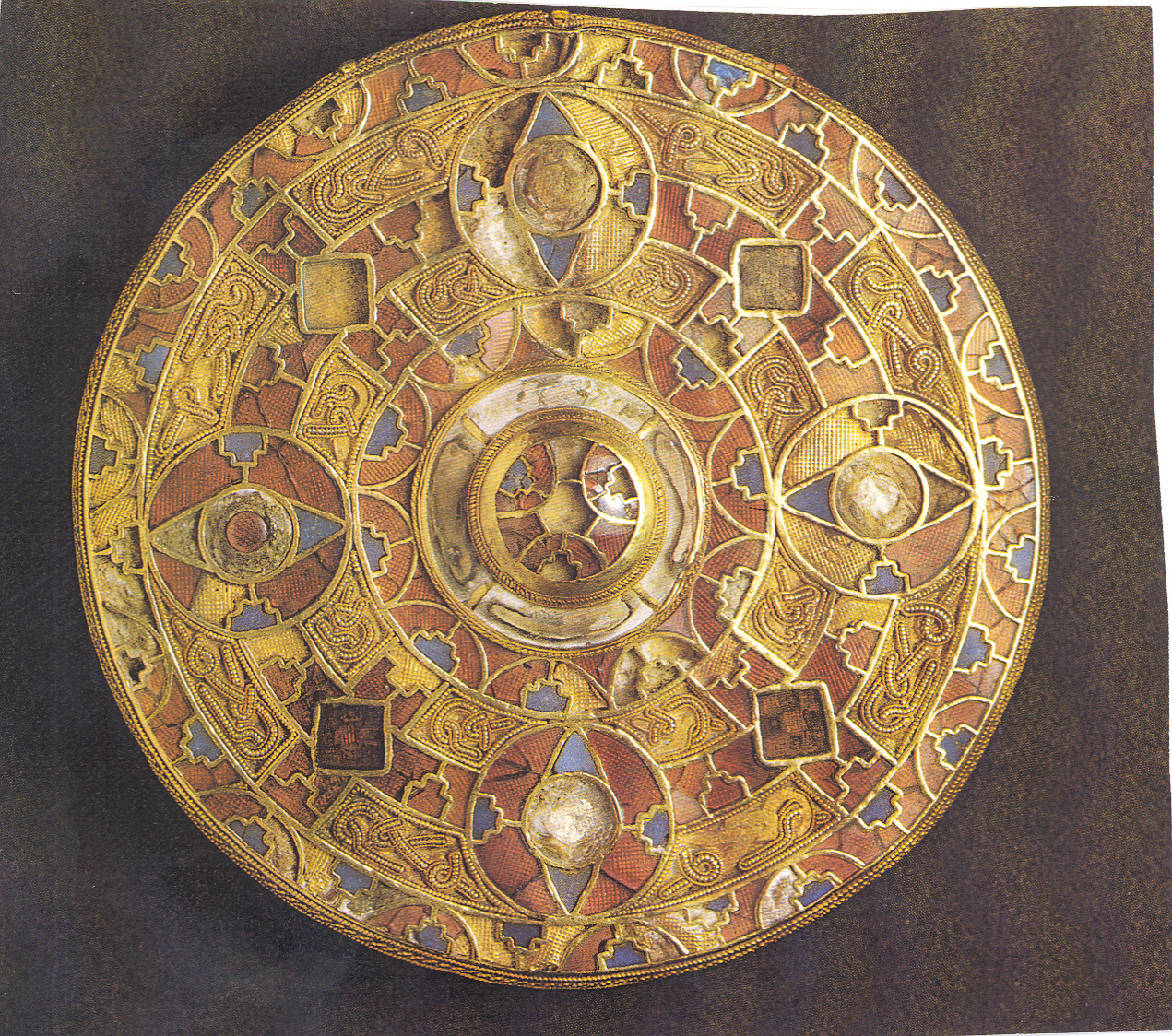
A piece of Anglo-Saxon ornamentation. Image from http://research.uvu.edu/mcdonald/Anglo-Saxon/Art.html.

A piece of Anglo-Saxon ornamentation. Image from http://research.uvu.edu/mcdonald/Anglo-Saxon/Art.html.

Back To Top
Abstract

Beowulf finishes off his reply to Unferth with another boast.

Back To Top
Translation

“‘After all, against that apostle of violence none arise
from among the Danish people, so he wars as he likes,
killing and feasting, prosecution he knows comes not
from the spear-Danes. But I shall now surprise
him with the might and strength of the Geats,
bringing him battle. Afterward whomever wants to
go to mead shall and heartily, once the morning light
brings another day to humanity,
when the light-clad sun shall shine once more from the south.'”
(Beowulf ll.598-606)

Back To Top
Recordings

Old English:

{Forthcoming}

Modern English:

{Forthcoming}

Back To Top
Finding the goddess in Beowulf

Since I’m reading Robert Graves’ The White Goddess over on my reading and gaming log Going Box by Box, I feel like I might have some insight into the meaning of Beowulf’s language here.

After all, this is the end of his speech to Unferth and the Danes. As such, he’d not want to waste any words getting his point across. He will defeat Grendel because he will do things in a way that the Danes never yet have. Such a statement is impressively logical.

But impressive enough to complete steam roll all of the Danes and get away with it? Well. Apparently. I still think he says things like “none arise/from among the Danish people” (“nænegum arað/leode Deniga” (l.598-599)) to stir them up to some extent. And to show that where they failed, he will not.

Though, using what I’ve gleaned from The White Goddess, I think that Beowulf isn’t just boasting about strength and power and the ever important element of surprise. I think he’s also speaking in a poetic language. Since I’ve not absorbed everything from The White Goddess like some sort of giant sponge, I won’t be covering all of the poetically sealed things that Beowulf has to say in this passage, but I will be speculating about the two that are the most apparent to me.

In line 602 when Beowulf speaks of the “power and might” (“eafoð ond ellen”) of the Geats, the second word he uses in his alliteration stands out. This word is fairly commonly used in the poem Beowulf, and, although my reading’s limited, probably other Old English writing as well. It stands out here, though, because one of the definitions that my Clark Hall & Meritt dictionary offers is “elder-tree; elder-wood.” A large part of The White Goddess is about Graves deciphering the Druidic tree alphabet, and elder is amidst its letters.

I think that there might be a connection between that alphabet and Beowulf’s speech here.

According to Graves, the elder tree is the one that stands for the last month of the Druidic calendar. It signifies death and is said to have been the crucifixion tree. Graves backs this connection up with the mention of elder-leaf shaped funerary flints found in megalithic long-barrows.

In short, the elder tree is deeply associated with death.

It’s also quite deeply connected with witches and the devil itself. Though, because of its white flowers that are “at their best at midsummer” (185), the elder is also an aspect of the white goddess herself, the ruling triple deity of Graves’ Indo-European religion.

Setting this into the context of Beowulf’s speech, specifically his boasting that Geatish “might and strength” ((“eafoð ond ellen”) l.60) will prevail, does actually make sense.

The word “eafoð” specifically means “power,” “strength,” or “might,” and “ellen” means “zeal,” “strength,” “courage;” “strife,” “contention.” As a noun or adjective “ellen” means “elder-tree” or “elder-wood” respectively.

Pairing both words up is, thus, a little redundant. Though this apparent redundancy could be emphasizing the power of which Beowulf speaks. Combining the strength of eafoð with the death connotations of ellen as “elder wood,” though, I think that Beowulf is pushing his claim that he’ll beat Grendel with brand new tactics even further. He’s really saying that with the strength of death he will overcome the fiend that has been terrorizing the Danes for years.

Maybe that sounds a little far-fetched, even for something on the blog of someone who studied literature up to the graduate level. But hear me out.

The Geats have so far been characterized as a warlike people. Anyone who is so warlike will likely invest a lot of importance in their armour and arms.

The Anglo-Saxons clearly do this, as a good portion of the poem to this point has been about this or that bit of armour. Beowulf even gives Hrothgar explicit instructions to send his armour back to Hygelac should he fail.

In a sense, then, Beowulf identifies with his armour, as any culture that puts hereditary significance onto arms will. (Passing a sword down from father to son, I think, signifies a passing of a sort of family spirit, something that identifies the rightful wielder as a true member of the tradition and therefore of the family.)

When push comes to shove, Beowulf’s tactic for defeating Grendel is to fight him at his own game. Beowulf knows that conventional weapons have no effect on the fiend and so he strips away his armour and wrestles with him. Removing his armour signifies a death of sorts, and I think that (along, of course with alliteration), that’s why Beowulf refers to the might of the Geats with eafoð and ellen. I think that he’s definitely pulling on the alternate interpretation of “ellen” as “elder” and all that the tree connotes.

Jumping down to the bottom of the excerpt, I think that Beowulf completes very intentionally ends his speech about defeating Grendel and restoring Heorot with a reference to the sun rising and shining from the south.

Again, turning to Graves, he gathers quite a bit of evidence for the conception of the most terrible place on earth in many European myths being the far reaches of the north (it’s basically the whole point of chapter six). Thus, the sun’s shining from the south signifies a complete turn around in which the Danes’ troubles are over and the light of the sun (already equated to the light of god elsewhere in Beowulf) will shine down on them with all of its might.

Ultimately, then, I think that Beowulf’s not just boasting about taking a new tack against Grendel to beat him, I think he’s making the extreme claim (at least in the connotation of his full boast from lines 601 to 606) that he will defeat Grendel by dying and resurrecting.

If this is the case, then I have no idea what to make of the reference to one of the most important events in the pre-Christian year (the festival celebrating the death and rebirth of the year) in a poem that was very clearly written in its current form in a post-Christian time. The reference’s not being a direct one does suggest the sort of subterfuge that Graves writes about poets using to avoid church persecution, but I’m not entirely sure that’s at work here.

Though I could push my analyses of these references further by pulling one more thing from Graves.

In chapter three he writes that in the old poetic language, the roebuck signifies something hiding. A hart (the animal on whose name “Heorot” puns) isn’t exactly a roebuck, but again, maybe the poet/scribe was just covering himself.

Back To Top
Words with mythical connotations

Unsurprisingly for a passage that contains the sort of arcana that I pointed out in the first part of this entry, this one has some doozies so far as words go.

In its first line, for example, is the mysterious word “nyd-bade.”

The Clark Hall & Meritt dictionary I have defines it as “messenger of evil?[sic]” and grabs this definition from the word’s context in the Old English Exodus. Breaking down the word doesn’t give us a clear definition, but it might shed some light on just what it means.

The word “nyd” is an alternate spelling of “neod” meaning any one of “desire,” “longing,” “zeal,” “earnestness,” “pleasure,” or “delight” or of “nied” meaning “need,” “necessity,” “compulsion,” “duty,” “errand,” “business;” “emergency,” “hardship,” “distress,” “difficulty,” “trouble,” “pain;” “force,” “violence,” “what is necessary;” “inevitableness,” or “fetter.” This word could also signify the name for the rune “n.”

Notwithstanding the possible rune reference, the common denominator in the various meanings of “nyd” is urgency. Drawing urgency out of “fetter” might be a stretch, but something that’s fettered is usually so bound quickly to prevent it from doing any unnecessary harm.

Thankfully, “boda” is much more straightforward; it means “messenger, herald, apostle, angel; prophet”

Taken together, then, these words seem to refer to someone who brings something urgent.

In that general sense, they don’t need to bring something evil.

It could even be interpreted as referring to someone who is a forerunner for some important piece of information. Actually, following that interpretation could lead to reading Grendel not as some godless monster, but perhaps as a pagan priest who continually visits the freshly converted Heorot in an effort to bring them back to the old beliefs.

Grendel’s only known relation being his mother makes this a very curious interpretation indeed, since that could make Grendel the final, faded champion of a now perverted great goddess. Or perhaps even the champion only of the death aspect of Graves’ triple goddess.

Looking at it that way really casts the whole poem into a new light – it’s not just about a vaguely Christian warrior claiming victories over monsters in god’s name and ruling his people well, but about the decay of the old religion and the revitalizing force of this new one. As well as how the new one is integrating aspects of the old.

A comparative study of Grendel’s mom and the as yet unintroduced Wealhtheow of Heorot could be quite curious in this light. But that’s a project for another day.

Another word worthy of note (and another compound!) is “sweglwered.” This word’s parts are much clearer than those of “nyd-boda.”

The word “swegl” means “sky,” “heavens,” “ether,” “the sun;” or possibly “music” while “wered” means “throng,” “company,” “band,” “multitude;” “host,” “army,” “troop,” or “legion.”

The combination of these two words creates a fairly vivid picture of the other things in the sky forming a sort of comitatus with the sun at its head.

Closing on this reference of a bright and shining lord and retinue really brings out the hope in Beowulf’s claim. He’s not just claiming that a new day will dawn on Heorot, bringing them all their old happiness, but that the sun will be out in all its grand array to herald this day, truly an omen of great things ahead.

Now, one more thing.

Something that’s clear to me from my reading of Graves is that the goddess of whom he writes is associated with the moon. The rising of the sun from its poetically strongest quarter, and with its full retinue then suggests something opposing the goddess.

In a general sense it could be the more aggressive, patriarchal religion that Graves believes overtook an older matriarchal one. This would make Beowulf’s claim all the grander, but it’s not as if his wrestling a terrible monster to death and then later facing a dragon were stories told with mind numbing regularity when one Anglo-Saxon asked another “how was your day?”

Back To Top
Closing

Next week there’s an interlude in the dialogue. Hrothgar takes in what Beowulf says and Wealhtheow, his queen, appears.

You can find the next part of Beowulf here.

Back To Top

Beowulf gets into puns and two regular words aren’t so regular (ll.590-597)

Abstract
Translation
Recordings
Beowulf gets into the puns
Regular words that aren’t that regular
Closing

A young man makes a mead hall stand.

A young man makes a mead hall stand.

Back To Top
Abstract

In a rather round about way, Beowulf attacks Unferth for his cowardice.

Back To Top
Translation

“‘I tell to you the truth, son of Ecglaf,
that Grendel never could such a horror perpetuate,
that dire demon, over your people,
the humiliation of Heorot, were thy courage,
your heart, so fierce as thou thyself sayest it is;
but he has discovered that he need not the vendetta,
the terrible thronging swords of your people,
greatly fear, the Victory-Scyldings.'”
(Beowulf ll.590-597)

Back To Top
Recordings

Old English:

{Forthcoming}

Modern English:

{Forthcoming}

Back To Top
Beowulf gets into the puns

All neat and tidy, Beowulf really covers it up here. He gets to the meat of the issue and makes his point very succinctly:

“Unferth, because of your cowardice, Grendel is terrorizing Heorot.”

Bang. Boom. Oof.

Though the actual poetry isn’t quite so straightforward.

However, I really think that Beowulf’s scattered sentence structure is the result of his being livid while he speaks. This emotional state would explain to some extent why he dives into apposition as often as he does, and why things are quite so lively. He’s just tearing into Unferth at this point.

But does Beowulf maybe lose control at the end of this rant? Is his referring to the Danes as a whole (the “Victory-Scyldings” (“Sige-Scyldinga” (l.597))) pushing things too far, and unfairly spreading the blame that Unferth must bear to the rest of Hrothgar’s people?

I’d say that he’s definitely going a bit far. But I think that it’s necessary for Beowulf to sort of gently call out all of Hrothgar’s men in this instance. After all, Beowulf will be doing things differently. Spreading the blame to all of them is no doubt a keen way to show that their approach simply isn’t working and so an outsider’s approach is necessary.

Beowulf’s upending the mead benches, as it were.

Though taking a look at his epithet for Unferth and Hrothgar’s Danes, the “Victory-Scyldings,” suggests that a little bit more than merely spreading the blame might be at work.

The latter part of this compound name means, simply refers to a group of people. But the word used before it, “sige” can mean “victory,” “success,” “triumph” or “sinking,” or the “setting of the sun.”

Is Beowulf playing the prophet here, sarcastically referring to the Danes as the “Victory-Scyldings” while implying that their power is waning?

Maybe it’s not all that prophetic to say so, since for the last seven years Grendel has been tormenting them and has made their house of joy into the home of sorrow.

Yet, I think the wordplay to be found in “Sige-Scylding” is definitely intentional. The Anglo-Saxons liked a bit of sarcasm in their writing, and puns have been around since the Epic of Gligamesh.

Plus, a word for something like “victory” would likely be one well-travelled over the tongues of Anglo-Saxon audiences. It stands to reason then, that the wise among them would also be well aware of the words referring to things that are waning in some way.

Beowulf may pun earlier in this passage, as well, when he uses the compound word “searo-grim” to describe Unferth’s heart and spirit. The first part of the compound is straightforward enough, it usually means something like “art,” skill, or cleverness. But the word “grim” is rather ambiguous. (Ain’t that always the way?)

This word can be interpreted as grimman: terrible sin, along with the more literal, “grimm” meaning “fierce,” “savage,” or “severe.”

Beowulf mentioned Unferth’s killing his own kin in last week’s passage. Such a deed is truly a terrible sin, so I think it’s entirely possible that (aside form reasons of alliteration) the poet/scribe went with “searo-grim” for the little punning wink it puts on Beowulf’s sarcastic burn against Unferth’s frosty courage.

What do you think – is Beowulf making puns along with pointing out Unferth’s failings? Why would he throw such things into so serious a part of his speech?

Back To Top
Regular words that aren’t that regular

To mix things up further this week, this part will still deal with words, but will entirely avoid discussing compounds.

Instead, there’re two regular, old words in this week’s passage that I think are worthy of discussion.

First up is the verb “onsittan” (from line 597). This one means “to seat oneself in,” “occupy,” “oppress,” “fear,” “dread.” Though sharing verbal real estate might not necessarily mean that those doing the sharing have much in common, “onsittan” offers a curious combination. The sort of combination that I like to read into. So read into it I shall!

Since the concepts of occupation and fear are paired together in this verb, I wonder if it implies a certain variety of fear. Not necessarily a sort of intensity of fear, but rather a certain quality of fear. One that doesn’t envelop you or creep up on you, but instead one that you set yourself into, like laying back on a nice massage bed – only to realize that the massaging fingers are thousands of squirming cockroaches.

Such a conception of fear, as something that you occupy rather than something that comes over you, may seem strange, but if you think about the larger implications it starts to make sense.

The Anglo-Saxons weren’t the most optimistic of people and so perhaps the more negative, primal emotions (such as fear) were conceptualized not as things that came from you but things that you encountered and entered into. Hence, you could come to occupy fear or dread just as you could occupy a room.

On the topic of different conceptions of things that we might take for granted, the Anglo-Saxons had a curious idea about colour.

Rather than defining it by hue, they had a tendency to define colour by its lustre. The brighter the colour, the better and more favourable it was. The darker, the more dim and drear. This might not sound too strange, but when you run into a bunch of colour descriptions only to find that they continually include light, it’s hard not to see how it differs from our modern ideas of colour.

With the word “atol” (from line 592), meaning “dire,” “terrible,” “ugly,” “deformed,” “repulsive,” “unchaste” “horror,” “evil,” I think something similar is happening. I don’t think appearance is necessarily being equated with moral uprightness as we might understand the old trope.

Instead, I think that ugliness is being related to evil simply because it lacks symmetry, it lacks the brightness that might define beauty or an incredibly valuable item or colour (like gold, for instance).

Further, I think that it’s possible that this is at the root of the old appearance/morality trope, or at least why it persisted in so much British culture and English literature.

What do you think about the Anglo-Saxons’ differing conceptions of things like fear and appearance? Are they so different from our own?

Back To Top
Closing

Next week, Beowulf finishes haranguing Unferth and confidently assures that Danes that he will kill their monster.

You can find the next part of Beowulf here.
Back To Top

Beowulf’s wild accusation and some “near relatives” (ll.581b-589)

Abstract
Translation
Recordings
Beowulf starts big
Who are these near relatives?
Closing

A young man makes a mead hall stand.

A young man makes a mead hall stand.

Back To Top
Abstract

Having finished his version of the swimming contest story, Beowulf begins to properly lay into Unferth.

Back To Top
Translation

“‘I from no man of you
in such strife have heard tell,
sword terror. Neither you nor Breca
at battle-play, still neither of you two,
have done sincerely such deeds
with the stained sword – nor do I mean to boast in this –
though thou brought death to thine own brother,
near blood relation; thus thou in hell shall
suffer damnation, though thine wit thrives.'”
(Beowulf ll.581b-589)

Back To Top
Recordings

Old English:

{Forthcoming}

Modern English:

{Forthcoming}

Back To Top
Beowulf starts big

Perhaps it’s just a formal formulation that Beowulf is quoting at the beginning of this week’s extract, but lines 581b and 582 stand out as being the most knotted of the bunch. That is, they’re the only ones in which his word order gets twisted around for some sort of effect.

My guesses are that these lines have their word order turned about to show Beowulf shifting from narrative to outright declamation (that is, in fact, defamation). He’s now turning his attention directly to Unferth and so perhaps there’s some dramatic value in having Beowulf speak in a more convoluted way as he turns to accusing Unferth of having done no deeds of note. Maybe there’s something there, but I’m not too sure about what it could be.

What’s much more explosive and attention grabbing is the meat of Beowulf’s attack on Unferth. He doesn’t pull any punches.

He starts by saying that neither he nor (for what it’s worth, I suppose) Breca have done any great deeds of might in battle to match his own against the sea monsters. He underscores this by saying that he doesn’t “mean to boast in this” (“no ic þæs fela gylpe” (l.586))

Then Beowulf very quickly raises the stakes, saying that Unferth is going to burn in hell because he killed his kin.

Wait. Where did that come from?

Is this a commonly known thing? Is this act something that’s been published abroad with Unferth as the fiend, the villain?

Or is Beowulf maybe misinterpreting something, sharing among the Danes some piece of news that was mangled by the time it reached the Geats?

It’s possible that Beowulf’s verbal finger wagging here is based on mangled, second hand news. In that case, Beowulf’s bold statement here makes him look like an ass. Though he’d put shame into the heart of Unferth (and the rest of the Danes) with next week’s words.

If, on the other hand, Beowulf’s accusations are based on a well known story, then where does that put Unferth?

I can’t help but get the feeling that Beowulf is being something of a prig in pointing out Unferth’s killing of his own kin. If he’s in a position of honour, close to Hrothgar, then this deed must be generally ignored. Beowulf’s dredging it up could be an oversimplification of what really happened.

Perhaps Unferth slew his kin because he was bound by some sort of complex system of alliances to do so?

Or maybe Unferth has a sister and her marriage soured to such a degree that her blood relations were forced to fight her relations by marriage?

The word “heafod-mægum” does, after all, merely mean “close kin.” And it can mean anything from wife to husband to uncle to aunt.

Whatever the case, I think that Beowulf is glossing over something major in his outright defamation of Unferth as a kinslayer.

I think there’s something here in Beowulf’s saying that even Unferth’s wits won’t be able to save him from burning in hell could be a reference to Unferth’s having reasoned his way out of whatever moral quandary lead him to kill his kin.

The weirdest part of this whole passage to me, though, is that no one interrupts.

No one steps in to say “Hey, Beowulf, lay off.”

It’s not as though dialogue gets interrupted elsewhere in the poem, but the way that things are presented here it feels as though Beowulf and Unferth are utterly alone rather than in a packed mead hall.

One way to read this whole bit is that it’s might calling out brains. Beowulf is very clearly might, and so it could be argued that his moral understanding is simplified to “good guys” and “bad guys.”

Whereas, Unferth, if he really is as witty as he’s said to be, represents the brainier side of things. He is perhaps, a coward at battle, but quick in his mind and able to evade the judgment of his peers because of this. Though, in true Christian fashion (and pre-Christian Anglo-Saxon beliefs, too?) Beowulf states that Unferth will face up to his crime in the day of judgment.

Perhaps, then, what Beowulf’s getting at is that his wits will save Unferth from the judgment of his peers, but not from the final judgment of god itself.

Do you think Beowulf is really being as religious as his reminding Unferth of his final judgment suggests?

Back To Top
Who are these “near relatives”?

Not to kick a dead brother, but this week, the second section is going to repeat the subject of the first.

The word that Beowulf uses to further describe Unferth’s slain kinsmen, “heafod-mægum,” is just too weird to pass up.

On its surface, the word meaning “near relatives.” It’s a combination of the Old English for “head,” “source,” “origin,” “chief,” or “leader” on the left side of its hyphen and the Old English for “male kinsman,” parent,” “son,” “brother,” “nephew,” “cousin,” “compatriot,” “female relation,” “wife,” “woman,” or “maiden” on its hyphen’s right side.

What we can take away from dissecting this one is that a near relative isn’t necessarily a blood relation (the only occurrences of blood relations in “mægum”‘s definition are “parent, son, nephew, cousin,” just 4 out of 11 total possibilities). It could be something as intimate as a spouse or fellow member of a close group that identifies as a singular unit.

I think that it’s also possible to see “mægum” being combing with “heafod” as a way to express that the connection implied by “near relatives” is something established through reasoning. The connection it describes relies on someone’s wits to understand it. Figuring out degrees of relation isn’t simple arithmetic after all.

Given the need for wits to understand the relationship denoted by “heafod-mægum,” could Beowulf be making a joke when he says that Unferth’s wits won’t save him from his hellish fate?

My thinking here is that if wits make this close connection, if the relationship between people joined through marriage or common membership in a certain group was regarded as being a connection based on understanding rather than anything physical, then it’s possible for such a connection to be cast aside using that same understanding. Wits can unbind what they have bound, though, if Beowulf’s right in saying Unferth is still damned, god does not forget what has been bound.

Disposing of a connection would mean forfeiting of whatever rights and privileges went with the connection. Reasoning your way out of a non-blood relationship also wouldn’t erase any heinous acts done to those near relatives. Acts like, say, murdering them. And it does sound like Unferth killed more than one of his close kin since both “broðrum” and “heafod-mægum” are in their plural forms.

Given all of this, I think Beowulf is speaking figuratively when he says that Unferth killed his own brothers. Rather than being blood relations, I think he’s going more towards the “compatriots” sense of “heafod-mægum.”

Why?

Because if someone were to slaughter his actual brothers, he would not end up in the inner circle of someone like Hrothgar.

However, it’s possible that Unferth is a turncoat, that he betrayed his birth tribe or group for the position that he now enjoys and Beowulf places the slaughter of his people squarely on his shoulders because if not for his betrayal they would have managed to overcome whatever was assailing them – even if that happened to be the Danes themselves as I’m guessing it was.

Because of the slithering sort of vibe I get from Unferth, I think it’s likely that he did betray the kin he slew. And that he probably did it for a place of honour with another group. However tarnished that place might be by a past that he has reasoned his way out of.

What do you think Unferth’s story is? Is he a stone-cold killer as Beowulf’s accusation suggests, or is he simply misunderstood by the Geatish hero?

Back To Top
Closing

Next week, Beowulf continues his haranguing of Unferth, laying the blame for Grendel’s terror on his cowardice.

You can find the next part of Beowulf here.
Back To Top

Beowulf’s return to civility and just what “foreign land” means (ll.569b-581a)

Abstract
Translation
Recordings
Beowulf’s come down
A land of something
Closing

An Anglo-Saxon world map known as the "Cotton" world map (c.1040). (Looks like I'm not the only one with a sketchy sense of geography.) Image found at http://en.wikipedia.org/wiki/Early_world_maps#mediaviewer/File:Anglo-Saxon_World_Map_Corrected.png.

An Anglo-Saxon world map known as the “Cotton” world map (c.1040). (Looks like I’m not the only one with a sketchy sense of geography.) Image found at http://en.wikipedia.org/wiki/Early_world_maps#mediaviewer/File:Anglo-Saxon_World_Map_Corrected.png.

Back To Top
Abstract

Beowulf brings his version of the events of his swimming contest with Breca to a close.

Back To Top
Translation

“‘Light of the east came,
God’s bright beacon; the sea abated
so that I the sea-cliff might see,
upon the windy shore. Wyrd oft saves
the unmarked man, when his strength thrives.
However they me confined, I with the sword slew
nine seabeasts. Never have I heard of any
through inquiry to fight so hard beneath heaven’s vault by night,
nor any man so miserable on the sea.
Yet I continued to survive the hostile distance,
weary of the journey. Then the sea bore me up,
the waters brought me to Finland,
the sea of a foreign land.'”
(Beowulf ll.569b-581a)

Back To Top
Recordings

Old English:

{Forthcoming}

Modern English:

{Forthcoming}

Back To Top
Beowulf’s come down

At long last, after three entries, Beowulf wraps up his account of the swimming contest. In this version, it’s unclear what exactly happened to Breca, save that he didn’t win. But it’s also clear that Beowulf’s not content to limit his tale of glory to some contest. He has to boast about how badass he was in beating up nine sea beasts!

Actually, given this information, It’s safe to say that he probably didn’t rout the sea beasts in the area, only put the fear of Beowulf (and the god that he keeps invoking?) into them.

Actually, Beowulf’s return to simple, straightforward language signals the audience rather nicely that his battle is over. I don’t think Beowulf is necessarily a berserker, but were he, this part of his story would show his ability to come down from his battle fury (and mescalin trip) so that he can re-enter normal society.

Sidebar: Beowulf could be a berserker, though. It’s thought that his name means “bear” since it’s a combination of “bee” and “wolf” – implying a wolf that hunts out bees. Berserkers wore bear hair shirts (or just plain bear skins). If someone was called a bear straight up, then maybe it was because that person was hoped to have the potential to go fight as berserkers did.

Beowulf’s showing that he so readily came down from his battle fury, along with being the denouement to his story, also might put the Danes at ease. As shown in the simplification of his diction the morning after his kill, once he’s defended himself he becomes relaxed and fully reasonable. Almost like the shore being revealed after the fury of the ocean recedes from it with the lowering tide.

Now, this isn’t to say that the Danes looked at this young Geat and worried that his monstrosity would replace Grendel’s should he defeat him, but I think that the Anglo-Saxons and other early medieval people were well aware of how people who became monstrous in battle (ie: berserkers) could sometimes carry that monstrosity over to times of non-battle. Because of that I think it’s safe to say that rhetorically Beowulf’s conclusion of the swimming episode is meant to show his ability to return to society despite doing something as incredible, and well, mad, as beating up nine sea monsters in one night.

But Beowulf doesn’t finish selling his ability to do what he Danes need done. In this conclusion, Beowulf also quips about wyrd. In doing so, I think that Beowulf is trying to suggest that he is favoured by this mysterious force.

For, being thrown around by the sea and attacked by so many mysterious monsters definitely suggests that he is a marked man (as in line 572-573). Yet, he’s quick to add that wyrd will spare those (even those marked) when they’re at the height of their strength (l. 573).

If Beowulf’s in his early twenties or late teens when he comes to Daneland, then it’s probable that he’s still at the ‘height of his strength.’ Or even that he’s at the very height of it. Whatever the specifics, wherever he is on the trajectory of his strength over the course of his life, it’s a stat that must still read fairly high (high enough for wyrd to give him some saving throws), and Beowulf, I think, is rhetorically banking on this to show the Danes that he can, indeed deal with their monster problem. He’s won glory against such foes before, so why not one more time, right?

Right?

Do you think the poet had all of these meanings in mind when he/she composed/wrote out Beowulf? Or am I reading way too much into this?

Back To Top
A land of something

Well, in this week’s passage there were quite a few things to do and see word wise.

The most interesting to me and my ever-on-the-back-burner project of sorting out early medieval Anglo-Saxon nationalism and how it relates to the Celts that they displaced/absorbed/wiped out from Britain is the word “wealland.”

This word simply means “foreign land.” However, there’s a loose thread on it to pull at. Why should there be such a thing? Because it’s a compound word.

So the seam between the words of this compound comes between the two l’s. The word “land” means the same thing that it does in modern English; it refers to a country, land, or, in the most clinical sense, a span of physical space. The first word in this compound, “weal” is where things get complicated. And, carrying on with the metaphor of clothing, is where the whole thing’s aesthetic appeal comes from.

The word “weal” can mean a few things. As “wiel” it can mean “slave,” “servant.” As “wael” it can mean “slaughter,” “carnage” or “dead bodies.” As “weall” it can mean “wall,” “dike,” “earthwork,” “rampart,” “dam,” “rocky shore,” or “cliff.”

Although, as with most of the compound words I dissect in this part of these entries, “wealland” was probably in such common use when Beowulf was written down as to simply mean “foreign country,” the two words that come together to make it wouldn’t have been put together without reason in the first place. So what could any of these combinations mean, and what might each say about the Anglo-Saxon world view?

Well, if the original first part of the compound was “wiel,” then “wealland” implies that the Anglo-Saxons viewed foreign lands as things to be conquered.

These lands were places that were ripe for plunder and invasion, places that, of course, would become subject to the Anglo-Saxons Germanic might and superiority. If this really was the original combination, then it suggests, in my mind anyway, that the word probably came together around the height of the Anglo-Saxons’ power.

Argument could be made in favour of “wiel” and “land” being the original combination since the country that eventually formed beside what eventually became England is known, in English, as Wales, implying that its people (the Celts on the British mainland) were slaves or servants to their Anglo-Saxon neighbours.

Though, come to think of it, the basis of this analysis means that “Wales” could also have been so named in reference to its being a place of great carnage, a field of constant battle.

More generally, if this gorier meaning of “weal” is what combined with “land” originally, then the Anglo-Saxons perhaps took a more sober view of foreign lands and their potential for conquest.

Instead of being unceasing optimists, they realized, somewhat philosophically (probably after having landed in Britain and growing fond of the place), that the conquest of foreign lands would lead to nothing but slaughter. Though on whose side exactly is unclear. The implication, nonetheless being that foreign lands were places of great and terrible conflicts.

The third possibility for the subtext of “wealland” is simply that it’s used to refer to foreign lands that are fortified. These fortifications could be from either sea-cliffs and promontories or from walls that these lands’ people built.

Since I’m not so sure about the Danes’ or Geats’ relationship with Finland (Sweden was their mutual big bad, at least in the world of Beowulf), I can’t say how the Danes are supposed to take Beowulf’s landing there. But specific to this passage, I think it’s entirely possible that this “walled land” or “sea-cliff-protected land”) is the subtext, at least in Beowulf’s use of “wealland” here. Beowulf mentions the sea-cliff and the tide receding from it after all. Plus, if he swam to Finland from the spot where he fought the nine sea-monsters its sea-side topography couldn’t be too different, right?

But I feel like bringing geography into this is a bad idea. My languages and history might be all right, but my geography gets pretty terrible pretty quickly – let alone historical geography.

There is also, actually, a fourth possibility for “wealland.” It’s totally possible that all three meanings could be taken from the word depending on context. I mean, if there’s one thing that I’ve often assumed in this part of these Beowulf entries it’s that one compound word with varying elements can have multiple meanings. So why wouldn’t that be the case with one used to refer to foreign lands, something that I imagine came up quite a bit in the Anglo-Saxons’ literature, poetry, and day to day dealings.

Which combination do you think makes this most sense in general? What about in the context in which Beowulf uses “wealland”?

Back To Top
Closing

Next week Beowulf starts to lay down a sick burn on Unferth.

You can find the next part of Beowulf here.

Back To Top

Beowulf heaps up his boasts, and three words are worked out (ll.559-569a)

Abstract
Translation
Recordings
Beowulf’s strategic boasting
Two straightforward words, a third undefined
Closing

St. Brendan and his crew celebrating Easter on the back of a whale. Found at http://saintsbridge.wordpress.com/2013/12/20/celts-to-the-creche-st-brendan-the-navigator/.

St. Brendan and his crew celebrating Easter on the back of a whale.
Found at http://saintsbridge.wordpress.com/2013/12/20/celts-to-the-creche-st-brendan-the-navigator/.

Back To Top
Abstract

In this week’s extract Beowulf fends off more of those sea-borne fiends.

Back To Top
Translation

Very often the loathed enemy
vexed me violently; I to them stretched out
my dear sword, as was suitable.
Nor did they there have much joy,
the evildoers, they that would have me served up,
they came to permanent seats in the sea-bed;
and come morning with sword wounds
they were laid upon the shore,
set to sleep by the sword, so that afterward none
near the steep ford the seafarers’
course could hinder.
(Beowulf ll.559-569a)

Back To Top
Recordings

Old English:

{Forthcoming}

Modern English:

{Forthcoming}

Back To Top
Beowulf’s strategic boasting

So Beowulf here takes a little opportunity to explain more of his exploits when fighting feral beasts. Of course, you kind of have to admire the guy. He’s here, supposedly just explaining what really happened with the whole swimming contest thing, but he manages to work in some boasts about his battle skill nonetheless.

Plus, what he describes is a battle with an enemy that’s just as ill-defined as Grendel is, too. No doubt that’s meant to give the Danes further hope in spite of Unferth’s attempt to chop Beowulf down.

Maybe, as unlikeable as Unferth is in my mind, that’s kind of why he speaks up. Or rather, that’s why Hrothgar let him speak up. He knows that Unferth, as cowardly as he is, will call Beowulf out and if this Geat is as worthy of the challenge of Grendel as he himself claims to be, then he’ll be able to repel Unferth’s accusations. Since he’s shown himself a master of rhetoric, it’s possible that if Unferth’s speech is part of some test of Hrothgar’s that he was also hoping that this young warrior newly come into his hall will prove his ability with words as well as with swords.

I’d say Beowulf does that with some success here. He might not be as eloquent as Hrothgar, or, of course, as the poet behind all of this, but Beowulf does become poetic when he’s talking of what he excels in: Battle.

The marauding sea beasts would have “served [him] up” (“þæt hie me þegon”(l.563)), and the beasts aren’t just killed, they’re “set to the sleep of the sword” (“sweordum aswefede”(l.567)).

Plus, having been a boaster since he was a child Beowulf not only takes this opportunity to boast about how he spent a night defeating sea beasts (a skill that the Danes no doubt hope will transfer to land), but also goes one step further. In this part of his version of the story Beowulf makes the self-aggrandizing claim that because of his handiwork the sailors in the area no longer have to worry about being harassed by these beasts.

This statement brings up some questions.

Is Beowulf trying to imply that he killed all of the region’s sea beasts or simply that he scared them off?

Was this part of the sea famous for being overrun with “whales” or whatever “sea deer” are/were? Or was it a little known place that anyone could say anything about and not really be called out on?

Answering the first pair of questions is tricky, at best.

In either case, Beowulf aggressively asserts his battle prowess. Almost to the point where it would sound like a drunken boast if Beowulf shouted outright – “I killed all the sea-deer dwelling in the swirling water there!” or “Never again would the sea-beasts of that bay trouble sailors, for my fighting filled them all with mortal fear!”

Left at just an implication, though, Beowulf’s saying that after his night of fighting “none/near the steep ford the seafarers’/course could hinder” sounds almost equal parts true and untrue.

Which brings us to the second pair of questions.

If this place was famous for monsters, then surely someone would pipe up with a contradiction or agreement.

Though, Beowulf did do all of this fighting when he was a few years younger, so, as long as the area didn’t fall back into the fins of the sea-deer, I guess there’d be no real objections to his story.

And that makes it all the more ingenious.

Maybe around the time that he did this the beasts actually did start to grow scarce, but not because of him. Perhaps they moved because they needed to find a better food source. Or they left the area in search of a place where boastful swimming contestants wouldn’t harass them so violently.

The same thing can be said if the area Beowulf’s story is set in is little known. These events’ happening a few years before his appearance in Heorot would simply make it all the more difficult to prove or disprove his story.

So, as much as Beowulf may be a brute when it comes to matters of sentence-level rhetoric, jamming his ideas into whatever constructions he has, it seems like he really does know his way around a boast.

However, whether or not that’s because he’s made many successful boasts or just has a stick-to-it attitude when it comes to fulfilling his boasts has yet to be seen.

Do you think Beowulf killed all of the area’s sea beasts or that he merely put the fear of human kind into those that remained?

Back To Top
Two straightforward words, a third undefined

Past weeks have left us with little to note in the way of weird words. This week, that changes.

These first two words paint vivid pictures of their subjects through their combinations.

The word “yð-laf” means “shore” or “beach.” But it’s actually a combination of the word for “wave” or “sea” and a word for “leavings,” “relic,” or “remnant.” That the sea’s leavings are the beach makes some sort of sense.

The constant motion of the waves over it could stir that sort of idea in an observer. Under close scrutiny, the waves might start to look like they were leaving the sand behind as they pulled away. It’s a rather poetic image that sheds some light on the Anglo-Saxon worldview.

Though, whether that particular aspect of their worldview is that the water is greater than the land or that the earth is the remains of some sort of long gone water being or simply that all things leave something behind when they depart is unclear. There’s something locked in the poetry of that image.

Similarly, though more straightforwardly, this week’s extract brings us the word “brim-liðende.” This word combines “brim” for “surf,” “flood,” “wave,” “sea,” or “ocean,” with “to go,” “travel,” or “sail” to give us a word for “sailor.” It’s neat and quite tidy, and is simply a more descriptive way of identifying someone who travels by sea.

This week’s third word isn’t quite so straightforward.

Now, the real star of this week’s word watch.

It’s a strange one primarily because it’s unclear. What it means as a whole is well-defined enough. But with my dictionaries and limited knowledge of Old English word formation I wasn’t able to come up with exactly what its parts mean.

The word is “man-fordædlan,” meaning “evil deed, crime, wickedness, guilt, sin.”

The first word in this compound is pretty easy to find (it’s on the page opposite the entry for “man-fordædlan” itself, in fact). The word “man” means “evil deed, crime, wickedness, guilt, or sin.”

The word “fordædlan,” though, is tougher to define.

My first instinct was to look up “fordæd,” thinking that the last three letters are probably a suffix of some kind. But that turned up nothing.

Next came the even shorter “dæd” meaning “deed, action, transaction, event.” If we take this word as the root of “fordædlan” and combine it with “man” its translating as “evil doers” makes sense. The doubling of the sense of act or deed could be a way of emphasizing just how evil the thing the word refers to is. The thing itself is an evil deed, an act of malice, an enacted expression of wickedness that, of course, begets its own wickednesses. Hence, the “evil doers” of line 563.

No doubt it’s actually unnecessary to do these sort of linguistic acrobatics to get the compound word “man-fordædlan” to work. There’s probably some little known “fordæd” or “dædlan” that means “doer” or “enactor.” Though an interesting nuance is that the prefix “for” can, and I quote from my Clark Hall and Meritt Anglo-Saxon Dictionary: “denotes loss or destruction…or is intensitive or pejorative[.]”

What do you think “fordædlan” of “man-fordædlan” means on its own? Could “man-fordædlan” be a compound that’s so old that its second half no longer stood on its own when Beowulf was written down?

Back To Top
Closing

Next week Beowulf brings us into the next day and tells of what he saw in the morning light.

You can find the next part of Beowulf here.

Back To Top

Beowulf versus the sea-deer, and, about those sea-deer (ll.550-558)

Abstract
Translation
Recordings
Beowulf (and Anglo-Saxons?) on armour
“Mere-deor” and other weird words
Closing

The medieval depiction of a kind of deer. Just picture this creature in the water and you may have a "mere-deor."

The medieval depiction of a kind of deer. Just picture this creature in the water and you may have a “mere-deor.”

Back To Top
Abstract

Beowulf relates his struggle with one of the sea-beasts.

Back To Top
Translation

“‘Then against the loathed my corslet,
hard, hand-woven, was of great help,
the broad coat of mail that on my breast lay
gold adorned. Me to the bottom pulled
the hostile enemy, held fast
in its grim grip; however I was yet given mercy,
that I the fiend could reach with sword-point,
my battle blade; in the war rush was taken the life
of the stalwart sea-deer by my hand'”
(Beowulf ll.550-558)

Back To Top
Recordings

Old English:

{Forthcoming}

Modern English:

{Forthcoming}

Back To Top
Beowulf (and Anglo-Saxons?) on armour

Beowulf goes on about his wondrous deeds here. And he includes a great deal of detail about how his armour saved him.

Actually, there seems to be a lot of emphasis on armour in Beowulf’s speeches.

Well, it’s not like that’s all that he talks of, but it does seem kind of strange how often he mentions armour.

In this extract, he spends just over three lines on it, and earlier, when speaking to Hrothgar he instructs him to send Hygelac his armour as a memento if he should die.

On the one hand, this armour focus could be ascribed to Beowulf and Beowulf alone. In that case, I’d say that it shows just how aware of the machinations of combat Beowulf is. He may know well the importance of the war rush, or having your opponent’s within reach of sword point, but more than that he realizes the importance of a good coat of mail.

Because sometimes you just can’t be sure.

If, on the other hand, this emphasis on armour is the poet’s doing (rather than just characterization), then it says something about the Anglo-Saxons.

Actually, it says just about the same thing, really. Though I’d add that if it is a general thing, then maybe armour has a special importance to memory.

Perhaps it’s sort of how things might be in a particularly sentimental cicada’s brain: its shell, as the armour of its youth, holds within it all of the memories that it made while wearing it. Likewise, just as a sword was regarded as imbued with special power if it’d been wielded by a male relative or great hero, a person’s armour could hold a memorial significance.

Or, more specifically, maybe these mentions of armour are part of a lost mnemonic, some sort of arcane technique for remembering not only heroes (as Beowulf would be remembered by his armour when it got to Hygelac in the event of his death), but their stories as well. It could be that the armour, after enduring with its wearer the great feat of facing Grendel (or the crash of the ocean waves), becomes a metonymy for its wearer. Not just in a metaphorical sense, but in the same sense as the shed carapace to the sentimental beetle, that armour becomes a shed part of that hero, that fighter.

Practically, speaking though, swimming in a mail shirt makes Beowulf’s bet with Breca all the wilder.

Those rings wouldn’t be made of fancy ultralight bicycle aluminium, they’d likely be made of iron. Swimming can get difficult if you’re weighed down by a particularly thick, wet shirt. It’s hard to imagine the struggle that both of them would endure wearing that sort of armour to sea.

Though it’s quite easy to imagine that weight working against Beowulf as the sea-beast he encounters in this passage drags him down.

But then, in his retelling the instance, he puts on the armour of the storyteller, shielding his tale in words reserved for warfare.

Terms like “war-rush” (“heaþoræs”) and “battle-blade” (“hildebille” (l.557)). But you know that the struggle was truly mortal when Beowulf doesn’t just say “I could just reach the fiend with the tip of my battle-blade” or “yet, I managed to wrench my sword into the beast’s gullet” but instead that he was “given mercy.”

By whom?

Well, no doubt by something between the Christian god and the Anglo-Saxon idea of “wyrd,” a kind of fate.

Invoking such a force, even indirectly, really shows how hard Beowulf was struggling because it places the battle on a cosmic level. This wasn’t just a wee brawl, it was a struggle that the cosmos had a hand in!

What do you think of the idea of a warrior’s armour being a container for the memory of his experiences while wearing it? Or of a warrior’s armour becoming metonymous for the warrior?

Back To Top
“Mere-deor” and other weird words

After last week’s “whale-fish,” this week we’re faced with what could literally be a “sea-deer.”

Tee word “mere-deor” (l.558) literally translates into that. And it creates a very simple image: A fish with horns, possibly a narwhal. Why exactly Beowulf would be fending off a narwhal isn’t clear, but that’s clearly not the point of his story. What it’s all about is his strength in overcoming the power of nature.

And what a terrible power that is.

In line 553 we’re told that Beowulf was being drug down to the “grunde.” Since he’s in the sea, this word generally gets translated as “bottom.” In fact, both Heaney and Gummere use this translation.

But “grunde” could also mean “foundation,” “abyss,” “hell.” These words might not be as accurate as “bottom,” but they all have a much deeper connotation to them; “abyss” and “hell” coming neatly packaged with implications of damnation and the impossibility of escape.

Given what Beowulf has to go through when he fights Grendel’s mother, this perception and conception of the bottom of the sea becomes very curious indeed.

Just as curious as some of this week’s compounds.

There’s “lic-syrc,” combining “body” with “shirt,” or “coat of mail,” to give us “mail coat” (specifically a mail shirt that would run down to its wearer’s thighs or knees). Then we get “hond-locen,” for “hand-made” from “hand” and the verb for “to lock,” “enclose,” “fasten,” or “intertwine.” And “beado-hraegl,” or, literally, “battle dress.”

The word “feond-sceatha” makes another appearance, too. And we’re joined by the dully straightforward “headthu-raes,” a combination of the words for “battle” and “rush” that gives us: “battle rush,” or “war press.”

So what does all this mean?

Well, to be completely honest, it’s hard to say. It’s possible that the use of all of these clear, literally translatable compound words is just due to Anglo-Saxon’s being short on words for these things that were more obscure or poetic.

Or maybe they’re the best choices for each line’s alliteration (they are).

But both of those possibilities wouldn’t really shed much light on Beowulf and his dramatic retelling of his adventure on the seas.

As such, I like to think that Beowulf is shifting his energies from using obscure words and forms to shaping his sentences to reflect the action he’s describing.

What then, does the straightforward and literally translatable, but still odd “mere-deor” mean (outside of being alliteratively convenient)?

Well, I think it, and the compounds with “hrone” and “fixas” from last week, are present in Anglo-Saxon because the sea was regarded as a mysterious place.

Who knows what goes on in there, right?

The Anglo-Saxons sailed it regularly, too, and so probably had a sort of reverent fear for things like the tides and the speed at which storms could come upon those ships that were unwary. As such, they probably had only words for the things that they saw most often.

Whales and fish definitely fit this bill because both are prevalent along the Northern coasts of Europe, as deer are on the land there.

But some sort of strange creature that was a tusked or horned thing in the sea was probably a rare sight indeed, and so to express the idea of that creature the Anglo-Saxons just took two of their existing words and ideas and mashed them together. Adding, in a way, to that creature’s mystery.

Do you think that the animal referred to as a “mere-deor” is just a narwhal, or could it be something rarer?

Back To Top
Closing

Next week Beowulf continues his tale with an account of the rest of the night and the next morning.

You can find the next part of Beowulf here.

Back To Top