A Blogger’s Beowulf in 2016

This quiet, joyous, community-centric holiday part of the year really isn’t suited to stories of kin-slaying and monster thrashing, so I took last week off from A Blogger’s Beowulf (sorry for the late notice!) and am doing the same this week.

So, watch for the next entry in the new year on January 7, 2016.

This entry will mostly be like those that came before it.

Mostly.

Thanks to a semi-reliable Google Alert, I’m planning to start posting news stories that I come across that are related to Beowulf every now and then (expect two per month).

Also, since I’ve picked up a better mic for a podcast I work on, I’m planning to catch up on the “Recordings” section of the posts. Though, this isn’t going to happen right away, it’s just something that’s on the slate for 2016.

As to what’s not on the slate for 2016, there’s finishing translating Beowulf. Even with another 50 or so weeks (factoring in a couple of weeks off), I’ll still be about 900 lines away from finishing the poem. In fact, at my current average of 10 lines per week, I’ll be finished this blog’s titular project in about three years.

I hope you’ll stick with me along the way.

Much more immediately, though, enjoy the rest of the holidays!
Happy New Year!
Be back in 2016!

Waes hael!

The Danes shred peace, and three diverse compounds (ll.1150b-1159a)

Abstract
Translation
Recordings
A Severed Peace
Three Diverse “Compounds”
Closing

An example of a 9th-10th century Anglo-Saxon sword

Back To Top
Abstract

Finn is definitively slain and the Danes head back to Daneland with Hildeburh and some keepsakes along with them.

Back To Top
Translation

“nor might the restless spirit
restrain itself at heart. Then was the hall made red,
red from the blood of their enemies, likewise was Finn slain,
king of the troop, and they seized the queen.
The Scyldings also bore away to their ships
all that had belonged to the lord of that land,
whatever within that hall they could find of
jewels, fine-worked gems. Then they left with that noble lady
on the sea voyage to Daneland,
lead her back to her people.”
(Beowulf ll.1150b-1159a)

Back To Top
Recordings

Old English:

{Forthcoming}

Modern English:

{Forthcoming}

Back To Top
A Severed Peace

As if killing Finn in his own hall wasn’t enough, the Danes go whole hog and ransack the place, too. In fact, lines 1154-1157 make it sound like they took everything that wasn’t bolted down. Then they loaded up their ships and left, bringing Hildeburh back to Daneland with them.

Minor spoilers for next week: this is the end of the song that Hrothgar’s poet sings.

So we’ve seen, at least from this little look at the episode of the Danes’ winter with Finn, that every attempt that had been made to clear up the feud between Danes and Frisians was undone.

Maybe that’s why this episode was so well known that the Beowulf poet/scribe could just launch right into it, starting off with Hildeburh’s mourning on the battlefield. Though looking back, that mourning takes on much more meaning than a single woman’s reaction to the sight of her brother and son slain in a terribly grotesque way.

Hildeburh, as a peaceweaver, as a Danish woman sent to Finn to be his wife, sees the devastation of her family and realizes that the peace she was meant to broker has failed. Perhaps in that moment, as the sun rose over the battlefield and she saw her relatives so bloodily slain, she knew that any hope for peace between Dane and Frisian had ended.

Going ahead to the funeral, as I pointed out in this entry we’re told that the glory of both Danes and Frisians burned up together.

It’s mostly speculation (this blog’s stock and trade, after all), but where there’s glory, honour can’t be far behind, right?

So, if the Danes and Frisians’ glory was gone, honour between them was likely on the way out as well. Though it must’ve lasted the winter, since Finn’s vow to the Danes that they’d be left alone as long as they stayed with him seems to have kept the Frisian lords in line until they left in the spring. But the Danes’ sense of honour towards their host and erstwhile partner in peace must’ve seriously waned. So maybe Hengest wasn’t so sympathetic with Finn as I’d imagined. Maybe, instead of Hunlafing and Guðlaf and Oslaf shoving Hengest into action, all they did was give him a gentle push.

All I can say for sure is that when the Danes take Hildeburh back to her home country of Daneland they’ve effectively undone whatever peace Hildeburh’s marriage to Finn had woven. They tore that tapestry. Stealing the gems was likely something for their trouble (and Anglo-Saxons loved treasure, so why not throw some of it into such a well known story?), though their thorough-sounding stealing of the gems is also akin to running that torn tapestry through a shredder and then lighting what’s left on fire.

Why do you think the Danes broke their peace with the Frisians? Because their leader, Hnæf, had been killed in battle? Or because they had to endure the tense and awkward winter with Finn? Or was it both and more?

Back To Top
Three Diverse “Compounds”

There are only two true compounds from this week’s passage that I want to point out. The other word is kind of a compound, but also kind of not.

This special case is the word “in-gesteald,” meaning “household goods” (found on line 1155). I think this is an older compound, or something more firmly entrenched in the language because “gesteald” itself is a modified version of of the verb “stealdan” (as far as I can tell). Let’s break it down:

The verb “stealdan” means “to possess,” or “to own.”

Meanwhile “ge” is a kind of intensifier (a weird quirk of old English grammar).

And “in” is thankfully the cognate of Modern English’s own “in,” so its meanings are similar.

So we have a word that means “in” plus an intensifier plus the verb for “to possess.” Yeah, I’d say that adds up to “household goods.” Though probably not in so far as we’d regard them as things like a coffee maker or specialized pan. I think the word refers to goods that the household had especially valued — basically, a household’s treasures.

Going from marshy murk to crystal lake clear, the next word to point out is “eorð-cyning.” This compound brings together the word “eorð” (“ground,” “soil,” “earth,” “mould,” “world,” “country,” “land,” or “district”) and “cyning” (“king,” “ruler,” or “Satan”) to make a word that means “earthly king” or “king of the country.” Not much surprising there.

Though it is a bit strange that the Old English “cyning” could refer to “Satan.” This little nuance gives the word “eorð-cyning” a curious tinge of greed and possessiveness. Maybe to imply (almost sarcastically?) that any king who was an “eorð-cyning” wasn’t a very high-minded ruler, but instead one who just ruled with greed and gluttony (or perhaps was ruled by them).

Though jumping to these conclusions about the word is risky since “cyning” having the sense of “Satan” could just be the result of missionaries using “cyning” to refer to Satan. It could have been their way of trying to devalue and dishonour what the word stood for when the Anglo-Saxons used it to refer to excellent kings, turning them instead into rulers who held nothing but earthly power and happiness in high regard in an attempt to turn the Anglo-Saxons’ imaginations away from treasure hoards and towards some glittering afterlife. But who knows?

And that brings us to “searo-gimma.” This word is a compounding of “searo” (“art,” “skill,” “cleverness,” “cunning,” “device,” “trick,” “snare,” “ambuscade,” “plot,” “treachery,” “work of art,” “cunning,” “device,” “engine (of war),” “armour,” “war-gear,” or “trappings”) and “gimma” (“precious stone,” “gem,” “jewel,” “sun,” or “star”) that means “curious gem.”

I think the point here is that a “searo-gimma” is a gem that’s been cut in a special way, or maybe designed to be part of a larger work of art — maybe even cut into a particular shape. Whatever the case, a “searo-gimma” isn’t just some ruby or sapphire lying around, but something that’s had a bit more craft applied to it. With things like “armour, war-gear and trappings” being senses of “searo,” maybe “searo-gimma” is simply short hand for jewelled armour — stuff that would dazzle as much as it would defend.

And that’s it. I think the compound words are relatively few in these, the last few lines of the song of Hildeburh and the Danes and Frisians’ fateful battle, because it’s supposed to be conclusive. As such, it’s much more straightforward than other passages about slaughter, robbery, and making off with people and booty, would be.

Though maybe the Beowulf poet just didn’t want to write a poet character who was more artful with compound words than he was himself.

My speculation about the word “cyning” and its carrying some sense of referring to “Satan,” comes from the idea that changing words can change thoughts. Do you think changing words can actually change thoughts? Or is that just an outmoded way of looking at how language and perception interact?

Back To Top
Closing

Next week we get back to the celebration in Hrothgar’s hall, since the poet’s song is over.

You can find the next part of Beowulf here.

Back To Top

A case for Danish sympathy and a sword’s name along with other words (ll.1142-1150a)

Abstract
Translation
Recordings
Hengest Gets Pushed over the Edge
A Sword’s Name and a few Other Compound Words
Closing

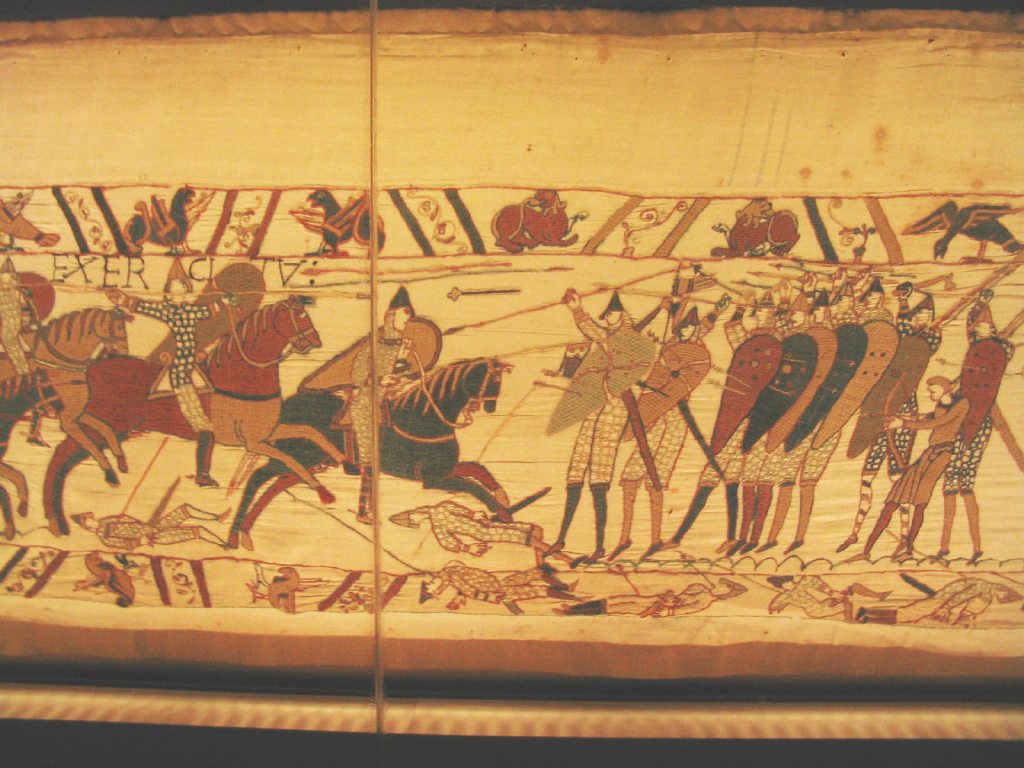
A section of the Bayeux Tapestry showing Anglo-Saxon warfare

Image found here: “Bayeux Tapestry 4” by photo by Gabriel Seah – gssq.blogspot.com. Licensed under Public Domain via Commons.

Back To Top
Abstract

After some cajoling from his fellow Danes, Hengest kills Finn before leaving Frisia in the spring.

Back To Top
Translation

“So he could not refuse the law of the world,
when to him Hunlafing gave War-Radiance,
the best of swords, placed it into his lap,
that was amidst the Jutes a known weapon.
Just so, it later befell Finn, the bold in spirit,
that he was cruelly killed in his own home,
suffered the dire attack after Guðlaf and Oslaf
spoke of the sorrow of their sea voyage,
all blamed their share of woe on Finn.”
(Beowulf ll.1142-1150a)

Back To Top
Recordings

Old English:

{Forthcoming}

Modern English:

{Forthcoming}

Back To Top
Hengest Gets Pushed over the Edge

I feel like finding sympathy for villains in this poem is something that I do a bit much of (see this entry in particular), but I can’t help but feel like there’s something in here regarding Finn’s feelings.

I mean, from the sounds of it, Hengest almost left without exacting revenge.

It’s not until Hunlafing gives him the famed sword, “War Radiance” (l.1143) and “Guðlaf and Oslaf/spoke of the sorrow of their sea voyage” (ll.1148-1149) that he acts. Or so it seems. These two actions turn Hengest towards killing Finn before leaving.

And rightly so, right? Finn is one of the Danes’ sworn enemies – a Frisian – and so his wreaking vengeance makes sense.

But what does it say about Hengest that he needed so much convincing?

If Hunlafing hadn’t given him the sword famed from fights with the Jutes or Guðlaf and Oslaf hadn’t complained about how sorry they’d be coming back to Daneland lord-less and leaving his slayer alive, would he have killed Finn?

I honestly don’t think so. I think Hengest, bitter as he was all winter, had started to like Finn, or at least respect him.

The Danes, after all, had been at Finn’s mercy, and yet he respected the pact that his marriage to Hildeburh represented. Finn extended a hand of friendship to the Danes, even if only out of obligation, and he did not go back on any of his terms. Hnæf and Finn’s own son were burned together, a funeral was held for all who perished in the battle we never see, and the Danes go unharassed all winter.

So it seems likely that Hengest, who must have been the second in command while Hnæf was alive (or at least shows the level headedness required of a leader), gradually had his grudge against Finn worn away through exposure. The ember of his hatred for the man and for his people would likely remain since this is a feud we’re talking about, but if Hunlafing, Guðlaf and Oslaf hadn’t fanned that ember back to life, I think the Danes would’ve left without incident.

But instead they kill Finn and run off – but not before committing another act to perpetuate the feud. Though that act is mentioned in the next part of the poem.

So let’s pull back for a second.

As a sword guy I just want to point out the significance of the sword Hunlafing shows Hengest. Because I think that’s probably more of a factor in what Hengest did than Guðlaf and Oslaf’s needling. After all, as a sword that “the Jutes knew well,” it’s safe to say that it was a battle-hardened sword.

Since this is a sword that seems to have been wrapped up or tucked away, it was probably Hnæf’s own weapon. As such, it probably rampaged through the battle that came before we see Hildeburh mourning on the battlefield, and so the memory of it would be fresh in Finn and the Frisian’s minds.

Or maybe they actually wouldn’t remember it at all.

What makes the reputation of the sword “War-Radiance” important is that the Danes perceive it has such a thing. Because more than idle talk of people back home thinking them dishonourable cowards for not killing Finn, showing a concrete artifact that represented the feud between Danes and Frisians, I think, would really get Hengest thinking about revenge.

Why?

Because it would remind him of all the conflict between the two in the past, such a reputed sword would stand as a testimony and representation of their feud and its enduring nature in steel. Plus, if “War-Radiance” was Hnæf’s, there’d be the twinge of duty Hengest would no doubt feel, the duty to avenge his lord at last, perhaps long since his initial feelings of frustration and anger had cooled.

Which do you think pushed Hengest toward killing Finn – the sword or Guðlaf and Orlaf’s telling him they’d be dishonoured back home?

Back To Top
A Sword’s Name and a few Other Compound Words

This passage’s compounds are pretty clear-headed. Perhaps because of the dire nature of the act the poet sings of here. After all, it’s not a battle in which you could become ecstatic in the telling, swinging compounds about like tree trunks, it’s a revenge killing of a lord in his own hall after having been his guests for the winter. It brings a chill into springtime. So the compounds are just as cold – but not less interesting.

Especially line 1143’s “hilde-leoman.” This technically isn’t a compound word since it’s the name of a sword, but that name is two other words smashed together, so here we go!

The word “hilde-leoman” comes from the compounding of “hilde” (“war,” or “combat”) and “leoman” (“ray of light,” “beam,” “radiance,” “gleam,” “glare,” or “lighting”), and I’ve chosen to translate it as “War-Radiance” (Seamus Heaney went with “Dazzle-the-Duel”) I think both have their merits.

But what’s interesting about this compound is that it’s a sword’s name.

Let me back up.

We see other named swords in this poem. There’s Hrunting and Nægling later on, for instance. But these are actual names, not just two words a poet (or someone) slammed together.

Sure, the usual alliteration comes to play with “hilde-leoman” (“Hunlafing hilde-leoman,” with the line’s cæsura right in the middle, perfectly bridges the gap), but it’s still neat that the name is just two words combined.

Plus, naming a sword something like “War-Radiance” makes sense. As a sword’s raised over and over again in a battle it’s going to catch whatever light there is on the field, especially if it’s constantly being swung but also being kept constantly clean either with quick wipes or jerky swings that shake any blood or gore free from the blade. So “War Radiance” (or the more personable” Dazzle-the-Duel”) makes an almost onomatopoeic sense (at least in Modern English).

The word “world-rædenne” (l.1142), meaning “way of the world,” is also kind of neat. Though more for its concept than anything to do with the word’s parts, those being “worold” (“world,” “age,” “men,” “humanity,” “way of life,” “life,” “long period of time,” “cycle,” or “eternity”) and “ræd” (“advice,” “counsel,” “resolution,” “deliberation,” “plan,” “way,” “design,” “council,” “conspiracy,” “decree,” “ordinance,” “wisdom,” “sense,” “reason,” “intelligence,” “gain,” “profit,” “benefit,” “good fortune,” “remedy,” “help,” “power,” or “might”).

I mean, no matter how you slice it, it basically comes back to meaning something pertaining to life and its order. The implication being, though, that killing Finn is just the way to go, it’s just what Hengest has to do as a rule of the world.

But I wonder if part of this editorializing on the part of Hrothgar’s poet sheds some light on the Anglo-Saxons’ view of history. Namely that history wasn’t something fluid that changes with every teller, but that it was something solid, and that since history was solid and fixed, so too what was to come. Though, obviously, what was to come couldn’t be read by people. So maybe there’s some determinism in that word, Hengest not being able to resist killing Finn simply because Danes and Frisians feud, and Finn’s murder would keep that going. It offers some insight into how a deterministic view of the past can lead to a deterministic view of the present and future, too, I think.

The next two compounds, “sweord-bealo” (l.1147) and “sæ-sið” (l.1149), just aren’t as interesting as “world-rædenne” and “hilde-leoman.”

Nonetheless, “sweord-bealo” brings together the unmistakable “sword” (“sword”) and “bealu” (“bale,” “harm,” “injury,” “destruction,” “rain,” “evil,” “mischief,” “wickedness,” “malice,” “a noxious thing” “baleful,” “deadly,” “dangerous,” “wicked,” or “evil”) to make a word that unmistakingly means “sword injury” or even more literally, “a grievous injury inflicted by a sword.”

And “sæ-sið” combines the nearly Modern English “sæ” (“sheet of water,” “sea,” “lake,” or “pool”) and “sið” (“going,” “motion,” “journey,” “errand,” “departure,” “death,” “expedition,” “undertaking,” “enterprise,” “road,” “way,” “time,” “turn,” “occasion,” “late,” “afterwards”) to give us “sea voyage” and almost nothing else. Though there is an implication that any kind of “sið” could be a euphemism for death since that is one of the word’s definitions according to Clark Hall and Meritt.

Do you think that the sword’s name, “hilde-leoman,” is something the poet came up with entirely for alliteration or because it was actually a sword’s name? Maybe both?

Back To Top
Closing

Next week we hear the rest of the story of Hengest and Finn, and see what the Danes do before they leave Frisia.

You can find the next part of Beowulf here.

Back To Top

The Frisians head home after a funeral full of wounding words (ll.1118b-1127a)

Abstract
Translation
Recordings
Heading Home, Gore Foreshadows
Wound Words Before a Shift for Home
Closing

An example of a 9th-10th century Anglo-Saxon sword

Back To Top
Abstract

The poet gives us some graphic details of the funeral pyre and then tells of how Finn’s troops went home.

Back To Top
Translation

“The warrior went up;
the great funeral fire wound into the sky,
the burial mound roared with it; heads melted,
gaping wounds burst anew, then blood gushed out,
the bodies’ grievous wounds. The flames swallowed all up,
speediest of spirits, there the blaze’s belly bore away men
of both peoples; their glory together passed away.

Departed then the warriors to go to their homes
deprived of friends, scattered across Frisia,
their homes and their strongholds.”
(Beowulf ll.1118b-1127a)

Back To Top
Recordings

Old English:

{Forthcoming}

Modern English:

{Forthcoming}

Back To Top
Heading Home, Gore Foreshadows

Reading this passage over again the thing that jumps out the most for me (aside from the gore) is that the poet makes a point of telling us where everyone went after the funeral. They all went back to their homes – they “scattered across Frisia” (“Frysland geseon” (l.1126)).

This kind of mass departure suggests that whatever battle was waged between Danes and Frisians must have been huge. Since soldiers are returning to their homes all across the land, Finn would have had to have brought in all of his vassals, all of those who had pledged loyalty to him in exchange for land or at the least the right to own enough property to create a home.

So this latest battle between Frisians and Danes wasn’t just one gang of Frisians fighting another gang of Danes, it sounds like it was some sort of all out offensive.

What makes this fight even more dire, though, is that we have no sense of how many Danes there were. They’re obviously not near home so we’re not told where they went after the funeral at this point. In fact, it’s even possible that Finn overpowered the Danes with force of numbers. We’ll learn next week that the Danes came by ship, so how many of them could there have been?

But even then, if you consider Hildeburh’s position as a peaceweaver between the Danes and Frisians (she’s Hnaef’s sister, after all, and had bore Finn at least one child), there must have been a very good reason for Finn to have called such a massive force together. Some incident must have re-sparked the conflict and brought it to a head in which this episode of attempted peace would come to a bloody conclusion.

Unfortunately, all I can do is offer wild speculation. But that’s just the spirit of this blog, really.

So, to the gore.

We haven’t seen many accounts of battles between human armies yet, and even Beowulf’s accounts of fighting monsters have been pretty tame in comparison to this scene. Hell, even when Beowulf pulls off Grendel’s arm, there’s nothing quite so bloody as this scene of head-melting heat. So why embellish it so?

I think that it’s a pretty clear metaphor that the violence between Danes and Frisians is going to burst anew in the fires of rage. The poet just phrases it in such burning red lines to underline the searing fury underlying this restarting of an apparently age old feud.

But amidst the very graphic foreshadowing that violence is going to break out between Frisian and Dane once more, I think there’s a quiet call for peace. Or at least a condemnation of war.

After all, the poet says “there the blaze’s belly bore away men/of both peoples” (“þara ðe þær guð fornam/bega folces” (ll.1123-1124) The rage or anger that fuels the next outbreak of violence won’t satisfy either side because it will be motivated by a passion that’s gotten into the offender. Just like the actual fire, such indignation will be indiscriminate, and burn all alike.

That’s my theory anyway. What do you think of all the gore and fire here? Feel free to leave them in the comments

Back To Top
Wound Words Before a Shift for Home

Well, in keeping with the pattern we’ve noticed when it comes to the Beowulf poet talking about war, this passage has some choice compound words.

First among them is line 1119’s “wael-fyra” meaning “deadly fire.” This one is incredibly straightforward, since “wael-fyra” comes from the combination of “wael” (“slaughter,” or “carnage”) and “fyr” (“fire”).

So this word is, literally, a “slaughter fire” or “carnage fire.” A bit more evocative in its literal form, though maybe not quite so clear as the old adjective-noun combo that is “deadly fire.”

Next we have a compound word that reminds me of Mercutio’s line in Romeo and Juliet: “No, ’tis not so deep as a well, nor so wide as a church door, but ’tis enough. ‘Twill serve” (III.i.96-97).

This is the word “ben-geato,” which means “wound-gash” (l.1121). Though this word comes to use from the compounding of “ben” (“wound,” or “mortal injury”) and “geat” (“gate,” “door,” or “opening”).

So, again, the literal form is quite evocative (if a bit clunky), as it comes out as “wound door.”

What I find especially evocative here is that the wound isn’t just gaping, or deep, or serious. It is literally a “door” or “gate” into the body.

These are wounds that’s definitely not closing any time soon, especially if the flames have anything to say about it – the fact that these wounds bursts suggests to me (with my limited medical knowledge when it comes to wounds) that the bodies and their damage is so fresh that the wounds had just lightly scabbed over, but were still raw underneath. So when the scabs melted in the flames, the fallen bled anew. Perhaps not something an audience rapt with the description of a funeral pyre would pick up on, but maybe something extra intended as further foreshadowing of friction between Danes and Frisians.

In a similar vein, we then get “lað-bite” on line 1122. This word means, simply, “wound.”

At least in translation. In a more literal form, it’s a combination of “lað” (“hated,” “hateful,” “hostile,” “malignant,” “evil,” “loathsome,” “noxious,” “unpleasant,” “pain,” “harm,” “injury,” “misfortune,” “insult,” “annoyance,” or “harmful thing”) and “bite” (“bite,” “sting,” “sword-cut,” or “cancer”), so something like “malignant sting” or “noxious sword-cut” is probably more in line with what the word intends. Again, definitely not something particularly pleasant.

Then, stepping away from war, there’s the word “heah-burg,” meaning “chief city,” or “town on a height” (l.1127). It comes from a combo of “heah” (“high,” “tall,” “lofty,” “high class,” “exalted,” “sublime,” “illustrious,” “important,” “proud,” “haughty,” “deep,” or “right (hand)”) and “burg” (“dwelling or dwellings within a fortified enclosure,” “fort,” “castle,” “borough,” or “walled town”), unsurprisingly.

This word signifies a major tonal shift from the graphic gore and blood of the funeral pyre, giving a sense of something very removed from such things. A sense that leaves me with the impression that, at least within the poem of Beowulf, there is an idea that war and life in general are separate.

It’s the idea that war is something to do far away from your high town, your home. It’s an idea that we definitely share with the culture from which Beowulf came. After all, wars in foreign lands often don’t seem real until they’ve touched us personally, or come to involve some threat to the “homeland.” Even if those threats are exaggerated or blown out of proportion for the sake of eyes on screens/pages/ads.

What do you think of the shift from the funeral to the talk of homes?

Back To Top
Closing

In the next part of the poem we’ll see what happened to Hengest and his Danes after the funeral. After a little poetic flourish, of course.

You can find the next part of Beowulf here.

Back To Top

Wild ideas about boars and words from corpses (ll.1107-1118a)

Abstract
Translation
Recordings
Wild Boars, Wild Boars!
Words Fit for a Corps(e)
Closing

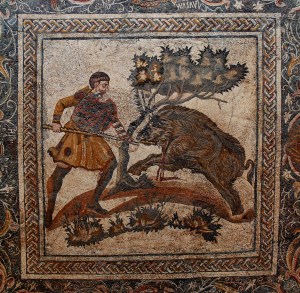
A man hunting down a boar on a 4th century AD Roman mosaic

“Mosaico de Las Tiendas (MNAR Mérida) 01” by Helen Rickard. Licensed under CC BY 2.0 via Commons – https://commons.wikimedia.org/wiki/File:Mosaico_de_Las_Tiendas_(MNAR_M%C3%A9rida)_01.jpg#/media/File:Mosaico_de_Las_Tiendas_(MNAR_M%C3%A9rida)_01.jpg

Back To Top
Abstract

The story of Hengest and Finn continues, as Finn makes good on his promise to treat the Danes well and begins a funeral for the fallen Danes – including Hildeburh’s brother Hnæf and her son by Finn.

Back To Top
Translation

“What was promised was prepared, and treasure-gold
was raised from the horde: the Scyldings
best battler was readied on the pyre.
Mail-shirts shiny with crusted blood were easily visible
on that heap, old gold boar images,
the iron-hard boar, many wounded warriors
were piled there; those few that fell in battle.
Commanded then Hildeburh that at Hnæf’s side
her own son’s body be placed for the blaze,
that his body burn on that same pyre.
Beside his uncle the lady mourned,
lamented with dirges.”
(Beowulf ll.1107-1118a)

Back To Top
Recordings

Old English:

{Forthcoming}

Modern English:

{Forthcoming}

Back To Top
Wild Boars, Wild Boars!

There’s a quote attributed to J.R.R. Tolkien that says that the Anglo-Saxons ate too much boar and drank too much mead. The mead part of that equation isn’t present in this passage, but their passion for boar certainly is. Well, in the form of things blazoned on their armour at any rate.

So what’s the deal with the boar references in lines 1111 and 1112? Well, the passage almost answers that question itself.

The first reference to a boar is the “old gold boar images” on the mail and armour of the fallen (“swyn ealgylden” (l.1111)). These images of the animals sound like they were decorative, something that adorned the armour that the fallen wore rather than something worn for practical purposes. The fact that these boars are “gold” definitely suggests decoration.

But then what about the “old” part?

My thinking is that since Hnæf is a lauded hero, he travels with the best he could muster. If they’re all part of a comitatus, perhaps their insignia is a golden boar. Or maybe the boar image at that time was just the symbol for a certain sort of soldier. So its being made of gold, the most prized metal at the time, signifies that these are the best soldiers that the Danes had to offer.

So these “old gold” boars are symbols of the fallen warriors’ status as celebrated fighters and heroes.

The next line definitely suggests the same thing, since a group of seasoned and skilled soldiers would certainly have the raw power of “the iron hard boar” (“eofer irenheard” (l.1112)). And boars are definitely powerful animals, as you can see here:

So the boar could easily have been the symbol for great warriors of old, those who fought and fought and fought and always came back.

And maybe that’s why the Anglo-Saxons (at least according to J.R.R. Tolkien) ate so much boar. Being Germanic the old German saying “you are what you eat” could well have been at work in their dietary choices.

The other major thing to address in this passage is that despite the sombre tone of this funeral scene, Hrothgar’s poet still throws in some comedy.

Line 1113’s “those few that fell in battle” just has to be sarcastic understatement. After earlier describing the dawn-lit battle field as a place where she sees “the violent death of her kin” (1079), there’s got to be more than a “few” that fell in battle. How else could someone so great as the hero Hnæf fall in battle?

Why the poet injects this little joke here may be a matter of pride – “there’s no way the Frisians killed that many of us, we still got him to follow through on his oath (as stated in this passage’s opening – “What was promised was prepared” (“Ad wæs geæfned” (l.1107)).

But the joke might also be here to dampen the military tone of recounting the soldiers and their garb as they lay on the pyre so that he can bring up the woman in mourning motif more effectively. The joke makes for a bittersweet bridge between the two, I think.

Do you think the poet’s trying to lighten the mood with this joke? Is it even a joke? Let me know what you think in the comments.

Back To Top
Words Fit for a Corps(e)

Because of the tonal variety of this week’s passage, and perhaps even to play down the glory angle of battle, the poet doesn’t use too many compound words. In fact, none of them relate to high falutin concepts as is usual when we hear about war and combat in Beowulf. Instead, they all relate to the body in very mundane ways.

Line 1109’s “beadu-rinc” is first, with its meaning of “warrior” or “soldier.” How this word derives this meaning from its parts is completely straightforward. The word “beadu” means “war,” “battle,” “fighting,” or “strife” and the word “rinc” means “man,” “warrior,” or “hero.”

So “beadu-rinc” refers to a warrior as literally a “battle man” or a “fighting man.” This is clearly someone who’s defined by their battle experience. Which, if the word’s modern cousins like “firefighter (or fireman) or “fisher” (or “fisherman”) are any indication, is probably quite a deep and long experience indeed. Maybe it’s even referring to people whose vocation was war.

Then we peer inside the warrior to get a compound word for what’s leaked out all over their torn and damaged armour: blood.

The word is “swat-fah” and it means “blood-stained,” or “bloody.” The word comes from “swat,” meaning “sweat,” “perspiration,” “exudation,” “blood,” “foam,” “toil,” or “labour”; and “fag” which means “variegated,” “spotted,” “dappled,” “stained,” “dyed,” “shining,” or “gleaming.”

There’s no doubt that the fallen warriors garments and arms are spotted or stained with blood. But I went a little further with my translation of “shiny with crusted blood” (l.1110) but I’d like to think that for the remaining Danes the blood-encrusted garb of their comrades had a certain gleam to it. That the blood dried on it was something that called out to those Danes still living and tore at their guts more than any Frisian barb about being in the service of their lord’s slayer.

On the other end of a slayer, you’ll likely find the slain. And a good word to describe such a person is “ban-fatu.” This word means “body, corpse” and comes to do so through combining “ban” (“bone,” “tusk,” or “the bone of a limb”) and “fæt” (“vessel,” “jar,” “cup,” “casket,” or “division”). So literally, “ban-fatu” means “bone vessel,” or “vessel for bones.”

Unfortunately, I can’t say if the Anglo-Saxons had any theological or cultural beliefs about bones being extra important to human life, but maybe there’s something about the bones as human frame in there. So that calling someone a “vessel for bones” meant that they were just a flesh vat carrying around their bone frame, which, in a way, is exactly what a corpse is.

What sort of image does the word “bone vessel” bring to mind when you hear it? Let me know in the comments.

Back To Top
Closing

With the funeral of the fallen Danes under way, the poet next meditates on the sight of the pyre ablaze.

You can find the next part of Beowulf here.

Back To Top

The poem returns to the status quo, words of war and of hall life (ll.1080b-1094)

Abstract
Translation
Recordings
Battleground just a Board Game?
Battle Words and Hall Words
Closing

A section of the Bayeux Tapestry showing Anglo-Saxon warfare

Image found here: “Bayeux Tapestry 4” by photo by Gabriel Seah – gssq.blogspot.com. Licensed under Public Domain via Commons.

Back To Top
Abstract

Hrothgar’s poet continues his story, as he shifts from Hildeburh to what’s happening between the battle’s commanders, Finn and Hengest.

Back To Top
Translation

“War had borne away
all of Finn’s warriors, save for a few alone,
so that he might not take to the field
to wage war against Hengest,
nor could the wretched remnant defend against hostility,
that lord’s man; but he to him offered terms,
that they for him clear the other side of the floor,
of the hall and high seat, so that he could control half
of what the sons of the Jutes possessed,
and that at the giving of gifts the son of Folcwalda
daily do honour to each Dane,
that even as generously to Hengest’s kin
he would grant those things, treasure rings
of twisted gold, as to his Frisian kin
during the giving in the beer hall.”
(Beowulf ll.1080b-1094)

Back To Top
Recordings

Old English:

{Forthcoming}

Modern English:

{Forthcoming}

Back To Top
Battleground just a Board Game?

Well, by now Hildeburh has fallen by the wayside, unfortunately, as the men debate and discuss what’s to be done. So the poem’s subject has returned to the status quo.

So what was even the point of showing Hildeburh mourning her fallen family?

I still think it’s supposed to mirror Grendel’s mother’s reaction to the death of Grendel. And I think it’s supposed to bring a bit of humanity to what might otherwise be simply expressed in lines 1080-1081’s “war had borne away/all of Finn’s warriors, save for a few alone” (“Wig ealle fornam/Finnes þegnas nemne feaum anum”).

I mean, starting with Hildeburh in mourning immediately establishes the tone of this war scene as sorrow and devastation rather than glory or action or excitement. And even though it’s not really clear who has the upper hand between Finn and Hengest in this situation, I think the poet at the least wanted to get across the direness of the battle between Finn and Hengest before it turned into just another war story.

But, who is in the position of power here? Finn’s forces are apparently nearly wiped out, but from line 1090’s alliteration with “d” on “daily” and “do” and “Danes” (in the original, it’s on “dogra” and “Dene” and “weorþode”) to the end of this passage it sounds like Hengest and his Danes are at the disadvantage. They’re the ones that need to be honoured and gifted to the same degree as Finn and his Frisians.

Running with that arrangement, it seems that Finn’s forces were nearly wiped out by Hengest’s, and yet Finn is the one who’s being called on to split up his wealth evenly for the time being. If Finn’s unable to take the field, but isn’t willing to admit defeat, then maybe this part of the passage shows the Danes being good sports, settling instead for hospitality rather than utter dominance.

If such is the case, then it makes you wonder why the Danes are willing to negotiate in the first place. The poem in general sets up the Frisians as great enemies of the Danes, so maybe, in an effort to keep that rivalry alive, this negotiation is the Danes’ letting Finn go this time so that he and his Frisians can shore up their numbers and try fighting them again.

But that makes it sound like a game. And the part of the passage about dividing the floor in half between the two groups makes it sound like it could be nothing more than a reference to a board game of some kind. Maybe something like chess or checkers. Though it would have to be a game with rules that include daily ring-giving (every turn, maybe?) and different movement rules and strategies than either of those games. Especially if dividing the board in half is some sort of special condition rather than the normal starting point of the game.

But if this conflict between Finn and Hengest is just a board game memorialized in poetry, why does it begin with Hildeburh mourning her fallen son and brother? Is the poet making a joke at the expense of her grief, implying that she’s a spectator who got so involved in the game she weeps over the loss of two pieces in particular? Or is it that Hildeburh’s grieving by the morning light is another of the game’s forgotten rules? Has Hengest activated the “mourning woman” card that entitles him to these negotiations in the first place?

As you’ve probably guessed this hard turn into peace negotiations with unclear sides is where this passage becomes truly mysterious, even laying aside its starting out with Hildeburh surveying the battlefield.

So what do you think? Is this poem that Hrothgar’s poet is reciting about an actual conflict or just some board game match?

Back To Top
Battle Words and Hall Words

The compound words in this passage are evenly split between matters of battle and matters of hall etiquette.

In the first category we’ve got “meðel-stede” and “weal-laf.”

Line 1082’s “meðel-stede” means “place of assembly,” or “battlefield.” It comes from the combination of “meðel” (“council,” “meeting,” “popular assembly,” “speech,” or “interview”) and “stede” (“place,” “site,” “position,” “station,” “firmness,” “standing,” “stability,” “steadfastness,” “fixity,” or “strangury”). As such, it’s pretty clear that it refers to a place where lots of people meet (or where lots of urine collects before leaving the body drop by drop, if we go with “strangury”).

The jump from “place of assembly” to the specific “battlefield” seems a bit of a leap, though. Neither of the words that make up “meðel-stede” are directly related to battle, so the meaning of the compound as “battlefield” implies that the Anglo-Saxons just regarded warfare as a different kind of council or meeting.

Maybe, like the ancient Greeks, and some early African peoples, war to the Anglo-Saxons wasn’t necessarily about killing but more about a kind of dramatic enactment of conflict, a kind of play with very real stakes (and very real injuries and deaths every now and then).

Or, maybe the use of this compound (beyond its alliterating with the line’s “m” sounds) feeds into the interpretation of this whole conflict between Finn and Hengest being some kind of board game. Maybe the two had some petty squabble so instead of putting actual people into the midst of it, they just played a round or two of whatever strategy game was popular at the time.

The other word that falls into the “war” category, line 1084’s “wea-laf,” is much more easily relatable to battle. After all, “wea” means “misfortune,” “evil,” “harm,” “trouble,” “grief,” “woe,” “misery,” “sin,” or “wickedness” and “laf” means “what is left,” “remnant,” “legacy,” “relic,” “remains,” “rest,” “relict,” or “widow.”

So the first word in “wea-laf” is a judgment of war that probably comes from the losing side rather than the winning one and the second word refers to those left behind (including the sense of a “widow,” which suits Hildeburh perfectly, and expands the meaning of the compound beyond merely those directly involved in the conflict).

Together, then, “wea-laf” implies that a small group was left over after the wickedness of war swept the rest away. So there is some small, beat up group left on the losing side of this conflict. Literally, they’re those that the battle left behind.

Then we move into the confines and mores of the hall.

The first of the hall compounds is line 1087’s “heah-setl.” Out of context it’s a bit trickier to just see the meaning of this word, but given that “heah” means “high,” “tall,” “lofty,” “high class,” “exalted,” “sublime,” “illustrious,” “important,” “proud,” “haughty,” “deep,” “right hand” and “setl” means “seat,” “stall,” “sitting place,” “residence,” “throne,” “see,” “siege,” this compound’s senses of “exalted seat,” “throne,” or “judgment seat” are quite clear.

As a “high seat,” “heah-setl” refers to the place of honour in a hall, that which the hall’s master occupies. It’s from this high seat that he would give treasure and hold audiences with guests and visitors. So splitting this power seems like a tall order, but if Hengest had really battered Finn’s forces, it might be seen as a valid request in exchange for mercy. Or as a clever stall tactic on Finn’s part.

Then comes “feoh-gyftum” on line 1089. This word means “bounty giving,” or “largesse” and comes from the combination of “feoh” (“cattle,” “herd,” “moveable goods,” “property,” “money,” “riches,” or “treasure”) and “giefan” (“give,” “bestow,” “allot,” “grant,” “commit,” “devote,” “entrust,” or “give in marriage”).

As a word that refers to the sharing of bounty and largesse, the intentions of “feoh-gyftum” are clear. So what can even be said about this word, really?

Well, I don’t think there was a treasure that an Anglo-Saxon (Beowulf‘s main audience) loved more than one given by a great figure. It’s kind of like the change of owner wasn’t a complete action in their minds, but rather the act of transferring ownership inherently shared not just the object being given but the giver’s very essence (though perhaps “residue” is more apt).

Actually, I think this sense that an object has more inherent value if it comes from someone great survived the rest of the medieval period in the veneration of saints’ relics and continues today in the high value people attach to things that celebrities have signed, used, or worn.

Why do you think an item that someone great or famous has used/signed is usually seen as more valuable than the same item that’s unused or that was just used by an average person?

Back To Top
Closing

The oath between Hengest and Finn is sealed in the next part of Beowulf. And we finally get clarification as to who’s got advantage over whom.

You can find the next part of Beowulf here.

Back To Top

Battlefield mourning and measured compound words (1071-1080a)

Abstract
Translation
Recordings
Two Mothers Mourning
Measured Compound Words
Closing

A section of the Bayeux Tapestry showing Anglo-Saxon warfare

Image found here: “Bayeux Tapestry 4” by photo by Gabriel Seah – gssq.blogspot.com. Licensed under Public Domain via Commons.

Back To Top
Abstract

Hrothgar’s poet begins a recitation of the story of Hildeburh, a woman in mourning.

Back To Top
Translation

“Indeed, Hildeburh had no need to praise
Jutish loyalty; guiltlessly she became bereft
of loved ones at the shield play,
of her son and of her brother; they were burdened
with ruinous spear wounds; she was made a mournful woman.
Not without reason was Hoc’s daughter
then fated to mourn, after morning came,
when she might under the sky see
the violent death of her kin, where they earlier
had held the great joy of the world.”
(Beowulf ll.1071-1080a)

Back To Top
Recordings

Old English:

{Forthcoming}

Modern English:

{Forthcoming}

Back To Top
Two Mothers Mourning

The most remarkable thing about this passage is that it’s coming from a woman’s perspective.

Hildeburh, the mother of a warrior, and sister to another, is, for some reason, near enough to the battlefield to go and see her fallen family the morning after a night battle. Her closeness suggests that this battle was probably a siege of some sort. If this is so, then she, distraught as she’s heard no word about her men, has left the city’s walls to see if she can find them herself.

Though it’s also possible that Hildeburh was along with the war party as some sort of supporter.

But I think that the line about “Jutish loyalty” (“Eotena treowe” (l.1072)) suggests that there’s been some treachery afoot, and so a siege is more likely. Or at least some sort of fortification.

Why?

Because when I think about treachery in what’s obviously some sort of war situation, I think of a betrayal that’s resulted in the fall of a fortification or castle that was hitherto impregnable. But Hildeburh’s exact situation isn’t important.

After all, the poet just launches into the story. This cold open likely comes from Hildeburh’s having been understood as a specific figure to the poem’s original audience. She’s someone who’s known to fit in with the context of the children of Finn and Hnaef Scylding, as mentioned in last week’s passage. So there’d be enough information for the poem’s early audience(s), but there definitely is not enough for us.

So, instead of trying to pull more information about the situation from this I just want to jump ahead a bit in the poem. After I’ve jumped back.

Grendel was defeated the night before the celebration at which this poet is singing. The monster’s arm was torn off, and he was left to wander, bleeding, back to his lair on the fens.

Later in the poem (about 200 lines from now) Grendel’s mother shows up to seek revenge for her son’s death.

I like to imagine that the poet’s giving us this episode from history (or common lore) about a woman going out to find her brother and son dead is supposed to parallel what Grendel’s mother is now doing (or has recently done) in the timeline of the poem.

As the Danes and Geats celebrate, Grendel’s mother is mourning. In the harsh light of dawn she’s found her son mangled and dead, having been dealt “ruinous/…wounds” (“hruron/…wunde” (l.1075-1076)). And so I can’t help but think that this part of the poem, a different version of the story found in the “Finnsburh Fragment,” is supposed to be showing us the other side of Beowulf’s great victory.

Grendel, to the Danes, and to the Geats who came to stop him, was monstrous. But Grendel is nonetheless the “kin of Cain.” He’s monstrous and some sort of abomination in the eyes of god, but he still has a family – a mother. And now that mother is grieving, angry.

But her rage comes out 200 lines down the road. Right now we just have Hildeburh. Who, even on her own, makes a curious statement about all of the war and violence in the poem so far. Showing the mourning side of battle adds the dimension of empathy for the fallen and their living relations that up to now hasn’t really been that big a deal.

But now we get to see just how that empathy plays out as Hildeburh’s part continues.

What do you make of a battle-celebrating poem like Beowulf‘s having a character mourn those freshly lost in battle? Is it a balancing element, just a token inclusion, or something else entirely?

Back To Top
Measured Compound Words

This is definitely a passage about battle. Though it’s coming from the side more familiar to most of us – that of the spectator, the person who doesn’t fight but has to live with what comes of fighting. Nonetheless, there are quite a few compound words used here, considering the length of the passage.

What’s particularly notable about these compound words, though is that their use is fairly measured.

For instance, the poet doesn’t throw down a few compounds for the same thing or concept in short succession, nor do these compounds appear in parenthetical clauses that aren’t really part of the passage’s main ideas.

In fact, in this passage, the compound words generally are the main ideas of the sentences, or at least integral to understanding those ideas. I think this measured use suggests a more focused sort of intensity than that which we’ve seen when the poet is simply slamming down compounds. But let’s take a look at these words.

On line 1073 we’re given “lind-plegan,” an innocent sounding word for “battle” that literally means “shield play” (since it combines “lind” (“shield (of wood)”) and “plegan” (“quick motion,” “movement,” “exercise,” “play,” “festivity,” “drama,” “game,” “sport,” “battle,” “gear for games,” or “applause”)).

This word is used for alliteration, but I think it’s also a reference to the sort of close combat that Beowulf and Grendel engaged in just some 300 lines ago.

Next, on line 1077 “metodsceaft” appears. This one means “decree of fate,” “doom,” or “death” and comes from the mix of “metod” (“Measurer,” “Creator,” “God,” or “Christ”) and “sceaft.”

It’s tempting to read the “sceaft” in “metod-sceaft” as the usually prefix-less “sceaft” meaning “staff,” “pole,” “shaft,” “spear-shaft,” or “spear.” I mean, this reading gives us a word that would mean something like “the spear of God,” an apt sounding metaphor for fate. Not to mention taking this compound to mean “spear of God” sees Hildeburh suffering the same sort of wound that killed her brother and son. But, I don’t think that pre-fix resistant “sceaft” is the word meant here.

Instead, there’s a similarly written word that does take prefixes, “sceaft” (“created being,” “creature,” “origin,” “creation,” “construction,” “existence,” “dispensation,” “destiny,” “fate,” “condition,” or “nature”). When this word combines with “metod,” we get the much clearer “God fate,” or “decree of fate” (extrapolated from “Measurer of fate”). Though I’m not sure what the mixture of a name of god and a word for “creature” or “fate” really implies in Old English.

Finally, the third compound word in this passage goes in for emphasis rather than some sort of new concept. The word “morthor-bealu” is already implicit in the two men dying from spear wounds, as it means “violent death,” or “murder.”

And breaking down “morthor-bealu” doesn’t do much to make the word’s implications less violent. On its own, the word “morthor” means “deed of violence,” “murder,” “homicide,” “manslaughter,” “mortal sin,” “crime,” “injury,” “punishment,” “torment,” or “misery”; while the word “bealu” means “bale,” “harm,” “injury,” “destruction,” “ruin,” “evil,” “mischief,” “wickedness,” “malice,” “a noxious thing,” “baleful,” “deadly,” “dangerous,” “wicked,” or “evil.” So we’re left with a double whammy of “murder” on the one hand and “destruction” on the other. It’s definitely a compound word that connotes inescapable violence.

But, just in case we weren’t sure about the fate of Hildeburh’s kin, we’re told through “morthor-bealu” that they met a “violent death” or “murder,” suggesting that even within the realm of warfare, their deaths were particularly grisly. Unless the poet, along with keeping up with alliterating, also wanted to give us a sense of the shock and horror that Hildeburh is likely feeling when she sees them in the dawn’s light, rather than the stoic male perspective we’ve seen the poem through up to this point.

All three of this week’s compound words alliterate with the major sound in their lines (“lind-plegan” with “l”; “metod-sceaft” with “m”; “morthor-bealu” with “m”). Do you think that’s important at all?

Back To Top
Closing

In the next passage we’ll find out what happens in the aftermath of the battle in which Hildeburh lost her son and brother.

You can find the next part of Beowulf here.

Back To Top

Payment for the dead and weird words with clear covers (ll.1050-1062)

Abstract
Translation
Recordings
Obligatory Gifts for the Living and the Dead
Sailing through a Batch of Inherited Words
Closing

Back To Top
Abstract

The poet fills us in on how Hrothgar rewarded the other Geats before telling us about “the fore-thinking mind.”

Back To Top
Translation

“Yet then the lord to each man
who had with Beowulf undertaken the sea-way,
there at the ale bench gave treasure,
bequested booty, and then commanded that immediately
gold be paid up, for to cover the one whom
Grendel earlier killed, as he surely would have killed more,
had not wise God and a single man’s
daring prevented that fate. The Measurer ruled
over all human kings then, as it now yet does.
Thus understanding is always best,
the fore-thinking mind. Much shall it endure
of love and of hate, so long as it partakes of
this world’s days of strife.”
(Beowulf ll.1050-1062)

Back To Top
Recordings

Old English:

{Forthcoming}

Modern English:

{Forthcoming}

Back To Top
Obligatory Gifts for the Living and the Dead

What is there to say about this passage? The other Geats get rewarded, the poet shares a bit of Christian-tinged gnomic wisdom and the way is made clear for more partying.

But. I’m just gonna hold us up on our way to that with a few small things.

First, on line 1152, the word for “gave” (“gesealan”) doesn’t really come off as nicely as line 1044’s “confer” (or “onweald geteah”) in last week’s passage. That is the word used for Hrothgar’s formally giving Beowulf those great gifts we’re told all about. But the treasures given to his fellow Geats seem to be given over a greater sense of obligation.

After all, “sellan” includes such senses as “furnish,” “supply,” and “allot.” It sounds like there’s much more of a need motivating Hrothgar’s giving treasure to the Geats who were either asleep or useless in the fight with Grendel. Social custom just says that you need to pay those who come in to help you, so Hrothgar’s paying up. And I guess they all get paid the same.

Even if they die in the line of duty.

On lines 1053-1055 we’re told that after he gave the other Geats gifts, Hrothgar then “commanded that immediately/gold be paid up, for to cover the one whom/Grendel earlier killed” (“ænne heht/golde forgyldan, þone ðe Grendel ær/mane acwealde”)

This makes Hrothgar sound like a very upstanding guy. Someone who really sticks to what had been offered, what had been promised. But there’s more to this exchange than a ruler simply paying everyone who came to his rescue.

Grendel had been feuding with the Danes, at least in a sense. The reason for the feud is unclear, but earlier in the poem reference is made to Grendel acting as if he had some sort of feud with them.

I’m not sure of all the laws involved, but one of the major ones in Anglo-Saxon Britain was the concept of “wergild.” I’ve mentioned this before when talking about the word itself and when talking about Hrothgar handling Beowulf’s father. But, as a quick refresher, “wergild” was the money paid out to a rival group if your group happened to kill one of their members. The purpose of this payment was to keep a feud from breaking out so that violence between familial or clan groups could be quelled in the interest of organizing these smaller groups into something bigger.

But back to the poem.

In this mention of payment for the dead Geat we might be seeing wergild paid out. Not because the Geat was killed in some sort of feud they had with the Danes. No such feud exists in the poem. Instead, this payment’s made, I think because when Beowulf was legal owner of Heorot for that night, he also took on Grendel’s feud (or, by virtue of Heorot being the Dane’s base of operations, legal ownership of it enveloped him in the relations surrounding the building). As such, since it was the Danes that got them involved in the feud with Grendel, and Grendel can’t pay any wergild, Hrothgar takes it on himself to make up for the death of the Geat that Grendel snacked on when he first arrived at Heorot that fateful night.

Plus, paying the wergild for a man killed in a battle not his own, would help to make the message of alliance and peace between Geats and Danes deafeningly clear. So there’s another reason to pay for the fallen Geat.

What do you think of the concept of attaching a monetary value to a life? Do you think such a payment was satisfying to the Anglo-Saxons?

Back To Top
Sailing through a Batch of Inherited Words

Since this is another meditative, kind of serious and slow paced passage we don’t get much in the way of wild compounds. There are few though. At the least, I’ll point them out.

First, on line 1051, we have “brim-lade,” a word for “flood-way” or “sea-way.” This word mixes “brim” (“surf,” “flood,” “wave,” “sea,” “ocean,” “water,” “sea-edge,” or “shore”) and “lade” (“course,” “journey,” “way,” “street,” “water-way,” “leading,” “carrying,” “maintenance,” “support,” “clearing from blame or accusation,” “purgation,” or “exculpation.”) for its aquatic meaning. The senses of “lade” involved blame aren’t likely related to this compound, but it’s kind of fun to wonder if such a seafaring people as the Anglo-Saxons saw sailing or going along the “sea-way” as somehow purgative. Maybe, because of the time for all parties involved to think things over and perhaps forgive, a sea voyage was seen as a good way to ultimately have people clear each other of blame.

Though even I think that’s a bit of a stretch.

For all of its simplicity, “yrfe-lafe” (1053) is a weird word.

Combining “yrfan” (“inherit,” “leave (by will),” or “honour with a funeral feast”) and “lafe” (“what is left,” “remnant,” “legacy,” “relic,” “remains,” “rest,” “relict,” or “widow”) to leave us with a word meaning “bequest, inheritance, heir,” it’s clear where the meaning of “yrfe-lafe” comes from. Though, in its use in this passage, it seems like its context skews its meaning.

On line 1053 we’re told that the other Geats are “bequested booty,” though I’ve translated that from a simple “yrfe-lafe.” The thing here is, as mentioned above, I think that Hrothgar’s giving gifts to the rest of the Geats more out of obligation than genuine gratefulness. It’s as if they’re inheriting them as a matter of fact rather than being rewarded with them.

Line 1060’s “fore-þanc” is quite a bit more straightforward, given its place in the philosophical part of this passage.

Meaning “forethought,” “providence,” “consideration,” or “deliberation,” this word is a combination of “fore” (“before,” “in the sight of,” “in presence of,” “because of,” “for the sake of,” “through,” “on account of,” “by reason of,” “from,” or “before”) and “þanc” (“thought,” “reflection,” “sentiment,” “idea,” “mind,” “will,” “purpose,” “grace,” “mercy,” “favour,” “pardon,” “thanks,” “gratitude,” “pleasure,” “satisfaction,” “reward,” or “recompense”). So “fore-þanc” very literally means “before thought” or several variations of the same that all boil down to consideration being made before things either temporally or pseudo-physically (in that the action is given because of, or in the presence of something.

Which brings us down to the last line’s “windagum,” or “days of strife.” The “dagum” part of this word is Old English for “day” (though it could also mean “lifetime,” “Last Day,” or just be used as name of the rune for “d”), while “win” is a word for “toil,” “labour,” “trouble,” “hardship,” “profit,” “gain,” “conflict,” “strife,” or “war.” So, since “dagum” is the plural form of “daeg,” we get “days of toil.” Pretty neat, huh?

But, that’s not all. Because as terrible as “days of toil” sounds, it seems like there’s a bit of a silver lining. Possibly, anyway. The non-toil or labour-intensive definitions of “win” are “profit” and “gain.” It’s unclear if we’re supposed to understand these gains as coming from toil and labour or if it’s just a different take on what makes days full of strife. Maybe instead of battling sin, for example, “days of profit” are those in which you can embrace virtue.

In either case it’s neat to know that an alternative perspective (or even meaning) is contained in a word like “win.” Though, given modern English’s “win” it’s pretty clear which senses of the word won out. Though, again, winning can take a lot of strife and toil, so maybe this struggle of the senses isn’t over yet.

How closely can you look at a word (like “win,” for example) before it starts to temporarily lose all meaning to you?

Back To Top
Closing

After all of this talk of gifts and understanding, we’re told of how high times finally return to Heorot.

You can find the next part of Beowulf here.

Back To Top

One word with two meanings, and two words all about swords (ll.1030-1042)

Abstract
Translation
Recordings
Protection and Aggression
The Wicked Cravings and the Names of Swords
Closing

An example of a 9th-10th century Anglo-Saxon sword

Back To Top
Abstract

The poet describes the helmet Beowulf’s given in more detail. And we see Hrothgar hand over eight horses — one of which is quite special.

Back To Top
Translation

“Around the helmet’s protective top there
was a wire-wound ridge to keep the blows out,
so that its wearer would not be imperilled
by the battle-hardened sword’s bite, when the wicked
craving comes over the blade.
The lord then ordered a man to draw eight mares
with gold-pleated bridles into the hall,
within Heorot’s bounds; among them one stood
with a saddle skilfully coloured, a worthy treasure.
That was the very battle seat of the high king,
the place in which the son of Halfdane rode forth in
to make the battle even; never was he in
wide-known wars laid low, when the ridge was overthrown.”
(Beowulf ll.1030-1042)

Back To Top
Recordings

Old English:

{Forthcoming}

Modern English:

{Forthcoming}

Back To Top
Protection and Aggression

The poet must’ve gotten excited about the mention of the four treasures Beowulf’s given or for the opportunity to weave more words about war, because this passage is particularly rich. Despite that, I’m just going to focus on one word.

In line 1031 “walu” appears in reference to the helmet that Beowulf was given. As part of the description of this wondrous bit of headgear, the “walu” is understood as a kind of ridge which sounds like it gives a little bit of extra protection from blows. That it’s wound about with wire suggests that maybe part of this protection comes from the tightness of the bunched up wound wire in much the same way that a properly wrapped turban is supposed to protect from the downward slice of a sword. Though the wire and the ridge must be working with the basic metal hat-ness of the helmet to begin with.

Anyway, the point is that this first use of “walu” is used to refer to the helmet’s extra protective properties. It’s not just any old helmet, but one that’s specially designed to protect your head in the heat of battle (beautifully expressed as “when the wicked/craving comes over the blade” (“þonne scyldfreca/ongean gramum gangan scolde” (l.1033-1034))).

This instance of “walu” also alliterates with line 1031’s “wirum” and “bewunden.” In fact, as the first word after the caesura, “walu” bridges the two half lines, making (at least to my ear) for a faster paced line when it’s spoken.

The second instance of “walu” comes in on line 1042. Here the word takes on two meanings.

First is the geographic sense that Clark Hall and Meritt provide with their definitions of the word as “ridge,” or “bank.” I understand that this definition fits the line’s meaning because a ridge or bank could easily be the strongest part of an enemy’s (or your own) line in battle, and so the spot likely to have the most intense fighting. Even if it wasn’t the strongest, a ridge would certainly be a spot that a military force primarily made of infantry would want to capture. After all, fighting uphill is much more difficult than downhill when you’re mostly engaging in mêlée combat on foot. So, again, a ridge would likely be among the most intense sites during a battle.

The other possible meaning of “walu” (both Clark Hall and Meritt and C.L. Wrenn consider a secondary meaning, referring to the word “wael”) is “slaughter” or “carnage.” I think that this interpretation has a similar meaning, it’s just much more direct about it and there’s no subtext of why there’s slaughter or carnage.

But whatever the precise meaning of “walu” in line 1042, it’s possible that it’s also here for the purpose of alliteration. The line starts with “wid-cuþes wig” and then “walu” is the second word after the caesura, so it bridges the two parts of the line a little less strongly than in line 1031, but does so all the same.

But even though both instances of the word alliterate, and the second “walu” is possibly just a scribal error or variation for “wael,” I find its double duty in this passage interesting because of what the echoing of “walu” with its very disparate uses suggests.

The first appearance of “walu” refers to protection — specifically protection on the battle field. There’s the sense that the helmet that it’s describing provides extra protection, but hidden in there is also the sense that a ridge is a fairly safe place in a medieval battle (or so I’d guess — being higher ground and all that — arrows not withstanding). But then, on line 1042 the same word is used to denote a place that lacks safety both because it’s a hot spot during battle (definitely a place where the “wicked/craving comes over the blade” (ll.1033-1034)) and because in the context of the poem it refers to the spot where the celebrated Hrothgar is rampaging.

So “walu” is used in practically opposite ways within the same passage — within 12 lines even, and I think that this is at least the scribe trying to throw in a micro-commentary about war. Namely that war is only ever safe for the victors, but that those victors imperil themselves in the process of winning both physically (usually having to fight through the toughest spot) and also spiritually since they gain a fearful reputation for cruelty on the battlefield. It’s not as heavy handed as you might expect from a medieval Christian scribe writing out a pseudo-pagan poem, but I think it’s there.

But what’s your take on this? Is “walu” used twice just because it sounds good or is easy to alliterate with a lot of words? Or is there something about war being said here?

Back To Top
The Wicked Cravings and the Names of Swords

I haven’t been formally recording or watching the instances of compound words since wondering if there’s any sort of pattern a few posts ago, but I think it’s safe to say that war equals compounds. Something about the heat of combat or the rhythm that the poet felt was needed in verses about fighting just seems to require compound words. This passage is full of them.

They range from the simple like heafod-beorge (a mix of heafod, meaning “head,” “source,” “origin,” “chief,” “leader,” or “capital”; and “beorge” meaning “protection,” “defence,” “refuge,” or “mountain,” “hill,” “mound,” “barrow,” or “burial place” that means “prominent hill”) to “faeted-hleore” (mixing faeted “ornamented with gold” and hleore’s “cheek,” “face,” or “countenance” to mean “with cheek ornaments”) which describes the horses to things like “hilde-setl” (“war, combat” and “seat,” “stall,” “sitting,” “place,” “residence,” “throne,” “see,” “siege,” meaning “saddle”).

There’s also “heah-cyninges” (meaning “high king,” or “God” — a mix of “heah,” meaning ” high” “tall,” “lofty,” “high-class,” “exalted,” “sublime,” “illustrious,” “important,” “proud,” “haughty,” “deep,” “right (hand)” and “cyning” meaning “king,” “ruler,” “God,” “Christ,” or “Satan”) and wid-cuþes (simply “widely known,” or “celebrated” from “wid” (“wide,” “vast,” “broad,” or “long”) and “cuþ” (“known,” “plain,” “manifest,” “certain,” “well-known,” “usual,” “noted,” “excellent,” “famous,” “intimate,” “familiar,” “friendly,” or “related”)).

But two of the compounds encountered in this passage stand out — even from the usual crowd of compounds I’ve been coming across lately.

The first of these is “scyld-frecu” from line 1033. This word takes “scyld,” (which means “offence,” “fault,” “crime,” “guilt,” “sin,” “obligation,” “liability,” “due,” “debt”; or as “scield”: “shield,” “protector,” “protection,” “defence,” “part of a bird’s plumage(?)”) and combines it with “frecu” (meaning “greedy,” “eager,” “bold,” “daring” or “dangerous”; or as “freca”: “warrior” or “hero”) to come out with “wicked craving.”

At first glance this looks like a logical combination, a word for “sin” and a word for “greedy” — you’ve got all the necessary parts. But then “frecu” could mean “warrior” or “hero” if it’s read as “freca.” A stretch perhaps, but synonyms and puns are wordplay staples in Modern English, so there must’ve at last been some awareness of these uses of language in Old English.

Take the name “Heorot” itself for instance. It sounds like the Old English term for a stag (“heort”) and also the term for the centre of human feeling (and thought as well, according to some classical natural philosophers), the “heorte.” This three way meeting of meanings can’t just be coincidental. That’s why I see something curious in the “freca” connection to “scyld-frecu.” (Not to mention it sounds an awful lot like this compound could simply mean “shield man”…and maybe it does — but that’s the beauty of poetry!)

So perhaps there’s a connection between the “greedy craving” which you could simplify to “bloodlust,” and being a warrior or hero. This could be acknowledgement of the cost of working in either of these roles.

But as a compound word “scyld-frecu” is completely overshadowed by “scur-heard.”

This compound is completely new to me, and possibly of a type that’s rare even in Beowulf. As Clark Hall and Meritt explain in the entry, this word means “made hard by blows (an epithet for a sword).”

So this compound word doesn’t just bring two terms together to create some other word, it’s an epithet for a sword. The Anglo-Saxons were so into swords that it wasn’t enough to have almost as many words for them as the Inuit have for snow, they had to also have words that were recognized as names for swords — not just words to refer to them (like “hildebill” or “gramum”).

But I digress, the parts of “scur-heard” are “scur” (“shower,” “storm,” “tempest,” “trouble,” “commotion,” “breeze,” or “shower of blows or missiles”) and “heard” (“hard,” “harsh,” “severe,” “stern,” “cruel,” “strong,” “intense,” “vigorous,” “violent,” “hardy,” “bold,” “resistant,” or “hard object”).

So literally read, you could take this one to mean something like “hardened in the shower of blows” or even “violent amidst the many blows.” On the one hand, maybe this is just referring to swords in general. Or. Maybe it’s referring to things a little more broadly. Maybe this is even evidence that the Anglo-Saxons attributed actions or personalities to swords.

Calling a sword (or swords in general) “hardened in the shower of blows” definitely makes me think that some of the power and agency of the sword in question are taken away from the wielder and given to the sword itself. Perhaps this denotes the Anglo-Saxons foisting something like “luck,” or even the intense violence of battle, off on the sword itself.

Or, maybe “scur-heard” contains the sense that the sword is so keen (being modified by that “wicked craving,” remember) that it’s just doing the work of slashing and parrying and drawing away attacks on its own. Perhaps the name’s a hint at an early longing for an inanimate object with a mind of its own.

Sounds crazy, perhaps. But legends and stories of magicians and mystics bringing statues to life (Jewish stories of the golem, the Greek myth of Pygmalion) go back quite a ways into recorded history.

If you could give an inanimate object life, or foist some characteristic of yours off on one (and not be thought crazy) what object would you choose?

Back To Top
Closing

In the next post’s passage, Hrothgar formally bestows these gifts and horses on Beowulf. And the poet comments.

You can find the next part of Beowulf here.

Back To Top
The difference between a son and a sword, functional and fantastical compound words (Beowulf ll.1020-1029)

Abstract
Translation
Recordings
Hrothgar as Son or as Sword
Four Functional Compounds, One That’s Nuanced
Closing

Back To Top
Abstract

Beowulf is given four gifts and the poet says that he’d never seen or heard of anyone receiving such gifts ever before.

Back To Top
Translation

“Then to Beowulf the sword of Halfdane
gave as reward a golden banner of victory,
an ornamented battle banner, helm and byrnie;
a famed treasure sword that many in prior times
had seen a hero use. Beowulf became very
feted on that floor; he felt no need there
to be ashamed for the largesse shown before the warriors.
Never have I heard of a friendlier gift
of four gold-adorned treasures from
such a great man in any other ale hall.”
(Beowulf ll.1020-1029)

Back To Top
Recordings

Old English:

{Forthcoming}

Modern English:

{Forthcoming}

Back To Top
Hrothgar as Son or as Sword

Some of you probably think that all of these commentaries making mountains out of molehills. The tiny nuances of a language long dead can hardly hold any meaning that could possibly be relevant to today, and to try and draw meaning out of Beowulf is like trying to get water from a well that’s been dry for years.

But poetry is poetry. When it’s read all the meaning packed into it comes out. Old poetry’s just in need of a few drops of water to restore it, like something dried out to preserve it. And this entry’s passage practically makes its own sauce once you’ve added a few drops of water. Because this entry’s passage is the site of a decades long controversy.

In line 1020, we’re told that “the sword of Halfdane” (“brand Healfdenes”) is the person who gives Beowulf the gifts featured in this passage. Or is it “the son of Halfdane” (“bearn Healfdenes”)? Seamus Heaney’s text (published in 2001) uses the latter reading of the original manuscript, while C.L. Wrenn’s somewhat older version (published in 1958) goes with the former.

Now, I’m not about to dive into a mess of orthography and manuscript analysis because I don’t think I’m qualified to do so after so much time away from formal academia. But I am going to point out one major thing about this discrepancy.

It’s a small detail, but whether the poem refers to Hrothgar as “the sword of Halfdane” or “the son of Halfdane” makes a big difference in the matter of the passage’s tone.

As the word “feoh-gift” (which I’ve translated as “largesse” (l.1026)) signifies, this is a very important giving of gifts since there’s a sense of a strong bond being formed (akin to marriage – then still primarily a business/financial matter more than one of love, so there’s a sense of legality, or formality here). But whether it’s “the son of Halfdane” — his heir and descendant — doing the giving or “the sword of Halfdane” — his general and foremost warrior — tells us about the nature of that bond. I think. If we take the reference to be to Hrothgar’s being the son of Halfdane, then the bond seems much more familial, as if Beowulf is being welcomed into the family of Hrothgar, whatever that might involve. At the very least, you’d think that a family would be closer than something like a war chief’s comitatus.

Also, if you read the reference to Hrothgar as “the son of Halfdane,” then the bond the gifts signify seems to be more one of strengthened trust than anything else. Beowulf was entrusted with the hall — was legally made its owner — over the course of the night and he handled it well. So he’s proven that he can measure up to his word, and as such can be trusted.

But, if Hrothgar is supposed to be the sword of Halfdane here, then it paints the giving and the bond that comes with it as something that’s much more martial. Hrothgar could be seen as one making a political alliance with a figure that has proven himself strong beyond belief and definitely a force that you wouldn’t want to face in battle. So the four gifts given by the sword of Halfdane become the basis of an alliance of Beowulf (and by extension, the Geats) with Hrothgar. Perhaps this bond is even a continuation or renewal of the older man’s relationship with Beowulf’s father.

Actually, these two readings leave us with a kind of dichotomy. On the one hand the martial alliance is made perhaps out of fear or calculation, while on the other the familial bond comes from something more personal and made out of respect and trust.

Figuring this out would be much easier, I think, if the “jewelled sword” of line 1023 were a little more specific. At least in so far as it’s the most described treasure, so if we knew if it was practical or just decorative could lend itself to either reading.

Given what Beowulf’s done for the Danes up to now, which do you think makes more sense – Hrothgar bringing Beowulf into the family, or Hrothgar making a more formal political alliance with Beowulf and the Geats?

Back To Top
Four Functional Compounds, One That’s Nuanced

One of the things that makes poetry interesting is variety. Whatever the frequency of compound words might mean, Beowulf just wouldn’t be as interesting if there was a very obvious pattern to them; like if the poet always used complex compounds while characters like Beowulf and Hrothgar only did so while boasting. This passage spoken by the poet keeps the use of compounds fresh since it’s got a mix in it that leans more to the simpler side.

First up is line 1022’s “hilde-cumbor,” a “war banner” and one of the gifts given to Beowulf. This compound is a straight up combination of the words “hilde” (“war,” or “combat”) and “cumbor” (“sign,” “standard,” or “banner”) that means exactly that: a “war banner.” Not much to say here since this is very much a compound of function.

Once again, the poet throws words together simply because the poet can on line 1023. The word “maðþum-sweord” is another compound of function since its meaning of “costly sword,” or “ornate sword” comes pretty directly from the combination of “maðm” (“treasure,” “object of value,” “jewel,” “ornament,” or “gift”) and “sweord” (“sword”). Now, which of the meanings of “maðm” you go with can determine the sort of import of the sword in question, but there’s not a lot of wiggle room in interpreting this word. Maybe reading this compound as referring to a “gift” sword is the same as considering it a “jewelled sword” or a “treasure sword.” After all, praiseworthy gifts are often decked out.

Now, line 1026’s “feoh-gift” is where this passage’s words get interesting. On its own, the word “feoh” means “cattle,” “herd,” “movable goods,” “property,” “money,” “riches,” or “treasure,” and the word “gift” means “gift,” “portion,” “marriage,” “gift,” “dowry,” “nuptials,” or “marriage.” So this compound definitely refers to a very valuable gift, but the heavy implication of a bond as strong as marriage makes anything called a “feoh-gift” more than just trinkets exchanged because of a job well one. These gifts are meant to seal a bond between Hrothgar and Beowulf, to somehow ally them. So this word is quite well chosen.

Then line 1029 sends us right back to the obvious compounds with “gum-manna.” Both “gum” and “man” mean “man” and so “gum-manna” means “man.”

But, given the word’s context, the poet uses “gum-manna” to suggest that these men are exemplary. That they’re shining examples of what a man should be. That’s the sort of emphasis that word doubling usually lays on a thing in Old English, after all.

Which brings us around to a compound that’s neat for unexpected reasons. This is 1029’s “ealo-benc,” meaning “ale bench.” This compound, unsurprisingly, comes from combining the words “ealu” (“ale,” or “beer”) and “benc” (“bench”) together. What makes it neat, though is that the poet hangs quite a bit of meaning on this word. Either the poet’s using a single ale bench as a metonymy for all halls everywhere, or the poet’s getting super specific and saying that he’s never heard of anything like this happening on any ale bench – ever.

Which do you find more interesting, practical compounds like “hilde-cumbor” or more nuanced ones like “feoh-gift”?

Back To Top
Closing

In the next entry, the gift giving continues as Hrothgar hands over some more gear and a few horses.

You can find the next part of Beowulf here.

Back To Top