Grendel’s mother inspires a new trope

A depiction of Grendel's mother from the graphic novel adaptation of the 2007 Beowulf movie.

Grendel’s mother in IDW’s graphic novel adaptation of the 2007 Beowulf movie. Image from: http://www.comicosity.com/buttkickn-moms-in-comics-beowulf-aliens-and-lois-lane/

On the translation side of this blog, I’m currently working through Beowulf’s fight with Grendel’s mother. Out of the three monsters, she somehow seems the one most shrouded in darkness.

For starters, we never really get a good description of her. We’re only told on lines 1349-1351 that she has a woman’s likeness. Beowulf encounters her in the depths of a strange lake, and fights her in an underwater cave. And, although she’s a monster, some sort of creature like Grendel, she pulls out a dagger at one point in their fight and tries to stab Beowulf.

So she’s definitely mysterious, but entirely monstrous? That’s left quite unclear.

Especially if you focus in on her motivation for attacking Heorot and killing Æschere.

Grendel’s mother only kicks into action once she learns that her son has been killed. So she’s plainly motivated by revenge and the sort of anguished sorrow that only a parent who loses a child can really know.

This mysterious figure whose motivations are not only clear but also relatable has inspired comics fan and writer Michael Hale to identify a new trope.

Writing for Comicosity, Hale jumps from Grendel’s mother’s motivation to the presence of other female characters stepping up when their children are in danger. He calls this trope the “Ripley Twist,” based on Ripley’s fighting the alien at the end of Aliens to protect her ward Newt. You can read Michael’s full article here.

Finding the connection that Hale makes with Beowulf reminds me of how relevant the poem remains. As he points out in his first sentence, the poem isn’t too well known anymore. And, sometimes it seems like people groan and bemoan its existence in favour of things wittier and more polite (Victorian lit, I’m looking at you).

And why not?

In Victorian literature the gruesome brutality of human nature is tucked away in things like My Secret Life.

Beowulf, on the other hand, makes no excuses for the brutality of life. Its brutality is much more physical and visceral, but that makes its violence a potent analogy to the to the social, psychological, and emotional brutality that people experience today.

As brutal as it can be, Beowulf is something that allows us to look back at ourselves in a very different context. That people like Hale can bring ideas like the “Ripley Twist” out of it, then I’d say Beowulf‘s definitely worth reading. Who knows what you’ll find within its wordhoard?

What’s your favourite era of stories and why?

Beowulf a law breaker? And Old English tips for facing your mortal foe (ll.1529-1540)

Synopsis
Translation
Recordings
Beowulf the Law Breaker?
Things to Remember When Facing your Mortal Foe
Closing

Grendel's mother menaces the pinned Beowulf with a knife.

By J. R. Skelton – Marshall, Henrietta Elizabeth (1908) Stories of Beowulf, T.C. & E.C. Jack, Public Domain, https://commons.wikimedia.org/w/index.php?curid=11001837


Back To Top
Synopsis

Beowulf gathers himself, and then grabs and throws Grendel’s mother.


Back To Top
Translation

“He was yet resolute, not at all did his courage wane,
mindful of the glorious deed at hand was that kin of Hygelac,
that angry warrior threw the sword with curved markings,
inlaid with ornamentation, so that it lay, useless, on the ground,
hard and steel-edged, he then trusted to his own might,
the strength of his hand-grip. So shall a man do
when he thinks to gain long-lasting fame in the midst
of combat; not at all is he anxious about his own life.
He grabbed her by the shoulder — feeling no sorrow for his violent act —
the man of the warrior Geats pressed against Grendel’s mother,
then flung the fiend from where she stood, enraged
against the deadly foe, so that she fell to the floor.”
(Beowulf ll.1529-1540)


Back To Top
Recordings

Old English:

{Forthcoming}

Modern English:

{Forthcoming}


Back To Top
Beowulf the Law Breaker?

Beowulf gathers himself after the sword that Unferth gave him falters (here’s a poem that speculates as to why it failed). And then? Well, Beowulf resolves to do things his way: the bare-handed way!

Though rather than going for some sort of karate chop or punch from a “horse” stance, Beowulf pulls a grab and throw. What exactly does he grab though?

The old English word for what he throws is “eaxl,” which means “shoulder” (l.1537). However, some translations of the poem render the word “eaxl” here into “hair” instead. They do this not because “eaxl” could also mean “hair” but because of the quick parenthetical that follows Beowulf’s grab: “feeling no sorrow at all for his violent act” (“nalas for fæhðe mearn” (l.1537)).

I think that this little phrase could be taken literally: the poet, if not also Beowulf, is respectful enough of women that to attack one by grabbing them is unfit for a warrior of any honour.

But, according to Anglo-Saxon law pulling on someone’s hair could be considered an insult, and quite a few translators believe that “eaxl” is a corruption of “feax” (the actual Old English word for “hair”). So some translators render “eaxl” into “hair”. This change makes this little phrase less about Beowulf or the poet expressing concern about being gentlemen and more about Beowulf feeling no remorse for insulting Grendel’s mother in such a crude and illegal way.

In other words, Beowulf, the upright fighter for god, feels no remorse for breaking the law.

Maybe this means that god’s law is indeed greater than that of human judges and kings. If this is how this act is meant, then of course Beowulf is all right with breaking the anti-hair pulling policy.

But maybe this phrase is more about Beowulf feeling extremely frustrated that once again a weapon doesn’t work for him. After all, when he fights the dragon at the end of the poem the poet tells us that no sword ever worked for Beowulf (ll.2682-2687). Though then I wonder why Beowulf would be frustrated about his sword not working.

Is he afraid that he doesn’t know his own strength when he’s bare-handed?

Is he afraid of fighting a woman without a weapon to keep distance between them?

Is there something dangerous about Grendel’s mother that Beowulf wants to keep away?

What do you think Beowulf is feeling as he flings Grendel’s mother to the floor? Frustration? Rage at her for resisting the sword? Rage at himself for trusting Unferth? Share your thoughts in the comments!


Back To Top
Things to Remember When Facing your Mortal Foe

If you’re facing your “feorh-geniðlan”1, then you’re probably “an-ræd”2 about things. There’s not likely a lot of grey area there.

I mean, this is your greatest foe and you are now ready to defeat them. You’ve got your “styl-ecg”3 sword that’s “wunden-mæl”4 with a lovely design and twice as deadly tight in your “mund-gripe”5 and are ready to go.

But you must be careful in this moment. If there’s even the smallest fruit fly of doubt buzzing around your brain, your foe could just lay out the slightest empathetic fact to get you to drop your guard. So be sure to have your mind “wunden-mæl”4 with your “an-ræd”2 purpose.

1feorh-geniðlan: mortal foe. feorh (life, principle of life, soul, spirit) + nið strife, enmity, attack, war, evil, hatred, spite; oppression, affliction, trouble, grief) [A word exclusive to Beowulf]

2an-ræd: of one mind, unanimous, constant, firm, persevering, resolute. an (one) + ræd (advice, counsel, resolution, deliberation, plan, way, design; council, conspiracy; decree, ordinance; wisdom, sense, reason, intelligence; gain, profit, benefit, good fortune, remedy; help, power, might)

3styl-ecg: steel-edged. style (steel) + ecg (edge, point, weapon, sword, battle axe) [A word exclusive to Beowulf]

4wunden-mæl: etched, damescened. wunden (wind, plait, curl, twist, unwind, whirl, brandish, swing, turn, fly, leap, start, roll, slip, go) + mæl (mark, sign, ornament, cross, crucifix, armour, harness, sword, measure) [A word exclusive to Beowulf]

5mund-gripe: hand-grasp. mund (hand, palm (of the hand, as a measure), trust, security, protection, guardianship, protector, guardian, the king’s peace, fine for breach of the laws of protection or guardianship of the king’s peace) + gripe (grip, grasp, seizure, attack, shield, handful) [A word exclusive to Beowulf]


Back To Top
Closing

Next week, Grendel’s mother turns the tables on Beowulf!

You can find the next part of Beowulf here.

Back To Top

Beowulf-based end of summer movie fun

Beowulf and Hrothgar talking in the movie Beowulf & Grendel.

Beowulf and Grendel talking in the 2005 movie Beowulf & Grendel. Image from https://moviesoothsayer.wordpress.com/2011/05/08/the-top-10-viking-movies-part-three/.

As summer winds down, it’s important to get it into a firm headlock and squeeze as much fun out of the season as possible. Movies might not seem like the most active way to do just that, but when those movies are based on Beowulf, I think that there’s an exception to be made.

Now, there have been quite a few movie adaptations of Beowulf across the decades that film has been around. But, in keeping with this article from Folio Weekly, I’m just going to share my thoughts on three: The 13th Warrior (1999), Beowulf & Grendel (2005), and Beowulf (2007).

The 13th Warrior (1999)

I remember watching this movie as part of a weekly family ritual from when I was growing up.

Every Friday my Dad, the resident movie nut, would rent two movies from the local video store. (To give you an idea of how old I am, it wasn’t until I was in my late teens that we stopped renting VHS tapes and started renting DVDs).

I could not tell you for the life of me what the other movie we rented with this one was, but I can still remember watching this movie on that long ago Friday night. I can recall sitting on the couch with a bag of chips or popcorn between the five of us, a glass of cola in my hand and Antonio Banderas playing a reluctant, unlikely hero-type early medieval Arab ambassador to the Northmen. And I definitely remember the way that the creatures he and the other 12 warriors were fighting, since they were quite well put together.

I remember much more recently reading the Michael Crichton novel Eaters of the Dead on which The 13th Warrior was based, and being much more interested in how it told the story. Crichton’s inclusion of “real” sources from Banderas’ character that back up his story was also a nice touch that couldn’t really be pulled off in a movie.

That said, though, I remember this being a fun movie that I probably wouldn’t sit down and re-watch now. Instead, I’d have it playing in the background or on my phone on Netflix as I went about my day.

Beowulf and Grendel (2005)

One of my biggest gripes with a lot of movie adaptations of Beowulf is that they never seem to get the story right. The movie always ends with Beowulf killing Grendel. Or Beowulf winds up inheriting Heorot instead of a hall over in Geatland and the dragon he fights is really his son and in some cases all sorts of crazy liberties get taken.

Beowulf & Grendel falls into the former category, since it just deals with Beowulf’s facing off with Grendel, but it’s probably my favourite adaptation to date.

It’s also much more of a thinking movie than The 13th Warrior. Though that sets the bar pretty low since The 13th Warrior is very much a dumb action movie. Beowulf & Grendel, on the other hand, has some action sequences, but is more about really asking what it means to be a hero.

Since I think that this question can be found all over the poem, I think that this movie does a lot to capture the feel of a more “realistic” Beowulf. Which is just what the movie was going for.

I also really love the inclusion of the Geat who’s something of a poet. Seeing him come up with lines from the poem as Beowulf’s adventures in Daneland unfold onscreen is a really nice touch.

So, yeah, this movie’s definitely one that I would turn on and be absorbed in for an hour and three quarters.

Beowulf

And that brings us to a movie that’s guilty of including all three of the monsters Beowulf fights but presenting those fights in weird and non-canonical ways: Robert Zemeckis’ 2007 adaptation Beowulf.

Though, with Neil Gaiman as one of the movie’s writers, you know that it’s all going to come together somehow. And, honestly, with Crispin Glover as Grendel (great casting!), Angelina Jolie as Grendel’s mother (great casting!) and Ray Winstone as the shape-shifting dragon (casting!), Zemeckis does manage to bring together a decent adaptation.

And, just as with Beowulf & Grendel, though Gaiman takes some liberties with the story’s setting, characters, and Beowulf’s relationship with them, I still see a lot of what this movie has in the original poem.

I mean, it’s entirely possible that Grendel’s mother is such a threat because of her sexuality, which means that Angelina Jolie is a fine fit. Also, in an email exchange with Victor Davis about Beowulf: A Musical Epic, he shared that when they staged their show they also had a seductive woman playing Grendel’s mother. In a poem that focuses so much on men and machismo, an enemy who is not just a monster but also an attractive woman definitely presents a very frightening threat, right?

Even Beowulf’s creating the dragon himself isn’t too far a cry from some of the themes later in the poem. I think this interpretation is particularly valid if you see the dragon as an embodiment of human greed and cunning, the very things that Hrothgar warns Beowulf about when he tells the story of the stingy and disloyal king Heremod.

So, pop this one in and get ready for a wild ride through quite an interpretation of Beowulf.

And, enjoy the rest of the summer everyone!

Beowulf’s borrowed sword fails, a quick guide to facing off against a water witch (ll.1518-1528)


Synopsis
Translation
Recordings
Why Hrunting Had to Fail, and Grendel’s Mother’s True Threat
How to Face a Water Witch
Closing

Grendel's mother menaces the pinned Beowulf with a knife.

By J. R. Skelton – Marshall, Henrietta Elizabeth (1908) Stories of Beowulf, T.C. & E.C. Jack, Public Domain, https://commons.wikimedia.org/w/index.php?curid=11001837


Back To Top
Synopsis

The sword Unferth leant to Beowulf fails him, just as Grendel’s mother advances on our shocked hero.


Back To Top
Translation

Then clearly he saw that accursed woman of the deep,
the strong sea-woman; a mighty blow he gave
with his battle blade, he held nothing back in his handstroke,
so that the ring patterned sword sang out upon her head
its greedy battle dirge. Yet there that surface dweller discovered
that the flashing sword would not bite,
that it would not harm his target’s life: the sword failed
that prince in his time of need. Before it had endured many
hand to hand combats, had often shorn away helmets,
sliced through the fated ones’ war garments; that was the first time
that dear treasure failed to show forth its true glory.
(Beowulf ll.1518-1528)


Back To Top
Recordings

Old English:

{Forthcoming}

Modern English:

{Forthcoming}


Back To Top
Why Hrunting Had to Fail, and Grendel’s Mother’s True Threat

A few entries back, I mentioned that Hrunting was the first named sword in the poem. Well, for all of the power and mystery and strength that’s implied for a sword when it’s given a name, Hrunting’s glory is short lived.

The sword proves useless in this fight, just as Beowulf needs it most. After all, if the sword worked as it should, then his attack should have ended the battle before it began. But, for a reason that the poet never gives (except through the audience’s assumption that Grendel’s mother shares her son’s immunity to weapons), Hrunting has no effect. It’s as if Beowulf just found an electric Pokemon to help him take out a gym leader’s ground type Pokemon, and he never realized that ground-types are immune to electric types. Unfortunately, for all of their board games and riddles, I don’t think the Anglo-Saxons had charts drawn up showing the strengths and weaknesses of various monsters to various heirloom swords.

Actually, I find the failure of Hrunting funny.

It’s supposed to be this 100% never fail, surefire thing, but then, in Beowulf’s hands, it fails.

Had it succeeded in killing Grendel’s mother in a single blow, where would the glory for a hero like Beowulf be? She’d be just like any other foe he’s faced. And that just wouldn’t do; the reputation of the sword needed to take the hit for Beowulf’s sake.

In fact, if Beowulf killed Grendel’s Mother in one strike, then she would’ve been weaker than Grendel. I mean, Beowulf had to wrestle Grendel for some time before he tore off the monster’s arm. And that’s not how this can work.

Grendel’s mother isn’t just some ghoul that comes around haunting halls, she’s a “water-wolf” (“grund-wyrgenne” (l.1518)), a “water witch” (“mere-wif” (l.1519)). So she’s still humanoid, but is, at least, given her titles (and maybe her nature in the eyes of an at times misogynistic culture), much more of an intellectual or spiritual threat than a physical one.

Sure, she grabbed Beowulf and dragged him down, but if you get into the spiritual element of the poem (read: the Christian element), it’s very easy to interpret Grendel’s mother dragging Beowulf down as tempting him. I mean, think about it, he’s this upright warrior for god who seems almost entirely chaste.

Plus, Beowulf’s beating Grendel shows that he’s nothing to be trifled with physically, and Beowulf is very pious about attributing his victory to god and fate. So where could the next big threat go except into the spiritual realm?

So it makes sense that the second threat Beowulf faces is more spiritual.

Who even knows how she “grasped” Beowulf when she was pulling him down? I’m imagining that she full on wrapped herself around him, almost like water itself.

The presence of water even adds a drowning motif, which, I’m not sure was commonly related to temptation at the time, but no doubt is now. Though, of course, there’s also the redemptive property of water in the rite of baptism, so, all’s not lost for Beowulf and his failed sword. A sword that, in Beowulf’s overly capable hands, just had to fail to increase his renown — otherwise, he’d just be another one who used Hrunting instead of the one man who used it to no effect.

How much of a threat do you think Grendel’s mother is to Beowulf? Is she more of a physical threat or a spiritual one?


Back To Top
How to Face a Water Witch

When fighting a “mere-wif”1 it’s important to be prepared.

Be sure to wear your best “fyrd-hrægl”2 for “hand-gemot”3. This will help you against the “mægen-ræs” that the “mere-wif”1 is bound to unleash upon you. In fact, if you’re particularly unlucky, she may show how feral she had to be to earn the epithet “grund-wyrgenne”4.

You’ll also want to bring along a “hilde-bille”5. It isn’t necessary to have a ” hring-mæl “6, nor is it recommended. These sorts of swords are fine against human opponents, but generally have no effect on your average “water witch”7. Any sword which can catch the light dramatically as you hold it aloft so that it can be your ” beado-leoma “8 while you sing your ” guð-leoð “9 will do. after all, the sword is mostly required to intimidate and parry the “mere-wif”1‘s attacks. Damaging such an opponent with any forged iron has long been thought impossible.

It is highly recommended that you do not fight a “mere-wif”1 on her own turf. Her familiarity with and power over water and the creatures of the deep is sure to prove overwhelming. And, if she brings you into a strange underwater cave, then may the Measurer, Lord of All, have mercy upon your soul. If you find yourself in such a situation, your wyrd is clear and inescapable.

1mere-wif: water witch. mere (sea, ocean, lake, pond, pond, cistern) + wif (woman, female, lady, wife) [A word exclusive to Beowulf]

2fyrd-hrægl: corslet. fierd (national levy or army, military expedition, campaign) + hrægl (dress, clothing, vestment, cloth, sheet, armour, sail) [A word exclusive to Beowulf]

3hand-gemot: battle. hand (hand, side (in defining position), power, control, possession, charge, agency, person regarded as holder or receiver of something) + (ge)mot (conflict, encounter) [A word exclusive to Beowulf]

4mægen-ræs: mighty onslaught. mægen (bodily strength, might, main, force, power, vigour, valour, virtue, efficacy, efficiency, good deed, picked men of a nation, host, troop, army, miracle) + ræs (rush, leap, jump, running, onrush, storm, attack)

5grund-wyrgenne: water-wolf. grund (ground, bottom, foundation, abyss, hell, plain, country, land, earth, sea, water) + wyrg (wolf, accursed one, outlaw, felon, criminal) [A word exclusive to Beowulf]

6 hilde-bille: sword. hilde (war, combat) + bill (bill, chopper, battle-axe, falchion, sword)

7 hring-mæl: sword with ring-like patterns. hring (ring, link of chain, fetter, festoon; anything circular, circle, circular group, border, horizon, rings of gold, corslet, circuit (of a year), cycle, course, orb, globe) + mæl (mark, sign, ornament, cross, crucifix, armour, harness, sword, measure) [A word exclusive to Beowulf]

8beado-leoma: battle-light, sword. beadu (war, battle, fighting, strife) + leoma (ray of light, beam, radiance, gleam, glare, lightning) [A word exclusive to Beowulf]

9guð-leoð: war-song. guð (combat, battle, war) + leoð (song, lay, poem) [A word exclusive to Beowulf]


Back To Top
Closing

Next week, Beowulf regroups and Grendel’s mother moves in.

You can find the next part of Beowulf here.

Back To Top
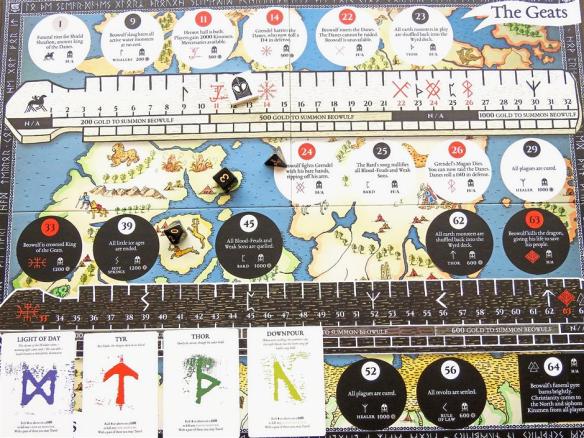
A board game built on Beowulf

The board for King Port's Beowulf game, complete with a bunch of cards and pieces.

I admit that my experience with board games is pretty limited. And I’m not too saddened by that.

There are definitely some board games I’d love to play again or pick up. But whenever I think about board games, the problem that always looms in my mind is getting the players together. Coordinating enough interested people, getting over the rules if others (or I) need to learn them, and then finally getting to a place where we can just sit and play can take a lot of time.

But I think such a commitment would be worth it to play King Post’s own Beowulf. This game came to my attention thanks to this review.

This is a board game that uses the story of Beowulf as the background for play. Instead of taking up the role of Beowulf, players step into the shoes of various Geat tribes. Players then progress systematically through turns that see Beowulf moving down the timeline of his life as monsters, events, and a trading/raiding phase unfold. It definitely sounds like a complicated game to grasp at first (kind of like Dominant Species), and even like it might take some getting used to even once you get the basics.

But because this game is more about exploring the context of the Beowulf story than about the story itself, I find it infinitely fascinating. Pairing that with the care and effort that clearly went into the game’s board, cards, and pieces makes me really consider buying the game. Not even to play it, I think it’d be neat to just read all the cards and bask in the atmosphere that this game looks like it exudes.

Though I can’t help but feel like admiring the game is all I’d get to do.

As mentioned above, it’s always seemed difficult to me to bring together enough interested people to try out a new game. Mind you, I’ve never coordinated a board game night before (I’d sooner just read or play video games or, thanks in part to Pokemon GO, go for a walk until my phone dies in my free time). But reading about King Port’s Beowulf board game makes me reconsider that. It definitely sounds like a game that I’d love to learn and play.

I might also stand a decent chance of getting the first turn advantage, since the game dictates that the “hairiest” player gets to go first. Finally a game where Eastern-European genes pay off!

The light seen after Beowulf’s drug home, and encounters of the fishy kind (ll.1506-1517)

Synopsis
Translation
Recordings
What is that Gleaming and Bright Light?
Encounters with Lake Monsters
Closing

Grendel's mother menaces the pinned Beowulf with a knife.

By J. R. Skelton – Marshall, Henrietta Elizabeth (1908) Stories of Beowulf, T.C. & E.C. Jack, Public Domain, https://commons.wikimedia.org/w/index.php?curid=11001837


Back To Top
Synopsis

Grendel’s mother drags Beowulf into her lair.


Back To Top
Translation

“That she-wolf of the water bore him away, once they came to the bottom,
carried the ring mailed prince to her dwelling,
so that he was unable to weild his weapon,
though he had his fill of courage. A rushing horde of wondrous creatures
pressed upon him in those waters, many a sea-beast
tore with its tusks at his war-shirt,
gave a fierce pursuit. Than that prince perceived
that he was in some hostile hall,
where water harmed him not at all,
saw that the roof of the place held back the current,
the sudden pull of the waters:
there a gleaming light shone bright within.”
(Beowulf ll.1506-1517)


Back To Top
Recordings

Old English:

{Forthcoming}

Modern English:

{Forthcoming}


Back To Top
What is that Gleaming and Bright Light?

Beowulf’s struggle with Grendel’s mother continues.

In this week’s passage he’s drug along the bottom of this mysterious lake as Grendel’s mother tears at him. But then, and it’s unclear if she’s still holding him at this point, a rush of sea creatures whiz by and tear at Beowulf. After travelling through a hole, Beowulf finds himself in a dry place. Given the description that there’s a roof overhead, my guess is that it’s a cave of some kind that extends under the lake.

I think of this place as kind of like a beaver’s den, at least in terms of how the entrance connects this dry place to the lake that Beowulf, and supposedly, Grendel’s mother have just left. Though there’s no mention of Grendel’s mother, and so it’s hard to say if she’s still clutching Beowulf in her claws or if she’s standing a little ways away, banking on his being dumbfounded by being rocketed through the entrance to her lair and attacked by a school of angry sea life.

And, after all of that action, the poet tells us that this cave was lit from within by some sort of gleaming, bright light (l.1517). Which raises a simple question for me: why?

We’ve just heard about a warrior jumping into a lake fully outfitted for war. He’s then grabbed by a humanoid sea monster, drug across a lake bottom, assaulted by a bunch of tusked sea creatures, and ultimately ends up in some sort of underwater cave. Is it necessary to tell us that the place is lit? I feel that if the last line of this section were taken out I’d be too caught up in the action and the weirdness of what’s come immediately before to worry about how Beowulf could see in the cave.

So why mention this light?

Well, I think in part it’s supposed to hearken back to the mention of Grendel’s eyes giving off a weird light (ll.726-727). They do this just before he sets upon the Geats he finds in the Heorot. So maybe that light is some important trait of Grendel and his mother, some sort of emblem of their kind.

Or, maybe there was a certain kind of light associated with monsters in the Anglo-Saxon imagination. Maybe there was a belief that light, for all of its heavenly aspects, also indicated the presence of the supernatural and a means of transportation between worlds for things like monsters and fairies and elves.

I mean, to this day, interdimensional portals are accompanied by flashes of light. Maybe that’s just a left over from an early film, or maybe there’s some old trope with long forgotten origins behind it. And maybe Beowulf is one of the works that uses this trope.

I find this line about the light as mysterious as the light itself, is what I’m getting at here. But what about you? Is this light a source of mystification for you, or is it just another part of the story? Why do you think the poet mentions it? Were people heckling him when he’d tell earlier versions of the story but not explain how Beowulf could see?

Leave your thoughts in the comments!


Back To Top
Encounters with Lake Monsters

I imagine that the “fær-gripe”1 of terror would clutch your heart quite tightly if you encountered a “sæ-deor”2 while in a hall. Especially if it was wielding its “hilde-tux”3, and seemed to be controlled by the “brim-wylf”4 who kept it in an aquarium in her hall.

Even if you were wearing your best “here-syrcan”5 you’d probably sustain a few wounds, and the hall you were in would come to be known as a “nið-sele”6. Even if otherwise you thought it was a pretty nice place, especially considering that it was a “hrof-sele”7 and keeping out the sun and rain were important to you. Being attacked by a “sæ-deor”2 kept in an aquarium would be just that upsetting.

1fær-gripe: sudden grip. fær (calamity, sudden danger, peril, sudden attack, terrible sight) + gripe (grip, grasp, seizure, attack)

2sæ-deor: sea monster. (sheet of water, sea, lake, pool) + deor (animal, beast, deer, reindeer)

3hilde-tux: tusk (as a weapon). hilde (war, combat) + tusc (grinder, canine tooth, tusk)

4brim-wylf: she wolf of the lake/sea. brim (surf, flood, wave, sea, ocean, water, sea-edge, shore) + wylf (she-wolf) [A word exclusive to Beowulf]

5here-syrcan: corslet. here (predatory band, troop,army, host, multitude, battle, war, devastation) + syrc (sark, shirt, corslet, coat of mail)

6nið-sele: hall of conflict. nið (strife, enmity, attack, war, evil, hatred, spite, oppression, affliction, trouble, grief) + sele (hall, house, dwelling, prison)

7hrof-sele: roofed hall. hrof (roof, ceiling, summit, heaven, sky) + sele (hall, house, dwelling, prison) [A word exclusive to Beowulf]


Back To Top
Closing

Next week, Beowulf takes a swing at Grendel’s mother.

You can find the next part of Beowulf here.

Back To Top

All about a legendary new Beowulf album

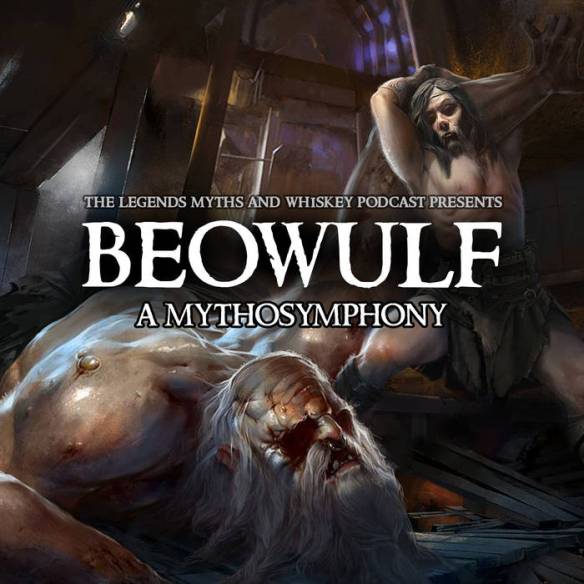
The cover art for LMAW's Beowulf album.

Art by Paolo Puggioni. Follow this link for more details: https://lmaw.bandcamp.com/

Full disclosure: I am in no way affiliated with The Legends, Myths, and Whiskey Podcast (LMAW). I’m just a big fan and want their Beowulf album to be a huge success so that they can give similar treatment to other epic stories from other cultures.

The world of podcasts is a very densely populated one. Since the medium’s rise to popularity among people with things to say, characters to share, or stories to tell, around 2009 (when over 1/5 of the population of the US over 12 became listeners), just about everyone of those sorts of people has launched a podcast. In terms of topics, these podcasts cover a range of things: politics, pop culture, science, serial radio dramas — there are even a few about history!

But one area that you don’t hear much about when it comes to podcasts is the stories that people have told for millennia. There aren’t very many podcasts about mythology or folklore.

There are some shows that are like excellent creepy pasta come to life (Welcome to Night Vale), but there aren’t many that focus exclusively on retelling old myths, legends, and folklore. Thankfully, there is one podcast that covers all three of these kinds of stories and does so expertly: The Legends, Myths, and Whiskey Podcast.

On each episode of the show, hosts Tanner Campbell and Eric DeMott take two stories and one whiskey. They read translations of the stories, sample the whiskey and tell listeners what they think of both. Thanks to these gents I’ve learned about stories like The Faithlessness of Sinogo or A Parrot Named Hiraman. And although I’m not much of a whiskey drinker, their commentary on what they’re drinking for the episode consistently leaves me feeling intrigued.

But this isn’t just an entry to share one of my new favourite podcasts with you all. I’m writing about the LMAW podcast because after hours and hours of work they’ve put together their first album: Beowulf: A Mythosymphony. This album features Tanner and Eric reading J.B. Kirtlan’s 1913 prose translation of Beowulf and adding their summaries, commentary, and analysis after finishing each of the story’s sections.

Beowulf facing off against Grendel in art for "Beowulf: A Mythosymphony".

Original art from Paolo Puggioni for the upcoming “Beowulf: A Mythosymphony” album. https://lmaw.bandcamp.com/

Along with the hosts reading and reflecting on Beowulf, this extended version of the LMAW podcast features brand new music that composer Nico Vettese (https://wetalkofdreams.com/) made specifically for this reading. It also features original art by Paolo Puggioni (http://www.paolopuggioni.com/).

If you’re at all curious about this album and want to find out more, I highly recommend that you check out the LMAW podcast’s bandcamp page. There you can listen to a couple of sample tracks. You can also put in a pre-order for the Beowulf: A Mythosymphony, which is set to be released on September 15.

After having listened to the two tracks that Tanner and Eric have made available, it sounds like the complete Beowulf album will be amazing. Tanner nails reading Kirtlan’s translation and the musical accompaniment fits the tone and content of Beowulf’s boasting beautifully.

If this album sounds like something you’d enjoy, definitely check it out!

What are your thoughts on podcasts as a way to tell stories?

Leave your thoughts in the comments!

Beowulf trespasses in Grendel waters, and over preparing for alien encounters (ll.1492-1505)

Synopsis
Translation
Recordings
Beowulf, Youth Culture, Wary Welcomes
Possibly Over-Preparing to Encounter Alien Beings
Closing

Grendel's mother menaces the pinned Beowulf with a knife.

By J. R. Skelton – Marshall, Henrietta Elizabeth (1908) Stories of Beowulf, T.C. & E.C. Jack, Public Domain, https://commons.wikimedia.org/w/index.php?curid=11001837


Back To Top
Synopsis

Beowulf dives into the Grendel’s watery lair, and is attacked by Grendel’s mother.


Back To Top
Translation

“After those words the Geatish lord
was quickened by courage, no answer
would he wait for, into the sea-wave he
threw himself. It was nearly the length of a full day
before he could see the bottom of that lake.
Soon that one sensed him, she who that underwater expanse
had occupied for a fiercely ravenous fifty years,
grim and greedy, she knew that a man,
an alien being, one from above had come exploring.
With claw outstretched she grasped towards him, wrapped the warrior
in her terrible grip. Yet nowhere on his body
was at all injured, his mail protected him all around,
she could not pierce through his war coat,
the linked mail shirt was locked against her loathsome fingers.”
(Beowulf ll.1492-1505)


Back To Top
Recordings

Old English:

{Forthcoming}

Modern English:

{Forthcoming}


Back To Top
Beowulf, Youth Culture, Wary Welcomes

Beowulf cuts the “good lucks” short here, as he just dives right into the mere where Grendel’s mother waits. No doubt part of him wants to get this experience over with, while another part is excited for the challenge.

But as he’s diving into the water and since he knows he’ll be facing a monster as strong as, if not stronger than, Grendel on its own turf, I wonder if he’s nervous?

Being a young man, Beowulf probably isn’t doubting his ability to do the same thing twice. That’s something that’s definitely an advantage of youth…says the guy who’s only 30, though had I been 30 three decades ago I’d be past the age where I could be trusted by mainstream youth culture…now I am youth culture.

Perhaps that little tangent is unrelated, but it brings to mind a curious question: Is Beowulf representative of the era’s youth culture?

Did Beowulf diving into the water after the monster that killed Hrothgar’s councillor Æschere inspire kids all over the northern parts of Europe to dive into strange lakes, looking for supernatural beasts? Or did the Anglo-Saxon audiences of Beowulf regard him as a supernatural being himself?

I think, since he is a hero (and therefore already different from most), that Beowulf would’ve been regarded as a supernatural being. in a way, after all, having the strength of 30 men isn’t exactly as common as blue eyes and brown hair. It’s also definitely not normal to be able to hold your breath for half a day. And yet that’s how long it took Beowulf to get to the bottom of this lake.

Personally, I don’t think Beowulf had much doubt in his mind as he dove into the lake. He seems like he’s pretty keen on getting to the bottom of things.

Just as Grendel’s mother is keen to eliminate those who intrude in her domains. And the poet even acknowledges that, to Grendel’s mother, Beowulf is doing just that. He’s regarded as a man by this woman of the deep, and therefore as “an alien being” (“ælwihta” (l.1500)).

So Beowulf is very clearly intruding into the space of another, perhaps looking to exact the “wergild” that Grendel’s mother owes for Æschere from her very body. Curiously, though, the poet doesn’t make it seem like Grendel’s mother is waiting for anyone; she’s not sitting out on the porch with a shotgun in her lap saying “you shouldn’t’ve come out here, surface dweller.” She’s just attacking Beowulf because he’s “come exploring” (“cunnode” (l.1500)).

Is Beowulf in the right, intruding in Grendel’s mother’s domain to seek vengeance for the man she killed? Or does Grendel’s mother have the upper hand since she’s defending her home from an intruder (much as Beowulf did earlier in the poem)?

Leave your thoughts in the comments!


Back To Top
Possibly Over-Preparing to Encounter Alien Beings

If you met an “æl-wihta”1 out on the “brim-wylm”2 you might not jump to the conclusion that it was “heoro-gifre”3.

Unless you were a “guð-rinc”4 of some kind.

And, if you were a “warrior” who met such a creature out on the open waters, you’d probably be prepared with a “fyrd-hom”5 or “leoðo-syrcan”6 to “ymb-bearh”7 your body entirely. Maybe some sort of kevlar wet suit.

But boy oh boy, would there be egg on your face if it turned out that the “æl-wihta”1 was just a walrus or something entirely peaceful.


1æl-wihta: strange creature, monster, alien being. el (foreign, strange) + wihta (wight, person, creature, being, whit, thing, something, anything)

2brim-wylm: ocean surge. sea-wave. brim (surf, flood, wave, sea, ocean, water, sea-edge, shore) + wielm (boiling, swelling, surf, billow, current, stream, burning, flame, inflammation, fervour, ardour, zeal) (a word exclusive to Beowulf)

3heoro-gifre: fierce, greedy for slaughter. heoru (sword) + gifre (greedy, rapacious, ravenous, desirous of)

4guð-rinc: warrior, hero. guð (combat, battle, war) + rinc (man, warrior, hero)

5fyrd-hom: corslet. fyrd (national levy or army, military expedition, campaign, camp) + hama (covering, dress, garment, womb, puerperium [period between child birth and a woman’s reproductive organs return to their original, non-pregnant state], slough of a snake)

6leoðo-syrcan: corslet. leoðo (retinue, following; limb, member, joint) + serc (sark, shirt, corslet, coat of mail)

7ymb-bearh: to run round, surround. ymb (around, about, at, upon, near, along, about, at, after, before) + beorg (protection, defense, refuge)


Back To Top
Closing

Next week, the struggle between Beowulf and Grendel’s mother continues.

You can find the next part of Beowulf here.

Back To Top

Thoughts on Beowulf’s new rock musical adaptation

So, come September, Beowulf will be getting the musical treatment!

And not just any sort of musical treatment, but the rock ‘n’ roll musical treatment!

Though, according to this article, this musical isn’t going to be a straight telling of Beowulf. Not entirely, anyway.

The twist with Beowulf: A Thousand Years of Baggage is that while the events of Beowulf unfold (simplified so that all three monsters attack Heorot), a panel of academics criticizes and unpacks what’s going on in the story.

This sounds like a really cool concept, especially because of the “rock” label that’s being applied to it. Musicals with the flavour of rock music are some of my favourite operas, after all. From prog rock concept albums to early attempts like The Phantom of the Paradise — the rock musical is a solid genre.

But what sticks out about this to me more than anything is that a new Beowulf musical suggests that history does indeed repeat itself.

Back in the 70s there was a musical version of Beowulf, simply called Beowulf: A Musical Epic. It might have slipped under the radar of many because it was a Canadian production, and I don’t think it had much of a run south of the border. But this production’s varied (too varied for “Rock” alone to suit, I think) musical score by Victor Davies and the lyrics by Betty Jane Wylie make for a fantastic retelling of the story.

But what I like most about the 70s adaptation is that there really aren’t any changes to the story.

Some of the digressions in the original are cut out or reworked, and at least one character is renamed, but other than that, Beowulf: A Musical Epic stays true to the poem: Beowulf goes to Heorot to fight Grendel, fights Grendel’s mother, then goes back to Geatland where he eventually becomes king, has to fend off a dragon, and leaves his warrior legacy in the hands of Wiglaf. For its fidelity alone, I think Beowulf: A Musical Epic is worth listening to, since so few adaptations let Beowulf grow old and show us his end.

In the popular culture (all of the movie, and book adaptations) Beowulf is usually seen only defeating Grendel and maybe Grendel’s mother, but we never really see Beowulf fighting the dragon as an old man and his death, and I think this is an essential part of the poem. The fact that the poem covers it suggests that the early audience of the poem thought much differently (maybe more complexly?) about heroes than many of us do today, and certainly more so than most modern people would give early medieval people credit for.

So I’m excited for this new musical, but, whenever (and however) I manage to engage with it, I know to approach it as something more than just an adaptation. Though, that said, I’m hoping for some raucous academic commentary to go along with the brutal physicality of so much of the story.

How do you think this new Beowulf musical will work out? Will it be the next Hamilton, or just enjoy a small run in Providence, Rhode Island? Leave your thoughts in the comments!

Beowulf gives his last will and testament (ll.1482-1491)

Synopsis
Translation
Recordings
Beowulf’s Flaw?
Generosity and Sharp Swords
Closing

Grendel's mother menaces the pinned Beowulf with a knife.

By J. R. Skelton – Marshall, Henrietta Elizabeth (1908) Stories of Beowulf, T.C. & E.C. Jack, Public Domain, https://commons.wikimedia.org/w/index.php?curid=11001837

Back To Top
Synopsis

Beowulf says that if he dies, Hrothgar is to send his treasure to Hygelac, and Unferth will get his sword.

Back To Top
Translation

“‘As for the treasure that thou gavest me,
dear Hrothgar, send it to Hygelac.
Thus, may the lord of the Geats gaze upon those riches,
the son of Hrethel will see it, when he looks upon that treasure,
that I a liberal and great ring giver
had found, and enjoyed his generosity to the full.
And you, Unferth, are to have my own treasure,
my sword so forged its metal shows waves, you the wide-known
man are to have that hard edge. With Hrunting, I shall
wreak vengeance, or death shall take me.'”
(Beowulf ll.1482-1491)

Back To Top
Recordings

Old English:

{Forthcoming}

Modern English:

{Forthcoming}

Back To Top
Beowulf’s Flaw?

Last week, Beowulf’s speech to Hrothgar was all about the people in the young man’s life: his lord, Hygelac, and his fellow young warriors. But now things get material. Sort of.

Beowulf starts out the second part of his speech with a call for the gifting of the treasure that he’s won to Hygelac. As we’ll find out in a few hundred lines, this is where the treasure ends up anyway, but I think it’s important for Beowulf to make clear what he wants to do with the treasure. I mean, this speech is basically his last will and testament as far as many of those thronging around him are concerned right now.

After all, they’ve come deep into the heart of monster country (hence all of those beasts on the slopes and dragons in the waters), and Beowulf is now about to dive into the home of the Grendels. In other words, the tables have turned and now all of the Danes and Geats are fearful wretches invading turf that isn’t theirs.

The imminent danger of all of this really drives home for me how the poet is trying to frame Beowulf as an ideal man.

Beowulf has physical strength (that hand grip of thirty men), but is humble and gives almost all the credit for his victory to god or fate’s favour. He’s also young and vigorous, and yet cautious and responsible enough to very dramatically tell everyone what to do if he doesn’t come back as he’s strapping on his armour.

As I think about it, I can see why this sort of character was so popular for so long. Beowulf’s inherent flaw isn’t any one thing but being as balanced as he appears to be. If you look at Beowulf later in the poem, he’s an old man whose personality has fallen out of step with his physicality.

At this point in the poem, though, Beowulf’s body and mind are perfectly in sync, and yet he’s being set up for a fall. The poet is using him to make clear that such a balance is unsustainable. Perhaps the few days that Beowulf is with the Danes are the ones he remembers the most fondly simply because they were those where he was able to show off a balanced nature between warlike rage and diplomatic humility.

He even pledges his sword to Unferth if he dies fighting Grendel’s mother. That is some serious diplomacy on Beowulf’s part.

But what does he hope to get out of all of this? Is Beowulf just being honourable so that he’ll be remembered as such, or do you think this is a show of the genuine Beowulf? Leave your thoughts in the comments!

Back To Top
Generosity and Sharp Swords

Maybe it seems a little paradoxical, but I think that in the early medieval world a “gum-cyst”1 lord would have a mighty weapon.

Yes, such a lord would need to be known for generosity, but how would the treasure he’d share be won? How would he keep other clans at bay? Surely it would be with a “heard-ecg”2 sword. Perhaps it’d even be something like Beowulf’s wondrous “waeg-sweord”3. Plentiful treasure could probably buy such a weapon, after all.


1gum-cyst: excellence, bravery, virtue, liberality. guma (man, lord, hero) + cyst (free-will, choice, election, the best of anything, the choicest, picked host, moral excellence, virtue, goodness, generosity, munificence)

2heard-ecg: sharp of edge, sword. heard (hard, harsh, severe, stern, cruel (things and persons), strong, intense, vigorous,violent, hardy,bold) + ecg (edge, point, weapon, sword, battle ax)

3waeg-sweord: sword with wavy pattern. waeg (motion, water, wave, billow, flood, sea) + sweord (sword)

Back To Top
Closing

Next week Beowulf drops the mic and plunges into the mire. But it’s not long before a certain mother of a certain monster launches her attack.

You can find the next part of Beowulf here.

Back To Top