Unknown's avatar

About NSCZach

A writer who translates Beowulf (and other things), freelances, reads voraciously, and is always catching up on (mostly retro) adventure video games/J-RPGs.

Author writes novel series called: The Women of Beowulf

Though there are women in the poem Beowulf, they’re entirely on the sidelines. Wealhtheow, the queen of the Danes, has a few lines, but she’s quite tightly sewn into her diplomatic role of peaceweaver. Otherwise, women are mothers or sisters or daughters, and they generally have few to no lines of dialogue. And yet they’re present in the poem’s asides about morality and honour, but none of them take centre stage.

Donnita L. Rogers has changed the state of women in the world of Beowulf by writing a series of novels called The Women of Beowulf. This series tells a story that shares its setting with Beowulf but that follows a priestess named Freawearu.

A character with the same name appears in the poem, but she, like her mother Wealhtheow, is a peaceweaver, a daughter married to the son of a rival group’s leader in an effort to foster peace between the two groups. So the connection to Beowulf via Freawearu seems tenuous.

But Rogers isn’t writing an adaptation of the epic poem. Instead, she’s taking another look at the scenario of the poem and its setting through the lens of the powerful women active in it.

Though Rogers released the first book in this series, Faces in the Fire back in 2013 and wrapped it up in 2015, it could still prove an interesting read. You can find a full review of Donnita L. Rogers’ series here:

http://www.huffingtonpost.co.uk/annie-martirosyan/beowulf-women_b_10638604.html

What do you think of the idea of using an old story’s setting and some of its characters to tell a new tale? Leave your thoughts in the comments!

Unferth gifts a sword to Beowulf, words tell of blades and battlefields(ll.1455-1464)

Synopsis
Translation
Recordings
A Named and Dangerous Sword
The Usefulness of an Ancient Sword on the Brutal Battlefield
Closing

Beowulf, Grendel, Old English, Anglo-Saxon

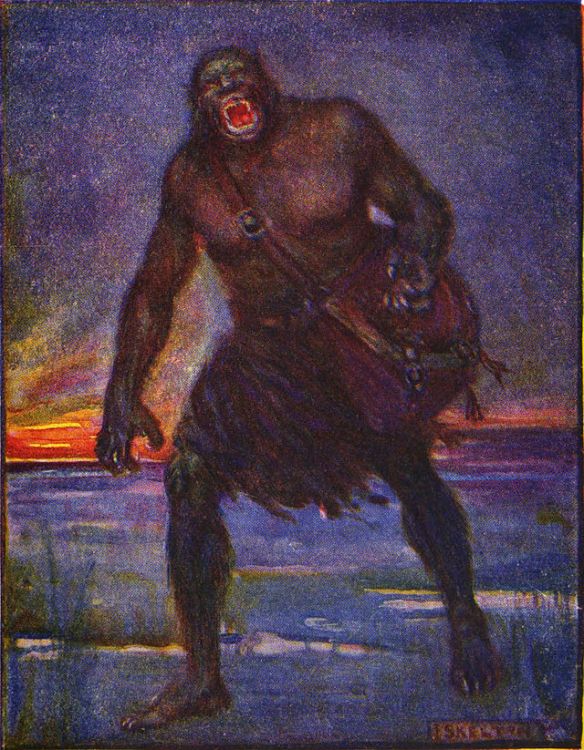
An illustration of Grendel by J.R. Skelton from Stories of Beowulf. Grendel is described as “Very terrible to look upon.”Stories of beowulf grendel” by J. R. Skelton – Marshall, Henrietta Elizabeth (1908) Stories of Beowulf, T.C. & E.C. Jack. Licensed under Public Domain via Wikimedia Commons.

Back To Top
Synopsis

Unferth lends Beowulf a sure-fire sword.

Back To Top
Translation

“Next was an item of no little service,
such was the thing that Hrothgar’s man leant him,
it was the hilted sword named Hrunting;
an ancient treasure beyond compare;
its edge was iron, decorated like an arm full of poison,
hardened in the blood of battle; never in combat had it failed
any of its weilders, whomever fought with it in their grip,
those who dared do perilous deeds,
who entered the battlefield full of foes. Indeed this was not
the first time the sword had been called upon for heroic deeds”
(Beowulf ll.1455-1464)

Back To Top
Recordings

Old English:

{Forthcoming}

Modern English:

{Forthcoming}

Back To Top
A Named and Dangerous Sword

Here we go!

In this passage we have the first of the named swords of the poem. And it sounds like it’s pretty badass. Not just because it’s never failed anyone who has used it (something I’ll get into a little below), but because of how it’s decorated.

My Old English dictionary, Clark Hall and Meritt’s A Concise Anglo-Saxon Dictionary (4th edition), suggests “with poisoned twigs or poison-stripes?[sic]” for “ater-tanum” (l.1459). It’s an entry that’s very unsure of itself.

When I think of poison and any sort of branching pattern I think of the horrific visual of poison either dilating or colouring a person’s veins as it rushes ever closer to their heart. And so “decorated like an arm full of poison” sounded like an apt translation of “ater-tanum”. My guess as to what that actually looks like is a branching pattern that was smithed into the steel. Perhaps as a sign of how many times the steel involved was folded.

Come to think of it, I wonder if “arm full of poison,” or even “twig of poison” was just a way of describing someone’s patterned tattoos. I mean, if your veins are picked out because of some sort of poison that’s entered your body you’re not going to be able to gawk at that for very long. But if someone were tattooed, which, if it was just a simple pattern could look like discoloured veins, it would be a lot easier to really contemplate the pattern and compare it to a poison-infested arm.

Anyway, stepping away from that detail about the sword’s decoration, I find it strange that the poet tells us that Hrunting has never failed its wielders. It sounds like it’s the Muramasa from Japanese lore, a sword that had to taste blood of any kind once it was unsheathed.

Though, given Unferth’s past conflict with his kin which lead to him slaying them (at least according to Beowulf) , I can’t help but wonder if he had entered into combat against them. Since Hrunting seems to be Unferth’s sword, in this battle he likely used Hrunting, and the dumb thing just did what swords do (and good swords do even better) and killed them.

That’s not to say that a well made sword removes the agency from its wielder, more that it takes an even better fighter to wield such a weapon well.

Along with the reference to Hrunting never failing could be the poet’s way of making Unferth a sympathetic character, I think it also suggests that he is not as great a warrior as Beowulf. He was unable to reign himself in while under the influence of wielding Hrunting. Kind of like how landing a series of blows in a sparring match can give you an incredible sense of power that kind of numbs your reason the first few times you experience it.

Of course, Beowulf won’t be swayed by such a thing as this sword, surely. Or will he succumb to the call of Hrunting as easily as Unferth seems to have? Leave your thoughts in the comments!

Back To Top
The Usefulness of an Ancient Sword on the Brutal Battlefield

I think it goes without saying that a “hæft-mece”1 would be a “mægen-fultuma”2 on just about any “folc-stede”3. Forget those swords without hilts — they’re really just oversized knives!

Now, take that sword, though, and make it an “eald-gestreona”.4 And then have a good look at that well worn (yet still sharp!) sword and make sure that it’s decorated in an “ater-tan”5 style. That’s sure to mean that it’s been through the “heaþo-swate”6 more than once, at least.

This is the kind of sword songs are sung about, and that can only be found in RPGs after finishing a really difficult/lengthy sidequest. The kind of sword you’d want with you on a “gryre-sið”7. It’s the sort of thing you use (maybe just in those songs) to do “ellen-weorc”8!


1hæft-mece: hilted sword. hæft (haft, handle) + mece (sword, blade) (A word exclusive to Beowulf)

2mægen-fultuma: mighty help. mægen (bodily strength, might, main, force, power, vigor, valour, virtue, efficiency, efficacy, good deed, picked men of a nation, host, troop, army, miracle) + fultum (help, support, protection, forces, army) (A word exclusive to Beowulf)

3folc-stede: dwelling-place, battlefield. folc (folk, people, nation, tribe; collection or class of persons, laity; troop, army) + stede (place, site, position, station; firmness, standing, stability, steadfastness, fixity, strangury)

4eald-gestreona: ancient treasure. eald (old, aged, ancient, antique, primeval, elder, experienced, tried, honoured, eminent, great) + streon (gain, acquisition, property, treasure, traffic, usury, procreation)

5ater-tan: with poison twigs or poison stripes?[sic] (“Looking like an arm full of poison”). ater (poison, venom, gall) + tan (twig, rod, switch, branch, rod of divination) (A word exclusive to Beowulf)

6heaþo-swate: blood of battle. heaðu (war) + swat (sweat, perspiration, exudation, blood, foam, toil, labour)

7gryre-sið: dangerous expedition. gryre (horror, terror, fierceness, violence, horrible thing) + sið (going, motion, journey, errand, departure, death, expedition, undertaking, enterprise, road, way, time, turn, occasion) (A word exclusive to Beowulf)

8ellen-weorc: heroic deed, good work. ellen (zeal, strength, courage) + weorc (work, labour, action, deed, exercise; affliction, suffering, pain, trouble, distress; fortification)

Back To Top
Closing

Next week, the poet reflects on Unferth’s character further.

You can find the next part of Beowulf here.

Back To Top

Game of Thrones and history: This Slate.com interview lays it out

A section of the Bayeux Tapestry showing Anglo-Saxon warfare

Image found here: “Bayeux Tapestry 4” by photo by Gabriel Seah – gssq.blogspot.com. Licensed under Public Domain via Commons.

Game of Thrones spoilers below, and through the link. You’ve been warned.

This interview between Slate.com‘s Ian Prasad Philbrick and Kevin Uhalde, professor of history at Ohio University is more Game of Thrones-related than Beowulf related, but the show is still a gateway to the medieval period. It’s all about historical analogues to the conquests in Game of Thrones and offers a quick summary of some medieval tactics and figures:

http://www.slate.com/blogs/browbeat/2016/07/07/a_medieval_historian_on_the_real_world_analogues_to_game_of_thrones_daenerys.html

Armour inspires thoughts on time, ad-libbing on sunken arms (ll.1441b – 1454)

Synopsis
Translation
Recordings
Antique Armour More Effective
Armour on Sea Bottoms
Closing

Beowulf, Grendel, Old English, Anglo-Saxon

An illustration of Grendel by J.R. Skelton from Stories of Beowulf. Grendel is described as “Very terrible to look upon.”Stories of beowulf grendel” by J. R. Skelton – Marshall, Henrietta Elizabeth (1908) Stories of Beowulf, T.C. & E.C. Jack. Licensed under Public Domain via Wikimedia Commons.

Back To Top
Synopsis

Beowulf gets geared up, starting with his armour and helmet.

Back To Top
Translation

“Beowulf geared himself
in warrior’s garb, he felt no anxiety for his life then;
his hand woven war-corslet, broad and skillfully decorated,
would soon know those depths,
confident in its ability to protect his bone-chamber,
so that no hand-grasp could crush his chest,
that no furious foe’s malicious hand could harm him;
and on his head a shining helmet he wore,
which would soon muddy the mere’s bottom,
would soon enter the surging waters, that treasure-embellished helm,
encircled by a lordly band, made as those in elder days,
wrought by a weapon smith, wondrously formed,
set all around with boar-images, so that he
may not be bitten by blade or battle sword.”
(Beowulf ll.1441b – 1454)

Back To Top
Recordings

Old English:

{Forthcoming}

Modern English:

{Forthcoming}

Back To Top
Antique Armour More Effective

Beowulf gets kitted out here. Whether one of the Geats with him (or maybe a Dane, as a sign of their good relations?) helps him into this gear as squires would knights in a few hundred years is unclear. All we know from what’s written is that Beowulf puts on his armour and then his helmet. So, much like old school JRPGs, it looks like there are just three pieces of equipment for your average warrior: armour, headgear, weapon.

Most interesting to me is just how important it seems to be that the armour is decorated. I mean, I’m not too familiar with the practicalities of medieval armour, but I’d imagine that it would be a great deal lighter and actually more effective if it was less decorated — not more. As far as I can guess, though, Beowulf’s not going to be guarded from harm because his outfit is so chic, rather its protective power comes from its being so old.

The armour he dons is described as “broad and skilfully decorated” (“sid ond searo-fah” (l.1443)).

Note that the phrase there isn’t “skillfully crafted” (potentially “searo-cræftig” in Old English), but “skilfully decorated” (“searo-fah”).

So, this armour must be old because it was made when people had the time to just sit back, crack into some mead and decorate their armaments. And when could you decorate armour and swords and such? When you’re living in a relative time of peace.

Or a time when fighting is so fierce that you become very skilled in making armour very quickly so that there’s time left over to embellish it.

Either way, the implication about Beowulf’s armour is that this armour is old.

And this implication is outright stated when it comes to Beowulf’s helmet.

On line 1451 the poet tells us it was “made as those in elder days” (“fyrn-dagum”). Which, if you think about it doesn’t put it into the past as much as it suggests that days don’t die, they just grow old and their influence is lessened as time moves onward. All the while, the works done in these days, the things that people made during their’ prime, carry into the future.

It’s a curious way to think about time.

Though, getting back on track,the idea that things “aren’t made like they used to be” in that their not made to last like they used to be continues to be a common sentiment.

After all, it seems like things are moving so quickly that everything made new is made fast rather than to last. For example, my uncle recently took apart an old piano (maybe from the early 20th century) to turn it into a liquor cabinet and the mechanism for the hammer looks and works as if it was made yesterday — although the only metal pieces in it are the spring and the pin that holds the thing together.

Now, there’s no denying that modern tech is growing exponentially and so on and so forth, but that the sense that “they don’t make things like they used to” existed in the time of the Beowulf poet seems to me ridiculous. It suggests that human progress has always been happening, and that however fast our times are, the present always has an element of speed to it. It’s only when we look at all of the days behind us, all gathered around the nursing home table that we just happen to see those things that happened in them much more slowly.

Do you think that spending so much time on Beowulf’s getting his armour on helps build a sense of security? Or is it just the poet stalling for time?

Back To Top
Armour on Sea Bottoms

A European “mere-grund”1 is probably the best place to find old “eorl-gewæde”2.

I mean, no doubt several warriors perished in the “inwit-feng”3 of “sund-gebland”4 over the centuries, whether they were swimming or sailing across such waters. And those “ban-cofa”5 these warriors would leave behind, in a weird inside-out kind of way, probably made perfect caskets for such lost “here-byrne”6. We’re talking top of the line pieces of arms and armour that were “searo-fah”7 with “swin-lic”8.

Plus, if some of these warriors were always losing their purses or just wanted to have the skate punk look way before its time, maybe there’d be a few “frea-wrasn”9 with the armour, as well. Nothing like a nice chain to keep the cash close, right?

What I have to wonder though, is if ladies of lakes are willing to chuck up the odd “beado-mece”10 since “fyrn-dagum”11, why don’t they ever seem to give away armour too? They must really have it in for warriors everywhere. Or maybe Arthur hastily left after getting Excalibur and ruined getting full sets of arms for the rest of us.

1mere-grund: lake-bottom, bottom of the sea. mere (sea, ocean, lake, pond, pool, cistern) + grund (ground, bottom, foundation, abyss, hell, plain, country, land, eart, sea, water)

2eorl-gewæde: armour. eorl (brave man, warrior, leader, chief, man, earl, nobleman) + gewæde (robe, dress, apparel, clothing, garment, covering) (A word exclusive to Beowulf)

3inwit-feng: spiteful clutch. inwit (evil, deceit, wicked, deceitful) + feng (grip, grasp, embrace, capture, prey, booty) (A word exclusive to Beowulf)

4sund-gebland: commingled sea, surge. sund (swimming, capacity for swimming, sea, ocean, water) + gebland (blending, mixture, confusion) (A word exclusive to Beowulf)

5ban-cofa: bodily frame. ban (bone, tusk, the bone of a limb) + cofa (clost, chamber, ark, cave, den)

6here-byrne: corslet. here (predatory band, troop, army, host, multitude) + byrne (corslet) (A word exclusive to Beowulf)

7searo-fah: variegated, cunningly inlaid. searo (art, skill, cleverness, cunning, device, trick, snare, ambuscade, plot, treachery, work of art, cunning device, engine of war, armour, war-gear, trappings) + fag (variegated, spotted, dappled, stained, dyed, shining, gleaming) (A word exclusive to Beowulf)

8swin-lic: boar image. swin (wild boar, pig, hog, swine, boar image) + lic (like, alike, similar, equal, suitable, likely) (A word exclusive to Beowulf)

9frea-wrasn: splendid chain. frea (lord, king, master, the Lord, Christ, God, husband) + wrasen (band, tie, chain) (A word exclusive to Beowulf)

10beado-mece: battle sword. beado (war, battle, fighting, strife) + mece (sword, blade) (A word exclusive to Beowulf)

11fyrn-dagum: days of yore. fyrn (former, ancient, formerly, of old, long ago, once) + dæg (day, lifetime, Last Day, name of the rune for “d”)

Back To Top
Closing

Next week, Hrothgar’s sleazy counsellor Unferth gives Beowulf a gift.

You can find the next part of Beowulf here.

Back To Top
The Danes’ deadly curiosity, life is dangerous in these waters (ll.1432b-1441a)

Synopsis
Translation
Recordings
Brutal Curiousity
The Dangers of Being a Child of the Waves
Closing

Beowulf, Grendel, Old English, Anglo-Saxon

An illustration of Grendel by J.R. Skelton from Stories of Beowulf. Grendel is described as “Very terrible to look upon.”Stories of beowulf grendel” by J. R. Skelton – Marshall, Henrietta Elizabeth (1908) Stories of Beowulf, T.C. & E.C. Jack. Licensed under Public Domain via Wikimedia Commons.

Back To Top
Synopsis

The Geats and Danes kill one of the monsters of the waters and drag it ashore.

Back To Top
Translation

“One of the Geats
severed the life of one with an arrow from his bow,
than did it battle against the waves, since that war arrow stuck in
its side; it was then slower against the waters
in that sea, until death took its fight away.
It was quickly pulled from the waves
in an assault of savagely barbed boar spears,
fiercely they attacked it to tug that wondrous
traverser of the waves to the shore; the men
all gazed upon that terrible stranger.”
(Beowulf ll.1432b-1441a)

Back To Top
Recordings

Old English:

{Forthcoming}

Modern English:

{Forthcoming}

Back To Top
Brutal Curiousity

There is no way to soften the blow here. The Geats and Danes are downright brutal with this sea monster — be it seal or walrus or actual monster.

First, it’s struck with an arrow. Then they all watch as it goes through its death throes in the water, no doubt bloodying them up further. But then they don’t just look at each other and grunt out “huh, I guess they can die.” No. Instead they stick spears intended for hunting boars into the corpse and bring it ashore for a closer look.

At least I guess I should credit them for being curious. I mean, these guys don’t just kill the thing and then leave it there. There’s a genuine inquisitiveness present in this passage. It’s just that it’s pretty deeply cut by a brutal kind of caution. Cut so deep in fact, that the metaphorical drink it’s diluting is just about all water at this point.

Still, the assembled warriors all gawk at the corpse of this animal (monster?) that they’ve pulled to shore. Which does accomplish a few things for the story.

As I noted above, it proves that these monsters can be killed. It also proves that they aren’t likely impervious to human weapons like Grendel was. Though I’m not sure how top of mind that is and how much more likely it is that they killed the beast to make sure it didn’t attack them when they tried to get a closer look. Though, it’s still hard to set aside their letting it thrash around in the water until it dies.

It doesn’t get mentioned here, since next week’s passage will jump back to Beowulf himself, but maybe this closer observation of one of these monsters confirms something very important for the Geats and Danes around it. That it’s no monster at all.

As a sea-faring people, I have no doubts that both Geats and Danes are familiar with sea-life, whether helpful or harmful to their crossing the seas. Maybe this closer look is all it takes for them to realize that the creatures in the water here aren’t monsters at all but just creatures as common as deer. And maybe that’s why this is the moment that the poet chooses to end his general narration before getting back to the heroics of Beowulf.

Unless, this creature is indeed a monster, or just monstrous. Last week there was the mention of these creatures all around them being the same ones that were responsible for wrecking ships on their way out to sea. Maybe seeing these creatures up close didn’t lead to a revelation about their nature, it just erased the fear that all the assembled people had for these beasts as these strange and unknown creatures. But, now, at the very least, as Arnold Schwarzenegger rightly observed in a movie about another monstrous menace, Predator: “if it bleeds we can kill it.”

What do you think? Are the Geats and Danes killing, then jamming boar spears into this creature’s corpse out of fear? Or just because they want to be sure about its nature and their own safety? Let me know what you think in the comments!

Back To Top
The Dangers of Being a Child of the Waves

If you’re a sea-going creature, you’ve spent your whole life in the water. You know the ebb and flow like the back of your fin. You truly are a “wæg-bora”1.

But the ways of the air are entirely foreign to you. The area above the water is where the great fiery ball lives, far off in the distance. Or it is simply quite small. None of the stories of your kind are certain. But they are certain that the space between water and fiery ball is usually clear and open. So being hit by sharp barb, or “here-stræl”2, from a “flan-boga”3 is entirely unexpected. Hard clouds sometimes pass along the surface of your waters, but stories of those sharp long barbs are few.

But they are brutal.

Especially since there are many mentions in these stories, talk of “heoru-hocyht”4 “eofer-spreot”5 being driven from an unknown enemy that lives in the space between waters and the fiery ball. Those who have witnessed such assaults with the barbs that swim through the space between often tell of these greater barbs following their smaller kin, just as certain of your own kind swim together. But instead of bringing the joy and safety of community, these barbs always cause great “yð-gewinn”6.

Such are the dangers of being a child of the waves.


1wæg-bora: child of the waves?[sic]; traverser of the waves?; goer upon the waves. wæg (motion, water, wave, billow, flood, sea) + bora (ruler)

2here-stræl: arrow. here (predatory band, troop, army, host, multitude, battle, war, devastation) + stræl (arrow, dart, missile; curtain, quilt, matting, bed)

3flan-bogan: bow. flan (barb, arrow, javelin, dart) + boga (bow, arch, arched place, vault, rainbow, folded parchment)

4heoru-hocyht: savagely barbed. heoru (sword) + hocyht (with many bends?[sic]. Perhaps a clue to how it was barbed?)

5eofer-spreot: boar-spear. eofer (boar, wild boar, boar-image on a helmet) + spreot (pole, pike, spear)

6yð-gewinn: wave-strife, life on the waves. (wave, billow, flood, sea, liquid, water) + winn (toil, labour, trouble, hardship, profit, gain, conflict, strife, war)

Back To Top
Closing

Next week, the poet shifts back to Beowulf. And the Geat hero gets geared up.

You can find the next part of Beowulf here.

Back To Top

Monsters on the shores, and monsters in the morning (ll.1422-1432a)

Synopsis
Translation
Recordings
Marine Mammals or Monsters?
Waking Monsters at Morning Time
Closing

Beowulf, Grendel, Old English, Anglo-Saxon

An illustration of Grendel by J.R. Skelton from Stories of Beowulf. Grendel is described as “Very terrible to look upon.”Stories of beowulf grendel” by J. R. Skelton – Marshall, Henrietta Elizabeth (1908) Stories of Beowulf, T.C. & E.C. Jack. Licensed under Public Domain via Wikimedia Commons.

Back To Top
Synopsis

Some of those with Hrothgar peer into the bloody depths of the waters and see monsters.

Back To Top
Translation

“Amidst the waters blood surged — clear for the men there to see —
hot with gore. At times a horn sounded
an urgent war-song. Those on foot all sat down;
there through the water they saw many of the race of serpents,
strange sea-dragons knew those depths,
likewise, on the headlands lay water monsters,
those that often undertake to hijack ships as they
set out on fateful voyages down the sail-road in the morning,
dragons and beasts. They rushed about the waters,
fierce and enraged; they had heard that sound,
the resounding war-horn.”
(Beowulf ll.1422-1432a)

Back To Top
Recordings

Old English:

{Forthcoming}

Modern English:

{Forthcoming}

Back To Top
Marine Mammals or Monsters?

After coming just a few miles from Heorot, Hrothgar and those with him haven’t just come to a strange swampy place. They have come to the heart of the world’s monsters’ home.

The Danes and Geats that look into the choppy waters see all manner of sea serpents, and those that look across to the cliffs see the very monsters the Anglo-Saxons may have feared the most as a sea-faring people: those that wreck ships. Since, you know, gremlins, or, rather, the “nicra,” are all about smashing ships. And, apparently, lazing on rocky shores.

I remember that when we got to this passage in a class that walked us through Beowulf we stopped and dug deep. And what the professor uncovered was the notion that the monsters Hrothgar, the Danes, and the Geats see on the far shore are seals or walruses, giant sea mammals that (probably wrongly?) they assumed wrecked ships since they were protective of all the sea as humans were protective of their homes. Building on this notion, I can’t help but wonder even now if the waters are bloody and churning because some of the seals are hunting. And, perhaps the horrendous writhing of the sea serpents is just the seals mowing down on fish or other water dwellers their size or bigger, leaving people on the shore with the impression of giant flailing monsters.

Of course, that’s just speculation.

Speculation that Hrothgar and those with him misinterpreted what they saw for what they expected instead of what actually was. Or, rather, speculation that this is what the Anglo-Saxons thought of seals and/or walruses. It’s hard to say for sure since I’m not sure how violent those animals are when they’re hunting. Or if they’d be violent enough to come onto land, steal a full grown man away and leave his head on the shore completely unintentionally.

Though, I guess the Grendels, in this den of monsters, being the only clear humanoids, are supposed the poem’s audience’s way into this experience. Everything around them is so strange that the Grendels, with their upright walking and sense of family, are actually much closer to our human heroes than to the lounging (and maybe laughing?) monsters that the assembled people see all around them.

But if they’re surrounded by these strange creatures, then is it somebody among Hrothgar’s men that blows on the war horn? Or is it one of the monsters doing it? Or, is that just the poet taking some licence with a seal’s bark or a walruses’ call?

For such a scene, the plain language here does wonders for setting up an utterly bizarre situation. But more than that I think it does a fantastic job of building up suspense.

Here’s this group of people — all warriors outfitted for fighting — in the midst of a bunch of monsters, looking for the one who is ostensibly their queen or maybe just the most aggressive of the bunch, and they can only guess that she’s beyond Æschere’s bloodily severed head, in the depths of the unfathomable choppy red water.

Do you think the monsters all around Hrothgar and his group are just seals or walruses? Or is the poet describing some other creatures?

Back To Top
Waking Monsters at Morning Time

One of the things I wonder as I read this passage again is why the monsters don’t seem to notice Hrothgar or any of those with him. They’re either chilling on another shore, or feeding in the water. It’s something that definitely strengthens the idea that they’re all just marine mammals doing their own thing, and, much like other animals of a certain size ignore people unless they get to close.

But. For the sake of this little exercise, let’s continue to consider them monsters. And how to rouse them from their lounging?

Well, “wil-deor”1, “sæ-dracan”2, and those of “wyrm-cynn”3, rush up no matter what the “næs-hleoðum”4, when the guð-horn5 plays the “fyrd-leoð”6, in the “undern-mæl”7.

Monsters love bacon, after all, especially when it comes in rashers.

1wil-deor: wild beast, deer, reindeer.
wild (wild) + deor (animal, beast (usu. wild), deer, reindeer; brave, old, ferocious, grievous, severe, violent)

2sæ-dracan: sea-dragon.
(sheet of water, sea, lake, pool) + draca (dragon, sea-monster, serpent, the devil, standard representing a dragon or serpent)

3wyrm-cynnes: serpent-kind, sort of serpent.
wyrm (reptile, serpent, snake, dragon; worm, insect, mite, poor creature) + cynn (kind, sort, rank, quality, family, generation, offspring, pedigree, race, kin, people, gender, sex, propriety, etiquette; becoming, proper, suitable)

4næs-hleoðum: declivity, slope of a headland.
næs (cliff, headland, cape, earth, ground) + hlið (cliff, precipice, slope, hill-side, hill)

5guð-horn: war-horn, trumpet.
guð (combat, battle, war) + horn (horn, musical instrument, drinking horn, cupping horn, beast’s horn, projection, pinnacle)

6fyrd-leoð: war-song.
fierd (national levy or army, military expedition, campaign, camp) + leoð (song, lay, poem)

7undern-mæl: morning-time.
undern (morning (from 9AM to Noon), the third hour (9AM, or 11AM), religious service at the third hour) + mæl (mark, sign, ornament, cross, crucifix, armour, harness, sword, measure; time, point of time, occasion, season, time for eating, meal, meals)

Back To Top
Closing

Next week, a Geat brings in a monstrous catch.

You can find the next part of Beowulf here.

Back To Top

What Grendel’s mother did with Aeschere’s head, a monstrous real estate listing (ll.1408-1421)

Synopsis
Translation
Recordings
A Grisly Joke
A Monstrous Listing
Closing

Back To Top
Synopsis

Hrothgar and his wisest thanes see a grisly sight at the Grendels’ doorstep.

Back To Top
Translation

“The prince’s thanes then rode on
over steep rocky slopes, around narrowly winding paths,
through ways that fit just single file soldiers, up trails unknown,
precipitous headlands, lined with homes of water monsters.
He went on ahead with a handful of the wise,
to see that strange place; they looked about
until suddenly they found a patch of mountain trees
all growing out over grey stones,
a joy-less forest; waters stood beneath them,
blood-stained and turbid. To all the Danes gathered there,
friends of the Scyldings, the sight caused harsh suffering
at heart, bringing the same heaviness to each of the many thanes,
striking each of them with grief, once they found
the head of Æschere on the cliff by the water’s side.”
(Beowulf ll.1408-1421)

Back To Top
Recordings

Old English:

{Forthcoming}

Modern English:

{Forthcoming}

Back To Top
A Grisly Joke

Hrothgar’s ride up to the mere is quite vivid — in a King James Version of the Bible sort of way.

The first few lines of this passage (and the last few of last week’s) are sparse in their description. And yet, somehow these lines say a lot in their handful of words. It certainly sounds like the mere is incredibly isolated, almost as if the journey there (though it’s “not many miles” away (“Nis þæt feor heonon/milgemearces” (l.1361-1362)), as Hrothgar’s said earlier in the poem) has taken them to an entirely new world. A world of crooked trees growing over stony ground that’s also swampy and saturated with ever-churning waters. It does indeed sound like a grim place. But topping it all off is the discovery of Æschere’s head.

As we’ll find out once the poem gets to Beowulf’s pursuing Grendel’s mother, the Grendels’ home is in this water. And so, since this cliff is at the water’s side, I can’t help but think that it is the Grendels’ equivalent of Heorot’s gables.

After Beowulf defeated Grendel he hoisted his opponent’s arm up into those gables as a prize and a sign of triumph. Of course, taking that trophy was fatal for our 12-year terror, Grendel. Likewise, taking off Æschere’s head would have been fatal for him. Also likewise, his head is being similarly displayed as a trophy and as a sign of triumph in the feud.

But now, since it’s Æschere’s head and not the limb of some miscellaneous monster, we’re meant to feel just as sad at heart as the Danes who look upon the grim sight with Hrothgar. And it’s easy to feel it. I mean, from the time that Grendel’s mother takes him it’s pretty clear that Æschere is dead. But even so, seeing such grisly proof that he is indeed gone is still pretty devastating.

And yet, the parallel to Grendel’s arm makes me wonder what the poet was trying to say here.

Maybe the poet’s driving home what I’ve pointed out before, that Grendel and Grendel’s mother, for all of their monstrousness, are still beings with reason and with a capacity for empathy and a strong sense of family. A sense strong enough to inspire Grendel’s mother to barge in on a hall full of armed warriors with nothing but the fear of her they feel for protection.

Maybe giving such a quality to monsters was meant to show how much the idea of family, an often elevated and ennobled feeling, is really just an animalistic instinct. And that the preyed upon and the hated feel it just as much as those who are in an elevated position of privilege.

Maybe the poet is exercising some dark humour. Æschere’s head being on display is a little elbow in the ribs, a little flip of the bird from monster kind.

What do you make of this scene? Is it just a grisly display of how low the Grendels will go or is it a little wink from the poet in some way?

Back To Top
A Monstrous Listing

Speaking of Old English humour, I think you could probably find a joke real estate listing like this if real estate listings were a thing in the days of Beowulf and Hrothgar:

Make your way along the “an-pað”1, up the “stan-hlið”2, and you’ll find a terrible “nicor-husa”3. This “nicor-husa” comes complete with a “wyn-leas”4 “fyrgen-beam”5 out front and an abysmal “holm-clif”6 view. Starting at three severed thanes’ heads or best offer.

Or, in Modern English:

Make your way along the narrow path, up the rocky slope and you’ll find a terrible sea-monster’s dwelling. This sea-monster’s dwelling comes with a joyless mountain-tree out front and an abysmal sea-cliff view. Starting at three severed thanes’ heads or best offer.

1an-pað: narrow path. an (one, each, every one, all) + pað (path, track)
2stan-hlið: rocky slope, cliff, rock. stan (stone, rock, gem, calculus, milestone) + hlið (cliff, precipice, slope, hill-side, hill)
3nicor-husa: sea monster’s dwelling. nicor (water-sprite, sea-monster, hippopotamus, walrus) + husa (house, temple, tabernacle, dwelling-place, inn, household, race)
4wyn-leas: joyless. wyn (friend, protector, lord, retainer) + leas (without, free from, devoid of, bereft of, false, faithless, untruthful, deceitful, lax, vain, worthless, falsehood, lying, untruth, mistake)
5fyrgen-beam: mountain tree. fyrgen (mountain) + beam (tree, beam, rafter, piece of wood, cross, gallows, ship, column, pillar, sunbeam, metal girder)
6holm-clif: sea-cliff, rocky shore. holm (wave, sea, ocean, water) + clif (cliff, rock, promontory, steep slope)

Back To Top
Closing

Next week, everyone in the party is entranced by the beasts in the water.

You can find the next part of Beowulf here.

Back To Top
Hrothgar leaps into action, words to find an empty vassal by (ll.1397-1407)

Synopsis
Translation
Recordings
Hrothgar on the Move
Tracking an Empty Vassal
Closing

Back To Top
Synopsis

Hrothgar responds immediately to Beowulf’s egging on and sets out after Grendel’s mother.

Back To Top
Translation

“Then the old one leapt up, thanked God,
the mighty Lord, for what the man had said.
Then Hrothgar’s horse was bridled,
the one with the braided hair; the wise king
rode out in fine array; the troop of shield-bearers
marched on. Tracks were widely seen
over the trails through the wood,
leading over earth, going straight
over to the darkened moor, where the
lifeless body of the dear servant had been drug,
he who had watched over the home of Hrothgar.”
(Beowulf ll.1397-1407)

Back To Top
Recordings

Old English:

{Forthcoming}

Modern English:

{Forthcoming}

Back To Top
Hrothgar on the Move

Now we’re on the hunt! And the trail is fresh!

Though it’s hard to say which trail exactly Hrothgar and his gang are following.

At first, it sounds like it must be Grendel’s Mother’s tracks. But then we’re told that Æschere’s “lifeless body…had been drug” (“magoþegna bær/…sawolleasne” (ll.1405-1406)), so maybe the furrow left behind by his feet or head are what they’re following. If that’s the case, then the humans here involved are sowing the seeds of destruction! After all, it sounds like Hrothgar’s riding out with quite a bit of force; he is in his finest array and riding out on a horse that has a braided mane. Though the detail of the horse makes me wonder if it’s more of a show horse — perhaps even making it a reflection of Hrothgar’s own existence as more of a figurehead than the machismo-dripping leader he had been in younger days. All the while accompanied by a “troop of shield-bearers” (“gumfeþa…/lindhæbbendra” (ll.1401-1402)). So, despite appearances (maybe because of them?), Hrothgar’s serious in his ride out to the mere.

And, of course, at the head of all of this forward momentum is Beowulf. The lad’s jab about Hrothgar’s needing to be the ruler Beowulf expects him to be was likely particularly stinging.

Still, it’s telling that Beowulf is able to inspire the old king like this. It makes it pretty clear, I think, that he’s not only some great monster slayer, but he’s got charisma and diplomatic skill as well — he can slay supernatural foes with the sword (or handgrip) and he can slay human ones with his tongue.

Actually, that makes it pretty neat and tidy when it comes to the morality of Beowulf himself. There’s no weird amorality to him despite the death that he’s steeped in because all of the stories of his fights we’ve heard so far involve fights with monsters. Yes, later Beowulf tells stories of fights against armies, but there the foes are far from humanized. The old trick of making enemies into monsters being well practiced well beyond the medieval period and into antiquity. Though thinking about that practice makes me wonder what Grendel and Grendel’s mother were before they were constantly called “kin of Cain.”

Do you think that Grendel and Grendel’s mother are monsters or people whom the Danes just want to exterminate?

Back To Top
Tracking an Empty Vassal

A bunch of “lind-hæbbendra,” a “gum-fetha” of them you might even say, is on the march. Such a bunch of “lind-hæbbendra” sounds rather intimidating. And no doubt the sight of a group of “shield-bearers” or “warriors” heading somewhere would be, after all they literally “have” (“hæbben”) “shields of wood” (“lind”). So you know just by looking at them that they’re serious business. Particularly because of that “gum-feþa” formation

But what else, if not a “gum-feþa” would warriors move in? The word “troop” just feels too appropriate. All the more so, since it’s a mix of “gums” (“man,” “lord,” or “hero”) and “feþa” (“foot-man,” “foot-soldier,” “band of foot-soldiers,” or “troops”).

Just for fun now, imagine each warrior in this troop having “wunden-feax”. Such “braided hair” might make them fulfil a lot of popular conceptions of what Vikings looked like, and why not?

Along with horned helmets, braids have always been a favourite of Viking cartoonists, but what’s really surprising is how straightforward the compound “wunden-feax” is. “Wunden” just means “wind,” “plait,” “curl,” “twist,” “unwind,” “whirl,” “brandish,” “swing,” “turn,” “fly,” “leap,” “start,” “roll,” “slip,” or “go,” and “feax” just means “hair,” or “head of hair”.

What’s more, this word is exclusive to Beowulf as far as we know, so there’s got to be a pretty good understanding of what “wound hair” is. And such an understanding is most likely to come out of braided hair being a familiar sight.

Now imagine this troop of warriors with braided hair heading down a “weald-swaþu.” Somehow knowing that “weald-swaþu” means “” (weald (“forest,” “wood,” “grove,” “bushes,” or “foliage”) + swaþu (“footstep,” “track,” “pathway,” “trace,” “vestige,” or “scar”)) doesn’t make this too much easier. I mean, it’s really hard to tell how deep this forest is.

But they are tracking the “sawol-leas” “mago-þegna,” so there might be more than one track to follow.

Not that anything “lifeless” (or soul-less) would be moving much (hence the very visceral “sawol” (“soul,” “life,” “spirit,” or “living being”) + “leas” (“without,” “free from,” “devoid of,” “bereft of,” “false,” “faithless,” “untruthful,” “deceitful,” “lax,” “vein,” “worthless,” “falsehood,” “lying,” “untruth,” or “mistake”)).

And, much like the near sound alike “vessel,” a “vassal” is pretty empty if you remove its life or its soul, so our mago-þegna (“mago” (“male kinsman,” “son,” “descendant,” “young man,” “servant,” or “warrior”) + “þegna” (“servant,” “minister,” “retainer,” “vassal,” “follower,” “disciple,” “freeman,” “master,” “courtier,” “noble (official rather than hereditary),” “military attendant,” “warrior,” or “hero”)) likely did nothing but drag as it was carried off.

Though the empty furrow formed from the empty body’s dragging could be what fills our braided troop of shield-bearers with hope.

Back To Top
Closing

Next week, the trip toward the home of the Grendels continues.

You can find the next part of Beowulf here.

Back To Top

Beowulf offers comfort, and who’s hiding in the mountain wood? (ll.1383-1396)

Synopsis
Translation
Recordings
Beowulf as Comforter
Warriors and Thieves
Closing

Back To Top
Synopsis

Beowulf tells Hrothgar to stiffen his upper lip and to get out there and get vengeance.

Back To Top
Translation

“Beowulf spoke, son of Ecgtheow:
‘Do not sorrow, wise lord! Better be it for each man
if he avenge his friend, than if he mourn long.
Each of us shall experience an end
to life in this world; achieve what glory you can
before death; that way you may be among the best of warriors
after you are no longer living.
Arise, protector of the realm, head out quickly,
so that we can find the trail of Grendel’s kin!
I to thee promise this: it shall not escape into protection,
nor into the earth’s bosom, nor into the mountain wood,
nor to the depths of the sea, try as it might.
This day you shall have patience enough
for each misery, as I have come to expect you to.'”
(Beowulf ll.1383-1396)

Back To Top
Recordings

Old English:

{Forthcoming}

Modern English:

{Forthcoming}

Back To Top
Beowulf as Comforter

Before heroically avenging the death of his dearest counsellor and fellow warrior, Beowulf sets out to relieve Hrothgar’s sorrow and worry. This whole speech is nothing more than Beowulf saying “buck up” with the most genuine of tones. Though he manages to slip a reference to his own prowess in here in the form of a pledge to let no form of escape work for Grendel’s mother.

Looked at in comparison to the strange and nebulous descriptions of the land that the Grendels call home found in previous entries, this direct and simple affirmation makes sense.

In Hrothgar’s words as he tells Beowulf about the swampy mere you can feel the fear and the uncertainty that haunt his heart. If Grendel shook Hrothgar’s resolve and lead him to despair, then all the more the reprieve of that hell ghast’s terrifying hold on Heorot. Like the kid who sees his parents hide away the exact toy that he wanted for Christmas only for Christmas morning to yeild nothing but socks.

And so Beowulf’s hopeful tone is just what’s needed here. Though why he should bother cheering Hrothgar up instead of just saying “I’m here to kill your monster” needs some explaining, I think.

Beowulf could be buttering Hrothgar up with these words of assurance and his vow to track Grendel’s mother to the ends of the earth. But, I don’t think that Beowulf is capable of that sort of calculation just yet. Sure, he knows how to spin a story and how to phrase his speech when he’s talking to nobility, but to just simply coo at Hrothgar with pleasant words sounds like something Unferth is more likely to do than Beowulf. There’s a certain sliminess to it that I just don’t see in the teenage Beowulf’s capacity, however much he might alter even the retelling of his fight with Grendel to suit his audience.

Instead I think that Beowulf looks up to Hrothgar to some extent. We have no idea what his life among the Geats was like. Not to mention if he was singled out or maligned because (as far as I know) only his father was a Geat. Beowulf’s unnamed, though praised mother (ll.942-946), could have been from any clan.

Yet here this young man is, coming across the sea to valiantly defend a people whom he’s only met once before, and maybe at an age from which no memory survives even into the teenage years.

With Hrothgar being an older man in a place of authority, possibly the third that Beowulf has encountered in his life (including Ecghteow and Hygelac), I think it makes sense that the young man would want to comfort the old one. Doing so would help all three of these figures to align with each other. After all, there wasn’t much variety in the form that authority took in early medieval Anglo-Saxon society.

A person (usually male) had their authority either from their deeds (or well known stories of them) or from their knowledge (which would need to be enough to convince people that they had some connection with a greater entity, whether that be a god or a demon). Such were the ultimate authorities.

Since, as far as I know, all three of the authoritative men in Beowulf’s life were warriors, it makes sense that Beowulf would hold each to a similar standard. Ecgtheow, I can only guess, was a competent enough dad, one who at the least inspired Beowulf to become a brawler himself, and this tendency would have been further nurtured by Hygelac. So seeing Hrothgar in such a state, I think it’s just Beowulf’s natural response to try to build the man back up.

And this response is encapsulated in the passage’s final line, in which Beowulf mentions his own expectation for Hrothgar to be able to put sorrow aside and endure it through patience. Patience, a key characteristic of the strong and strategy-minded warrior as much as the faithful and thoughtful religious. How could Beowulf, someone who seems to be in the middle of the Venn diagram for these things expect anything less than patience from someone whom he sees as authoritative?

Wealhtheow is neither a man nor a warrior, but do you think that she has some authority in Heorot? Or is she just Hrothgar’s wife?

Back To Top
Warriors and Thieves

Even in Old English, a “firgen-holt” would not hold “driht-guma.” Such a place as a mountain-wood (firgen (mountain) + holt (“forest,” “wood,” “grove,” “thicket,” “wood,” or “timber”)) would only contain þéof-mann.

The difference between “driht-guman” and “þéof-mann” being essential.

After all, “driht-guma” or “warriors” carry the connotation of someone in step with those around them.

Such a person is one who fights for those that he or she loves rather than just to fight for the sake of fighting or for themselves. Which only makes sense when you have a word that combines “driht” (“multitude,” “army,” “company,” “body of retainers,” “nation,” or “people”) and “guma” (“man,” “lord,” or “hero”). This mix suggests someone very much fighting for their fellow people, or at least someone who is part of a group of organized fighters in some sense.

Meanwhile, a “þéof-mann,” a “robber” or “brigand,” is singled out in Old English. Both of this word’s parts endure into Modern English, with “[dth]eof” meaning “criminal,” “thief,” or “robber,” and “mann” meaning “person,” “man,” “mankind,” “brave man,” “hero,” vassal,” “servant.”

But this word is very solitary. Only in “mann’s” indefinite sense or as “mankind” does it suggest a group of people, and one that is strangely more anonymizing than any of those general terms included in the definition of “driht”. So such a brigand is alone, without a clan or a lord. Which is exactly why you’d find such a “þéof-mann” in the “firgen-holt” but would have to look elsewhere for a “driht-guma.”

Back To Top
Closing

Next week, Hrothgar, the Danes, Beowulf, and the Geats head out to the Grendels’ mere.

You can find the next part of Beowulf here.

Back To Top

Hrothgar’s motives, wolves and ancient treasure (ll. 1368-1382)

Synopsis
Translation
Recordings
Hrothgar Holding Out?
Of Wolves and Ancient Treasure
Closing

Beowulf, Grendel, Old English, Anglo-Saxon

An illustration of Grendel by J.R. Skelton from Stories of Beowulf. Grendel is described as “Very terrible to look upon.”Stories of beowulf grendel” by J. R. Skelton – Marshall, Henrietta Elizabeth (1908) Stories of Beowulf, T.C. & E.C. Jack. Licensed under Public Domain via Wikimedia Commons.

Back To Top
Synopsis

Hrothgar tells Beowulf more about the terrifying surroundings of the Grendels’ home, and offers a generous reward.

Back To Top
Translation

“Even the stag harassed by wolves,
that hart strong of horn would seek security in the wood,
even if it was far off, would turn to offer its horns,
lose its life on the bank, before it would enter that water,
conceal his head. That is no pleasant place;
thence rise up surging waves
to a darkened sky, there the winds stir
hateful storms, so much so that the air becomes gloomy,
and the sky weeps. Now as before we depend
upon you alone for help. That region is not yet known,
a perilous place, there thou mayst find
the very guilty creature; seek it out if thou darest.
I will reward you with great wealth for ending this feud,
award you with ancient treasures, as I did already,
works of twisted gold, if thou goest on this way.”
(Beowulf ll.1368-1382)

Back To Top
Recordings

Old English:

{Forthcoming}

Modern English:

{Forthcoming}

Back To Top
Hrothgar Holding Out?

In the moment, Beowulf probably didn’t think twice about Hrothgar’s offer. “More treasure? For just killing another monster? Sure!” could very well be his internal monologue.

But does Hrothgar know more than he lets on?

Considering the fact that he’s able to go on for lines about the characteristics of the mere, and yet he says “that region is not yet known” (“[e]ard git ne const” (l.1377)) really makes me wonder. Plus, I don’t think that anyone who knew nothing about a place could paint as rich a picture as Hrothgar does when he uses the example of the buck who would rather die than escape the wolves by swimming away through the mysterious burning waters.

Sure, fear could be a factor here.

Maybe Hrothgar is speaking as someone who is terrified of this place, and so his description of it is tinged with the fear of the unknown; he has released his doubts about the place in exchange for grasping whatever slivers of information there are available to him as tightly as possible. And then he’s blown them out of proportion.

Though, perhaps this description isn’t coming from a frightened old man.

As a warrior himself, and someone who had to prove himself in his earlier days just as Beowulf is doing now, maybe Hrothgar is being quite shrewd here. The description he gives, with all of its extreme dangers and air of mystery despite the details would definitely appeal to Beowulf’s sense of hunting down glory. Though, really, even if Hrothgar said that Grendel’s mother could be found in the bread wall at the local grocery store, I’m sure Beowulf would go after her. He is that kind of fighter after all.

What’s more troubling anyway is that Hrothgar’s marking the end of this feud with the death of Grendel’s mother suggests something other than rhetoric. I think that it’s the poet’s way of suggesting that gaining a reputation for fighting and slaying monsters as Beowulf did when he beat Grendel (and even before if his boasts are to be believed) leads not to an end of your struggles with the unknown but to their continuation.

In fact, if you become known as an expert monster slayer, you’ll do it until the thing fighting as the supernatural’s representative naturally overcomes you, the natural. After all, as the stakes are raised more and more the best a mere mortal can do is take down the monstrous with them.

What do you think Hrothgar knows about the Grendels that he’s not telling Beowulf?

Back To Top
Of Wolves and Ancient Treasure

I feel like it’s a bit judgy, from the perspective of a people relying on crops and livestock for sustenance and trade a “hæð-stapa” would be very bad news. At least in some cases.

The word “hæð-stapa” is kind of an odd one since it can mean either “wolf” or “hart.” As strange as that sounds, it makes sense since the word’s literal translation is simply “heath-stalker.”

In fact, since “hæð-stapa is a combination of “hæð” (“heath,” “untilled land,” “waste,” or “heather”) and “stapa” (“going,” “gait,” “step,” “pace,” “spoor,” “power of locomotion,” “short distance,” or “measure of length”), it could be taken to mean just about anything that is known to wander land that is unused by humans. Perhaps that’s why adding “fela-sinnigne” to “hæð-stapa” points it towards “wolf”.

After all, I haven’t met many deer that I would call “very guilty,” the very literal meaning of “fela-sinnigne” (fela (“many,” or “much”) + sinnigne (“guilty,” “punishable,” “criminal,” or “sinful”)).

But whatever judgments are passed, such a “fela-sinnigne” “hæð-stapa” is right at home in a “holt-wudu.”

That word combines “holt” (“forest,” “wood,” “grove,” “thicket,” “wood,” or “timber”) and “wudu” (“wood,” “forest,” “grove,” “tree,” “the Cross,” “Rood,” “wood,” “timber,” “ship,” or “spear shaft”) to mean simply “forest,” “grove,” or “wood,” though I’m sure that the doubling of a similar meaning in both words means that this is the deepest of forests.

Just as “yð-geblond” could refer to the mysterious waters of casa Grendel or to the roiling waves of the open sea. I mean, this compound does literally mean “wave” (“yð”) “mix” (“blandan”) after all.

But wolves (guilty or otherwise) are in short supply on the open sea, while something much more valuable is there for the taking thanks to shipwrecks and Viking burials. Yes, the ocean is home to much “eald-gestreon.”

Once again (seems there’s a trend in this passage’s compound words) the word “eald-gestreon” literally means “ancient treasure” (being a mix of “eald” (“aged,” “ancient,” “antique,” “primeval,” “elder,” “experienced,” “tried,” “honoured,” “eminent,” or “great”) and “streon” (“gain,” “acquisition,” “property,” “treasure,” “traffic,” “usury,” or “procreation”)).

So, in a sense you could say that the “fela-sinnigne hæð-stapa” is to the “holt-wudu” as the “eald-gestreona” is to the “yð-geblond.”

Back To Top
Closing

Next week: Beowulf’s reply!

You can find the next part of Beowulf here.

Back To Top