Translation and the Bejewelled Truth [ll.2794-2808] (Old English)

A quick note: I realize that I had planned the first entry for the poem “Dum Diane vitrea” this past Tuesday. However, since I was quite distracted by travelling to Toronto for a Peter Gabriel concert by way of Guelph, that entry was not published. Watch for it next week, and my apologies for missing a beat. I’ve got my rhtyhm back now, though.

So, onwards!

Abstract
Translation
Recordings
The Facets of Translation
Answering Questions Raised
Probing Possibility
Closing
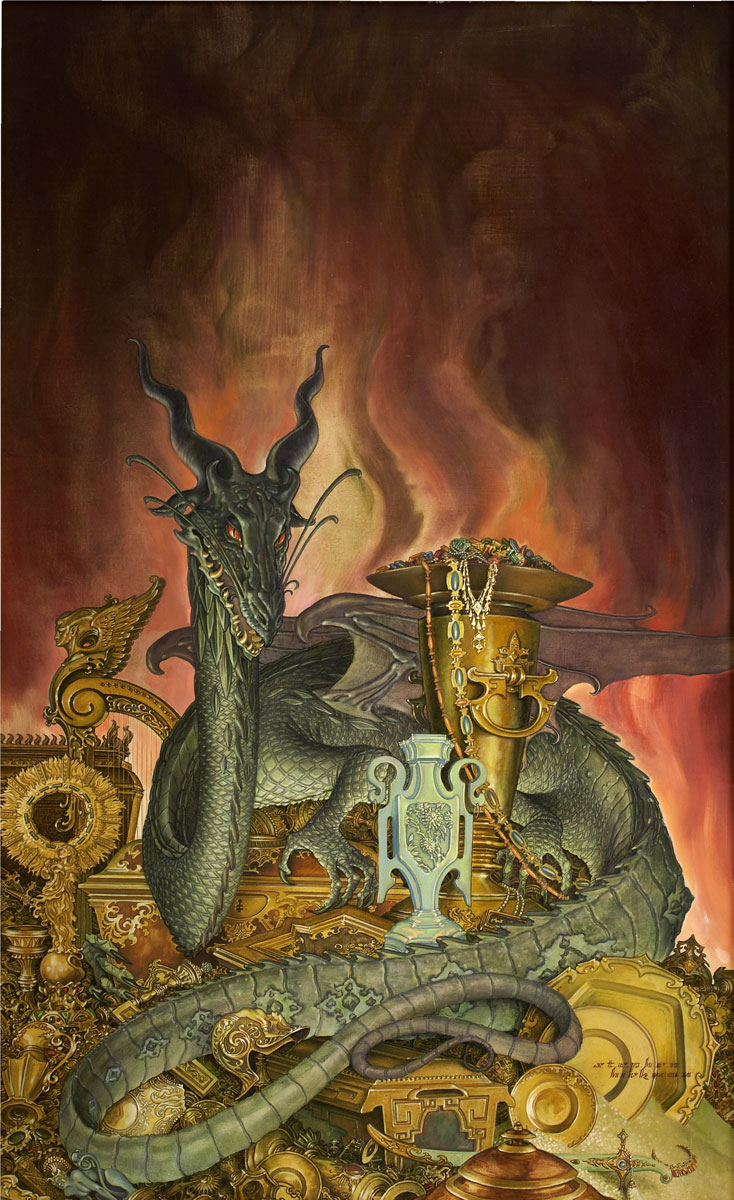
{Is the dragon’s hoard perhaps much less substantial, but much more potent? Image found on the blog PowerOfBabel.}
 

Back To Top
Abstract

Beowulf gives thanks for his seeing the dragon’s treasure, and gives Wiglaf instructions for his funerary arrangements.

Back To Top
Translation

“‘I for all of these precious things thank the Lord,
spoke these words the king of glory,
eternal lord, that I here look in on,
for the fact that I have been permitted to gain
such for my people before my day of death.
Now that I the treasure hoard have bought
with my old life, still attend to the
need of my people; for I may not be here longer.
Command the famed in battle to build a splendid barrow
after the pyre at the promontory over the sea;
it is to be a memorial to my people
high towering on Whale’s Ness,
so that seafarers may later call it
Beowulf’s Barrow, those who in ships
over the sea mists come sailing from afar.'”
(Beowulf ll.2794-2808)

Back To Top
Recordings

Old English:

Modern English:

Back To Top
The Facets of Translation

The most prominent feature of this week’s passage is the awkward opening sentence.

Its gist is straightfrward enough: Beowulf is thanking what we can safely guess is the Christian god for his successes, as he has done previously. However, if translating things fairly literally (perhaps too literally), we wind up with a second clause about the words being spoken by god (“wuldurcyninge wordum secge” ll.2795). Many translations omit this line since it appears to just repeat and expand upon Beowulf’s thanks to god, as it could come out as “[I…]speak these words to the king of glory.”

Yet, and this is where I exert a bit of extra pressure on the text, I’ve translated the second line as a reference to the jewels and the like being the words of god.

The reason for taking this route with the translation is simple: it gives the reader the opportunity to interpret the dragon’s hoard as the words of god, as some sort of cosmological truth as spoken directly by the creator of those cosmos. Opening up this possibility forces readers to take another look at the dragon, too. It’s still antagonistic in that it’s keeping the words of god to itself and needs to be killed for them to be distributed, but then just what kind of entity is it?

It might stretching things to the breaking point, but it seems that the dragon could be interpreted as the powerful priesthood or any entrenched exclusionary religious group, and Beowulf could then be considered some kind of scholar, wrenching the truth from those who are in places of religious power and being ready to redistribute it. Though, as we find out later in the poem, this doesn’t happen since the treasure is buried with Beowulf since the Geats consider it too dangerous to add massive wealth to their leader-less state.

Back To Top
Answering Questions Raised

In this reading of the hoard as cosmological truth, we need to consider what it means for Beowulf to die for it. One possibility is that in taking on such a major source of authority he destroys all of his own credibility, and as a result the truth that he uncovers can’t be successfully transmitted since without credibility (or in more contemporary terms, authority or auctoritas) no one will willingly accept what he has to say.

That brings us around the matters of the theif and of Wiglaf. In this interpretation of the dragon’s hoard as some sort of great truth, the theif could well be one who haplessly leaked one of its aspects and therefore set the whole of Beowulf’s kingdom astir. A little bit of knowledge can be much more dangerous than a lot, after all.

As per Wiglaf, he could be an acolyte of the elder scholar Beowulf. He could be a youth who has joined his cause when noone else was brave enough to, and who cared enough for the tradition of truth than the institution which had grown up and kept it from the masses.

Back To Top
Probing Possibility

The last question that this interpretation needs to face is whether or not it could have been knowingly injected into a poem written down by people working for the medieval church, an institution that was rarely free from accusations of withholding knowledge or working contrarily to the truth of things. Representing the church as a dragon, something commonly equated with the devil, could be risky in a medieval context, but I argue that this interpretation of the dragon’s hoard would hold up since the dragon could be explained as a symbol only for the corrupt within the Church and not necessarily the Church itself.

So, do you think that this interpretation holds water, or am I just stretching my own credibility by trying to keep my translation as literal as I can? Or, for that matter, have I missed something in my translation? Let me know in the comments!

Back To Top
Closing

Next week, the full complement of a Latin and Old English entry will return, with the first verse of “Dum Diane vitrea” and Beowulf’s further final words to Wiglaf.

You can find the next part of Beowulf here.

Back To Top

Extending Lore on Love and Passion [12:60] (Latin)

Abstract
Translation
Recordings
Repetition Leading to Implication
Word Woes: Overcome?
Closing

{Words upon words – some to be lost between languages. Image found on the blog Thoughts on Books.”}

Back To Top
Abstract

Isidore further expounds on the theory and lore of good animal husbandry.

Back To Top
Translation

[60] “Then are those which have the heavy mares look at no animal of deformed appearance, such as dog-headed apes and gorillas, such faces are not made visible to those looking like they are pregnant. Truly this is natural for females that is if such is seen or if the mind conceives of it in the extreme heat of passion, that is conception, such will be in the children that they create. As a matter of fact, animals in the enjoyment of Venus transfer their outside to the inside, and they seize their fill of such a figure of their types in appropriate quality. Among animals those born of diverse kind are called two-kinded/mutts such as mules from mares and donkeys; hinny from horses and female donkeys; mongrels/half-breeds from boars and pigs; sheep-goat (tityrus) from ewes and he-goats; raidos [from ram + IE *ghaidos] (musmo) from she-goats and rams. On the other hand, these are truly the leaders of the herds.”
(St. Isidore of Seville, Etymologiae 12:60)

Back To Top
Recordings

Latin:

{Forthcoming}

Modern English:

{Forthcoming}

Back To Top
Repetition Leading to Implication

While he repeats much of what was written in paragraphs 58 and 59 here, Isidore seems to be expanding to all women the reproductive lore from those paragraphs. Otherwise he would have gone with a different phrase than “…this is natural for females” (“Hanc enim feminarum esse naturam”) to describe the practice of keeping ugly things away from pregnant women.

Unfortunately, this is just a matter of implication, since Isidore jumps right back to the animal after he has finished getting into some titillating descriptors (the “extreme heat of passion” (“in extremo voluptatis aestu”) and the “enjoyment of Venus” (in usu Venerio) both being polite euphemisms for orgasm and sex respectively).

Back To Top
Word Woes: Overcome?

When he settles back on animals, Isidore rounds off the first part of his book about animals with some of the different two-kinded and hybrid mixtures that people have come up with.

Now, either English breeders have been put to shame here, or Latin simply has a far greater depth of expression, since “burdo” translates easily enough into hinny, but “tityrus” and “musmo” remain untranslatable to varying degrees (as far as I can tell).

It’s not as satisfying as a portmanteau of the two, but sheep-goat is the result of a sheep/goat cross-breeding, though these are apparently rare in nature (and referred to as geeps when created in labs). So sheep-goat is the closest translation of “tityrus” that English has to offer.

On the other hand, “musmo” is apparently entirely untranslatable, since even a satisfactory compound English name isn’t available. Yet, if mules and hinnies are different based on the gender of the horse or donkey in the pairing, so too should the result of a she-goat and a ram and a ewe and a he-goat be different.

So, to remedy the untranslatable malady of “musmo,” a little digging was done and the word “raidos” was created. It’s a combination of “ram” and the reconstruction of the Proto-Indo-European word for sheep – *ghaidos. It sounds kind of like “Raiden,” and so is appropriate, given the sentence that Isidore ends with: “…these are truly the leaders of the herds” (“Est autem dux gregis”).

Back To Top
Closing

This Thursday, Beowulf continues his speech, talking about his time as king and making a very curious statement.

Back To Top

On Water and Words [ll.2720-2732a] (Old English)

Abstract
Translation
Recordings
A Good Washing
Passing (Things) On
Closing

{Wiglaf raising the washing water to Beowulf. Image found at the Tolkien Library}
 

Back To Top
Abstract

Wiglaf tends to Beowulf and Beowulf begins to speak to Wiglaf, signalling that his death is imminent.

Back To Top
Translation

“Then he with hand, blood-stained,
the famed lord, a man unmatched for good,
washed his dear lord with water,
battle-worn, and unclasped his helm.
Beowulf spoke – he spoke through the pain,
the ache, of his miserably vexatious wound; well he knew,
that he had fulfilled the days of his life,
of earthen joy; that all of his life-time had
fled, death was immeasurably near:
‘Now I to the son of mine would give
the war garments, if it had been so granted
by fate that I any heir had,
flesh of my flesh.'”
(Beowulf ll.2720-32a)

Back To Top
Recordings

Old English:

{Forthcoming}

Modern English:

{Forthcoming}

Back To Top
A Good Washing

The washing of Beowulf requires some note here.

First, there’s the general importance of the act as a means of humbling yourself before someone whom you respect.

Then there’s the fact that it’s a simple act of subservience, the sort of thing that is an active display of obedience and respect.

And that interpretation of the act leads into the Christian significance. However, if this death is meant to mirror that of Christ in the New Testament, then there’s something interesting going on here.

In the NT and in the Catholic ritual recreating the Last Supper, it’s Christ who washes his disciples’ feet.

Wiglaf’s washing is more general, but if the parallels between these stories are followed, then Wiglaf is effectively becoming the Christ figure of the story, possibly in a more meaningful way than Beowulf.

Yes, Beowulf defeated the dragon, but that cost him his life, and Beowulf would never be characteristically elegiac if he came back to life afterwards (nor would the Anglo-Saxons have told it like that, regardless of whatever their source material may have been).

This transference of Christ-ness might even have been one of the original purposes of the poem as a conversion tool, since it’s the sort of succession that Anglo-Saxon’s would have understood. After all, it’s the exact same way that kingship would be transferred when no heir was available: through a ritualistic act and acknowledgement.

Back To Top
Passing (Things) On

The opening of Beowulf’s speech also says a lot about the Christian intent of the written version of the poem.

If Beowulf is taken as a heroic heathen, someone who is Christian in all ways but name (ignore for a moment, his constant references to a single ‘Lord of Men’/’Ruler’/’King of Glory’), then he simply can’t have an heir. There can be no continuation of the virtuous heathens, since there is no further need for such people, the virtuous will, of course, be Christians. And so enter the transitional figure of Wiglaf, the one who reprimands the cowardly thanes and does his best to guide Geatland gently into the good night awaiting it after Beowulf’s death.

Beowulf signals his death not by saying that he has reached the end, as the poet/scribe does before we get his dialogue, but by saying that he has no heir to give his weapons to.

He has no offspring that he could call “flesh of my flesh” (or “belonging to my body” for a curiously medieval Christian rendering of “lice gelenge” (l.2732)) that can continue his line directly. And so, it passes to one who’s proven himself to be worthy: Wiglaf.

However, it’s important that Beowulf opens his speech with talk of handing down his war garb. Because Wiglaf is not his son, the war garb will not be touching the same flesh (more practically, it may also be less of a snug fit than on any son of Beowulf). As a result, Wiglaf is not going to be able to do the same things that Beowulf did with his gear, in both the literal and figurative senses.

And that a body patently different from Beowulf’s carries forward the symbols of the old way embodied by Beowulf’s war garb (arguably, his most precious possession) is a great metaphor for the spread of Christianity throughout Early Medieval Europe.

Back To Top
Closing

Check back here next week, for Isidore’s finishing off the first section of book 12 with further discussion of fertility lore, and for Beowulf’s quick review of his kingship and current predicament.

You can find the next part of Beowulf here.
Back To Top

Silent Sorrow Following Frabjous Joy [ll.2706-2719] (Old English)

Abstract
Translation
Recordings
Strengthened by Juxtaposition
Who’s Heart-Wise?
Closing

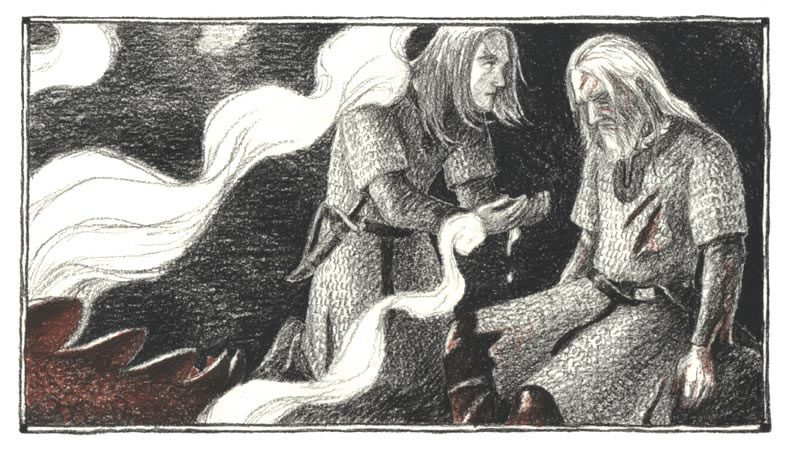
{Wiglaf tends to Beowulf. Image found on Wikipedia.}
 

Back To Top
Abstract

The poet revels over the victory of Beowulf and Wiglaf, but their joy is short lived as Beowulf’s wound is shown to be dire.

Back To Top
Translation

“The fiend had fallen – courage punished his life –
and those two both had killed it,
brother nobles. So should every man be,
loyal thanes ready for the need! Yet for that king it was
the final hour of victory for his own deeds,
his works in the world. Then that wound began,
the one the earth-drake had earlier dealt him,
to sear and swell; soon he discovered that
poison welled forth from within the wickedness that
marred his chest. Then the prince went
to him that was by the wall, wise at heart,
he sat on the stone; looked upon the work of giants,
how the stone arches were secured with columns,
beheld what the cave-dwelling held within.”
(Beowulf ll.2706-2719)

Back To Top
Recordings

Old English:

{Forthcoming}

Modern English:

{Forthcoming}

Back To Top
Strengthened by Juxtaposition

The juxtaposition of the opening lines of this passage is perfectly suited to Anglo-Saxon thought.

Placing a bit of gnomic wisdom aside the revelation that Beowulf is indeed dying only strengthens that wisdom. After all, Wiglaf now proves himself to truly be one of the “loyal thanes” (“þegn” l.2709).

Within this passage we see him run over to his dying liege lord and take a seat beside him. For now, there is no dialogue, but instead Wiglaf looks over what they’ve won together. Without words of any sort he takes up the role of world interpreter for Beowulf as he lies against the wall, his wound festering in fast forward.

Back To Top
Who’s Heart-Wise?

In the above translation the person being desribed as “wise at heart” (“wīs-hycgende” l.2716) is unclear, and so too is it in the original: “Ðā se æðeling giong/þæt hē bī wealle wīs-hycgende/gesæt on sesse” (ll.2715-2717).

This ambiguity shows not only the shared wisdom of these two, but it also works to further the idea that Beowulf has successfully passed on the role of Geatish ruler to the best candidate. Though his death and the cowardice of the other 11 thanes does prophesy that tribe’s beginning decline.

Turning to what either case might mean more specifically, if the phrase refers to Wiglaf, then it simply means that he is doing what he feels is right and the poet is validating this.

On the other hand, if this phrase refers to Beowulf, then it may be a bit of foreshadowing of a phrase that comes up in a passage nearly 100 lines away, or it may simply refer to the inborn wisdom that a fifty winters as a successful king brings.

Back To Top
Closing

Next week, Isidore writes of the ways in which animals are manipulated while conceiving, and Beowulf finally comes to terms with his end.

You can find the next part of Beowulf here.

Back To Top

Beowulf [ll.2409-2419] (Old English)

Introduction
Section Summary
A Word Wanted
A Difficult Word
Speculation on Hengest and Horsa
Closing

Introduction

Thursday is here again, and so I’ll continue with my work on Beowulf.

Back To Top
Section Summary

The next section of my Beowulf translation covers line 2409-2419: The part at which the thrall is forced to guide Beowulf and his eleven chosen warriors to the place where he found the stolen cup that Beowulf believes is the cause of the dragon’s rage. They reach the cave (hleaw, 2411) and discover that it is full of wondrous treasures (“wraetta ond wira,” or “wrought and wound,” as I translate it, 2413).

But, they also know that the treasure’s guardian is the dragon and, as the poet points out, no man is able to extract that treasure cheaply because of the dragon’s eagerness to guard it (“gearo guð-freca gold-maðmas heold” 2414) (2416). The passage ends when Beowulf sits down on the cliff-top overlooking the sea and wishes all of his warriors health and luck (haelo abead, 2418). For he already seems to know that his loan of days is due.

Back To Top
A Word Wanted

I always have a lot of fun with this language. Maybe it’s because the expression seems so fancy free or because it’s from a time before there was really a formalized register and diction that could be learned in school (since English wasn’t taught in school back then, it was just the common tongue – what people spoke to communicate with each other. Latin, Celtic, and probably even some Old French would have been used for business, since native Old English speakers would trade with those peoples).

Whatever the case, this degree of enjoyment tends to turn me onto a word that should still be around in one form or another.

In the case of this passage, the word that I want to see come back is heorð-geneat (hearth-companion). The origin of the term probably came from the practice of those fighting wars/feuds together sitting down and talking/eating/relaxing by a fire. The same sort of bonding happens today with MMORPGS or online forums. Flickering lights still help us to bond with one another.

But not too many people actually sit around fires on a regular basis. Sure, some people go camping, and maybe some use wood furnaces to heat their living space. But, it’s generally not a daily occurrence to wind up beside friends in front of a roaring blaze. But, it is a daily occurrence for people to bond while playing MMORPGS and other such online games (sorry TV, but high speed internet and wi-fi have done to you what you did to radio).

So, as a modernized version of heorð-geneat, I propose that we bring in the term connection companion. Or, for short, conn-comp. Think about it.

Back To Top
A Difficult Word

Within the passage the only word completely unfamiliar to me was “unhiore,” on line 2413. The word translates as terrible, a shuffle that is easy enough, but it’s parts are a little bit curious to me.

A hearty little particle, “un” meant then what it still means now – a negation of what follows (such as unsure for not sure). The rest of the word, “hiore,” as best as I can figure is a variant of “hearra,” meaning lord, master, or it is a variant of “heorra,” meaning “hinge, cardinal point.”

The latter actually makes a little bit more sense to me, since something that is “not a hinge/cardinal point” would mean that it is not tied into the world in an extremely structured way (perhaps not subject to wyrd/fate like everything else).

Basically, this combination makes the word “unhiore” seem like it refers to an anomaly in the system. Such a variation is a truly terrifying thing when your system is there to help navigate life in a world full of strife. Especially since that strife was not of the life-choice kind we face today (seriously think through grad school if it be among your choices, oh ye bright eyed senior undergraduate) but of the wayward sword cutting open an artery kind.

Of course, this interpretation of “unhiore” is primarily supported by my trusty Concise Anglo-Saxon Dictionary.

Back To Top
Speculation on Hengest and Horsa

Since we’re in the realm of speculation already, here’s some more.

While looking up “yð-gewinne” (“wave-strife”) I came across the word “yð-hengest” (“sea horse,” a kenning for “ship”). This got me thinking.

Recently I listened to the Anglo Saxon podcast by frederic and he mentioned that Gildas calls only Hengest and Horsa by name among all of those Angles called in by the king of the Britons to help fend off the other Celtic tribes. On the podcast frederic noted that these names translate as horse and mare respectively. But what if Gildas meant yð-hengest instead of just Hengest? Then it would be ship and mare.

Further, what if this is an old saying signifying men and supplies? Or families and rations? I mean, it’s clear that the Angles didn’t just bring two guys and a few ships over when they came, there were much more than that coming to the Britons’ aid.

Old English idioms like this are notoriously difficult to figure out because there are so few sources, but I think that this could be something. I mean, until England became the major super power, English was just a bunch of dialects that at times could pose some difficulty to each other.

Hundreds of years earlier, when the only permanent media was the written word, idiom would have traveled at a snail’s pace and probably would have taken years, if not decades, to work its way into everyday use between dialects.

So maybe horse and mare or ship and mare is an example of a dialect from Gildas’ region. Already clear is that ships are super important to Anglo-Saxons – they can be treasure houses, the means to travel for adventure and conquest, and potentially the final resting place for warriors. But what are horses to them? A means of transit? A thing to gamble on?

Maybe if I can establish what a horse *was* to the Anglo-Saxons of 800-1100 AD, then I can write more about what a mare by itself might signify beyond the animal. And what something like “ship and mare” might mean.

Back To Top
Closing

Anyway, with that question, and that quest, I leave off with Beowulf until next Thursday. Leave any suggestions, contentions or comments in the text box below.

Back To Top