Beowulf & the Dragon: Little Appetite for Mutual Destruction [ll.2554-2565] (Old English)

Introduction
Translation
Recordings
Shorter Sentences
Beowulf Attacks the Dragon, or Fends it Off?
Closing

{Benjamin Bagby knows well the power of shorter sentences. Image from Benjamin Bagby’s Beowulf}

Back To Top
Introduction

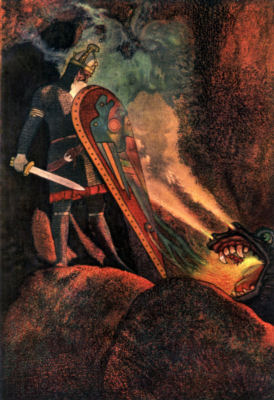
Roused by Beowulf’s heavy metal scream at the end of last week’s passage, the dragon is angry this week. Yet neither of the two fighters are particularly pleased to be forced into battle:

Back To Top
Translation

“Hatred was aroused, the hoard guardian recognized
man speech; then there was no more time
to ask for friendship. First came the
breath of the fierce assailant from out of the stones,
a hot vapour of battle; the earth resounded.
The warrior below the barrow, the lord of the Geats
swung the rim of his shield against the dreadful stranger;
then was the coiled creature incited at heart
to seek battle. The good war-king
had already drawn his sword, the ancient heirloom,
sharp of edges; each was in horror from a mutual
intent upon destruction evident in the both of them.”
(Beowulf ll.2554-2565, Ch.XXXV)

Back To Top
Recordings

Old English:

Modern English:

Back To Top
Shorter Sentences

One constant in narratives from all ages is that action sequences are made up of shorter sentences. Although this passage doesn’t include any that are shorter than 19 words, the sentences here are, on average, quite a bit shorter than those in previous weeks. The shorter sentence length here makes it clear that the poet/scribe is moving into the thick of the action – things are happening now, and in real time.

In fact, it could even be argued that the shorter sentences here are the natural Old English mode of the reportage of action as it is happening. Whenever the poet describes things such as passages of time, or the interaction of characters, various details tend to be lingered upon, providing extra information that’s really ornamental rather than practical.

Back To Top
Beowulf Attacks the Dragon, or Fends it Off?

The action that’s currently taking place, however, takes on a different dimension when considered alongside the other major fights in the poem.

Unlike when Grendel comes to Beowulf or when Beowulf seeks out Grendel’s mother to continue their feud, Beowulf is pure interloper in regards to the dragon. In fact, had it not been for the thief that stole the cup, the dragon may never have left its barrow and may never have caused the Geats any distress.

So, in a sense, this is a new kind of fighting for Beowulf. Rather than being the avenging hero who is reacting to something that has happened to him or to his retainer, he is taking the initiative.

In his youth, Beowulf fought battles for others, now in his old age he fights them for himself. Perhaps this aspect of the fight is meant to reflect the simplicity in fighting for another, a person from whom you can sever yourself if it happens to be necessary to do so. On the other hand, fighting the battles made necessary to fight because of being a king are made out to be all the more difficult since you can no longer defer to some ring-lord or other but are ultimately answerable to yourself.

Perhaps Beowulf’s having a “sorrowful heart” (as noted in last week’s entry) is not just because of some direct feeling of his impending death, but the feeling that he has become the cause of the problem, and in order to defeat the problem, he also needs to destroy its cause: himself.

Back To Top
Closing

As will be seen in next week’s entry, that is indeed a valid reading of the fight.

Also on Saturday hear St. Isidore talk more of boar, and next Tuesday he’ll move onto bull and oxen.

Back To Top

Beowulf’s ‘Barbaric Yawp’ to Dragonkind [ll.2542-2553] (Old English)

Translation
Recordings
Back to the “grey stone”
On Dragons and the Need for Weapons
Beowulf’s Persistent Youth
Closing

{Old Beowulf in a pose befitting his bellow. Image from Sandra Effinger’s “BEOWULF: Still a Hero” website.}

Back To Top
Translation

“Then by the wall, the man who had survived
with good manly virtue a great many battles,
the crash of combat, when the band on foot clashed,
saw standing a stone arch, a stream out from there
burst from the barrow; there it was a surging stream
of hot deadly fire; he could not be near the hoard
for any length of time without being burned up
could not survive in the depths of the dragon’s flame.
Then he allowed it from his breast, when he was enraged,
the lord of the Weder-Geats sent the word out,
fierce-hearted he shouted; his voice came in
clear as in battle as it roared under the grey stone.”
(Beowulf Ch. XXXV, ll.2542-2553)

Back To Top
Recordings

Old English:

Modern English:

Back To Top
Back to the “grey stone”

The first thing that jumps from this passage is the mention of “grey stone” (hārne stān) in line 2553. Where last week’s section seemed to nod to the story of Sigemund as it’s told earlier in Beowulf, this phrase is practically quoted from the story (“under hārne stān” appears in line 2553 and line 887).

This repetition is evidence of a kind of narrative inverse parabola within the poem, where events in the first part are mirrored by events in the third, with the descent into the mire (lines 1492-1631) being the “depths” of the poem as it were.

What’s most curious here though is that since the precedence is a celebratory story about a victorious dragon slayer, expectations seem to be running against Beowulf’s own disposition. His heart is heavy, and he’s ready for whatever fate has in store for him (“Him wæs geōmor sefa,/wǣfre ond wæl-fūs[;]” “He was of a sorrowful mind,/restless and ready for death” ll.2419-2420).

Back To Top
On Dragons and the Need for Weapons

The previous presence of a dragon was in a story nested in a story (the scop’s song in celebration of Beowulf defeating Grendel, ll.884-915) whereas the dragon is now as ‘real’ as the story’s main character.

Maybe this confrontation between the ‘real’ and what was heretofore imagined is meant to show the way in which the real world twists things – even imagined things – about, but it’s hard to say with certainty just what the poet/scribe is up to here.

Something that any reading of these parallel events also needs to deal with is the fact that the story of Sigemund and the dragon is about a young man fighting a dragon, whereas Beowulf is by no means young any longer. Perhaps his boasts of his youthful exploits are meant to be invocations of his youthful strength, but they’re too tempered by an awareness of his own mortal reality. This awareness is made clear in his admission that if he knew another way to face the dragon he would do so unarmed.

So then, what does it mean for Beowulf, a warrior and king who relied on his natural body for glory so much in the past, to now need to add weapons to that body to win glory?

Is Beowulf cursed in an opposite sense to Grendel – where the monster can’t be harmed by metal, the hero can’t wield metal? The giant’s sword he uses to finish off Grendel’s Mother and Grendel himself could be an exception, but perhaps whatever enchantment it was under nullified his curse?

Back To Top
Beowulf’s Persistent Youth

Given what’s present in the passage, it seems that Beowulf, at least in calling out the dragon, is still as wild as he was when he wrestled Grendel. He doesn’t unsheathe his sword and bang it against his shield or otherwise use what he’s wearing to call out the dragon, but instead shouts. And he shouts so that it “roared under the grey stone” (“hlynnan under hārne stān” l.2553).

The word “hlynnan” could be translated as “resounded” or “reverberated” instead of “roared,” but with what’s come before, and Beowulf’s feeling of unease (brought on, perhaps, because he knows he can’t fight the dragon with his bare hands, and that makes him incredibly nervous), the primal connotations of “roared” makes it seem the best fit.

Back To Top
Closing

Next Tuesday Isidore talks Bull, and the dragon rushes into the open where he and Beowulf stare each other down.

Back To Top

Beowulf’s is no "cowardly course of action!" [ll.2529-2541] (Old English)

{The sort of shield Beowulf may’ve borne off with him. Image from the Lighthouse Journal}

Translation
Recording
Commentary Intro
Death and Glory
Echoes of Sigemund
Closing

At last in this week’s reading of Beowulf, the hero becomes a man of action once more. Since deeds speak louder than words, let’s check in with the poet/scribe’s own deeds, which, ironically, are words.

Back To Top
Translation

“‘Wait you on the barrow, my armed men,
warriors in war gear, while we see which of
we two can endure the wounds
after the deadly onslaught. This is not your fight,
nor any other man’s, but mine alone
to share my might with the foe,
indeed my courage. By that courage shall
I win the gold, or, in battle,
peril of a violent death, may your lord be taken away!’
Arose then behind the shield that renowned warrior,
hard under helm, bore his battle shirt beneath
the stony cliffs, trusted in the strength of one
man alone. That was no such cowardly course of action!”
(Beowulf ll.2529-2541)

Back To Top
Recordings

Old English:

Modern English:

Back To Top
Commentary Intro

So here we have Beowulf announcing that this is his fight, and then heading off to the dragon’s den. Even the poet/scribe notes that he “trusted in the strength of a single man” (“strengo getruwode/ānes mannes” ll.2541-42). But what’s this all about?

Back To Top
Death and Glory

If Beowulf knows that he is likely to die in this fight it could be argued that he wants to minimize the danger to his thanes by rushing into battle alone. However, that’s a bit of an anachronistic way of looking at the passage.

All puns pardoned, it’s more likely that Beowulf specifically orders his men to stay out of the fray so that he can go out in a blaze of glory. What better way to die than in battle, let alone battle with a dragon – the very embodiment of the greed that all good kings must eschew in order to be good kings.

The passage could also be analyzed as the poet/scribe taking a bit of a jab at a system where a mere man calls the shots in a society that runs on glory and heroic deeds, since it is the doing of such deeds that gets Beowulf killed and ultimately leads to the Geats’ being leaderless, and shortly after war-ravaged.

So, is this merely the vehicle to set up the main character for his triumphant death as hero and dragon slayer, or a Christian twist that’s supposed to undermine the old pagan Germanic way?

Back To Top
Echoes of Sigemund

One thing can definitely be agreed on, there’s an echo of the story of Sigemund and Fafnir in the description of Beowulf’s approach to the barrow’s entrance. It’s only in the phrase “stony cliffs” (“stān-cleofu” l.2540), but the inclusion of “stān” makes this phrase too close to “grey stone” (“hārne-stān”) to be mere coincidence.

Unless dragons are somehow related to these sorts of rocky outcrops, it seems that the poet/scribe is trying to hint at some connection between the Sigemund story and this. Perhaps he is merely foreshadowing the victory (and the curse that comes with it), or trying to suggest that such old stories have no basis in reality. After all, this is Beowulf whose moving under these rocks to kill a dragon, not some distant mythological figure like Sigemund.

Nonetheless, for a passage that’s full of bravado these lines provide a lot more than mere introspection on the part of Beowulf. It really speaks to his own desire to show himself that he’s still as good as he was when he was young.

As the hero of the story he has internalized the very ethos of the Germanic pagan heroic tradition, and it is that which will ultimately cause his downfall. He feels that he is going to die, he’s got that heavy heart, and he constantly talks of how fate is the only one who can decide which of the two will live or die. But yet he still goes on, and his final words to his men suggest a tone of “don’t bother me, I need to show you (and myself) that I can still do this.”

Beowulf needs to validate himself within the system that he has so successfully internalized, first as the celebrated slayer of Grendel and Grendel’s Mother, then as king of the Geats, and then finally (and hopefully, in his current frame of mind), as the slayer of the dragon. But only time will tell.

Back To Top
Closing

Come back next week for Isidore’s brief take on rabbits and longer musing on pigs, and for Beowulf’s final approach to the dragon.

Back To Top

All About Beowulf’s Final "Boast-Words" [ll.2510-2528] (Old English)

Translation
Recordings
Initial Thoughts
Why so Compounded?
Three Possibilities
Closing

{What Beowulf imagines his fight with the dragon will look like – war-fire, breath, venom, shield, and all. Image from eKits.}

Back To Top
Translation

This week’s section of Beowulf sees him boast for the last time, before turning and addressing his thanes. Let’s listen in:

“Beowulf spoke, gave form to boast-words
for the final time: ‘In youth I
risked much in combat; yet I will once more
though an old king of the people, pursue the feud,
gain glory, if only the fiend to men
will come out from his earth-hall to face me!’
Addressed he then each warrior,
each helm-wearer for truly the final time,
each dear companion: ‘I would not bear a sword,
bring the weapon to the worm, if I knew how
I might otherwise gloriously grapple against
that foe, as I once with Grendel did;
but there will be hot war-fires, I expect,
breath and venom; thus I have on
both shield and byrnie. Nor will I give a foot’s length
when I meet the barrow’s guard, but between us two
what is to happen later on this sea wall, that is as fate,
measurer of men, is drawn to decide. I am firm of heart,
so that I may cease from boasting over this war-flyer.'”
(Beowulf ll.2510-2528)

Back To Top
Recordings
Now, to give you a sense of how that would sound:

And in Modern English:

Back To Top
Initial Thoughts

This passage, for all of its high boast density, is quite straightforward. Beowulf says that he will fight the dragon as long as he comes out of the barrow, and then turns to his men to tell them why he’s carrying a shield and wearing armor. Then, he closes it all off by saying that he is “firm of heart,/so that I may desist from boasting over this war-flyer” (“Ic eom on mōde from/þæt ic wið þone guð-flogan gylp ofersitte” ll.2527-8)

That’s it.

There’s definitely something to say for its directness. This quality might even be the result of Beowulf’s melancholic belief that this will be his last fight, and the poet’s own admission of the same. But, as always, there is one curious thing to poke at – like a sleeping dragon coiled around a heap of gold.

Back To Top
Why so Compounded?

This passage uses a fair number of compound nouns: “Bēot-wordum” for “boast-words;” “mān-sceaða,” for “fiend to men;” “eorð-sele” for “earth-hall;” “helm-berende;” for “helm-wearers;” “heaðu-fyres,” for “war-fires;” “guð-floga” for “war-flyer.”

All of these compound words share two characteristics. They’re all related to war, and they’re all direct , straightforward terms. Though it might be contentious, none of them are the fancier type of compound words known as kennings (like “līchama” for “body” (literally “body-raiment”) or “heofon-candel” for “sun” (literally “sky-candle”).

Maybe Beowulf isn’t in the mood for speeches wrought with fine words like cups studded with jewels. Maybe the poet is trying to just skate on through this section being straight to the point and direct. Or maybe, there’s something more going on here – something at the level of connotation and association.

Maybe direct, clear compound words, are those that are related to war specifically. Granted, you might be able to come up with more elaborate compounds that are used to describe battles and what not, but at least here, it’s curious that they’re so streamlined. If this is indicative of something about the poem that’s one thing. But what if it’s pointing to something present in all of Anglo-Saxon poetry, maybe even the culture itself?

Back To Top
Three Possibilities

If we run with the idea that this compounding cluster relates to Anglo-Saxon culture, then the compound words/phrases relating to war being straightforward and direct could mean a number of things. It could be meant to reflect the manly nature of war, men being more direct and active. Though this is a little bit anachronistic, since Anglo-Saxon women could rise to the same level of martial power as men.

Alternatively, this straightforwardness of war-related compounds could mean that war itself was something that the Anglo-Saxons regarded as straightforward. Or, maybe they saw it as something that need not be embellished when its reality is about to be brought home.

For all of Beowulf’s boasting up to this point has been about the past, only now does he actually boast about what he is going to do next. Maybe the rough drafts of boasts, boasts for deeds undone, are underplayed so that they can be elevated to ecstatically glorious places after the deeds they describe are done.

Or, again, maybe this straightforward language on the part of Beowulf (and the poet) is meant to be taken as a deference to fate.

Everything is cold and windy on the promontory. Beowulf is about to face the dragon, and talking to his men before the worm comes from its underground lair. Things are tense. Things are heavy. Beowulf knows that he’s an old man, “an old king of the people” (“frōd folces weard” l.2513). He knows that the dragon’s breath and venom are to be feared, to be protected against. So maybe his direct boasting, and its firm, resolute ending, are meant to show his humility before fate. After all, for our two combatants, it will be as fate decides, “swā…wyrd getēoð” (l. 2526).

Back To Top
Closing

What do you make of this crowd of compound words, these straightforward and unassuming combinations? Let me know down in the comments.

Next week, be ready for more of St. Isidore’s writing on deer, and Beowulf gives his final commands to the men before heading off to draw the dragon from its den.

Back To Top

Beowulf’s Boasts – Dayraven’s and Dragon’s Bane [2496-2509] (Old English)

Translation
A Word and a Name
Compounded Words
Conclusion and Wrap Up

There’s more boasting from Beowulf today, as he recalls the turning point in his career and then starts to talk some smack about the dragon’s hoard.

{Perhaps the younger Beowulf that our hero has in mind. Image created by Sandra Effinger}

Translation

“Always would I go on foot before him,
first in the line, and so ’til age takes me
shall I conduct war, so long as this sword survives,
that which has and will endure;
ever since before the hosts I became the
hand slayer of Dayraven,the Frankish warrior
No treasure at all did he
bring back to the Frisian king,
No breast plate could he have carried,
for, in the field as standard bearer, he fell,
princely in courage; he was not slain by the sword
but by hostile grip I halted the surge of his heart,
broke his bone-house. Now shall the sword’s edge,
hand and hard blade, be heaved against the hoard.”
(Beowulf ll.2496-2509)

As with any passage that concentrates so much on warfare there are some bits here that are so loud that they can’t be ignored.

Return To Top
A Word and a Name

One such bit is the word “feðan.” It looks like it should be a verb because of its “an” ending, but the Clarke Hall & Meritt dictionary isn’t quite so sure about it.

However, the translation of “marched” or “go on foot” makes sense since the entry right before it is feða, meaning “footsoldier.” It might not be a perfect translation, but just turning that word into a verb might be an all right way to go. Sense be damned, right?

Speaking of sense, the name Dayraven (originally Dæghrefne) could carry an odd one. As came up in an earlier entry, the raven is one of the three beasts of battle. But the significance of the raven isn’t finished there.

Based on the appearance of a raven at daybreak earlier in the poem (l.1801, during the celebration of Beowulf defeating Grendel’s mother), the bird is definitely a bringer of joy. So what could it mean for Beowulf to kill a warrior named for this good omen-bearing bird?

Moreover, should we take the suggestion that Beowulf has killed a symbol of joy to mean that he has doomed himself, or is this joy only that of the Franks who have lost their standard bearer and a man that is “princely in courage” (“æþeling on elne,” l.2506)?

Dayraven’s being identified with the Franks twice within two consecutive lines suggests that if he is to be understood as some sort of embodiment of joy he is definitely the Franks’ joy only. But given what happens to Beowulf when he faces the dragon, one wonders.

Return To Top
Compounded Words

As this passage is one of the climaxes of Beowulf’s boasting there are some cool compound words in it. Among them are “brēost-weorðunge,” “hilde-grāp” and “bān-hūs.” None of these yield any crazy literal translations, being breast-ornament, hostile grip, and bone-house respectively, but they’re all compounds that hint at bits of the poem’s culture.

“Brēost-weorðunge” is possibly the most nebulous. A breast ornament could be decorative plate armor, but maybe it refers to something like a heavy necklace, or something that you could hang off of armor – medals, maybe. But that such an accessory was important enough to have its own name (poetic or otherwise) implies that the Anglo-Saxons took their bling seriously.

“Hilde-grāp” and “bān-hūs” are clearer and more direct, but no less curious. Why? Because they’re both readily translatable into words/phrases that could easily transfer into today’s English.

Also, that “hilde-grāp” specifies a certain kind of grip makes it clear that grappling was pretty important to Anglo-Saxons. Beowulf’s feats earlier in the poem also back up this implication about their culture.

With “bān-hūs” the implication seems to be more metaphysical, or at the least spiritual. Referring to a body as a “bone-house” might hint at there being something not of flesh dwelling within that house. That Clark Hall & Meritt translate it as “body, chest, breast” supports this idea that it hints at a belief in a soul of in-dwelling life force, since the “chest” or “breast” contains the heart.

All of this connotation puts me in mind of another Old English compound: “word-hoard.”

Return To Top
Conclusion and Wrap Up

Since Beowulf has talked up his sword skill with all of this boasting the dragon definitely needs to fear what’s coming to it. But – it won’t be coming just yet. Beowulf still has some more boasting to get out of the way before he’s ready to head over to the beast’s den. And, at the opposite end of things, Isidore gets into talk of ibexes next week.

So, be sure to check back next week for those two entries. In the meantime, what do you make of Beowulf’s killing Dayraven? Feel free to leave your thoughts in a comment.
Return To Top

Credits in a Comitatus and Boasts Filled with Wonder Words [ll.2484-2495] (Old English)


The Translation
Ongentheow’s Killer and the Comitatus
“heoro-blāc”
“ēðel-wynn”
“Gifðum”
Wrap-up

{a younger Beowulf, perhaps, flashing his gams and doing some boasting. From “Gayle’s Bard Blog.”}

The Translation

We return to Beowulf now, as he rounds out his history lesson and starts to verbally fist pump. Let’s listen in:

“Then in the morning I heard that his kin
avenged him by the blade, plunged its edge to end
the slayer’s life where Eofor’s attack fell upon Ongenþēow;
his war-helm split, the Swedish warlord
fell sword-wan; his hand held memory enough
of feuding, he could not hold off that fatal blow.

“The treasure, which Hygelac gave to me,
I won for him by flashing sword; he gave to me land,
a native place, land joy. For him there was no need,
no reason to be required to seek some worse warrior
from the gifthouse or the spear-danes or the swedes,
my worth was well known.”
(Beowulf ll.2484-2495)

Some interesting stuff is going on in this passage.

Back To Top
Ongentheow’s Killer and the Comitatus

First, there’s the question of who killed Ongenþēow. The text suggests that it was Hygelac who killed him “by the sword’s edge” (“billes ecgum” l.2485), but it also mentions an Eofor who is credited with splitting his helmet (“thǣr Ongenþēow Eofores nīosað;/gūð-helm tōglād” ll.2486-7). So who’s the real hero, Beowulf?

To a modern reader this double crediting of Ongenþēow’s kill (something that might lead to another killing if it happened in a MMORPG), might seem confused. But, to an Anglo-Saxon sensibility, it makes perfect sense.

Consider for a minute the fact that Hygelac is, at the point when Ongenþēow’s killed, the leader of the Geat forces against the Swedes at this battle since Hæðcyn has been killed. Thus, Eofor is fighting as Hygelac’s thane – Eofor is part of Hygelac’s group.

In Anglo-Saxon terms, such a group could be called a “comitatus,” a band of warriors held together by mutual quid pro quo. If a warrior pledges his life and sword to a lord, he fights until his death – even if that lord should die before he does. In return, the lord provides the warrior with treasure and land.

“The Battle of Maldon” is a perfect example of the comitatus style of loyalty because it tells of a band of warriors that fights on after their lord dies, even though they all know that they are doomed to die.

What’s happening in Beowulf, then, is that Hygelac is being credited with Eofor’s kill because Hygelac is the head of the Geats, of the Geatish comitatus, and likewise, all of the warriors within Hygelac’s comitatus are his swords. So it’s fair to say that Hygelac had his vengeance on Ongenþeow by the edge of the sword, in the sense that he was killed by one of Hygelac’s men.

At the level of words within the passage, there are indeed a few that are quite curious.

Back To Top
“heoro-blāc”

The word “heoro-blāc”, meaning “mortal wound” is unique among these curious words since it is a somewhat mysterious combination of “heoru” meaning “sword” and “blāc” meaning “pallid, pale, wan.” So, literally, someone who is “heoro-blāc” is “sword-pale.”

Unfortunately, the literal translation doesn’t work quite so well, since “sword-pale” suggests that something is as pale as a sword. Depending on what it’s made of, a corpse might get to a similar pallor as a clean, shiny sword, but it’s a rather fantastical comparison.

“Mortal wound” is a little on the nose, though, so “sword-wan” is what was used above. The term is used in the senses that Ongenþēow is weakened by the sword, and about as strong as a sword without a wielder. He is mighty, yet useless, as he lay where Eofor split his helmet.

Moving into Beowulf’s boast about his own accomplishments yields more tricky and wondrous words.

Back To Top
“ēðel-wynn”

First up there’s “ēðel-wynn” meaning “joy of ownership,” but made up of “ēðel” (native land, country, home) and “wynn” (joy). So translating the term as “joy of ownership” does work, in that there will be a joy in a native owning their own land, but at the same time “joy of ownership” falls short by generalizing the original word too much.

Nonetheless, what’s telling about the translation is that it completely ignores the fact that “ēðel-wynn” contains a specific reference to land (“ēðel”). There might not be an exact and precise equivalent term in English, but by cutting out any reference to land, it seems like that there’s a desire to deny a sense of landed-ness in Anglo-Saxon at play.

But that’s just not true.

The fact that a compound word with “ēðel” is used here is important because it shows that whenever Beowulf was written (or maybe even when it was still being sung) land ownership was a big deal to Anglo-Saxons. This means that they might have had a sense of nationhood as we do today, since it wasn’t something nebulous or abstract.

Words like “ēðel-wynn” allow you to make a case that there was a sense among Anglo-Saxons that a place defined a people and that if a certain people was given a certain space then that people would be joyous. So, it seems that Seamus Heaney’s translation of the word as “the security that land brings” is better, though still wanting for the implied sense of nationhood.

Back To Top
“Gifðum”

The other word is “Gifðum,” which is not in the Clark Hall & Meritt Anglo-Saxon Dictionary. However, Seamus Heaney translates it as “gift house.”

Heaney’s translation might just be in a newer dictionary, or it could be derived from the idea that “Gifðum” is a corruption of “giefu-hus.” A stretch, maybe, but the poem Beowulf isn’t beyond having a few textual ticks here and there.

For example, in the original Anglo-Saxon, there’s a consistent difference in spelling between the first and second halves of the poem, suggesting that there were two scribes involved in making the copy of the poem that we still have today.

Of course, textual ticks or no, that still leaves the nature of “Gifðum” a mystery.

Back To Top
Wrap-up

If you’ve got your own theory about what “Gifðum” could mean, I want to know, just leave it in a comment for me.

Next week, St. Isidore talks of the goat, we get some more medieval lore, and Beowulf starts into more boasting. Don’t miss it!
Back To Top

Swedish Retribution "from over wide water" [ll.2472-2483] (Old English)

Abstract
Translation
On Swedes and Geats
Compounding New Words
Closing

Back To Top
Abstract

We get the history hard and fast in this week’s passage of Beowulf (ll.2472-2483, Chapter XXXV).

Back To Top
Translation

“‘Then between Swedes and Geats was war and enmity;
from over wide water causing laments,
wall-hard warfare, after Hrethel had perished,
Ongeonðēow’s sons to them came,
warlike; they would not free
those they held under sorrow’s sway, and near Hrēosnahill
they oft launched voracious ambushes.
My close-kin avenged this,
feud and war-fire, as it is known,
though one of them bought the victory, at a hard price,
with his life; Haethcyn, Geatish lord,
was taken in the war’s assailing.'”
(Beowulf ll.2472-2483)

{Approximation of the Hrēosnahill fight offered by a mural of the Battle of Maldon. From the Braintree collection of murals.}

Back To Top
On Swedes and Geats

Questions bubble up like air in a flagon of ale upon reading this passage. Who was Ongeonðēow? What’s important about Hrēosnahill? What liberties were taken with the translation?

Ongeonðēow [On-g’in-thou] was the king of the Swedes who launched an attack on the Geats to recover his daughter and his gold, both of which had been taken by the Geats on an earlier raid. He was famed as a powerful king, and two Geats (Eofor and Wulf) had to work together to defeat him (read more here). Though, as we’ll see in next week’s entry, Beowulf makes it sound like Hygelac himself lands the deathblow.

Hrēosnahill [Heh-res-na-hill] is where Hæðcyn had taken Ongeonðēow’s daughter, and is apparently a real place (modern Swedish:”Ramshult”), as well as a place that is traditionally within Geatish territory. Go to this Wikipedia page for more info.

So, what’s happening here is a little bit of old fashioned early medieval back and forth. The Geats stole Ongeonðēow’s daughter and gold (according to Wikipedia), and now the Swedes are coming for rescue and revenge – which they (again, from Wikipedia) only half exact. The Swedes recover the woman, but not the gold.

Two liberties were taken in the above translation. In the third line (l.2474) “wall-hard warfare” is altered from the literal “hard warfare” since the alliteration makes it sound more Anglo-Saxon and “hard warfare” isn’t as evocative as the original “here-nīð hearda.”

The phrase “under sorrow’s sway” was also altered from the literal “lamentation holding” since it doesn’t have enough punch in Modern English. It also confuses the metaphor of being held under extreme emotion, which is clarified by “under sorrow’s sway.”

Back To Top
Compounding New Words

The words “here-nīð,” and “inwit-scearo” are both compound words worthy of elaboration.

The first combines the word for “predatory band, troop, army; war, devastation” (“here”) and for “strife, enmity, attack, spite, affliction,” (“nīð”). Literally, then, it could be rendered “war-strife” or “troop-enmity” and so warfare is a clear translation of it. The redundancy of a literal translation also makes the standard translation of the phrase more efficient than a literal rendering.

The word “inwit-scearo” on the other hand, is more worthy. The term is a mix of “inwit,” meaning “evil, deceit, wicked, deceitful,” and “scearo,” a form of “scieran,” meaning “to cleave, hew, cut; receive tonsure; abrupt.”

Literally, the word could be rendered as “evil-cleave” or “abrupt-deceit” which sound like they could still be productive words among modern counterparts. “Evil-cleave” at least sounds like a technique in an RPG, while “abrupt-deceit” could be a spicier way to describe an ambush or surprise attack.

Back To Top
Closing

To let me know what you think about these compound words (or this entry in general) just post a comment below. And feel free to follow this blog, I’ll follow yours back.

Next week, Isidore elaborates on the workings of sheep and rams, and Beowulf tells of Hygelac’s revenge, all the while bolstering his own warrior-like image.

Back To Top

Hreðel’s Choice [ll.2460-2471] (Old English)

Abstract
Translation
A Religious Out
Another Crucial Phrase
A Word to Modernize
Closing

Back To Top
Abstract

In this week’s excerpt Beowulf finishes his retelling of Hreðel’s reaction to Herebeald’s death. The old king is conflicted and ultimately gives up all of his possessions and holdings to his remaining sons:

Back To Top
Translation

“‘Then he lays himself in his bed and, wailing a dirge,
is alone even with himself; to him it all seems too large,
the fields and the halls. Thus was the Geat lord’s
heart sorrow after Herebeald
went into that far country; he knew not how he might
wreak his feud on the slayer;
nor could he hate that warrior,
despite his loathsome deed, though he loved him not.
Amidst that sorrow, that which sorely him concerned,
he gave up life’s joys, chose God’s light;
he left all to his sons, as any prosperous man does,
lands and towns, when he left off this life.'”
(Beowulf ll.2460-2471)

Back To Top
A Religious Out

What more is there to say here? Hreðel’s great sorrow is combined with the utter failure that he faces in the face of the social code of the feud.

He can’t kill his own son. So he does what anyone in a bind did in those medieval days (and these modern ones as well), he turns to “God’s light”. However, the phrase “chose God’s light,” (“Godes lēoht gecēas” l.2469) is open to interpretation.

Hreðel might’ve gone and joined a monastery, maybe became an anchorite, or he might have just given up entirely and let his body waste away until he died. The phrase could also refer to a conversion, but that interpretation isn’t likely given the history of the poem’s transmission.

If Beowulf was written out by Christian monks as a way of preserving it/using it for teaching/propaganda, it seems odd that a conversion would cause a character to drop out of society as Hreðel, a king, does.

So, I think, that the phrase “chose God’s light” refers to some great act of austerity (fasting, seclusion) that leads Hreðel, in his weakened state, to his death.

{Job also “chose God’s light” it seems. A William Blake original.}

Back To Top
Another Crucial Phrase

That’s not the only sticky phrase in the mix, though.

Afterall, there is the phrase used to describe the old man of Beowulf’s simile when he shuts himself in his room: “ān æfter ānum.” I translate this as “alone even with himself” (l.2461). As I have it, the phrase might seem to be lacking sense, but it’s based on the apparent meaning of a literal translation: “alone for the purpose of being alone.”

My rendering is intended to have the same basic meaning as a literal translation but with fewer words. “Alone even with himself” demonstrates how the old man is alone and separated from his thoughts and feelings even when he is by himself; that’s just how much his grief and sorrow consume him.

Other than those cruxes, the passage is pretty straightforward. It’s even got a neat Old English word that Modern English should pick up and dust off.

Back To Top
A Word to Modernize

This word is “gum-drēam” (“enjoyment of life”), definitely a favourite. It’s a compounding of a word for “man” (“gumma”) and “joy, mirth, music, singing” (“drēam”), certainly a curious combination.

Literally it would translate as “man-joy” or “man-mirth,” a word that definitely wouldn’t resonate as well in a world where “man” is very rarely used to represent all of humanity. But it’s a cool word, and if, say, someone wanted to bring it back, “lifejoy” or “are-mirth” could work.

Back To Top
Closing

If you’ve got your own take on how “gum-dream” could be modernized, or on what Hreðel’s choosing “God’s light” means let me know about it in a comment!

Next week, Isidore writes about animals for war and animals for sacrifice, and Beowulf relates how the Swedes and Geats met in the field of war and how a certain Geat doesn’t return. Watch this blog for those entries next Tuesday and Thursday respectively!

Back To Top

The End of an Epic (Simile) [Beowulf ll.2450-2459] (Old English)

Abstract
Translation
On Heirs and Reasons
Summary and Surmise
Some Potential New Words
Closing

Back To Top
Abstract

Beowulf finishes his digression in this section and then returns to the specifics of Hreðel’s situation after the death of Herebeald. Here, read for yourself.

Back To Top
Translation

“‘Relentlessly he is reminded each morning
of his son’s demise; he does not care to wait
for another heir in his hall
since his firstborn has been fettered
by death’s decree.
He looks with sorrowful soul into his son’s chambers,
a joy-hall now desolate, the dwelling place of winds,
bereft of all joy; the riders are asleep,
the fighters are laid down in darkness; no harp sounds are
there, no men in the yard, as there once were.'”
(Beowulf ll.2450-2459)

Back To Top
On Heirs and Reasons

Among the images used in the passage, I think that of the father who has no interest in producing another heir because his first born has been killed is the strongest. That image really speaks to the sort of despair and sense of futility that anyone within a hierarchical inheritance system would feel when, as the Old English word implies, one has lost their inheritance guardian (“yrfe-weard,” ll.2453).

True, the man has his other sons to inherit his lands and property upon his death, but the death of the firstborn throws the identity of the heir into question. If mere birth order determines it then there could be a motive for the murder there.

Hæðcyn could have possibly killed his older brother to jump ahead in line, thus marking him as dishonourable and selfish and thus a bad king. If it was just an accident then might Hæðcyn also be a bad choice because he lacks control?

Yet simply handing the realm over to Hygelac and skipping Hæðcyn entirely would be a slight to him as the second eldest – and besides, who’s to say that the two didn’t conspire against Herebeald? The destruction of even a single link in the chain of inheritance throws the whole sequence into question.

And I think that’s why Hreðel’s sorrow is described in terms that are similar to those used for the last survivor’s sorrow. Though he has sons and his line will continue, he may be the last one who can fully enjoy the legacy of his properties and lands.

In the Lay of the Last Survivor (ll.2247-66) the bitterness of being the last of a clan is described, and these lines are particularly relevant:

“‘[…] the tried warriors passed elsewhere'” (l.2254)

“‘[…] No harp joy,
no delight of musical instruments, nor any good hawk
flies through the hall, nor any swift mare
stomps in the courtyard.'” (ll.2262-65)

Back To Top
Summary and Surmise

The first of these sections echoes the statement in line 2458 that the “fighters are laid down in darkness,” after some verbal acrobatics. The word used for “elsewhere” in line 2254 (“ellor”) is also used in a compound word meaning death (ellor-sīð) in reference to Herebeald.

The death of the fighters in line 2458 is sheerly communicated via metaphor, but the idea of death being some ‘far country’ could be present in the mention of ‘darkness.’ Darkness was a very strong marker of the Other, and death is a great Other as well.

The second section is more clearly related to Beowulf’s description of Hreðel’s sorrow in that the imagery is that of lack of music, emptiness in the hall, and silence in the yard.

Essentially, spaces that were once filled – the air with sound, the hall with feasting, and the yard with motion – are now lacking these qualities.

Just as the last survivor laments the loss of people who bear cups, polish armour, or use any of the treasures that he’s returning to the earth, so too is the lack of what defines these spaces useful as an expression of mourning. One who is integral to the regular function of life and society has been lost.

Could there be more of a connection here? Does Beowulf perhaps look at the younger generation of Geats and think that he too is a last survivor? Is that why he uses similar imagery? Or was the poet/scribe just strapped for ideas?

{Image from Shopify.}

Back To Top
Some Potential New Words

Narrowing my focus down to words that caught my eye, one that I would like to get back into everyday speech is “windgereste,” “resting place of the winds,” implying an empty or disused space. That whole phrase is a bit much (it’d take 26 characters out of any tweet!), so instead it could be introduced as wind-place, or wind-dwelling, or wind-home.

“Ellor-sīð” is also curious (meaning “journey elsewhere, death”), but ideas of death and dying are now so much broader than they were in the recorded West of the early middle ages. It’s a broad term, but I’m not sure if it would work given the acknowledged breadth of current ideas of death.

“Yrfe-weard,” mentioned near the top of this entry, could work on the same level as “windgereste,” since inheritance still happens and wills can be sticky situations.

However, inheritances don’t have the same general importance as they did then, since they aren’t the only (near) surefire way to a life of comfort/success/wealth. Whether it’d fly or not, “surety-heir” could work since surety is basically a term for a very specific kind of guard, and it does have a nice flow.

What’s your preference among those three compound words for a new English word? Let me know in a comment!

Back To Top
Closing

Next week, come on back for the continuation of St. Isidore’s entry on herd animals and beasts of burden, and for the completion of Hreðel’s part in Beowulf’s reminiscence.

Back To Top

Quoth the Beowulf [ll.2441-2449] (Old English)

Abstract
The Passage in Brief
Ravens and Ruin?
The Passage’s Words and a Modernization
Beowulf and the Raven
The Raven As Symbol of Sacrifice
Closing

Back To Top
Abstract

Things take a turn in this passage (ll.2441-2449). Not from Hæðcyn’s sorrowful act, but from Beowulf’s direct retelling of his tale to his use of a peculiar simile.

Back To Top
The Passage in Brief

On lines 2444-46 he compares Hreðel’s sorrows to those of an old man who sees his young son hanging on the gallows (“‘Swā bið geōmorlīc gomelum ceorle/to gebīdanne, þæt his byre rīde/giong on galgan.”) He goes on to expand this image by explaining that the old man can only look on helplessly while the raven rejoices over his son’s corpse (“hrefne tō hrōðre” l.2448).

Back To Top
Ravens and Ruin?

What makes the image of a raven over Hæðcyn’s corpse so striking is that it not only efficiently brings out Hreðel’s sorrow, but the emotions evoked here resemble those in the “Lay of the Last Survivor.”

This section of the poem (ll.2247-66) details how the one who originally left the dragon’s hoard must have felt, being the last of his people. It describes the futility of treasure without people to use it and with whom it can be shared. But it also emphasizes the importance of community to the Anglo-Saxons.

Back To Top
The Passage’s Words and a Modernization

The language of this passage is fairly straightforward and strangely filled with words that don’t seem to have changed much between then and now. “gefeoht” for “fight, strife,” “linnan” for “to lie,” “rīde” for “ride,” “giong” for “young,” “sārigne” for “sorrowful” “sunu” for “son,” “hangað” for “to hang,” “hrefne” for “raven,” “helpe” for “help,” and so on. As per coolness factor, one word stands out: “hyge-mēðe.”

The last word in that previous paragraph is a combination of the words “hyge” for “heart, breast, mind” and “mēðe” for “tired, worn out, dejected, sad.”

As far as modernizations go, “heart-sad” sounds both poetic and syrupy at the same time, but “mind-worn” could work for a modernization, I think. It could express a feeling of being so overwhelmed by a task or emotion that your mind is sore; just as a muscle feels sore after it’s been worked out. “mind-tired” could also work, there’d be some internal rhyme that way.

Back To Top
Beowulf and the Raven

Although it only gets cursory mention here, a little bit of explanation of the raven in Old English lit is in order since I think it plays a larger role here.

The raven is one of the three “Beasts of Battle” (along with the wolf and the eagle) and held many different meanings (check this site for a good deal of info). Just as they’re regarded as bad luck, or ill omens by some today, so too were ravens regarded before the 11th century. But some also associated the raven with victory or sacrifice, and in Old English another word for raven is wælceasega (“chooser of the slain”) linking the bird to the Valkyrie of Old Norse thought.

Aside from the raven in Beowulf’s speech clearly being an ill-omen (Hreðel becomes despondent and the realm is soon threatened by war), I think that it can also be interpreted as a symbol of sacrifice.

Back To Top
The Raven As Symbol of Sacrifice

Herebeald wasn’t sacrificed in the same way that say, Iphigenia was (by Agamemnon, for a wind to get the Greeks to Troy), but his death could still be regarded as the sacrifice of an eldest son for lasting fame.

Sacrifice is also likely at the fore of Beowulf’s mind at this point – perhaps it is even a cause of his being in such a heavy mood. He knows that he will die if he fights the dragon, but he also knows that doing so will win him fame, save his people, and land them a hefty amount of treasure.

All three of these things are necessary for a good king, as established by Beowulf‘s opening with Scyld Scēfing. He won a great amount of fame, and of treasure and was able to use both to increase his people’s prosperity (ll.4-11).

The treasure also helped his son to forge bonds and obligations with warriors who would fight for his right to succeed his father upon his death (ll.20-24).

Within the situation that Beowulf describes, Herebeald can be read as a sacrifice not just for the fame of Hreðel, but also for the fame of Beowulf.

After all, if Herebeald had lived he may have ruled well and been loved by all, giving Hæðcyn and then Hygelac no reason to rule, and thus leaving Beowulf without a kingship from which to launch his own fame.

So Herebeald’s death is also a sacrifice for the betterment of posterity – even if that eventually leads to the destruction of his people.

Back To Top
Closing

Next time, Beowulf continues to expand his comparison, detailing how the old man regards nothing in the same light again.

If you’ve got a strong argument for “heart-sad,” “mind-worn,” or “mind-tired” as a new word; if there’s anything about Beowulf that you want to ask; or if there’s anything in the poem that you want to see given special attention, then please do leave a comment.

Back To Top