All About Three Things on Four Legs [12:31-33] (Latin)

Translation
Recordings
Cattle-trot Strut
On Calves
A Buffalo Re-Buff?
Closing
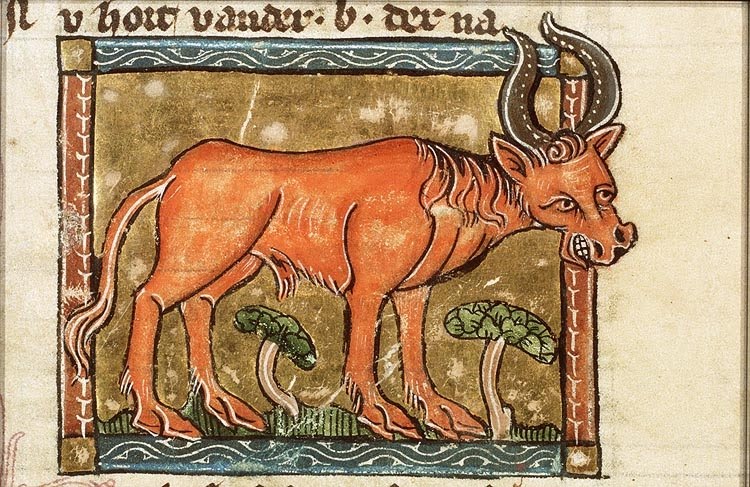
{Buffalo: so wild that they don’t even keep within manuscript borders. Image from the National Library of the Netherlands Medieval Illuminated Manuscript Collection.}

St. Isidore moves pretty quickly through the next three types of animals, so let’s get right to it.

Back To Top
Translation

[31] “Cow it is called, like cattle. In fact, it is a name from the quality of their movement, just as leonine comes from lion and draconic comes from dragon.

[32] Calves are so called from the Latin for greenness, that is the green age, just like a maiden. Thus the calf is small and does not have the power of generation: for only the bullock or cow has the power of generation.

[33] Buffalo they are called by derivation, which are like cattle; though they are wild so that they will not take the burden of a yoke upon their necks.”
(St. Isidore of Seville, Etymologiae 12:31-33)

Back To Top
Recordings

Latin:

Modern English:

Back To Top
Cattle-trot Strut

Cow and cattle – the relationship in English is as clear as the relationship in Latin, that is, between “vacca” (the “v” is pronounced like a “w”) and “boacca” (12:31).

What’s not clear though is just what is meant by “cattle” coming from “the quality of their movement,” (“Est enim ex qualitate mobilium nominum” (12:31)), it’s just plain bizarre.

Maybe English has a word for the same sort of movement already, or maybe there just wasn’t a need for a word for that kind of movement. What sort of movement marks a cow, anyway? Slow, steady, and sturdy? This is a relatively simple passage to translate, but the precise meaning of it is rather puzzling.

Back To Top
On Calves

Calves (“vitulus et vitula” (12:32)) being so named because of the Latin words’ relation to the Latin for “green” (“viriditate”) is much clearer.

Calves are young, prefer to frolic in the field, and, if pagan religious rites are any indication, iconic of the innocence associated with youth. Likewise, the propensity to sacrifice bullocks also makes sense since those are the male cattle that have just gained the power of generation, having gone through bovine puberty.

Paragraph 32 definitely deserves a medal of some sort for being so forthright and direct. But maybe it’s like that because there’s so little to say about the calf – cattle have already been likened to humans in that they seem to show compassion and so all that’s needed here is an analogy to a maiden, one without any sort of blemish or lack in its purity. In fact, the word translated into “maiden,” (“virgo” (12:32)), also could be translated as “virgin.”

Back To Top
A Buffalo Re-Buff?

Then, we have the buffalo.

Isidore must mean that they’re like cattle in appearance and maybe in the way that they move, but otherwise they’re not given much of a chance. In fact, the mere note that they’re too wild to be yoked suggests, through negation, that they’re nothing at all like cattle in their character.

After all, the yoke is very much symbolic of cattle in this period. The yoke could even be used as a metonymy for them with no real problem in understanding whatsoever. So the buffalo’s refusal of the yoke seems to be Isidore’s way of making clear that they look like cattle, but lordy, they ain’t no cattle.

Back To Top
Closing

Check back here on Thursday for Beowulf’s reaction to his sword that “bit less strongly” than necessary in last week’s entry (Beowulf l.2578).

Back To Top

Isidore of Seville on the Nobility of Cattle [12:30] (Latin)

Introduction
Translation
Recordings
A Word on “Plows”
Oh, Noble Cattle
Closing

{With a dewlap like that, this cow’s royalty. Image from FithFath.}

Back To Top
Introduction

Today’s is a short extract from the Etymology, and, with an ending that concentrates on the camaraderie between cattle, a sweet one.

Back To Top
Translation

[30] “The Greeks call cattle Boun. These the Latins call plows, those which turn the earth, as the plow. Naevius (trag. 62):

The plow is the governor of the countryside.

The width of whose hide from chin to legs is called a dewlap, from the skin itself, like dewlap hide; which in cattle signifies nobility. Cattle are exceptionally dutiful in groups; for one checks with another when they are usually lead together at the plow, and they will frequently make their affection clear by lowing if the other begins to fail.”

(St. Isidore of Seville, Etymologiae 12:30)

Back To Top
Recordings

Latin:

Modern English:

Back To Top
A Word on “Plows”

Maybe English just isn’t as poetic as Latin (it is the root of French, Spanish, and Portuguese after all), but anything called a “plow” just brings to mind a plow. The word doesn’t exactly stir ideas of some cherished thing or animal.

Nonetheless, “plow” is the best translation that could be found for the Latin “trionem” (the simple “trio” being nonsensical in this context).

The word “trionem” might not be the greatest term of endearment, but a rolling “r” has to stand for something. Or maybe the Latin farmers were all about using metonymy.

Back To Top
Oh, Noble Cattle

At any rate, the nobility attributed to cattle, working cattle in particular here, does suggest a certain fondness for the animal. What’s curious about this fondness though is that there’s no real mention of milk or the meat taken from these animals.

Maybe these extras are simply seen as a given part of cattle’s nobility (their magnanimity, if you will) since true nobility includes true generosity. Yet there’s no comparison of cattle to Christ, so maybe the milk and meat offered by cattle simply weren’t as highly prized as the labor they could undertake.

Besides, like the lambs that can recognize their parents, cattle that apparently encourage each other while at the plow are one step closer to being human. That may just be the highest praise a 7th century church man can offer. Being called the “governor of the countryside” (12:30) must count for something, too.

Back To Top
Closing

On Thursday check back here for a look at the first exchange of blows in Beowulf’s fight with the dragon.

Back To Top

Quietly Boar-ish about Bulls [12:27-29] (Latin)

Introduction
Translation
Recordings
Persistent Etymologizing
Bull on Bulls?
Closing

{One of today’s featured animals, looking very much like its hide will ‘refuse all weapons.’ Image from the National Library of the Netherlands Illuminated Manuscript Collection.}

Introduction

In this special weekend make-up edition of Tongues in Jars, St. Isidore talks boars and bulls:

Back To Top
Translation

“[27] The boar is named for its savagery, take away the letter F and replace it with a P. From whence and cloely the Greek Saugros, that is, wild, by which it’s called. Truly all, that are wild and irritable, we call wild marauders.
[28] A bullock it is called, which began as a help to men in cultivating the earth, or which the pagans always and everywhere sacrifice to Zeus/Jupiter, never a bull. For the age of the sacrifice is considered. Taurus is the name in Greek, as it is here.
[29] A dun colour indicates the bull, agility of a bird, its hair in opposing rows; the head they flexibly turn any way they wish; their back is quite hardy, refusing all weapons brought to bear against it.”
(St. Isidore of Seville, Etymology 12:27-29)

Back To Top
Recordings

Latin:

Modern English:

Back To Top
Persistent Etymologizing

Sticking true to his work’s name (Etymology, the origin of words), St. Isidore tries his darndest to relate the word “aper” (boar) to “feritate” (savagery) by replacing the “F” with a “P.” Words starting with the letter “f” could logically begin to start with “p” so maybe “aper” broke off from “feritate” at some point. Nonetheless, the connection isn’t quite as strong as some of Isidore’s other efforts.

Back To Top
Bull on Bulls?

What’s really curious in this passage is Isidore’s description of the bull. Its agility would definitely be impressive given its size and its weight, but the description of its hair and flexible neck is quite odd.

Do the opposing rows of hair suggest curliness? Is the flexible neck considered something to prize – a sort of flexibility in being commanded? These are both things that we’re left to wonder, as St. Isidore does not elaborate.

The toughness of leather (being a cow’s skin, even on its back, after all) is also mentioned here, though the fact (likely the exaggeration) that it “refus[es] all weapons brought to bear against it” (“omne telum respuunt inmiti feritate” (12:29)) suggests that bulls just aren’t made like they used to be. The drying process must make the cow hide too stiff, and thus unable to be flexible enough to turn weapons any which way it pleases.

Back To Top
Closing

Though he doesn’t do much of it here, St. Isidore does elaborate on cattle in this week’s regular Tuesday entry. And Beowulf strikes a blow against the dragon on Thursday, don’t miss it!

Back To Top

Beowulf & the Dragon: Little Appetite for Mutual Destruction [ll.2554-2565] (Old English)

Introduction
Translation
Recordings
Shorter Sentences
Beowulf Attacks the Dragon, or Fends it Off?
Closing

{Benjamin Bagby knows well the power of shorter sentences. Image from Benjamin Bagby’s Beowulf}

Back To Top
Introduction

Roused by Beowulf’s heavy metal scream at the end of last week’s passage, the dragon is angry this week. Yet neither of the two fighters are particularly pleased to be forced into battle:

Back To Top
Translation

“Hatred was aroused, the hoard guardian recognized
man speech; then there was no more time
to ask for friendship. First came the
breath of the fierce assailant from out of the stones,
a hot vapour of battle; the earth resounded.
The warrior below the barrow, the lord of the Geats
swung the rim of his shield against the dreadful stranger;
then was the coiled creature incited at heart
to seek battle. The good war-king
had already drawn his sword, the ancient heirloom,
sharp of edges; each was in horror from a mutual
intent upon destruction evident in the both of them.”
(Beowulf ll.2554-2565, Ch.XXXV)

Back To Top
Recordings

Old English:

Modern English:

Back To Top
Shorter Sentences

One constant in narratives from all ages is that action sequences are made up of shorter sentences. Although this passage doesn’t include any that are shorter than 19 words, the sentences here are, on average, quite a bit shorter than those in previous weeks. The shorter sentence length here makes it clear that the poet/scribe is moving into the thick of the action – things are happening now, and in real time.

In fact, it could even be argued that the shorter sentences here are the natural Old English mode of the reportage of action as it is happening. Whenever the poet describes things such as passages of time, or the interaction of characters, various details tend to be lingered upon, providing extra information that’s really ornamental rather than practical.

Back To Top
Beowulf Attacks the Dragon, or Fends it Off?

The action that’s currently taking place, however, takes on a different dimension when considered alongside the other major fights in the poem.

Unlike when Grendel comes to Beowulf or when Beowulf seeks out Grendel’s mother to continue their feud, Beowulf is pure interloper in regards to the dragon. In fact, had it not been for the thief that stole the cup, the dragon may never have left its barrow and may never have caused the Geats any distress.

So, in a sense, this is a new kind of fighting for Beowulf. Rather than being the avenging hero who is reacting to something that has happened to him or to his retainer, he is taking the initiative.

In his youth, Beowulf fought battles for others, now in his old age he fights them for himself. Perhaps this aspect of the fight is meant to reflect the simplicity in fighting for another, a person from whom you can sever yourself if it happens to be necessary to do so. On the other hand, fighting the battles made necessary to fight because of being a king are made out to be all the more difficult since you can no longer defer to some ring-lord or other but are ultimately answerable to yourself.

Perhaps Beowulf’s having a “sorrowful heart” (as noted in last week’s entry) is not just because of some direct feeling of his impending death, but the feeling that he has become the cause of the problem, and in order to defeat the problem, he also needs to destroy its cause: himself.

Back To Top
Closing

As will be seen in next week’s entry, that is indeed a valid reading of the fight.

Also on Saturday hear St. Isidore talk more of boar, and next Tuesday he’ll move onto bull and oxen.

Back To Top

All About Beowulf’s Final "Boast-Words" [ll.2510-2528] (Old English)

Translation
Recordings
Initial Thoughts
Why so Compounded?
Three Possibilities
Closing

{What Beowulf imagines his fight with the dragon will look like – war-fire, breath, venom, shield, and all. Image from eKits.}

Back To Top
Translation

This week’s section of Beowulf sees him boast for the last time, before turning and addressing his thanes. Let’s listen in:

“Beowulf spoke, gave form to boast-words
for the final time: ‘In youth I
risked much in combat; yet I will once more
though an old king of the people, pursue the feud,
gain glory, if only the fiend to men
will come out from his earth-hall to face me!’
Addressed he then each warrior,
each helm-wearer for truly the final time,
each dear companion: ‘I would not bear a sword,
bring the weapon to the worm, if I knew how
I might otherwise gloriously grapple against
that foe, as I once with Grendel did;
but there will be hot war-fires, I expect,
breath and venom; thus I have on
both shield and byrnie. Nor will I give a foot’s length
when I meet the barrow’s guard, but between us two
what is to happen later on this sea wall, that is as fate,
measurer of men, is drawn to decide. I am firm of heart,
so that I may cease from boasting over this war-flyer.'”
(Beowulf ll.2510-2528)

Back To Top
Recordings
Now, to give you a sense of how that would sound:

And in Modern English:

Back To Top
Initial Thoughts

This passage, for all of its high boast density, is quite straightforward. Beowulf says that he will fight the dragon as long as he comes out of the barrow, and then turns to his men to tell them why he’s carrying a shield and wearing armor. Then, he closes it all off by saying that he is “firm of heart,/so that I may desist from boasting over this war-flyer” (“Ic eom on mōde from/þæt ic wið þone guð-flogan gylp ofersitte” ll.2527-8)

That’s it.

There’s definitely something to say for its directness. This quality might even be the result of Beowulf’s melancholic belief that this will be his last fight, and the poet’s own admission of the same. But, as always, there is one curious thing to poke at – like a sleeping dragon coiled around a heap of gold.

Back To Top
Why so Compounded?

This passage uses a fair number of compound nouns: “Bēot-wordum” for “boast-words;” “mān-sceaða,” for “fiend to men;” “eorð-sele” for “earth-hall;” “helm-berende;” for “helm-wearers;” “heaðu-fyres,” for “war-fires;” “guð-floga” for “war-flyer.”

All of these compound words share two characteristics. They’re all related to war, and they’re all direct , straightforward terms. Though it might be contentious, none of them are the fancier type of compound words known as kennings (like “līchama” for “body” (literally “body-raiment”) or “heofon-candel” for “sun” (literally “sky-candle”).

Maybe Beowulf isn’t in the mood for speeches wrought with fine words like cups studded with jewels. Maybe the poet is trying to just skate on through this section being straight to the point and direct. Or maybe, there’s something more going on here – something at the level of connotation and association.

Maybe direct, clear compound words, are those that are related to war specifically. Granted, you might be able to come up with more elaborate compounds that are used to describe battles and what not, but at least here, it’s curious that they’re so streamlined. If this is indicative of something about the poem that’s one thing. But what if it’s pointing to something present in all of Anglo-Saxon poetry, maybe even the culture itself?

Back To Top
Three Possibilities

If we run with the idea that this compounding cluster relates to Anglo-Saxon culture, then the compound words/phrases relating to war being straightforward and direct could mean a number of things. It could be meant to reflect the manly nature of war, men being more direct and active. Though this is a little bit anachronistic, since Anglo-Saxon women could rise to the same level of martial power as men.

Alternatively, this straightforwardness of war-related compounds could mean that war itself was something that the Anglo-Saxons regarded as straightforward. Or, maybe they saw it as something that need not be embellished when its reality is about to be brought home.

For all of Beowulf’s boasting up to this point has been about the past, only now does he actually boast about what he is going to do next. Maybe the rough drafts of boasts, boasts for deeds undone, are underplayed so that they can be elevated to ecstatically glorious places after the deeds they describe are done.

Or, again, maybe this straightforward language on the part of Beowulf (and the poet) is meant to be taken as a deference to fate.

Everything is cold and windy on the promontory. Beowulf is about to face the dragon, and talking to his men before the worm comes from its underground lair. Things are tense. Things are heavy. Beowulf knows that he’s an old man, “an old king of the people” (“frōd folces weard” l.2513). He knows that the dragon’s breath and venom are to be feared, to be protected against. So maybe his direct boasting, and its firm, resolute ending, are meant to show his humility before fate. After all, for our two combatants, it will be as fate decides, “swā…wyrd getēoð” (l. 2526).

Back To Top
Closing

What do you make of this crowd of compound words, these straightforward and unassuming combinations? Let me know down in the comments.

Next week, be ready for more of St. Isidore’s writing on deer, and Beowulf gives his final commands to the men before heading off to draw the dragon from its den.

Back To Top

The Final Notes of "Tempus Adest Floridum" (Latin)

Introduction
The Whole Song
A Time for Recitation
Now it is the Animal Hour
Closing

Introduction

Now that I’ve translated the entire song “Tempus Adest Floridum”, I’ve brought it all together. I also made some improvements to the last two verses to get them to better fit the song’s meter, and I think that it came out rather nicely. Here’s how I’m going to pledge my complete translation to the ages:

Back To Top
The Whole Song

“The time for flowers now is come, for the flowers now &nbsp&nbsparise.
All things now are of the spring, nature’s likeness is in &nbsp&nbspall eyes.
This which winter once had attacked, has regained its &nbsp&nbspfire;
We all see winter’s weeping, since spring has perspired.

“The meadows are full of flowers now, as they start &nbsp&nbspappearing.
These are brought where all may see, plants their pleasure &nbsp&nbspbringing,
Grasses, shoots both rising through, making winter turn &nbsp&nbspin.
Spring growing stronger in due time, bringing renewed bird &nbsp&nbspdin.

“This lovely creation shows your fullness, oh God,
to whom we entrust all deeds whether they be bare or shod.
O time therefore of great joy, pleasing all by laughter,
Now we pray you renew the world fill our souls to the &nbsp&nbsprafters.

“The earth is filled by flowers now, and with much beauty,
Death and love we now do dignify absolutely.
Thus we now in this season most pleasing rejoice,
With praise and laud of the lord with our heart’s voice.”

Back To Top
A Time for Recitation

And here’s a version that I wouldn’t mind the ages getting a hold of, but really have no strong feelings either way:

And with that, “Tempus Adest Floridum” is complete.

Back To Top
Now it is the Animal Hour

Now, it’s my intention to work on mostly medieval Latin on this blog and with that in mind I’ve decided to move on to an entry from Isidore of Seville‘s Etymologiae.

The Etymologiae is the medieval world’s Wikipedia, essentially, an encyclopedia covering all fathomable topics.

Of course, Isidore didn’t write it, but he did compile it – much like how the first edition of the Oxford English Dictionary wasn’t written by a single person or even a small group, but was an effort of an entire mass sending in slips of paper with words and meanings and uses.

Because medieval bestiaries are often great fun, I’ll be translating a passage about an animal. Which animal, however, I’ll leave a mystery until next week.

Back To Top
Closing

If you want to compliment my reciting voice, perhaps make a special request, or just drop a line, feel free to do so in the comments.

Back To Top