Grendel as the Goddess’ champion, three neat words (ll.791-801a)

Abstract
Translation
Recordings
Grendel as twisted champion
Three neat words
Closing

Beowulf, Grendel, Old English, Anglo-Saxon

An illustration of Grendel by J.R. Skelton from Stories of Beowulf. Grendel is described as “Very terrible to look upon.”Stories of beowulf grendel” by J. R. Skelton – Marshall, Henrietta Elizabeth (1908) Stories of Beowulf, T.C. & E.C. Jack. Licensed under Public Domain via Wikimedia Commons.

Back To Top
Abstract

Beowulf is aided by his troop of Geats, who move valiantly to defend him.

Back To Top
Translation

“For nothing at all would that man
allow the death-bringer to leave alive,
he did not consider that one’s life days of
any worth to anyone anywhere. Then the mobile host
moved swiftly to defend Beowulf with fathers’ swords,
they wished to defend the very soul of their leader,
those of the famed people, where they might do so.
But they knew not that their work was in vain,
the tough-spirited war men,
that each man’s looking to hew the beast in half was faulty,
their seeking his soul with the sword point unsuccessful:…”
(Beowulf ll.791-801a)

Back To Top
Recordings

Old English:

{Forthcoming}

Modern English:

{Forthcoming}

Back To Top
Grendel as twisted champion

This week’s passage is one half of a complete scene. As such, it ends on a bit of a cliffhanger. Just why is it that Beowulf’s men’s swords are being used in vain? All will be revealed next week.

For now, however, I think we have enough to spin some theories around. Once again, I’ll be basing my ramblings here on Robert Graves’ The White Goddess. I’m breaking this book out again because it’s what gives the most interesting reading of this passage. Though the most interesting reading isn’t always the most supported one. I’ve got to say up front that my idea here might not stand up outside of Beowulf and in our collection of known Anglo-Saxon literature.

However, in the world that the poem creates and within the poem itself, I think it’s a valid way of looking at things.

Grendel’s being immune to swords I read not necessarily as a side effect of his being some sort of monster. Instead I see it as an effect of his being a twisted version of the goddess’ champion. I base this in the interpretation of the first part of Beowulf as a play on what Graves points out as the trifecta of goddess, god of the waning year and god of the waxing year. Grendel’s mother is the goddess in this case, though she is, perhaps a twisted and gnarled one who lacks the power she had of old since Beowulf is a predominantly masculine poem and, at least for the purposes of this reading, an artifact of a patriarchal society.

As such, a woman who may have headed her own power structure and not just occupied a high place in one defined by men (as Wealhtheow does) would be be depicted as some sort of monstrosity. As Grendel’s mother is just a little later in the poem.

If Grendel is the champion of this goddess, then he could be either the god of the waxing or waning year. However, in keeping with the idea from an earlier entry that Grendel is actually the god of the waxing year whom Hrothgar hasn’t acknowledged for a full cycle of twelve years, he has begun to wane. And now Beowulf acts the part of the king of the waxing year. This changing of roles allows Beowulf to defeat Grendel because of his position.

I also think that Beowulf beats Grendel because he challenges the otherwise slightly feminized creature with sheer masculinity. The two of them engage in a wrestling match, which from classical times was a thoroughly masculine sport, and Beowulf is said to have the strength of thirty men. And strength has always been considered one of the primary virtues of masculinity.

Of course, that means that Grendel must be feminine, at least in some ways. I don’t think these ways are obvious, however.

Looking at the poem as a whole, three things are expected of great men. They must think right thoughts, do right deeds, and speak the right words. Since Grendel does none of these he is obviously no true man.

It might be a bit of a stretch (what’s this blog for otherwise, though?) but I think that Grendel’s is aggressively feminine in his devouring of his victims. Say what you will about men’s thoughts of women’s genitalia, but I think a yonic reading of Grendel’s devouring his victims is definitely valid.

With all this in mind, as much of a cliffhanger as this passage is, I also think that it’s a commentary on the old matriarchal system of government.

Not only is the goddess that society used to worship decrepit (I am getting a little ahead of myself there still), her champion shows no proper masculine virtue and is himself feminized. My point here is that the entire matriarchal system of a cyclical kingship that Graves outlines in The White Goddess is too feminine and not as stable as the more long lasting male kingship that was coming about during the lifetime of the scribes (if not the poet(s)) of Beowulf.

But back to my jumping off point. In my reading of this week’s passage, swords don’t work against Grendel because he’s not subject to the usual ways of masculine warfare, hence Beowulf can only defeat him in hand to hand, unarmed combat.

Do you think it’s useful to use one book as a lens through which to view another book? Or should you just stick with figuring out one book at a time?

Back To Top
Three neat words

This week’s passage offers up some neat words.

First among these (in their order here, and in general interesting-ness) is “cwealm-cuman.”

A combination of the word “cwealm” (“death,” “murder,” “slaughter,” “torment,” “pain,” “plague,” or “pestilence”) and “cuman” (“come,” “approach,” “get to,” or “attain”), together these words are taken to mean “death-bringer.” As you might’ve noticed, there aren’t any really crazy combinations for “cwealm-cuman”, but it’s neat because of how it’s used in the poem.

Alliteration aside, the poet’s referring to Grendel as a “death-bringer” as he struggles to escape Beowulf’s hold and the overwhelming power that the Geat wields strikes me as a clever way to talk about Grendel the death-bringer getting adose of his own fatal medicine. It seems to me that he’s saying that Beowulf wanted Grendel to leave Heorot with a taste of the same death that he had visited upon it countless times before.

Next up is “frea-drihtnes,” a combination of “frea” (“ruler,” “lord,” “king,” “master,” “the Lord,” “Christ,” “God,” or “husband”) and “drihten” (“ruler,” “king,” “lord,” “prince,” “the Lord,” “God,” or “Christ”).

What’s neat here is that this is another instance of intensification through doubling, as we’ve seen in an earlier entry. Perhaps the sentiment contained in this compound word might also have become the phrase “lord and king,” too. They are both poetic terms, after all.

And that brings us to “heard-hicgend.”

I want to say that this compound is cool because it’s intuitive, but only “heard” is probably recognizable to Modern English speakers. It is, unsurprisingly, Old English for “hard.” The word “hicgend” translates as “mind” or “spirit”.

So, literally, “heard-hicgend” is a “hard spirit” or “hard mind,” a way of expressing the idea of courage. After all, what’s courage if not a certain kind of hardness (or immovability or unwaveringness) of spirit or mind? As odd a way to express courage as saying “hard spirit” might be, it still makes sense on a kind of basic level.

Do you ever find yourself doubling negatives or adjectives to intensify what you’re saying?

Back To Top
Closing

Next week, all is revealed about the enchantment that Grendel has on himself, and why Beowulf’s fellow Geats are of no help to him in this fight.

You can find the next part of Beowulf here.

Back To Top

Beowulf in a state of undress, compounds-Compounds-Compounds! (ll.662-674)

Abstract
Translation
Recordings
Beowulf prepares himself
On “warmakers,” “bedmates,” “kings of praise,” and more
Closing

A page from an illuminated manuscript. Words are important. Image from http://www.myarmoury.com/talk/viewtopic.php?t=28126&view=next.

A page from an illuminated manuscript. Words are important. Image from http://www.myarmoury.com/talk/viewtopic.php?t=28126&view=next.

Back To Top
Abstract

Hrothgar and his retinue depart the hall, and Beowulf prepares himself for the coming brawl.

Back To Top
Translation

“Then from him Hrothgar went among his warrior band,
the prince of the Scyldings out from the hall;
the war chief would seek out Wealhtheow,
the queen consort. The king of heaven had
against Grendel, as people later learned by inquiry,
set a hall guard; one with a special office to fulfil
for the lord of the Danes, a steadfast guard against monsters.
Indeed that Geatish man eagerly trusted
the courage of his strength, the Measurer’s protection.
Then he did off with his iron corselet,
took the helm from his head, entrusted his ornamented sword,
servant of the best iron,
and he commanded them to keep his war gear.”
(Beowulf ll.662-674)

Back To Top
Recordings

Old English:

{Forthcoming}

Modern English:

{Forthcoming}

Back To Top
Beowulf prepares himself

In this week’s passage of Beowulf the main focus is on the man himself.

Hrothgar leaves with his retainers and the hall is, as far as is implied anyway, vacated by all except for the Geats. Interestingly, the language sort of signals this departure of the Danes in an interesting way. The word here used for Hrothgar as prince of the Danes is “eodur”, a word that means “boundary/limit/enclosure” along with “prince” or “lord.”

Such a combination of meanings in one word may seem strange but makes a sort of clear sense – to rule one must be the protector of his or her people, and what better way to represent that protection than a fence or a hedge growing round about them?

The association with greenery that comes in with the related meaning “hedge” may also say something about the Anglo-Saxons’ Germanic roots, but what exactly I cannot say. There’s still much more for me to learn about this period.

As per Beowulf himself, we see him her un-equipping all of his gear. He removes his equipment piece by piece and hands off his sword to his fellow Geats, who, at least literally, are nowhere to be seen. As a means of putting the spotlight squarely on Beowulf, the poet makes no mention of any of the other Geats here, instead only using an implied pronoun packed into the verb “het” (meaning “commanded,” but only in the third person singular) to refer to someone to whom Beowulf is handing off his sword.

It’s weird that it’s in the singular rather than the plural, but I suppose Beowulf has a squire of sorts with him. Maybe it’s the later named (on line 2076) Handscio?

Grammatical ticks aside, I don’t think it’s too weird that the poet would cut out the other Geats here. This is, after all, Beowulf’s time to shine. It’s just very odd that he travel with so many other men and not really use their skill at all. If Beowulf is so over-powered, then why bother with any other party members?

Honestly, the only thing I can think of is to make a parallel between this story and that of Christ and his apostles. Such an analogy certainly wouldn’t have been lost on medieval (or Early medieval) audiences, and this sort of monstrous take on a demi-god come to redeem mankind from sin (Beowulf as Christ, Grendel as sin (being the kin of Cain, the first murderer)) could well be a major reason why our copy of Beowulf was found bundled with stories about monsters in the Nowell Codex.

But moving on from the matter of the vanishing convenient Geats, Beowulf’s un-equipping himself seems to serve more purpose than just getting him to do some great deed. The word “truwode” is used in describing his mental state.

This is a curious word to use in such a context because along with the somewhat visible Modern English meaning of “trust” the word also means “persuade.” I see two ways to take its having this mixture of meanings.

One is somewhat positive: the Anglo Saxons regarded trust as something that needed to be earned, and that could be built up, but that was not, in any way, automatic.

The other way to interpret it is less so: Anglo-Saxons were far more cynical than we might realize and their perception of trust is that it was nothing more than a pretense. A pretense with real results, but a pretense nonetheless.

Since the reference to Beowulf’s trusting in his strength is paired with a mention of his faith in god’s protection (l.670), I feel like the first interpretation is probably more likely true.

It’s curious, too, though. If Paul’s mention of spiritual armour (Ephesians 6:11) was only known to people writing poetry in English after a certain time, then maybe that could help date Beowulf. Or, maybe some preacher to the Anglo-Saxons (maybe even one from the Irish Celts) mentioned the concept of faith as armour in passing and it just stuck in someone’s head, bounced around, and found its way into their big ol’ poem.

Finally, I just want to mention one weird thing about Beowulf’s sword. Actually, this ties back to the idea of a ruler being an enclosure for his or her people.

On line 673, Beowulf’s sword is literally described as “best of iron servant” (“irena cyst ombihtþegne”). I think that this means it is served by the best of iron, that its concept as a sword is brought to greatest realization through its expression in its excellent iron. But why not just express this greatness of the sword with a reference to sharpness or the sword’s origin? What should it matter that Beowulf’s sword is served by the best of iron?

What’re your thoughts on all of these points? Are the other Geats just forgotten by the poet because this poem is called Beowulf and not Beowulf and the Geats? Is Hrothgar an “enclosure” of his people as much as he’s their “prince”?

Back To Top
On “war makers,” “kings of praise,” “hall-wards” and more

Since this week’s passage has quite a bit going on in it, it’s also got its fair share of curious words. All of those that I’ve picked out for this section are compounds. Let’s see if I can get through them all in my fifteen minute writing time.

So first up is wigfruma, a combination of the word for “war” or “strife” (“wig”) and the word for things like “beginning/creation/originator” and “prince/chief/ruler” (“fruma”). Since “fruma” carries senses of both being the first and being the topmost, I think this appellation fits Hrothgar rather snugly.

No doubt Hrothgar started the odd war in his time and he’s described as having the fortunes of war favouring him (l.64). Actually, “wigfruma” suggests that the Danes are a put upon people, a people who have endured much strife and tribulation.

In fact, I wonder just how common it was for a people to enter into a pact with another through a peaceweaver, a woman sent over as a sort of arranged marriage to secure peace. Was this something of a last resort or was it something that happened frequently enough to not really be talked about or mentioned in literature?

Though, saying that Hrothgar is a war starter (one interpretation of “wigfruma”), I can’t help but wonder if he had started a strife with the Celts or Welsh, or wherever Wealhtheow hails from, and at the time that group perceived the Danes to be their greater, a people who could crush them, so they sent her to stop things from moving to total war.

Next up is “cyningwuldor,” a word that combines the word for “king” (“cyning”) with the word for “glory/praise/heaven” (“wuldor”). There’s not much to say here. No matter how you interpret this word it’s meaning is pretty clear: god.

Though it’s a strange way to think of a deity as the “king of praise” or the “king of thanks.” I mean, is that a title given because this particular deity is given the greatest amount of thanks and praise? Could this be referring necessarily to an early conception of the Christian god as taught by missionaries, or instead to the sort of all-god that Graves writes about in The White Goddess?

The word “seleweard” is similarly simple. But, of course, it hides a certain twist when you dig down. The word combines “sele” (hall) with “weard” (“ward/advance post/waiting for/guardian/king;possessor”).

Beowulf’s being a “hall ward” or “hall lord” or “hall protector” is clear enough: Hrothgar gave him possession of the hall for the night and he’s been keen on guarding it himself since he heard of the Danes’ plight. But, the other combination of “hall” and “lurking, or “waiting for” works just as well in this instance. Beowulf is indeed waiting in ambush for Grendel since the kin of Cain has no idea whatever that this mad Geat is there to meet him this night.

Moving right along, the word “sundornytt” doesn’t seem to have much going for it. It refers to a special office or duty, but, weakly, could also mean “varied office.” Yeah, I don’t think there’s much here.

The last compound word of note in this week’s passage is “eotonweard.” It brings together the word for “giant,” “monster,” “demon” (“eoton”) and “guard,” “ward,” etc. (“weard”).

Now. In its original printing my Clark Hall and Meritt dictionary defined this word in the most tantalizing of ways: “watch against monsters?[sic]” It also lists this instance in Beowulf as the only appearance of the word in Old English.

Unfortunately (fortunately?) in the supplement that’s part of my edition “eotonweard” makes another appearance.

There it’s defined as “watch against the monster.” It’s a small difference (basically changing “monsters” to “monster,” made, perhaps, because there is just one Grendel, after all), but I still like to read this word as an echo of Hrothgar’s joking with Beowulf about not knocking the place down in the process of beating Grendel; I think it’s another hint at Beowulf’s own monstrousness. Actually, perhaps part of god’s help (whether it’s what Beowulf explicitly calls down or not) is helping him to keep his strength in check so that he doesn’t destroy the hall along with Grendel.

Since this section is often about compound words, what do you think of my being so hung up on them? Are they just words that happen to be combinations of others, is there a fixed meaning to these combinations, or do you think that they’re a fluid mix of their parts?

Back To Top
Closing

Next week we get Beowulf’s pre-bedtime speech explaining why he’s un-equipped himself.

You can find the next part of Beowulf here.

Back To Top

Hrothgar maybe jokes, and compound words abound (ll.652-661)

Abstract
Translation
Recordings
Hrothgar’s Joke?
Compound words and a single seed
Closing

Interlaced men motif. Image from http://public.wsu.edu/~hanly/oe/503.html.

Interlaced men motif. Image from http://public.wsu.edu/~hanly/oe/503.html.

Back To Top
Abstract

Hrothgar hands authority over the hall to Beowulf and promises him great riches if he survives the night.

Back To Top
Translation

“Greeted the men each other then,
Hrothgar Beowulf, and to him wished health,
gave rule of the drinking hall, and these words said:
‘Never before have I to any man yielded up,
since I could raise my own hand my own shield,
the noble house of the Danes but to thee now.
Have now and hold this best of houses:
Have remembrance of fame, mighty valour’s seed,
be wakeful against the wrathful one! Thy desire shall not
lack if you this brave deed survive with your life'”
(Beowulf ll.652-661)

Back To Top
Recordings

Old English:

{Forthcoming}

Modern English:

{Forthcoming}

Back To Top
Hrothgar’s Joke?

The main focus of this week’s passage is Hrothgar’s handing the hall over to Beowulf for the night. This is a pretty big deal. And not just because Hrothgar says that it’s unprecedented (lines 655-657).

The lord of Heorot’s handing the hall over to Beowulf for the night suggests that he, Hrothgar, has full and utter trust in Beowulf to be successful. Beowulf isn’t just a glorified night watchman; he’s been made the ward of the hall. It is his to use as he sees fit. But what does such ownership confer?

Well, no doubt there are some things in Anglo-Saxon law that could shed some interesting tints of light on the matter, but I don’t have those to hand, nor do I have the time to chase them down just now. However, in and of itself, I think the trust that Hrothgar is putting into Beowulf is significant enough.

Hrothgar knew Beowulf’s father, so there’s a connection between them. Nonetheless, Hrothgar has only just met Beowulf, really. So his handing over his hall — the hall that he built when the Danes were powerful and prosperous — into the power of one whom he’s really only just met shows a great deal of trust.

But, of course, I think that there’s something more here, too.

After Hrothgar hands the metaphysical/figurative keys to Heorot over to Beowulf he adds something to his wishes of luck and success. He tells Beowulf to “be wakeful against the wrathful one!” (“waca wið wraþum” (l.660)).

On one level the “wrathful one” is clearly Grendel. Again, his wrath goes unexplained, but as hearers of the poem, wrath alone is really the only motivation that the marsh monster is given for the repeated raids against Heorot. Simple wrath.

But, given all of the previous points at which I found readings of the poem that take references like these and point them to Beowulf, I think it’s possible that Hrothgar is throwing a bit of a jibe the Geat’s way.

I think that Hrothgar, having never before given control of his grand hall over to someone else, is trying to coolly warn Beowulf to not get too carried away. I think he’s saying “hey, be careful and try not to bring the place down tonight, okay?” or more philosophically, “when you confront the monster don’t become monstrous yourself, all right?”

After all, Beowulf’s stories of overcoming terrible beasts have involved him becoming just as savage to overcome them.

In this passage I think reading Hrothgar’s wish of luck as a lighthearted warning against his own strength and temper gives a little more credit to Hrothgar, a character who is often depicted as being in the very dredges of despair.

That Hrothgar could crack a joke at a time like this, even one that would probably be accompanied by a slight glint of the eye and a weak half-smile, suggests that he’s got some resilience left in him. Hrothgar’s still able to rule, it’s just difficult for him to ask for help and to acknowledge that he needs it.

Though that only further supports reading this line as a crack at Beowulf as well as a warning to be vigilant against Grendel. Comedy is often a disarming way for people to assert themselves and why not give the otherwise utterly melancholic Hrothgar a bit of a joke line as he makes his way out?

Besides, later on, we’ll hear Beowulf throw a jibe right back at him.

In the meantime, I think it’s also interesting that Hrothgar feels the need to tell Beowulf he’ll be rewarded handsomely for his efforts. It’s possible that along with being just a simple incentive, mentioning the reward is also Hrothgar’s way of reminding Beowulf what’s in it for him if he doesn’t destroy the hall in the process of defeating Grendel. His stories of might and courage have painted him as being rather reckless after all.

What do you think about this situation? Is Hrothgar joking with Beowulf? Or is he just wishing Beowulf rote luck?

Back To Top
Compound words and a single seed

There were a lot of words of note in this week’s passage. Some more so than others because of their placement in the poem, and some because they’re just curious words. Well, because they’re compound words.

Actually, there were two sets of compounds in Hrothgar’s speech. The first is “winærn” and “ðryþærn.” The common element between these two words (“ærn”) means “dwelling,” “house,” “building,” “store,” or “closet.” The first of the pair’s modifier is “win” which means simply “wine,” while the second’s, “ðryð” has a broader variety of meanings: “might,” “power,” “force,” “strength,” “majesty,” “glory,” “splendour;” “multitude,” “troop,” or “host.”

The first of the pair isn’t really all that interesting. It pretty much just means wine-house. I could also mean “wine-closet,” but that’s basically just a shade of the meaning of “wine-house” (that is, a house for wine) spelled out rather than left up to implication and context.

The word “ðryþærn” is slightly more interesting because of the variety of meanings for “ðryð.” Though if you look at the list of them, they all, again, kind of make sense translated as simply “great house” or “powerful house.” After all, a great house is what you’d need for a multitude of people, just as it’s what you’d need to express strength or power.

I do think it’s kind of neat how it’s the narrator who refers to Heorot as a “winærn” and Hrothgar who refers to it as a “ðryþærn.” Alliteration is definitely at work in this, but still, there’s no real reason the poet couldn’t have composed this part so that he was left with “ðryþærn” and Hrothgar with “winærn.” Their order definitely suggests a kind of up-scaling of the house in he eyes of its owners. Though, really, even were it not for Grendel, Heorot would just be a drinking hall.

Similarly the words “ellenweorc” and “mægenweorc” star in this week’s passage. They mean “deed of courage” and “deed of might” respectively. But what’s so interesting about them is that they’re both spoken by Hrothgar. Either he’s feeling the pinch of alliteration, going for emphasis, or feeling a bit sleepy.

Maybe it’s a mix of all three. It’s definitely possible that along with his gentle jibe at Beowulf’s possibly losing control Hrothgar is trying to keep Beowulf in check with the promise of glorious deeds — something that he’s clearly after since his swimming contest story was so elaborate.

I’m not so sure, though, that there’s any special significance to the order in which these two compounds appear.

They’re both part of their respective lines’ alliterating pairs, so the poet/scribe likely just wanted to express the same idea with a bit of alliterative flexibility. In this case are deeds of might really that different from deeds of courage?

The last word that I found particularly interesting in this week’s passage is “cyð” from “mægenellen cyð” on line 659.

One interpretation of this word makes it “seed,” “germ,” “shoot,” “mote.” This makes for some neat natural imagery. Hrothgar’s comparing this great undertaking to a seed of glory puts me in mind of mythological, sacred trees — even Yggdrasil, the world tree.

But there’s also a second way to read “cyð.” It could be an altered spelling of “cyðð” meaning “kith,” “kinsfolk,” “fellow-countrymen,” “neighbours” or “acquaintance,” “friendship;” “knowledge,” or “familiarity.”

Similar to the above interpretation of “cyð,” this puts some figurative language into Hrothgar’s mouth. Though this time the imagery is more familial, more interpersonal.

This deed Beowulf is about to undertake is a close friend to glory; it’s glory’s next of kin.

I feel like this might actually be the better interpretation between the two. Why? Because it has more to do with kinship and interpersonal ties.

Hrothgar can offer all the treasures he likes, but I think that this sense of kinship is the true reward from Beowulf’s quest.

Reading the word in this way makes the store of treasure that’s waiting for Beowulf all the more meaningful, too, since all of that gold will come along with a strong bond, and that is practically invaluable in a world in which groups need to rely on other groups, either for goods, protection, or mutual peace.

Beowulf can win all the gold in Daneland, but what will really win him glory in Geatland is forging a strong alliance with the Danish tribe.

Which of the two interpretations of “cyð” do you think is better? As “seed” or as “kin”?

Back To Top
Closing

Next week, Hrothgar gets into bed, Beowulf prepares for Grendel, and the poet drops spoilers.

You can find the next part of Beowulf here.

Back To Top

Meanderings on Hrothgar and closely watching words (ll.642-651)

Abstract
Translation
Recordings
Meandering through analysis: Hrothgar’s departure
Delving deeply into three words
Closing

Interlaced men motif. Image from http://public.wsu.edu/~hanly/oe/503.html.

Interlaced men motif. Image from http://public.wsu.edu/~hanly/oe/503.html.

Back To Top
Abstract

It’s party time in Heorot until Hrothgar, noticing the imminent falling of darkness, decides it’s time to call it a night.

Back To Top
Translation

“Then it was again as it had been in the hall,
brave words spoken, people milled about beneath its roof,
the sounds of a victorious people, until in a short time
the son of Healfdane’s will turned to seeking his
evening rest. Knew he that the wretch
against that high hall planned attack,
after the sun’s light might be seen,
when grown dark was the night over all,
draped in shade mail the shape would come stalking
under the waning heavens. All the throng arose.”
(Beowulf ll.642-651)

Back To Top
Recordings

Old English:

{Forthcoming}

Modern English:

{Forthcoming}

Back To Top
Meandering through analysis: Hrothgar’s departure

As had been the case the last time we were treated to quite a bit of expositional poetry from the poet/scribe himself, this week’s passage is rich primarily in words. And in one significant detail on which he dwells.

Near the end of this weeks’ passage we’re treated to three and a half lines about the transition from day to night and the shifting from light to darkness. I think it goes without saying that there’s something of importance here. Or at least there could be.

This transition to night begins around the middle of the passage, at which point Hrothgar begins to consider leaving the hall and heading to his evening rest. This is no doubt a reference to the first period of sleep in the usual way people slept before artificial light; he’s heading off to the first shift of sleep from sunset to about midnight. (At that point, people woke up and wrote, composed, met, talked, had sex, etc. before heading back to bed around 2 or so and then rising with the sun.)

Why is this sort of sleep pattern the pre-industrial usual? I can’t rightly say. What significance does it have here? Well, maybe not much, but it’s a fun tidbit to trot out every now and then.

As per stuff actually relevant to what’s going on in the passage, Hrothgar uses a curious word to describe what Grendel’s been doing: “geþinged.” This word comes up on line 647 and means “plan,” broadly. But specifically within the Clark Hall and Meritt dictionary I’m using, it translates as “to beg, pray, ask, intercede, covenant, conciliate, compound with, settle, prescribe; reconcile oneself with; determine, purpose, design, arrange, talk, harangue.”

Some of those words suggest “plan,” some don’t. But just about all of them suggest collaboration rather than singular action. I can’t help but get the impression that, aside from alliterative purposes (geþinged alliterates with þæm from earlier in the line), the poet put this word here to suggest one of two things about Hrothgar’s perception of Grendel.

It could suggest that Hrothgar regards Grendel as a shrewd and potent planner. He sees Grendel as a being that lays out careful plans and then follows through, as if working by committee or with the force of will of several beings.

Or, it suggests that Hrothgar is aware of Grendel’s collaboration with some other being. This doesn’t necessarily need to be Grendel’s mother. It could just as easily be a sense of some sort of spiritual communication amongst the other kin of Cain. Maybe those shunned by god just like to co-ordinate things really well.

Looking further at Hrothgar’s departure from the hall, I wonder why he leaves at all. Is it that he’s running away? Clearing the way for this Geat who’s so eager to gain glory?

Perhaps there was some kind of tradition that involved everyone belonging to a troop or band or peoples would just walk out once their leader did the same. If that’s the case, then Hrothgar could be trying to protect the Danes in this way. Though whether that’s from Grendel or from the menace of Beowulf and his seductive confidence, who can say?

Back To Top
Delving deeply into three words

This week’s passage bucks the pattern that the last few have kept: it’s actually got some compound words!

There is, however, one that I noted in the entry “Beowulf gets into puns and two regular words aren’t so regular (ll.590-597).” Well, the first half of it, anyway. This is “sige-folc.” I don’t really have anything new to say about it, except that in this context it is likely meant sincerely.

After all, it isn’t necessarily calling the Danes a “victorious people,” just comparing the noise that they rose to the sort of noise that a victorious people would raise. The obvious connection is that the poet is saying that they’re celebrating before their problem has been solved.

Though, at this point, I get the impression that the original audience probably already figured out that Beowulf was going to win. But maybe there’s more dramatic tension here than I realize. I mean, we haven’t really seen much of Grendel in action. We’ve heard the aftermath of his attacks described, but we’ve never really seen him in action.

The opposite is also true. We’ve never seen Beowulf do anything. He’s boasted plenty, but done little aside from wearing his armour with a lordly air.

So what’s the conclusion here?

I don’t think the poet is trying for much beyond the surface reading of sige-folc. There’s a subtle reminder that the Danes are pre-empting their victory with a celebration here. Maybe there was an Anglo-Saxon sense of karma or cosmic irony and so this reminder could work as foreshadowing for Grendel’s mother’s attack after Beowulf has defeated Grendel. Though, I really can’t say what the poem’s earliest audiences thought and anticipated.

The other two compounds are unique (so far) to this passage. The first is from line 643: “þryðword.”

This word is a combination of “þryð” (meaning “might,” “power,” “force,” “strength,” “majesty,” “glory,” “splendour;” “multitude,” “troop,” or “host”) and “word” (meaning “word,” “speech,” “sentence,” “statement;” “command,” “order,” “subject of talk;” “story,” “news,” “report;” “fame;” “promise,” or “verb.”)

“Word” can also refer to “rod,” “(possibly) gooseberry bush” or “the word incarnate.” Why that last trio of meanings includes “rod” and possibly “gooseberry bush,” I can’t really say.

Unless, it’s a reference to words relating to Ogham alphabets. But so far in my reading, Graves hasn’t said anything about gooseberry bushes. He has put forth the idea that the burning bush was some loranthus (a kind of mistletoe) growing on a wild acacia, but other than designating this wood to Sunday and equating it with the Celtic broom, he hasn’t said much about it (The White Goddess 264)

Anyway, the thing that makes this combination of words interesting to me is that it could be a reference to armies being stereotyped as talking about manly, powerful things.

The literal translation of the compound is “power words,” and so I suppose it’s aptly applied to a bunch of warriors excitedly talking and drinking. It’s as if their confidence were returning to the Danes. For, even if a boast is empty, a boast is still something spoken from a place of confidence – even if that confidence is just an act.

Now, we come to what I think could be the coolest compound word in the passage. Maybe even up to this point in the poem. “Scadu-helm”

This word combines the Old English word for “shade,” “shadow,” “darkness,” “shady” “place,” “arbour;” “shelter,” or “scene,” “scadu,” and the word for “protection,” “defense,” “covering,” “crown,” “summit,” “top (of trees);” “helmet,” “protector,” “lord;” or “elm,” “helm.”

So the compound’s literal meaning is something like “cover of darkness.” Though that’s a bit plain. I think that something like “shade covering” or “shade mail” is a better fit — something that suggests that Grendel comes clothed in the darkness, not just under it.

I prefer that sort of interpretation because it suggests that he was civilized, but not in the civil ways of man — no — rather in the ways that kin of Cain understand civility.

Now, since elm and arbour are involved, what’s Robert Graves got to say?

(By the way, I’m referring to Robert Graves so much because I’m reading his The White Goddess right now for my blog Going Box by Box.)

On page 190 of that book, graves simply says that the elm became the alma mater (pun intended, I think) of the wine god because it was used to support grape vines. Other than that, there’s not much. So, it’s a supportive tree, and so that may well be why it’s connected to the word “helm” and all of its implications of protection.

Back To Top
Closing

Next week, check back to read about how Hrothgar hands things over to Beowulf on his way out.

You can find the next part of Beowulf here.
Back To Top

Hrothgar’s gloom and Heorot’s hall cup (ll.607-619)

Abstract
Translation
Recordings
Hall joy and Hrothgar’s mood swing
Straightforward compounds and the “hall cup”
Closing

The lady of Heorot serving Hrothgar. It looks genial enough.

The lady of Heorot serving Hrothgar. It looks genial enough.

Back To Top
Abstract

Heorot revels in Beowulf’s promise. The beer-drinking commences!

Back To Top
Translation

“Then in the hall was the treasure-giver joyed,
grey-haired and battle strong; consolation lived
for the ruler of the bright Danes, he heard in Beowulf
the guardian of the people’s steadfast hope.
There was the laughter of men, the roar of singing,
words were joyful. Then came forth Wealhtheow,
Hrothgar’s queen, mindful of her king;
she greeted the gold-ornamented warriors in the hall,
and the freeborn woman dearly/quickly gave
first to the lord of the East-Danes’ realm;
told him to be blithe at the beer-drinking,
dear to the people; he then turned more to
the feast and the hall-goblet, a victorious king.”
(Beowulf ll.607-619)

Back To Top
Recordings

Old English:

{Forthcoming}

Modern English:

{Forthcoming}

Back To Top
Hall joy and Hrothgar’s mood swing

In this week’s passage of Beowulf we take a break from all that dialogue and get some good old fashioned descriptive narrative. Hoo yeah!

So, in the passage Hrothgar responds incredibly positively to Beowulf and his boastful promise to destroy Grendel. I use “boastful” because, well, that’s still what his promise is.

Beowulf has shared stories of past victories with the Danes, but none of his fellow Geats have stepped up to back him nor has he shown any proof of these past victories. So far, Beowulf has just boasted expertly and looked the part of a warlike leader.

And that’s enough for Hrothgar. At the beginning of this passage he seems to be smiling benevolently at Beowulf. The poet even goes so far to say that Hrothgar saw in Beowulf “the guardian of the people’s steadfast hope” (“folces hyrde fæstrædne geþoht” (l.610)). It seems that after months, probably even years, of feeling utterly defeated at the hands of Grendel, this monster that listens neither to reason nor responds to human valour, he will finally find relief in this Geat.

This sense of joy and happiness then disperses itself throughout the hall and washes over the poet.

I’m not sure if the poem’s suddenly simple sentences (ex 1; ex 2) are a reflection of this joy or not, but I can see how they could be. In extreme happiness (especially that of the drunken variety that seems likely in the hall once the festivities start) it’s probable that the Anglo-Saxons abandoned their usual poetic wordiness in favour of more straightforward three word statements.

But then Wealhtheow, queen of the Danes, comes into the poem.

And for a brief second, for the space of maybe a line at most, it seems like that joy drains out of Hrothgar.

Already, unless I’m missing something, he seemed to be blithe and happy as he recognized in Beowulf the hero on which his people had waited. Yet Wealhtheow, when she serves him first from the beer jug, tells him “to be blithe at the beer-drinking” (“bæd hine bliðne æt þære beorþege,” (l.617)). Did Hrothgar slip back into his depression while the poet went off and described the general feeling in the hall?

I’ll cut right to it. I think he did.

But I don’t think gloomy thoughts stormed back in on him once the poet turned from him to the hall at large. I think the renewed furrow in Hrothgar’s brow is the result of Wealhtheow’s appearing. I think that she and Hrothgar are in the middle of some sort of spat.

I can’t say that the particulars can be sussed out from such a short appearance, but the poet (for reasons of alliteration, mind) mentions that she is a “freeborn woman” (“freolic wif”). Such a description directly contradicts Wealhtheow’s name, both parts of which (“wealh” and “theow”) translate as “slave”.

Interestingly, though, the first part of her name could also translate as “Welsh,” or “Briton.”

In the context of Beowulf‘s being an Anglo-Saxon poem it could just be that she represents the people of the British Isles that the Anglo-Saxons subjugated. So as pleasant as Wealhtheow appears at this point, I can’t help but wonder if she harbours some sort of resentment for Hrothgar. That is, of course, if the Danes represent the ruling Anglo-Saxons.

Whether representatives of something larger, or simply husband and wife, there’s definitely a tension between Hrothgar and Wealhtheow in this scene. But, that said, it wouldn’t surprise me if the poet/scribe created Wealhtheow and the tension based on the plight of the Britons who were under Anglo-Saxon rule.

Of course, there wouldn’t even need to be marital difficulties or any deeper meaning behind the tension I feel in this scene. Wealhtheow is, after all, in the position of being a sort of peace offering between the Danes and another tribe. That could be reason enough for tension, I think.

But what does it mean, though, having the ostensibly only actually British character in a poem from Britain be a woman and a wife to the king of a fading people who hold a grand old palace of a hall?

Back To Top
Straightforward compounds and the “hall cup”

Because so much of this passage is straightforward, there aren’t too many words of great interest.

Of the few compounds that are used, gamolfeax and guðrof seem like they should stick out. But the former literally means old hair or old head of hair. The latter compound, likewise has a straightforward translation as war renowned or strong in battle. There’s not really much room to wiggle around in either of these cases.

In the last part of the passage that describes Hrothgar’s reaction to Beowulf’s pledge (line 610, specifically), we’re given one compound that’s kind of neat.

The word “faest-raedne” means “steadfast.” Taken apart, translators got to this meaning by combining the security of “faest” with a word that generally means “counsel.”

That is, the word “raedne” means (aside from counsel) things like “resolution,” “deliberation,” “plan,” “way,” “design;” “decree,” “ordinance;” “wisdom,” “reason,” “intelligence;” “gain,” “profit,” “benefit,” “good fortune,” “remedy;” “help,” “power,” “might.” All of those concepts do sort of relate back to advice and advisers to some extent, but there are nuances. None of them are so far out of step as past parts of compounds, however.

Taken as a part of the larger sentence, though, “faest-raedne” as “steadfast” works with “geþoht” to shift the meaning of the clause away from simply “the people’s fervent thought” to the “people’s steadfast hope.” It’s a slight difference, but it’s still a curious one considering the elements that the poet put into place to achieve it (or, more large scale, considering how Anglo-Saxon developed to where it could express such things with this sort of nuance).

Oh, and there’s one more word that defies a simple breakdown but is still fun to speculate about. It’s the word “hall goblet” (“seleful”) on line 619.

The word “sele” is taken to mean “hall,” “house,” “dwelling, “prison,” or “tabernacle.” Given the importance placed on Heorot, this part of “hall goblet” fits most of those definitions quite nicely.

But add in “prison,” and the word fits Heorot almost like a glove. Since Grendel’s imposition, it’s a place that, for the Danes at least, is definitely prison-like.

The word “ful” is also pretty clear, meaning only “beaker, cup.”

So, taken together, “hall goblet” is just one sense of the word, the more general expression of which would be something like “sacred cup” or “exalted cup.” Basically, the sense that I get of the cup referred to with “seleful” is that it’s the one that the lord of the hall gets to use.

This cup may well have a ceremonial function, too, it being necessary for the lord of the hall to drink from this cup before any festivity or celebration really gets under way. There could also be a belief that any invited to drink from that cup shares in that lord’s glory.

More relevant to the poem, though, is the wondering that I got up to about the cup that’s stolen from the dragon in the latter half of the poem.

It’s just one cup, and it’s rust covered, but maybe it’s the hall cup of the forgotten people who used to live where the dragon took up residence. And maybe, since halls were generally places to go to be social and to drink, the hall cup represents the spirit of its hall.

As such, when the thief steals what could be the same cup from the dragon’s hoard, it recognizes the loss of this object with value beyond its physical worth and attempts to retrieve it to restore order to its hoard.

Or, when Wealhtheow fills Heorot’s “hall goblet” for Hrothgar maybe the act signifies the reinvigoration of Heorot and the Danes.

What do you think of a steadfast thought being a hope? Or of the hall cup having so much significance?

Back To Top
Closing

Next week we watch as Wealhtheow travels around the assembled host, doling out beer until she gets to Beowulf.

You can find the next part of Beowulf here.
Back To Top

Beowulf heaps up his boasts, and three words are worked out (ll.559-569a)

Abstract
Translation
Recordings
Beowulf’s strategic boasting
Two straightforward words, a third undefined
Closing

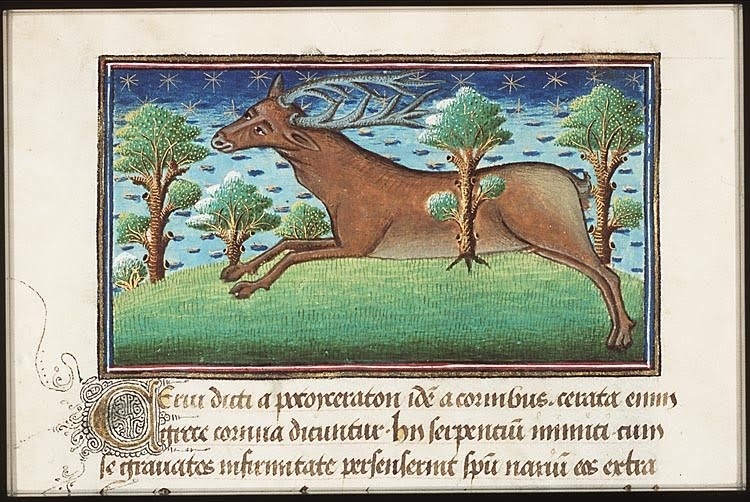
St. Brendan and his crew celebrating Easter on the back of a whale. Found at http://saintsbridge.wordpress.com/2013/12/20/celts-to-the-creche-st-brendan-the-navigator/.

St. Brendan and his crew celebrating Easter on the back of a whale.
Found at http://saintsbridge.wordpress.com/2013/12/20/celts-to-the-creche-st-brendan-the-navigator/.

Back To Top
Abstract

In this week’s extract Beowulf fends off more of those sea-borne fiends.

Back To Top
Translation

Very often the loathed enemy
vexed me violently; I to them stretched out
my dear sword, as was suitable.
Nor did they there have much joy,
the evildoers, they that would have me served up,
they came to permanent seats in the sea-bed;
and come morning with sword wounds
they were laid upon the shore,
set to sleep by the sword, so that afterward none
near the steep ford the seafarers’
course could hinder.
(Beowulf ll.559-569a)

Back To Top
Recordings

Old English:

{Forthcoming}

Modern English:

{Forthcoming}

Back To Top
Beowulf’s strategic boasting

So Beowulf here takes a little opportunity to explain more of his exploits when fighting feral beasts. Of course, you kind of have to admire the guy. He’s here, supposedly just explaining what really happened with the whole swimming contest thing, but he manages to work in some boasts about his battle skill nonetheless.

Plus, what he describes is a battle with an enemy that’s just as ill-defined as Grendel is, too. No doubt that’s meant to give the Danes further hope in spite of Unferth’s attempt to chop Beowulf down.

Maybe, as unlikeable as Unferth is in my mind, that’s kind of why he speaks up. Or rather, that’s why Hrothgar let him speak up. He knows that Unferth, as cowardly as he is, will call Beowulf out and if this Geat is as worthy of the challenge of Grendel as he himself claims to be, then he’ll be able to repel Unferth’s accusations. Since he’s shown himself a master of rhetoric, it’s possible that if Unferth’s speech is part of some test of Hrothgar’s that he was also hoping that this young warrior newly come into his hall will prove his ability with words as well as with swords.

I’d say Beowulf does that with some success here. He might not be as eloquent as Hrothgar, or, of course, as the poet behind all of this, but Beowulf does become poetic when he’s talking of what he excels in: Battle.

The marauding sea beasts would have “served [him] up” (“þæt hie me þegon”(l.563)), and the beasts aren’t just killed, they’re “set to the sleep of the sword” (“sweordum aswefede”(l.567)).

Plus, having been a boaster since he was a child Beowulf not only takes this opportunity to boast about how he spent a night defeating sea beasts (a skill that the Danes no doubt hope will transfer to land), but also goes one step further. In this part of his version of the story Beowulf makes the self-aggrandizing claim that because of his handiwork the sailors in the area no longer have to worry about being harassed by these beasts.

This statement brings up some questions.

Is Beowulf trying to imply that he killed all of the region’s sea beasts or simply that he scared them off?

Was this part of the sea famous for being overrun with “whales” or whatever “sea deer” are/were? Or was it a little known place that anyone could say anything about and not really be called out on?

Answering the first pair of questions is tricky, at best.

In either case, Beowulf aggressively asserts his battle prowess. Almost to the point where it would sound like a drunken boast if Beowulf shouted outright – “I killed all the sea-deer dwelling in the swirling water there!” or “Never again would the sea-beasts of that bay trouble sailors, for my fighting filled them all with mortal fear!”

Left at just an implication, though, Beowulf’s saying that after his night of fighting “none/near the steep ford the seafarers’/course could hinder” sounds almost equal parts true and untrue.

Which brings us to the second pair of questions.

If this place was famous for monsters, then surely someone would pipe up with a contradiction or agreement.

Though, Beowulf did do all of this fighting when he was a few years younger, so, as long as the area didn’t fall back into the fins of the sea-deer, I guess there’d be no real objections to his story.

And that makes it all the more ingenious.

Maybe around the time that he did this the beasts actually did start to grow scarce, but not because of him. Perhaps they moved because they needed to find a better food source. Or they left the area in search of a place where boastful swimming contestants wouldn’t harass them so violently.

The same thing can be said if the area Beowulf’s story is set in is little known. These events’ happening a few years before his appearance in Heorot would simply make it all the more difficult to prove or disprove his story.

So, as much as Beowulf may be a brute when it comes to matters of sentence-level rhetoric, jamming his ideas into whatever constructions he has, it seems like he really does know his way around a boast.

However, whether or not that’s because he’s made many successful boasts or just has a stick-to-it attitude when it comes to fulfilling his boasts has yet to be seen.

Do you think Beowulf killed all of the area’s sea beasts or that he merely put the fear of human kind into those that remained?

Back To Top
Two straightforward words, a third undefined

Past weeks have left us with little to note in the way of weird words. This week, that changes.

These first two words paint vivid pictures of their subjects through their combinations.

The word “yð-laf” means “shore” or “beach.” But it’s actually a combination of the word for “wave” or “sea” and a word for “leavings,” “relic,” or “remnant.” That the sea’s leavings are the beach makes some sort of sense.

The constant motion of the waves over it could stir that sort of idea in an observer. Under close scrutiny, the waves might start to look like they were leaving the sand behind as they pulled away. It’s a rather poetic image that sheds some light on the Anglo-Saxon worldview.

Though, whether that particular aspect of their worldview is that the water is greater than the land or that the earth is the remains of some sort of long gone water being or simply that all things leave something behind when they depart is unclear. There’s something locked in the poetry of that image.

Similarly, though more straightforwardly, this week’s extract brings us the word “brim-liðende.” This word combines “brim” for “surf,” “flood,” “wave,” “sea,” or “ocean,” with “to go,” “travel,” or “sail” to give us a word for “sailor.” It’s neat and quite tidy, and is simply a more descriptive way of identifying someone who travels by sea.

This week’s third word isn’t quite so straightforward.

Now, the real star of this week’s word watch.

It’s a strange one primarily because it’s unclear. What it means as a whole is well-defined enough. But with my dictionaries and limited knowledge of Old English word formation I wasn’t able to come up with exactly what its parts mean.

The word is “man-fordædlan,” meaning “evil deed, crime, wickedness, guilt, sin.”

The first word in this compound is pretty easy to find (it’s on the page opposite the entry for “man-fordædlan” itself, in fact). The word “man” means “evil deed, crime, wickedness, guilt, or sin.”

The word “fordædlan,” though, is tougher to define.

My first instinct was to look up “fordæd,” thinking that the last three letters are probably a suffix of some kind. But that turned up nothing.

Next came the even shorter “dæd” meaning “deed, action, transaction, event.” If we take this word as the root of “fordædlan” and combine it with “man” its translating as “evil doers” makes sense. The doubling of the sense of act or deed could be a way of emphasizing just how evil the thing the word refers to is. The thing itself is an evil deed, an act of malice, an enacted expression of wickedness that, of course, begets its own wickednesses. Hence, the “evil doers” of line 563.

No doubt it’s actually unnecessary to do these sort of linguistic acrobatics to get the compound word “man-fordædlan” to work. There’s probably some little known “fordæd” or “dædlan” that means “doer” or “enactor.” Though an interesting nuance is that the prefix “for” can, and I quote from my Clark Hall and Meritt Anglo-Saxon Dictionary: “denotes loss or destruction…or is intensitive or pejorative[.]”

What do you think “fordædlan” of “man-fordædlan” means on its own? Could “man-fordædlan” be a compound that’s so old that its second half no longer stood on its own when Beowulf was written down?

Back To Top
Closing

Next week Beowulf brings us into the next day and tells of what he saw in the morning light.

You can find the next part of Beowulf here.
Back To Top

Beowulf versus the sea-deer, and, about those sea-deer (ll.550-558)

Abstract
Translation
Recordings
Beowulf (and Anglo-Saxons?) on armour
“Mere-deor” and other weird words
Closing

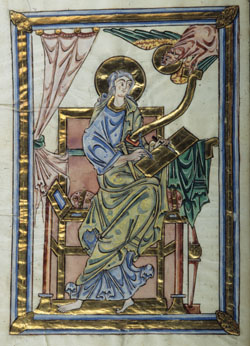
The medieval depiction of a kind of deer. Just picture this creature in the water and you may have a "mere-deor."

The medieval depiction of a kind of deer. Just picture this creature in the water and you may have a “mere-deor.”

Back To Top
Abstract

Beowulf relates his struggle with one of the sea-beasts.

Back To Top
Translation

“‘Then against the loathed my corslet,
hard, hand-woven, was of great help,
the broad coat of mail that on my breast lay
gold adorned. Me to the bottom pulled
the hostile enemy, held fast
in its grim grip; however I was yet given mercy,
that I the fiend could reach with sword-point,
my battle blade; in the war rush was taken the life
of the stalwart sea-deer by my hand'”
(Beowulf ll.550-558)

Back To Top
Recordings

Old English:

{Forthcoming}

Modern English:

{Forthcoming}

Back To Top
Beowulf (and Anglo-Saxons?) on armour

Beowulf goes on about his wondrous deeds here. And he includes a great deal of detail about how his armour saved him.

Actually, there seems to be a lot of emphasis on armour in Beowulf’s speeches.

Well, it’s not like that’s all that he talks of, but it does seem kind of strange how often he mentions armour.

In this extract, he spends just over three lines on it, and earlier, when speaking to Hrothgar he instructs him to send Hygelac his armour as a memento if he should die.

On the one hand, this armour focus could be ascribed to Beowulf and Beowulf alone. In that case, I’d say that it shows just how aware of the machinations of combat Beowulf is. He may know well the importance of the war rush, or having your opponent’s within reach of sword point, but more than that he realizes the importance of a good coat of mail.

Because sometimes you just can’t be sure.

If, on the other hand, this emphasis on armour is the poet’s doing (rather than just characterization), then it says something about the Anglo-Saxons.

Actually, it says just about the same thing, really. Though I’d add that if it is a general thing, then maybe armour has a special importance to memory.

Perhaps it’s sort of how things might be in a particularly sentimental cicada’s brain: its shell, as the armour of its youth, holds within it all of the memories that it made while wearing it. Likewise, just as a sword was regarded as imbued with special power if it’d been wielded by a male relative or great hero, a person’s armour could hold a memorial significance.

Or, more specifically, maybe these mentions of armour are part of a lost mnemonic, some sort of arcane technique for remembering not only heroes (as Beowulf would be remembered by his armour when it got to Hygelac in the event of his death), but their stories as well. It could be that the armour, after enduring with its wearer the great feat of facing Grendel (or the crash of the ocean waves), becomes a metonymy for its wearer. Not just in a metaphorical sense, but in the same sense as the shed carapace to the sentimental beetle, that armour becomes a shed part of that hero, that fighter.

Practically, speaking though, swimming in a mail shirt makes Beowulf’s bet with Breca all the wilder.

Those rings wouldn’t be made of fancy ultralight bicycle aluminium, they’d likely be made of iron. Swimming can get difficult if you’re weighed down by a particularly thick, wet shirt. It’s hard to imagine the struggle that both of them would endure wearing that sort of armour to sea.

Though it’s quite easy to imagine that weight working against Beowulf as the sea-beast he encounters in this passage drags him down.

But then, in his retelling the instance, he puts on the armour of the storyteller, shielding his tale in words reserved for warfare.

Terms like “war-rush” (“heaþoræs”) and “battle-blade” (“hildebille” (l.557)). But you know that the struggle was truly mortal when Beowulf doesn’t just say “I could just reach the fiend with the tip of my battle-blade” or “yet, I managed to wrench my sword into the beast’s gullet” but instead that he was “given mercy.”

By whom?

Well, no doubt by something between the Christian god and the Anglo-Saxon idea of “wyrd,” a kind of fate.

Invoking such a force, even indirectly, really shows how hard Beowulf was struggling because it places the battle on a cosmic level. This wasn’t just a wee brawl, it was a struggle that the cosmos had a hand in!

What do you think of the idea of a warrior’s armour being a container for the memory of his experiences while wearing it? Or of a warrior’s armour becoming metonymous for the warrior?

Back To Top
“Mere-deor” and other weird words

After last week’s “whale-fish,” this week we’re faced with what could literally be a “sea-deer.”

Tee word “mere-deor” (l.558) literally translates into that. And it creates a very simple image: A fish with horns, possibly a narwhal. Why exactly Beowulf would be fending off a narwhal isn’t clear, but that’s clearly not the point of his story. What it’s all about is his strength in overcoming the power of nature.

And what a terrible power that is.

In line 553 we’re told that Beowulf was being drug down to the “grunde.” Since he’s in the sea, this word generally gets translated as “bottom.” In fact, both Heaney and Gummere use this translation.

But “grunde” could also mean “foundation,” “abyss,” “hell.” These words might not be as accurate as “bottom,” but they all have a much deeper connotation to them; “abyss” and “hell” coming neatly packaged with implications of damnation and the impossibility of escape.

Given what Beowulf has to go through when he fights Grendel’s mother, this perception and conception of the bottom of the sea becomes very curious indeed.

Just as curious as some of this week’s compounds.

There’s “lic-syrc,” combining “body” with “shirt,” or “coat of mail,” to give us “mail coat” (specifically a mail shirt that would run down to its wearer’s thighs or knees). Then we get “hond-locen,” for “hand-made” from “hand” and the verb for “to lock,” “enclose,” “fasten,” or “intertwine.” And “beado-hraegl,” or, literally, “battle dress.”

The word “feond-sceatha” makes another appearance, too. And we’re joined by the dully straightforward “headthu-raes,” a combination of the words for “battle” and “rush” that gives us: “battle rush,” or “war press.”

So what does all this mean?

Well, to be completely honest, it’s hard to say. It’s possible that the use of all of these clear, literally translatable compound words is just due to Anglo-Saxon’s being short on words for these things that were more obscure or poetic.

Or maybe they’re the best choices for each line’s alliteration (they are).

But both of those possibilities wouldn’t really shed much light on Beowulf and his dramatic retelling of his adventure on the seas.

As such, I like to think that Beowulf is shifting his energies from using obscure words and forms to shaping his sentences to reflect the action he’s describing.

What then, does the straightforward and literally translatable, but still odd “mere-deor” mean (outside of being alliteratively convenient)?

Well, I think it, and the compounds with “hrone” and “fixas” from last week, are present in Anglo-Saxon because the sea was regarded as a mysterious place.

Who knows what goes on in there, right?

The Anglo-Saxons sailed it regularly, too, and so probably had a sort of reverent fear for things like the tides and the speed at which storms could come upon those ships that were unwary. As such, they probably had only words for the things that they saw most often.

Whales and fish definitely fit this bill because both are prevalent along the Northern coasts of Europe, as deer are on the land there.

But some sort of strange creature that was a tusked or horned thing in the sea was probably a rare sight indeed, and so to express the idea of that creature the Anglo-Saxons just took two of their existing words and ideas and mashed them together. Adding, in a way, to that creature’s mystery.

Do you think that the animal referred to as a “mere-deor” is just a narwhal, or could it be something rarer?

Back To Top
Closing

Next week Beowulf continues his tale with an account of the rest of the night and the next morning.

You can find the next part of Beowulf here.

Back To Top

Taking a break for a brew and some nuanced words (ll.491-498)

Abstract
Translation
Recordings
Breaking for a brew
Words of nuance
Closing

Interlaced men motif. Image from http://public.wsu.edu/~hanly/oe/503.html.

Interlaced men motif. Image from http://public.wsu.edu/~hanly/oe/503.html.

Back To Top
Abstract

Space is cleared for the Geats to sit, ale is poured, and songs are sung in Heorot hall.

Back To Top
Translation

“Then for the Geat men together at once
a space was cleared on a beer hall bench;
there the bold went to sit,
exulting in their strength; a thane acted on that office,
he who in hand bore the adorned ale cup,
poured out the sweet brightness; the poet meanwhile sang
clear in Heorot; there were songs of heroic joy,
among the none too few noble warrior Danes and Geats.”
(Beowulf ll.491-498)

Back To Top
Recordings

Old English:

{Forthcoming}

Modern English:

{Forthcoming}

Back To Top
Breaking for a brew

It’s no secret that the Anglo-Saxons enjoyed their beer. Such could be said for all Germanic peoples, really. But, they weren’t swillers of whatever they could get their hands on. At least, one would hope so after reading such a vivid description of a perfect presentation and pour as that found on lines 494-496.

The best way to approach this description is line by line, since each has a singular focus.

First, the second half of line 494 is about the person doing the pouring. Notice that this is the shortest part of the description. Also, that pouring the ale isn’t just some act or event that stands in the way of drinking it – it’s an “office.”

The Old English word used is “nytt,” which could translate as “use,” “utility,” “advantage;” “duty,” “office,” “employment,” “supervision,” “care;” “useful,” “beneficial,” “helpful,” “profitable.”

The word “office” best captures the sense that I think is implied here, a combination of officialdom with importance.

It goes unsaid throughout these three lines, but aside from the enjoyment of a good brew, ale-pouring would have been one of the major ways in which a host could make an impression upon his guests. Just as various modern cultures have various drinking etiquettes, the Anglo-Saxons surely had their own. As such, knowing how to properly pour was likely included in this and something that was learned early and learned well.

There’s some room for interpretation in the word “þegn,” since it could mean “servant” or “retainer.” But, whether it’s someone who is only a servant in Heorot or who is one of Hrothgar’s remaining retainers, I think that the act of pouring ale in Anglo-Saxon culture confers a great deal of importance on the pourer. Just like a bartender who knows how best to get that stout from the tap to your glass, anyone who could pour ale well no doubt commanded some respect.

After all, it is that servant who bears the ornamented drinking cup (as read on line 495). Probably a large pitcher-sized thing from which the smaller cups were filled, this cup’s exact decoration remains unmentioned. Likely with good reason.

The recitation of poetry in Anglo-Saxon Britain happened in social settings. In such settings just the same sort of pouring and drinking would be going on, so leaving out any fine details that would make this “adorned ale-cup” a specific item allows hearers of the poem to step into the fiction of Beowulf through this detail (or lack thereof).

Perhaps some hearers may even have thought, “maybe this ale-cup that poet’s caterwauling about is just like this one?” as they admired the design carved around their own cup, fingering over its design as much as looking at it.

But the bearer and the cup are just vehicles for the ale itself. That’s why the most vivid brief description of all is saved for the ale (or mead?) itself – that “sweet brightness” of line 496. It doesn’t contain so much detail as to become self-parodying, but the original Old English, “,” is, nonetheless open to interpretation.

Heaney translates the phrase as “bright/helpings of mead.” Wren would render it “bright [or “glorious”] sweet drink.” And Francis Gummere went with “clear mead.” These are all fairly similar, and mead is definitely implied (if not outright stated).

Yet, it’s curious that the word for the drink is not “medu” meaning “mead” or “ealu” meaning “ale.” It’s possible that the poet declined the use of either because it was obvious enough to contemporary audiences what the drink was. Though to us (and to me) it’s rather vague. There’s mention of the ale cup, and yet this is a sweet drink that’s being poured out. So is it mead or is it ale?

A meaning taken for granted is lost to us.

Or maybe I just need to get a little of either in me to work this one out.

Back To Top
Words of nuance

One of the things that drew me to the study of words when I was younger is their power to reflect the values and ideas of the people and cultures who use them.

One of the words that stands out in this week’s extract is “swiðferhð.” Taken together, the word means “bold, brave, rash.”

Curiously, there’s a kind of gradient present in these definitions: to be called “bold” is generally a compliment, calling someone “brave” could go either way, and then calling someone “rash” sounds like a downright insult. Coming from a society that seems steeped in physical conflict and warfare, such nuance to a word that sounds like it should bear only positive connotations is curious. But, of course, contemplation and wisdom were highly valued in that society, too.

Taken apart, the word’s halves, “swið” and “ferð,” mean, respectively: “very,” “much,” “exceedingly,” “severely,” “violently,” “fiercely;” and “mind,” “intellect,” “soul,” “spirit,” “life,” “person.”

All of the definitions of “ferð are benign enough. But, the last four interpretations of “swið” sound like adverbs for something taken too far. Yet someone who is “severely spirited,” for example, could well be an asset or a liability on the battlefield. He’d be a powder keg, as likely to do much good as he would be to do much ill. So characterized are the Geats as they sit amongst the Danes for their entertainment.

I don’t think the poet means this as a backhanded compliment, though. I read the use of “swiðferð (aside from its use for alliteration’s sake) as the poet’s take on the Dane’s feeling about the Geats at this point. They don’t know if Beowulf will be successful against Grendel, or if he and his band will be smeared around their precious Heorot come morning.

Such an atmosphere is perfect for songs of man rejoicing, though. Or are they songs of hero gladness?

Line 497’s “hæleða dream” isn’t exactly a compound word, but its interpretation is still something of a crux.

The words “warrior,” “hero,” and “man” cover “hæleða” well enough. But that leaves the strangely familiar “dream,” a word that has a meaning that’s almost analogous to its Modern English cognate: “joy,” “gladness,” “delight,” “ecstasy,” “mirth,” “rejoicing;” “melody,” “music,” “song,” “singing.”

All of these words are close enough to one another, but the question is: which shade of meaning should someone translating Beowulf go with?

Songs of a warrior’s ecstasy are likely different from those of a warrior’s rejoicing. He might rejoice after a hard-won battle, but he may well be ecstatic right in the middle of it.

That’s kind of a problem of translation, though. Too often, in the process of moving words from one language to another, the original needs to be unpacked since all together it just won’t fit into its target language. It doesn’t help when one such word is attached to another (a man’s ecstasy is likely to be different from a man’s rejoicing, just as a warrior’s ecstasy is different from his rejoicing).

This sort of nuance might not be as wild as that of swiðferð or of other words I’ve covered in previous entries, but it’s still something that makes translating a fascinating task.

Back To Top
Closing

Next week, one of Hrothgar’s closest thanes calls Beowulf out on his boasting.

You can find the next part of Beowulf here.

Back To Top

Hrothgar’s pro-story agenda and two normal compounds (ll.480-490)

Abstract
Translation
Recordings
On the use of stories
Two normal compounds
Closing

A page from an illuminated manuscript. Image from http://www.myarmoury.com/talk/viewtopic.php?t=28126&view=next.

A page from an illuminated manuscript. Image from http://www.myarmoury.com/talk/viewtopic.php?t=28126&view=next.

Back To Top
Abstract

Hrothgar closes off his speech to detail with an account of the carnage Grendel has wrought upon Heorot.

Back To Top
Translation

“‘Quite often ale-drunken threats
from warriors were issued over ale-cups,
that they would wait in the beer-hall
for Grendel’s onslaught with sword horror.
Yet when morning came to this mead hall,
this noble-hall was blood-stained, as day was lit,
all the bench space was smeared with blood,
the hall battle-bloodied; then had I fewer loyal
dear men, those death had carried off.
Sit now to the feast, and in the hall hear
of heroes’ glorious victories, as thine heart urges thee!
(Beowulf ll.480-490)

Back To Top
Recordings

Old English:

{Forthcoming}

Modern English:

{Forthcoming}

Back To Top
On the use of stories

This week’s passage is pretty straightforward.

Hrothgar tells Beowulf of those who have come before him in sparse, yet gory, detail, and then sends him off to make merry. It’s such a quick turnabout that I wonder if it’s supposed to be comical.

Schadenfreude can’t possibly be that recent a phenomenon after all. Especially when it’d be crystal clear that Beowulf will win, despite the odds. I mean, the poem is named after him and so it’d be hard for it to go on too far beyond his death were Grendel to bring it about.

If not schadenfreude, then maybe there’s some sort of irony at work here. Maybe Hrothgar’s conclusion is meant to be tragicomic.

Or perhaps Hrothgar is just drunk. That’s another possibility for sure.

Whatever his own state is, Hrothgar’s definitely a tragic figure and so that could well be what’s powering the comedy here.

It’s also important to remember that these characters, as much as they are the front end of the poem, are still puppets dancing upon the poet/scribe’s strings of words.

Another possibility is that Hrothgar’s emphasis falls on his final sentence. Maybe he’s trying to get Beowulf to fill his head with stories in which the hero triumphs over the monster. Medieval belief in the idea that what you carried around in your head affected your conduct and life in general was pretty widespread after all. So the big man’s conclusion might be less for comedic effect and more along the lines of “get your head in the game!”

Actually, stepping into the territory usually reserved for the second section of these posts, the word that Hrothgar uses for “urge” in that last sentence is worth a closer look.

In the original Old English it’s “hwette,” a clear ancestor of modern English’s “whet” and also translatable as “sharpen, incite, encourage.” The last two of these definitions are what led me to “urge.” But keeping the first two possibilities in mind makes Hrothgar’s use of “hwette” all the more fascinating.

(A quick note, “hwette” appears not to be used for its alliterative qualities since this line’s sound is “s,” curiously.)

If Hrothgar (or the poet) meant to mean “whet,” or “sharpen” then the line still retains its meaning. Beowulf is still being encouraged to sharpen himself on the whetstone of stories. But what does that say about stories?

I think this line gives us some minor insight into how the Anglo-Saxons (and many other cultures of the time, in keeping with the belief that what you enshrined in your memory affected you) regarded stories. In instances like those in which Beowulf finds himself, they could be used as much for entertainment as they could be for preparation.

Under such circumstances, it’s not likely that such stories were not necessarily closely analyzed. They were likely taken more or less at face value; the heroes are real and the monsters are real and that’s that.

I think we can add a layer of complexity to this matter, though.

I don’t think that the Anglo-Saxon’s necessarily believed that the monsters and heroes of such stories were real. Instead, I think they regarded their deeds as being such stories’ major purpose. Regaling each other with such stories could help to remind people that whether it was with divine or supernatural aid, or merely through human wit and wisdom, people can overcome some very large obstacles.

However, just as it’s possible to over-sharpen a knife, I think that the Anglo-Saxons also believed it was possible to over-sharpen oneself on such stories as those that Hrothgar encourages Beowulf to give an ear to.

However willing you might be to believe that hero x defeated supernatural terror y, hearing too many of these stories would inevitably lead to an awareness of their gaps. Analysis of such stories – whether out loud or only on reflection – would seriously undercut their power to empower.

Though, perhaps that’s why such stories are traded over ale or mead or beer, rather than, say, strong coffee or gentle tea.

Back To Top
Two normal compounds

This week’s passage doesn’t have any wacky compounds.

However, it does have one that apparently isn’t in the Clark Hall & Meritt dictionary that I’m using as my primary reference.

This word is “hreðsecga,” meaning “hero,” and it’s from line 490. The glossary in the back of C.L. Wren’s edition of Beowulf does include this word, though, and in it he gives the quite literal translation of “glorious warrior.”

How is that quite literal?

Well, “hreð” means “victory” or “glory” and “secga” means “warrior,” “hero,” or “man.”

All in all it’s pretty straightforward.

Except that “secga” also translates to “sedge,” “reed,” “rush,” flag,” and “ocean,”

Given the word’s context it’s clear that it’s not meant to mean “glorious reed” or “glorious ocean.” But it’s curious to think that a word for “man,” or “warrior” could also mean things like that. Especially such unwarlike things as “sedge,” or “rush.”

A “flag” could refer to the standard or emblem that a tribe bore into battle for symbolic and psychological reasons. As the Anglo-Saxons (and the Danes and Geats) were familiar with sailing, the “ocean” may have been (and was) commonly characterized as war-like.

But, those plants are just there.

Still, it’s possible that the Anglo-Saxons saw sedge and rushes as bristling clumps of swords and spears respectively, mêlées in which a hundred swords were drawn, raised, and then frozen in the moment before they all strike their targets, preserving these scenes as grasses that bristle in the breeze.

Maybe these alternate translations for “secga” nod towards some forgotten myth about just such a martial scene being transformed into a plant doomed to dress the fen and marshy waste that the Anglo-Saxons populated with beings like Grendel. Such a myth wouldn’t be outside the ken of Western mythology, since Greek mythology is full of origin stories involving people being turned into plants.

The word “oret-mecgas” is another compound word found in this week’s passage (on line 481). It doesn’t carry any mystifying possible alternate meanings like “hreðsecga,” but it’s a compound word that sort of tells a story.

The word’s first part, “oret,” means “contest,” or “battle” and its second part means “man,” “disciple,” or “son.” So, combined, the whole compound literally means “disciple of battle” or “son of contest,” referring to someone deeply versed in combat. Indeed an apt definition for a word meaning “warrior.”

Back To Top
Closing

Next week Beowulf and his crew are treated to an intermission of mead and minstrel song before a new challenger appears.

You can find the next part of Beowulf here.

Back To Top

Hrothgar’s speech gets casual but his words stay interesting (ll.456-472)

Abstract
Translation
Recordings
Hrothgar gets calculatedly casual
Less colourful words, but words nonetheless
Closing

An example of an image touched with gold leaf from an illuminated manuscript. Image from http://ica.princeton.edu/conferences/2010march16-17.php.

An example of an image touched with gold leaf from an illuminated manuscript. Image from http://ica.princeton.edu/conferences/2010march16-17.php.

Back To Top
Abstract

Hrothgar replies to Beowulf. He opens with an explanation of how and when he knew his father.

Back To Top
Translation

“Hrothgar spoke, protector of the Scyldings:
‘For manly deeds thou, friend of mine Beowulf,
and for our benefit have you sought us.
Thy father fought his way into a terrible feud,
he became Heatholaf’s killer by hand
amongst the Wulfings; so that he might not have
shelter with those kin for dread of war.
From thence he sought South Dane folk
over the surging waves, the Ar-Scyldings;
that was when I had just begun rule of the Danish people
and in youth governed this fierce empire,
walled and treasure-filled towns of warriors;
then was Heregar dead, my elder kinsmen left unliving,
son of Halfdane; he was better than I!
Afterwards I settled that feud with goods;
sent I to the Wulfings over the water’s ridges
old treasures; he to me oaths swore.'”
(Beowulf ll.456-472)

Back To Top
Recordings

Old English:

{Forthcoming}

Modern English:

{Forthcoming}

Back To Top
Hrothgar gets calculatedly casual

It seems that Beowulf has proven himself to Hrothgar.

Certainly not because he’s shown the Danish lord what he can do, but because his words have inspired him with belief. That’s my explanation for Hrothgar’s switching to a more plain speaking style, anyway.

Throughout the entirety of his speech in this week’s extract, Hrothgar leaves out any sort of interlaced structure. He doesn’t start an idea before the caesura of one line and then end it on the opposite side of the next line’s mid-way pause.

Considering that he’s just met Beowulf, and only just heard him speak, Hrothgar is also being quite open and forthwith. Certainly the thanes that he has around him would only faintly correct him when he says that his brother was a better man than he (l.469) at this point in the struggle with Grendel, but it’s still a strange thing to admit to a total stranger.

One thing’s for sure, historical accuracy in regards to these men’s exchange takes a back seat here.

Instead of having to go through several meetings to get to this level of candid speech, Hrothgar just immediately moves to it after hearing Beowulf’s pitch. And that is exactly what the main man’s speech was, a pitch.

Epic poems can’t be all bluster and long-winded speeches after all, so rather than showing a series of meetings between the leaders where Beowulf and Hrothgar gradually build up a rapport and mutual trust (no doubt a decent way to turn this story into a modern novel), the poet just has Hrothgar accept Beowulf at his word. Oh – and at his father’s word, too.

For, although Ecgtheow isn’t present, I think his having sworn oaths to Hrothgar (l.472) gives Beowulf some privileges within his estimation. From the sounds of it Ecgtheow caused Hrothgar some worry when he was just starting to rule over the Danes, but I think something important remains unsaid here.

I think that Hrothgar’s being given the opportunity to solve the feud between Ecgtheow and the Wulfings is something that he used to secure his then new-found position as ruler of the Danes.

On line 467 he describes the Danish people as consisting of “walled and treasure-filled towns of warriors” (“hordburh hæleþa”). These are a people who would probably not readily transition into having a new king. Any one who was fresh to the throne would likely have to prove himself worthy of it.

Such proof would probably come in the form of a show of might, but I think part of why Hrothgar brings up Ecgtheow here is that he sees the man as having given him an alternative way of showing is aptitude. He’s given a diplomatic situation to solve, and he does so handily. Hrothgar sends the Wulfings what amounts to wergild – payment as recompence for a slaying – and gets the exile to swear oaths to him. Thus, the Wulfings are appeased and the threat that is Ecgtheow is neutralized.

So on one hand, Hrothgar helped Ecgtheow when he was in a tight spot. Being exiled because you’ve killed a man with your bare hands isn’t an enviable position. But Hrothgar took Ecgtheow in. On the other hand, Ecgtheow helped Hrothgar, though it seems that this help was much less explicit. Yet, I think that Hrothgar is well aware of both of these and so he feels desperation because only might (something Hrothgar lacks) can deal with Grendel and a sense of obligation to Ecgtheow’s kin.

Hrothgar’s feeling this way explains his shift into a more open style of conversation.

Going further, I think that Hrothgar mentions the oaths that Ecgtheow swore to him to confirm to Beowulf his father’s honorability and to inspire in our hero a sense of filial obligation. Beowulf did not take such oaths. Nor can he be expected to at this point in his relationship with Hrothgar.

Yet, Hrothgar would certainly have been aware of Beowulf’s understanding of the importance of words after hearing his pitch. Thus, he likely mentioned his father’s oaths in a calculated move to appeal to Beowulf’s underlying philosophy of following through on his word.

So Hrothgar’s jumping to much more open speech (though it’s still not free from his use of words like “ðu”) fits into the poem’s current situation. This shift is also, of course, a convenient way to pick up the story’s pace.

Back To Top
Less colourful words, but words nonetheless

Hrothgar’s speech is much less colourful than Beowulf’s. He doesn’t use nearly as many words that could be interpreted in more than one way, nor does he use that many compound words. Though of those that he does use, the curious “hordburh” and “gesloh,” an example of how much the prefix “ge” can change a word, are worth pointing out.

The word “hordburh” is made up of the word “hord” (meaning “treasure”) and the word “burh” (meaning “walled town,” “fort,” or “castle”). This word is noteworthy partially because it also appears in the Anglo-Saxon poetic version of Genesis and the Cartularium Saxonicum (a collection of Old English charters), and apparently in all three can mean simply “treasure city.”

Now, fierce as the Danish people that Hrothgar rules over are, and as likely as they are to live in towns filled with plunder, “treasure city” just doesn’t have enough of a ring to it for my tastes. So I got a little creative and instead rendered “hordburh” as “walled and treasure-filled towns.” It’s a bit wordy, but I think it works.

Modern English just doesn’t compound like its ancestor.

The other word to be aware of in this week’s excerpt is “gesloh.”

This prefixed verb means “to enter into by fighting.” It’s pretty straightforward in context, and I’ve kept it nearly as it is in the passage above. But what happens when you take “ge” away?

The word “sloh” is a form of “slean,” which can mean “strike,” “beat,” “stamp,” “coin (money),” or “forge (weapons)” in one sense, “throw,” “cast,” “sting,” or “pitch,” in another, “strike across,” “dash,” “break,” “rush,” or “come quickly” and “slay,” or “kill” in yet another. It’s a single word that covers a lot of ground. Yet with “ge” added to it, it becomes quite narrowly focused.

Though, in the first sense of “slean” there’s some of “geslean” to be seen. For that first group of words relates to creation in some form or another (as long as you understand “strike” and “beat” as referring to hitting instruments or mixing things. Building on this relationship, I think that you can draw a connection between the first sense of an un-prefixed word and its prefixed form. The latter may also bring in some of the former’s other senses.

Another word that becomes more specific when you add “ge” to it is “ascian.”

On its own, this word means “ask,” “inquire,” “seek for,” “demand,” as well as “call,” or “summon,” and “examine,” or “observe.”

Put a little “ge” on the front, though, and the word means “to learn by asking,” “discover,” or “hear of.”

These “ge-” words are sort of the opposite of the words that I’ve been tracking over the last few weeks because of their specificity, but they’re just too odd to pass up.

There really isn’t anything like the “ge” prefix in Modern English. Just another reason to study these old books.

Back To Top
Closing

Next week Hrothgar continues to speak, telling Beowulf that his thanes are thinning out.

As for this week’s excerpt: What do you make of Hrothgar’s switching tones? Do you think that he’s come to trust Beowulf based on his family connections and speech alone?

What about this week’s words, “is walled, treasure-filled town” a good translation of “hordburh”?

You can find the next part of Beowulf here.

Back To Top