Battlefield mourning and measured compound words (1071-1080a)

Abstract
Translation
Recordings
Two Mothers Mourning
Measured Compound Words
Closing
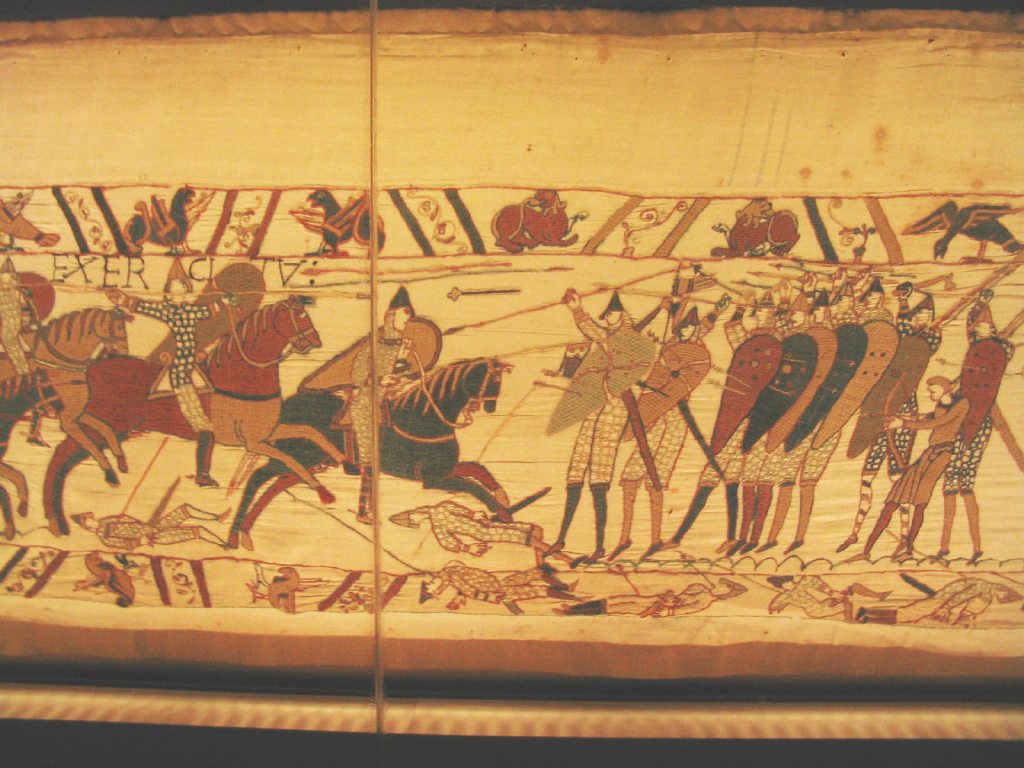
A section of the Bayeux Tapestry showing Anglo-Saxon warfare

Image found here: “Bayeux Tapestry 4” by photo by Gabriel Seah – gssq.blogspot.com. Licensed under Public Domain via Commons.

Back To Top
Abstract

Hrothgar’s poet begins a recitation of the story of Hildeburh, a woman in mourning.

Back To Top
Translation

“Indeed, Hildeburh had no need to praise
Jutish loyalty; guiltlessly she became bereft
of loved ones at the shield play,
of her son and of her brother; they were burdened
with ruinous spear wounds; she was made a mournful woman.
Not without reason was Hoc’s daughter
then fated to mourn, after morning came,
when she might under the sky see
the violent death of her kin, where they earlier
had held the great joy of the world.”
(Beowulf ll.1071-1080a)

Back To Top
Recordings

Old English:

{Forthcoming}

Modern English:

{Forthcoming}

Back To Top
Two Mothers Mourning

The most remarkable thing about this passage is that it’s coming from a woman’s perspective.

Hildeburh, the mother of a warrior, and sister to another, is, for some reason, near enough to the battlefield to go and see her fallen family the morning after a night battle. Her closeness suggests that this battle was probably a siege of some sort. If this is so, then she, distraught as she’s heard no word about her men, has left the city’s walls to see if she can find them herself.

Though it’s also possible that Hildeburh was along with the war party as some sort of supporter.

But I think that the line about “Jutish loyalty” (“Eotena treowe” (l.1072)) suggests that there’s been some treachery afoot, and so a siege is more likely. Or at least some sort of fortification.

Why?

Because when I think about treachery in what’s obviously some sort of war situation, I think of a betrayal that’s resulted in the fall of a fortification or castle that was hitherto impregnable. But Hildeburh’s exact situation isn’t important.

After all, the poet just launches into the story. This cold open likely comes from Hildeburh’s having been understood as a specific figure to the poem’s original audience. She’s someone who’s known to fit in with the context of the children of Finn and Hnaef Scylding, as mentioned in last week’s passage. So there’d be enough information for the poem’s early audience(s), but there definitely is not enough for us.

So, instead of trying to pull more information about the situation from this I just want to jump ahead a bit in the poem. After I’ve jumped back.

Grendel was defeated the night before the celebration at which this poet is singing. The monster’s arm was torn off, and he was left to wander, bleeding, back to his lair on the fens.

Later in the poem (about 200 lines from now) Grendel’s mother shows up to seek revenge for her son’s death.

I like to imagine that the poet’s giving us this episode from history (or common lore) about a woman going out to find her brother and son dead is supposed to parallel what Grendel’s mother is now doing (or has recently done) in the timeline of the poem.

As the Danes and Geats celebrate, Grendel’s mother is mourning. In the harsh light of dawn she’s found her son mangled and dead, having been dealt “ruinous/…wounds” (“hruron/…wunde” (l.1075-1076)). And so I can’t help but think that this part of the poem, a different version of the story found in the “Finnsburh Fragment,” is supposed to be showing us the other side of Beowulf’s great victory.

Grendel, to the Danes, and to the Geats who came to stop him, was monstrous. But Grendel is nonetheless the “kin of Cain.” He’s monstrous and some sort of abomination in the eyes of god, but he still has a family – a mother. And now that mother is grieving, angry.

But her rage comes out 200 lines down the road. Right now we just have Hildeburh. Who, even on her own, makes a curious statement about all of the war and violence in the poem so far. Showing the mourning side of battle adds the dimension of empathy for the fallen and their living relations that up to now hasn’t really been that big a deal.

But now we get to see just how that empathy plays out as Hildeburh’s part continues.

What do you make of a battle-celebrating poem like Beowulf‘s having a character mourn those freshly lost in battle? Is it a balancing element, just a token inclusion, or something else entirely?

Back To Top
Measured Compound Words

This is definitely a passage about battle. Though it’s coming from the side more familiar to most of us – that of the spectator, the person who doesn’t fight but has to live with what comes of fighting. Nonetheless, there are quite a few compound words used here, considering the length of the passage.

What’s particularly notable about these compound words, though is that their use is fairly measured.

For instance, the poet doesn’t throw down a few compounds for the same thing or concept in short succession, nor do these compounds appear in parenthetical clauses that aren’t really part of the passage’s main ideas.

In fact, in this passage, the compound words generally are the main ideas of the sentences, or at least integral to understanding those ideas. I think this measured use suggests a more focused sort of intensity than that which we’ve seen when the poet is simply slamming down compounds. But let’s take a look at these words.

On line 1073 we’re given “lind-plegan,” an innocent sounding word for “battle” that literally means “shield play” (since it combines “lind” (“shield (of wood)”) and “plegan” (“quick motion,” “movement,” “exercise,” “play,” “festivity,” “drama,” “game,” “sport,” “battle,” “gear for games,” or “applause”)).

This word is used for alliteration, but I think it’s also a reference to the sort of close combat that Beowulf and Grendel engaged in just some 300 lines ago.

Next, on line 1077 “metodsceaft” appears. This one means “decree of fate,” “doom,” or “death” and comes from the mix of “metod” (“Measurer,” “Creator,” “God,” or “Christ”) and “sceaft.”

It’s tempting to read the “sceaft” in “metod-sceaft” as the usually prefix-less “sceaft” meaning “staff,” “pole,” “shaft,” “spear-shaft,” or “spear.” I mean, this reading gives us a word that would mean something like “the spear of God,” an apt sounding metaphor for fate. Not to mention taking this compound to mean “spear of God” sees Hildeburh suffering the same sort of wound that killed her brother and son. But, I don’t think that pre-fix resistant “sceaft” is the word meant here.

Instead, there’s a similarly written word that does take prefixes, “sceaft” (“created being,” “creature,” “origin,” “creation,” “construction,” “existence,” “dispensation,” “destiny,” “fate,” “condition,” or “nature”). When this word combines with “metod,” we get the much clearer “God fate,” or “decree of fate” (extrapolated from “Measurer of fate”). Though I’m not sure what the mixture of a name of god and a word for “creature” or “fate” really implies in Old English.

Finally, the third compound word in this passage goes in for emphasis rather than some sort of new concept. The word “morthor-bealu” is already implicit in the two men dying from spear wounds, as it means “violent death,” or “murder.”

And breaking down “morthor-bealu” doesn’t do much to make the word’s implications less violent. On its own, the word “morthor” means “deed of violence,” “murder,” “homicide,” “manslaughter,” “mortal sin,” “crime,” “injury,” “punishment,” “torment,” or “misery”; while the word “bealu” means “bale,” “harm,” “injury,” “destruction,” “ruin,” “evil,” “mischief,” “wickedness,” “malice,” “a noxious thing,” “baleful,” “deadly,” “dangerous,” “wicked,” or “evil.” So we’re left with a double whammy of “murder” on the one hand and “destruction” on the other. It’s definitely a compound word that connotes inescapable violence.

But, just in case we weren’t sure about the fate of Hildeburh’s kin, we’re told through “morthor-bealu” that they met a “violent death” or “murder,” suggesting that even within the realm of warfare, their deaths were particularly grisly. Unless the poet, along with keeping up with alliterating, also wanted to give us a sense of the shock and horror that Hildeburh is likely feeling when she sees them in the dawn’s light, rather than the stoic male perspective we’ve seen the poem through up to this point.

All three of this week’s compound words alliterate with the major sound in their lines (“lind-plegan” with “l”; “metod-sceaft” with “m”; “morthor-bealu” with “m”). Do you think that’s important at all?

Back To Top
Closing

In the next passage we’ll find out what happens in the aftermath of the battle in which Hildeburh lost her son and brother.

You can find the next part of Beowulf here.

Back To Top

Payment for the dead and weird words with clear covers (ll.1050-1062)

Abstract
Translation
Recordings
Obligatory Gifts for the Living and the Dead
Sailing through a Batch of Inherited Words
Closing

Back To Top
Abstract

The poet fills us in on how Hrothgar rewarded the other Geats before telling us about “the fore-thinking mind.”

Back To Top
Translation

“Yet then the lord to each man
who had with Beowulf undertaken the sea-way,
there at the ale bench gave treasure,
bequested booty, and then commanded that immediately
gold be paid up, for to cover the one whom
Grendel earlier killed, as he surely would have killed more,
had not wise God and a single man’s
daring prevented that fate. The Measurer ruled
over all human kings then, as it now yet does.
Thus understanding is always best,
the fore-thinking mind. Much shall it endure
of love and of hate, so long as it partakes of
this world’s days of strife.”
(Beowulf ll.1050-1062)

Back To Top
Recordings

Old English:

{Forthcoming}

Modern English:

{Forthcoming}

Back To Top
Obligatory Gifts for the Living and the Dead

What is there to say about this passage? The other Geats get rewarded, the poet shares a bit of Christian-tinged gnomic wisdom and the way is made clear for more partying.

But. I’m just gonna hold us up on our way to that with a few small things.

First, on line 1152, the word for “gave” (“gesealan”) doesn’t really come off as nicely as line 1044’s “confer” (or “onweald geteah”) in last week’s passage. That is the word used for Hrothgar’s formally giving Beowulf those great gifts we’re told all about. But the treasures given to his fellow Geats seem to be given over a greater sense of obligation.

After all, “sellan” includes such senses as “furnish,” “supply,” and “allot.” It sounds like there’s much more of a need motivating Hrothgar’s giving treasure to the Geats who were either asleep or useless in the fight with Grendel. Social custom just says that you need to pay those who come in to help you, so Hrothgar’s paying up. And I guess they all get paid the same.

Even if they die in the line of duty.

On lines 1053-1055 we’re told that after he gave the other Geats gifts, Hrothgar then “commanded that immediately/gold be paid up, for to cover the one whom/Grendel earlier killed” (“ænne heht/golde forgyldan, þone ðe Grendel ær/mane acwealde”)

This makes Hrothgar sound like a very upstanding guy. Someone who really sticks to what had been offered, what had been promised. But there’s more to this exchange than a ruler simply paying everyone who came to his rescue.

Grendel had been feuding with the Danes, at least in a sense. The reason for the feud is unclear, but earlier in the poem reference is made to Grendel acting as if he had some sort of feud with them.

I’m not sure of all the laws involved, but one of the major ones in Anglo-Saxon Britain was the concept of “wergild.” I’ve mentioned this before when talking about the word itself and when talking about Hrothgar handling Beowulf’s father. But, as a quick refresher, “wergild” was the money paid out to a rival group if your group happened to kill one of their members. The purpose of this payment was to keep a feud from breaking out so that violence between familial or clan groups could be quelled in the interest of organizing these smaller groups into something bigger.

But back to the poem.

In this mention of payment for the dead Geat we might be seeing wergild paid out. Not because the Geat was killed in some sort of feud they had with the Danes. No such feud exists in the poem. Instead, this payment’s made, I think because when Beowulf was legal owner of Heorot for that night, he also took on Grendel’s feud (or, by virtue of Heorot being the Dane’s base of operations, legal ownership of it enveloped him in the relations surrounding the building). As such, since it was the Danes that got them involved in the feud with Grendel, and Grendel can’t pay any wergild, Hrothgar takes it on himself to make up for the death of the Geat that Grendel snacked on when he first arrived at Heorot that fateful night.

Plus, paying the wergild for a man killed in a battle not his own, would help to make the message of alliance and peace between Geats and Danes deafeningly clear. So there’s another reason to pay for the fallen Geat.

What do you think of the concept of attaching a monetary value to a life? Do you think such a payment was satisfying to the Anglo-Saxons?

Back To Top
Sailing through a Batch of Inherited Words

Since this is another meditative, kind of serious and slow paced passage we don’t get much in the way of wild compounds. There are few though. At the least, I’ll point them out.

First, on line 1051, we have “brim-lade,” a word for “flood-way” or “sea-way.” This word mixes “brim” (“surf,” “flood,” “wave,” “sea,” “ocean,” “water,” “sea-edge,” or “shore”) and “lade” (“course,” “journey,” “way,” “street,” “water-way,” “leading,” “carrying,” “maintenance,” “support,” “clearing from blame or accusation,” “purgation,” or “exculpation.”) for its aquatic meaning. The senses of “lade” involved blame aren’t likely related to this compound, but it’s kind of fun to wonder if such a seafaring people as the Anglo-Saxons saw sailing or going along the “sea-way” as somehow purgative. Maybe, because of the time for all parties involved to think things over and perhaps forgive, a sea voyage was seen as a good way to ultimately have people clear each other of blame.

Though even I think that’s a bit of a stretch.

For all of its simplicity, “yrfe-lafe” (1053) is a weird word.

Combining “yrfan” (“inherit,” “leave (by will),” or “honour with a funeral feast”) and “lafe” (“what is left,” “remnant,” “legacy,” “relic,” “remains,” “rest,” “relict,” or “widow”) to leave us with a word meaning “bequest, inheritance, heir,” it’s clear where the meaning of “yrfe-lafe” comes from. Though, in its use in this passage, it seems like its context skews its meaning.

On line 1053 we’re told that the other Geats are “bequested booty,” though I’ve translated that from a simple “yrfe-lafe.” The thing here is, as mentioned above, I think that Hrothgar’s giving gifts to the rest of the Geats more out of obligation than genuine gratefulness. It’s as if they’re inheriting them as a matter of fact rather than being rewarded with them.

Line 1060’s “fore-þanc” is quite a bit more straightforward, given its place in the philosophical part of this passage.

Meaning “forethought,” “providence,” “consideration,” or “deliberation,” this word is a combination of “fore” (“before,” “in the sight of,” “in presence of,” “because of,” “for the sake of,” “through,” “on account of,” “by reason of,” “from,” or “before”) and “þanc” (“thought,” “reflection,” “sentiment,” “idea,” “mind,” “will,” “purpose,” “grace,” “mercy,” “favour,” “pardon,” “thanks,” “gratitude,” “pleasure,” “satisfaction,” “reward,” or “recompense”). So “fore-þanc” very literally means “before thought” or several variations of the same that all boil down to consideration being made before things either temporally or pseudo-physically (in that the action is given because of, or in the presence of something.

Which brings us down to the last line’s “windagum,” or “days of strife.” The “dagum” part of this word is Old English for “day” (though it could also mean “lifetime,” “Last Day,” or just be used as name of the rune for “d”), while “win” is a word for “toil,” “labour,” “trouble,” “hardship,” “profit,” “gain,” “conflict,” “strife,” or “war.” So, since “dagum” is the plural form of “daeg,” we get “days of toil.” Pretty neat, huh?

But, that’s not all. Because as terrible as “days of toil” sounds, it seems like there’s a bit of a silver lining. Possibly, anyway. The non-toil or labour-intensive definitions of “win” are “profit” and “gain.” It’s unclear if we’re supposed to understand these gains as coming from toil and labour or if it’s just a different take on what makes days full of strife. Maybe instead of battling sin, for example, “days of profit” are those in which you can embrace virtue.

In either case it’s neat to know that an alternative perspective (or even meaning) is contained in a word like “win.” Though, given modern English’s “win” it’s pretty clear which senses of the word won out. Though, again, winning can take a lot of strife and toil, so maybe this struggle of the senses isn’t over yet.

How closely can you look at a word (like “win,” for example) before it starts to temporarily lose all meaning to you?

Back To Top
Closing

After all of this talk of gifts and understanding, we’re told of how high times finally return to Heorot.

You can find the next part of Beowulf here.

Back To Top

A fair and square exchange and the simple words for it (ll.1043-1049)

Abstract
Translation
Recordings
The Legality of Hrothgar’s Giving
Why the Plain Speaking Compounds?
Closing

Back To Top
Abstract

The poet describes how Hrothgar gives Beowulf all of the stuff that was described in the last two passages.

Back To Top
Translation

“And then the lord there, descendant of Ing,
conferred both those gifts unto Beowulf,
horses and weapons; commanded/entreated him to use them well.
Thus the famed lord nobly,
The guardian of those treasures rewarded the warrior for the storm of battle
with treasures and steeds, so that no man might ever find fault with
the two, for what those words exchanged were rightly aligned with truth.”
(Beowulf ll.1043-1049)

Back To Top
Recordings

Old English:

{Forthcoming}

Modern English:

{Forthcoming}

Back To Top
The Legality of Hrothgar’s Giving

Since the last two passages pretty much covered Beowulf getting the gifts, there’s more to this passage than simply restating that Hrothgar gave him the horses and four weapons. This little cap off for this part of the poem could just be a formality, or part of the poetic practice of making things just a bit longer than they need to be. But there’s a reason for the poet to say that Hrothgar, then and there, “conferred both those gifts unto Beowulf” (“Ond ða Beowulfe bega gehwæþres/…onweald geteah” (ll.1043-1044)).

The crux of this passage comes at its end, and I think it’s directly related to the poet’s foreshadowing Heorot’s doom on line 1018-1019 (discussed in this post).

Just as that passage ended with the poet saying that treachery would not yet tear Heorot apart, the poet’s statement here that Beowulf and Hrothgar acted in such a way that “no man might ever find fault with/the two” (“swa hy næfre man lyhð,” (l.1048)) is meant to make it clear that the Geats played no part in the treachery that does Heorot in.

Just as I discussed two posts ago, whether Hrothgar is first referred to as Halfdane’s sword or his son makes no difference when it comes to the substance of the gifts themselves – whether it’s familial or political, the gifts are given to solidify an alliance.

And here, since the “words exchanged were rightly aligned with truth” (“se þe secgan wile soð æfter rihte” (l.1049)), that alliance is definitely a clear and forthright one. It’s not the sort of agreement where one part misinterprets the other’s intention or aim (which was a fairly common cause of tricksters justifying their treacherous deeds in some of the Norse sagas and no doubt in similar Germanic stories). So this passage firmly establishes that the Geats and the Danes are perfect friends. There is no bad blood between them whatever.

But why establish that?

Well, without knowing a lot of the history of the actual interactions between the Geats and the Danes (so long as the Geats actually were a people at the same time Hrothgar’s Danes were around), it’s hard to say. This whole passage could be sarcastic and the Geats, in actual fact, could be a central player in the downfall of Heorot. But I don’t think that’s why this passage is here.

I think it’s a sincere expression of an actual state of the alliance between Geats and Danes. Maybe it’s overstating the strength of the bond between real life Geats and Danes, but I think it’s here mostly to underscore Beowulf’s success. He’s defeated Grendel handily (*ahem*), brought peace back to Heorot, and didn’t let too much damage mar Heorot while it was legally his. Hence Hrothgar’s legally handing these things over to Beowulf (as the word “conferred” (“onweald geteah” (l.1044)) implies).

Everything is fair, square, and above board because that’s the kind of clean acting hero Beowulf is. He’s uncomplicated as far as his deeds go because that’s just who he is.

And perhaps it’s just how young he is. As we’ll see later in the poem, the older Beowulf we find in the poem’s latter half is a more complicated hero. But for now, he and his dealings are straightforward and simple. Singing out the legal transference of goods is part of expressing that, I think.

And, maybe this singing is a clue to the poem’s age since the early Scandinavian “skalds” were responsible for poetry as well as preserving and chanting the laws (mostly from memory). This repetition for legality’s sake could refer to that Scandinavian legal singing and so suggest that the Beowulf scribes were familiar with the practice. Though maybe only through books about it.

Everything medieval’s muddy, isn’t it?

What’s your theory on why the poet repeats Hrothgar’s giving Beowulf the arms and horses?

Back To Top
Why the Plain Speaking Compounds?

After having been indulged these last few weeks I feel a little cheated by what the poet’s left me in this passage. There’s a serious shortage of compound words. But, as always, I think there’s a purpose behind that lack.

The two compound words that are given are “hord-weard” and “heaþo-raesas.” Both of these compounds are very straightforward. If you’ve been following this blog for a while you might even be able to translate their parts on sight.

The first of these, “hord-weard,” means “guardian of treasure,” “king,” “heir,” or “firstborn.” To get to this meaning, it combines “hord” (“hoard” or “treasure”) and “weard” (“watching,” “ward,” “protection,” “guardianship,” “advance post,” “waiting for,” “lurking,” “ambuscade,” “keeper,” “watchman,” “guard,” “guardian,” “protector,” “lord,” “king,” or “possessor”). So all together, the word means, “guardian of treasure” pretty plainly.

Though, there’s some interesting stuff in the meanings of “weard” that lean more toward stealth or even sneak attacks rather than outright guarding of something, But the two are still related within those senses, I think. If you’re setting traps, you’re guarding your life after all. The same goes for “waiting for” or “lurking”; you’re present in a place and in an active state of watching for something or someone. So the sense of “guardian of treasure” is pretty consistent throughout.

The next word in this pair is “heaþo-raesas.” This one means “onrush,” “attack,” or “storm of battle,” and comes to use from the union of “heaþo” (“war”) and “raes” (“rush,” “leap”, “jump,” “running,” “onrush,” “storm,” or “attack”). And, just like with “hord-weard” that meaning, “storm of battle,” is consistent throughout combinations. The word basically means a fierce, sudden attack.

At the top of this section, though, I mentioned that I think having only these two compound words in this passage is intentional.

In past entries it’s been clear that the complicated compound words come out when the poet (or the poet’s subjects) become excited. When big speeches with rhetorical flourishes are made, or wise asides, or descriptions of action and battle – those are the times when the compounds come out in full force. And the complexity of those compound words matches the level of excitement to some extent. These speakers (or the poet themselves) don’t have time to come up with common compound words – they need to make up their own!

And there’s no saying that the calm, clear giving of gifts for a job well done is anything but heart pounding in the same way as a battle or a rousing speech. So there being no complex compounds fits the tone of this part of the poem.

But, I also think the poet keeps the compounds toned down here because of the legality of this little recap. Yeah, this kind of turns on the legal implications of “confer” (which I’ve translated from “onweald geteah” (l.1044)), but I think that’s enough. Simply giving us a summary of the goods exchanged practically stands in as a kind of receipt after all. And what’s a receipt except a record of a transaction that can later be used for bureaucratic stuff like taxes. And what’s the language of bureaucracy? Law.

So I think we can consider any kind of legal passage or bit of the poem that’s a formality as a stretch where the compound words that are used will be pretty straightforward to keep confusion to a minimum. Like a receipt, this section of the poem is probably meant to be as bare bones as an alliterative poem can be.

But so what? Well, the idea that clarity of language is important to this sort of legal passage suggests that the Anglo-Saxons liked their laws simple, or at least the poet wanted to promote the clean dealing of a trade of gifts for services rendered. Perhaps it’s a bit of anti-feuding, anti-treachery propaganda – give gifts plainly instead of with malicious machinations!

Plus, that simple compounds appear at all in such a straightforward passage suggests that compounds are so important to Old English that they’re simply everywhere – even in legalese.

It’s not exactly related, but what’s your favourite weird law? I’m not sure if it’s on the books any more, but in 19th century Canada it was illegal to wear a mask in the woods – a pretty good weird law.

Back To Top
Closing

After all of this gift giving, there’s more still to come in the next passage. Hrothgar’s rewarded Beowulf, but that doesn’t mean he’s forgotten the other Geats.

You can find the next part of Beowulf here.

Back To Top

Foreshadowing history, words with secrets (ll.1008b-1019)

Abstract
Translation
Recordings
The Poem gets Historical
Words with Secrets to Unlock
Closing

Wealhtheow serving Hrothgar

Back To Top
Abstract

It’s party time in Heorot once again, though the poet reminds us that this high hall won’t be standing high forever.

Back To Top
Translation

“Then came the due time
that Hrothgar’s son come to the hall;
and Hrothgar himself would come to enjoy the feast.
I have no need to ask if ever a greater group of assembled peoples
has gathered around their revered ring-giver.
The renowned then bowed onto the benches,
filling them with joy; they tore into the fare
and went round after round through cups of mead,
becoming bold minded, in that high hall,
Hrothgar and Hrothulf among them. Within Heorot were
many friends; not at all was treachery
yet made amongst the Scyldings.”
(Beowulf ll.1008b-1019)

Back To Top
Recordings

Old English:

{Forthcoming}

Modern English:

{Forthcoming}

Back To Top
The Poem gets Historical

Okay, so the big thing to take away from this passage is that Heorot has been restored to normal! Huzzah!

But, the Anglo-Saxons must’ve collectively been a Taurus because as soon as the poet establishes that everyone’s enjoying the feast and slugging back mug after mug of mead he decides its time to foreshadow how Heorot meets its ultimate end. He decides that it’s time to lay some history on us. Though only in a way that people who’d have been incredibly familiar with their history (perhaps in the same way that Americans are familiar with their history) would understand it.

After all of this talk of friendship and happiness, even of a level of comfort that allows Hrothgar to bring out his son and heir Hrothulf, the poet says “not at all was treachery/yet made amongst the Scyldings” (“nalles facenstafas/þeodscyldingas þenden fremedon” (ll.1018-1019)).

This passage and even the one about death from last week, but to a lesser extent, really make it seem that these parts of the poem are all about relating to the very specific audience that Beowulf would’ve been initially performed for. Not even written down for (that’s a totally different kettle of fish) but written down for. People who knew about the history of Heorot and the Scyldings.

So what?

Well, it means that this poem must’ve been written a fair bit after all of this stuff happened with the Scyldings. Long enough for it to have become part of the historical record, but not so long before that it would’ve been forgotten. Though I get the feeling that by the time Beowulf was completed (likely as an oral performance piece), this bit of history had passed into legend to some degree. That it was the stuff of Geoffrey of Monmouth’s History of the Kings of England. So it was historical in that it happened some time before the writer/performer lived, but as factually accurate as our stories of Arthur and his knights. Things have been muddied. But then maybe that’s why the poet goes for a vaguely prophetic sort of reference to these future hardships here. Instead of diverting the audience’s attention away from the story that’s being woven over these 3182 lines, the poet’s instead just riveting the story down into the realm of past facts, of history, with references like this one.

In another form of speaking of the future, the poet trots out Hrothulf here. I think Hrothgar might’ve referred to his son earlier, but this is the first time that we see him mentioned by name. I take this action of Hrothgar’s as a sign that he believes the hall is truly saved, and that the Danes’ troubles are over at last. So the young prince, his heir and successor, can come to the hall without any tragedy befalling the Danes.

Getting back to the reference to history, though, I find it interesting that the poet just says that the hall was full of friends and that treachery wasn’t there quite yet. Putting it like that makes it sound like treachery itself is a guest that wouldn’t visit just yet, and that Heorot would host some wild parties before treachery comes calling to totally destroy Heorot later. It seems like treachery is just another house guest.

I feel like this sense of future ruin is a lot of the Norse influence on Anglo-Saxon culture coming through, since sagas of great families falling into ruin account for quite a few of the older legendary ones we still have. There’s definitely not just a sense that whatever goes up must come down but that nothing great lasts because this is a world of change, set below the influence of the ever changing moon and not within what later poets would refer to as the immutable heavens.

Couched within a story that’s very much about a culture shifting from non-Christian to Christian what could such a reference to the fall of a great house mean? Maybe the poet and the others along with them thought that this limit to great things, great families, extended to religion, and believed that just as the Germanic religions gave way to Christianity someday Christianity would also wane? Who knows?

Isn’t literature great?

Back To Top
Words with Secrets to Unlock

The two (yep, just two) standout words from this entry’s passage are “blæd-agende” and “facen-stafas.”

The first of these, coming to us on line 1013, is a combination of “blæd” (“blowing,” “blast,” “inspiration,” “breath,” “spirit,” “life,” “mind,” “glory,” “dignity,” “splendour,” “prosperity,” “riches,” or “success”; or it’s a form of the word “bled” meaning “shoot,” “branch,” “flower,” “blossom,” “leaf,” “foliage,” “fruit,” “harvest,” or “crops”) and “agende” (“owner,” “possessor,” “master,” “lord,” or “the lord”).

Even with its second possible meaning as “bled,” the word “blæd” is undeniably a word of great prosperity (that is, in fact, even one of the original word’s senses). So it’s not very surprising to see that combined with the Old English word for things like “owner” and “master” we get a word that means “renowned.” Such a person is a lord of inspiration, or dignity, or splendour, or success – take your pick, they all really boil down to the same thing: a thing to be renowned for. Though we could get into chicken and egg questions here in that are these people renowned for the splendour that they’ve built up or are they renowned for having reached such a level of success? It’s hard to say from this compound word alone.

The second word has its own secrets to unlock.

The word “facen-stafas” as a combination of “facen” (“deceit,” “fraud,” “treachery,” “sin,” “evil,” “crime;” “blemish,” or “fault (in an object)”) and “stæf” (“staff,” “stick,” “rod,” “pastoral staff”; or, when “stæf” is in the plural form, as it is in this passage, it usually means “letter,” “character,” “writing,” “document,” “letters,” “literature,” or “learning”) curiously means “treachery” or “deceit.”

Obviously the Anglo-Saxons respected the intelligence required for a good bit of intrigue (and if the continuation of the mystery genre of storytelling in the northern parts of Europe’s anything to go by, they still do) since this word essentially combines the idea of treachery with some sense of command, of having power over it as represented by the image of the pastoral staff, or by the control required for things like writing, letters, or literature.

What’s more, the word “stæf” is a part of another compound word, “stæfcraft,” meaning “grammar” or “learning.” So, somewhat unsurprisingly since education still followed the classical model of literally beating concepts into students through corporal punishment and rote memorization, that same staff which I think stands as a controlling influence in “facen-stafas” is essential to learning the basics in a classical education. But this association doesn’t just buttress the idea that “stafas” in this compound refers to some sort of control through intelligence, it builds on the idea that treachery was respected (at least in some way) inherently in Anglo-Saxon culture. Maybe not on the surface, there’s probably no epic poem about a liar who makes their way to the top (unless those lies are stories) left for us to find, but definitely under it. Maybe it could stem from an interest in gossip since rumours are often convoluted and largely constructed to falsely damage reputations at some point over their lifespans.

Do you think it takes a smart person to be successfully treacherous? Or does treachery depend on a trait other than smarts?

Back To Top
Closing

Next up, Beowulf is rewarded for his victory over Grendel with some shiny new armour – which he does not equip at all over the course of the poem. So far as we see, anyway.

You can find the next part of Beowulf here.

Back To Top

The poet meditates on death, and four words that come of it (ll.1002b-1008a)

Abstract
Translation
Recordings
Reasons to Meditate on Death and Four Names for People
Four Compound Words from the Wave of Death
Closing

Back To Top
Abstract

The poet steps away from Grendel, Beowulf, and the assembly at Heorot to mediate briefly, but deeply, on death.

Back To Top
Translation

“That wave cannot be
fled – no matter what one does to avail themselves –
but seeking shall all humans,
those desirous of need, the sons of men,
earth-dwellers, in a place eager for us
where this body holds fast to its bed,
sleep after the feast.”
(Beowulf ll.1002b – 1008)

Back To Top
Recordings

Old English:

{Forthcoming}

Modern English:

{Forthcoming}

Back To Top
Reasons to Meditate on Death and Four Names for People

To cap off the section of the poem that’s primarily about Beowulf fighting Grendel, the poet meditates on death. I think this section is here for a few reasons.

Chief among these reasons is all of the death that Grendel caused. This passage shows that those deaths aren’t necessarily something to mourn for too long. After all, there’s an inevitability to death, since all people come to it in their ends. But also presented is the idea that death is rest, that after the feast that, in this metaphor I think is life, the souls of the dead are sent to rest. So death puts those in its care to rest.

There’s also the obvious reason of this passage: Grendel is, at this point in time, bleeding out somewhere in the fen. His death, too, is inevitable. Even after a 12 year reign of terror, there’s an end to it. There’s change to be had, and perhaps it’s not so much a matter of whether there will be change when your main meeting space is a place of terror and your mighty reputation is ruined, but a matter of whether or not you’ll be around to see it. Though even if it’s missed, at least, keeping with the poet’s metaphor, there is rest to be found in death.

Then, the other, big picture sort of reason I think the poet meditates on death here is that Beowulf itself is a poem that always has death hanging over it. Not necessarily the death of central, or even named characters, but the death on the battlefield, or death in the family, or death as the end of all of the soldiers and monsters a figure like Beowulf has killed. The poem is drenched in blood and cloaked in death. So the poet’s meditation on the inevitability of death calls to mind that though Beowulf is victorious now, he too is ultimately heading to death. It’s a kind of reminder that he’s a mortal man, despite whatever divine favour – or even divine role – he may or may not have.

But the thing with this meditation on death isn’t so much its “why?” as its “what?”

There’s a lot to these few lines, but I’ll do what I can, picking at the bigger stuff in it. Namely the idea of death as a wave and the tangle of titles for humanity around the passage’s end.

I think the poet describes death as a wave because in a world of seafarers and adventurers like the Anglo-Saxons, a wave is the perfect symbol of inevitability. On the sea, in a wind- or muscle-powered boat, there wouldn’t be much control to avoid waves that weren’t seen well in advance. Besides that, in a truly stormy sea – or even in just a choppy one – slowly avoiding one wave would probably just leave your vessel facing another one. So being hit by waves while on the sea would be seen as inevitable.

Add to that the use of a lone sailor out on the sea as a metaphor for exile (in the poem The Seafarer), and there’s something to be said for the Anglo-Saxons associating ships with people, or more accurately (I think) bodies. So saying that death is an inevitable wave fits into the imagination of the Anglo-Saxon world quite nicely, I think.

Related to the idea that the Anglo-Saxons used boats or other vessels as metaphors for bodies, is the word “sawl-berendra” (l.1004), meaning, literally, “soul bearer,” but taken to simply mean “human being.” So it’s safe to say that the Anglo-Saxons had a sense of the soul being separate from the body.

“So what?” you may well ask.

Well, I think the flurry of human epithets in this passage is meant as a reminder of mortality. After all, the terms for humanity go from literally “soul-bearer” to noting how people are beings of need and desire (unlike classical ideas of angels, beings without need or want, kind of like pre-robot robots), then “the sons of men,” putting emphasis on humanity’s being a bunch that reproduce themselves, nesting themselves deep into the body, then, finally, “earth-dwellers,” making it clear that these people are bound to the earth, they walk on the ground.

So on the one hand, this cluster of terms for humanity could just be a poetic burst, but there’s also a descending order to it. You could even say that this whole passage works its way from a high concept of death as a wave and a high concept of people as “soul-bearers” down to the very basic ideas that humans are things that walk the earth and death is the big sleep.

What do you think about the idea of death as a wave? Does that imagery still hold up today, or are we (for the most part) too landlocked for it to work?

Back To Top
Four Compound Words from the Wave of Death

What sort of meditation on a heavy philosophical topic would be complete without a cadre of compound words? Let’s get right into those the poet used here.

First up is line 1004’s “sawl-berendra” meaning “human being.” This word literally means “soul bearer” and its constituent parts mean the same – “sawl” is Old English for “soul,” “life,” “spirit,” or “living being” and “berendra” means “bearer,” or “carrier” in the language. Now, normally a straightforward compound is a straightforward compound. But here it seems like the plainness of this combination helps strengthen its literal meaning. It’s just a clean descriptor of a concept that cleanly splits the soul and the body in two, making for the foundation of a whole school of thought.

Line 1006’s “grund-buend” isn’t quite so exciting. The word’s mix of “grund” (“ground,” “bottom,” “foundation,” “abyss,” “hell,” “plain,” “country,” “land,” “earth,” “sea,” or “water”) and buend (“dweller,” or “inhabitant”) gives us “earth-dweller” pretty readily. It’s curious how “sea” and “water” are part of this word that has so many connotations of solid ground or foundation . But I think that’s supposed to signal that the aquatic sense of the word doesn’t necessarily mean a body of water. Instead I think those sense of the word refer to water as a fundamental thing, as something essential to life – maybe even as a reference to the primordial waters in the Biblical creation story.

But put even that sense of “grund” together with “buend” and you just get the sense that it refers to “dwellers in creation.” Still not very exciting, right?

Thankfully, the word “lic-homa” (found on line 1007) is weird.

(Yeah, I throw that word around a bit much on this blog, but this one’s definitely worthy.)

Instead of combining two words to make another like most compounds, this is one of those intensifying kinds of compounds. But it’s one in which I think a lot is lost in translation. The first part of the compound, “lic” means “body,” or “corpse,” while “homa” means “village,” “hamlet,” “manor,” “estate,” “home,” “dwelling,” “house,” “region,” or “country.”

So with a literal combination like “body house” or “body estate” you’d think that you’d get a word meaning something like “graveyard” or “corpse dwelling” y’know, somewhere that’s a home to corpses. Instead, we just get “body,” “corpse,” or “trunk.” But I think, if this is an intensifying kind of compound, that “lic-homa” has connotations of referring to the bodily portion of a living person, that is, to a corpse that has the energy and liveliness of a “village” or a “home.” Or, at the least, that this intensified version of “body” refers to the body of a dearly departed person. So maybe there’s not an inherent vibrancy, but there’s at least some life in the body this word refers to.

Capping of this passage’s compound words is line 1007’s “leger-bedde.” This word mixes “leger” (“lying,” “illness,” “lair,” “couch,” “bed,” or “grave”) and “bedde” (“bed,” “couch,” “resting-place,” “garden-bed,” or “plot”) to mean “bed,” “sick bed,” or “grave.” Not too surprising. Nor is there much room for interpretations to wiggle with this word. Though I guess you could say that the death subtext is baked into it since a “garden-bed” or a “plot” could make for a good spot for a “grave.” Though when I hear the word I think of a slab more than a bed, the sort of thing sacrifices might be laid on.

Or monstrous but dead sons – but that’s not going to come up for another few hundred lines.

What do you think of the idea that we as humans are a combination of body and spirit/soul/mind/self? Is it a solid notion, or is it more accurate to think of ourselves as more of a singular being that just happens to have a mental/spiritual manifestation and a physical one somehow working in harmony? Does thinking of ourselves as a distinct and separate body and spirit/mind make death easier to think about or deal with?

Back To Top
Closing

In the next passage, the poet sets us up for more good times in Heorot, though some of the sparkle of history is put into the air.

You can find the next part of Beowulf here.

Back To Top

The fight with Grendel quickly retold (again), five more humbly amazing compound words (ll.991-1002a)

Abstract
Translation
Recordings
Heorot Restored, Beowulf Vs. Grendel Revisited
Pedestrian, but Nuanced, Compounds
Closing

Back To Top
Abstract

The assembled crowd starts to rebuild Heorot, and the poet goes over the scars the hall won when Beowulf grappled Grendel.

Back To Top
Translation

“Then came quickly the command to the people
to adorn Heorot inward; many were there
men and women, so that that wine hall,
that guest hall was bedecked. Variegated with gold,
wall tapestries shone over walls, such a wonderful sight
they all agreed as they stared upon the same.
That bright house had been swiftly broken into pieces,
all of the inside’s iron bonds no longer fast,
the hinges sprung apart; the roof alone escaped
all untouched, that fiendish foe’s wicked deed
of winding away in his escape could be seen in the damage,
despairing of his life.”
(Beowulf ll.991-1002a)

Back To Top
Recordings

Old English:

{Forthcoming}

Modern English:

{Forthcoming}

Back To Top
Heorot Restored, Beowulf Vs. Grendel Revisited

So this post’s passage recounts, once more, the fight between Beowulf and Grendel.

First we saw the battle play out as the poet described it. Then we got Beowulf’s retelling. And now, we have the hall’s retelling. Though this retelling is curious in light of what Beowulf’s done with Grendel’s arm. For the inside of Heorot is where they fought, where the damage of their brawl is obvious and where the action itself is all marked out. But that internalization of the heroic deed can’t stand. Instead, the inside of Heorot is restored to its former glory as things are tidied up and shining tapestries are hung from the walls. Instead of being internalized, then, Beowulf’s victory over Grendel is put on public display. After all, a good story is something to share, not keep bottled up, right?

But then what’s up with the assembled people putting Heorot back together again?

This clean up seems to be something that they do mostly to erase the destruction of Grendel. Which makes good sense, since it’s here that Heorot starts to be referred to as a social hub once more. On line 993 the hall’s describe as a “wine-hall” (“win-reced”) and one line later it’s called a “guest hall” (“giest-sele” (994)). The abstract qualities of Heorot are stripped away. It’s no longer some shining hall, or the highest hall of them all, it’s no longer an idea, but something concrete. Heorot is once more a place where people can go for wine. It’s a place to go to entertain guests. Heorot is once more the social organ of the Danes’ society under Hrothgar’s rule. No longer are the Danes to relate to the outside world only through their troubles, but now they have a legitimate place to go when they want to share stories or cups of wine or simply to host guests. Guests like the Geats.

But, as much as this passage is about Heorot being restored to some extent, the scars that were opened over the course of Beowulf’s fight with Grendel are also meditated on. Actually, in describing the damage done to Heorot through the fight, the poet adds yet another piece of information to its story.

In the pivotal moment when Grendel escaped Beowulf’s hold and fled for the fens, he didn’t just slither out of Beowulf’s grip but his wriggling free is given the brunt of the blame for the hall’s sorry state (l. 1001).

What I find really neat about this third telling of the struggle between Grendel and Beowulf is that it’s a story that places the fight into a physically bounded space. Grendel didn’t just struggle against the hold of Beowulf, but the hold of Heorot itself.

I think the poem moves in this way to make it clear that when Grendel runs out to the fens he’s escaping Heorot itself and whatever promise the place held for the kin of Cain as much as he’s escaping Beowulf. From Grendel’s perspective this means that he’s finally giving up on Heorot (a sure sign of his death, given the stick-to-itiveness we’re been told about earlier). But from Beowulf and the Danes’ perspective this physical scar of Grendel’s escape might just be laughed at as the sign that the monster had had enough of being a guest in Heorot, which adds a curious hint of hazing to their social relations. Grendel played too roughly, but Beowulf, again assuring the audience that he’s not a monster, is able to control his power and successfully overcome Grendel — the image of what Beowulf could be if he lost control.

Of course, if there was this hazing ritual in place, then the bar for Gendel’s acceptance would be set incredibly high, leaving him with no choice but to refuse any sort of guest status in Heorot. Unlike Beowulf, who, if this hazing was a thing, seems to have faced his at the hands of Unferth and successfully out-worded the man to find acceptance.

Why do you think we keep hearing about how Beowulf fought Grendel although we just saw the fight a few hundred lines ago?

Back To Top
Pedestrian, but Nuanced, Compounds

The compound words in this passage are, weirdly, pedestrian. Perhaps because this is supposed to be a more descriptive than poetic passage with the poet going into the detail of Heorot’s destruction, all of the compound words on display here have simple enough definitions. Let’s start with the most straightforward.

These would, without a doubt, be “win-reced” (meaning “wine hall”) (l.993) and “giest-sele” (meaning “guest hall”) (l.994). The first of these combines “win” (“wine”) and “reced” (“building,” “house,” “palace,” “hall,” or “triclinium”) to simply mean exactly the sum of its parts. Really, the only thing that subtly changes the meaning of “win-reced” is the “triclinium” sense of “reced” since the reference to a Roman dining table with three couches around it emphasizes the hospitality and social vibrancy you’d expect from a “wine hall.”

The word “giest-sele” is similar in its mix of “giest” (“guest,”or “stranger”) and “sele” (“hall,” “house,” “dwelling,” or “prison”). But there is some nuance in “giest-sele” After all, there is the meaning of “giest” that’s “stranger” and of “sele” that’s prison.

Perhaps Anglo-Saxons, for all of their apparent defensiveness around strangers (as we glimpsed when Beowulf and his crew appeared on Daneland’s shores) have the attitude that strangers are just potential guests — even that they’re one and the same except that strangers are unexpected and likely unannounced (perhaps making them a minor annoyance, since, let’s be honest, who 100% enjoys being dropped in on unexpectedly?).

The meaning of “sele” as “prison” also makes for an interesting point since it reflects on how Anglo-Saxons perceived prisoners. Treating them well, be they guest or stranger, would be important to keeping feuds to a low boil after all.

Then we come to an even more straightforward word with “gold-fag,” meaning “variegated with gold” or “shining with gold” (l.994). This one’s so straightforward because there’s no ambiguity around either of the terms that constitute it. The Old English word “gold” means “gold” and the word “fag” means “variegated,” “spotted,” “dappled,” “stained,” “dyed,” “shining,” or “gleaming” — all of which are basically saying the same thing — whatever “fag” describes is somehow shiny.

“Wunder-seon” is similarly plain, but, weirdly, is a Beowulf exclusive. The word itself means “wonderful sight” and is a combination of “wundor” (“wonder,” “miracle,” “marvel,” “portent,” “horror” “wondrous thing,” or “monster”) and “seon” (“see,” “look,” “behold,” “observe,” “perceive,” “understand,” “know,” “inspect,” “visit,” “experience,” “suffer,” or “appear”). Both of these individual words don’t offer much in the way of nuance. There could be a bit of variation in the sense of “seon” as “suffer” but I take it to mean a more intense kind of seeing, a sort of unfiltered vision, which perhaps works with the “miracle” and “portent” senses of “wundor” to give “wundor-seon” its more supernatural connotations.

Then, lastly, we come to “isenbend” which is maybe the plainest word of this bunch.

Now, that’s not because there aren’t nuances to this word’s individual parts, but because the nuances that are there don’t really mix. But let’s step back for a second.

The word “isenbend” means “iron bond” or “fetter” and brings “isen” (“iron,” “iron instrument,” “fetter,” “iron weapon,” “sword,” or “ordeal of red-hot iron”) and “bend” (“bond,” “chain,” “fetter,” “band,” “ribbon,” “ornament,” “chaplet,” or “crown”) together to do it.

So with “isen” there’s the nuance of it referring to an “ordeal of red-hot iron.” But, that one just doesn’t fit, plain and simple. The others do to a better extent, in that any kind of bond or even crown could have its value, its power, reinforced by the sword or by an iron weapon. Perhaps this compound could be used to refer to particularly powerful tyrants.

But whatever you take “isenbend” to mean,and however you try to bend that meaning, I have to admit that it’s a very strong word. Maybe it’s the “s” sound in “isen” but “isenbend” sounds much stronger to me than Modern English’ “ironbound.”

How useful do you think Old English compound words are? Are they just words that were jammed together for a single purpose, or do they carry a unique set of connotations?

Back To Top
Closing

The next few lines of the poem get philosophical, and tricky. But how can you not get those things when you’re writing about inevitable death?

Watch for the next post next Thursday!

You can find the next part of Beowulf here.

Back To Top

Grendel’s arm inspires awe, compound words get weird (ll.980-990)

Abstract
Translation
Recordings
Grendel’s Myth Grows
Five Words of Increasing Weirdness
Closing

Beowulf, Grendel, Old English, Anglo-Saxon

An illustration of Grendel by J.R. Skelton from Stories of Beowulf. Grendel is described as “Very terrible to look upon.”Stories of beowulf grendel” by J. R. Skelton – Marshall, Henrietta Elizabeth (1908) Stories of Beowulf, T.C. & E.C. Jack. Licensed under Public Domain via Wikimedia Commons.

Back To Top
Abstract

The poet takes ten lines to describe Grendel’s hand in more detail and to show how the assembled warriors react to the sight of it.

Back To Top
Translation

Then more silent were those words, of the son of Ecglaf,
of boastful speech about warlike deeds,
after the noblemen that man’s strength
saw in that hand hung on the high roof,
the fiend’s fingers. At the tip of each was
a firm nail most like unto steel,
the heathen’s claw, the horribly dreadful
warrior. Everyone assembled said
that they had never heard of any time-tested sword
that could strike it, that would injure the wretch’s
bloodied battle hand.
(Beowulf ll.980-990)

Back To Top
Recordings

Old English:

{Forthcoming}

Modern English:

{Forthcoming}

Back To Top
Grendel’s Myth Grows

It’s not exactly within the purview of this top section, but I think it bears immediate wondering about: the poet has no trouble using compound words in this part of the poem. So are compounds words doled out with some sort of rhyme (or rather, alliteration) or reason? Does the poet keep most of them in the narration? Which character has the most compound words in their dialogue? Which character has the most compound rich dialogue? Who are these characters?

Anyway.

That bit of research question writing aside, this passage is weirdly mimetic of what it’s describing. That is, these 10 lines are all about awe and people being struck dumb save for a few whispers. And because this passage is fairly straightforward, even in Old English (though the vocabulary here is pretty rich), it’s just a very smooth passage in which the noise of tangled clauses or clamorous kennings aren’t issues or characteristics.

What’s more though, is that, like a movie director, as the poet moves away from Beowulf’s story, the poem moves away from Beowulf not just in terms of subject, but also in terms of perspective. I don’t get the impression from this passage that Beowulf is surveying those assembled with confident grin on his face and “I’m hot shit” running through his head.

I get the impression that this passage represents more of a sweeping shot in which we see Unferth front and centre, jaw agape, mouth maybe working but nothing coming out.

Next the camera pans around the hall’s yard to a group of lords or warriors or both that are just silent, looking up at the gable on which the arm is pinned.

Then, to finish the scene off, the camera then moves to a group that’s huddled and whispering, perhaps just loud enough for a boom mic to pick up “I’ve never heard of anything that could cut such an arm – to just tear it right off…” perhaps with the speaker going a shade or two paler, and with a look of worry on his face as he looks in the direction of Beowulf. Then the scene ends and a fresh shot comes up or we fade to black.

Stepping aside from this filming analogy, the one thing that grabs me in this passage is the extra time that the poet puts into building Grendel up after his defeat and death. Why mention that his severed hand has claws like steel now, when it’s completely disabled? Is it just part of immersing the reader or hearer in the fight with Grendel, a fight in which little details like steel claws might’ve gone unnoticed?

Actually, throughout the rest of the poem Grendel has more and more detail added to him. Later we see his body in his mother’s lair, and after that Beowulf tells again of the night and the fight and gives Grendel some sort of dragon skin bag in which he stuff his victims. Maybe it’s just that Beowulf is so long that it gets a bit meta with its myth-making and actually has characters building up their own myths and legends while they’re still being told.

It’s also neat that the onlookers’ go-to weapon is the sword, which by now would certainly be a sign of wealth and power rather than just a fighting implement. Spears would’ve been much cheaper and the standard weapon of any infantry after all. So it’s a sure sign that those looking on at Grendel’s arm are of noble lineages or prestiges of one sort or another.

Though it could also be a bit of socio-economic commentary — the old guard and established nobles wouldn’t have thought of debasing themselves by fighting such a monster barehanded. Perhaps their not considering such a tactic might even reflect on the poet’s opinion that nobles hide behind their swords (that is, their prestige and their wealth) rather than actually doing the fighting themselves and, very literally, getting their hands dirty.

Sometimes there’s just too much to this poem.

In your opinion, why does the poet give more detail about Grendel here?

Back To Top
Five Words of Increasing Weirdness

Whatever the reason — if there even is one — this passage is rich in compound words. So much so in fact, that I can actually arrange them in order of ascending weirdness rather than just going at them as they appear. Here we go.

The word “beadufolm” appears in line 990 and means “battle-hand.” There’s not much to this one since it’s a very straightforward combination of “beadu” (“war,” “battle,” “fighting,” “strife”) and “folm” (“palm,” “hand”). Aside from referring to a hand that participates in combat, I think this word could also carry connotations of one who, in his or her hand, carries war in the sense that the work of their hands is strife and difficulty for all those they encounter. Since it’s describing Grendel that seems very appropriate, too. Could the same word describe Beowulf, though?

Next up is the slightly more nuanced “gielp-spræc” of line 981. This word means “boastful speech” and combines “gielp” (“boasting,” “pride,” “arrogance,” “fame,” “glory”) and “spræc” (“language,” “power of speech,” “statement,” “narrative,” “fable,” “discourse,” “conversation,” “eloquence,” “report,” “rumour,” “decision,” “judgment,” “charge,” “suit,” “point,” “question,” “place for speaking”) to come to this meaning.

This is the first of this post’s words that’re Beowulf exclusive, meaning that, as far as we know, the Beowulf poet(s) made this word up specifically for the poem since there aren’t any other Old English texts that use it. Considering the importance of boasting and making big claims in Beowulf, I think it’s safe to say that this one was definitely handcrafted for the poem.

The “gielp” part of the word is fairly straightforward, since its meanings are logical enough and sensible enough. But, things get more vague with “spræc.” This word includes the expected things like “language” or “conversation,” but also includes “rumour,” “charge” (in the legal sense), and even “place for speaking.” Because of this versatility, I’d like to think that “gielp-spræc” would’ve been popular with the thanes and warriors who heard it in the poem, the range of places and functions of boasting it seems to encompass as well as being a more decorative way of getting the idea across really dress up the practice of boasting.

Similar to “gielp-spræc” in its mostly straightforward meaning and combination is “guð-geweorc” (also from line 981) This one means “warlike deed” and is another Beowulf exclusive compound. As a combination of “guð” (“war,” “conflict,” “strife,” “battle”) and “geweorc” (“labour,” “action,” “deed,” “exercise,” “affliction,” “suffering pain,” “trouble,” “distress,” “fortification”), it’s kind of hard to interpret it as anything other than a “warlike deed.” Even pulling something like “war fortification” out of it suggests a “warlike deed” because of the intention involved.

But I think that this is just the power of the compound word in Old English, it can get across intentionality in a way that other words just aren’t able to.

Next, a word that comes from near the passage’s end (line 988 to be exact), but is full of the surprises you’d expect from an opener. The word “ærgod” means, as you might have guessed, “good from old times.”

This word combines “ær” (“ere,” “before that,” “soon,” “fomerly,” “beforehand,” “previously,” “already,” “lately,” “til”) and “god” (“good,” “virtuous,” “desirable,” “favourable,” “salutary,” “pleasant,” “valid,” “efficient,” “suitable,” “considerable,” “sufficiently great”) to come to its august meaning and strong sense of describing something that’s withstood the test of time.

What’s surprising about this one, though, is that it’s a Beowulf exclusive. This might be explained away because it fits the line’s alliteration, but “ær-god” doesn’t really alliterate with anything on its line. So I think it’s safe to take this line to mean that the Anglo-Saxons (a people definitely not living in a disposable culture) prized things that lasted, even went so far as to give these things special meaning and status. So it’s really strange to me that “ær-god” isn’t found in any other Old English texts that have, themselves, withstood the test of time.

Now, the final word from this passage that’s worth note: “handsporu,” meaning “claw,” or “finger.” A mix of “hand” (“hand,” “side (in defining position),” “power,” “control,” “possession,” “charge,” “person regarded as holder or receiver of something”) and “sporu” (“spoor,” “track,” “trail,” “footprint,” “trace,” “vestige”), this word’s compound meaning is strange to say the least.

Why is it so strange?

Well, this word implies that, at least conceptually, Anglo-Saxons (or, perhaps their Germanic ancestors) saw fingernails as “hand poop.” After all, only the “hand” part of “handsporu” has any internal variation. No matter how you cut it, “sporu” means “leaving,” and is the root of the Modern English “spoor” which has become specialized to refer exclusively to animal poop that trackers and hunters and the like use to guess an animal’s trail or whereabouts. Though maybe this was just the poet’s own creative way of looking at fingernails, and claws since this one’s also a Beowulf exclusive. I guess no one else wanted to touch this one.

Four out of this week’s five words are exclusive to Beowulf. Do you think there’s any kind of pattern to words that are exclusive to Beowulf?

Back To Top
Closing

In the next passage we’ll see the Anglo-Saxon equivalent of an 80s montage as everyone assembled at Heorot rushes around to fix up the hall.

You can find the next part of Beowulf here.

Back To Top

Beowulf explains Grendel’s escape, keeps speaking plainly

Abstract
Translation
Recordings
Beowulf Covers his Tracks with Grendel’s
Just Three Simple Words
Closing

Beowulf, Old English, Anglo-Saxon, translation

Back To Top
Abstract

Beowulf wraps up his story of the struggle with Grendel, excusing himself from killing the creature by saying that god will deal with him.

Back To Top
Translation

“‘Nevertheless he relinquished his hand
as a protection of life and as a thing to leave behind,
arm and shoulder; not in any way did that
wretched being find comfort here;
nor will the hateful attacker be afflicted
with a long life of sin, but he knew pain
while tightly squeezed in my inexorable grip,
the deadly fetter; where he goes he shall await
with men bespeckled with crimes the great judgment,
what for them resplendent God will allot.'”
(Beowulf ll.970b-979)

Back To Top
Recordings

Old English:

{Forthcoming}

Modern English:

{Forthcoming}

Back To Top
Beowulf Covers his Tracks with Grendel’s

The conclusion of Beowulf’s version of his fight with Grendel is fitting for one who’s trying to be more than just some slaughterer himself. Beowulf’s story of how Grendel escaped, but was mortally wounded, works so well because it takes Beowulf out of the role of killer and leaves that to god. This is important because it suggests that Beowulf’s strong enough to beat these monsters, but simply defeating them isn’t enough to fully vanquish them. As such it’s better to leave that to god itself, the one who sits in judgment over all those “bespeckled with crimes” (“maga mane fah” (l.978)).

But that’s not to say that deferring responsibility for Grendel’s death to god is a way for Beowulf to get out of blame if Grendel comes back. I think he’s well aware that he needs to cover for having let Grendel escape. But the fact that Grendel left his arm behind as a memento (“as a thing to leave behind” (“last weardian”(l.971))), really works in Beowulf’s favour. After all, what kind of creature could survive having its arm — including the shoulder — torn off?

Though, weirdly, Beowulf also sounds like one who’s aware that Grendel should have a more long lasting punishment when he says

“nor will the hateful attacker be afflicted
with a long life of sin, but he knew pain
while tightly squeezed in my inexorable grip”

“no þy leng leofað laðgeteona,
synnum geswenced, ac hyne sar hafað
mid nydgripe nearwe befongen”
(ll.974-976)

Here Beowulf’s basically saying “look, he won’t suffer for very long, but while I held him in my grip he knew the meaning of the word pain, so don’t worry about it.” I’m sure that as Beowulf said this audiences would imagine him gesturing up to the arm and maybe saying something like “after all, no one’s going to survive after that – have any of you ever had your arm torn off?”

So, as before we really see Beowulf flex his rhetorical muscle here, as he addresses the major concerns that the Danes might have with his performance since there’s no body to show for his victory (unlike that time when he fought sea monsters by night and woke up surrounded by corpses, perhaps something closer to what some Danes wanted). Grendel suffered, and though he ran off, he’s definitely doomed to die. Very soon, as Beowulf’s speech ends, Grendel will face the ultimate death at the judgment of god, where the wretch will have just punishment doled out to him. As if death wasn’t just enough, right?

It is, however, strange that Beowulf should refer to Grendel’s leaving his hand behind as a “protection of life” (ll.971). The entire first two lines are tricky to translate into Modern English, but the sense seems to be that Grendel left his arm behind in the same way that a lizard might leave its tail behind when a predator grabs onto it. Though there was definitely more pain and trauma in Grendel’s losing his arm than a lizard’s losing its tail. I get the feeling from these lines that Beowulf refers to the arm as a “protection of life” to imply that Grendel was a coward ultimately and just couldn’t stand up to the Geat’s own incredible power.

Why do you think Beowulf makes such a big deal of Grendel’s continuing to suffer after he escaped from Heorot?

Back To Top
Just Three Simple Words

Beowulf’s diction doesn’t drastically change from the first half of his speech to the second. So we still get a bunch of compounds, though they’re still pretty grounded. All three of those I’m writing about here are exclusive to Beowulf, too.

On line 971, we meet the first of the bunch: “lifwraðu.” This word means “protection of life” and combines “lif” (“life,” “existence,” “life time”) and “wraðu” (“prop,” “help,” “support,” “maintenance”) to get there. It seems that “protection of life” might not be 100% what you’d expect these two words combined to mean, but I think that’s what’s meant to come out of the word’s context.

After all, the implication is that Grendel left his arm behind so that he could escape. His fate is sealed, and he will die (even after he escapes to the fens), but the idea that Beowulf’s trying to get across here is that rather than face the judgment of death, Grendel fled his sure quick death at Beowulf’s hands to go and suffer through a few more hours of life out in the wilds. So not only is Grendel a terrible monster, he doesn’t even die honourably. Or rather, he doesn’t even have the decency to die with grace.

The word laðgeteona (from line 974), meaning “hateful attacker,” “hateful giant,” or “enemy” is next up.

This combination of “lað” (“hated,” “hateful,” “hostile,” “malignant,” “evil,” “loathsome,” “noxious,” “unpleasant,” “pain,” “harm,” “injury,” “misfortune,” “insult,” “annoyance,” or “harmful thing”) and “geteona” (“giant,” “monster,” or “enemy”) speaks for itself. Another compound that is more about intensifying a single meaning rather than combining meanings to create a hybrid, “laðgeteona” is definitely an Old English word that loses little to nothing being translated into Modern English. Sure, the reference to giants (“geteona”) might not work today, but “hated enemy” is still a clear concept, even across the variations that combining these two words might afford you.

As far as weird words go, this last one’s not quite there, either.

Line 976’s “nid-gripe” means “coercive grip.” Simple enough. So, too, are its constituent parts.

This third compound combines “nyd” (from “nied,” meaning “need,” “necessity,” “compulsion,” “duty,” “errand,” “business,” “emergency,” “hardship,” “distress,” “difficulty,” “trouble,” “pain,” “force,” “violence,” “what is necessary,” “inevitableness,” “fetter,” or the “name for the rune ‘n'”) and “grip” (“grip,” “grasp,” “seizure,” or “attack”).

One neat thing that jumps out at me about “nid-gripe” is that one of the senses of “nyd” is “fetter” and Beowulf refers to his grip as “the deadly fetter” (“balwon bendum” (ll.977)). Just a little thing to notice. But, otherwise, the only thing I can really say about this compound is that it carries the weight of being inevitable not just because that’s one of the senses of “nyd,” but because many of the senses of the word carry urgency. So Beowulf sees his grip’s power as inevitable, perhaps as the power of inevitability that ultimately brings all mortals what they deserve.

Anyway, it’s not a bad crop of words. There’s just nothing stand out about any of them to me.

Weigh in in the comments: Do this passage’s words stand out from your usual Old English? Or do you think they’re just the standard for one of Beowulf’s speeches?

Back To Top
Closing

In the next part of the poem, the poet dwells on the silence that falls after Beowulf’s speech and the arm he refers to.

You can find the next part of Beowulf here.

Back To Top

Beowulf as storyteller, words sharp and simple (ll.957-970a)

Abstract
Translation
Recordings
Beowulf Embellishes Grendel
Rich and Simple Compounds
Closing

Beowulf, Old English, Anglo-Saxon, translation

Back To Top
Abstract

Beowulf speaks of his fight with Grendel and the monster’s god-defying strength.

Back To Top
Translation

“Beowulf spoke, the son of Ecgtheow:
‘We that brave deed did with much good will,
carried out the fight, daringly risked ourselves
against strength unknown. Wish I very much
that thee thyself might have seen it,
the enemy entangled and exhausted to the point of death!
I swiftly grasped him tight and thought
to bind him then and there to his death bed,
so that for my handgrip he should
lie struggling for life, but his body slithered out.
For I might not, though god willed it not,
prevent him from going, nor could I then firmly enough grasp him,
that deadly foe.'”
(Beowulf ll.957-970a)

Back To Top
Recordings

Old English:

{Forthcoming}

Modern English:

{Forthcoming}

Back To Top
Beowulf Embellishes Grendel

The first thing that struck me about this passage is Beowulf’s first word. He says that “we” defeated Grendel (l.958).

He doesn’t put the brunt of the glory on himself, but on his team of Geats. His team that was, as far as the poet told us, not even really around for the start of the fight and not really all that effective by the time that they came in to help. Yet Beowulf spreads the credit around. Almost as if, being a warrior but not yet a leader with a castle and treasure of his own, all he has to share out among his band is that glory.

It’s a curious idea, if you think about it. I mean, it’s what would happen with Anglo-Saxon social groups with treasure, so why not with glory, too? After all, the actions of the leader reflect upon that leader’s followers. So Beowulf’s defeating Grendel suggests that his fellow Geats are also quite powerful and formidable.

Though not so powerful as Grendel is made out to be.

Because as a boaster and storyteller Beowulf knows his way around suspense, we’re told by our hero that he had Grendel in a grasp designed to kill the fiend. Yet, the monster’s “body slithered out,” suggesting that he lithely escaped Beowulf (l.967). Though there’s the implication that Grendel’s morale took a serious hit. What I’ve translated as “body” is “lic”, after all, a word that is hard to disassociate from the notion of a physical form (since it generally means “body” or “corpse” and is the root of the Modern English word “lich,” referring to a sort of zombie). So Grendel’s body slithered out, but his spirit might not have escaped quite so easily.

What’s more, Beowulf doesn’t let this example of Grendel turning the tables on him work as an example of his own mortal weakness. No. Beowulf quickly moves on to the point that he didn’t want Grendel to escape and that he did so even “though god willed it not” (“þe Metod nolde” (l.967)). So, first off Grendel was a bit more of a slippery guy than Beowulf imagined. And he was strong enough to openly and effectively defy god itself. In this single line, Grendel is made into the ultimate outlaw. Even if you don’t buy the idea that Beowulf is the instrument of God’s justice in the world of the poem, at the very least Grendel’s escape from our hero is said to go against god’s own will. According to Beowulf, anyway.

He is, after all, the one retelling this story.

And that in itself is neat.

Here (and elsewhere in the poem) Beowulf is framed as a hero not just because he’s got the strength and the poise for the job, but because he’s also an experienced speaker and storyteller. So he can do the deed, sure, but he can then head back to the hall and spread the word about that deed himself. It’s like he’s a self-publishing author writing a novel and then going out and shouting about it himself rather than relying on someone else to cover marketing. Here, though, his duality of fighter and storyteller is mildly threatening to the poet writing this epic and to every poet before or since – poets after all were said to be the ones with the ultimate power, no matter what the strength of a hero, since it was the poets who made and kept the detailed records of their deeds.

Do you think that Beowulf is a reliable story teller? He’s a known boaster, sure, but does that mean that his retellings of events will always be embellished?

Back To Top
Rich and Simple Compounds

This passage is rich in compound words. So, let’s get right to them.

Up first is line 962’s “fyl-werigne.” This is a straightforward compound, especially if you can wrap your mind around the words “fyl” and “werigne” and sort of sense by linguistic intuition, that the compound brings together a word generally meaning “very” and another meaning “weary.” More specifically, “fyl” (a form of “fyllu” meaning “fulness (of food),” “fill,” “feast,” “satiety,” or “impregnation”) and “werig” (“weary,” “tired,” “exhausted,” “miserable,” “sad,” or “unfortunate”). The one thing to note here is that the Old English word for weary doesn’t just encompass physical weariness, as Modern English’s “weary” seems to (you can be “weary in spirit” or “weary of heart” but need to specify as much in most instances), it also includes more emotional or spiritual weariness as well. So when someone or something is “fyl-werigne” you know that they’re simply done.

Next up is another straightforward word (it seems that Beowulf is laying rhetoric on thick, but keeping it simple, too – maybe as a courtesy to a Hrothgar who’s just woken up?): “wael-bedd.” This word just means “slaughter bed.” That’s it. Even the combinations across the different senses of “wael” (“slaughter,” or “carnage”) and “bedd” (“bed,” “couch,” “resting place,” “garden bed,” or “plot”) come out to this (though there could be a bit of a horticultural slant to some combos). So, onto number three.

The word “lif-bysig” isn’t entirely what it seems. At first glance you might think that it refers to having a busy life or some such, but there’s a bit of a spin that seems to have been lost over millennia. Indeed, this word does bring “lif” (“life,” “existence,” or “lifetime”) and “bysig” (“busy,” “occupied,” or “diligent”) together, but the result is a word meaning “struggling for life.” This word is exclusive to Beowulf, and definitely sounds like something a performer could’ve come up with on the fly or to fill out a line. Either way, it’s neat how this word demonstrates the compound’s power to be more than the sum of its parts.

Actually, the next word in my list does something similar. And this one’s exclusive to Beowulf; it’s the word “feorh-geniðlan.” This word means “mortal foe.” And it comes to that meaning through a combination of “feorh” (“life,” “principle of life,” “soul,” or “spirit”) and “nið” (“strife,” “enmity,” “attack,” “war,” “evil,” “hatred,” “spite;” “oppression,” “affliction,” “trouble,” “grief”). So, much like “lif-bysig,” “feorh-geniðlan” takes its parts and twists them together to create its compound meaning rather than just sticking two concepts together. By combining the concept of life and struggle this compound refers to something or someone that is striving against the principle of life or oppressing it in a major way. Hence “mortal foe.”

Do you think that Beowulf’s going easy on the compound words because Hrothgar’s just waking up, or is there another reason for his relatively simple diction?

Back To Top
Closing

In the next passage Beowulf finishes his account of the fight with Grendel, and declares his opponent painfully dead.

You can find the next part of Beowulf here.

Back To Top

Missionary Beowulf, propaganda, words plain and poetic (ll.928-942a)

Abstract
Translation
Recordings
Beowulf as Beefy Missionary or Hrothgar’s Propaganda
Poetic Compounds found in Poetry
Closing

Beowulf, Old English, Anglo-Saxon, translation

Back To Top
Abstract

Hrothgar makes a speech thanking god – and so far only god – for ridding the Danes of Grendel.

Back To Top
Translation

“For this sight to the almighty thanks
be given immediately! Great grief I endured,
the affliction of Grendel; always may god work
wonder after wonder, the shepherd of glory!
It was not long ago, that I expected never
to meet anyone who could soothe
my miseries, when blood-bedecked
stood the best of halls gory from battle,
wide-reaching woe knew everyone so that
none would venture near, so that for a long time
the people in their stronghold had to hold out against
hated demons and evil. Now shall we have through
the might of god this deed done,
a thing requiring skill that that none before
may have even conceived of.”
(Beowulf ll.928-942a)

Back To Top
Recordings

Old English:

{Forthcoming}

Modern English:

{Forthcoming}

Back To Top
Beowulf as Beefy Missionary or Hrothgar’s Propaganda

In this passage, or rather, in this the first half of Hrothgar’s speech, Beowulf is suspiciously absent. Instead, this god character gets top billing.

So what’s the deal with this?

I mean, Beowulf makes mention of god and god’s favour and help in his boasts and stories of past deeds, but Hrothgar really doesn’t say much of anything about god up until now. The way I see it, this could mean that Beowulf is an Anglo-Saxon twist on a missionary – think Rambo crossed with an evangelist – or that Hrothgar has converted (or just always been quietly Christian) and is now using Beowulf’s victory as a bit of propaganda to stir his people to conversion.

In the first instance, Beowulf makes for an archetypically macho missionary. And, the first half of the poem definitely supports this interpretation.

With the Danes you’ve got a people at their wits end. Their own gods have done nothing to help them and none who have come to deal with Grendel have succeeded for the last twelve years. Then this Beowulf fellow shows up and suddenly that Grendel problem’s dealt with. Of course, if in this analogy Grendel represents something like wrong belief or vile practices or the perceived wickedness that comes from being a non-Christian, then things are definitely sped up for dramatic effect. Though the speed at which missionary Beowulf turns his audience toward his message can be found in other stories, like that of Saint Boniface, who chopped down a sacred oak tree in one swing and replaced it with an evergreen, unwittingly setting up what would become the Christmas tree and, according to the story, converting crowds. Of course, Christianity has always brought its own host of problems to the various places it’s been taken, either because of the people bearing it or the way in which it melded or failed to meld with the target peoples’ beliefs. Still. With Beowulf as a super hero missionary who spreads the Word through his thirty-men strong grip, things getting done quickly is unsurprising.

What’s more when it comes to this missionary reading, though, is that if we jump ahead to the instance with Grendel’s mother, we can then read that as Beowulf facing off with powerful and seductive temptation. In which case Grendel’s mother represents the possible feelings that Beowulf has for Wealhtheow and/or vice versa, feelings that could lead to a terrible scandal. But, when he defeats Grendel’s mother, Beowulf proves himself to be so good at what he does that he’s able to overcome that potential scandal, too.

The alternative reading, that Hrothgar is just using Beowulf’s victory as a way to do some preaching himself, digs up a thing or two, as well. Namely that Hrothgar may have been so dejected when we first meet him because he’d converted but his people hadn’t followed since it alone hadn’t rid them of Grendel. But with the defeat of Grendel at the hands of Beowulf – a warrior who entrusts himself to fate and to god – Hrothgar sees an opportunity to put Christianity into a positive light and proceeds to do so by saying that without god none of this would be possible. It wouldn’t even be conceivable (ll.941-942a).

In the light of these two possible readings of this passage I think it’s important to note that I feel I can get away with these sorts of analyses because Beowulf would’ve been written down by someone who had at least experienced the Church’s educational system. In other words, whatever this story was when it was simply being told, it took on a few Christian elements in its being written down. And maybe the possibility of reading Beowulf as a missionary or Hrothgar as a Christian propaganda opportunist are just products of it having been written that way. Maybe.

What do you think is happening with religion here? Is Beowulf a macho missionary? Is Hrothgar a propagandist? Or are both true?

Back To Top
Poetic Compounds found in Poetry

I’m not sure if prolonged exposure to Beowulf has made me a little jaded when it comes to Anglo-Saxon compound words or what. But this passage’s crop of them just isn’t doesn’t stack up to previous passages’. Gone are the combinations of words with almost opposite meanings, or senses that you’d normally not put together. Instead we have stuff that’s much more straightforward, but that still carries the quirk of age.

Take for instance “un-geara.” This isn’t a compound word in the truest sense, since it’s just the word for “yore,” “formerly, “in former times,” “once,” or “long since” with the prefix “un” stuck to it. But still, it’s pretty interesting to look at. I mean, this one means “not long ago” but literally translates as “not formerly.” You can clearly see the connection there, in that if something isn’t formerly, then it’s simply “not long ago.”

The word “heoro-dreorig” gets more straightforward as it’s just a combination of “heoro” (“sword”) and “dreorig” (“bloody,” “blood-stained,” “cruel,” “grievous,” “sad,” “sorrowful,” or “headlong?[sic]”). So it means “gory from battle,” though a more literal translation would be “sword gory.” I think it gets across its sense of the messy leavings of battle quite nicely. After all, even the sharpest knife, the most battle ready, is going to catch some of the gore, some of the blood on itself, and so too would anything that was the setting for battle, such as Heorot.

The word “wide-scofen” gets a little more poetic, thankfully. A combination of “wide” (“wide,” “vast,” “broad,” or “long”) and “scufan” (“shove,” “thrust,” “push,” “push with violence,” “urge,” “impel,” “push out,” “expel,” “deliver up,” or “display”) this word means “scattered far and wide.” A simple translation of the two words gives the sense of things being shoved or pushed wide apart, though. And I think the nuance here is important because unlike the modern English “scattered far and wide” to say that something’s been shoved far apart suggests a more forceful and immediate agency to me. It’s not that some invisible force from on high has scattered these things involved, but something more immediate, something that exercised force directly on them or on their surroundings has forced these things apart. Shoving things wide apart is just so much more evocative than the seemingly random sense of being “scattered far and wide”. So it goes without saying that this is my favourite compound of the passage.

Though “land-geweorc” is a close second. Combining “land” (“earth,” “land,” “soil,” “territory,” “realm,” “province,” “district,” “landed property,” “country as opposed to town,” or “ridge in a ploughed field”) and “weorc” (“work,” “workmanship,” “labour,” “construction,” “structure,” “edifice,” “military work,” or “fortification”), this word comes out as “fortified place,” though literally translated it means something like “earth structure.” So it’s not just some sort of structure built on the land, but there’s a very real sense here that this structure or fortification is built very much with the land in mind. Whether that means that it’s built into its area’s natural features or if it means that it’s simply taking advantage of those features, this combination really makes me think of something built cleverly rather than with a lot of sweat and labour. Actually, as with “wide-scofen” there’s a certain connotation of immediacy to this word which I find really interesting. Why? Because it carries with it a sense almost of being closer to the natural world and being able to take advantage of knowledge of its rhythms and patterns.

Why do you think old words like “wide-scofen” (which looks like “wide-shoved” if you think about it) changed to different phrases with similar meanings? Does this just reflect a change in taste, or is there something more at work in these changes?

Back To Top
Closing

In the next entry, Hrothgar’s speech continues and he mentions the man of the hour.

You can find the next part of Beowulf here.

Back To Top