Beowulf finds his footing in public speaking and thoughts on a “whale” of a word (ll.539-549)

Abstract
Translation
Recordings
Understanding Beowulf’s interjections
A word on “whale”
Closing
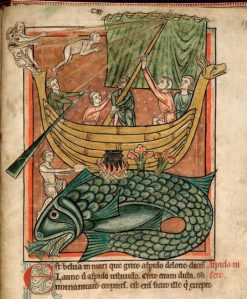
St. Brendan and his crew celebrating Easter on the back of a whale. Found at http://saintsbridge.wordpress.com/2013/12/20/celts-to-the-creche-st-brendan-the-navigator/.

St. Brendan and his crew celebrating Easter on the back of a whale.
Found at http://saintsbridge.wordpress.com/2013/12/20/celts-to-the-creche-st-brendan-the-navigator/.

Back To Top
Abstract

Beowulf tells a more detailed version of his swimming contest with Breca.

Back To Top
Translation

“‘We had swords naked, as we two rowed over the waves,
hardiness in hand; we two against the whales
thought to protect ourselves; he not at all far from me
could float on the ocean-waves,
the swifter on the swell, I would not float from him.
When we two together had been on the sea
for five nights’ time, then we two drifted apart on the flood,
wading on the raging waves, in the coldest of weather,
the night darkened, and the north wind
battle-grim blew against us. Wild were the waves,
enraging the hearts of the sea-fish.'”
(Beowulf ll.539-549)

Back To Top
Recordings

Old English:

{Forthcoming}

Modern English:

{Forthcoming}

Back To Top
Understanding Beowulf’s interjections

In this part of Beowulf’s version of the swimming contest story, we see a return to an old form.

Once more Beowulf is setting descriptions within his narrative, dropping short descriptive phrases between points of action. And he’s doing it an awful lot. So much so that I can’t help but wonder if the poet is deliberately having Beowulf chew the scenery.

Or maybe this is just what Beowulf, brash and bold, is like when he tells a story. Perhaps working through each of his little description digressions will help shed some light on what exactly is going on.

The first one comes in line 540: “hardiness in hand” (“heard on handa”). In reference to the swords that they held in their hands as they swam, this line seems like it’s mostly a space-filler.

It reiterates that the swords they held to guard themselves are hard, and therefore useful weapons. Not to mention, within the alliterative scheme of the line, the original Old English alliterates entirely with itself.

This alliterative scheme separates the first half of line 540 from the second, which in turn suggests the semi-colon that divides the line in Heaney’s text, and the comma that does something similar in the text found on the McMaster University site I link to beneath the extract.

So would Beowulf the speaker run one of his sentiments into another line like this, overflowing his expression in such a way?

Maybe.

I mean it is the beginning of the passage, and it’s not unlikely that he’d feel impassioned as he told of yet more of his wondrous feats.

So, maybe in putting this half line here and having it link directly with the previous one the poet is showing Beowulf’s near loss of control over his own story and his own boasting. Or, maybe at this point Beowulf’s starting to feel all that ale he’s no doubt been drinking.

The next among Beowulf’s additional phrases is line 543’s “the swifter on the swell” (“hraþor on holme”).

Definitely Beowulf’s way of making sure that everyone knows that he’s the stronger swimmer between he and Breca, this half line fits perfectly with its surroundings. It doesn’t seem to be overflow or anything like that.

So what’s it mean for it to be compartmentalized like it is?

I think, if anything, because this statement is a boast. Beowulf’s been boasting since he was a child, he knows his way around such things and is able to smoothly fit it into his description of their swimming. It almost naturally flows with what’s around it, too.

It’s sort of difficult to pin down the next extraneous descriptive phrase, because after line 543 they all become necessary.

Beowulf’s description of his and Breca’s “wading on the raging waves,” how the atmosphere shifted to “the coldest of weather,” how “the night darkened” and the storm winds picked up around them, all feed into each other.

This part of the extract practically imitates the storm it describes. The shuffling of four distinct and independent half-lines simulates the way in which everything around Beowulf and Breca at this point came crashing into them.

This analysis runs a bit short of something you’d find in an academic journal, but I think the main thing to take away from it is that Beowulf, for all his prowess on the battle field, is not so great in front of a crowd. He’s only truly comfortable speaking about the battles in which he fares so well.

We can see this as his interjections move from the strangely extraneous feeling, through to a boast, and ending with a series of short clauses that themselves descriptively crash against themselves.

Before he starts into the threat of the “sea-fishes.”

But that’s in next week’s extract.

What do you think of Beowulf’s speechifying? Is this part of his reply to Unferth perfectly smooth or is it as craggy as I seem to think? In either case, what do you make of it?

Back To Top
A word on “whale”

Okay everyone. There are, as always, more words than one that are notable for one weirdness or another in this week’s passage.

However.

One stands out from the rest. Technically two. (They both carry one word that could unlock them both.)

This word is “fiscas,” as it’s found in the compounds “hron-fixas” and “mere-fixas.”

The first of these combines the word for “whale” and for “fish” to make the word “whale.” Seamus Heaney translates the instance of “hron-fixas” on line 540 as “whale-beasts;” Francis Gummere translates it as “whales;” and C.L. Wrenn offers “whale.” So it sounds like there’s agreement across the board.

But why append “fixas” to the word for whale? Well, if you guess “for alliteration” you would be sort of right.

As I mention above, line 540 is neatly divided by its caesura. On the left side of the line “h” is definitely the alliterative sound. But on the right side of that caesura, where “hron-fixas” is found, the alliterative sound is “w.”

So another alliterative pair stands between it and its alliterating brethren. It’s safe, then, I think, to say that “hron-fixas” isn’t there to add music to the poetry of Beowulf’s speech.

Maybe, then, the dictionary will have some answers.

Looking at the definition of “fixas” in Clark Hall and Meritt only yields up “fish” (after pointing us to “fisc”).

So that doesn’t really tell us much about why the poet didn’t just use “hron” either.

Perhaps, then, looking at “mere-fixas” will shed some light on why “hron-fixas” has that extra “fixas.”

In Seamus Heaney’s translation, the “mere-fixas” of line 549 is translated as “sea-brutes.” Gummere gives us “sea-fish.” C.L. Wrenn gives us the straightforward variation “fish of the sea.”

What other sort of “fish” were the Anglo-Saxons writing about?

But that brings up a good point. Especially with “mere-fixas,” both of these compounds are redundant. That is, “hron-fixas” and “mere-fixas,” combine words that are so alike that they easily reduce into one word when translated. But why compound them in the first place?

Well, since both involve “fixas,” which we’ve already established means “fish,” maybe it’s to emphasize their being in the sea. These aren’t land or sky beasts or brutes – they’re “sea-beasts” and “sea-brutes.” At least according to Seamus Heaney.

But, then why does Beowulf even bother calling these beasts “whales”?

My guess is that “whale” was just the Anglo-Saxon word for any enormous sea creature, whether it was actually what we know today as a whale or something else entirely (a giant squid or now extinct dinosaur-like creature).

Some have theorized, based on x-rays, that whales carry vestigial legs. It’s possible (though unlikely?) that the whales that Beowulf fought still had these legs and they were recognizable as legs. If that’s the case, then maybe these legs lead the Anglo-Saxons to seeing them as the sea’s guardians just as dragons were the guardians of caves and hoards.

Of course, because we don’t have Anglo-Saxons to pull aside and ask just what was meant by “hron-fixas” specifically, we may never know exactly what Beowulf means when he uses the word.

It could, after all, just be a general word for a general application that the poet felt was the best fit.

It should also be said that two men swimming in stormy waters aren’t likely to get a good look at such creatures. That they were swimming armed suggests that they weren’t worried about getting a good look, either.

How do you understand Beowulf’s use of “whale” and “sea-fishes”? Do you think he’s referring to things that we would refer to with these words, or some other class of animal entirely?

Back To Top
Closing

Next week, the action continues as Beowulf recounts his bout with one of these mysterious sea creatures.

You can find the next part of Beowulf here.

Back To Top

Beowulf’s reply to Unferth (part 1) and words with picky translations (ll.529-538)

Abstract
Translation
Recordings
Beowulf’s opening statement
Tallying swimming strength in youth
Closing

A young man makes a mead hall stand.

A young man makes a mead hall stand.

Back To Top
Abstract

Beowulf presents his counter argument to Unferth’s accusations of weakness and introduces his version of what really happened with Breca.

Back To Top
Translation

“Beowulf spoke, son of Ecgtheow:
‘Well, you are very much, my friend Unferth,
beer-drunken speaking of Breca,
telling of his victory! The truth as I reckon
is that I more swimming strength had,
hardship on the waves, than any other man.
We two dared and bet with each other
since we were children – we two were then
yet in youth – that we two out on the spear-sea
would risk our lives; and so it happened.'”
(Beowulf ll.529-538)

Back To Top
Recordings

Old English:

{Forthcoming}

Modern English:

{Forthcoming}

Back To Top
Beowulf’s opening statement

Well, if Beowulf is to be believed, Unferth is in his cups at this point. But Beowulf? If he’s been drinking, then drink may well make him more eloquent.

Immediately after Unferth’s saying that Beowulf is not as great as he’s said he is, the main man himself throws down his rebuttal.

Ever aware of the order of things, though, Beowulf doesn’t just reply with a quick “That’s not true!” (or the even simpler “nuh-uh!”). Instead we get a very structured, very well laid out rebuttal of what one of Hrothgar’s closest thanes had to say about Beowulf.

First in Beowulf’s reply we hear what Unferth did in the subtext of his accusation: Beowulf attacks Unferth’s character.

Of course, being Beowulf, he does so up front and boldly. Making the jab that Unferth’s not doing the talking, but the beer is if he’s going to say that sort of thing about Breca. I like to think that Beowulf paused for laughter then, if only that of his own men (while Hrothgar, or maybe some of his other thanes, groaned).

Then Beowulf presses onward to “The truth as I reckon” (“Soð ic talige” (l.532)). He admits that making such a bet is reckless, but also that that was just the nature of his friendship with Breca. It’s not direct, but I read this as Beowulf’s reply to Unferth’s implication that the swimming challenge was something off the cuff or coming from a drunken mind.

What’s more, Beowulf reflects that he and Breca were yet young then, and so the foolishness of the boast should be definitely be set aside.

Now, whether the poem’s audience or the audience in the poem (or both) would find this funny is up for debate. But, at this point in the poem, Beowulf can’t be older than 20. So, though he may well have been younger when he and Breca braved the waves in this foolish bet, he isn’t now that much older.

I get the definite impression that Beowulf, as serious as he may be taking himself here, might also be trying to diffuse the seriousness of Unferth’s attacks with some comedy. He may be trying to lighten the room a bit so that things don’t get too gloomy and throw him off his game (or get him thrown from the feast table). As pompously as he says it, I think the bit about their age is meant to sound similar to someone today saying (perhaps starting with an audible sigh) “Ah! We were so young and foolish then!”

Whatever sort of verbal tricks and public speaking strategies Beowulf might have used up to the end of this week’s extract, its final sentence really shows his acumen as a story teller.

Or, at the least, it shows the poet’s desire to have his subject appear to be expert in this essential skill. Compelling storytelling would be essential even for warriors, though, since if you couldn’t tell a great story (or had such a teller with you always), how would your deeds be immortalized in the memories of men, women, and children?

Whatever the case, Beowulf’s saying that he and Breca bet that they would risk their lives on the “spear-sea” (“gar-secg” (l.537)) – not even just the “secg” but the dangerous-sounding “gar-secg” – and that things turned out that way too is the perfect end point for an introduction. It’s like the hook you’d find at the end of a book’s prologue or first chapter.

It’s also important that Beowulf make this predictive statement since it suggests that circumstances would see the boast fulfilled. He’s just boasted about beating Grendel (god willing), so making good on a boast about racing in the sea would help boost his hosts’ confidence in him. Such a statement reinforces the idea that Beowulf is able to turn his words into deeds.

Do you think that Beowulf’s really putting this much thought into his reply to Unferth? Or is he just opening his mouth and talking?

Back To Top
Tallying swimming strength in youth

I don’t think any Anglo-Saxon would have sucked on the blade of grass he had in his mouth, thumbed his overalls, rocked on his heels and said “Well. I reckon…” But Beowulf pretty much does just that before he tells Unferth and whomever else is listening his version of the Breca event.

Nonetheless, the word he uses in his “The truth as I reckon” (“Soð ic talige” (l.532)) is “talian,” (the root of the modern “tally”) a word that can also mean “count,” “calculate,” “account,” “relate,” or “impute.” Among these options, I went with “reckon” because I think that even in Old English this understanding of “talian” connotes clear, sober thinking. Unferth may have been drinking well before the Geats arrived, but Beowulf’s maybe had a mug or two. So I think “reckon” suits when it comes to describing his present thinking.

Such presence of mind and considered thought also give Beowulf an air of maturity. Though authority and gravity weren’t the only things the Anglo-Saxons saw coming with such maturity. They also seem to have thought mastery came with it, too. At least, that’s what I’ve gleaned from the word “mere-strengo.”

This compound combines the word for “sea,” “ocean;” “lake,” “pond;” “pool,” or “cistern” and the word for “strength,” “power,” “vigour,” “ability,” “firmness,” “fortitude,” “manhood,” “mature years.” Together these words mean “strength in swimming.”

Looked at apart, though, we get a pretty clear suggestion that such skill, such strength, comes only in “manhood,” or “mature years.” The implication that I pull out of that being that you can only achieve that level of strength after practicing something into your “mature years.” Actually, if that’s the case then translating “geogoð-feore” of four lines down as “youth” seems inaccurate.

Yes, Beowulf and Breca would have been fairly young when their boast was made and carried out, but “geogoð-feore” implies more than simply being “young.”

As a combination of the word for “youth” (“geogoð,” which even sounds sort of like the Modern English word since its vowel-ensconced “g”s are pronounced as “y”s) and the word for “life, principle of life, soul, spirit” (“feore”) a literal translation of this compound could be “youthful in spirit”.

What do you think is more important when it comes to translation? Is it better to go with the rough equivalent of a word in Modern English even if it simplifies the Old English original, or should a translation err on the side of being literal as much as possible?

Back To Top
Closing

Next week, Beowulf details the dangers the two faced, their strength in the race, and what befell them on the sixth night.

You can find the next part of Beowulf here.

Back To Top

Unferth doubly damns a doomed Beowulf (ll.520-528)

Abstract
Translation
Recordings
Unferth’s biting conclusion
Normal words spiced with speculation
Closing

A medieval depiction of a donkey. An apt animal for Unferth.

A medieval depiction of a donkey. An apt animal for Unferth.

Back To Top
Abstract

Unferth finishes his account of Beowulf and Breca’s swimming match before predicting Beowulf’s doom at the hands of Grendel.

Back To Top
Translation

“‘Then he sought his dear father land
those dear to him, the land of the Brondings,
splendid strongholds against war, where he had folk
fortress and rings. So in truth the son of Beanstan
fully bested you by endurance in your bet with him.
Then I believe that you will have the worse outcome,
though thou hast thrived in combat everywhere,
bloody battle, if thou darest wait
nearly all the long night for Grendel'”
(Beowulf ll.520-528)

Back To Top
Recordings

Old English:

{Forthcoming}

Modern English:

{Forthcoming}

Back To Top
Unferth’s biting conclusion

Haters are gonna hate. Doubters are gonna doubt. But Unferth, really, seems to be neither of these things.

There’s no two ways about it: he doesn’t like Beowulf. And his account of the swimming match between Beowulf and Breca does not put the poem’s titular character in a good light.

But, I don’t think Unferth’s being entirely dismissive of Beowulf either last week’s or this week’s half of his outburst. I think he’s being a little more precise with his heckling.

I’m grounding this idea of Unferth’s being more subtle in his line “though thou hast thrived in combat everywhere,/bloody battle” (“ðeah þu heaðoræsa gehwær dohte,/grimre guðe” (l.526-527)). It’s sarcastic, sure. But Unferth isn’t just being smarmy, he’s saying that Beowulf lacks individual prowess.

Battles, such as they were in the early medieval period, were free for alls. Melees.

As such, there would be individual bouts, sure, but these would be surrounded by other fights. Within the mesh of warriors mashing each other to pulp archers could have your back. Fellow warriors, spearmen or swordmen, could have your back. So as long as you were quick enough and didn’t get in the way of your support team, you could no doubt do quite well and be quite the celebrated warrior.

After all, the Anglo-Saxons recognized that team work was an essential thing both on and off the battlefield. They were well aware that if you completely isolated yourself socially, you would have no means of understanding what was going on outside of your hall or hovel.

So I think that Unferth presents his account of Breca to say that Beowulf, for all of his boasting about beating Grendel, isn’t likely to come off well because his usual strategy of working in a tight team (he does have what is basically a comitatus of 12 Geats with him after all) won’t work because it hasn’t worked for the Danes.

Moreover, I think Unferth’s using the swimming match to illustrate Beowulf’s individual incompetence is meant to underline his inability to cope with things alone. It was he who floated off and wound up washed ashore in some foreign land, after all.

Breca, on the other hand, according to Unferth (or rather, the version of events that he heard – or maybe is making up on the spot), won their match handily. As such Beowulf is bound to get “the worst outcome” (“wyrsan geþingea” (l.525)) if he waits for Grendel.

As to why Unferth bothers specifying the difference in Beowulf’s team and solo performances in this subtle way, I think it’s because it’s more biting than just saying “hey, you work well in a team but stink on your own.”

Unferth is supposed to pose a threat to Beowulf’s state of mind and the way in which he’s perceived by the other Danes. Thus, he damns him directly and then follows up with further damning via faint praise. At least poetically (and in my own opinion), this is the best way to do so.

What do you think? Is Unferth just being sarcastic when he talks of Beowulf having “thrived in combat everywhere”? Or is there a bit of faint praise there?

Back To Top
Normal words spiced with speculation

What to say about the words in this extract, this passage? Well, there aren’t many strange compounds. Actually, there really aren’t any at all.

There’s the word “eðel,” meaning “country,” “native land,” “ancestral home.” This word is completely straightforward when it comes to translating (though some might argue its implications that Anglo-Saxons had a sense of nationality or some grander unity beyond their immediate group are anachronistic).

But in this word’s dictionary entry, you can find that it combines with the word for whales (“hwales”) to make a compound word for “sea.” Of course, this makes sense, since the sea is the whales’ ancestral home and native land.

Though I can’t help but read this combination and think that the Anglo-Saxons had some crazy ideas about the origins of whales and just what they were. It’s not very likely, but maybe some had over developed vestigial legs and so the very early Anglo-Saxons regarded the whales as being somewhat like them?

Or maybe because of the whales’ incredible strength and size and sociability they were regarded as being powerful denizens of the sea in a kind of spiritual way.

Maybe they were just big creatures that captured the imaginations of the Anglo-Saxons and fired up many a tale around a hearth fire.

There’s also the phrase “þaer he folk ahte.” Unferth uses this to describe Breca’s homeland. It more than likely means that he just had kinsmen there. But, because the word “ahte” means “to have, possess,” and combines with “folc,” could it be a reference to Breca’s having slaves or servants in that country?

It’s incredibly unlikely that that’s what’s intended, but it is something to think about. Maybe “having slaves there” was a kind of short hand for “has a well-established home there.” But that’s some deep speculation on my part. So deep in fact, that it’s pretty much groundless.

Rounding out the collection of words to at least stop and sniff at in this week’s passage is “freoð-burh.”

A combination of “friðu” meaning “peace, safety, protection; refuge, asylum” and “burh” meaning “stronghold,” “enclosed area,” this word strikes me as notable for its redundancy.

You’d hope that a stronghold or enclosed area would offer safety and protection. Though, maybe it’s like Old English’s use of double negatives for emphasis. Doubling up on words that imply protection means that this fortress of Breca’s is nigh unto impenetrable and so well-supplied that none could successfully lay siege to it or capture it in all out war.

If this Breca is the same Breca who later became a ruler of the strategic Swedish island of Brännö, then such a fortress may well have been there. Any strategic site in medieval Europe would need to be well fortified, after all.

What do you think of my interpretations of these words and phrase? Am I onto anything, or just filling space with groundless speculation?

Back To Top
Closing

Well, we’ve heard Unferth’s heckling of Beowulf. It kind of splutters near the end, though. Next week we’ll get the main man’s reply.

You can find the next part of Beowulf here.
Back To Top

Unferth blasts boasts, and I wonder about boats (ll.506-519)

Abstract
Translation
Recordings
Unferth blasts boasts
Did Beowulf and Breca row or swim for their row?
Closing

Back To Top
Abstract

Unferth sets up his eventual accusation of Beowulf.

Back To Top
Translation

“‘Art thou the Beowulf, he who contended against Breca,
on the wide sea in a swimming contest,
where you two for pride moved as you could
and for a foolish boast in the deep water
ventured your lives? No man whatever,
neither loved nor loathed, could dissuade you two
from that distressing journey, as you rowed out to sea;
there you two eagerly covered the waters with your arms,
traversing the sea-street, moving more quickly with your hands,
gliding over spear-like waves. Ocean ripples roiled,
the winter’s surge; you two on the waters
had toil for seven nights; he who the flood overcame,
it had greater strength; so that come the morning
the sea had carried him to the land of the Heatho-Reams.'”
(Beowulf ll.506-519)

Back To Top
Recordings

Old English:

{Forthcoming}

Modern English:

{Forthcoming}

Back To Top
Unferth blasts boasts

Unferth addresses Beowulf like any one wishing to talk to someone contemptuously would: in the third person.

But what’s weird about how Unferth speaks to Beowulf in this part of his counter-boast is that he continues to talk about Beowulf in the third person after starting with “[a]rt thou the Beowulf[?]” (“[e]art þu se Beowulf[?]” (l.506))

The distancing that’s going on in this continued use of “he” definitely makes it clear that Unferth wants as little to do with the Geat as possible.

It also makes it clear that he’s holding himself aloft from Beowulf’s heroic persona.

Unferth’s relation of the swimming contest definitely doesn’t confirm Beowulf as some sort of grandiose figure. Instead it portrays him as nothing more than an idle-boaster (think of a drunk challenging all comers to whatever contest they might cook up), someone who tries to aggrandize himself through pointless challenges. Not entirely unlike a lot of modern day reality TV.

Actually, I think the implication of Unferth’s claim and that sort of TV are the same.

He’s implying that Beowulf has nothing better to do than to engage in such contests, just as a lot of reality TV’s audience probably has nothing better to do than watch (and/or participate). Unferth’s point in making this implication is to show that Beowulf isn’t nearly as worthy as a champion as he’s made himself out to be.

In fact, Unferth suggests that Beowulf not only lost the swimming contest, but in fact wound up washed ashore – the sea overcame him!

Him, the one with the power of thirty men in his grip!

Him, the one who has so pompously boasted that he will kill Grendel (if god so allows)!

On the one hand it’s easy to see how Unferth’s bringing up an old challenge is a direct attack on Beowulf’s integrity. Maybe the story of this swimming match is something that Beowulf would rather keep under wraps, and Unferth, in revealing it to all of Heorot’s gathered elite, has destroyed Beowulf’s posture of perfect warrior-hood. Or maybe it’s something ambiguous that Beowulf’s had to explain away before.

On the other hand, is there really any shame in being overcome by the sea? Especially after, as Unferth puts it, having “had toil for seven nights” (“æht/seofon niht swuncon” (ll.516-517)) on its waters?

It’s easy to see how Unferth’s sudden accusation would probably turn heads and gather all of the crowd’s attention onto Beowulf – the one who, until Unferth opened his mouth – was very clearly the focus of the Danes’ hopes for relief from Grendel.

But, I think, Unferth’s broad and accusatory tone, combined with his distancing Beowulf through the use of the third person in his accusation, also signalled to the poem’s listeners that Unferth’s threat to Beowulf’s heroic image is fiery but unfounded. His appeal to the rhetorical tactic of immediately seizing upon some hitherto unknown weakness of his target probably sounded as desperate to that early audience as it does to us, familiar as we are with political debates.

In fact, we can, I think, almost see Beowulf slowly nodding and grinning slightly as Unferth speaks, knowing full well that he can either twist the man’s version of the story to maintain his heroic image or correct it with his own version of what happened – the truth.

Do you think Unferth is just a strawman the poet set up for Beowulf to knock down? Or does he pose a real threat? Write your take in the comments.

Back To Top
Did Beowulf and Breca row or swim for their row?

The exact word that Unferth uses to describe the challenge between Beowulf and Breca is “dol-gilpe.” This word, when translated as a whole comes out as “idle-boasting.” Taken as the words “dol” and “gilpe” we get “foolish,” “silly,” and “presumptuous,” and “boasting,” “pride,” “arrogance,” “fame,” and “glory” respectively.

Cultural differences between the Anglo-Saxons and ourselves aside, the first half of the word is none too flattering, and being able to interpret “gilpe” as “arrogance” doesn’t do much for the second half. So this word’s pejorative connotation, at least in Unferth’s usage, is pretty clear to see.

Even combining one of the more upstanding interpretations of “gilpe” with any of those for “dol” gives us something like “silly glory” or “presumptuous glory.” In other words, a sort of glory that is as valuable as the sands on which Beowulf washed up. This quality of “dol-gilpe” shows that there is some meat to Unferth’s calling Beowulf out on his boastful ways.

In a way, Unferth’s even trying to get under the skin of boasting words in that using the word “dol-gilpe” could well imply that all boasts are nothing more than words.

Although the parallel isn’t perfect, it could even be that Unferth is trying to make the swimming contest and Beowulf’s challenging Grendel parallel events. Both start with idle boasting, nothing more than words, and then deeds are quickly shown to run contrary to all those words. Actually, on the level of words, Unferth could also use this compound (matters of the poet’s concern with alliteration aside) to call attention to Beowulf’s affected way of speaking, his use of stiff forms of address and of formalized rhetoric.

On the topic of words and their being void of meaning, Unferth’s “reon” in line 512 may as well mean nothing.

This word, as it appears, means “rowing.” It could also, however, mean “go by water, sail, swim.”

In the context of Unferth’s telling of the swimming contest between Breca and Beowulf this brings up a small, but niggling question: Did they row out to sea and then start swimming? Or did the two start from the shore?

As I said, it’s a very minor thing, but it is an important detail. If they did row out to sea in a boat, then it’s likely that some sort of third party was involved – otherwise that boat would have to be abandoned.

If there was a third party, he could have stopped the two, or he could have been the contests’ judge. Also, if they did go out in a boat, then maybe the race was merely from the boat to the shore. In that case it’s possible that Beowulf wound up ashore elsewhere because he tripped on the boat’s edge, fell into the sea rather than heroically leaping into it, and was washed away.

If “reon” is meant to be “swim” or “go by water,” though, and Beowulf and Breca swam for the entirety of their challenge, then it could well have been nothing more than a contest between two drunks who jumped in the ocean late at night and wound up ashore elsewhere some time later.

Without clarity about the boat – not to mention clarity about the rules of the race – it’s entirely unclear just what happened. We only have Unferth’s (and later Beowulf’s) version of events to go by.

There may be some clue as to how deep the waters were, though, in the word “gar-secg.”

Literally translated as “spear-sea,” this word implies that the waters were choppy, the tiny waves atop it looking like spear blades pointing skyward (or, feeling like the points of hundreds of spears because of the intense chill). If the waters were that choppy, the race must’ve been a ways out to sea, and a boat was probably present. Probably. Maybe the boatman was among the “neither loved nor loathed” (“ne leof ne lað” (l.511)) who couldn’t dissuade Beowulf and Breca from their fool’s errand.

Do you think the two “rowed” out to sea, or “swam”? Leave your take on this in the comments.

Back To Top
Closing

Next week, Unferth’s attack on Beowulf continues. Can it get much nastier?

You can find the next part of Beowulf here.
Back To Top

Tolkien’s influence on Unferth? And unbinding battle runes. (ll.499-505)

Abstract
Translation
Recordings
Unferth’s first impression – a success?
Unpacking the battle runes
Closing

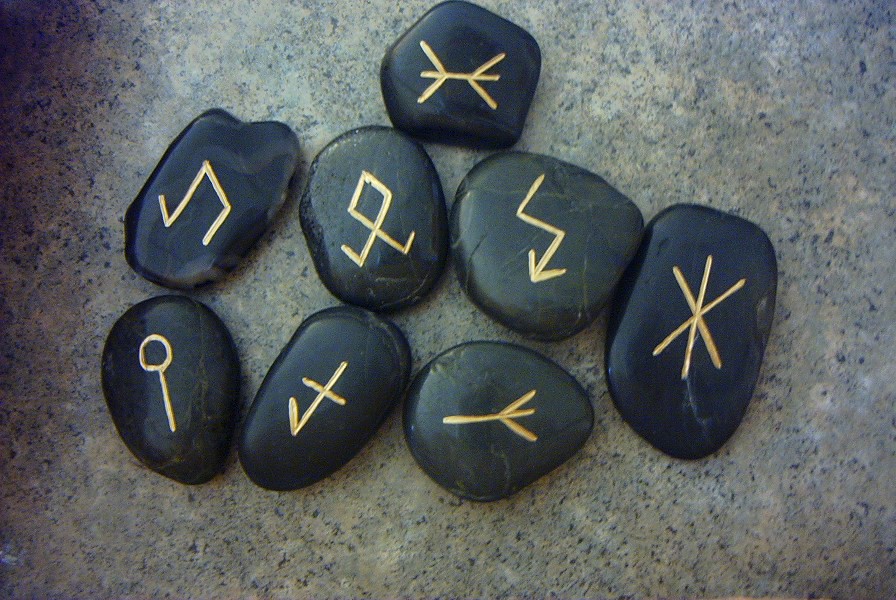
What they are: Runestones. What they mean: ...I'm not entirely sure.

What they are: Runestones. What they mean: …I’m not entirely sure.

Back To Top
Abstract

Unferth is brought onto the stage and introduced as a self-important toady who can’t stand the greatness of others.

Back To Top
Translation

“Unferth spoke, son of Ecglaf*
he who sat at the foot of the Scylding lord,
unbound battle words**, that venture of Beowulf’s,
the courageous sea-farer, a great grudge***,
for he would not allow that any other man
over all the earth and under heaven
could ever achieve fame to match his own:****”
(Beowulf ll.499-505)

Back To Top
Recordings

Old English:

{Forthcoming}

Modern English:

{Forthcoming}

*”Ecglaf” – “sword-leaving/Sword-heirloom” Hm. So he’s a child of war? Or is this a ref to penis?
**onband beadu-rune: unbound his ‘secret of a quarrel’ [HALL, MERRIT]//battle words/hostile words [CL WRENN] = unbound + war/battle/fighting/strife + mystery/secrecy/secret/counsel,consultation;council;runic character, letter;writing – Is this meant to be a foil to beowulf’s “unlocked his word hoard”? Hm…
***interweaving structure starts up here. This clause refers back to the battle words.
****Gets really, really tangled in terms of regular ModE syntax here. A literal translation is
“|that any other man//ever fame compared to greater|in earth//care for under heaven| than he himself:”
-Unferth introduced as one who sits at the feet of Hrothgar, a close councilor, a coward who is close to Hrothgar to avoid fighting. Does this relate to his father’s name? Is my impression of him as wormtongue because he could be the template for wormtongue or because I encountered wormtongue first? Hm…little help, Tolkien?

Back To Top
Unferth’s first impression – a success?

Beowulf is not a poem that’s full of characters or character introductions. Many of those that do appear in it are just dropped into place. Wulfgar, Hrothgar’s trusted councillor and herald is a great example of this class of character. Major characters like Hrothgar and Beowulf, on the other hand, get more of an introduction.

And then there’s Unferth.

This guy, whom I’ll forever remember as being well-played by John Malkovich in the mostly terrible Zemeckis Beowulf of 2007, is a character of a third sort.

Unferth occupies a grey middle ground between protagonist and antagonist. In this position he’s able to become a much more interesting character than most of the others in the poem. Yet these seven lines are his introduction, and set the tone for his character going forward.

So what can we say about him?

Being told that he comes from the foot of Hrothgar, tells us that he’s very close to the elder Dane. He’s probably a councillor in a similar capacity to Wulfgar.

However, his breaking into the poem with the line “Unferth spoke, son of Ecglaf,” (“Unferð maþelode, Ecglafes bearn” (l.499)) gives the impression that he’s been holding his tongue until this very moment, at which, like a coiled cobra, he strikes into the din of the partying troop.

Nonetheless, he’s saved from being entirely maligned in the reference to his father that the poet adds in for alliterative reasons.

Though what kind of a father a man named “sword heirloom” was is up for debate. Maybe he was the son of some sort of illicit, war-time love affair. Or, maybe more crudely, his name’s a play on simply being a “sword’s leavings.” Either way, it’s not him but his son (whose name in the manuscript is reported as “Hunferth”) that we’re concerned with here.

After the next line in which we’re told that he was sitting at Hrothgar’s foot the poet decides to shuffle the syntax of his line halves around. This means that, as had happened in some of Hrothgar’s dialogue, one line contains two halves that combine with the next line’s opposite halves to create full thoughts.

Making this change in descriptive poetry rather than dialogue, where we’ve mostly seen it before, leaves me with the impression that these lines are made to endure. They’re given extra care in their making, and so are meant to stand as important. Of course, the single phrase “unbound his battle words” (“onband beadu-rune” (l.501)) also marks this as important. For the poet earlier used a similar phrase to set off the first speech of the poem’s hero himself.

As a gamer immersed in the lore of The Legend of Zelda, I can’t help but take this parallel sort of setup as a cue to view Unferth as Shadow Beowulf.

This man is a reflection of Beowulf’s darker side and what he could become were he to use his powers for ill.

The poet doesn’t give much leeway for such an interpretation after this echoing phrase, though, since we’re told in some of the most tangled Old English I’ve ever read, that Unferth can’t stand the thought that anyone is considered more famous than himself.

Nonetheless, Beowulf’s key characteristic up to this point is his optimism. His boasts are claims of great power and the ability to defeat Grendel despite the odds. He willingly faces death with high hopes for glory.

Here, though, we’re shown that Unferth’s outlook is inherently pessimistic since he refuses to acknowledge anything great from outside of himself. To some extent, this portrayal makes him Beowulf’s foil. It also makes him a character that forces Beowulf to reflect on his own goals and aspirations. This gives Beowulf some room to grow spiritually, perhaps something that’s required of him to overcome Grendel.

It’s also got to be said of Unferth that I can’t decide if I view him as a slimy toady sort of character because I first encountered a similar type in Tolkien’s Wormtongue or if I see him as such because Tolkien used him as a template for Wormtongue.

What do you think is more likely? What came first in terms of impressions – the slimy underling Wormtongue or the shady and suspect Unferth?

Back To Top
Unpacking the battle runes

Carrying on from something mentioned above, let’s take a look at the phrase “onband beadu-rune” (“onband beadu-rune” (l.501)) Starting, of course, with the definitions of each word.

The verb here, “onband,” is quite close to its Modern English equivalent: “unbound.” It could also mean “untie,” “loosen,” “release,” or “disclose.”

The word “beadu” translates as “war,” “battle,” “fighting,” “strife.”

And, finally, the word “rune,” along with its less than helpful translation to the Modern English “rune” could also mean “mystery,” “secrecy,” “secret,” “counsel,” “consultation;” “secret council;” “runic character,” “letter,” or “writing.” Translating it as “words” is kind of a stretch, but it’s one that fits well and makes clear sense of the phrase.

But those first four definitions of the word are tempting. The word “rune” is clearly one that’s quite coloured by things unknown, unseen.

Perhaps it’s the poet’s use of this word rather than something more straightforward like, well, “word” that puts me in mind of Tolkien’s Wormtongue as I read this passage.

The word “rune” is definitely not used for reasons of alliteration, since it’s the only word that starts with “r” in the line. In fact, people who know more about Old English prosody than I could probably argue that “rune” could be substituted for with “word” with only a small change to the quality of the line.

So then why is it there? Why choose the word “rune” if it has these associations with the mysterious rather than a straightforward word?

I think it’s used here because it suggests that Unferth is about to say things that Beowulf would rather have hidden. He is about to challenge Beowulf not with swords but with facts to undercut his boasts.

In a metaphorical sense, this makes Unferth a representation of Beowulf’s doubt.

A hero of so clear a purpose and one-track a mind can’t be clouded by complex internal strife, and so the self-doubt that a normal person would feel in Beowulf’s position is placed in another character all together. Personifying Beowulf’s doubts like this allows him to overcome and disprove them, basically to work through them, in the forum that Heorot provides. It gives Beowulf a chance to speak through the secrets and possibly less-than-heroic facts of his past.

That Unferth would utter such secrets does nothing for his character, though. The idea that he can’t stand the existence or idea of there being people more famous than himself around boldly paints him as a schemer and underhanded coward. He’s a cad who would sooner undercut a boaster than suffer him to try to actually fulfil his boasts.

I think that quality in his character – an apparent desire to impose his own limits on other people – is what gives the lasting impression of Unferth’s villainy. He is made to personify the antithesis of the idea of grasping beyond what you expect is your reach.

As a people interested in treasure and in venturing off to new locales, I think it goes without saying that the Anglo-Saxons prized such a characteristic in people. It’s definitely a strong one in Beowulf and he’s the poem’s hero after all.

So maybe my reaction to Unferth is less learned and more cultural.

Back To Top
Closing

But just what are the secrets that Unferth lets out of the bag? Well, find out in next week’s extract!

You can find the next part of Beowulf here.

Back To Top

Taking a break for a brew and some nuanced words (ll.491-498)

Abstract
Translation
Recordings
Breaking for a brew
Words of nuance
Closing

Interlaced men motif. Image from http://public.wsu.edu/~hanly/oe/503.html.

Interlaced men motif. Image from http://public.wsu.edu/~hanly/oe/503.html.

Back To Top
Abstract

Space is cleared for the Geats to sit, ale is poured, and songs are sung in Heorot hall.

Back To Top
Translation

“Then for the Geat men together at once
a space was cleared on a beer hall bench;
there the bold went to sit,
exulting in their strength; a thane acted on that office,
he who in hand bore the adorned ale cup,
poured out the sweet brightness; the poet meanwhile sang
clear in Heorot; there were songs of heroic joy,
among the none too few noble warrior Danes and Geats.”
(Beowulf ll.491-498)

Back To Top
Recordings

Old English:

{Forthcoming}

Modern English:

{Forthcoming}

Back To Top
Breaking for a brew

It’s no secret that the Anglo-Saxons enjoyed their beer. Such could be said for all Germanic peoples, really. But, they weren’t swillers of whatever they could get their hands on. At least, one would hope so after reading such a vivid description of a perfect presentation and pour as that found on lines 494-496.

The best way to approach this description is line by line, since each has a singular focus.

First, the second half of line 494 is about the person doing the pouring. Notice that this is the shortest part of the description. Also, that pouring the ale isn’t just some act or event that stands in the way of drinking it – it’s an “office.”

The Old English word used is “nytt,” which could translate as “use,” “utility,” “advantage;” “duty,” “office,” “employment,” “supervision,” “care;” “useful,” “beneficial,” “helpful,” “profitable.”

The word “office” best captures the sense that I think is implied here, a combination of officialdom with importance.

It goes unsaid throughout these three lines, but aside from the enjoyment of a good brew, ale-pouring would have been one of the major ways in which a host could make an impression upon his guests. Just as various modern cultures have various drinking etiquettes, the Anglo-Saxons surely had their own. As such, knowing how to properly pour was likely included in this and something that was learned early and learned well.

There’s some room for interpretation in the word “þegn,” since it could mean “servant” or “retainer.” But, whether it’s someone who is only a servant in Heorot or who is one of Hrothgar’s remaining retainers, I think that the act of pouring ale in Anglo-Saxon culture confers a great deal of importance on the pourer. Just like a bartender who knows how best to get that stout from the tap to your glass, anyone who could pour ale well no doubt commanded some respect.

After all, it is that servant who bears the ornamented drinking cup (as read on line 495). Probably a large pitcher-sized thing from which the smaller cups were filled, this cup’s exact decoration remains unmentioned. Likely with good reason.

The recitation of poetry in Anglo-Saxon Britain happened in social settings. In such settings just the same sort of pouring and drinking would be going on, so leaving out any fine details that would make this “adorned ale-cup” a specific item allows hearers of the poem to step into the fiction of Beowulf through this detail (or lack thereof).

Perhaps some hearers may even have thought, “maybe this ale-cup that poet’s caterwauling about is just like this one?” as they admired the design carved around their own cup, fingering over its design as much as looking at it.

But the bearer and the cup are just vehicles for the ale itself. That’s why the most vivid brief description of all is saved for the ale (or mead?) itself – that “sweet brightness” of line 496. It doesn’t contain so much detail as to become self-parodying, but the original Old English, “,” is, nonetheless open to interpretation.

Heaney translates the phrase as “bright/helpings of mead.” Wren would render it “bright [or “glorious”] sweet drink.” And Francis Gummere went with “clear mead.” These are all fairly similar, and mead is definitely implied (if not outright stated).

Yet, it’s curious that the word for the drink is not “medu” meaning “mead” or “ealu” meaning “ale.” It’s possible that the poet declined the use of either because it was obvious enough to contemporary audiences what the drink was. Though to us (and to me) it’s rather vague. There’s mention of the ale cup, and yet this is a sweet drink that’s being poured out. So is it mead or is it ale?

A meaning taken for granted is lost to us.

Or maybe I just need to get a little of either in me to work this one out.

Back To Top
Words of nuance

One of the things that drew me to the study of words when I was younger is their power to reflect the values and ideas of the people and cultures who use them.

One of the words that stands out in this week’s extract is “swiðferhð.” Taken together, the word means “bold, brave, rash.”

Curiously, there’s a kind of gradient present in these definitions: to be called “bold” is generally a compliment, calling someone “brave” could go either way, and then calling someone “rash” sounds like a downright insult. Coming from a society that seems steeped in physical conflict and warfare, such nuance to a word that sounds like it should bear only positive connotations is curious. But, of course, contemplation and wisdom were highly valued in that society, too.

Taken apart, the word’s halves, “swið” and “ferð,” mean, respectively: “very,” “much,” “exceedingly,” “severely,” “violently,” “fiercely;” and “mind,” “intellect,” “soul,” “spirit,” “life,” “person.”

All of the definitions of “ferð are benign enough. But, the last four interpretations of “swið” sound like adverbs for something taken too far. Yet someone who is “severely spirited,” for example, could well be an asset or a liability on the battlefield. He’d be a powder keg, as likely to do much good as he would be to do much ill. So characterized are the Geats as they sit amongst the Danes for their entertainment.

I don’t think the poet means this as a backhanded compliment, though. I read the use of “swiðferð (aside from its use for alliteration’s sake) as the poet’s take on the Dane’s feeling about the Geats at this point. They don’t know if Beowulf will be successful against Grendel, or if he and his band will be smeared around their precious Heorot come morning.

Such an atmosphere is perfect for songs of man rejoicing, though. Or are they songs of hero gladness?

Line 497’s “hæleða dream” isn’t exactly a compound word, but its interpretation is still something of a crux.

The words “warrior,” “hero,” and “man” cover “hæleða” well enough. But that leaves the strangely familiar “dream,” a word that has a meaning that’s almost analogous to its Modern English cognate: “joy,” “gladness,” “delight,” “ecstasy,” “mirth,” “rejoicing;” “melody,” “music,” “song,” “singing.”

All of these words are close enough to one another, but the question is: which shade of meaning should someone translating Beowulf go with?

Songs of a warrior’s ecstasy are likely different from those of a warrior’s rejoicing. He might rejoice after a hard-won battle, but he may well be ecstatic right in the middle of it.

That’s kind of a problem of translation, though. Too often, in the process of moving words from one language to another, the original needs to be unpacked since all together it just won’t fit into its target language. It doesn’t help when one such word is attached to another (a man’s ecstasy is likely to be different from a man’s rejoicing, just as a warrior’s ecstasy is different from his rejoicing).

This sort of nuance might not be as wild as that of swiðferð or of other words I’ve covered in previous entries, but it’s still something that makes translating a fascinating task.

Back To Top
Closing

Next week, one of Hrothgar’s closest thanes calls Beowulf out on his boasting.

You can find the next part of Beowulf here.

Back To Top

Hrothgar’s pro-story agenda and two normal compounds (ll.480-490)

Abstract
Translation
Recordings
On the use of stories
Two normal compounds
Closing

A page from an illuminated manuscript. Image from http://www.myarmoury.com/talk/viewtopic.php?t=28126&view=next.

A page from an illuminated manuscript. Image from http://www.myarmoury.com/talk/viewtopic.php?t=28126&view=next.

Back To Top
Abstract

Hrothgar closes off his speech to detail with an account of the carnage Grendel has wrought upon Heorot.

Back To Top
Translation

“‘Quite often ale-drunken threats
from warriors were issued over ale-cups,
that they would wait in the beer-hall
for Grendel’s onslaught with sword horror.
Yet when morning came to this mead hall,
this noble-hall was blood-stained, as day was lit,
all the bench space was smeared with blood,
the hall battle-bloodied; then had I fewer loyal
dear men, those death had carried off.
Sit now to the feast, and in the hall hear
of heroes’ glorious victories, as thine heart urges thee!
(Beowulf ll.480-490)

Back To Top
Recordings

Old English:

{Forthcoming}

Modern English:

{Forthcoming}

Back To Top
On the use of stories

This week’s passage is pretty straightforward.

Hrothgar tells Beowulf of those who have come before him in sparse, yet gory, detail, and then sends him off to make merry. It’s such a quick turnabout that I wonder if it’s supposed to be comical.

Schadenfreude can’t possibly be that recent a phenomenon after all. Especially when it’d be crystal clear that Beowulf will win, despite the odds. I mean, the poem is named after him and so it’d be hard for it to go on too far beyond his death were Grendel to bring it about.

If not schadenfreude, then maybe there’s some sort of irony at work here. Maybe Hrothgar’s conclusion is meant to be tragicomic.

Or perhaps Hrothgar is just drunk. That’s another possibility for sure.

Whatever his own state is, Hrothgar’s definitely a tragic figure and so that could well be what’s powering the comedy here.

It’s also important to remember that these characters, as much as they are the front end of the poem, are still puppets dancing upon the poet/scribe’s strings of words.

Another possibility is that Hrothgar’s emphasis falls on his final sentence. Maybe he’s trying to get Beowulf to fill his head with stories in which the hero triumphs over the monster. Medieval belief in the idea that what you carried around in your head affected your conduct and life in general was pretty widespread after all. So the big man’s conclusion might be less for comedic effect and more along the lines of “get your head in the game!”

Actually, stepping into the territory usually reserved for the second section of these posts, the word that Hrothgar uses for “urge” in that last sentence is worth a closer look.

In the original Old English it’s “hwette,” a clear ancestor of modern English’s “whet” and also translatable as “sharpen, incite, encourage.” The last two of these definitions are what led me to “urge.” But keeping the first two possibilities in mind makes Hrothgar’s use of “hwette” all the more fascinating.

(A quick note, “hwette” appears not to be used for its alliterative qualities since this line’s sound is “s,” curiously.)

If Hrothgar (or the poet) meant to mean “whet,” or “sharpen” then the line still retains its meaning. Beowulf is still being encouraged to sharpen himself on the whetstone of stories. But what does that say about stories?

I think this line gives us some minor insight into how the Anglo-Saxons (and many other cultures of the time, in keeping with the belief that what you enshrined in your memory affected you) regarded stories. In instances like those in which Beowulf finds himself, they could be used as much for entertainment as they could be for preparation.

Under such circumstances, it’s not likely that such stories were not necessarily closely analyzed. They were likely taken more or less at face value; the heroes are real and the monsters are real and that’s that.

I think we can add a layer of complexity to this matter, though.

I don’t think that the Anglo-Saxon’s necessarily believed that the monsters and heroes of such stories were real. Instead, I think they regarded their deeds as being such stories’ major purpose. Regaling each other with such stories could help to remind people that whether it was with divine or supernatural aid, or merely through human wit and wisdom, people can overcome some very large obstacles.

However, just as it’s possible to over-sharpen a knife, I think that the Anglo-Saxons also believed it was possible to over-sharpen oneself on such stories as those that Hrothgar encourages Beowulf to give an ear to.

However willing you might be to believe that hero x defeated supernatural terror y, hearing too many of these stories would inevitably lead to an awareness of their gaps. Analysis of such stories – whether out loud or only on reflection – would seriously undercut their power to empower.

Though, perhaps that’s why such stories are traded over ale or mead or beer, rather than, say, strong coffee or gentle tea.

Back To Top
Two normal compounds

This week’s passage doesn’t have any wacky compounds.

However, it does have one that apparently isn’t in the Clark Hall & Meritt dictionary that I’m using as my primary reference.

This word is “hreðsecga,” meaning “hero,” and it’s from line 490. The glossary in the back of C.L. Wren’s edition of Beowulf does include this word, though, and in it he gives the quite literal translation of “glorious warrior.”

How is that quite literal?

Well, “hreð” means “victory” or “glory” and “secga” means “warrior,” “hero,” or “man.”

All in all it’s pretty straightforward.

Except that “secga” also translates to “sedge,” “reed,” “rush,” flag,” and “ocean,”

Given the word’s context it’s clear that it’s not meant to mean “glorious reed” or “glorious ocean.” But it’s curious to think that a word for “man,” or “warrior” could also mean things like that. Especially such unwarlike things as “sedge,” or “rush.”

A “flag” could refer to the standard or emblem that a tribe bore into battle for symbolic and psychological reasons. As the Anglo-Saxons (and the Danes and Geats) were familiar with sailing, the “ocean” may have been (and was) commonly characterized as war-like.

But, those plants are just there.

Still, it’s possible that the Anglo-Saxons saw sedge and rushes as bristling clumps of swords and spears respectively, mêlées in which a hundred swords were drawn, raised, and then frozen in the moment before they all strike their targets, preserving these scenes as grasses that bristle in the breeze.

Maybe these alternate translations for “secga” nod towards some forgotten myth about just such a martial scene being transformed into a plant doomed to dress the fen and marshy waste that the Anglo-Saxons populated with beings like Grendel. Such a myth wouldn’t be outside the ken of Western mythology, since Greek mythology is full of origin stories involving people being turned into plants.

The word “oret-mecgas” is another compound word found in this week’s passage (on line 481). It doesn’t carry any mystifying possible alternate meanings like “hreðsecga,” but it’s a compound word that sort of tells a story.

The word’s first part, “oret,” means “contest,” or “battle” and its second part means “man,” “disciple,” or “son.” So, combined, the whole compound literally means “disciple of battle” or “son of contest,” referring to someone deeply versed in combat. Indeed an apt definition for a word meaning “warrior.”

Back To Top
Closing

Next week Beowulf and his crew are treated to an intermission of mead and minstrel song before a new challenger appears.

You can find the next part of Beowulf here.
Back To Top

Hrothgar’s speech gets casual but his words stay interesting (ll.456-472)

Abstract
Translation
Recordings
Hrothgar gets calculatedly casual
Less colourful words, but words nonetheless
Closing

An example of an image touched with gold leaf from an illuminated manuscript. Image from http://ica.princeton.edu/conferences/2010march16-17.php.

An example of an image touched with gold leaf from an illuminated manuscript. Image from http://ica.princeton.edu/conferences/2010march16-17.php.

Back To Top
Abstract

Hrothgar replies to Beowulf. He opens with an explanation of how and when he knew his father.

Back To Top
Translation

“Hrothgar spoke, protector of the Scyldings:
‘For manly deeds thou, friend of mine Beowulf,
and for our benefit have you sought us.
Thy father fought his way into a terrible feud,
he became Heatholaf’s killer by hand
amongst the Wulfings; so that he might not have
shelter with those kin for dread of war.
From thence he sought South Dane folk
over the surging waves, the Ar-Scyldings;
that was when I had just begun rule of the Danish people
and in youth governed this fierce empire,
walled and treasure-filled towns of warriors;
then was Heregar dead, my elder kinsmen left unliving,
son of Halfdane; he was better than I!
Afterwards I settled that feud with goods;
sent I to the Wulfings over the water’s ridges
old treasures; he to me oaths swore.'”
(Beowulf ll.456-472)

Back To Top
Recordings

Old English:

{Forthcoming}

Modern English:

{Forthcoming}

Back To Top
Hrothgar gets calculatedly casual

It seems that Beowulf has proven himself to Hrothgar.

Certainly not because he’s shown the Danish lord what he can do, but because his words have inspired him with belief. That’s my explanation for Hrothgar’s switching to a more plain speaking style, anyway.

Throughout the entirety of his speech in this week’s extract, Hrothgar leaves out any sort of interlaced structure. He doesn’t start an idea before the caesura of one line and then end it on the opposite side of the next line’s mid-way pause.

Considering that he’s just met Beowulf, and only just heard him speak, Hrothgar is also being quite open and forthwith. Certainly the thanes that he has around him would only faintly correct him when he says that his brother was a better man than he (l.469) at this point in the struggle with Grendel, but it’s still a strange thing to admit to a total stranger.

One thing’s for sure, historical accuracy in regards to these men’s exchange takes a back seat here.

Instead of having to go through several meetings to get to this level of candid speech, Hrothgar just immediately moves to it after hearing Beowulf’s pitch. And that is exactly what the main man’s speech was, a pitch.

Epic poems can’t be all bluster and long-winded speeches after all, so rather than showing a series of meetings between the leaders where Beowulf and Hrothgar gradually build up a rapport and mutual trust (no doubt a decent way to turn this story into a modern novel), the poet just has Hrothgar accept Beowulf at his word. Oh – and at his father’s word, too.

For, although Ecgtheow isn’t present, I think his having sworn oaths to Hrothgar (l.472) gives Beowulf some privileges within his estimation. From the sounds of it Ecgtheow caused Hrothgar some worry when he was just starting to rule over the Danes, but I think something important remains unsaid here.

I think that Hrothgar’s being given the opportunity to solve the feud between Ecgtheow and the Wulfings is something that he used to secure his then new-found position as ruler of the Danes.

On line 467 he describes the Danish people as consisting of “walled and treasure-filled towns of warriors” (“hordburh hæleþa”). These are a people who would probably not readily transition into having a new king. Any one who was fresh to the throne would likely have to prove himself worthy of it.

Such proof would probably come in the form of a show of might, but I think part of why Hrothgar brings up Ecgtheow here is that he sees the man as having given him an alternative way of showing is aptitude. He’s given a diplomatic situation to solve, and he does so handily. Hrothgar sends the Wulfings what amounts to wergild – payment as recompence for a slaying – and gets the exile to swear oaths to him. Thus, the Wulfings are appeased and the threat that is Ecgtheow is neutralized.

So on one hand, Hrothgar helped Ecgtheow when he was in a tight spot. Being exiled because you’ve killed a man with your bare hands isn’t an enviable position. But Hrothgar took Ecgtheow in. On the other hand, Ecgtheow helped Hrothgar, though it seems that this help was much less explicit. Yet, I think that Hrothgar is well aware of both of these and so he feels desperation because only might (something Hrothgar lacks) can deal with Grendel and a sense of obligation to Ecgtheow’s kin.

Hrothgar’s feeling this way explains his shift into a more open style of conversation.

Going further, I think that Hrothgar mentions the oaths that Ecgtheow swore to him to confirm to Beowulf his father’s honorability and to inspire in our hero a sense of filial obligation. Beowulf did not take such oaths. Nor can he be expected to at this point in his relationship with Hrothgar.

Yet, Hrothgar would certainly have been aware of Beowulf’s understanding of the importance of words after hearing his pitch. Thus, he likely mentioned his father’s oaths in a calculated move to appeal to Beowulf’s underlying philosophy of following through on his word.

So Hrothgar’s jumping to much more open speech (though it’s still not free from his use of words like “ðu”) fits into the poem’s current situation. This shift is also, of course, a convenient way to pick up the story’s pace.

Back To Top
Less colourful words, but words nonetheless

Hrothgar’s speech is much less colourful than Beowulf’s. He doesn’t use nearly as many words that could be interpreted in more than one way, nor does he use that many compound words. Though of those that he does use, the curious “hordburh” and “gesloh,” an example of how much the prefix “ge” can change a word, are worth pointing out.

The word “hordburh” is made up of the word “hord” (meaning “treasure”) and the word “burh” (meaning “walled town,” “fort,” or “castle”). This word is noteworthy partially because it also appears in the Anglo-Saxon poetic version of Genesis and the Cartularium Saxonicum (a collection of Old English charters), and apparently in all three can mean simply “treasure city.”

Now, fierce as the Danish people that Hrothgar rules over are, and as likely as they are to live in towns filled with plunder, “treasure city” just doesn’t have enough of a ring to it for my tastes. So I got a little creative and instead rendered “hordburh” as “walled and treasure-filled towns.” It’s a bit wordy, but I think it works.

Modern English just doesn’t compound like its ancestor.

The other word to be aware of in this week’s excerpt is “gesloh.”

This prefixed verb means “to enter into by fighting.” It’s pretty straightforward in context, and I’ve kept it nearly as it is in the passage above. But what happens when you take “ge” away?

The word “sloh” is a form of “slean,” which can mean “strike,” “beat,” “stamp,” “coin (money),” or “forge (weapons)” in one sense, “throw,” “cast,” “sting,” or “pitch,” in another, “strike across,” “dash,” “break,” “rush,” or “come quickly” and “slay,” or “kill” in yet another. It’s a single word that covers a lot of ground. Yet with “ge” added to it, it becomes quite narrowly focused.

Though, in the first sense of “slean” there’s some of “geslean” to be seen. For that first group of words relates to creation in some form or another (as long as you understand “strike” and “beat” as referring to hitting instruments or mixing things. Building on this relationship, I think that you can draw a connection between the first sense of an un-prefixed word and its prefixed form. The latter may also bring in some of the former’s other senses.

Another word that becomes more specific when you add “ge” to it is “ascian.”

On its own, this word means “ask,” “inquire,” “seek for,” “demand,” as well as “call,” or “summon,” and “examine,” or “observe.”

Put a little “ge” on the front, though, and the word means “to learn by asking,” “discover,” or “hear of.”

These “ge-” words are sort of the opposite of the words that I’ve been tracking over the last few weeks because of their specificity, but they’re just too odd to pass up.

There really isn’t anything like the “ge” prefix in Modern English. Just another reason to study these old books.

Back To Top
Closing

Next week Hrothgar continues to speak, telling Beowulf that his thanes are thinning out.

As for this week’s excerpt: What do you make of Hrothgar’s switching tones? Do you think that he’s come to trust Beowulf based on his family connections and speech alone?

What about this week’s words, “is walled, treasure-filled town” a good translation of “hordburh”?

You can find the next part of Beowulf here.

Back To Top

Beowulf focuses though his words run free (ll.442-455)

Abstract
Translation
Recordings
Beowulf focuses his speech for arms’ sake
Words off-book and revealing
Closing

Interlaced men motif. Image from http://public.wsu.edu/~hanly/oe/503.html

Interlaced men motif. Image from http://public.wsu.edu/~hanly/oe/503.html

Back To Top
Abstract

Beowulf finishes his speech with a prediction of what will happen if Grendel takes him and instructions should such a thing occur.

Back To Top
Translation

“‘I expect that he will, if he be allowed,
in the hall of battle, the Geatish people,
devour unafraid, as he often has,
that flower of men. You need not
to cover my head,but he will have me
blood-stained, if death take me;
he will bear away my bloodied body, thinking to taste;
mournlessly will the lone-goer eat me,
staining his moor-den; nor need you be long anxious
about my body’s state.
Send to Hygelac, if me battle take,
this best of battle dresses, that I bear upon my breast,
choicest of garments; that is Hraedlan’s heirloom,
the work of Weland. Always fate shall go as it will!'”
(Beowulf ll.442-455)

Back To Top
Recordings

Old English:

{Forthcoming}

Modern English:

{Forthcoming}

Back To Top
Beowulf straightens his speech for arms’ sake

Beowulf’s first sentence this week offers up more of something that we saw earlier in his speech (see June 13’s entry). The interlace of clauses once more makes the climactic statement “devour unafraid” (“etan unforhte” (l.444)) applicable to Grendel or Geat alike.

Grendel will be unafraid as he devours them because they pose no threat to his otherworldly might, and/or the Geats will be unafraid because they always accept their fate without flinching. If taken in the latter sense, this statement foreshadows Beowulf’s closing remark, actually.

Curiously, however, Beowulf’s clauses stop interlacing after that first sentence. He still retreats into subordinate clauses to add extra description to his subjects, but he doesn’t talk about parallel subjects again.

Why does he make this shift in speech?

My theory is that Beowulf’s speech becomes more focused after he wraps up about Grendel because he stops talking about the battle and matters that involve two feuding parties. Since he’s now discussing serious matters pertaining only to him (he is talking about his own death here) he brings more concentration to his words. They need to convey things clearly after all.

And convey things clearly they do. How could Beowulf’s instructions not be clear when “send my mail coat back to Hygelac” is stretched over four lines?

Part of the extension of his instructions involves some curious information about his mail coat. It’s being the work of Weland is definitely noteworthy. Though, as was the case the last time Weland was mentioned, it’s possible that “the work of Weland” (“Welandes geweorc” (l.455)) is just a very high compliment to the smith responsible for it.

More tangible is Beowulf’s mentioning that his mail coat is an heirloom of Hraedlan’s. Now that’s a name we haven’t seen before.

Though according to every translation of the poem I have at hand (Seamus Heaney’s, Allan Sullivan’s, and R.M. Liuzza’s) “Hraedlan” (l.454) is an alternative spelling of “Hrethel.”

This figure is none other than Beowulf’s maternal grandfather.

So Beowulf’s armour, made by Weland the Smith or not, is at least from Beowulf’s grandfather’s younger days.

Age and history added value to arms, making it obvious why Beowulf would not want to lose this mail coat. A sword that’s passed down from a grandfather is one thing – it can be broken to pieces and reforged. But armour that lasts that long must be doing something right.

Back To Top
Words off-book and revealing

Telling someone “gullible” isn’t in the dictionary is one thing. Using a word that’s not in that language’s dictionary (at least the one you happen to be looking in) is completely another.

Yet that’s just what happened with the word “hreð-manna” (l.445)

This word apparently translates as “flower of men,” but more literally could be “quick-man.”

Combined with the word “mægen,” the first half of line 445 could be taken to mean “mighty fast-men” – people who combine speed and strength. You may well wonder how “flower of men” can be pulled from such a line, but the path from “mighty fast-men” to “flower of men” is fairly logical.

The word “manna” on its own means “men,” and the word “hreð” on its own means “quick,” nimble,” ready,” active,” alert,” prompt.” The general implication of those words is liveliness, a certain vivacity of spirit that could be represented by a vibrant flower.

Plus, it doesn’t hurt that “hreð” + the Old English word for “month,” “monað,” means “March” – traditionally the first month of spring. A very lively season, especially when people had no long-lasting artificial light to extend those short winter days.

From this place of “hreð” comes the translation of “maegan hreð-manna:” “the flower of men,” or “the liveliest/most vital of men.”

Another unclear word in this passage is “byrgean” (l.448).

In the context of Beowulf’s speech the word means “to taste, eat,” but there are two other senses in which it can be taken.

One of these is “to raise a mound, hide, bury, inter,” and the other is “to save, deliver, preserve, guard, defend, fortify, spare; beware of, avoid, guard against.”

Translating “byrgean” as “to taste” definitely makes the most sense, but it’s interesting to see what other meanings branched off of the same word. In a sense they all mean to “bury,” since eating something certainly covers it, and, although drastic, burying something could be a way of saving it. Applied in this situation, though, it’s strange to think that Grendel would want to save Beowulf – or even more so that he would want to bury him.

Though this word’s alternative meanings are one of the poem’s several entry points to the view that Beowulf and Grendel share a certain kinship, that they’re both monstrous in a sense.

If the word “byrgean” is supposed to be translated as “to cover” or “to bury,” then the implication is definitely that Grendel doesn’t take Beowulf back for a midnight snack, but instead to pay the proper respects to his fallen kin.

Actually, maybe it’s just a question of Beowulf’s alignment.

He could be a monstrous being who’s not on the cusp of society as Grendel is because he has learned how to act within it (something shown in his speech to Hrothgar and to the coast guard), yet in the alternate future where Beowulf is beaten by Grendel the only reason he loses is because he comes to identify too closely with his monstrous self.

Without recourse to his association to the godly kin of Seth, Beowulf fails in ridding the Danes (included in the kin of Seth) of Grendel (kin of Cain). Because Beowulf, reminded of his own monstrousness, is set on an equal footing with Grendel he is bested and Grendel takes him back to his den to bury his fallen kin.

But all that is just a theory. A Beowulf theory.

Back To Top
Closing

With that, Beowulf’s speech to Hrothgar and his assembled thanes is finished. Next week Hrothgar takes up the mic to fill us all in on how exactly he came to know Beowulf’s father Ecgtheow.

You can find the next part of Beowulf here.

Back To Top

Beowulf’s slip of the tongue and linden wood’s importance? (ll.429-441)

Abstract
Translation
Recordings
Beowulf’s ego between the lines?
A balance of compound words
Closing

Back To Top
Abstract

Standing before Hrothgar himself, Beowulf states that he will face Grendel unarmed.

Back To Top
Translation

“‘That you do not refuse me, protector of warriors,
close friend of the people, that for which I have now come from afar,
that I might alone and my band of warriors,
this hardy heap, to cleanse Heorot.
I have also learned, by asking, that this demon
in his recklessness does not care for weapons.
I the same shall scorn, that Hygelac may be for me,
my liege-lord, blithe of heart,
that I neither sword nor the broad shield shall bear,
the linden-bound battle buckler; and I shall grapple
against the fiend with my grasp and struggle for life,
hater against hated; in that I shall trust
in god’s judgement to take whom he will in death.'”
(Beowulf ll.429-441)

Back To Top
Recordings

Old English:

{Forthcoming}

Modern English:

{Forthcoming}

Back To Top
Beowulf’s ego between the lines?

As has been the case since Beowulf opened his mouth a few weeks ago, he says some curious things in this week’s passage. Either that, or the space of centuries has changed English so much that (my) modern interpretations are mismatched with his intentions.

Also, as has been the case with past posts, this week’s most curious passage could be the result of poetic conventions.

In lines 431-432 Beowulf states that he and his crew are here to cleanse Heorot. But in line 432 there’s a curious division between him and the rest of the Geats.

In Old English poetry, each line consists of two parts separated by a medial caesura. The medial caesura is a full stop used to give poetry a set meter and rhythm. On line 431, however, the caesura happens to fall at a crucial point in Beowulf’s statement.

The first part of this line ends with the nearly complete thought “that I might alone” (“þæt ic mote ana” (431)). At first glance such a statement seems perfectly normal. But then the audience/readers are reminded of the other Geats in the second part of the line “and my band of warriors” (“ond minra eorla gedryht”).

The caesura’s separating these two thoughts so cleanly leads me to believe that Beowulf, for a second, forgot about his fellow Geats.

He may have became so inflated with thoughts of the personal glory to be won that his focus was entirely on himself. But then something must have twinged in his memory and he snapped back to his senses, just in time to realize that there were other Geats – his “band of warriors” – with him.

Because the break in the line occurs in such a perfect place I find it hard to write off this apparent mental slip as merely the result of Old English poetic convention. Using a multifaceted word rather than a definite one to fill in alliteration is one thing. Splitting the line between clauses like this is entirely another.

But does such a slip necessarily mean that Beowulf is temporarily blinded by an egotistical drive for glory? Or could it be that his continuing use of interlacing clauses is starting to confuse him, showing that his forceful use of rhetorical speech is nearly too much for even him to handle?

Or, again, if you want to approach things on the meta level, is having the hero become so tongue-tied the poet’s way of stepping in to say, in a small way, “this poetry stuff is so hard even Beowulf here can’t fully handle it!”?

It’s this poem’s ability to generate these sorts of questions that makes it so fascinating. That’s why I keep coming back to it time and again and why I run this blog in the first place. What are your thoughts on Beowulf’s mental slip?

If Beowulf has tied himself into a bit of a rhetorical knot here, by the end of this part of his speech he’s pretty much recovered.

The phrase “lað wið laþum” is a linguistic gem. A near literal translation of this phrase is “the hater against the hated.” In the context of Beowulf’s fight with Grendel it works wondrously well no matter who its subject and object are between the two.

Back To Top
A balance of compound words

Unlike the other parts of his speech that we’ve seen so far, Beowulf’s boast is rather short on strange compound words. The word “wonhydum” (a variation of “wanhygd”) is kind of neat, but it’s one of those compounds that makes perfect sense.

The first part, “wan” means “wanting,” “deficient,” “lacking,” or “absent,” and the second means “mind,” thought,” “reflection,” or “forethought.” So “wanhygd” translates into “reckless” quite nicely.

However, “gealobord,” meaning “buckler covered with yellow linden bark,” is something of a find.

Why should it matter that a shield is covered within yellow? And why is it linden bark?

Maybe it’s just because linden bark is the best bark suited to covering a shield and it happens to be yellow? Maybe one or both have special significance outside of practicality?

From what I’ve been able to turn up online the reason that linden bark (or more likely just plain old linden wood – unless there’s a ship metaphor in there somewhere (“bark” could mean “ship”) – was used for shields is because it’s soft and light. It didn’t tend to split like harder woods such as oak, and could even catch and hold spear blades.

Such is the explanation that this page about arms and armour on Regia Anglorum has to offer anyway.

Also, Della Hook notes on page 215 of Trees in Anglo-Saxon England: Literature, Lore and Landscape that linden wood was so commonly used for shields that the word “lind” came to be used as a metonymy for shields in poetry.

Perhaps there was also some mythic or folkloric understanding of why linden wood was so well-suited to shields, but I’d need to dig deeper to find it. If you happen to know of such a thing though, please drop a link (or a line) in the comments.

Back To Top
Closing

Next week Beowulf balances his boasting with a description of his gruesome defeat and outlines what the Danes should do with his remains. If he happens to lose, that is.

You can find the next part of Beowulf here.

Back To Top