All About Beowulf’s Final "Boast-Words" [ll.2510-2528] (Old English)

Translation
Recordings
Initial Thoughts
Why so Compounded?
Three Possibilities
Closing
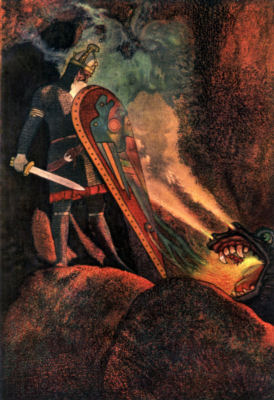
{What Beowulf imagines his fight with the dragon will look like – war-fire, breath, venom, shield, and all. Image from eKits.}

Back To Top
Translation

This week’s section of Beowulf sees him boast for the last time, before turning and addressing his thanes. Let’s listen in:

“Beowulf spoke, gave form to boast-words
for the final time: ‘In youth I
risked much in combat; yet I will once more
though an old king of the people, pursue the feud,
gain glory, if only the fiend to men
will come out from his earth-hall to face me!’
Addressed he then each warrior,
each helm-wearer for truly the final time,
each dear companion: ‘I would not bear a sword,
bring the weapon to the worm, if I knew how
I might otherwise gloriously grapple against
that foe, as I once with Grendel did;
but there will be hot war-fires, I expect,
breath and venom; thus I have on
both shield and byrnie. Nor will I give a foot’s length
when I meet the barrow’s guard, but between us two
what is to happen later on this sea wall, that is as fate,
measurer of men, is drawn to decide. I am firm of heart,
so that I may cease from boasting over this war-flyer.'”
(Beowulf ll.2510-2528)

Back To Top
Recordings
Now, to give you a sense of how that would sound:

And in Modern English:

Back To Top
Initial Thoughts

This passage, for all of its high boast density, is quite straightforward. Beowulf says that he will fight the dragon as long as he comes out of the barrow, and then turns to his men to tell them why he’s carrying a shield and wearing armor. Then, he closes it all off by saying that he is “firm of heart,/so that I may desist from boasting over this war-flyer” (“Ic eom on mōde from/þæt ic wið þone guð-flogan gylp ofersitte” ll.2527-8)

That’s it.

There’s definitely something to say for its directness. This quality might even be the result of Beowulf’s melancholic belief that this will be his last fight, and the poet’s own admission of the same. But, as always, there is one curious thing to poke at – like a sleeping dragon coiled around a heap of gold.

Back To Top
Why so Compounded?

This passage uses a fair number of compound nouns: “Bēot-wordum” for “boast-words;” “mān-sceaða,” for “fiend to men;” “eorð-sele” for “earth-hall;” “helm-berende;” for “helm-wearers;” “heaðu-fyres,” for “war-fires;” “guð-floga” for “war-flyer.”

All of these compound words share two characteristics. They’re all related to war, and they’re all direct , straightforward terms. Though it might be contentious, none of them are the fancier type of compound words known as kennings (like “līchama” for “body” (literally “body-raiment”) or “heofon-candel” for “sun” (literally “sky-candle”).

Maybe Beowulf isn’t in the mood for speeches wrought with fine words like cups studded with jewels. Maybe the poet is trying to just skate on through this section being straight to the point and direct. Or maybe, there’s something more going on here – something at the level of connotation and association.

Maybe direct, clear compound words, are those that are related to war specifically. Granted, you might be able to come up with more elaborate compounds that are used to describe battles and what not, but at least here, it’s curious that they’re so streamlined. If this is indicative of something about the poem that’s one thing. But what if it’s pointing to something present in all of Anglo-Saxon poetry, maybe even the culture itself?

Back To Top
Three Possibilities

If we run with the idea that this compounding cluster relates to Anglo-Saxon culture, then the compound words/phrases relating to war being straightforward and direct could mean a number of things. It could be meant to reflect the manly nature of war, men being more direct and active. Though this is a little bit anachronistic, since Anglo-Saxon women could rise to the same level of martial power as men.

Alternatively, this straightforwardness of war-related compounds could mean that war itself was something that the Anglo-Saxons regarded as straightforward. Or, maybe they saw it as something that need not be embellished when its reality is about to be brought home.

For all of Beowulf’s boasting up to this point has been about the past, only now does he actually boast about what he is going to do next. Maybe the rough drafts of boasts, boasts for deeds undone, are underplayed so that they can be elevated to ecstatically glorious places after the deeds they describe are done.

Or, again, maybe this straightforward language on the part of Beowulf (and the poet) is meant to be taken as a deference to fate.

Everything is cold and windy on the promontory. Beowulf is about to face the dragon, and talking to his men before the worm comes from its underground lair. Things are tense. Things are heavy. Beowulf knows that he’s an old man, “an old king of the people” (“frōd folces weard” l.2513). He knows that the dragon’s breath and venom are to be feared, to be protected against. So maybe his direct boasting, and its firm, resolute ending, are meant to show his humility before fate. After all, for our two combatants, it will be as fate decides, “swā…wyrd getēoð” (l. 2526).

Back To Top
Closing

What do you make of this crowd of compound words, these straightforward and unassuming combinations? Let me know down in the comments.

Next week, be ready for more of St. Isidore’s writing on deer, and Beowulf gives his final commands to the men before heading off to draw the dragon from its den.

Back To Top

Credits in a Comitatus and Boasts Filled with Wonder Words [ll.2484-2495] (Old English)


The Translation
Ongentheow’s Killer and the Comitatus
“heoro-blāc”
“ēðel-wynn”
“Gifðum”
Wrap-up

{a younger Beowulf, perhaps, flashing his gams and doing some boasting. From “Gayle’s Bard Blog.”}

The Translation

We return to Beowulf now, as he rounds out his history lesson and starts to verbally fist pump. Let’s listen in:

“Then in the morning I heard that his kin
avenged him by the blade, plunged its edge to end
the slayer’s life where Eofor’s attack fell upon Ongenþēow;
his war-helm split, the Swedish warlord
fell sword-wan; his hand held memory enough
of feuding, he could not hold off that fatal blow.

“The treasure, which Hygelac gave to me,
I won for him by flashing sword; he gave to me land,
a native place, land joy. For him there was no need,
no reason to be required to seek some worse warrior
from the gifthouse or the spear-danes or the swedes,
my worth was well known.”
(Beowulf ll.2484-2495)

Some interesting stuff is going on in this passage.

Back To Top
Ongentheow’s Killer and the Comitatus

First, there’s the question of who killed Ongenþēow. The text suggests that it was Hygelac who killed him “by the sword’s edge” (“billes ecgum” l.2485), but it also mentions an Eofor who is credited with splitting his helmet (“thǣr Ongenþēow Eofores nīosað;/gūð-helm tōglād” ll.2486-7). So who’s the real hero, Beowulf?

To a modern reader this double crediting of Ongenþēow’s kill (something that might lead to another killing if it happened in a MMORPG), might seem confused. But, to an Anglo-Saxon sensibility, it makes perfect sense.

Consider for a minute the fact that Hygelac is, at the point when Ongenþēow’s killed, the leader of the Geat forces against the Swedes at this battle since Hæðcyn has been killed. Thus, Eofor is fighting as Hygelac’s thane – Eofor is part of Hygelac’s group.

In Anglo-Saxon terms, such a group could be called a “comitatus,” a band of warriors held together by mutual quid pro quo. If a warrior pledges his life and sword to a lord, he fights until his death – even if that lord should die before he does. In return, the lord provides the warrior with treasure and land.

“The Battle of Maldon” is a perfect example of the comitatus style of loyalty because it tells of a band of warriors that fights on after their lord dies, even though they all know that they are doomed to die.

What’s happening in Beowulf, then, is that Hygelac is being credited with Eofor’s kill because Hygelac is the head of the Geats, of the Geatish comitatus, and likewise, all of the warriors within Hygelac’s comitatus are his swords. So it’s fair to say that Hygelac had his vengeance on Ongenþeow by the edge of the sword, in the sense that he was killed by one of Hygelac’s men.

At the level of words within the passage, there are indeed a few that are quite curious.

Back To Top
“heoro-blāc”

The word “heoro-blāc”, meaning “mortal wound” is unique among these curious words since it is a somewhat mysterious combination of “heoru” meaning “sword” and “blāc” meaning “pallid, pale, wan.” So, literally, someone who is “heoro-blāc” is “sword-pale.”

Unfortunately, the literal translation doesn’t work quite so well, since “sword-pale” suggests that something is as pale as a sword. Depending on what it’s made of, a corpse might get to a similar pallor as a clean, shiny sword, but it’s a rather fantastical comparison.

“Mortal wound” is a little on the nose, though, so “sword-wan” is what was used above. The term is used in the senses that Ongenþēow is weakened by the sword, and about as strong as a sword without a wielder. He is mighty, yet useless, as he lay where Eofor split his helmet.

Moving into Beowulf’s boast about his own accomplishments yields more tricky and wondrous words.

Back To Top
“ēðel-wynn”

First up there’s “ēðel-wynn” meaning “joy of ownership,” but made up of “ēðel” (native land, country, home) and “wynn” (joy). So translating the term as “joy of ownership” does work, in that there will be a joy in a native owning their own land, but at the same time “joy of ownership” falls short by generalizing the original word too much.

Nonetheless, what’s telling about the translation is that it completely ignores the fact that “ēðel-wynn” contains a specific reference to land (“ēðel”). There might not be an exact and precise equivalent term in English, but by cutting out any reference to land, it seems like that there’s a desire to deny a sense of landed-ness in Anglo-Saxon at play.

But that’s just not true.

The fact that a compound word with “ēðel” is used here is important because it shows that whenever Beowulf was written (or maybe even when it was still being sung) land ownership was a big deal to Anglo-Saxons. This means that they might have had a sense of nationhood as we do today, since it wasn’t something nebulous or abstract.

Words like “ēðel-wynn” allow you to make a case that there was a sense among Anglo-Saxons that a place defined a people and that if a certain people was given a certain space then that people would be joyous. So, it seems that Seamus Heaney’s translation of the word as “the security that land brings” is better, though still wanting for the implied sense of nationhood.

Back To Top
“Gifðum”

The other word is “Gifðum,” which is not in the Clark Hall & Meritt Anglo-Saxon Dictionary. However, Seamus Heaney translates it as “gift house.”

Heaney’s translation might just be in a newer dictionary, or it could be derived from the idea that “Gifðum” is a corruption of “giefu-hus.” A stretch, maybe, but the poem Beowulf isn’t beyond having a few textual ticks here and there.

For example, in the original Anglo-Saxon, there’s a consistent difference in spelling between the first and second halves of the poem, suggesting that there were two scribes involved in making the copy of the poem that we still have today.

Of course, textual ticks or no, that still leaves the nature of “Gifðum” a mystery.

Back To Top
Wrap-up

If you’ve got your own theory about what “Gifðum” could mean, I want to know, just leave it in a comment for me.

Next week, St. Isidore talks of the goat, we get some more medieval lore, and Beowulf starts into more boasting. Don’t miss it!
Back To Top

Swedish Retribution "from over wide water" [ll.2472-2483] (Old English)

Abstract
Translation
On Swedes and Geats
Compounding New Words
Closing

Back To Top
Abstract

We get the history hard and fast in this week’s passage of Beowulf (ll.2472-2483, Chapter XXXV).

Back To Top
Translation

“‘Then between Swedes and Geats was war and enmity;
from over wide water causing laments,
wall-hard warfare, after Hrethel had perished,
Ongeonðēow’s sons to them came,
warlike; they would not free
those they held under sorrow’s sway, and near Hrēosnahill
they oft launched voracious ambushes.
My close-kin avenged this,
feud and war-fire, as it is known,
though one of them bought the victory, at a hard price,
with his life; Haethcyn, Geatish lord,
was taken in the war’s assailing.'”
(Beowulf ll.2472-2483)

{Approximation of the Hrēosnahill fight offered by a mural of the Battle of Maldon. From the Braintree collection of murals.}

Back To Top
On Swedes and Geats

Questions bubble up like air in a flagon of ale upon reading this passage. Who was Ongeonðēow? What’s important about Hrēosnahill? What liberties were taken with the translation?

Ongeonðēow [On-g’in-thou] was the king of the Swedes who launched an attack on the Geats to recover his daughter and his gold, both of which had been taken by the Geats on an earlier raid. He was famed as a powerful king, and two Geats (Eofor and Wulf) had to work together to defeat him (read more here). Though, as we’ll see in next week’s entry, Beowulf makes it sound like Hygelac himself lands the deathblow.

Hrēosnahill [Heh-res-na-hill] is where Hæðcyn had taken Ongeonðēow’s daughter, and is apparently a real place (modern Swedish:”Ramshult”), as well as a place that is traditionally within Geatish territory. Go to this Wikipedia page for more info.

So, what’s happening here is a little bit of old fashioned early medieval back and forth. The Geats stole Ongeonðēow’s daughter and gold (according to Wikipedia), and now the Swedes are coming for rescue and revenge – which they (again, from Wikipedia) only half exact. The Swedes recover the woman, but not the gold.

Two liberties were taken in the above translation. In the third line (l.2474) “wall-hard warfare” is altered from the literal “hard warfare” since the alliteration makes it sound more Anglo-Saxon and “hard warfare” isn’t as evocative as the original “here-nīð hearda.”

The phrase “under sorrow’s sway” was also altered from the literal “lamentation holding” since it doesn’t have enough punch in Modern English. It also confuses the metaphor of being held under extreme emotion, which is clarified by “under sorrow’s sway.”

Back To Top
Compounding New Words

The words “here-nīð,” and “inwit-scearo” are both compound words worthy of elaboration.

The first combines the word for “predatory band, troop, army; war, devastation” (“here”) and for “strife, enmity, attack, spite, affliction,” (“nīð”). Literally, then, it could be rendered “war-strife” or “troop-enmity” and so warfare is a clear translation of it. The redundancy of a literal translation also makes the standard translation of the phrase more efficient than a literal rendering.

The word “inwit-scearo” on the other hand, is more worthy. The term is a mix of “inwit,” meaning “evil, deceit, wicked, deceitful,” and “scearo,” a form of “scieran,” meaning “to cleave, hew, cut; receive tonsure; abrupt.”

Literally, the word could be rendered as “evil-cleave” or “abrupt-deceit” which sound like they could still be productive words among modern counterparts. “Evil-cleave” at least sounds like a technique in an RPG, while “abrupt-deceit” could be a spicier way to describe an ambush or surprise attack.

Back To Top
Closing

To let me know what you think about these compound words (or this entry in general) just post a comment below. And feel free to follow this blog, I’ll follow yours back.

Next week, Isidore elaborates on the workings of sheep and rams, and Beowulf tells of Hygelac’s revenge, all the while bolstering his own warrior-like image.

Back To Top

Hreðel’s Choice [ll.2460-2471] (Old English)

Abstract
Translation
A Religious Out
Another Crucial Phrase
A Word to Modernize
Closing

Back To Top
Abstract

In this week’s excerpt Beowulf finishes his retelling of Hreðel’s reaction to Herebeald’s death. The old king is conflicted and ultimately gives up all of his possessions and holdings to his remaining sons:

Back To Top
Translation

“‘Then he lays himself in his bed and, wailing a dirge,
is alone even with himself; to him it all seems too large,
the fields and the halls. Thus was the Geat lord’s
heart sorrow after Herebeald
went into that far country; he knew not how he might
wreak his feud on the slayer;
nor could he hate that warrior,
despite his loathsome deed, though he loved him not.
Amidst that sorrow, that which sorely him concerned,
he gave up life’s joys, chose God’s light;
he left all to his sons, as any prosperous man does,
lands and towns, when he left off this life.'”
(Beowulf ll.2460-2471)

Back To Top
A Religious Out

What more is there to say here? Hreðel’s great sorrow is combined with the utter failure that he faces in the face of the social code of the feud.

He can’t kill his own son. So he does what anyone in a bind did in those medieval days (and these modern ones as well), he turns to “God’s light”. However, the phrase “chose God’s light,” (“Godes lēoht gecēas” l.2469) is open to interpretation.

Hreðel might’ve gone and joined a monastery, maybe became an anchorite, or he might have just given up entirely and let his body waste away until he died. The phrase could also refer to a conversion, but that interpretation isn’t likely given the history of the poem’s transmission.

If Beowulf was written out by Christian monks as a way of preserving it/using it for teaching/propaganda, it seems odd that a conversion would cause a character to drop out of society as Hreðel, a king, does.

So, I think, that the phrase “chose God’s light” refers to some great act of austerity (fasting, seclusion) that leads Hreðel, in his weakened state, to his death.

{Job also “chose God’s light” it seems. A William Blake original.}

Back To Top
Another Crucial Phrase

That’s not the only sticky phrase in the mix, though.

Afterall, there is the phrase used to describe the old man of Beowulf’s simile when he shuts himself in his room: “ān æfter ānum.” I translate this as “alone even with himself” (l.2461). As I have it, the phrase might seem to be lacking sense, but it’s based on the apparent meaning of a literal translation: “alone for the purpose of being alone.”

My rendering is intended to have the same basic meaning as a literal translation but with fewer words. “Alone even with himself” demonstrates how the old man is alone and separated from his thoughts and feelings even when he is by himself; that’s just how much his grief and sorrow consume him.

Other than those cruxes, the passage is pretty straightforward. It’s even got a neat Old English word that Modern English should pick up and dust off.

Back To Top
A Word to Modernize

This word is “gum-drēam” (“enjoyment of life”), definitely a favourite. It’s a compounding of a word for “man” (“gumma”) and “joy, mirth, music, singing” (“drēam”), certainly a curious combination.

Literally it would translate as “man-joy” or “man-mirth,” a word that definitely wouldn’t resonate as well in a world where “man” is very rarely used to represent all of humanity. But it’s a cool word, and if, say, someone wanted to bring it back, “lifejoy” or “are-mirth” could work.

Back To Top
Closing

If you’ve got your own take on how “gum-dream” could be modernized, or on what Hreðel’s choosing “God’s light” means let me know about it in a comment!

Next week, Isidore writes about animals for war and animals for sacrifice, and Beowulf relates how the Swedes and Geats met in the field of war and how a certain Geat doesn’t return. Watch this blog for those entries next Tuesday and Thursday respectively!

Back To Top

Quoth the Beowulf [ll.2441-2449] (Old English)

Abstract
The Passage in Brief
Ravens and Ruin?
The Passage’s Words and a Modernization
Beowulf and the Raven
The Raven As Symbol of Sacrifice
Closing

Back To Top
Abstract

Things take a turn in this passage (ll.2441-2449). Not from Hæðcyn’s sorrowful act, but from Beowulf’s direct retelling of his tale to his use of a peculiar simile.

Back To Top
The Passage in Brief

On lines 2444-46 he compares Hreðel’s sorrows to those of an old man who sees his young son hanging on the gallows (“‘Swā bið geōmorlīc gomelum ceorle/to gebīdanne, þæt his byre rīde/giong on galgan.”) He goes on to expand this image by explaining that the old man can only look on helplessly while the raven rejoices over his son’s corpse (“hrefne tō hrōðre” l.2448).

Back To Top
Ravens and Ruin?

What makes the image of a raven over Hæðcyn’s corpse so striking is that it not only efficiently brings out Hreðel’s sorrow, but the emotions evoked here resemble those in the “Lay of the Last Survivor.”

This section of the poem (ll.2247-66) details how the one who originally left the dragon’s hoard must have felt, being the last of his people. It describes the futility of treasure without people to use it and with whom it can be shared. But it also emphasizes the importance of community to the Anglo-Saxons.

Back To Top
The Passage’s Words and a Modernization

The language of this passage is fairly straightforward and strangely filled with words that don’t seem to have changed much between then and now. “gefeoht” for “fight, strife,” “linnan” for “to lie,” “rīde” for “ride,” “giong” for “young,” “sārigne” for “sorrowful” “sunu” for “son,” “hangað” for “to hang,” “hrefne” for “raven,” “helpe” for “help,” and so on. As per coolness factor, one word stands out: “hyge-mēðe.”

The last word in that previous paragraph is a combination of the words “hyge” for “heart, breast, mind” and “mēðe” for “tired, worn out, dejected, sad.”

As far as modernizations go, “heart-sad” sounds both poetic and syrupy at the same time, but “mind-worn” could work for a modernization, I think. It could express a feeling of being so overwhelmed by a task or emotion that your mind is sore; just as a muscle feels sore after it’s been worked out. “mind-tired” could also work, there’d be some internal rhyme that way.

Back To Top
Beowulf and the Raven

Although it only gets cursory mention here, a little bit of explanation of the raven in Old English lit is in order since I think it plays a larger role here.

The raven is one of the three “Beasts of Battle” (along with the wolf and the eagle) and held many different meanings (check this site for a good deal of info). Just as they’re regarded as bad luck, or ill omens by some today, so too were ravens regarded before the 11th century. But some also associated the raven with victory or sacrifice, and in Old English another word for raven is wælceasega (“chooser of the slain”) linking the bird to the Valkyrie of Old Norse thought.

Aside from the raven in Beowulf’s speech clearly being an ill-omen (Hreðel becomes despondent and the realm is soon threatened by war), I think that it can also be interpreted as a symbol of sacrifice.

Back To Top
The Raven As Symbol of Sacrifice

Herebeald wasn’t sacrificed in the same way that say, Iphigenia was (by Agamemnon, for a wind to get the Greeks to Troy), but his death could still be regarded as the sacrifice of an eldest son for lasting fame.

Sacrifice is also likely at the fore of Beowulf’s mind at this point – perhaps it is even a cause of his being in such a heavy mood. He knows that he will die if he fights the dragon, but he also knows that doing so will win him fame, save his people, and land them a hefty amount of treasure.

All three of these things are necessary for a good king, as established by Beowulf‘s opening with Scyld Scēfing. He won a great amount of fame, and of treasure and was able to use both to increase his people’s prosperity (ll.4-11).

The treasure also helped his son to forge bonds and obligations with warriors who would fight for his right to succeed his father upon his death (ll.20-24).

Within the situation that Beowulf describes, Herebeald can be read as a sacrifice not just for the fame of Hreðel, but also for the fame of Beowulf.

After all, if Herebeald had lived he may have ruled well and been loved by all, giving Hæðcyn and then Hygelac no reason to rule, and thus leaving Beowulf without a kingship from which to launch his own fame.

So Herebeald’s death is also a sacrifice for the betterment of posterity – even if that eventually leads to the destruction of his people.

Back To Top
Closing

Next time, Beowulf continues to expand his comparison, detailing how the old man regards nothing in the same light again.

If you’ve got a strong argument for “heart-sad,” “mind-worn,” or “mind-tired” as a new word; if there’s anything about Beowulf that you want to ask; or if there’s anything in the poem that you want to see given special attention, then please do leave a comment.

Back To Top

Young Beowulf’s Melancholic Tale [ll.2430-2440] (Old English)

Summary
What is and What’s to Come
All About a Name
Beowulf’s Phrasing
Closing

Back To Top
Summary

This part of Beowulf is one that makes the Anglo-Saxon propensity for melancholic reflections painfully obvious. We see the old king sitting on the sea cliffs and talking with his thanes about his life, and how even at an early age he witnessed something tragic – fratricide.

Back To Top
What is and What’s to Come

Lines 2430 to 2440 actually present a curious kind of contrast. In the first five lines Beowulf tells of Hreðel’s (Hrethel) warm reception (“mindful as kin,” “sibbe gemunde” (l.2431)).

But then in the second, we get his report of the murder. According to Beowulf (no mean storyteller, he did, after all, boast to Hrothgar about his deeds, clear up the matter of the swim with Breca, and give Hygelac a slightly diverging story about his fights with the Grendels upon his return to Geatland) Hreðel’s eldest son, Herebeald, was shot and killed by the youngest, Hæðcyn (Haethcyn).

Within his account, two things come up that I want to expand upon here. First is one of the brother’s names, and second is Beowulf’s phrasing.

Back To Top
All About a Name

Perhaps a bit of Christian propaganda, Herebeald’s name echoes a similarly killed Aesir in Norse mythology.

This Aesir is the son of Odin, Baldur, god of Light and Spring. For the full story of his death check here. The gist of it is that Baldur’s death is foretold, all of the things on the earth take an oath that they will not hurt Baldur, yet through some of Loki’s trickery and a technicality Hodor is given a sprig of mistletoe that did not take the oath. Hodor fires and Baldur is killed.

This could be some low level Christian propaganda because it points towards fratricide within Nordic myth, thus attempting to show its wrong-headedness. However, Beowulf seems to be defending Hæðcyn.

Here is how he describes Hæðcyn’s act: “he aimed for a misted mark and shot his own kin” (“miste mercelses ond his mǣg ofscēt” (l.2439)). Because this is a whole line and not just a word or phrase, I think that strategic language on the poet/scribe’s part for the sake of form can be ruled out.

Back To Top
Beowulf’s Phrasing

Within the phrase itself, all of the words are quite clear. “Miste,” “ond,” “his,” and “ofscēt” are all more or less left unchanged on their way into Modern English. “Mǣg” is less immediately clear, but translates as “kin, family.” Ah, but “mercelses,” that offers some difficulty.

Knowing that the word is a form of “mearc” meaning “mark, sign, standard, border, etc.” means that it’s just a matter of figuring out its case. That it ends in “es” gives solid ground to say that it is indeed in the genitive case, which I expressed by adding in “aim” to clarify a more literal translation.

Such a literal translation is: “mark of mist and his brother shot.” Since it’s mentioned that Hæðcyn has a bow in line 2437 (“bogan”), the logical step that must come between his having it and the mention of a “mark of mist” is that he must have been aiming his bow. Hence the addition.

Though even without this addition, the emphasis that the line’s alliteration puts on “misty” suggests that Hæðcyn was in some sort of daze.

I think that this ambiguity absolves him of the murder, in a way. it certainly makes it more ambiguous, and might even be pointing towards the moral idea that a person cannot be judged on their actions but only on their intent.

Beowulf (and/or the poet/scribe) might just be unclear on what his motivation was, but there is a germ of something more here, I believe. Why? Because it’s coming in at a part of the larger story of Beowulf in which Beowulf is looking for solace in the sorrows of his past.

Perhaps, some might argue that he is trying to forgive himself for killing Grendel whom he somehow viewed as a brother. Or perhaps he is just trying to work out his feelings for the Geats that he will be leaving behind through an analogy with Hreðel and the loss of his son.

Beowulf has seen the Geats come far, but also has seen their youth lose their spark. Whatever the case is, the ambiguity presented here makes it plain that this whole episode is more opaque than evil dragons and troublesome killers.

Back To Top
Closing

Next week the story continues, as Beowulf adds more detail to his tale – what becomes of Hæðcyn? Just how melancholic can Anglo-Saxon poetry get? Read on next week to find out!

And if you’ve got any opinions, arguments, or points on or about this week’s section, toss them in the comments.

Back To Top

Beowulf [ll.2419-2429] (Old English)

Introduction
Summary
Beowulf’s Greatest Foe?
Beowulf’s Opening Lines
Genæs: Further Analysis
Briefly Autobiographical
Closing

Back To Top
Introduction

When we last left Beowulf, he was sitting on a cliff, looking out to sea. His mind was heavy with thoughts of his impending death, and this week’s section gives us an idea of what those thoughts were like.

Back To Top
Beowulf’s Greatest Foe?

We’re told that Beowulf knows that he would soon “encounter old age,” (“gomelan grētan sceolde,” l. 2421) that it would seek his “hoarded (?) soul,” (“sēcean sāwle hord,” l. 2422). And before Beowulf at last addresses the 12 with him the poet offers the elaborations of Beowulf’s life being rent from his body (“sundur gedǣlan/līf wið līce,” l. 2422-3) and of his “flesh…soon unravel[ing] from his spirit” (“nō þon lange wæs/feorh æþelinges flǣsce bewunden,” l. 2423-4).

Death is definitely violent, but very firmly not the end, and Beowulf knows this well. But all of this is mentioned in the context of Beowulf sitting in “sorrowful mind” (“geōmor sefa,” 2419). There’s definitely a strong sense of the elegy that J.R.R. Tolkien detected in the poem here (see page 14 of this article). And there’s also the sense that Beowulf feels some remorse. But why?

Because his kingdom has been ruined by the dragon and, upon seeing its lair, he realizes that he will die fighting it? Because he feels that those he has taken with him, the leaders of the next generation, surely, are not capable of the glory that he achieved? Perhaps he regrets the conquests and triumphs of his youth? Or is it merely an expression of the extreme anxiety around death?

Back To Top
Beowulf’s Opening Lines

The first line and a half of the section set the atmosphere by telling us that Beowulf was “restless and ready for death,” that he could feel “fate immeasurably near” (“wǣfra ond wæl-fūs, wyrd ungemete nēah,” l. 2420). Then the poet/scribe offers things more concrete.

Beowulf’s ensuing speech is about his youth and accomplishments, but I’ll get more into that next week. This week, I just want to focus on the first two lines (one sentence) of it.

Beowulf opens by saying that he “survived” (genæs) countless battles and war-times in his youth. His choice of words here is curious, since, according to my dictionary, all senses of “genæs” suggest the last-minute removal from a dire situation (survive, escape from, be saved).

Why doesn’t Beowulf (or the scribe/poet) simply use “won glory,” or “succeeded”? Is this a sign that Beowulf is well aware of the horrors of war and that the poem itself can be read not as a document glorifying it, but maybe the first recorded account in English of someone who has experienced Post Traumatic Stress Disorder (PTSD)? Or, is it just the only word that would fit the line’s meter and/or alliteration?

Back To Top
Genæs: Further Analysis

Following the line of reasoning that the poet/scribe could have used another word in place of “genæs,” here’s my analysis.

“Survived” makes it sound as though all of the battles that Beowulf has seen were trials or hardships sent by some greater entity, or merely as a part of life. “Escaped from” makes armed conflict seem like some terrible, impersonal machine or happening.

And, “been saved” makes it seem as though Beowulf got lucky each time he fought and was spared from the sword or arrow by the intervention of his fellow warriors or some sort of supernatural being. This last meaning of “genæs” perhaps gels the best with the laggard that everyone at the Geatish court believed Beowulf to be until he returned from Daneland with stories of slaying Grendel and his mother.

So then did Beowulf actually change from a weakling boy into a fierce warrior, or was his original softness just masked by luck – is this a propagandic Christian twist that suggests that trusting in god will keep you safe in skirmishes and war time?

Beowulf at this point is 50 years old – the same age as Hrothgar and Grendel’s mother when he was in Daneland. Rulers in the world of Beowulf seem to last their 50 winters and then tip off the mortal coil in one way or another. Though in such a world, living to see 50 does seem remarkable.

Whatever the case may be, modern interpretations of “genæs” all come with this connotation of getting through something larger than an individual human’s machination.

At the least, I feel secure in saying that this word suggests that human conflict is something outside of the control of individual people and possibly even groups of people. In fact, the word could be read as the poet/scribe suggesting that war is another kind of natural disaster. The cosmological implications are fascinating.

Back To Top
Briefly Autobiographical

The next sentence of Beowulf’s speech begins his auto-biography. At the age of seven he went to his treasure lord (“sinca baldor,” l. 2428) for fostering at his father’s command. This treasure lord, “leader and friend of the people” (“frēa-wine folca,” l. 2429), seems benevolent enough, and the practice of fostering is evident throughout the middle ages. Even Chaucer was fostered.

The transition from the first sentence of his speech and the second is where these two get interesting.

Beowulf ends his first sentence with the bold statement that he “remembers all of [the conflicts]” (“ic þaet eall gemon,” l. 2427). And from what comes next it seems that he also remembered much of his youth. He specifically recalls a story from his youth that may well be the earliest political strife he encountered. But I’ll get into that next week.

Back To Top
Closing

Think I’m a little too loose with my translations of words or phrases? Or that I dig too deep for meaning? Or do you think that I’m right on and should just write a book about it all already? Let me know in the comments.

Back To Top

Beowulf [ll.2409-2419] (Old English)

Introduction
Section Summary
A Word Wanted
A Difficult Word
Speculation on Hengest and Horsa
Closing

Introduction

Thursday is here again, and so I’ll continue with my work on Beowulf.

Back To Top
Section Summary

The next section of my Beowulf translation covers line 2409-2419: The part at which the thrall is forced to guide Beowulf and his eleven chosen warriors to the place where he found the stolen cup that Beowulf believes is the cause of the dragon’s rage. They reach the cave (hleaw, 2411) and discover that it is full of wondrous treasures (“wraetta ond wira,” or “wrought and wound,” as I translate it, 2413).

But, they also know that the treasure’s guardian is the dragon and, as the poet points out, no man is able to extract that treasure cheaply because of the dragon’s eagerness to guard it (“gearo guð-freca gold-maðmas heold” 2414) (2416). The passage ends when Beowulf sits down on the cliff-top overlooking the sea and wishes all of his warriors health and luck (haelo abead, 2418). For he already seems to know that his loan of days is due.

Back To Top
A Word Wanted

I always have a lot of fun with this language. Maybe it’s because the expression seems so fancy free or because it’s from a time before there was really a formalized register and diction that could be learned in school (since English wasn’t taught in school back then, it was just the common tongue – what people spoke to communicate with each other. Latin, Celtic, and probably even some Old French would have been used for business, since native Old English speakers would trade with those peoples).

Whatever the case, this degree of enjoyment tends to turn me onto a word that should still be around in one form or another.

In the case of this passage, the word that I want to see come back is heorð-geneat (hearth-companion). The origin of the term probably came from the practice of those fighting wars/feuds together sitting down and talking/eating/relaxing by a fire. The same sort of bonding happens today with MMORPGS or online forums. Flickering lights still help us to bond with one another.

But not too many people actually sit around fires on a regular basis. Sure, some people go camping, and maybe some use wood furnaces to heat their living space. But, it’s generally not a daily occurrence to wind up beside friends in front of a roaring blaze. But, it is a daily occurrence for people to bond while playing MMORPGS and other such online games (sorry TV, but high speed internet and wi-fi have done to you what you did to radio).

So, as a modernized version of heorð-geneat, I propose that we bring in the term connection companion. Or, for short, conn-comp. Think about it.

Back To Top
A Difficult Word

Within the passage the only word completely unfamiliar to me was “unhiore,” on line 2413. The word translates as terrible, a shuffle that is easy enough, but it’s parts are a little bit curious to me.

A hearty little particle, “un” meant then what it still means now – a negation of what follows (such as unsure for not sure). The rest of the word, “hiore,” as best as I can figure is a variant of “hearra,” meaning lord, master, or it is a variant of “heorra,” meaning “hinge, cardinal point.”

The latter actually makes a little bit more sense to me, since something that is “not a hinge/cardinal point” would mean that it is not tied into the world in an extremely structured way (perhaps not subject to wyrd/fate like everything else).

Basically, this combination makes the word “unhiore” seem like it refers to an anomaly in the system. Such a variation is a truly terrifying thing when your system is there to help navigate life in a world full of strife. Especially since that strife was not of the life-choice kind we face today (seriously think through grad school if it be among your choices, oh ye bright eyed senior undergraduate) but of the wayward sword cutting open an artery kind.

Of course, this interpretation of “unhiore” is primarily supported by my trusty Concise Anglo-Saxon Dictionary.

Back To Top
Speculation on Hengest and Horsa

Since we’re in the realm of speculation already, here’s some more.

While looking up “yð-gewinne” (“wave-strife”) I came across the word “yð-hengest” (“sea horse,” a kenning for “ship”). This got me thinking.

Recently I listened to the Anglo Saxon podcast by frederic and he mentioned that Gildas calls only Hengest and Horsa by name among all of those Angles called in by the king of the Britons to help fend off the other Celtic tribes. On the podcast frederic noted that these names translate as horse and mare respectively. But what if Gildas meant yð-hengest instead of just Hengest? Then it would be ship and mare.

Further, what if this is an old saying signifying men and supplies? Or families and rations? I mean, it’s clear that the Angles didn’t just bring two guys and a few ships over when they came, there were much more than that coming to the Britons’ aid.

Old English idioms like this are notoriously difficult to figure out because there are so few sources, but I think that this could be something. I mean, until England became the major super power, English was just a bunch of dialects that at times could pose some difficulty to each other.

Hundreds of years earlier, when the only permanent media was the written word, idiom would have traveled at a snail’s pace and probably would have taken years, if not decades, to work its way into everyday use between dialects.

So maybe horse and mare or ship and mare is an example of a dialect from Gildas’ region. Already clear is that ships are super important to Anglo-Saxons – they can be treasure houses, the means to travel for adventure and conquest, and potentially the final resting place for warriors. But what are horses to them? A means of transit? A thing to gamble on?

Maybe if I can establish what a horse *was* to the Anglo-Saxons of 800-1100 AD, then I can write more about what a mare by itself might signify beyond the animal. And what something like “ship and mare” might mean.

Back To Top
Closing

Anyway, with that question, and that quest, I leave off with Beowulf until next Thursday. Leave any suggestions, contentions or comments in the text box below.

Back To Top

Beowulf – In Media Res [ll.2401-2409] (Old English)

Introduction
Background to the Project
Old English Appreciation
Section Summary
Two Words
Closing

Introduction

Today I’m breaking out the glittering armour, gift from the ring-giver, a tight-knit coat in the battle-storm.

Yep. Today’s entry is the first about Beowulf.

Back To Top
Background to the Project

It’s a project that started in my third year of studying for my BA, though it didn’t really take off until just after I had finished that degree. I’m using the bilingual edition of Seamus Heaney’s translation that has the Anglo Saxon original on the left and the poet’s translation on the right (an online version of the original can be found here).

Heaney’s arrangement is great, but the running glossary in George Jack’s student edition is even more helpful – when I borrowed it from the library for a graduate class I barely used my dictionary.

However, now that Jack’s edition is back in Victoria and I’m over in Ontario, I make good use of my copy of the Fourth Edition of the Anglo-Saxon Dictionary as edited by Hall and Meritt. If I can’t find a word in the dictionary then I’ll usually look it up in the website Old English Made Easy’s dictionary.

The weight of this project hasn’t crushed me just yet, but it is something that has provided an ongoing struggle. Not just because of the size of the poem, but because its use of multiple adjectival clauses can really cloud sense and make things seem obtuse.

However, when things get grammatical, my Magic Sheet is never out of sight. This handy little chart from the English Faculty at the University of Virigina summarizes the declensions and conjugations of everything in Old English, so it’s super useful.

So armed, I’ve been able to translate 5/6 of the poem over the years and once I’m finished my plan is to bring a consistent voice to the whole thing (possibly by re-writing), type it up, and try to get it published. A bold move perhaps, but this is something that I’m passionate about. Maybe it’s just a bunch of barbarians hitting each other (and monsters) over the head with pointy sticks to some, but to me it’s a piece of grand old art.

And it’s something that’s fun to translate.

Back To Top
Old English Appreciation

Sure, the grammar can get sticky and there are points that scholars still contend to this day (was Beowulf swimming until nightfall to get to the bottom of the mire? Why does the Danish bard sing such a sad song after Beowulf’s victory?). But there’s a joie de vivre in the poet/scribes’ language that isn’t really present in a lot of Modern English.

And no, I’m not a snob. I think that Middle English (Chaucerian English) and Early Modern (Shakespearean English) are just as lovely. But when all of the grammarians stuck their fingers in the delicious hot pie that was English in the 17th and 18th centuries they sucked a lot of life out of it. They set it up to become a reliable and powerful lingua franca for all, but they made it a little bit dull in the process.

Now when somebody drops a consonant and replaces it with an apostrophe people are all up ins. And slang is slang. Before the grammarians came about (I’m looking at you Samuel Johnson) all of English (all the dialects) were pretty slang-laden. It’s just the way that the language was.

And it was grand.

Not so great for national or international communication maybe, but the plays, treatises, and poems that remain are all excellent examples of what a language can do.

Back To Top
Section Summary

Anyway, I don’t want this entry to be fully derailed by a rant. Right now I’m working through the scene where Beowulf fights the dragon, so I’m really sticking to the story-telling principle of starting in media res.

But, true to most modern novels, I’m starting just where the action is picking up – Beowulf has just gotten his band of 11 fellow Geats together and has compelled the slave that brought him the dragon’s cup to guide them the the lizard’s lair.

All of this happens in lines 2401-2409.

Back To Top
Two Words

Two words really struck me in section:

First, “gebolgen” on l. 2401. It reminds me of the “Gáe Bolga,” the mysterious, foot-held spear that Cuchulain was trained in by the warrior woman Scáthach, and with which he killed his friend and rival Ferdiad in the Táin Bó Cuailnge.

The other word that caught my eye was “meldan,” from l.2405. This one means finder according to Heaney. The dictionary definition is “tell, reveal, accuse” – but I’m guessing that Heaney let his translation lean on “cwom” (come) the combination of which with “tell, reveal, accuse” suggests a kind of giving – like coming with tales or news, things which are only useful if given.

Plus, a shiny cup from a whole pile of treasure would indeed be welcome news to any Geat (or Anglo-Saxon listener).

Though, I do admit that combining words in this way is kind of like trying to stretch a single ox hide over an acre of land.

Back To Top
Closing

If you’ve got any suggestions/corrections for me, leave them in a comment. I’ll be back next week with Beowulf’s arrival at the cave.

Back To Top

Salvete! Wæs hæl!

Introduction
Purposes
Wrap Up

Introduction

This blog is a platform from which I’m going to be writing, gushing, and otherwise working through the sense of my various translation projects. Currently I’m working on a translation of Beowulf from Anglo-Saxon, and another of the thirteenth century song “Tempus adest Floridum” from Latin.

Two old and gone languages might seem a little, well, anachronistic in this internet-set age of ours, but as Facebook offers its site in Latin and other blogs for old languages exist, there is definitely a readership for the thoughts and meanderings of a wit as he moves meaning from one language and into another.

Back To Top
Purposes

Of course, to reach the conclusion that there is an audience for this sort of thing I’m applying an idea that I’ve always tried to keep firmly in mind: that among a finite number of people with access to print media there’s definitely a sizable audience for anything from a slightly more finite number of genres and forms.

To put it more simply, there are a lot of people in the world, and somewhere out there there’s got to be a solid 5000 of them interested in what I have to say or the stories that I have to tell. Scale that number up or down as you please.

However, the primary purpose of this blog is to give me a space to write about my own reactions to what I translate. These will definitely include bits where I wax academical, but there will also be bits where I just laugh at the literal translation of a word, or sit in wide-eyed wonder at how a perfectly awesome word did not make it into casual Modern English.

I might even flex some alumni muscle and pull out etymologies from the Oxford English Dictionary Online (hereafter the OEDO) to show these words’ journeys if they’ve been traced.

Back To Top
Wrap Up

So, as you might guess, what I write here is going to generally be scholarly but with a more casual tone than that which you’ll find in an academic journal or book. I’ll be keeping the long sentences, though.

Back To Top