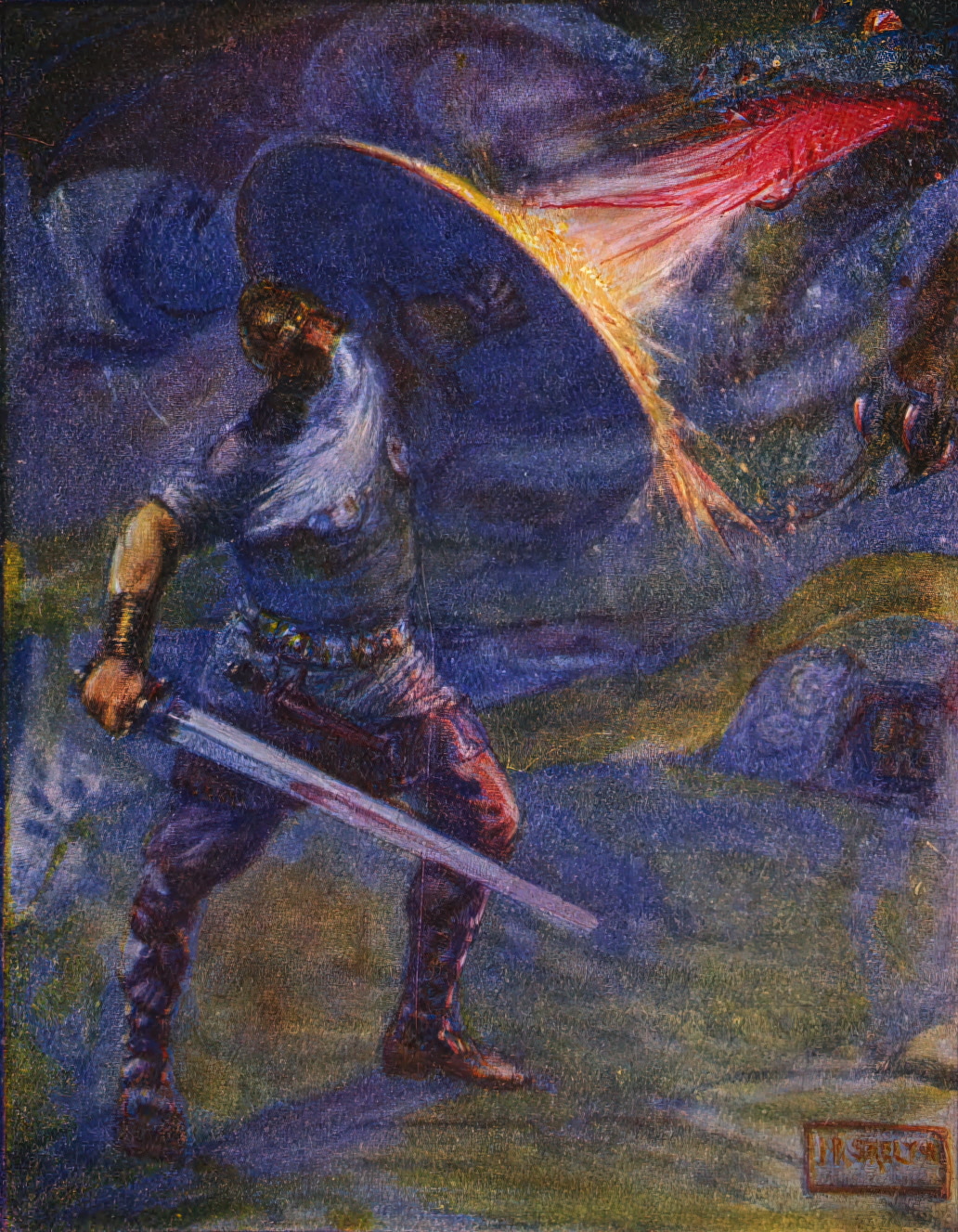
Beowulf as storyteller, words sharp and simple (ll.957-970a)

Abstract
Translation
Recordings
Beowulf Embellishes Grendel
Rich and Simple Compounds
Closing

Beowulf, Old English, Anglo-Saxon, translation

Back To Top
Abstract

Beowulf speaks of his fight with Grendel and the monster’s god-defying strength.

Back To Top
Translation

“Beowulf spoke, the son of Ecgtheow:
‘We that brave deed did with much good will,
carried out the fight, daringly risked ourselves
against strength unknown. Wish I very much
that thee thyself might have seen it,
the enemy entangled and exhausted to the point of death!
I swiftly grasped him tight and thought
to bind him then and there to his death bed,
so that for my handgrip he should
lie struggling for life, but his body slithered out.
For I might not, though god willed it not,
prevent him from going, nor could I then firmly enough grasp him,
that deadly foe.'”
(Beowulf ll.957-970a)

Back To Top
Recordings

Old English:

{Forthcoming}

Modern English:

{Forthcoming}

Back To Top
Beowulf Embellishes Grendel

The first thing that struck me about this passage is Beowulf’s first word. He says that “we” defeated Grendel (l.958).

He doesn’t put the brunt of the glory on himself, but on his team of Geats. His team that was, as far as the poet told us, not even really around for the start of the fight and not really all that effective by the time that they came in to help. Yet Beowulf spreads the credit around. Almost as if, being a warrior but not yet a leader with a castle and treasure of his own, all he has to share out among his band is that glory.

It’s a curious idea, if you think about it. I mean, it’s what would happen with Anglo-Saxon social groups with treasure, so why not with glory, too? After all, the actions of the leader reflect upon that leader’s followers. So Beowulf’s defeating Grendel suggests that his fellow Geats are also quite powerful and formidable.

Though not so powerful as Grendel is made out to be.

Because as a boaster and storyteller Beowulf knows his way around suspense, we’re told by our hero that he had Grendel in a grasp designed to kill the fiend. Yet, the monster’s “body slithered out,” suggesting that he lithely escaped Beowulf (l.967). Though there’s the implication that Grendel’s morale took a serious hit. What I’ve translated as “body” is “lic”, after all, a word that is hard to disassociate from the notion of a physical form (since it generally means “body” or “corpse” and is the root of the Modern English word “lich,” referring to a sort of zombie). So Grendel’s body slithered out, but his spirit might not have escaped quite so easily.

What’s more, Beowulf doesn’t let this example of Grendel turning the tables on him work as an example of his own mortal weakness. No. Beowulf quickly moves on to the point that he didn’t want Grendel to escape and that he did so even “though god willed it not” (“þe Metod nolde” (l.967)). So, first off Grendel was a bit more of a slippery guy than Beowulf imagined. And he was strong enough to openly and effectively defy god itself. In this single line, Grendel is made into the ultimate outlaw. Even if you don’t buy the idea that Beowulf is the instrument of God’s justice in the world of the poem, at the very least Grendel’s escape from our hero is said to go against god’s own will. According to Beowulf, anyway.

He is, after all, the one retelling this story.

And that in itself is neat.

Here (and elsewhere in the poem) Beowulf is framed as a hero not just because he’s got the strength and the poise for the job, but because he’s also an experienced speaker and storyteller. So he can do the deed, sure, but he can then head back to the hall and spread the word about that deed himself. It’s like he’s a self-publishing author writing a novel and then going out and shouting about it himself rather than relying on someone else to cover marketing. Here, though, his duality of fighter and storyteller is mildly threatening to the poet writing this epic and to every poet before or since – poets after all were said to be the ones with the ultimate power, no matter what the strength of a hero, since it was the poets who made and kept the detailed records of their deeds.

Do you think that Beowulf is a reliable story teller? He’s a known boaster, sure, but does that mean that his retellings of events will always be embellished?

Back To Top
Rich and Simple Compounds

This passage is rich in compound words. So, let’s get right to them.

Up first is line 962’s “fyl-werigne.” This is a straightforward compound, especially if you can wrap your mind around the words “fyl” and “werigne” and sort of sense by linguistic intuition, that the compound brings together a word generally meaning “very” and another meaning “weary.” More specifically, “fyl” (a form of “fyllu” meaning “fulness (of food),” “fill,” “feast,” “satiety,” or “impregnation”) and “werig” (“weary,” “tired,” “exhausted,” “miserable,” “sad,” or “unfortunate”). The one thing to note here is that the Old English word for weary doesn’t just encompass physical weariness, as Modern English’s “weary” seems to (you can be “weary in spirit” or “weary of heart” but need to specify as much in most instances), it also includes more emotional or spiritual weariness as well. So when someone or something is “fyl-werigne” you know that they’re simply done.

Next up is another straightforward word (it seems that Beowulf is laying rhetoric on thick, but keeping it simple, too – maybe as a courtesy to a Hrothgar who’s just woken up?): “wael-bedd.” This word just means “slaughter bed.” That’s it. Even the combinations across the different senses of “wael” (“slaughter,” or “carnage”) and “bedd” (“bed,” “couch,” “resting place,” “garden bed,” or “plot”) come out to this (though there could be a bit of a horticultural slant to some combos). So, onto number three.

The word “lif-bysig” isn’t entirely what it seems. At first glance you might think that it refers to having a busy life or some such, but there’s a bit of a spin that seems to have been lost over millennia. Indeed, this word does bring “lif” (“life,” “existence,” or “lifetime”) and “bysig” (“busy,” “occupied,” or “diligent”) together, but the result is a word meaning “struggling for life.” This word is exclusive to Beowulf, and definitely sounds like something a performer could’ve come up with on the fly or to fill out a line. Either way, it’s neat how this word demonstrates the compound’s power to be more than the sum of its parts.

Actually, the next word in my list does something similar. And this one’s exclusive to Beowulf; it’s the word “feorh-geniðlan.” This word means “mortal foe.” And it comes to that meaning through a combination of “feorh” (“life,” “principle of life,” “soul,” or “spirit”) and “nið” (“strife,” “enmity,” “attack,” “war,” “evil,” “hatred,” “spite;” “oppression,” “affliction,” “trouble,” “grief”). So, much like “lif-bysig,” “feorh-geniðlan” takes its parts and twists them together to create its compound meaning rather than just sticking two concepts together. By combining the concept of life and struggle this compound refers to something or someone that is striving against the principle of life or oppressing it in a major way. Hence “mortal foe.”

Do you think that Beowulf’s going easy on the compound words because Hrothgar’s just waking up, or is there another reason for his relatively simple diction?

Back To Top
Closing

In the next passage Beowulf finishes his account of the fight with Grendel, and declares his opponent painfully dead.

You can find the next part of Beowulf here.
Back To Top

Thanks given to Beowulf’s mother, words nuanced but simpler than others (ll.942b-956)

Abstract
Translation
Recordings
Beowulf’s Mother, Divinity
Simple Words Hide Complexity
Closing

Beowulf, Old English, Anglo-Saxon, translation

Back To Top
Abstract

Hrothgar’s speech of thanks continues as he praises Beowulf’s mother and then strengthens his ties with Beowulf.

Back To Top
Translation

“Indeed let those who may say
even to such a woman, who gave birth to such a son
among the human race, if she yet lives,
that the god of old was gracious to her
in her child-bearing. Now I, Beowulf, accept you,
best of warriors, shall see you as a son
in heart and in hand; keep well this
new kinship. And be thee never wanting for
any desirable thing in the world, that I have power to give.
Quite often I’ve given rewards for less,
honouring with gifts men more lowly,
weaker in battle. You yourself have
done this deed, that thy fame may
endure well into the future. The Ruler of All
reward you with good, as it has to now done!”
(Beowulf ll.942b-956)

Back To Top
Recordings

Old English:

{Forthcoming}

Modern English:

{Forthcoming}

Back To Top
Beowulf’s Mother, Divinity

Hrothgar’s speech gets a little more florid now, as he continues to not thank Beowulf. Though, instead of thanking a deity, he thanks Beowulf’s otherwise unmentioned mother. We know that the hero’s father is Ecgtheow, and we can guess his mother is a Geat woman, but we’re never told so and we’re never given her name. Yet Hrothgar thanks her here, after he’s thanked god for getting the deed done.

Now, it’s possible that Hrothgar’s just following a formula here. Maybe the Anglo-Saxons went from god to the family tree to the person themselves when giving praise, but even for an Old English poem it seems very formal. Though, it does tie in rather nicely with the Christian colourings that this poem has. After all, the father, the mother and the son are essential figures in Christianity. So maybe this formulaic thank you is just another finger print of the monks or scholars that wrote Beowulf down. Though what exactly is said when Hrothgar thanks Beowulf’s mother?

Well, Hrothgar starts off with the condition that those who “may say” (“secgan maeg” (l.942)) what follows say it. I think the idea here is that those who are thankful should thank his mother for having him as a son. Next, Hrothgar delivers the subject of this part of his speech in his usual interconnected clause manner. And then he gets to the meat of his praise when he says “the god of old was gracious to her/in her child-bearing.” (“þæt hyre ealdmetod este wære/bearngebyrdo” (ll.945-946)). So he’s thanked Beowulf’s still unnamed (and therefore specifically unrecognized) mother and said that god was good to her. Other than this divine favour, it sounds like Beowulf’s mom just did what all mothers do, though Hrothgar makes no connection at all between Beowulf’s merit as a man of action and his mother’s actions. She’s just being thanked as a vessel, as a conduit, for the mighty Beowulf.

Since we’ve got a possible divine birth and this poem’s context is at least partially Christian, we need to ask: is this at all similar to the way Mary is pictured in the Bible? Well…kind of.

I mean we’re never shown Christ’s childhood in the Bible. He’s born, hangs back to talk to the elders and is separated from his parents then, but they quickly reunite and his parents just have the generic joyous reaction to said reunion. Then, if they’ve even given us that, the gospels skip ahead a few years to when Christ is in his early thirties and preaching. Likewise here, we’re told that Beowulf must’ve indeed been born by a mortal woman (at least by implication), but as far as his childhood goes all we have that comes close is Beowulf’s contest with Breca. The rest is all lost in the mists of history. Christ is Christ because of the divine birth and god wanting to reconcile with people. Beowulf is Beowulf because a woman was fortunate enough to have him as a son, and thanks to the grace of “the god of old.”

So, yeah, there does seem to be a bit of a Christian influence here as far as Beowulf’s mother is presented. Aside from knowing Beowulf’s father (perhaps something kept in explicitly so the poem would retain some of the original Anglo-Saxon flavour), the only other reason we can see that he’s successful as a fighter is the grace of god in both his being born to a woman who, I guess, could handle him, and his own status as a divine vessel of sorts: a vessel for the judgment of god.

What do you think of all this? Is this part of Beowulf another istance where the Christian religion of its scribes shows through, or is this passage left untouched and am I just missing an Anglo Saxon formula for thanking someone via god, parents, and then self?

Back To Top
Simple Words Hide Complexity

Despite using his typical archaic-sounding clause arrangements, Hrothgar’s speech of thanks is pretty straightforward. It seems that to the Anglo-Saxons joy was a feeling that was unfettered by sadness. It was a feeling that, like sunlight itself, simply was and simply streamed into places, lighting and warming them. As such, expressions of joy like Hrothgar’s continuing speech of thanks is pretty simple to follow. He does use two compound words, though. But these are fairly simple combinations.

One of them is “gum-cynnan” meaning “human race,” “men,” or “nation.” This word combines “guma” (“man,” or “lord”) with “cynnan” (“kind,” “sort,” “rank,” “quality,” “family,” “generation,” “offspring,” “pedigree,” “kin,” “race,” “people,” “gender,” “sex,” “propriety,” “etiquette,” “becoming,” “proper,” or “suitable”), so it’s fairly clear that it’s a word for “human kind” as that’s what it literally translates to. Though it’s neat to wonder about the extra weight this word carries when we peek into its constituents words as we do here.

Even “guma” with its sense of “lord” implies that there’s a certain standard that a person needs to meet to be considered a member of this “race” or “family.” And we can see a similar notion of quality reflected in the senses of “cynnan” like “pedigree,” or, simply, “quality.” Actually, there’s a whole set of meanings of this word relating to things that are up to snuff (“becoming,” “proper,” or “suitable”). So, though we think of “human race” as an inclusive term, it seems likely that the Anglo-Saxons thought of it as a more exclusive kind of club. But perhaps in such a violent time such was necessary – after all, how could you fight and kill fellow members of the “human race”? It’s so much easier to slaughter demons or monsters or animals on and off the battlefield.

The other compound word that the poet gives Hrothgar in this half of his speech of thanks is “hord-weorþunge” which means “honouring by gifts.” This one combines “hord” (“hoard,” or “treasure”) and “weorþung” (“honouring,” “distinction,” “honour,” “glory,” “celebration,” “worship,” “excellence,” or “ornament”). Just like “gum-cynnan” this one’s pretty straightforward. But it’s also quite a bit plainer.

You could make the case that Honouring someone and worshipping them (both of which are senses of “weorþung”) are different, but when it comes to gifts I don’t see much distinction. Both of these intentions are similar except that one is more secular. But, if Beowulf is god’s agent, the earthly vessel of god’s will and judgment, and Hrothgar sees him this way, then Beowulf’s being “worshipped” isn’t particularly sacrilegious. Though perhaps it speaks to the Danes’ alleged idol worship earlier in the poem, in that Hrothgar’s framing Beowulf as such a vessel and then praising him at all means that he’s worshipping his “god of old” that much less – unless Beowulf’s being a divine vessel of sorts works both ways.

Such is the nuance of words – especially old ones.

Do you think that words and their meanings or senses reflect the thoughts of the people using them? Like, if one group of people uses the word “chew” while another group uses “masticate” instead, does the second group have more complex thoughts?

Back To Top
Closing

In the next post Beowulf replies to Hrothgar.

You can find the next part of Beowulf here.
Back To Top

Missionary Beowulf, propaganda, words plain and poetic (ll.928-942a)

Abstract
Translation
Recordings
Beowulf as Beefy Missionary or Hrothgar’s Propaganda
Poetic Compounds found in Poetry
Closing

Beowulf, Old English, Anglo-Saxon, translation

Back To Top
Abstract

Hrothgar makes a speech thanking god – and so far only god – for ridding the Danes of Grendel.

Back To Top
Translation

“For this sight to the almighty thanks
be given immediately! Great grief I endured,
the affliction of Grendel; always may god work
wonder after wonder, the shepherd of glory!
It was not long ago, that I expected never
to meet anyone who could soothe
my miseries, when blood-bedecked
stood the best of halls gory from battle,
wide-reaching woe knew everyone so that
none would venture near, so that for a long time
the people in their stronghold had to hold out against
hated demons and evil. Now shall we have through
the might of god this deed done,
a thing requiring skill that that none before
may have even conceived of.”
(Beowulf ll.928-942a)

Back To Top
Recordings

Old English:

{Forthcoming}

Modern English:

{Forthcoming}

Back To Top
Beowulf as Beefy Missionary or Hrothgar’s Propaganda

In this passage, or rather, in this the first half of Hrothgar’s speech, Beowulf is suspiciously absent. Instead, this god character gets top billing.

So what’s the deal with this?

I mean, Beowulf makes mention of god and god’s favour and help in his boasts and stories of past deeds, but Hrothgar really doesn’t say much of anything about god up until now. The way I see it, this could mean that Beowulf is an Anglo-Saxon twist on a missionary – think Rambo crossed with an evangelist – or that Hrothgar has converted (or just always been quietly Christian) and is now using Beowulf’s victory as a bit of propaganda to stir his people to conversion.

In the first instance, Beowulf makes for an archetypically macho missionary. And, the first half of the poem definitely supports this interpretation.

With the Danes you’ve got a people at their wits end. Their own gods have done nothing to help them and none who have come to deal with Grendel have succeeded for the last twelve years. Then this Beowulf fellow shows up and suddenly that Grendel problem’s dealt with. Of course, if in this analogy Grendel represents something like wrong belief or vile practices or the perceived wickedness that comes from being a non-Christian, then things are definitely sped up for dramatic effect. Though the speed at which missionary Beowulf turns his audience toward his message can be found in other stories, like that of Saint Boniface, who chopped down a sacred oak tree in one swing and replaced it with an evergreen, unwittingly setting up what would become the Christmas tree and, according to the story, converting crowds. Of course, Christianity has always brought its own host of problems to the various places it’s been taken, either because of the people bearing it or the way in which it melded or failed to meld with the target peoples’ beliefs. Still. With Beowulf as a super hero missionary who spreads the Word through his thirty-men strong grip, things getting done quickly is unsurprising.

What’s more when it comes to this missionary reading, though, is that if we jump ahead to the instance with Grendel’s mother, we can then read that as Beowulf facing off with powerful and seductive temptation. In which case Grendel’s mother represents the possible feelings that Beowulf has for Wealhtheow and/or vice versa, feelings that could lead to a terrible scandal. But, when he defeats Grendel’s mother, Beowulf proves himself to be so good at what he does that he’s able to overcome that potential scandal, too.

The alternative reading, that Hrothgar is just using Beowulf’s victory as a way to do some preaching himself, digs up a thing or two, as well. Namely that Hrothgar may have been so dejected when we first meet him because he’d converted but his people hadn’t followed since it alone hadn’t rid them of Grendel. But with the defeat of Grendel at the hands of Beowulf – a warrior who entrusts himself to fate and to god – Hrothgar sees an opportunity to put Christianity into a positive light and proceeds to do so by saying that without god none of this would be possible. It wouldn’t even be conceivable (ll.941-942a).

In the light of these two possible readings of this passage I think it’s important to note that I feel I can get away with these sorts of analyses because Beowulf would’ve been written down by someone who had at least experienced the Church’s educational system. In other words, whatever this story was when it was simply being told, it took on a few Christian elements in its being written down. And maybe the possibility of reading Beowulf as a missionary or Hrothgar as a Christian propaganda opportunist are just products of it having been written that way. Maybe.

What do you think is happening with religion here? Is Beowulf a macho missionary? Is Hrothgar a propagandist? Or are both true?

Back To Top
Poetic Compounds found in Poetry

I’m not sure if prolonged exposure to Beowulf has made me a little jaded when it comes to Anglo-Saxon compound words or what. But this passage’s crop of them just isn’t doesn’t stack up to previous passages’. Gone are the combinations of words with almost opposite meanings, or senses that you’d normally not put together. Instead we have stuff that’s much more straightforward, but that still carries the quirk of age.

Take for instance “un-geara.” This isn’t a compound word in the truest sense, since it’s just the word for “yore,” “formerly, “in former times,” “once,” or “long since” with the prefix “un” stuck to it. But still, it’s pretty interesting to look at. I mean, this one means “not long ago” but literally translates as “not formerly.” You can clearly see the connection there, in that if something isn’t formerly, then it’s simply “not long ago.”

The word “heoro-dreorig” gets more straightforward as it’s just a combination of “heoro” (“sword”) and “dreorig” (“bloody,” “blood-stained,” “cruel,” “grievous,” “sad,” “sorrowful,” or “headlong?[sic]”). So it means “gory from battle,” though a more literal translation would be “sword gory.” I think it gets across its sense of the messy leavings of battle quite nicely. After all, even the sharpest knife, the most battle ready, is going to catch some of the gore, some of the blood on itself, and so too would anything that was the setting for battle, such as Heorot.

The word “wide-scofen” gets a little more poetic, thankfully. A combination of “wide” (“wide,” “vast,” “broad,” or “long”) and “scufan” (“shove,” “thrust,” “push,” “push with violence,” “urge,” “impel,” “push out,” “expel,” “deliver up,” or “display”) this word means “scattered far and wide.” A simple translation of the two words gives the sense of things being shoved or pushed wide apart, though. And I think the nuance here is important because unlike the modern English “scattered far and wide” to say that something’s been shoved far apart suggests a more forceful and immediate agency to me. It’s not that some invisible force from on high has scattered these things involved, but something more immediate, something that exercised force directly on them or on their surroundings has forced these things apart. Shoving things wide apart is just so much more evocative than the seemingly random sense of being “scattered far and wide”. So it goes without saying that this is my favourite compound of the passage.

Though “land-geweorc” is a close second. Combining “land” (“earth,” “land,” “soil,” “territory,” “realm,” “province,” “district,” “landed property,” “country as opposed to town,” or “ridge in a ploughed field”) and “weorc” (“work,” “workmanship,” “labour,” “construction,” “structure,” “edifice,” “military work,” or “fortification”), this word comes out as “fortified place,” though literally translated it means something like “earth structure.” So it’s not just some sort of structure built on the land, but there’s a very real sense here that this structure or fortification is built very much with the land in mind. Whether that means that it’s built into its area’s natural features or if it means that it’s simply taking advantage of those features, this combination really makes me think of something built cleverly rather than with a lot of sweat and labour. Actually, as with “wide-scofen” there’s a certain connotation of immediacy to this word which I find really interesting. Why? Because it carries with it a sense almost of being closer to the natural world and being able to take advantage of knowledge of its rhythms and patterns.

Why do you think old words like “wide-scofen” (which looks like “wide-shoved” if you think about it) changed to different phrases with similar meanings? Does this just reflect a change in taste, or is there something more at work in these changes?

Back To Top
Closing

In the next entry, Hrothgar’s speech continues and he mentions the man of the hour.

You can find the next part of Beowulf here.

Back To Top

I don’t think the poet’s letting up on Hrothgar, more words of mild note (ll.916-927)

Abstract
Translation
Recordings
Persistently Satirizing Hrothgar
Thoughtful Brides on the Mead Hall Path are Marvelling
Closing

Beowulf, Anglo-Saxons. poetry

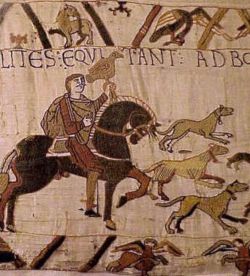
King Harold out for a hunt on the Bayeux Tapestry, no doubt a song was sung soon after. Image found at http://regia.org/research/misc/pastimes.htm.

Back To Top
Abstract

The beach front horse races continue, and Hrothgar steps into the crowd.

Back To Top
Translation

“Meanwhile the contending continued among
the tawny mares racing on the sand. By then the morning light
shoved and rushed over the horizon. Came retainers many,
all bold-minded, to that high hall,
to see that strange object; the king himself
from the bed chamber, guardian of the ring-hoard,
walked with a sense of leading an army,
of renowned virtue, and his queen with him
tread the path to the mead hall with her maiden troop.
Hrothgar spoke – he stood upon the steps
once he reached the hall, saw the lofty roof
with its gold decor and Grendel’s hand alike:”
(Beowulf ll.916-927)

Back To Top
Recordings

Old English:

{Forthcoming}

Modern English:

{Forthcoming}

Back To Top
Persistently Satirizing Hrothgar

What I’m fixated on in this passage is how the poet describes Hrothgar. Sure, there’s the stuff about the men still racing on the sand and the sun light rushing out over the horizon and all that, but I think that there’s more to be said about Hrothgar here.

So, let’s look at his intro. He’s said to be coming from the bedchamber “with a sense of leading an army” (“tryddode tirfæst getrume micle” (l.922)). This is my interpretation of the phrase, which Heaney (the main translation I’m using as my base since it’s poetic yet strives to be “Anglo-Saxon” where it can) seems to just gloss over. Heaney renders the same Old English (as far as I can tell) as “Walked in majesty…with a numerous train” (ll.921-922). The sense of these two is definitely similar, but I think that mine is hitting on a bit more of the satire or caricaturization that might be going on here. Maybe I just can’t believe that Hrothgar still holds power despite his failing to oust Grendel over the course of 12 years. Not to mention the poet’s chiming in twice now that the stories of Sigemund and Beowulf aren’t meant to bring down Hrothgar’s authority.

Anyway, Heaney’s rendering of that bit of line 922 shares in attributing majesty to Hrothgar, and I think that’s definitely what’s going on here. But I think that what’s important but missing from Heaney’s translation is what gives Hrothgar the sense of majesty: being at the head of an army (“getrume micle”). This is important because with it in place, Hrothgar’s character as the fallen warlord is given more detail.

Indeed, Hrothgar once walked at the head of armies on the field, but now he merely walks at the head of a train of women coming from the bedchamber. In short, he’s been put out to stud and, not unlike Heremod, has pulled away from battle after being greatly discouraged by Grendel. The overly melancholic Hrothgar of “Beowulf: A Musical Epic” is a bit much, but I think what Victor Davis and Betty Jayne Wylie really picked up on (and emphasized for the stage and the speaker) is Hrothgar’s sense of despair. Though, unlike Heremod, Hrothgar hasn’t become so glum as to put the rest of his court at risk. He’s still able to ask for help and to put out a call, even if it takes twelve years for that call t be answered.

More than anything, though, I can’t help but read these few short lines of Hrothgar coming out with Wealhtheow and her attendants as emasculating. I see it this way because there’s just so much contrast with what we’ve just heard about conquest and battle. And not even about the pitched group battle that Hrothgar’s army of old would’ve fought in, but single combat – and single combat with a mythical creature no less. And yet, here we have the formerly glorious warrior king coming out from his bedchamber at the head of a troop of women. It’s definitely still majestic, but I think the poet is really emphasizing what can happen to even the greatest warriors in their old age. Part of this is definitely giving the audience ideas of what could happen to Beowulf down the road.

And, yeah, there’s the matter, of the sunlight, too (on line 918). I think that’s just the poet’s way of saying that this, the first post-Grendel dawn, is eagerly awaited because it signifies the real and definite defeat of the monster (light shines again on Heorot!). Plus, the way the light’s said to shove and rush over the horizon suggests to me that this sunrise is a symbol of an aggressive reassertion of the natural order that Grendel had disrupted.

Do you think the poet meant to sarcastically glorify Hrothgar here? And do you think the early audiences of Beowulf would pick up on this?

Back To Top
Thoughtful Brides on the Mead Hall Path are Marvelling

In this passage there are a few more compound words than in the past few weeks’. These words’re cool and all that, but none of them are that complex. No doubt this is because the description of the men riding around after the story’s finished is supposed to be a light moment. Not to mention, the sight of a war proud lord leading his wife and her handmaids from their chambers is also probably meant to bring out some smirks before things get serious again with Hrothgar’s speech.

That said, here are this week’s compounds:

The word “swið-hicgende” (l.919) combines “swið” (meaning “strong,” “mighty,” “powerful,” “active,” “severe,” or “violent”) with “hycgan” (meaning “think,” “consider,” “meditate,” “study,” “understand,” “resolve upon,” “determine,” “purpose,” “remember,” or “hope”) to mean bold-minded, or literally “strong thinker.” Though I think the concept is more about having strong thoughts than being one who thinks a lot. Those that this word describes on line 919 are the ones who are leaders because of their ground breaking ideas (no doubt mostly martial, but so what?).

Then there’s the compound “bryd-bure” meaning “bride-chamber.” How this combination gets to “bride-chamber” is pretty straight forward since it’s a combination of “bryd” (meaning “bride,” “betrothed,” “newly married woman,” “wife,” or “consort”) and “būr” (meaning “bower,” “apartment,” “chamber,” “storehouse,” “cottage,” or “dwelling”). There are a few little things with this one. Like the idea that a bed chamber could be thought of (maybe exclusively through our perspective) as a storehouse for brides or wives (unless the word’s where the idea for the story of Bluebeard came from). I really like the idea of a bridal cottage, it ties in neatly with the very European-seeming idea of the rural couples retreat, the sense that in a natural setting a man and a woman who are married will be able to rekindle their spark or reconnect. Though that idea itself could go back even to Homer and Odysseus and Penelope’s bed being made of a carved tree that was also what the entire house was built around.

Also, a fun fact here is that “bryd” is also how the Old English forerunner of the modern word “bird” used to be pronounced (and, therefore, spelled), so that’s probably one reason why women are sometimes regarded as flighty in Anglo-Saxon derived cultures.

Then we stagger onto “medo-stigge” on line 924. This compound for “path to the mead hall” comes from a cocktail of “medu” (simply “mead”) and “stigge” (meaning “narrow path,” “way,” “footpath,” “track,” “road,” “course,” “line”). There’s some sense of the “path to the mead hall” being a little well worn here, but I think that the variety of roads that “stigge” covers simply opens up that possibility rather than actually reflecting anything really meaningful.

And, the last of the bunch is the marvelous “searo-wundor” or “strange object.” This one has a little bit more to show.

A combination of searo (meaning “art,” “skill,” “cleverness,” “cunning,” “device,” “trick,” “snare,” “ambuscade,” “plot,” “treachery,” “work of art,” “cunning,” “device,” “engine (of war),” “armour,” “war-gear,” or “trappings”) and “wundor” (meaning “wonder,” “miracle,” “marvel,” “portent,” “horror,” “wondrous thing,” or “monster”), this compound holds the secret of how the Anglo-Saxons viewed the world.

If “searo-wundor” is any indication, then, just as we still do today, the Anglo-Saxons regarded things that were out of the ordinary both “marvels” and “portents.” I don’t find this interesting because it suggests a connection from the Old English world to the Modern English world via superstition. Superstition is something that every culture has. The thing here is that the doubling of “wundor” suggests that the Anglo-Saxons had some idea that exceptions to the established rules must mean that there are other higher rules we don’t know about. Those, of course, to the Anglo-Saxons would be god’s rules. The funny thing is that even now there’s still a great deal of things that we just can’t account for. A millennium later and we’re still seeking rules when the ones we know are broken.

Do you think medieval people had some idea of world order or structure beyond their religious beliefs?

Back To Top
Closing

In the next passage Hrothgar thanks god and Beowulf alike.

You can find the next part of Beowulf here.

Back To Top

A single half line of warning, a single word about patrimony (ll.907-915)

Abstract
Translation
Recordings
Sin at the end of a Story
A Single Word on Inheritance
Closing

Beowulf, Anglo-Saxons. poetry

King Harold out for a hunt on the Bayeux Tapestry, no doubt a song was sung soon after. Image found at http://regia.org/research/misc/pastimes.htm.

Back To Top
Abstract

The horseback poet wraps up his singing of Sigemund, Heremod, and Beowulf.

Back To Top
Translation

“That campaign was often a source of anxiety for
many wise men before the time of the king’s brash way of life,
it made those miserable who relied on him for relief,
those that wished the king’s son would prosper,
receive his patrimony, protect the people,
their stores and their strongholds, a man of might,
the ancestral home of the Scyldings. Just the same there,
the kin of Hygelac, to all man kind,
became a decorated friend; yet sin still slinked in.
(Beowulf ll.907-915)

Back To Top
Recordings

Old English:

{Forthcoming}

Modern English:

{Forthcoming}

Back To Top
Sin at the end of a Story

Maybe it’s because covering at least eight lines of Beowulf every week breaks some things up, but I’m not sure of what to make of this passage. It’s the end of the section of the poem that’s the horseback poet’s song about Sigemund, Heremod, and Beowulf. So, the question is, I suppose, what can we say about this ending?

Looking at the very last line of the passage, we see that it ends with a note of warning: “yet sin still slinked in” (“hine fyren onwōd” (l.915)). This half line suggests that though Beowulf is celebrated in this instance something still comes up to throw off the joy of Danes and Geats. Having read the poem a few times before, this half line could refer to a few things. First among them is the idea that Grendel’s mother, when she comes seeking revenge for her son, is the sin that still slinks in. Or it could be a reference to some sort of slip up on Beowulf’s part that lands him in the poor state he’s in when he faces the dragon at the poem’s end. More broadly, this half line warning could just be a comment that there is no perfect joy, and that there will always be some little niggling thing or other that brings down the most secure seeming happiness.

Of course, “yet sin still slinked in” is my own interpretation of this apparently crucial half line.

Seamus Heaney translates it simply as “But evil entered into Heremod” (l.915). Why Heaney pulled Heremod out for this line is unclear. It could be that he’s just following the poet’s example of making reference to not the most recent antecedent but to one related to the content of its clause instead. This sort of context-sensitive referring seems to be a big part of how the poets of Old English wove the language together since there have already been a few points in the poem where pronouns or implied subjects and antecedents are a few lines apart. And I can understand why Heaney would want to make this line about Heremod. The poem really does not give much context for the last half line of this passage, and leaving it vague as I did is ambiguous.

Though ambiguity does have its place in Beowulf and the bits of gnomic wisdom that crop up in the poem from time to time. The best example of these bits of wisdom being “fate goes ever as she shall!” (“Gæð a wyrd swa hio scel!” (l.455)). So a line like “yet sin still slinked in” shouldn’t necessarily be made specific just because it’s vague where scant lines earlier the poet was singing specifics. Since this is the end of the horseback poet’s song, I think a general statement, especially one that’s a warning makes sense.

Using such a statement is a great way to end off a story about someone still living, because that person’s story is still being written. Though if that’s what the poet’s going for, there are some heavy implications that to live is to sin, suggesting that already the Anglo-Saxons had adopted ideas of Catholic guilt. Or at least this poet and his audience had.

But I also think the general ending of this story makes sense because leading up to it is a bramble of clauses and words that gives the sense of the poet not so much reciting form something he knows as bringing out something based on inspiration. So capping off his ramble, from the fanned fire in his head, is a bit of prescience. Though it’s a prediction based on experience. Heremod was once grand, and yet he fell. Likewise, even though it’s not mentioned here, Sigmund ultimately falls in battle at the hands of attackers after Odin shatters his sword (inescapable divine disfavour, if ever I’ve seen it). Likewise, Beowulf, the real life mythical hero, falls in the end. Not only is this fall foreshadowed in the idea of sin still slinking in, but capping his story off with this bit of wisdom suggests that the poet is grounding his tale in reality both because of Beowulf’s being included and in its bittersweetness.

Why do you think poets in Old English bothered to make their language more complicated when describing things like battle or complex emotion?

Back To Top
A Single Word on Inheritance

This passage is sparser than any before it when it comes to compound words of interest. Even words of interest are in short supply here. But I make no promises about this section being short. I can be a bit like Rumpelstiltskin at times, spinning nearly nothing into quite a bit (though I won’t go so far as to say that I spin that nearly nothing into gold).

Anyway. The single stand out word in this passage is “faeder-aeþelum.” This word means “patrimony,” or “paternal kinship.” This meaning shouldn’t be too surprising since this compound is made up of the words “faeder” (“father,” “male ancestor,” “the Father,” or “God”) and “aeþeling” (“man of royal blood,” “nobleman,” “chief,” “prince,” “king,” “Christ,” “God;” “man,” “hero,” or “saint”). So the compound meaning is pretty much right there in the words involved.

But what makes this word stand out? Well, looking at the word itself, it’s interesting how self contained it is. We’ve seen our share of obvious compounds here at A Blogger’s Beowulf, but this one is neatly wrapped up in itself. This ouroboros like effect comes from both of the words being very similar in meaning. Sure, “faeder” is pretty limited to a sense of masculine power, but so too is “aeþeling.” Really, the biggest difference is that, to me at least, the latter carries a sense of youthfulness. Fathers, especially authoritative fathers, aren’t usually that young. So it’s like this word combines one part the power of youth and two parts the power of masculinity to come out with a word for male inheritance either of property and responsibility or of name and reputation or both. So, the effect of compounding “faeder” and “aeþeling” is more like an intensifying one than any sort of subtle modification.

There’s also the sense that this inheritance is something passed on only through the male parent or guardian. That it’s something that only the male parent can give to a child. That’s also something that strikes me as interesting. though not nearly as much as the sense of “faeder” as “god,” which at least hints at some notion of there being some sort of divine element to patrimony. And, maybe also to kingship itself, since that’s what’s at stake here. Though just in general, I can see it being a more divinely regarded thing, since Biblical stories about inheritance tend to be through the male line. Like the story of Jacob stealing Esau’s place as the inheritor of Isaac’s honour and divine favour, or of the parable of the prodigal son.

On the level of the word itself, there’s not much to say. It’s the first word in line 911, so there’s that, I guess. But otherwise, it looks like its primary function on the line is to alliterate with “onfōn” and “folc.” And, I’m not entirely sure of its significance, but there is the matter of the alliteration falling on the first, seventh, and eighth syllables of the line. Or its being in the first and last syllables of the first half line and the first syllable of the second half line. Whichever you prefer.

Point is, there’s some extra meaning packed into this word, and I think I’ve taken some of that out for inspection.

How much meaning do you think poets pack into single words? If we can look at a single word like I just did and pull out so much meaning, is it because the poet meant it that way, or is it just what the culture or context of the interpreter gets out of it?

Back To Top
Closing

In the next passage of Beowulf, the Danes continue their joy riding and Hrothgar steps out with a speech.

You can find the next part of Beowulf here.

Back To Top

The subversive power of the poet’s song, people and sadnesses (ll.898-906)

Abstract
Translation
Recordings
All Hail the King of the Danes
Peoples and Sorrows
Closing

Beowulf, Anglo-Saxons. poetry

King Harold out for a hunt on the Bayeux Tapestry, no doubt a song was sung soon after. Image found at http://regia.org/research/misc/pastimes.htm.

Back To Top
Abstract

The poet’s song turns from Sigemund and his glorious victory to look instead at a man defeated: Heremod.

Back To Top
Translation

“His fame was pushed most widely
among the nations, protector of warriors,
for deeds of courage — he prospered from then after —
after Heremod retired from war,
his strength and courage; he against the Jutes
had his power stolen in ambush and his force
was quickly slain. His sorrow oppressed him
far too long; to his people he waned,
to all his nobles his life grew too full of care.”
(Beowulf ll.898-906)

Back To Top
Recordings

Old English:

{Forthcoming}

Modern English:

{Forthcoming}

Back To Top
All Hail the King of the Danes

Although there’s no poet interjecting here to keep things from getting messy, this passage is dangerous.

Earlier, before this poet on horseback started to sing of Sigemunde, there was some noise made about everyone praising Beowulf, but being happy with Hrothgar as their king. In fact, the poet goes so far as to give Hrothgar one of the highest epithets: “that was a good king!” (“þæt wæs god cyning” (l.863)).

In light of this passage, though, there could be some sarcasm in that earlier statement.

Here we’re told how Sigemund’s fame grew after he beat the dragon and stole away its treasure, bringing it to his own people. In fact, it even sounds like Sigemund had some sort of happy homecoming because of his courageous deed. In fact, it sounds like he might have been in that far country where the poet alleged his story of the hero came from because of some sort of exile. And, what’s more, possibly exile at the hands of king Heremod. After the first three lines, the poet shifts over to this figure of lore.

Heremod is king of the Danes, and when we meet him here he is the very picture of melancholy. Having suffered a great loss when fighting the Jutes (maybe the giants? the word used is “eotena” which could mean either), Heremod falls into a depression and loses his warlike demeanour. He must’ve been some battler since his entire court is thrown into disarray when he no longer steps out to campaign or bring in treasure from raids.

As a reader of Anglo-Saxon culture as much as Anglo-Saxon poetry, this passage — the poet’s song on horseback in general — is supposed to show the two examples of great man that stand before Beowulf — the man triumphant in Sigemund and the leader who is shackled by shame and fear in Heremod. Later on, Hrothgar talks more explicitly about Heremod as a bad king (the kind Beowulf should not be), but right now this whole thing being an example for Beowulf is just implied.

But it’s really hard to not see it as a subversion of the poet’s saying “the people thought Beowulf was great! But, oh yeah, they still like Hrothgar, too.” I mean, you’ve got the young hero Sigemund who’s just reversed his fortunes by defeating the dragon and winning the treasure and that’s pretty much Beowulf. Sure, our hero hasn’t fought a dragon yet, but he’s beaten Grendel and won great fame that’s quickly spread thanks to the treasure that Grendel left: his arm and claw. Then you’ve got Heremod, the man who sits in his court and bemoans his defeat. Isn’t that too much like the Hrothgar of the last 12 years for any sort of analogy or parallel to be made?

So I think this passage is the poet insinuating that Beowulf could become the new ruler of the Danes. But we can’t know for sure until we get the rest of the story in the next part of the poem.

How subversive do you think the poem Beowulf is? Is it just some light entertainment? Or is it about the young overtaking the old? Or is Beowulf a Christianized Germanic hero bringing new vibrancy to an old tradition?

Back To Top
Peoples and Sorrows

Maybe it’s because sorrow and pitched battle are involved in this passage, but compound words are coming back! Actually, it wouldn’t surprise me if their reappearance was due more to the depression and sorrow of Heremod. If Anglo-Saxon poets wove their words into tangles to accurately represent war, then surely they could do the same to represent the complexities of the deep sadness the old king’s experiencing.

Anyway. Onto the words.

First in the passage, on line 899, is “wer-þeod,” a combination of “wer” (meaning “male being,” “man,” “husband,” “legal money-equivalent of a person’s life,” “a man’s legal value,” “dam,” “fish-trap,” “catch,” “draught,” “troop,” or “band”) and þeod (meaning “people,” “nation,” “tribe,” “region,” “country,” “province,” “men,” “war-troop,” “retainers,” “Gentiles,” “language,” or “fellowship”). This compound is taken to mean “folk,” “people,” or “nation,” and I can see why. It could literally be translated as “people of men.”

But, of course, there are some very interesting nuances to both of these words.

With “wer” we get a look into the Anglo-Saxon idea of the value of life in that the word can mean the “legal money-equivalent of a person’s life,” or “a man’s legal value.” Of course, it has to be noted that a monetary value was attached to human life in Anglo-Saxon society because of law makers’ attempts to control rampant feuding. So, if you happened to kill someone from that group over there, they wouldn’t have to come and kill you, you could just pay that group the value of the life you took and the feud would be called off (legally, anyway). This bunch of laws is an unfortunate imposition since it might’ve been used to turned a few lives into bits of silver, but still. This concept helped to keep people from endlessly feuding so they could do other things. Plus, I bet these laws had some repercussions on ideas of manliness that have resonated down through the centuries, too.

The other half of this compound similarly has some neat meanings. Like “Gentiles” or “language.” In combination with the former, the compound could mean the collection of those who weren’t Jewish, those who weren’t chosen by God. In light of the Anglo-Saxons trying to identify with the Jews of Exodus, a people in search of a homeland, referring to the Danes as Gentiles even through vague implication is interesting. And as a story about pre-Christian times, this meaning seems unlikely to be a coincidence. At the least, I can see the poet smiling after the fact and considering himself very clever indeed for using “wer-þeod where he has.

But combining “wer” with the “language” sense of “þeod” is where things really pick up. The sense of such a combination is that all of those who speak the same language are one group. That’s a really cool idea!

But I digress, since there’re other compounds to get to.

Like the less mysterious “sorh-wylmas.” This combination of “sorg” (“sorrow,” “pain,” “grief,” “trouble,” “care,” “distress,” or “anxiety”) and “wielm” (“boiling,” “swelling,” “surge,” “billow,” “current,” “stream,” “burning,” “flame,” “inflammation,” “fervour,” “ardour,” or “zeal”) means “wave of sorrow.” And its constituent parts don’t really make that meaning a secret. Though I suppose there’s a bit more colour to the idea of a wave of sorrow if you add in the sense of that wave being arduous or zealous. It’s not just a lazy lolling mass of sadness washing over you, but the sort of wave a ship in the middle of the sea might encounter while in a storm’s clutches.

Then, rounding out the bunch but being strangest of the three is “aldor-cearu” of line 906. Meaning “great sorrow,” this one combines “ealdor” (“elder,” “parent,” “ancestors,” “civil or religious authority,” “chief,” “leader,” “master,” “lord,” “prince,” “king,” “source,” “primitive,” “life,” “vital part,” “age,” “old age,” or “eternity”) with “cearu” (a form of “carig” carrying meanings like “sorrowful,” “anxious,” or “grievous”).

“Cearu” is pretty straightforward. But “ealdor” much less so. This one could combine with the former to mean a few shades of “great sorrow.” It could be old sorrow, implying that it’s the sort of sorrow that’s sat and festered for years; it could mean that it is a princely sorrow, a sorrow that comes with the responsibility of ruling over a people; or it could be seen as the sorrow that simply comes with age, the regret and feelings of inadequacy a person experiences as they inevitably compare their present selves to their younger, remembered as happier and stronger, selves. It’s definitely a worthy companion to the much simpler “sorh-wylmas,” though, since both carry a heavy weight with them.

If you agree that the language of the poem is intentionally more complex around descriptions of battles and of sorrow, what do you make of it? Is treating sorrow as the same sort of complex ordered mess as a battle accurate, or just a weak comparison? What do you think of all of this if you don’t agree that the language’s complexity is intentional?

Back To Top
Closing

In the next post, the story of Heremod wraps up.

You can find the next part of Beowulf here.

Back To Top

Beowulf gets introspective, even plain words can be lovely (ll.884b-897)

Abstract
Translation
Recordings
Myth on Myth
Passing Judgement on Words
Closing

Beowulf, Old English, translation, poetry

Beowulf fighting the dragon. There are striking similarities between this fight and Sigemund’s. Image found at https://upload.wikimedia.org/wikipedia/commons/6/6f/Beowulf_and_the_dragon.jpg.

Back To Top
Abstract

The poet in the poem sings of Sigemund defeating the dragon alone and winning its treasures.

Back To Top
Translation

“Sigemund’s fame saw
no small surge after his death day,
after ward in cruel combat he killed the dragon,
the hoard’s guardian. Under the grey stone,
the nobleman’s son, alone he dared to do
the dangerous deed; Fitela was not with him then;
without that comrade, he plunged his sword through
the wondrous wyrm, so that it stuck in the wall,
that lordly iron; the dragon died its death.
His courage over the foe won him its treasure fully,
so that he the ring hoards had to give
as he saw fit; a boat they loaded,
they bore in the ship’s bosom bright treasures,
Waels’ son; the hot wyrm melted.”
(Beowulf ll.884b-897)

Back To Top
Recordings

Old English:

{Forthcoming}

Modern English:

{Forthcoming}

Back To Top
Myth on Myth

We’ve got another simple, straightforward type passage here. Though it begs an important question: what’s the story of Sigemund doing here? It’s something that the poet on horseback has conjured up out of his knowledge of the hero, and there are definitely analogues to Beowulf. Though these analogues are really only present if you’re already familiar with Beowulf. Otherwise, all of the talk of Sigemund fighting the dragon and winning is just foreshadowing. Weirdly, though, the exact phrase “under the grey stone” (“under harne stan” (l.887)) comes up when Beowulf faces the dragon in the last third of Beowulf. Anyway, I think what’s going on here with the analogues to Beowulf — his slaying a dragon, driving the sword through a dragon who guarded a bunch of treasure,and the dragon being liquid in some way — is a bit of play with the nature of myth and legend.

Where Sigemund beats the dragon and lives, Beowulf beats his dragon but dies in the process. Nonetheless, as spoils Beowulf gains control over the dragon’s hoard much like Sigemunde does. Though this control passes from Beowulf to his own Fitela figure: Wiglaf. These twists on the events of the Sigemunde story — Beowulf’s death, his Fitela being with him — I think are the poet trying to make the myth of Beowulf more realistic. Maybe it’s even the product of an imagination that knew that the age of deathless heroes who earned great glory forever was past. So, perhaps with Sigemund foreshadowing or contrasting with Beowulf the poet is trying to make sense of what a mythic figure might look like in a world with a new religious system that overturned much of what went before and in an era in which law and order were starting to centralize. Heroes were still needed in this new world, they were still craved, but the shifting realities of the Anglo-Saxons (or maybe their blending Germanic, Roman, and Celtic traditions and ideas into a single culture) forced them to create a hero who followed the mythic formula of fighting a dragon and triumphing, but whose glorious victory cost him his life. The point perhaps being: “glory comes at a great cost these days. Be wary of glory.”

It’s also interesting that when the ring hoard of the dragon comes into Sigemund’s possession it’s not a cause for celebration because he has the treasure for himself. Instead, it’s a great event because Sigemund’s able to spread the wealth among his closest relations. Beowulf also celebrates the gain of the treasure not as a personal victory but as one for his people.

How much do you think is going on with this story of Sigemund? Is it here because the poet’s trying to say something about heroes? Or just something sung while the people of Heorot rejoice?

Back To Top
Passing Judgement on Words

I’m starting to wonder if the language of the poem is getting simpler as this other poet sings because of how the actual poet wants this in-tale poet to look. If the actual poet of Beowulf is trying to put his all into it, then there can’t be a poet in the story who’s use of language is more complex or descriptive, right?

Anyway, the simplicity of the language throughout this section means that there aren’t many compound words. And generally when there are, they’re pretty simple.

The word “beah-hordes” meaning “ring hoard” is the only compound of note in the passage for this entry. It’s a combination of the word “beah” (meaning “ring,” “coil,” “bracelet,” “collar,” “crown,” or “garland”) and “hord” (meaning “hoard,” or “treasure”). And that’s really all there is to it. Combining these two words really does nothing more than specify the kinds of rings that you’re dealing with. Not much more fantastical stuff beyond that, really.

But, there are two words in the passage for this entry that do offer a little more. Even if they’re perfectly normal, singular words.

The first of these is “dōm” a word meaning “doom,” “judgement,” “ordeal,” “sentence,” “decree,” “law,” “ordinance,” “custom,” “justice,” “equity,” “opinion,” “advice,” “choice,” “option,” “free will,” “condition” “authority,” “supremacy,” “majesty,” “power,” “might,” “reputation,” “dignity,” “glory,” “honour,” “splendour,” “court,” “tribunal,” “assembly,” “meaning,” or “interpretation.”

What makes “dōm” stand out is that in the context of the passage it means “glory” or “reputation,” meanings that are kind of a ways down the list. But even so, it’s not an interesting word because its in-context meaning is low on its list of meanings. The word itself seems to really express what underpins reputation, and therefore fame, in a very neutral way.

Judgement underlies fame, after all. And, weirdly, in Modern English the connotations have shifted, since to us “fame” generally seems like a good thing while “judgement” feels like it’s the face of a beast called guilt. Maybe there’s something to say here about the perceptions of judgement and the cultural influence of Christianity, a religion promising judgement with eternal consequences.

But in Old English, the sense of “dōm” meaning judgement and its forms and offshoots is much more neutral. Simply put, you need to be judged to have a reputation or fame, so “dōm” covers a lot of this area of meaning. Maybe because it also seems to be a general sort of word. It’s used as it is here to mean” reputation or “fame” and it’s used elsewhere to refer to divine judgement and elsewhere still to refer to the day the world ends in judgement (so I guess its appearances in Old English are soaked in Christianity, too). But maybe more than anything it all just comes from the Old English “dōm” being narrowly cognate with our own “doom,” a much much more streamlined term for having been judged and found wanting, or for hopeless consequences.

The other weird word in this passage is much lighter. In line 887, the poet describes the dragon as the “hierde” of his hoard of treasure. The use for the sake of alliteration here is supremely obvious, but I still find it neat that the word for “shepherd,” “herdsman,” “guardian,” “keeper,” or “pastor” could be stretched in this way.

A “guardian” makes sense in reference to gold, as does a “keeper.” But what about the sense of guidance in “shepherd,” “herdsman,” and “pastor”? How could you guide a hoard of treasure, especially if you weren’t sharing or spending it, but just sitting on it as dragons do? Maybe there’s a bit of foreshadowing in this sense of the word, or even a judgement passed on the dragon, since when Sigemund becomes master of the treasure he does much more to guide it into the hands of his people. There’s a Christ analogy here, too, with the dragon as Satan or a pre-Christian deity, while Sigemund, going it alone under the grey stone (itself perhaps a reference to Jesus going into the sealed tomb after the crucifixion, or even a reference to the harrowing of hell) is the Christ figure and the treasure is salvation, which Sigemund gives freely.

Old English words have a lot of different shades of meaning to them. Do you think the same is still true with Modern English, or, as English has changed over the years its vocabulary has become specialized?

Back To Top
Closing

In the next passage, we hear how Sigemund’s victory affected his home and old king Heremod’s court.

You can find the next part of Beowulf here.

Back To Top

A mysterious start to a tale of Sig(e)mund (ll.874b-884a)

Abstract
Translation
Recordings
A Promise of Mysterious Tales
Mostly Simple Compounds
Closing

Beowulf, Anglo-Saxons

King Harold out for a hunt on the Bayeux Tapestry. Image found at http://regia.org/research/misc/pastimes.htm.

Back To Top
Abstract

The singer begins to tell of Sigemund and deeds hitherto little heard about.

Back To Top
Translation

“Of everything he spoke,
what he of Sigemund had heard said,
deeds of courage, many not widely known,
the wrangling of Wælsing’s son, his wide wanderings,
where that warrior’s child was not often recognized
nor the feud and wicked deed, but to Fitela, the one with him,
when he would tell him of such things,
from uncle to nephew, as they were always
companions bound by need come every strife;
they had a great many of the giants race
slain with their swords.”
(Beowulf ll.874b-884a)

Back To Top
Recordings

Old English:

{Forthcoming}

Modern English:

{Forthcoming}

Back To Top
A Promise of Mysterious Tales

In this passage the poem takes a break from Beowulf’s story to talk about a different hero: Sigemund (a.k.a. Sigmund). We’re not told much about this figure of mythic proportions yet, except that he travels with his nephew and has a darkened past. But is he trying to escape this past and the feuds and deeds it contains or is he just working with that as a feature of his story? The poet’s not at all clear about any of it. Actually, the poet seems to go pretty far to weave a curtain of mystery around Sigemund. And, to a lesser extent, Fitela. Or at least Fitela’s in there because the curtain’s just so damn big.

So this curtain of mystery (it’s too heavy to be a veil, I think), is made up of a few things. First the poet says that “many [of these deeds are] not widely known,” (“ellen-dædum, uncuþes fela” (l.876)). That’s straight forward enough. Maybe these stories aren’t widely known because they’re the ones that were told in the far country where Sigemund wasn’t very well known himself. No doubt he went on to make a name for himself in this country, but maybe that name was a pseudonym (maybe “Sigemund” is that pseudonym – not the cleverest, but hey, the extra syllable causes some confusion to this day). Or, maybe the locals that passed these stories on had a different angle on Sigemund’s deeds than most other tales about them. Whatever the case, this layer of the mystery curtain isn’t too far from being translucent.

But the next one is completely opaque.

When the poet moves onto the feuds and deeds that Sigemund apparently had some part in, he says that these things were as little known in the places he travelled to as he himself was. So, if these stories are coming from these countries, any information about these feuds and deeds will likely be scanty. What’s more though,is that we’re told that Sigemund only shared details about any of these things with Fitela.

Fitela is said to be Sigemund’s nephew (this checks out, the similarly named Sigmund travelled with his nephew/son (Norse mythology has some very racy bits), too). Fitela’s also said to be Sigemund’s companion in battle, maybe one who was so reliable that they always faced hardship together, or maybe one that just seemed to find Sigemund whenever he fell into difficulty. It’s hard to say. Whatever the reason for their partnering up, the fact that Sigemund only told these things to Fitela suggests that the only way the poet knows them well enough to sing about them is through Fitela. At some point, the nephew must’ve spilled it about his uncle. That is, if the poet is telling true stories or stories coming from a very close witness to these “deeds of courage” (“ellen-dædum” (l.876)).

Because this part of the poem is scant on details, maybe this poet knows these little known stories of Sigemund because he heard them not from Fitela but from this far country’s people. If that’s the case, then how far has this poet himself gone?

The question of how much the poet singing about Sigemund learned about his subject first hand is a tricky one. What do you think matters most in story telling – accurately relating facts, or action, intrigue, and suspense?

Back To Top
Mostly Simple Compounds

These story telling sections of the poem are always so vivid and direct that compound words take on a completely different function in them. Instead of seeing those that I’d call “high action” compounds, we’re given those that are plainer. Like “ellen-dædum.”

The parts of this compound, “ellen” and “dædum,” literally mean “zeal,” “strength,” “courage,” “strife,” or “contention” and “deed,” or “action,” respectively. The combined meaning of “deeds of courage” isn’t far from clear. Though mixing the “contention” or “strife” sense of “ellen” with “deed” gets so clear that it upends the glorious/courageous implications of “ellen-dædum” by suggesting a pretty plain Jane sort of performance in war. Applying such a word to someone would mean that person just did a “strife deed,” which sounds like something that you just do by default in combat.

The word “eal-fela” graces line 883, just about rounding out this section. And it might be the plainest compound of them all. Though it does demonstrate the intensifying formula of Old English (combine two like words, (including negatives)), since “eal” means “all,” “many,” or “much” and “fela” means “very,” or “much.” So “eal-fela” literally means “all much,” with the sense of something that’s all-encompassing. Or, as is the case in the poem, the sense of “mostly all” of the giants.

No, this passage doesn’t really offer complexity in its compounds. It’s more about the simple word combinations.

Except for “nyd-gestealla.”

Now, maybe I’m piecing this one together wrong, but “nyd” could be a form of “neod” (meaning “desire,” “longing,” “zeal,” “earnestness,” “pleasure,” “delight”) or “nied” (meaning “need,” “necessity,” “compulsion,” “duty,” “errand,” “business,” “emergency,” “hardship,” “distress,” “difficulty,” “trouble,” “pain,” “force,” “violence,” “what is necessary,” “inevitableness,” “fetter” or just being the name of the rune for “n”). For the most part the difference between these two words is negligible. But, there are some exceptions. The word “neod” suggests a sort of leisurely need, as its meanings include “pleasure” and “delight,” while “nied” comes across as more business like as it can mean “errand,” or “duty” (or, even, “business”). But the compound that “nyd” is a part of doesn’t get any simpler in its second half.

The word “gestealla” seems to break down into “steal” or “steall.” The difference between these two lies primarily in specificity. The former word just means “structure,” even “frame,” while the latter means “standing,” “place,” or “position.”

So is the companionship that “nyd-gestealla” describes one that’s structured on duty or on pleasure? Or is it one that’s putting those involved in a position of business or of pleasure? Or is it that it’s supposed to do both, the ambiguity coming in to add a sense of reciprocity to the relationship it’s describing?

Do you think there’s a connection between the tone of sections of Beowulf and the intensity of the compound words found in them? So far, this part of the poem is very light-hearted and the compound words here have mostly been straightforward, almost relaxed. Is there a connection between the two? If so, what could using a word like “nyd-gestealla” mean for this part of the poem? Is it being used as a reminder of hard times or as something else?

Back To Top
Closing

In the next passage, the poet begins to tell of Sigemund and Fitela’s victory over a dragon and the raid on its hoard.

You can find the next part of Beowulf here.

Back To Top

So relaxed, even the language reclines, and challenging a word (ll.864-874a)

Abstract
Translation
Recordings
Suspiciously Low-Key
Being Made of Stories
Closing

Beowulf, Anglo-Saxons

King Harold out for a hunt on the Bayeux Tapestry. Image found at http://regia.org/research/misc/pastimes.htm.

Back To Top
Abstract

The warriors keep riding and racing, while stories of Beowulf are told.

Back To Top
Translation

“Meanwhile the battle-reputed let the horses trot,
in contests the bay horses sped,
there they found the path quite fair,
they thought it best; around then one of the king’s thanes,
a man made of stories, mindful of many tales,
such that he was in old tradition
immersed, bound words one to the other
according to appropriate meter. The man began again
of Beowulf’s struggle to smartly sing
and quickly made a new narrative account,
wrangled words.”
(Beowulf ll.864-874a)

Back To Top
Recordings

Old English:

{Forthcoming}

Modern English:

{Forthcoming}

Back To Top
Suspiciously Low-Key

I’ve kind of cut things off in the middle ending this passage at the first half of line 874. But I did it with good reason. This next section of the poem is a pretty lengthy bit of storytelling. Weirdly, actually, this is the last time we hear any mention of Beowulf’s story for a while.

But that’s not the case with this passage.

The passage from line 864 to line 874 is all about the lead in to all that story telling. As such, there’s not much going on here as far as what’s described. But even the language here is pretty plain.

In previous scenes, like Beowulf’s fight against Grendel, or even the events after the fight, the lines are heavy with words and tightly jammed together. The words themselves give the impression of a lot of quick, decisive action. But here the Old English and the English translation of it have a much lighter, open air sort of quality.

Which makes sense, since this passage sees the group racing across a beach while somebody renowned for storytelling is spinning yarns, and all things are pretty cheerful. On the language side of things, all this leisure time leaves the poet’s sentences to repeat with variation. A lot of clauses in this section just wind down to their core meaning. Take for instance, the first three and a half lines. In the first of these lines we’re told about the men racing, then we’re told about the path they race on, and everything’s topped off with a generally positive comment about things being “best.” Ambiguity comes out to play again here, but in a much more light hearted way since the “it” on line 867 could be the path or the racing in general. Either way, what’s being thought “best” is pretty light stuff.

Then we come to the description of the storyteller. Of whom there’s not much to say. Though the same narrowing device seen at the start of the passage is used again: we start with a description of the teller and then wind up with a very straightforward bit about how he tells his stories.

Really, the only truly odd part of this passage is that directly after the final sentence, from the next passage onward, the poet tells of how this story teller recounts the deeds of Sigemund the dragon slayer and his partner Fitela. What I take from this is that Beowulf‘s original audience was already familiar with this other song of Beowulf, the storyteller is the poet’s self-insertion character, or to an Anglo-Saxon audience Beowulf was closely associated with Sigemund.

That last possibility stands out from the rest for me. In my thinking, for an audience to associate two characters so closely, they’d need to be familiar with each character’s story. In the case of Beowulf and Sigemund, this familiarity would mean that the audience would already know that both characters slew dragons. Sure, Beowulf beating Grendel might be reminiscent of a Nordic hero defeating a dragon, but Beowulf’s actually doing the same much later on in the poem would make the association more concrete. Plus, I think throwing in a story about dragon slaying here is too on the nose for mere foreshadowing. There’s more to why this story is told than that, especially since there’s such a shocking switch from mentioning this new song about Beowulf’s deeds to a story about someone completely different.

How does this the tone of this entry’s passage strike you? Does it feel more open and free roaming than those of past passages, or is it just more business as usual?

Back To Top
Being Made of Stories

Much as was the case in my last post, the words in this passage are pretty straightforward. In fact, from line 869 onwards, the poet stops using compounds completely. And, in keeping with last week’s post, the compounds that are used are pretty straightforward.

We’ve got “heaðo-rōfe,” meaning “famed in war, brave” (a combo of “heaþo” (“war”) and “roofe” (“vigorous,” “strong,” “brave,” “noble,” “renowned,” “array,” or “number”)). You might pull something out of mixing “war” with a word that can mean “number,” but I think, in context, this combination means the same as joining “war” with “strong” or “renowned”; the person you’re talking about has been in many wars. And, since the Anglo-Saxons fought pitched battles rather than those based in trenches or with remote arsenals, to survive many wars suggests prowess or luck. And either of those qualities could make for a famed warrior.

Then there’s “fold-weg.” As a combination of “fold” (“earth,” “ground,” “soil,” “terra firma,” “land,” “country,” “region,” or “world”) and “weg” (“way,” “direction,” “path,” “road,” “highway,” “journey,” or “course of action”), this word could be literally translated as “earthen path.” But, its general translation simplifies this to “path” or “road,” which I’m perfectly okay with.

Now, the last two compounds that appear in this passage are a little more interesting. The word “gilp-hladen” claims this status because Clark Hall and Meritt somehow completely misrepresent it as “boastful.”

If we take it apart, though, we can see that “gilp-hladen” is a combo of “gielp” (“boasting,” “pride,” “arrogance,” “fame,” or “glory”) and “laedan” (a form of “hladan” meaning “lade,” “draw,” “take in water,” “heap up,” “lay on,” “build,” “load,” or “burden”). My translation of this compound word to “made of stories” might seem overly poetic, especially because “gielp” apparently doesn’t include “story” as an interpretation. But I think that underlying all of the meanings that Clark Hall and Meritt give the word is the concept of a story. None of those attributes are possible without a story. A person who is proud or arrogant feels that way because of how they perceive their actions and abilities, and the way that they relate those things to themselves and others is their story. Likewise, fame and glory are absolutely reliant on a story (or, sometimes stories) of the famed or glorious person spreading. So I consider the stuff of all of the listed meanings of “gielp” to be story; that is their essence. Hence, “made of stories” instead of something like “boast laden.”

The final compound for this post’s passage is “eald-gesegena” (combining “eald” (“old”) and “gesegena” (a variant of “gesegen” meaning “sayings”)). The neat thing here is that the tradition (of story telling, or at least of lore) is referred to by the short hand “sayings.” Not only are these old stories that the storyteller’s familiar with, but they’re things that people often quote or relate to each other or to themselves. That sort of detail is cool because it not only works well as a short hand for tradition (what could be more traditional than things that may, at least to cynics, be clichés or tropes?) but also very lovingly conveys the down-to-earth nature of this tradition, a word which itself refers to things that are earthy and of foggy origin.

Up until now we’ve seen a lot of compound words. Do you think the poet’s using fewer compound words in this passage is supposed to reflect a change in the poem’s tone?

Back To Top
Closing

In the next entry, the singer sings a song of Sigemund.

You can find the next part of Beowulf here.

Back To Top

On Grendel’s soul and joyous but plain compound words (ll.853-863)

Abstract
Translation
Recordings
Getting to Grendel’s Soul
Three Not Weird Words
Closing

Beowulf, Anglo-Saxons

King Harold out for a hunt on the Bayeux Tapestry. Image found at http://regia.org/research/misc/pastimes.htm.

Back To Top
Abstract

Beowulf, the visiting chiefs, and the young warriors of Heorot go out for a celebratory ride. Along the way tales of Beowulf’s glory are told.

Back To Top
Translation

Afterwards the old war-wagers went out,
so too did many youths go on that merry journey,
from the sea high spirited horses they rode,
warriors on their steeds. There was Beowulf’s
glory retold; many oft spoke of it,
that in neither north nor south between the two seas
there was no other on all the face of the earth
and under the sky’s expanse was no better
shield bearer, one worthy of kingship.
Though they indeed found no blame with their lord and friend,
gracious Hrothgar, for he was a good king.
(Beowulf ll.853-863)

Back To Top
Recordings

Old English:

{Forthcoming}

Modern English:

{Forthcoming}

Back To Top
Getting to Grendel’s Soul

Okay. Two things.

First off, in line 855, it’s really unclear if the horses that Beowulf and the gang are riding are high spirited or if the riders are. Admittedly, my Old English grammar isn’t perfect, but I think this ambiguity (mostly from word order, as far as I can tell, as little importance as that usually has in Old English) says something important about the spirit of this ride.

I think the idea isn’t that either the horses or the men are in high spirits, but that both are. I think this is a bit of pathetic fallacy before Shakespeare and other giants of English literature put the device to wide use. You see, in my mind the horses are in high spirits because the defeat of Grendel has restored the natural order; there’s nothing binding the horses’ spirits, there’s no shadow of the fens holding them back. Further, as part of this restoration of the balance the connection between man and beast has been restored. There’s no more conflict between the two because Grendel the freak has been killed and is no longer able to terrorize either.

Of course, this interpretation being subtextual adds a layer to it. After all, implying the restoration of what might have been understood as the natural order of things (including a belief in humanity’s having a place over animals) with the death of Grendel seems harsh. After all, not but a few lines ago the poet suggested that Grendel was a creature that may well have had a soul like a human’s and that seemed to have been empathized with by the poet. I’m no Anglo-Saxon philosophy expert, but maybe this relates to an idea of a soul being granted or manifesting at the time of death. Maybe the poet’s even getting at an idea that the soul boils down to a matter of will power.

Perhaps those who die honourably within the social structure of Anglo-Saxon civilization do so knowing full well that they’ve died honourably and so they die willingly. They willingly let go of their life, of their consciousness, of their soul. On the opposite end of things, those who die dishonourably, assuming that they know that they’re dying in such circumstances and they’re aware of the consequences might struggle more against death, though their body can no longer sustain it. Then, maybe the knowingly dishonourable person’s unwillingness to die or their rejection of it forms a sort of makeshift soul. Maybe that’s all that Grendel’s was, a manifestation of the pain he endured as he struggled back to the fen.

The other thing that’s important to mention in this passage comes in the last few lines. As you probably noticed, one line after the poet mentions that Beowulf is truly worthy of being king in line 861, he goes back on it faster than someone married to a jealous partner caught flirting with a super model. This is perhaps less metaphysical than the matter touched on above, but I still think it bears mentioning, since it shows the Danes’ loyalty to Hrothgar, since there’s no greater endorsement of something than turning something that seems better down, right? Though later on, we’ll have a similar pro-King Beowulf sentiment from Hrothgar himself.

What do you think the nature of the soul is? Is it something you’re born with? something you earn? Or is it something that only manifests itself in the way you die?

Back To Top
Three Not Weird Words

In his joyous revelry, the poet doesn’t use many compound words. And, really, even those that he does use don’t really have any weird hidden meanings.

Still.

First up, on line 853, the poet gives us “eald-gesið meaning “old comrade.” Though I’ve translated it as “old war-wagers” because of the alliteration and the weirdly light lilt of a noun for combative folk fits the jaunty tone of this passage.

The “old” part of this compound is definitely straightforward, since “eald” translates directly and literally to “old”. And, likewise, “sið” (the root of “gesið)” just means “comrade,” “companion,” “follower,” “retainer,” “warrior,” “count,” “thane.” So there’s no realy surprise there. This compound is just a handy combo that can be busted out for purposes of alliteration and convenience.

Line 854’s “gamen-waþe” is kind of similar.

Combining the word “gamen” (“sport,” “joy,” “mirth,” “pastime,” “game,” “amusement”) and the word “wað” (meaning “wandering,” “journey,” “pursuit,” “hunt,” “hunting,” “chase”), we get “merry journey.” Yes, it almost sounds like a town in Newfoundland. But there’s not a whole lot more to say here. Even though the Old English “wað” includes meanings like “pursuit,” “hunt,” “hunting,” “chase,” and the Modern English “merry journey” doesn’t really get that part of the word’s meaning across, I think it still works. Why? Well, maybe it’s a bit of a romantic notion on my part, but I really think that part of any merry journey in Anglo-Saxon England would be a casual hunt. After all, if you were a noble out joy riding on your estate and you happened across a boar or a stag – even a rabbit – I’m sure you’d probably chalk the encounter up to your continuing good fortune and then put arrow to bow and take aim. It’s almost as if a “gamen-waþe” encompassed hunting as well as just riding in high spirits, while Modern English has separated the two concepts out into separate words.

Then we get to “eormen-grund” (l.859). Like the other two compound words for this entry, there’s nothing really all that weird here. Sure, you could try to bring “abyss” or “hell” into your interpretation, but I can’t see that getting too far. Though I like the sound of “between hell and here,” which, loosely, might work in a really liberal translation. But I stand by my own “face of the earth” because of the wideness implied in “eormen” since thinking about ears of corn or waves immediately puts images of expanses of corn swaying in a breeze or waters from horizon to horizon chopped with waves.

Honestly, the weird thing here is that “eormen” seems to be a conjugation of the word “ēar” which is a name of the rune for “ea.” It seems that none of the Old English words derived from rune names are very clear, which, in my mind (well, maybe more so my imagination) makes it seem like a mysterious word that has secrets even Clark Hall and Meritt haven’t dreamed of.

What do you think of Old English compound words? Are they a thing because the Anglo-Saxons liked the convenience of combining words to come up with new ones with varied meanings, or are they just useful for poets trying to alliterate?

Back To Top
Closing

In the next entry, one of the riders begins to tell a tale of yore.

You can find the next part of Beowulf here.

Back To Top