On Requests and Namelessness [ll.2743b-2755] (Old English)

Abstract
Translation
Recordings
Digging Deeper into Beowulf’s Request
Going Nameless
Closing

{J.R.R. Tolkien: Believer in Beowulf‘s being an elegy. Image found on The-HobbitMovie.com.}
 

Back To Top
Abstract

Beowulf instructs Wiglaf to get some gold from the hoard to show him what he fought for, and Wiglaf runs off to oblige him.

Back To Top
Translation

&nbsp&nbsp&nbsp&nbsp&nbsp&nbsp&nbsp”Now go you quickly
to see the hoard under the grey stone,
dear Wiglaf, now the serpent lay dead,
sleeping in death sorely wounded, deprived of treasure.
Be now in haste that I ancient riches,
the store of gold may see, clearly look at
the bright finely worked jewels, so that I may the more
peacefully after the wealth of treasure leave my
life and lordship; that which I have long held.’
I have heard that then the son of Weohstan quickly obeyed
after the spoken word of his lord in wounds and
in war weariness, bearing mailcoat
the broad ring-shirt, under the barrow’s roof.”
(Beowulf ll.2743b-2755)

Back To Top
Recordings

Old English:

{Forthcoming}

Modern English:

{Forthcoming}

Back To Top
Digging Deeper into Beowulf’s Request

On the surface, Beowulf’s request seems simple enough. ‘Go and grab some gold, that I may be able to see it,’ but there’s more to it then a validation of his final battle. Within this request lay the very stuff of revenge.

Beowulf acknowledges that now the serpent is dead and thus “deprived of treasure” (“since bereafod” (l.2746)). Thus, were he to die without seeing what he had fought for then, he would, in a way, not have won at all.

For Beowulf would then not have been able to say that he had laid eyes on that for which he fought, while the dragon enjoyed the sight of it constantly. Further, he also wouldn’t have experienced it, and wouldn’t therefore have fulifilled the treasure’s basic purpose: to be used by being enjoyed through sight (just as a grammatical object is used simply by being linked to a grammatical subject).

However, the act of seeing it, of using it, also puts Beowulf on par with the dragon on the level of greed, since he is not able to dole out the treasure to his people, as any good king must, in person.

Back To Top
Going Nameless

But, what’s curious about this passage is Wiglaf’s lacking reference by name. First he is the “son of Weohstan” and then he is referred to with a bit of metonymy when the poet simply says that he bore a mailcoat into the barrow (“hringnet beran/…under beorges hrof” (ll.2754-2755)).

So why does Wiglaf, the one who was instrumental in Beowulf’s victory, suddenly lose his name? Perhaps to keep the focus on Beowulf, rather than Wiglaf so that it truly does become an elegy rather than a story of succession, of hope.

It’s also possible that this is merely poetic license, but the fact is that Wiglaf is not referred to by name again until line 2852. That’s over one hundred lines later, and the point at which his fellow Geats recognize him as the new leader for the first time.

That Wiglaf is named for the occasion of recognition as the new authority strongly suggests that indeed he is occluded for the next 100 lines to keep Beowulf in the spotlight. Going out at Beowulf’s behest, Wiglaf isn’t really Wiglaf anymore, but he is made into Beowulf’s double, at least for the brief time that he scrambles out to the hoard, through it, and back.

It could even be argued, that Wiglaf’s washing Beowulf clean and then undoing his helmet are both acts that signify a complete rescindment of the will, perhaps as an acknowledgement of the end of a life. In doing these things Wiglaf drops his own desires and takes up Beowulf’s request entirely so that he can be a comfort to the old lord in his final moments.

Back To Top
Closing

Next week, the second stanza of “O Fortuna” will be posted, and Wiglaf, though nameless, finds himself immersed in a fabulous treasure room.

You can find the next part of Beowulf here.

Back To Top

Fortune Bewailed ["O Fortuna," First Stanza] (Latin)

Introduction
Abstract
Translation
Translation Notes
A Few Words on the Moon
Closing

{A picture of the page of the Carmina Burana manuscript, where “O Fortuna” first appears. Image found on Wikipedia.}

Back To Top
Introduction

I’ve chosen to spend the next three weeks with “O Fortuna” because of it’s wide popularity, because of my own curiousity, and because I wanted to be clear on just what the lyrics are.

Although in the coming weeks I’ll be back to my trusty pocket Latin dictionary, today’s translation was done with the help of Google Translate and InterTran. Rather than just presenting a literal translation though, some parts have been embellished in an effort to keep something of a medieval feel.

Recordings of this poem will be posted, but not until all three stanzas have been translated and posted.

Back To Top
Abstract

Fortune’s instability is bemoaned, and the extremity of bad fortune rather than that of good fortune is dwelt upon.

Back To Top
Translation

“Oh Dame Fortune, as variable of state as the &nbsp&nbsp&nbsp&nbsp&nbsp&nbspmoon,
Ever waxing, ever waning –
Ah execrable life – now firm, now full of cares,
A game for the sharp-minded,
Down in the depths of poverty –
As does ice you too often melt away.”
(“O Fortuna,” 1st stanza)

Back To Top
Translation Notes

Along with moving the words of the poem from Medieval Latin to Modern English, I’ve also made some other changes to it as part of the translation. Some of these changes involve leaving things just as they are, while others involve me taking some poetic license with words or phrases. What follows is a general overview of these changes.

Literally, the second line reads “ever rising, or ever falling” (“semper crescis aut decrescis”). This literal translation captures the sense of a person’s fortune rising or falling, using senses of those two verbs that are still commonly understood.

However, the above translation makes the case that the second line is supposed to describe the first line’s simile further. The words “waxing” and “waning” are still used of the moon specifically, but their otherwise medieval flavour is one of the things done to keep the original medieval feel of the poem.

Punctuation is another thing that was altered.

In the version from Wikipedia, there’s a comma after the first line, a semi-colon after the second, and a comma after the fourth and fifth. However, because the last line refers back to Fortune herself, everything from line three to line five has been put between em-dashes.

These em-dashes mark lines three to five as the diversion that they are. For these lines aren’t about Fortune directly, but are about the wretched uncertainty of life under such a constantly shifting power.

Back To Top
A Few Words on the Moon

That the power of Fortune is represented by the moon shows that the poem’s original composer had a sense being under such consistent inconsistency. Yet, although much of this stanza focuses on the ills of Fortune and of being on the bottom of her wheel, the fact that she uses a wheel does instill some hope; just as the moon will grow full and light the night after being absent.

Moreover, in addition to being linked with shifting Fortune, the moon was also associated with virginity in the medieval world. The two are connected in medieval thought because of the moon’s classical association with the ever-virgin Roman goddess Diana.

This association with virginity may be working in “O Fortuna” to imply that Fortune is not only fickle and ever-changing, but also impossible to impregnate. That is, you cannot change Fortune from outside of Fortune, if you wanted to somehow alter your Fortune you would need to have some sort of “in” with Dame Fortune.

Back To Top
Closing

Come Thursday, Beowulf will give Wiglaf his penultimate command, and the young thane will run to the hoard to fulfil it.

Back To Top

On Water and Words [ll.2720-2732a] (Old English)

Abstract
Translation
Recordings
A Good Washing
Passing (Things) On
Closing

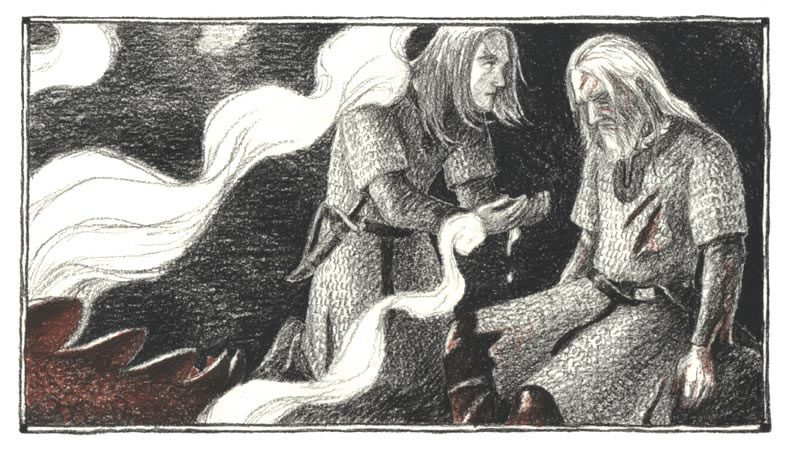
{Wiglaf raising the washing water to Beowulf. Image found at the Tolkien Library}
 

Back To Top
Abstract

Wiglaf tends to Beowulf and Beowulf begins to speak to Wiglaf, signalling that his death is imminent.

Back To Top
Translation

“Then he with hand, blood-stained,
the famed lord, a man unmatched for good,
washed his dear lord with water,
battle-worn, and unclasped his helm.
Beowulf spoke – he spoke through the pain,
the ache, of his miserably vexatious wound; well he knew,
that he had fulfilled the days of his life,
of earthen joy; that all of his life-time had
fled, death was immeasurably near:
‘Now I to the son of mine would give
the war garments, if it had been so granted
by fate that I any heir had,
flesh of my flesh.'”
(Beowulf ll.2720-32a)

Back To Top
Recordings

Old English:

{Forthcoming}

Modern English:

{Forthcoming}

Back To Top
A Good Washing

The washing of Beowulf requires some note here.

First, there’s the general importance of the act as a means of humbling yourself before someone whom you respect.

Then there’s the fact that it’s a simple act of subservience, the sort of thing that is an active display of obedience and respect.

And that interpretation of the act leads into the Christian significance. However, if this death is meant to mirror that of Christ in the New Testament, then there’s something interesting going on here.

In the NT and in the Catholic ritual recreating the Last Supper, it’s Christ who washes his disciples’ feet.

Wiglaf’s washing is more general, but if the parallels between these stories are followed, then Wiglaf is effectively becoming the Christ figure of the story, possibly in a more meaningful way than Beowulf.

Yes, Beowulf defeated the dragon, but that cost him his life, and Beowulf would never be characteristically elegiac if he came back to life afterwards (nor would the Anglo-Saxons have told it like that, regardless of whatever their source material may have been).

This transference of Christ-ness might even have been one of the original purposes of the poem as a conversion tool, since it’s the sort of succession that Anglo-Saxon’s would have understood. After all, it’s the exact same way that kingship would be transferred when no heir was available: through a ritualistic act and acknowledgement.

Back To Top
Passing (Things) On

The opening of Beowulf’s speech also says a lot about the Christian intent of the written version of the poem.

If Beowulf is taken as a heroic heathen, someone who is Christian in all ways but name (ignore for a moment, his constant references to a single ‘Lord of Men’/’Ruler’/’King of Glory’), then he simply can’t have an heir. There can be no continuation of the virtuous heathens, since there is no further need for such people, the virtuous will, of course, be Christians. And so enter the transitional figure of Wiglaf, the one who reprimands the cowardly thanes and does his best to guide Geatland gently into the good night awaiting it after Beowulf’s death.

Beowulf signals his death not by saying that he has reached the end, as the poet/scribe does before we get his dialogue, but by saying that he has no heir to give his weapons to.

He has no offspring that he could call “flesh of my flesh” (or “belonging to my body” for a curiously medieval Christian rendering of “lice gelenge” (l.2732)) that can continue his line directly. And so, it passes to one who’s proven himself to be worthy: Wiglaf.

However, it’s important that Beowulf opens his speech with talk of handing down his war garb. Because Wiglaf is not his son, the war garb will not be touching the same flesh (more practically, it may also be less of a snug fit than on any son of Beowulf). As a result, Wiglaf is not going to be able to do the same things that Beowulf did with his gear, in both the literal and figurative senses.

And that a body patently different from Beowulf’s carries forward the symbols of the old way embodied by Beowulf’s war garb (arguably, his most precious possession) is a great metaphor for the spread of Christianity throughout Early Medieval Europe.

Back To Top
Closing

Check back here next week, for Isidore’s finishing off the first section of book 12 with further discussion of fertility lore, and for Beowulf’s quick review of his kingship and current predicament.

You can find the next part of Beowulf here.
Back To Top

Silent Sorrow Following Frabjous Joy [ll.2706-2719] (Old English)

Abstract
Translation
Recordings
Strengthened by Juxtaposition
Who’s Heart-Wise?
Closing

{Wiglaf tends to Beowulf. Image found on Wikipedia.}
 

Back To Top
Abstract

The poet revels over the victory of Beowulf and Wiglaf, but their joy is short lived as Beowulf’s wound is shown to be dire.

Back To Top
Translation

“The fiend had fallen – courage punished his life –
and those two both had killed it,
brother nobles. So should every man be,
loyal thanes ready for the need! Yet for that king it was
the final hour of victory for his own deeds,
his works in the world. Then that wound began,
the one the earth-drake had earlier dealt him,
to sear and swell; soon he discovered that
poison welled forth from within the wickedness that
marred his chest. Then the prince went
to him that was by the wall, wise at heart,
he sat on the stone; looked upon the work of giants,
how the stone arches were secured with columns,
beheld what the cave-dwelling held within.”
(Beowulf ll.2706-2719)

Back To Top
Recordings

Old English:

{Forthcoming}

Modern English:

{Forthcoming}

Back To Top
Strengthened by Juxtaposition

The juxtaposition of the opening lines of this passage is perfectly suited to Anglo-Saxon thought.

Placing a bit of gnomic wisdom aside the revelation that Beowulf is indeed dying only strengthens that wisdom. After all, Wiglaf now proves himself to truly be one of the “loyal thanes” (“þegn” l.2709).

Within this passage we see him run over to his dying liege lord and take a seat beside him. For now, there is no dialogue, but instead Wiglaf looks over what they’ve won together. Without words of any sort he takes up the role of world interpreter for Beowulf as he lies against the wall, his wound festering in fast forward.

Back To Top
Who’s Heart-Wise?

In the above translation the person being desribed as “wise at heart” (“wīs-hycgende” l.2716) is unclear, and so too is it in the original: “Ðā se æðeling giong/þæt hē bī wealle wīs-hycgende/gesæt on sesse” (ll.2715-2717).

This ambiguity shows not only the shared wisdom of these two, but it also works to further the idea that Beowulf has successfully passed on the role of Geatish ruler to the best candidate. Though his death and the cowardice of the other 11 thanes does prophesy that tribe’s beginning decline.

Turning to what either case might mean more specifically, if the phrase refers to Wiglaf, then it simply means that he is doing what he feels is right and the poet is validating this.

On the other hand, if this phrase refers to Beowulf, then it may be a bit of foreshadowing of a phrase that comes up in a passage nearly 100 lines away, or it may simply refer to the inborn wisdom that a fifty winters as a successful king brings.

Back To Top
Closing

Next week, Isidore writes of the ways in which animals are manipulated while conceiving, and Beowulf finally comes to terms with his end.

You can find the next part of Beowulf here.

Back To Top

A Co-ordinated Dragon Kill [ll.2688-2705] (Old English)

Abstract
Translation
Recordings
When Words Flash, Sharp as Swords
A Matter of Succession
Closing

{Wiglaf shown landing the distracting blow, or Beowulf landing the fatal one – that’s just how much of a team this duo is. Image found on Weird Worm.}
 

Back To Top
Abstract

Thanks to a team effort, Beowulf and Wiglaf bring down the dragon.

Back To Top
Translation

“Then the ravager of a people for a third time,
the terrible fire dragon intent on a hostile deed,
rushed on that renowned one when for him the opportunity
permitted, hot and battle fierce. All of his neck was
clasped by sharp tusks; he was made to become bloody
with ichor, gore in waves surged out.
Then, as I have heard, the soldier by his side showed
known courage for his liege lord,
strength and boldness, as was inborn.
He worked not upon the head, but the hand of that daring
man was burned, when he his kin helped by striking
a little lower at the strife-stranger with blade full
of cunning, so that the decorated sword, gleaming and
gold-adorned, stuck in the beast’s stomach so that the
fire began to abate afterwards. Then once more the king
himself wielded his wit, brandished a hip-blade, bitter
and battle-sharp, that he wore on his byrnie;
the protector of the Weders cleaved the dragon in its
middle.”
(Beowulf ll.2688-2705)

Back To Top
Recordings

Old English:

{Forthcoming}

Modern English:

{Forthcoming}

Back To Top
When Words Flash, Sharp as Swords

The words here are definitely meant to mimic the flashing of blades. The exact words are different, of course, being translated, but the description of the duo’s weapons and their working is preserved.

The descriptive phrases “sword full of cunning, so that the decorated sword,/gleaming and gold-adorned” (“þæt ðæt sweord gedēaf,/
fāh ond fǣted” (ll.2700-2701)) and “brandished a hip-blade,/bitter and battle-sharp,” (“wællseaxe gebrǣd/biter ond beaduscearp” (ll.2703-2704)) in both Englishes still give a vivid image of steel being swung or stabbing, all the while glittering with either jewels or fatal intent.

Such description and rhetorical use of language is effective here because it brings listeners/readers into the action of the poem while also reminding them of the extreme danger of the dragon. After all, the gleam of Wiglaf’s sword is likely as much due to whatever natural light is available as it is to the dragon’s fire illuminating it; and Beowulf’s “bitter and battle-sharp” dagger, drawn with wit, reminds us of the kind of cunning required to slay something so ancient, deadly, and tricky in its own right.

Back To Top
A Matter of Succession

If there was ever a history of Wiglaf penned by a monk or sung by a bard, and if that history involved a successor, it would not be surprising if Wiglaf’s successor helped him win his final battle.

Kingship is something that needs to be continuous, lest a contest for the throne result in the destruction of a house, much like the case of Haethcyn and Herebeald. And there is no better way to pass on kingship than to slay a dragon with your successor.

In fact, if the line of kings is regarded as a kind of chain, Wiglaf’s selfless stabbing of the dragon below its armored head is exactly where his link connects to that of Beowulf as the poem’s hero rallies and defeats the dragon, drawing his own link on the chain of kingship (and, *spoilers* his life */spoilers*) to a close.

But Neil Gaiman wasn’t far from the mark when he has Wiglaf succeed Beowulf, for although it may be short lived, Wiglaf’s succession of Beowulf is exactly what this team effort solidifies.

Back To Top
Closing

Next week, Beowulf gazes at the dead dragon’s treasure cave.

You can find the next part of Beowulf here.

Back To Top

Beowulf Strikes the Dragon’s Head, and the Poet/Scribe Strikes at the Poem’s Heart [ll.2672b-2687] (Old English)

Abstract
Translation
Recordings
Beowulf’s Flaw, and an Old Dichotomy
Striking at the Heart of the Poem
Closing

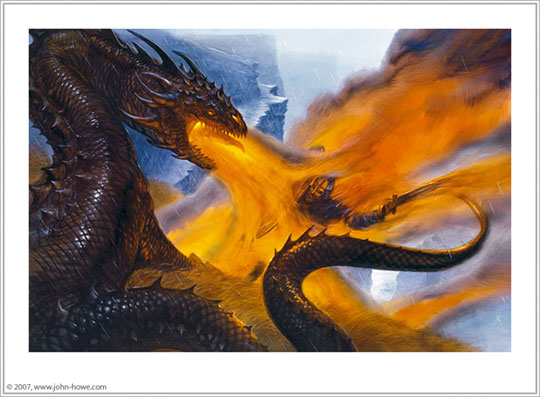
{A good example of how flame might advance in a wave. Image by John Howe, and found on john-howe.com.}

Back To Top
Abstract

Wiglaf’s valor inspires Beowulf, but this leads to the revelation of the truth about Beowulf and his swords.

Back To Top
Translation

“Flame in a wave advanced,
burned the shield up to the boss; mail coat could not
for the young spear-warrior provide help,
but the man of youth under his kinsman’s shield
valiantly went on, when his own was
by flame destroyed. Then the war king again set
his mind on glory, struck with great strength
with the war sword, so that it in the dragon’s head stuck
and impelled hostility; Naegling broke,
failed at battle the sword of Beowulf, ancient
and grey-coloured. To him it was not granted by
fate that his sword’s edge may be a help at battle;
it was in his too strong hand, he who did so with
every sword, as I have heard, the stroke overtaxed
it, when he to battle bore any weapon wondrously
hard; it was not for him at all the better.”
(Beowulf ll.2672b-2687)

Back To Top
Recordings

Old English:

Modern English:

Back To Top
Beowulf’s Flaw, and an Old Dichotomy

All heroes need a flaw.

Eddard Stark in the Song of Ice and Fire was simply too noble, Link in the Legend of Zelda games is always inexperienced, and Beowulf can’t effectively wield swords. Beowulf’s particular weakness is especially interesting in relation to the rest of the poem.

On the one hand, it’s potentially a great reflection of Beowulf’s name, whether it means “bear” (bee-wolf), or is simply “wolf.” His being unable to use swords effectively (almost pervasively a symbol of cultivated, human nobility) plays well to his animalistic aspect.

Rather than fighting like a civilized man with sword and shield, Beowulf instead fights bare handed, and is indeed the better for it. After all, defeating Grendel empty-handed is a much more boast-worthy feat than defeating him with a sword, not necessarily because of the strength that it requires, but because it plays so well into the mythology around Grendel as a monster who resists iron weapons.

However, it also implies that Beowulf is somehow on a level with Grendel, who, as it is noted, “scorns/in his reckless way to use weapons” (“þæt se ǣglǣca/for his won-hȳdum wǣpna ne recceð”(ll.433-434)).

In this way, Beowulf’s prowess in unarmed combat speaks to something uncivilized in him that he’s note entirely capable of controlling. After his fight with Grendel, he doesn’t seem to take up sword and shield to the same effect again (after Grendel we hear no more of “sea-brutes” (“niceras” (l.422)) or trolls (“eotena” (l.421))). Except of course, in his final, fatal battle with the dragon.

Back To Top
Striking at the Heart of the Poem

The fact that the whole poem is essentially an elegy to Beowulf and the Geatish (probably, by proxy, Anglo-Saxon) culture that he is so much a part of, while also presenting Beowulf as uncivilized in war (something uncivilized in itself) might just be the strongest argument for Beowulf’s really being about the Anglo-Saxons transitioning from their own traditions to something more Christian. The brutality of empty-handed combat gives way to something regarded as more civil.

The way of the sword (very obviously a cross, if the blade is stuck into the ground), is left in the absence of the way of the brutal fist. But even the way of the sword fades, if you look beyond the far end of the poem, as the Geats are prophesied to soon meet their end as a nation (ll.3010-3030).

So in addition to elegy, the poem is also apocalyptic, indicating the end of warfare, the way of the sword, for one of the many groups in early medieval Europe. Perhaps, from a Christian perspective, this is meant to point towards a Utopian future, or Second Coming, that is inevitable if the old ways are left behind and new ones are adapted.

Back To Top
Closing

Check back next week for more of Isidore’s colorful explanations, and for the climax of the battle between team Beowulf and the dragon.

You can find the next part of Beowulf here.
Back To Top

A Chatty Wiglaf and an Encouraged Beowulf [ll.2661-2672a] (Old English)

Abstract
Translation
Recordings
Wiglaf: The Chatty Youth
An Early Ascension Speech?
Closing

{Just what the dragon’s doing while Wiglaf stages his dramatic entrance. Image from Quest for Glory V concept art at RPGamer.com}

Back To Top
Abstract

Wiglaf rushes over to Beowulf, and reassures him that his glory will not falter for this difficulty. But, just as Wiglaf finishes his short speech, the dragon starts back towards the pair.

Back To Top
Translation

“Advanced he then through that deadly smoke, in helmet
he bore to the lord his help, few words he spoke:
‘Dear Beowulf, perform all well,
just as you in youth long ago said
that you would not allow while you are alive
your glory to decline; You shall now in deed be famous,
resolute prince, all strength
your life to defend; I you shall help.’
After that word the serpent angry came,
the terrible malicious alien from another time
glowing in surging fire attacked his enemy,
hateful of men.”
(Beowulf ll.2661-2672a)

Back To Top
Recordings

Old English:

Modern English:

Back To Top
Wiglaf: The Chatty Youth

Wiglaf is a very strange character. It’s not that his name is odd (aside from what’s been said before, what could naming someone “war heirloom” mean, anyway?), or that his introduction is hastily foisted onto an explanation of his equipment, but that he gets so many lines of dialog.

After all, considering the length of this poem, there really isn’t that much dialog.

Hrothgar and Beowulf have some long speeches, but they’re both in the poem for a substantial amount of time, while Wiglaf is only prominently featured in the last 500 lines or so.

So, why does Wiglaf have such a major speaking role relative to the length of his presence in the poem?

It could be that speech is shorthand for the kind of thing that his generation of Geats excels in. That the rest of his fellow thanes ran away when Beowulf’s distress became clear is a clear mark of this. Or it could be that Wiglaf, as someone who hasn’t yet seen real battle and killed with his own sword, primarily interacts with the world through speech rather than weaponry.

But then, one thing still stands out.

In almost every instance of Beowulf, the poem’s other major hero, talking, he does it in response to other characters’ actions. He answers Unferth’s challenge to his valor (ll.529-606), he boasts to Wealhtheow when she presents him with a drinking cup (ll.628-638), and he retells his exploits in Daneland when Hygelac asks for a tale of his adventures (ll.1900-2162).

Otherwise, Beowulf is mostly a silent protagonist. The only major instance where he speaks unbidden is before his thanes, when he gives them his lengthy autobiography and assures them that this dragon fight will be tough, but he’ll handle it himself.

Back To Top
An Early Ascension Speech?

With that in mind, is it possible that the poet/scribe behind the poem is setting Wiglaf up as the next Geatish king?

Since Beowulf’s speech to his thanes is the product of his office as well as his emotional state at the time, the only thing that marks Wiglaf as different is his lack of a title. Perhaps his outburst is meant to stand as a kind of shorthand for youthful vigor, a vigor that he tries to impart to or revive in Beowulf through his words of encouragement – themselves completely unbidden.

Going back to the idea that Wiglaf’s speeches are the result of his inexperience in the field of war (a man’s proving grounds in the poem), maybe he is an early case study in the idea behind the phrase “fake it before you make it.”

Having no past battle experience, Wiglaf can only put on a brave face, something expressed through words, but he can’t put on a brave show aside from his apparently impulsive rush from the band of thanes to his lord’s side.

Of course, if all of this is true, then the depiction of Wiglaf speaking to his fellow thanes and rushing to his lord’s side is a great portrayal of a young thane bound for great things.

Back To Top
Closing

Next week, Isidore runs through three of the colors from this week’s guide to good horses. And, in Beowulf, another hardship befalls the rallied lord of the Geats.

You can find the next part of Beowulf here.

Back To Top

The Second Half of Wiglaf’s Speech to the Thanes: Rhetoric [ll.2646b-2660] (Old English)

Abstract
Translation
Recordings
Anglo-Saxon Understatement
On Fate and Rhetoric
Closing

{The sort of sheild that Wiglaf brings to the fight – hopefully his sword proves sturdier! Image from the blog Beowulfian, hosted by wikimedia.org.}

Back to Top
Abstract

Wiglaf completes his speech, and in doing so presents himself as the shining example that the other thanes should follow.

Back to Top
Translation

Now is the day come
that our liege lord strength needs
good warriors. Let us go to,
to help the leader in battle while it is possible,
against the fierce terror from fire. God knows
that it is much dearer to me that my body
be with my gold-giving lord while fire should enfold him.
Nor does it seem to me fitting that we shields
bear back to home unless we first may
the foe kill, by life defend
the Weder’s prince. I know well
that it is not merited by past deeds, that he alone must
without the Geatish host affliction suffer,
fall at the battle; both of us shall sword and helm,
mail coat and battle garment together share.”
(Beowulf ll.2646b-2660)

Back to Top
Recordings

Old English:

Modern English:

Back to Top
Anglo-Saxon Understatement

Wiglaf really gives it to his fellow thanes in this part of his speech. How can you tell such a thing? Because he uses token Anglo-Saxon sense of understatement. Not very liberally, but in such a way that it remains obvious even to this day.

So, we hear Wiglaf start a sentence with “God knows,” (“God wāt” (l.2650)), and it’s quite clear that he’s either being incredibly genuine or relying on a higher power to embolden himself. The understatement comes next when he moves from citing god to state that it wouldn’t be fitting to go home as warriors if they didn’t even fight.

The understatement in this sentence is clear from Wiglaf’s beginning it with “nor” (“ne”(l.2653)). This negative start undercuts his own position (“…seem to me…” ( “…þynceð me…”(l.2653))) and puts it squarely in contrast with his previous reference to god. And so the young warrior cunningly sets himself up for a verbal finger wagging as he calls his fellow warriors on even thinking about calling themselves warriors without even fighting the dragon.

Back to Top
On Fate and Rhetoric

Wiglaf’s statement “I know well/that it is not merited by past deeds” (“Ic wāt geare,/þæt nǣron eald-gewyrht”(ll.2656-2657)) that Beowulf should suffer alone sets human knowledge and the unknowable power of fate at an incredible contrast.

Earlier in the poem we’ve been told that fate has left Beowulf’s side (ll.2574-2575), that it is indeed his fate to die, but Wiglaf, because of his dedication to kin, is not deterred by this, however obvious it might be given the state of the fight.

As the one who is set up to succeed Beowulf as king of the Geats, it seems that Wiglaf has an uncanny way of seeing how to make the best of fate, since he does indirectly acknowledge the fact that Beowulf is doomed while at the same time he calls for all the Geats to rally around him so that Beowulf will not be alone when he falls. It’s a nice emphasis of the importance of community to Anglo-Saxon life and culture.

However, where all of Wiglaf’s rhetoric falls flat is in his final sentence. Old English pronouns included some that were just for two people, but the one used here, “bām,” is definitely of the dual sense. So, just as Wiglaf is acutely aware of the fact that Beowulf should be attended because of his great stature as a warrior, it also seems that by the speech’s end he’s acutely aware of the fact that he is the only one about to rush off to help.

Back to Top
Closing

Next week, St. Isidore starts to wrap up coverage of horses, and concludes the overview of the last two characteristics of a great horse. In Beowulf, Wiglaf rushes to Beowulf and says some more words before we’re all reminded that the dragon’s still about.

You can find the next part of Beowulf here.

Back to Top

Wiglaf Speaks – But Will The Others Listen? [ll.2631-2646a] (Old English)


{An ideal warrior, indeed. Image from Geograph.co.uk.}
 

Abstract
Translation
Recordings
Getting Grammatical
Geatland’s Next Top Warrior
Closing

Back to Top
Abstract

Wiglaf speaks to his fellow thanes, making his intentions to fulfill their pledges to Beowulf made in the mead hall and trying – indirectly – to stir his fellows to do the same.

Back to Top
Translation

“Wiglaf spoke, many true words were
said by the companion (though at heart he was sad):
“I that time remember, when we mead drank,
when we pledged ourselves to our lord
in the beer hall, he who to us these rings gave,
promised that we the war-equipment would repay
if such need to him befell, [fend for him] with
helms and hard swords. For that reason he us from
the army chose, for this expedition by his own will,
considered us worthy for glory, and to me this
treasure gave, because he us good spear-fighters
judged,valiant warriors in helmets — though the
lord this courageous deed alone intended to
perform, herder of the people, because he
among men a glorious deed would accomplish,
do that deed audaciously.”
(Beowulf ll.2631-2646a)

Back to Top
Recordings

Old English:

Modern English:

Back to Top
Getting Grammatical

The most characteristic thing about this passage of Beowulf is the placement of its pronouns. Clauses like “he who to us these rings gave” (“ðe ūs ðās bēagas geaf” l.2635) sound pretty unnatural to modern ears since. It sounds off since in modern English this statement would be written “he who gave these rings to us.” Yet, throughout this passage the pronouns for the Subject and Direct Object (the thing directly acted on by the Subject) are constantly side by side (or closer than they are in Modern English).

This placement definitely emphasizes the connection between Beowulf and the thanes on the level of straightforward meaning, but it also works on a grammatical level. For there is almost no verbal distance between the Subject and the Direct Object, and this close proximity shows just how closely related the two are. Each one of Wiglaf’s statements underlines this fact, and it is this idea of their closeness that he uses to try to rouse his fellow thanes so that they all go and help Beowulf together.

However, at first glance there is something in this passage that works against Wiglaf’s rhetorical emphasis of his and the other thanes’ reliance on Beowulf.

The last five lines of this section of the poem are entirely about Beowulf’s desire to fight the dragon alone.

The line “though the lord/this courageous deed alone intended to perform” (“þēah ðe hlāford ūs/þis ellen-weorc āna āðōhte/tō gefremmanne”) sounds like it could be referring to Beowulf’s telling the thanes to stay out of the fight because he wanted to handle it himself, but it also suggests that Beowulf intended to fight alone from the start – which makes you wonder why he bothered to bring along the twelve thanes in the first place.

Back to Top
Geatland’s Next Top Warrior

Whether fighting solo was something premeditated or not, bringing along the best of the best for this fight might have been Beowulf’s way of finding a successor.

The dragon is indeed the ultimate foe, and Beowulf may’ve guessed that even most of the cream of the martial crop would fear it. If that’s the case, then bringing this cream along would make it easy to find out who could possibly rule the Geats after his death – Beowulf was, after all, having dark premonitions after the dragon came and before the fight.

Though, this raises the question of why Beowulf never had any children. Whether he married Hygd after Hygelac’s death or not, fifty years is a long time to go without fathering any children. It stretches the belief, though maybe remaining unwedded and childless are characteristics of the hero that the scops were aiming for when Beowulf was being told and retold, molded into what was written down and what we have today.

Some bits of the manuscript were eaten by rats, or destroyed by a fire, but even those that remain still hold much mystery.

Back to Top
Closing

Next week, come back for more early medieval thoughts on horses with St. Isidore of Seville, and to get the second half of Wiglaf’s stirring speech.

You can find the next part of Beowulf here.

Back to Top

On Wiglaf’s Weapons (Pt. 2) [ll.2620-2630] (Old English)

Abstract
Translation
Recordings
Two Possibilities for “mid Geatum”
Medieval Shorthand?
A Curious Word
Closing

Back to Top
Abstract

The story of Weohstan and the arms winds down here, and things move back to Wiglaf, as he is on the verge of breaking from the host to go help Beowulf.

Back to Top
Translation

“He kept those adornments for many half-years,
sword and mail shirt, until his son could
perform heroic deeds as his late father did;
then he gave to him among the Geats war garbs
in countless number, when he departed from life,
old and on his way forth. Then was the first time
for the young warrior, to himself advance into
the battle onslaught with his noble lord. His spirit
did not melt away then, nor did his kinsman’s
heirloom fail in the conflict; this the serpent
discovered, after they had come together.”
(Beowulf ll.2620-2630)

Back to Top
Recordings

Old English:

Modern English:

Back to Top
Two Possibilities for “mid Geatum”

Just as with so many other sets of equipment in Beowulf, Wiglaf’s arms were passed onto him by his father. However, the poet/scribe also sees fit to add that these things were passed onto Wiglaf when father and son were “among the Geats,” (“mid Geatum” (l.2623)).

Since Weohstan had previously been in exile (as the poem made plain when describing his slaying of Eanmunde), this added detail is rather significant for one reason or another.

On the one hand, this detail suggests the importance of community. Possibly, even, this small prepositional phrase implies an underlying belief of the poet’s/scribe’s that communal memory is better than individual memory. At the least, with the constant references to friendship, kin ties, and the sound of the raucous joy of groups in halls, a community is regarded as being better than being alone.

On the other hand, it might just be another detail. Something to add to the colour of the story and not really a thread that’s woven around or with something else in the poem as so many things are.

Back to Top
Medieval Shorthand?

Actually, It’s easy to wonder then if the phrase “among the Geats” is shorthand for a more detailed setting. But the marker of community might just be setting enough for the sort of transitional act that passing on war garb is in Anglo-Saxon culture.

For there was a firm belief among the Anglo-Saxons that a person’s belongings carried a part of his or her essence even after he or she died. So, passing these things on is as much a passing on of the physical objects as it is of the memory held within them, the things they used to make their mark on the world.

To pass these weapons, these memories, on, within the structures of a community, to make it an event within that community and thus set it into that community’s memory, would ensure that it definitely becomes entrenched there. It becomes as much a community act as a family act.

Back to Top
A Curious Word

The other highlight of the passage is the original Old English verb used on line 2628: “gemealt.”

According to the Clark Hall & Merritt dictionary of Old English, the verb can be translated as “to consume by fire,” “melt,” “burn up,” “dissolve,” or “digest.” Since it’s referring to Wiglaf’s spirit, it seems most appropriate to go with melt. That way the words invoke an image of the young warrior envisioning his attack on the dragon and the aid that he’ll give his lord and having this vision stand firm rather than melting away (like a Jello mold in the heat of the sun).

{Possibly how Wiglaf imagines himself fighting the dragon. Image from Lady, That’s My Skull}

Back to Top
Closing

That’s all for this week, but check back next for Isidore’s continuing look at horses, and for Wiglaf’s stirring speech to his fellow thanes.

Back to Top