Two Fallen Greats [ll.2821-2835] (Old English)

Abstract
Translation
Recordings
Showing Mourning
Seeking Meaning
Closing
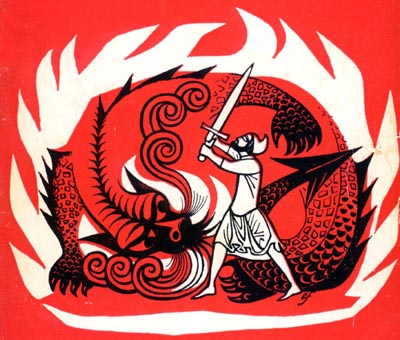
{A dramatic rendition of the dragon battle that gives it an intense, resonant scope. Image found on Zouch Magazine & Miscellany.}
 

Back To Top
Abstract

A reflection on Beowulf’s death dwells on the dragon.

Back To Top
Translation

“That which had happened was painfully felt
by the young man, when he on the ground saw
that dearest one pitiably suffering
at his life’s end. The slayer also lay so,
the terrible earth dragon was bereaved of life,
by ruin overwhelmed. In the hoard of rings no
longer could the coiled serpent be on guard,
once he by sword edge was carried off,
hard, battle-sharp remnant of hammers,so
that the wide flier by wounds was still and
fallen on earth near the treasure house. Never
after did he move about through the air by flight
in the middle of the night, in his rich possession
glorying, never could he make more appearances,
since he fell to earth at the war leader’s deed of the
&nbsp&nbsp&nbsp&nbsp&nbsp&nbsp&nbsphand.”
(Beowulf ll.2821-2835)

Back To Top
Recordings

Old English:

Modern English:

Back To Top
Showing Mourning

The first question to surface here, like the hideous sea beasts pulled from Grendel’s Mother’s mire, is why a section of the poem that’s showing Wiglaf’s grief for Beowulf immediately after his death dwells so long on the dragon rather than Beowulf.

It could be that the poet/scribe went this way because so much of the rest of the poem is given over to Beowulf. Or it could be that Wiglaf’s attention is simply drawn to the dragon because of the sheer spectacle of the sight. Though, it could also be that Wiglaf looks over to the dragon for the sake of contrast, to put off the reality of Beowulf’s death for just a short time so that he, as all but Beowulf’s named successor, can have a brief respite before he must coldly go forth and fulfil his duty as the new Geatish leader.

Of course, it could also be the poet’s own voice that pulls away from Wiglaf at this point, leaving his perspective behind for a time to turn a little more omniscient, and to give us, the listers/readers a view of the dragon as it lay dead so that we can contrast it with Beowulf.

Back To Top
Seeking Meaning

Germanic culture widely held that dragons were symbols of the greed that would undermine the gift-centric Germanic society. So perhaps the focus on the dragon and the recounting of how it can no longer do anyone any harm suggests that greed itself has been defeated, and by one so noble as to sacrifice his own good for going against the advice of his counsel and fighting the dragon.

Maybe even the defeat of greed and the destruction of the Geats themselves that is an almost inevitable result (since they’re now kingless and sitting on all of this gold) are related.

If this version of the poem is as Christian as some believe, then this shift over to the dragon shouldn’t be read as Wiglaf’s or the poet/scribe’s attempt to contrast a death with a death, but instead as a way to show that the perfection of a society through the defeat of its greatest evil leaves that society at its end.

If Beowulf was ever used as a missionary tale, then this part of the poem could well be that which attempts to sooth potential converts into the belief that in becoming Christian their previous beliefs die off and they enter into something more perfect.

Or, again, their physical being ends, but just as Beowulf persisted up until he defeats his society’s major evil, so too would the spirit of the assimilated society persist in its people. Plus, missionaries would probably say the new converts were all imbued with the spark of life that, in the Christian tradition, is generally regarded as a spoken thing – just as this story itself would’ve been at the time, even after having been written out.

Back To Top
Closing

So could this episode in the Beowulf saga be another key moment in the use of the poem as missionary propaganda, or is it just the poet/scribe’s representation of Wiglaf’s mourning? Leave a comment in the box to let me know your thoughts!

Next week, stanza three of “Dum Diane vitrea” will drop, and Wiglaf meets the cowardly thanes as they slink onto the scene.

And you can find the next part of Beowulf here.
Back To Top

Fading Light, Rising Passion ["Dum Diane vitrea" Second Stanza] (Latin)

Abstract
Translation
Recordings
Sleeping on It
Setting Speculation in a Bed of Structure
Closing

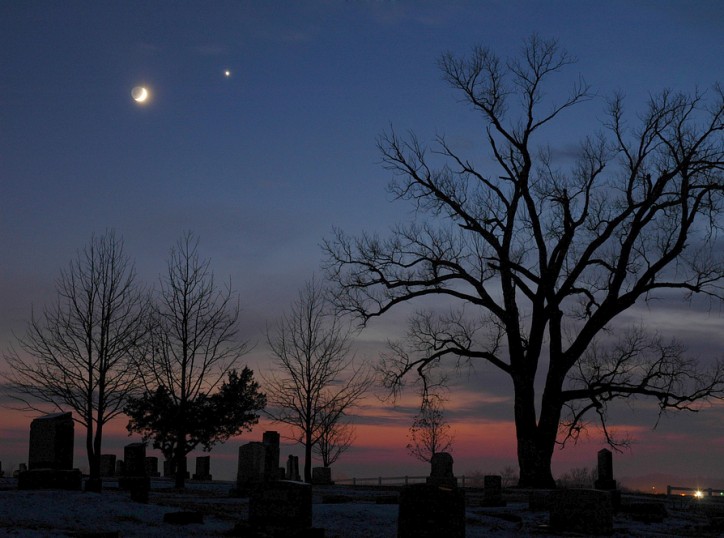
{The evening star, shining bright within the embrace of coming night. Image found on NASA’s Astronomy Picture of the Day webpage.}

Back To Top
Abstract

Some action parallel to that of the previous stanza occurs, as the evening star fades.

Back To Top
Translation

“As the light of the evening star fades,
Charm’s humour is given to
The drowsy dew of fleeting passion.”
(“Dum Diane vitrea” Stanza 2)

Back To Top
Recordings

Watch for the recordings of the whole poem once its translation is fully posted (around November 20).

Back To Top
Sleeping on It

Time is a tricky thing to pin down when it’s not referred to with a clock reference.

All the same, this brief stanza looks like it’s about the point in a typical night when people would rise from sleep for a brief period to do some night activities. This dual-phase sleep practice goes back to the pre-artificial light days, when people would go to bed around sunset, wake around midnight and then go back to bed two hours later until day break.

It might sound a little useless to sleep in bursts like this, but aside from the practical purposes (like guard shifts), sleeping in two phases seems to make the mind more perceptive and to really help cognition (just ask any regular napper).

More to the point for our poem, with this bi-phasal sleeping pattern in mind this stanza describes the influence of Venus, the evening star (“Hesperus”) on the people as they sleep. This stirs their passions and their loins as “the drowsy dew of fleeting passion” (“roris soporiferi
mortalium generi”) falls upon them.

To be more direct, the couples in the poem have sex – one of the many things that people would do during their nightly two hour vigil. And an activity that’s quite perfectly suited to that time between sleeps. After all, you’d be out working all day and probably a little to weary and weighted to be in the mood for sex before sunset, but after that initial rest, your mind would be relaxed, your loins would be fired,and you’d be ready for it.

So perhaps the action of last week’s stanza wasn’t so much about the power of palour to assauge the woes of a person’s public life and to soothe them as it was simply about the moon rising (since it would be the middle of the night) when people woke after their first shift of sleep.

Back To Top
Setting Speculation in a Bed of Structure

As per how these two stanzas work together, this one doesn’t seem to be moving anything forward, rather it just describes another act that goes on during the action of the first stanza.

As Diana rises in the moon and the stars come out, the evening star fades and its influence over the sleepers is complete as they awake and are ready to consummate the desire of their hearts.

Structurally, it’s also likely that this stanza would work as the first chorus of this poem as a song. After all, it is from the “Carmina Burana” – a collection of such songs. Further, this stanza’s brevity also suggests that it’s a chorus.

Yet, however “Dum Diane vitrea” develops from verse to chorus to verse to chorus and onwards will need to be seen next week.

Back To Top
Closing

Leave your thoughts on my theories in the comments for today’s entry, and check back here on Thursday for how the poet portrays Wiglaf’s immediate reaction to Beowulf’s death.

Back To Top

The Last of its Name

These look back/look ahead entries have proven to be less useful than anticipated. Because the lists that get posted here are seldom worked on over the course of the week, and part of each of the last three Sundays have been consumed by these entries to little avail, I’m going to be stopping their posting all together.

However, as one final list, here’s what I’m planning on doing between now and the end of the calendar year:

  • Outlined and completed Dekar 4
  • Outlined and completed Dekar 5
  • Edited and made publicly presentable a very loosely autobiographical novel about an English teacher in South Korea
  • Edited and made publicly presentable a poetic novel about mythological creatures
  • Edited and made publicly presentable an epic poem about a night in the life of a dishwasher
  • Gathered and organized all of my poetry
  • Gathered and organized all of my short stories
  • Had 3 short stories accepted for publication
  • Had 1 poem accepted for publication

As you might’ve guessed from such a list of creative writing-related tasks, I’m dropping this update from my blogging schedule so that I can have more time for my fiction and poetry writing.

However, as counter productive as it may seem, I’m still planning to start a video game playlog over over the coming weeks.

Until then keep checking out this blog and my general blog: A Glass Darkly.

The latter has the usual creative writing post on Monday, movie review on Friday (this week: The Screaming Skull), and “annotated links” post on Saturday.

Meanwhile, here at this blog you’ll be able to find the second stanza of “Dum Diane vitrea” on Tuesday, and the first of Wiglaf’s reactions to Beowulf’s death on Thursday.

Back to Top

Beowulf’s Death, and his Soul’s Departure [ll.2809-2820] (Old English)

Abstract
Translation
Recordings
Ambiguity in Beowulf’s Death
Beowulf Doomed?
Closing

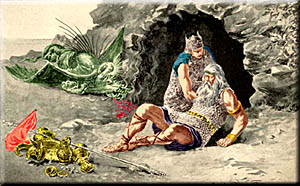
{Wiglaf listens to Beowulf’s final words. Image found on “Outpost 10F” of The Poetry Guild.}
 

Back To Top
Abstract

Beowulf bestows his war garb unto Wiglaf, and then gives up the ghost.

Back To Top
Translation

He did off the golden ring about his neck,
the brave hearted prince, gave it to the thane,
the young spear warrior, his gold adorned helmet,
ring and mail shirt, commanded him to use them well:
“You are the last remaining of our kin,
of the Waegmundings; fate has swept away all
of my line as per the decree of destiny,
warriors in valour; I after them now shall go.”
That was the old one’s last word
of thoughts of the heart before he chose the pyre,
the hot battle flame; from his breast went
his soul to seek the judgment of the righteous.
(Beowulf ll.2809-2820)

Back To Top
Recordings

Old English:

Modern English:

Back To Top
Ambiguity in Beowulf’s Death

As will be the case with the death of any great literary figure, this passage is one that’s often studied. Beyond its importance to the story, we’re also once more confronted with some ambiguity around Beowulf’s deeds. Yet, rather than being confronted with ambiguity by the words of Beowulf himself, we’re confronted with ambiguity in the poet/scribe’s own phrasing.

At the passage’s end we’re told that Beowulf’s soul leaves to “seek the judgement of the righteous.” Just as the phrase “judgement of the righteous” is ambiguous in Modern English, since the litigous could defend its meaning either ‘the judgement handed down by the righteous,’ or ‘the judgement that is passed on the righteous,’ it’s the same in Old English. There it simply reads: “soðfæstra dom” (l.2820).

The problem here is that there’s no clarifying word or phrase either in the original or in most translations that strive to be accurate. As a result we’re left with something that leaves the interpretation up to the listener/reader.

But could this maybe be the point here? Could the poet/scribe who created the version of the poem that we have today have been going for ambiguity at this part of the poem?

Just as either side of the phrase’s meaning could be argued, so too could either side of the interpretation debate.

In brief, if it’s understood to mean that Beowulf is a righteous one going to the judgment that awaits him it sets him among the holy heathens whom Christ pulled from the upper levels of hell during its harrowing.

Alternately, if the phrase is interpreted as meaning that the righteous are passing judgment, there’s a strong implication that either righteousness is something a person earns after being judged worthy by those who have it (thereby becoming one of their peers).

Or, taking this meaning could mean that Beowulf really isn’t righteous at all, and that his being judged by them means that there will be a great deal of hardship in his afterlife.

Back To Top
Beowulf Doomed?

Of these three possibilities, the most interesting is that Beowulf might be doomed in the end since he’s being judged by the righteous.

A truly puritanical Christian audience might be expecting as much from such a violent, alcoholic figure, but at the same time, that would seriously undermine any missionary value that this story had. After all, the Christian monks who recorded stories such as this from oral traditions would definitely have given them a spin that could be useful for bringing around the unconverted.

Of course, that gives the idea that this moment of ambiguity is intentional even more steam.

Yes, it could maybe spark debate among those who differ in their interpretations, but as long as this version was being told by a priest or religious, they would be there to point the way to their own version of the truth. If monks or religious actually went around reciting this poem, then this moment in particular would be the perfect one to serve as a crisis moment that could be turned around and explained so as to make Christ seem super appealing.

Unfortunately, the only way we’ll ever know for sure if any of this speculation about the ambiguity of the phrase “soðfæstra dom” is accurate is if another version of the poem shows up or the scribe of our version is definitively identified.

Until then, feel free to leave your thoughts on the phrase in the comments!

Back To Top
Closing

Next week, the second verse of “Dum Diane vitrea” will be up, along with what Wiglaf does next after Beowulf’s demise.

You can find the next part of Beowulf here.
Back To Top

Moon Love ["Dum Diane vitrea" First Stanza] (Latin)

Abstract
Translation
Recordings
Liminal Evening
Sister to the Stars
Lifting the Cloud of Unloving
Closing

{The moon and stars looking ready for a night out. Image found on NASA’s “Astronomy Picture of the Day” website.}

Back To Top
Abstract

The poem begins like so many days: with the dawning of the sun as a stand in for love.

Back To Top
Translation

“When Diana’s glassy torch rises late
And is kindled by her rosy brothers,
A pleasant breath of wind lifts
the etheric cloud from all couples;
Thus she softens emotive power
And immoveable hearts, which
Towards the pledge of love she sways.”
(“Dum Diane vitrea” Stanza 1)

Back To Top
Recordings

Since this is a poem, it will be recorded as a whole and then posted as a whole once it’s been completely translated. Once that happens, and all of the individual stanzas have been posted, an entry will be dedicated to looking at the poem as a whole. This entry will also include a complete recording.

Back To Top
Liminal Evening

What is “Diana’s glassy torch”? Is it the final light of evening? Or is it the way that the sun reflects from the curvature of the earth so that we can still see some light even though the sun’s already set. Whatever it is, it makes it clear that this stanza is about a liminal moment.

That is, this moment is one between two set, concrete points of time – the day and the night.

Yet, even with this stanza’s liminality established, what is it that causes this cloud that’s apparently settled over couples to lift?

As far as can be told from this stanza, it’s just the switching over from day to night.

The most relevant aspect of this transition seems to be that it’s a move from the outward show of day toward the private and unknown night.

The reference to Diane’s mysterious brothers (or allies, “fratris”) supports this interpretation, after all, only when night has fully arrived do the stars emerge.

And that’s just what her brothers are – the stars.

Back To Top
Sister to the Stars

For, Diane is the moon and her glassy torch is the moon as it sheds its pale light, so her rosy allies are the stars. Why they’re described as being rosy is unclear, unless it used to have a meaning along the lines of self-luminescent. A person with rosy cheeks is usually blushing, and a rose itself is red – a colour that is vibrant enough to pull in human attention.

With all of that out of the way, just what is the cloud that settles over couples?

Back To Top
Lifting the Cloud of Unloving

Since this cloud is dispelled as the moon rises and the stars come out, it sounds likely to be the troubles of the day. The moon, accompanied by the stars gives such a different atmosphere that it changes the context of perception and allows people to forget their troubles.

Perhaps, along with factors of wealth and work, this is also why palour was sought after among women in classic ideas of beauty – just as Diane’s pale light could inspire lovers to come together, so too could the palour of a young woman be considered a palliative against the troubles of the day. Maybe such paleness was also important because it helped to wash away whatever troubles a husband/lover experienced in the public sphere.

Th public/private binary is definitely an interesting thing to apply to this poem since it already invokes the binary of night and day (through implication), but it’s also problematic.

Medieval life wasn’t exactly one that leant itself to privacy – walls were thin, roads were narrow, and small towns banded together not to be cliquey and such, but because it was necessary for survival and protection.

As a result, private/public would be better represented as public/less-public, in that at least around the house (most) people wouldn’t be intentionally watching you.

Back To Top
Closing

Next week’s stanza continues along the way of love and calls on a lot of night imagery, so perhaps we’ll see all of these ideas come into play again then. In the meantime, leave your own thoughts in the comments, and watch for Beowulf’s final farewell on Thursday.

Back To Top

Translation and the Bejewelled Truth [ll.2794-2808] (Old English)

A quick note: I realize that I had planned the first entry for the poem “Dum Diane vitrea” this past Tuesday. However, since I was quite distracted by travelling to Toronto for a Peter Gabriel concert by way of Guelph, that entry was not published. Watch for it next week, and my apologies for missing a beat. I’ve got my rhtyhm back now, though.

So, onwards!

Abstract
Translation
Recordings
The Facets of Translation
Answering Questions Raised
Probing Possibility
Closing

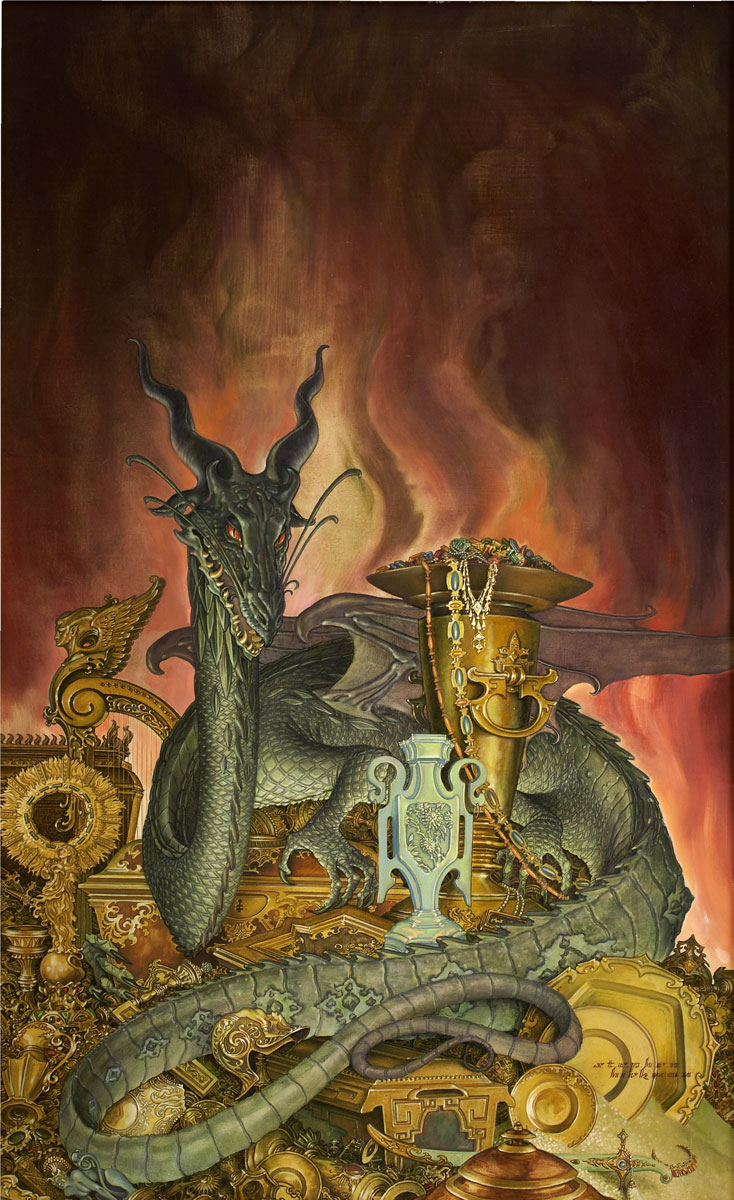
{Is the dragon’s hoard perhaps much less substantial, but much more potent? Image found on the blog PowerOfBabel.}
 

Back To Top
Abstract

Beowulf gives thanks for his seeing the dragon’s treasure, and gives Wiglaf instructions for his funerary arrangements.

Back To Top
Translation

“‘I for all of these precious things thank the Lord,
spoke these words the king of glory,
eternal lord, that I here look in on,
for the fact that I have been permitted to gain
such for my people before my day of death.
Now that I the treasure hoard have bought
with my old life, still attend to the
need of my people; for I may not be here longer.
Command the famed in battle to build a splendid barrow
after the pyre at the promontory over the sea;
it is to be a memorial to my people
high towering on Whale’s Ness,
so that seafarers may later call it
Beowulf’s Barrow, those who in ships
over the sea mists come sailing from afar.'”
(Beowulf ll.2794-2808)

Back To Top
Recordings

Old English:

Modern English:

Back To Top
The Facets of Translation

The most prominent feature of this week’s passage is the awkward opening sentence.

Its gist is straightfrward enough: Beowulf is thanking what we can safely guess is the Christian god for his successes, as he has done previously. However, if translating things fairly literally (perhaps too literally), we wind up with a second clause about the words being spoken by god (“wuldurcyninge wordum secge” ll.2795). Many translations omit this line since it appears to just repeat and expand upon Beowulf’s thanks to god, as it could come out as “[I…]speak these words to the king of glory.”

Yet, and this is where I exert a bit of extra pressure on the text, I’ve translated the second line as a reference to the jewels and the like being the words of god.

The reason for taking this route with the translation is simple: it gives the reader the opportunity to interpret the dragon’s hoard as the words of god, as some sort of cosmological truth as spoken directly by the creator of those cosmos. Opening up this possibility forces readers to take another look at the dragon, too. It’s still antagonistic in that it’s keeping the words of god to itself and needs to be killed for them to be distributed, but then just what kind of entity is it?

It might stretching things to the breaking point, but it seems that the dragon could be interpreted as the powerful priesthood or any entrenched exclusionary religious group, and Beowulf could then be considered some kind of scholar, wrenching the truth from those who are in places of religious power and being ready to redistribute it. Though, as we find out later in the poem, this doesn’t happen since the treasure is buried with Beowulf since the Geats consider it too dangerous to add massive wealth to their leader-less state.

Back To Top
Answering Questions Raised

In this reading of the hoard as cosmological truth, we need to consider what it means for Beowulf to die for it. One possibility is that in taking on such a major source of authority he destroys all of his own credibility, and as a result the truth that he uncovers can’t be successfully transmitted since without credibility (or in more contemporary terms, authority or auctoritas) no one will willingly accept what he has to say.

That brings us around the matters of the theif and of Wiglaf. In this interpretation of the dragon’s hoard as some sort of great truth, the theif could well be one who haplessly leaked one of its aspects and therefore set the whole of Beowulf’s kingdom astir. A little bit of knowledge can be much more dangerous than a lot, after all.

As per Wiglaf, he could be an acolyte of the elder scholar Beowulf. He could be a youth who has joined his cause when noone else was brave enough to, and who cared enough for the tradition of truth than the institution which had grown up and kept it from the masses.

Back To Top
Probing Possibility

The last question that this interpretation needs to face is whether or not it could have been knowingly injected into a poem written down by people working for the medieval church, an institution that was rarely free from accusations of withholding knowledge or working contrarily to the truth of things. Representing the church as a dragon, something commonly equated with the devil, could be risky in a medieval context, but I argue that this interpretation of the dragon’s hoard would hold up since the dragon could be explained as a symbol only for the corrupt within the Church and not necessarily the Church itself.

So, do you think that this interpretation holds water, or am I just stretching my own credibility by trying to keep my translation as literal as I can? Or, for that matter, have I missed something in my translation? Let me know in the comments!

Back To Top
Closing

Next week, the full complement of a Latin and Old English entry will return, with the first verse of “Dum Diane vitrea” and Beowulf’s further final words to Wiglaf.

You can find the next part of Beowulf here.
Back To Top

The Emptiness of All that Gold [ll.2771b-82] (Old English)

Abstract
Translation
Recordings
The Hoard’s Sheer Immensity
The Golden Power
Closing

{The immensity of the Lost Underworld in Earthbound is just like that of the hoard: identity erasing. Image found on flyingomelette.com.}
 

Back To Top
Abstract

The dragon is dwelled on, while Wiglaf wanders through the hoard.

Back To Top
Translation

&nbsp&nbsp&nbsp&nbsp&nbsp&nbsp&nbsp&nbsp&nbsp&nbsp”None of that sight there
was for the serpent, when the blade carried him off.
Then, I have heard, the hoard in the barrow, ancient
work of giants, was ransacked by one man, he loaded
his lap with drinking vessels and dishes of his own
choosing, the standard he also took, brightest of banners.
The sword earlier had injured – the blade was iron – that
of the aged lord, that was the treasure’s guardian for
a long time, terrifying fire brought
hot from the hoard, fiercely willing in
the middle of the night, until he a violent death died.”
(Beowulf ll.2771b-82)

Back To Top
Recordings

Old English:

{Forthcoming}

Modern English:

{Forthcoming}

Back To Top
The Hoard’s Sheer Immensity

Already it’s been mentioned how Wiglaf is not referred to by name for some time after this point, but here the poet/scribe takes this lack of identity to a strange place.

Instead of referring to Wiglaf via synecdoche with a piece of a warrior’s equipment, or calling him a “thane” or “fighter,” the poet/scribe simply calls Wiglaf “one man” (“ānne mannan” (l.2774)).

The effect of this pronoun and its adjective is immense.

However, this immensity doesn’t come from the alienation that the poet/scribe subjects Wiglaf to, but rather from the sheer size of the hoard that the poet/scribe’s making Wiglaf suddenly so small implies. Don’t forget that because of that shining banner everything is now illuminated, so we can liken this part of the poem to a long panning shot that might be used in movies to show a suddenly-broken-into, vast treasure chamber in an ancient temple or tomb.

Yet, it’s curious that the poet/scribe describes the immensity of the hoard in this way, especially since there’s so much build up to it.

We hear about it when the thief stumbles into it (ll.2283-4), again when Beowulf and his thanes head to the barrow (ll.2412-3), and then again in Beowulf’s command to Wiglaf (ll.2745-6).

Plus, any Anglo-Saxon would have been practically salivating at the prospect of finding so much treasure all in one spot – becoming instantly wealthy and instantaneously being able to exercise huge influence over others through gifts, thereby shoring up his or her own reputation and social network so that they would be more secure than gold alone would allow.

Back To Top
The Golden Power

In fact, it’s exactly within the gold-giving culture of the Anglo Saxons that we can find another reason for the poet/scribe’s describing the hoard as he does.

Rather than focus on how much there is, the poet/scribe has described the hoard through a kind of lack. It’s big and immense, but it’s the sort of thing that you can lose yourself in – even if you’re a loyal thane who’s already pledged your very being to help your lord in his dying moments.

And this is what makes the dragon’s hoard so dreadful. It’s big, it’s vast, it’s unwieldy.

No one could use that much gold for social reasons, and the temptation to fall into self-indulgence (as Heremod does in the story Hrothgar tells Beowulf (ll.1709-1722)) is practically irresistible. If there is a curse on the gold, that is the curse: to be instantly given so much that you don’t know what to do with yourself so you revert to an animalistic state.

Some have even theorized that the survivor who sings the “Lay of the Last Survivor” (ll.2247–66) somehow became the dragon: The last of his kind pining away over the treasure that could not buy back the lives of his fallen people or return them to their former glory.

This might also explain why the dragon is so prominently featured in this passage, despite his being long since dead. As Beowulf’s wishes have taken over Wiglaf’s identity, now the dragon’s identity, the miserly lord of plenty, threatens to do the same. Yet ultimately Wiglaf resists, for the poet/scribe sings that the dragon “a violent death died” (“hē morðre swealt” (l.2782)) to round out Wiglaf’s time in the hoard.

Back To Top
Closing

Next week, this blog will be on break. I’ve fallen too far behind in the recordings to keep heading onwards and since I finished “O Fortuna” this week, I want to give myself time to catch up before moving onto my next Latin text.

In the meantime be sure to check my past entries and recordings, and if you like what you read and hear, feel free to support my efforts here!

And, you can find the next part of Beowulf here.
Back To Top

Fortune Beguiled? ["O Fortuna," Third Stanza] (Latin)

Abstract
Translation
Recordings
Final Notes
Sorrow maybe made Joyous
Closing

{Lady Fortune likes to greet those she favours with a fist bump – for obvious reasons. Image found on Doctor Michael Haldane’s Translation Homepage.}

Back To Top
Abstract

The poem’s speaker finally gives in under the crushing weight of Fortune, and laments, calling all others to join him.

Back To Top
Translation

Ah Fortune, you do invert
My health and my power,
Ay do you torture me with desire and weakness.
Now without hindrance let us strike
The chord in time, lament loudly with me,
For Fortune foils even the fortunate.
(“O Fortuna”, 3rd stanza)

Back To Top
Recordings

Latin:

{Forthcoming}

Modern English:

{Forthcoming}

Back To Top
Final Notes

Once more, the translation above is not entirely literal – but that’s just not my modus operandi.

Though the most altered line is the final one. Not that the original Latin (“quod per sortem sternit fortem”) doesn’t come out to something similar when translated literally, word for word (“which by fortune overthrow the strong”). It’s just that the above translation dwells less on the words of the original and attempts to delve more into the sense of those original words.

The basic idea is that Fortune treats everyone equally, regardless of their merits. What better way to express that in English than to match “Fortune” with “fortunate”? Plus, though not necessarily a quality in thirteenth century Goliardic poetry, the alliteration is also very English.

Back To Top
Sorrow maybe made Joyous

Now, although this poem ends on a pretty down note, one phrase is curious. In the original Latin it is “mecum omnes plangite,” in the above translation it’s “lament loudly with me.” What’s interesting here is that, though it’s framed by the sorrowful “lament” the speaker calls for everyone to come together to lament Fortune’s tyranny.

But, what usually happens when a bunch of people get together (even medieval people)? A cracking party ensues – of one sort or another.

So it might be something that’s coming from looking a little too deep, but including the call for everyone to come complain with him suggests that the speaker is aware that Fortune is not the only thing that runs in cycles.

It could be that he’s trying to start some kind of spirit boosting gathering, even if it’s just a bunch of monks getting together and moaning about their misfortunes. Unless they’re all Dominicans, chances are one will tell a joke or relate a misfortune that another will chuckle at, and things will go up from there.

Or, of course, they’ll reason that this Fortune stuff is all pagan nonsense and go off to read the loose-parchment copies of the story of Christ jousting against Satan that they’ve hidden in their bound books of theology.

Back To Top
Closing

Come Thursday, Wiglaf is in the dragon’s hoard and does some hoarding of his own – while the poet ornaments his tale with a brief meditation on the dragon.

Back To Top

Treasuring Words and Admiring Their Weave [ll.2756-2771a] (Old English)

Abstract
Translation
Recordings
Finding Use for Treasure
A Shining Standard
Closing

{Shy of the characters, Wiglaf may have seen a standard just like this one. Image found on Wikipedia.}
 

Back To Top
Abstract

Wiglaf hurries to the hoard, where he is mesmerized by the treasure that he finds.

Back To Top
Translation

“He, the triumphant in victory, when he beyond the seat
went, the young brave thane, saw many precious jewels,
glittering gold lay on the ground,
wondrous objects on the wall, and in that dragon’s lair,
daybreak flier of old, cups stood,
vessels of men of old, now lacking a burnisher,
deprived of adornment.* There were many a helmet,
old and rusty, a multitude of arm-rings
skillfully twisted. Treasure easily may,
gold in ground, overpower each one of
mankind, though one may hide it.
Also hanging he saw a standard all of gold
high over the hoard, greatest of marvels made by hand,
woven by skill of craft; from there light
shone out, so that he might see the surface of the floor,
could look at every part of those ornate objects.”
(Beowulf ll.2756-2771a)

Back To Top
Recordings

Old English:

{Forthcoming}

Modern English:

{Forthcoming}

Back To Top
Finding Use for Treasure

After the excitement of the battle with the dragon, and Beowulf’s heartfelt summary of his kingship, this passage is definitely something of a rest. But that doesn’t mean that it’s entirely silent, a point in the story where the poem’s original audiences could entirely rest.

For there is treasure about.

And, along with the treasure comes a very interesting passage: “cups stood,/vessels of men of old,now lacking a burnisher,/deprived of adornment” (“orcas stondan,/fyrnmanna fatu feormendlease,/hyrstum behrorene” (ll.2760-2762)).

What makes this passage more than what it seems is it’s implication about treasure and people’s relationship to it. Because “deprived of adornment” follows “now lacking a burnisher” it sounds as if the burnishing, the polishing, was these cups’ adornment. This makes sense since whatever precious metal they were made of would require maintenance of some sort to keep its shine.

But what’s more is that as this treasure was in the care of a characteristically miserly dragon, it didn’t receive that care that people would have given it. But add to this why people would care to preserve their treasure, especially the sorts of things described here. My own theory is that they would use these things and they would need them to be in their top shape.

Putting this all together you come out with the impression that the passage implies that treasure is ostensibly valuable only when it’s being used by people. And treasure can’t be used by the same person indefinitely, so the best way to keep treasure in use is to give it away. It’s given away to be used by the young, who can then maintain it and then give it away again, thus keeping the cycle going indefinitely.

Not to mention keeping the preciousness of the treasure in tact indefinitely.

However, this reading of treasure as the fuel in a perpetual motion machine of gifting and receiving is troubled by what happens to the treasure hoard that Beowulf and Wiglaf won. It all gets buried with Beowulf.

To be fair, the treasure may well have been buried for a strategic purpose. After all, having great wealth would likely bring down the Geats’ old enemies upon them much more quickly than the news of their loss alone.

Back To Top
A Shining Standard

Another illuminating part of this passage comes at it’s end. The standard that lights the cave in which Wiglaf finds the hoard is clearly very shiny (being described as “all of gold” (“eallgylden” (ll.2767))), and must have sunlight striking it. But this sparkling standard is also significant because it echoes an earlier light in a cave: That which appears when Beowulf kills Grendel’s Mother in her den (ll.1570-1572).

Because of the parallels – the light appears in a cave, comes from a fantastical source, flares up only after the defeat of a powerful monster of one sort or other – it’s tempting to say that Wiglaf’s assist in slaying the dragon is his own killing of Grendel’s Mother. This reading is also bolstered by Wiglaf’s taking treasures back with him to Beowulf just as Beowulf bore the hilt of the giants’ sword and Grendel’s head back to Hrothgar.

Yet, then, we run into the question: Is that where the parallels end? After the treasure is brought back to Beowulf and Wiglaf is cemented as the new leader of the Geats is he not still on the same trajectory as Beowulf?

Maybe he is, but because he isn’t Beowulf (even if he is, for now, nameless) it’s not his fate for a similar trajectory to land him in the same place as the poem’s lead character.

Back To Top
Closing

Next week, the third and final stanza of “O Fortuna” gets translated (and the whole thing gets posted as a recording), and Wiglaf takes as much treasure as he can back to the waiting Beowulf.

You can find the next part of Beowulf here.
Back To Top

Fortune Bemoaned ["O Fortuna," Second Stanza] (Latin)

Abstract
Translation
Quick Notes
Fortuna’s Subtlety
Translating Poetry can be Torturous
Closing

{Another of Fortune’s wheels? Image found on Wikipedia.}

Back To Top
Abstract

The speaker further builds on his complaint against Fortune.

Back To Top
Translation

“Ah, Fortune, vast and void,
On your spinning wheel idle health ay turns to bad standing;
Both ever dissoluble, viewed but darkly,
Yet always to me seeming vainly lovely
As you bring your laughing, desecrating lash
To my naked back.”
(“O Fortuna”, 2nd stanza)

Back To Top
Quick Notes

If you look at the translation offered on Wikipedia, and then at the one that I present here you’ll probably notice some differences. Once more, they’ve been made to keep the medieval flavor of the poem more or less intact.

Line 4 might be going a bit too far with its phrasing, but nothing was ever said about the poem’s original flavor being mild.

Back To Top
Fortuna’s Subtlety

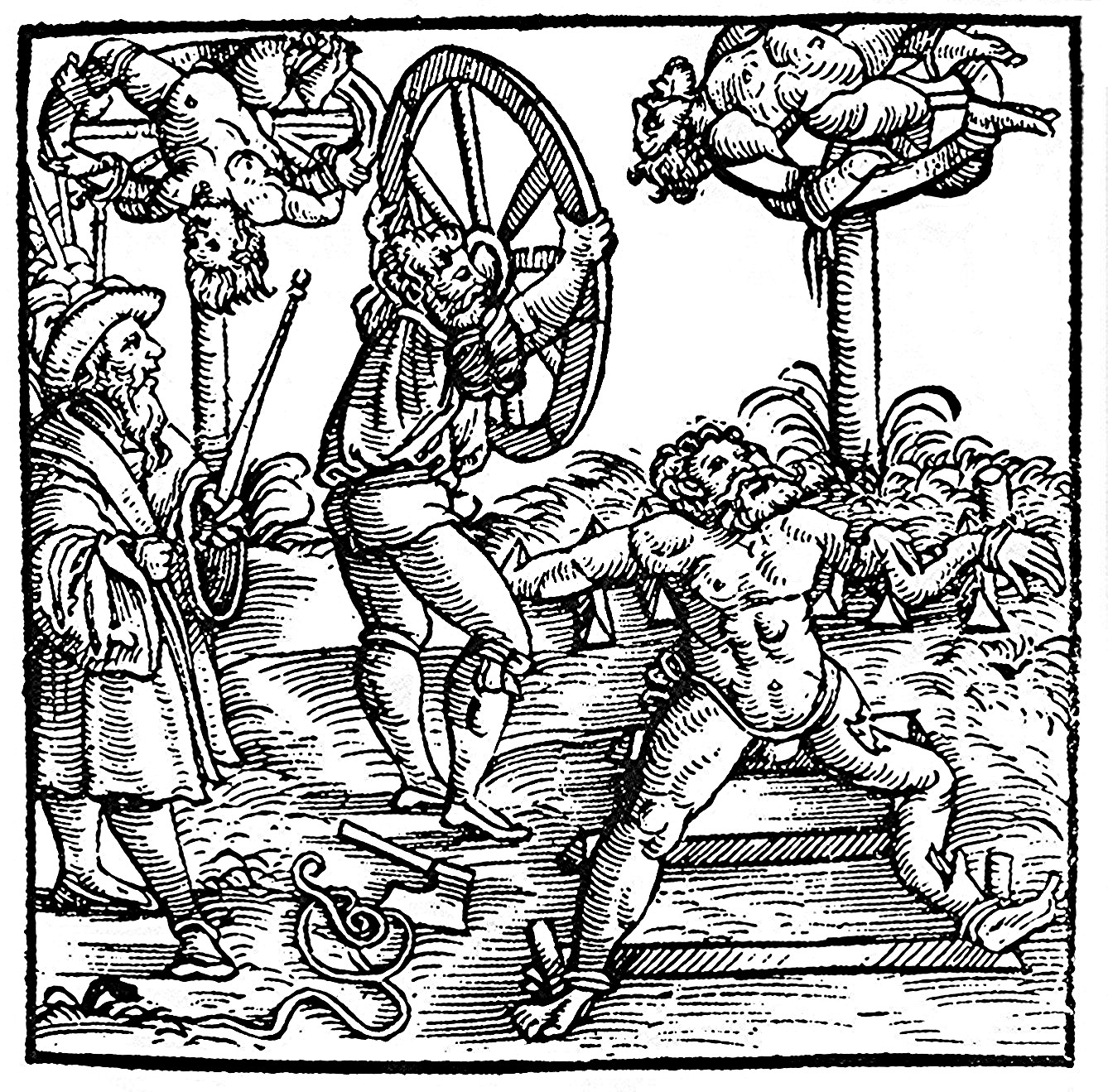
In fact, torture is clearly at play here. The wheel as a torture device was used in the middle ages, and the poem was written right in the middle of this period, sometime in the thirteenth century. But even then, there’re the final two lines of the stanza that explicitly mention a “laughing, desecrating lash” (ludum, ) that is brought to the speaker’s “naked back.”

There’s really no question that torture imagery is at play here. This might even be building on the subtle dominance of women peeked at in the first stanza of the poem.

Though they lacked prominence in places of power, their influence, however subtle and unseen in history books, cannot be overlooked. Even through to today, women who are villains (and even heroines) more often than not work their schemes through wit and wiles rather that brawn and brawling.

The binary stereotype that men are strong and women are smart (though usually not book smart) has persisted for a long time, and “O Fortuna” definitely looks like a medieval manifestation.

Back To Top
Translating Poetry can be Torturous

Although it might be a unique variation, what does it mean for the sort of torture imagery here (variably the breaking wheel, and fortune’s laughingly lashing a person’s back or taking her “pleasure” (“ludum”) on a naked back (“dorsum nudum”))?

The Latin word used for “laughter” or “pleasure” is “ludum.” This word refers to things like laughter, play, jests, or just a generally fun, interactive time. So how does that relate to being whipped?

On the one hand it could be a bit of the repressed seeping through. In the middle ages those who could write and had the means to do so were trained by the Church. So, it could be that the whip is “laughing” as well as “desecrating” because it injures the body that god created while also relieving the pent up desires that that body has through taking on pain: a feeling as extreme as pleasure.

On the other hand, the above translation does take some license in coming out with “As you bring your laughing, desecrating lash/to my naked back.” The poem in Latin reads “…ludum dorsum nudum…,” all three of those words are together, but it’s not entirely clear what’s doing what.

If they all create a single direct object phrase (since they are in the accusative case), then any order could be used. “Laughing naked back,” “back laughing naked,” “naked back laughing.” Even if any of these are used, the element of fun remains in the act of torture.

The only real change in meaning that results from these variations is that the laughter’s moved from the whip to the speaker’s back: the gashes opened by the whip being likened to the open mouth of someone laughing.

In either case, this is definitely a poem that has more going on than another, more pious piece translated earlier.

Back To Top
Closing

Check back here on Thursday when Wiglaf views the hoard for the first time, helped by the luminescence of a battle standard.

Back To Top