Beowulf’s effectiveness questioned, words for advisers (ll.1321-1333a)

Synopsis
Translation
Recordings
Beowulf: a Half-Assing Hero?
Seeking Advice when faced with a Murderous Sprite
Closing
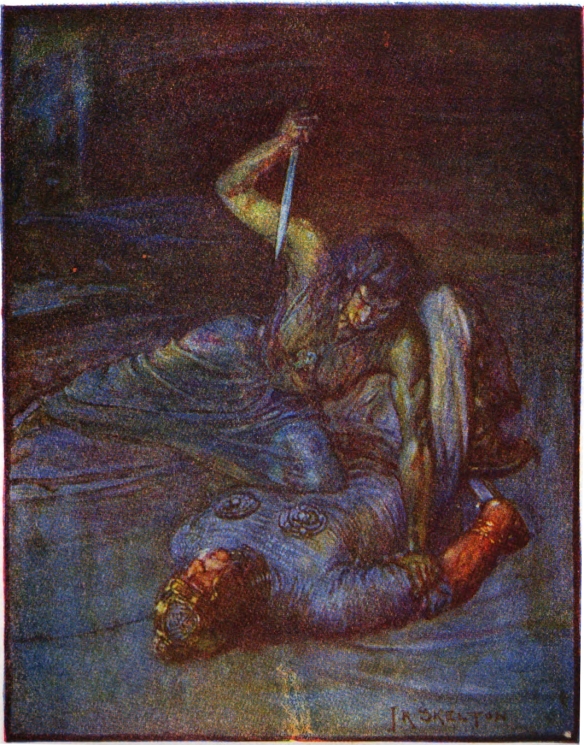
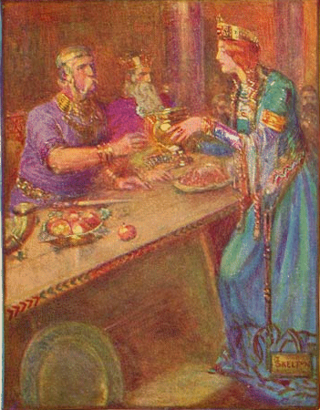
Grendel's mother menaces a pinned Beowulf with a knife.

By J. R. Skelton – Marshall, Henrietta Elizabeth (1908) Stories of Beowulf, T.C. & E.C. Jack, Public Domain, https://commons.wikimedia.org/w/index.php?curid=11001837

Back To Top
Synopsis

Hrothgar explains why Æschere was so dear, and faces the reality that now confronts his taken friend.

Back To Top
Translation

“Hrothgar spoke, protector of the Scyldings:
‘Ask ye not about the night’s joy; sorrow is renewed
to the Danish people. Æschere is dead,
Yrmenlaf’s elder brother,
my counsellor and confidant, my adviser,
my shoulder companion, when we at battle
were both at the fore, when we clashed with foes,
when the boar figures were struck. So should a man be,
a warrior who has proven his worth, so Æschere was!
This deadly creature came wandering to Heorot
to kill him by hand; I know not to what secret place
that terrible one slunk to turn him to carrion,
to make of him a gladdening feast.'”
(Beowulf ll.1321-1333a)

Back To Top
Recordings

Old English:

{Forthcoming}

Modern English:

{Forthcoming}

Back To Top
Beowulf: a Half-Assing Hero?

Hrothgar is laying it all out there. The warrior that Grendel’s mother carried off wasn’t just some thane or some hall dweller, but his dearest companion and, from the sound of it, his trusted long-time adviser. Of course, all of this comes across in Hrothgar’s relating how he and the man fought side by side in the heat of battle, as well as the statement that he “had proven his worth” (“ærgod” (l.1329)). This line is a bit difficult to swallow for me, though.

It sounds like Hrothgar might be calling Beowulf out here, only lightly and through implication, but still. Yet, hasn’t Beowulf also proven himself as a warrior in defeating Grendel? It sounds like the difference is that the foes that Hrothgar and Æschere beat in their heyday didn’t retaliate after a sound thrashing. But, being monsters (and yet, very human since she is motivated by grief for family), Grendel’s mother does so. I definitely get a strong sense that along with Hrothgar’s woe in losing Æschere there’s a sense that Beowulf did not entirely complete the job.

Sure, the Geat killed Grendel, but he didn’t manage to rid Heorot of its monster problem. Though, of course Beowulf and everyone else had no idea that Grendel had a mother, or a family.

In fact, leading up to his appearance, Grendel is only ever referred to as the “kin of Cain.” We’re never really told anything else about his other relations. It’s almost as if Grendel wasn’t born through sex and conception, but instead sprang fully formed from Cain’s murdering Abel; as if he himself is a physical manifestation of a terrible sin. One that would have a lot of resonance with people like the Anglo-Saxons because of their familiarity with stories like Hod’s killing his brother Balder. Though that is a story of accidental fratricide.

What do you think? Is Hrothgar about to lay into Beowulf for not realizing that Grendel’s mother would come crashing in on Heorot’s new “peace”? Or was Grendel’s mother a surprise to everyone and Hrothgar is struggling through his grief and shock to try to say “Beowulf, do it again!”?

Back To Top
Seeking Advice when faced with a Murderous Sprite

If you’re ever about to encounter a “wæl-gæst,” you’d likely want to get some advice. Why? Because running into a “murderous sprite” (from “wæl” (“slaughter,” or “carnage”) and “gæst” (“breath,” “soul,” “spirit,” “life,” “good or bad spirit,” “angel,” “demon,” “Holy Ghost,” “man,” or “human being”)) is no small thing.

You’d definitely want to go and seek a “run-wita.”

Such a person is someone who could be considered an adviser. After all, “wita” means “sage,” “philosopher,” “wise man,” “adviser,” “councillor,” “elder,” “senator,” “witness,” or “accomplice”); and run means “mystery,” “secrecy,” “secret,” “counsel,” “consultation,” “council,” “runic character,” “letter,” or “writing”. So such a person would be able to tell you much that is mysterious or secret.

Though your adviser should also be someone whom you could trust indefinitely because of the mysteriousness of your situation (how else can you be sure of their secretive information?).

So you’d want someone whom you could (or, hopefully already do) consider a person that you’ve been to shoulder to shoulder with before – whether it was in a tight shield wall formation on the battle field or it was waiting together in a packed line at some government office. The kind of person whom you could call an “eaxl-gestealla” with confidence, a person who indeed was a “shoulder-companion” (from the combination of “eaxl” (“shoulder”) and “steall” (“standing,” “place,” “position,” “state,” “stall (for cattle),” “stable,” or “fishing ground”)).

This sort of adviser would, in that way, be more than just someone giving you some pointers, they would be a veritable “ræd-bora.” That is, someone whom you consider a ruler (bora, or “ruler”) of wisdom (ræd (that is: “advice,” “counsel,” “resolution,” “deliberation,” “plan,” “way,” “design,” “council,” “conspiracy,” “decree,” “ordinance,” “wisdom,” “sense,” “reason,” “intelligence,” “gain,” “profit,” “benefit,” “good fortune,” “remedy,” “help,” “power,” or “might”)).

And, of course, given the fact that people might think you’re crazy if you come to them asking for help with a murderous sprite problem, your chosen adviser should be someone whom you knew was good at sharing tips from way back, or, as the Anglo-Saxons would say, was “ær-god.” This word comes from the combination of “ær” (“ere,” “before that,” “soon,” “formerly,” “beforehand,” “previously,” “already,” “lately,” or “’til”) and “god” (“good (of persons or things),” “virtuous,” “desirable,” “favourable,” “salutary,” “pleasant,” “valid,” “efficient,” “suitable,” “considerable,” “sufficiently great,” “good thing,” “advantage,” “benefit,” or “gift”) to mean “good from old times.”

With such an “ær-god” person on your team, you could definitely survive the quest to the murderous sprite and the “eft-sið,” or “journey back” (from “eft” (“again,’ “anew,” “a second time,” “then,” “thereupon,” “afterwards,” “hereafter,” “thereafter,” “back,” “likewise,” or “moreover”) combined with “sið” (“going,” “motion,” “journey,” “errand,” “departure,” “death,” “expedition,” “undertaking,” “enterprise,” “road,” “way,” “time,” “turn,” or “occasion”)).

Back To Top
Closing

Next week Hrothgar talks Beowulf.

You can find the next part of Beowulf here.
Back To Top

Hrothgar’s renewed sorrow, an Anglo-Saxon syllogism (ll.1302-1309)

Synopsis
Translation
Recordings
The Man Grendel’s Mother Seized
An Anglo-Saxon Syllogism
Closing

Back To Top
Synopsis

After a week off from the blog we return to the poet showing us how Hrothgar takes the news of Grendel’s Mother’s visit.

Back To Top
Translation

“Uproar burst forth from Heorot; in blood she’d seized
the best known hand; sorrow was renewed,
it had happened again in that hall. Their trade was harsh,
both parties had to pay a steep price
with the lives of friends. Hrothgar was now an old king,
a grey-haired battle-ruler, troubled at heart,
when he had heard his chief retainer was lifeless,
when he learned his dearest follower was dead.”
(Beowulf ll.1302-1309)

Back To Top
Recordings

Old English:

{Forthcoming}

Modern English:

{Forthcoming}

Back To Top
The Man Grendel’s Mother Seized

Since Grendel’s mother has left the poet returns his focus to Heorot itself. But, he does so only to find it awash in all of the emotions that Beowulf had supposedly rid it of. As the brief half-line 1303b has it: “sorrow was renewed” (“cearu wæs geniwod”).

That might sound like quite an extreme escalation, but it’s clearer than crystal that the man Grendel’s mother took was an important one.

First off there’s the word “ealdor-þegn” on line 1308. I’ve defined this word as “chief retainer,” but one of the definitions of the word “þegn” is “noble” with the clarification that it refers to nobles who are officially so rather than noble by birth. So, this man that Grendel’s mother carried off had truly distinguished himself in the past. We never have the details revealed to us, but he definitely must have done something great to be elevated to a status that’s referred to with a word that means, at least in a sense, “noble by deed rather than by birth.”

Though it is possible that this man was noble by birth and his deed only confirmed this status.

Nonetheless, another word that tells a lot about this man whose death has plummeted Hrothgar into the pit of despair is the incredibly straightforward “freond.” One of the few words that makes it from Old English to Modern English with little modification (aside from the simplifying of the dipthong “eo” into “e”), this word means in Old English what it does in Modern English: friend. It can also mean “relative” or “lover.”

But in the context that we find it here, “freond” refers to Grendel and this taken man.

Grendel is his mother’s son, sure, but what then is this taken man to Hrothgar?

Clearly he’s as close as family since his death causes Hrothgar to lose all the vigour he’d regained upon hearing of Beowulf’s triumph over Grendel. Maybe the two were even lovers, though there don’t seem to be many homoerotic undertones in the poem. Unless, of course, homo-eroticism was just something that happened when Beowulf was being put together and so the signals of it are subtler than I’m used to.

What do you think this taken man was to Hrothgar? Simply a noble friend and advisor? Someone as close as a brother? Or were the two men long-time lovers?

Back To Top
An Anglo-Saxon Syllogism

In this week’s brief passage, there’re only two compound words. So this week’s attempt to string its passage’s compound words together will be brief. And built on what I know of the Anglo-Saxon social hierarchy (which, admittedly, isn’t much).

Every “ealdor-þegn” is a “hilde-rinc,” but not every “hilde-rinc” is an “ealdor-þegn.”

I’ll explain.

The word “ealdor-þegn” means “chief attendant,” “retainer,” “distinguished courtier,” “chieftan,” or “chief apostle.” Since I don’t think the taken man in this passage was just an attendant, I’ve combined a few senses of this compound to translate it as “chief retainer.”

This word comes to its meaning through the combination of “ealdor” (“elder,” “parent,” “ancestors,” “civil or religious authority,” “chief,” “leader,” “master,” “lord,” “prince,” “king,” “source,” “primitive,” or, it could also mean “life,” “vital part,” “age,” “old age,” or “eternity”) and “þegn” (“servant,” “minister,” “retainer,” “vassal,” “follower,” “disciple,” “freeman,” “master (as opposed to slave),” “courtier,” “noble (official as distinguished from hereditary),” “military attendant,” “warrior,” or “hero”).

So the idea behind this compound is that it describes someone in the role of a follower/fighter who has distinguished themselves through long service. In fact, as mentioned above, such a person could even earn a noble standing, which, as far as I know, could be how new noble families got started.

The word “hilde-rinc,” a combination of “hilde” (“war” or “combat”) and “rinc” (“man,” “warrior,” or “hero”), means “warrior” or “hero.”

This word is much more specific, and I’m sure that “hilde-rinc” was sometimes used generally and sometimes used as an emphatic (think of someone today thinking they’re a writer when they’ve written something but they’re a writer when they’ve published something people are buying and reading).

These two are so closely connected because combat was one of the main arenas in which an Anglo-Saxon could show their worth. And, after having been through several combats, their advice (in matters of battle and politics, I imagine) would likely take on more and more weight.

Hence, every chief retainer is a warrior but not every warrior is a chief retainer.

War and battle were a pretty big part of Anglo-Saxon life, so it makes sense that experienced warriors were regarded as authority figures. But war and battle are the expertise of just a few today, so what do you think is the defining job of Western society that gives people authority just because they do that job for long enough?

Back To Top
Closing

In next week’s passage Beowulf is summoned and comes marching in to see Hrothgar.

You can find the next part of Beowulf here.
Back To Top

A great Danish warrior? And compact reward words (ll.1292-1301)

Abstract
Translation
Recordings
How Great is this “Famed Fighter”?
Treasure for Glory
Closing

Grendel's mother menaces a pinned Beowulf with a knife.

By J. R. Skelton – Marshall, Henrietta Elizabeth (1908) Stories of Beowulf, T.C. & E.C. Jack, Public Domain, https://commons.wikimedia.org/w/index.php?curid=11001837

Back To Top
Abstract

Grendel’s mother grabs a Dane for the road.

Back To Top
Translation

“She was in haste, she wished to be away from there,
to save her life, since she had been discovered.
Quickly, before she went, she seized one
man fast, as she fled to the fens.
That man was Hrothgar’s dearest warrior,
his closest companion of all people living between the seas,
a powerful shield-warrior, that was the man she killed while at rest,
that famed fighter. Beowulf was not there,
he had been assigned a different resting place earlier,
during the gift giving for that renowned Geat.”
(Beowulf ll.1292-1301)

Back To Top
Recordings

Old English:

{Forthcoming}

Modern English:

{Forthcoming}

Back To Top
How Great is this “Famed Fighter”?

Grendel’s mother flees now, but takes one with her. Why, exactly she grabbed anyone isn’t entirely clear. I mean, I guess she came for revenge, was frightened by all the clamour and such that met her and then just grabbed someone in lieu of killing several. I guess it’s just her luck that she grabbed one so dear to Hrothgar. First her son’s killed, now she’s unwittingly called down the wrath of the Danish fighting force (and Beowulf, too, since he’s still around somewhere).

If he was such a renowned warrior, though, then why was this Dane so easily carried off?

Perhaps, like Hrothgar, this warrior was past his prime but was quite a fighter in his day? That seems most likely, though if that was the case, I just don’t understand the blocking of the scene.

I mean. at this point in Grendel’s mother’s attack, everyone in the hall has grabbed their swords and shields. They’ve left behind their helmets and mail shirts, so that’s how you know that they’re in haste. In a sense, they’ve forgone the proper defensive measures (putting on armour) in favour of just getting right to their offense. Like someone who slinks down to the kitchen and grabs their biggest knife when they hear someone breaking in, the Danes here aren’t thinking of their own personal safety but are more interested in getting the intruder out.

I can understand that.

But why, then, is this one guy taken away?

Reading the passage again, it sounds like the Dane Grendel’s mother grabbed was probably out front, being such a renowned fighter and all of that. Which does make sense, though it also shows just how hasty everyone was in the face of this new terror. Unless the one that Grendel’s mother carried off was well in front of everyone else, I don’t see why those around him didn’t struggle against her or somehow try to wrench him from her grasp.

Though if any of the Danes had the wits about them to do that, I suppose that they wouldn’t have had much need for Beowulf in the first place.

Do you think Grendel’s mother plucked the Dane she took from a crowd, or just from the front of the Danes’ group?

Back To Top
Treasure for Glory

This week’s passage doesn’t have many compound words, but here’s a short sort of sentence all the same.

A truly worthy “rand-wiga” would enjoy great “blaed-faestne” on the battlefield. And rightfully so, since fighting well with a spear or sword and shield, as a “rand-wiga,” (combining “rand” (“border,” “edge,” “boss of a shield,” “rim of a shield,” “shield,” or “buckler”) and “wiga” (“fighter,” or “man”)) or “shield-warrior” (or “man at arms,” more generally), would require a lot of skill.

Though that skill would help such a “rand-wiga” to be “blaed-fastne,” (“blaed” (“blowing,” “blast,” “inspiration,” “breath,” “spirit,” “life,” “mind,” “glory,” “dignity,” “splendour,” “prosperity,” “riches,” or “success”) and “faeste” (“fast,” “firmly,” “securely,” “straitly,” “strictly,” “heavily,” or “speedily”)). And being “blaed-faestne” is a great thing, since the word means “glorious,” “prosperous,” or “[a] success.”

Plus, based on the meanings of “blaed,” it sounds like just about anyone could be “blaed-faestne” if they were well practiced enough. You’d just need to hold securely enough your spirit, or inspiration.

And, in the world of Beowulf, if you were “blaed-faestne” with anything that was relevant to someone with wealth, you’d no doubt be given a “maþðum-gife,” or “gift of treasure.” Perhaps because it was such a common practice to reward good work with treasure, this word combines “maþðum” (“treasure,” “object of value,” “jewel,” or “ornament”) and “giefu” (“giving,” or “gift”) to mean just what those words together suggest: a gift of treasure, whether that treasure is just something valuable or something shiny.

One other thing to note about the compounds in this week’s passage is that they’re all concentrated around the Dane that Grendel’s mother seized and Beowulf. Given how the poet tends to use more compounds in war scenes, I’d have thought they’d be more spread out in this passage, but I guess he’d used enough to talk about Grendel’s mother and wanted to put the spotlight back on male glory.

Maybe all that time on monstrous femininity was a bit too much for the poem’s early audiences.

What do you think about the distribution of compound words in this week’s passage?

Back To Top
Closing

Next week, more on what Grendel’s mother stole from Heorot.

You can find the next part of Beowulf here.

Back To Top

The threat Grendel’s mother poses, more war words (ll.1279-1291)

Abstract
Translation
Recordings
Grendel’s Mother’s Real Threat?
Of War-Terror and Armed Men
Closing

Grendel's mother menaces a pinned Beowulf with a knife.

By J. R. Skelton – Marshall, Henrietta Elizabeth (1908) Stories of Beowulf, T.C. & E.C. Jack, Public Domain, https://commons.wikimedia.org/w/index.php?curid=11001837

Back To Top
Abstract

Grendel’s mother arrives at Heorot, and even though the poet pretends like they don’t, everyone freaks out.

Back To Top
Translation

“It came then to Heorot, where the ring-Danes
within that hall slept. There would soon be
a reversal among the warriors when
in came Grendel’s mother. The terror she inspired
was only lessened slightly, as a woman warrior’s might
may be against the great strength of an armed man
when with ornamented sword, hammer forged,
blade bloody and raised over the boar helm,
the sharp edge shears the opponent.
Then in the hall were swords drawn,
blades pulled over benches, many a broad shield
held firm in hand; but they paid no mind to helmets,
or the battle shirt, when terror returned to the hall.”
(Beowulf ll.1279-1291)

Back To Top
Recordings

Old English:

{Forthcoming}

Modern English:

{Forthcoming}

Back To Top
Grendel’s Mother’s Real Threat?

All right, I can’t let the mention of warrior women slip by me here. What’s up with the reference to warrior women in line 1283?

It sounds like the assumption is that these women warriors would be unarmed. Or is it that they’d be armed but couldn’t handle their weapon as well as men? Or is it that these woman warriors seldom used swords whereas men were used to swinging their sharpened metal sticks around and so anyone else using them was a joke?

But why is there even this assumption? Is it that a man with a sword is a natural fighter because he’s a man? Or is it that “sword” refers to what a man has between his legs, and so a woman would indeed be “unarmed”?

Yes, this part of this week’s passage really bothers me.

Seamus Heaney’s translation of “wig-gryre wifes” as “amazon [sic] warrior’s” makes it clearer, but even the Amazonian women were armed and expert in the use of their weapon of choice. But if the poet is referring to Amazons here (quite possible, given their popularity in Greek and Roman mythology, not to mention women like Boudicca who may have been a little closer to the poet’s experience if he was Germanic or Celtic), then it just sounds like he’s making the assumption that women just aren’t as skilled when it comes to fighting as men are. Well, maybe slicing through someone’s head to a palm below the neck is more spectacular than just getting hit with an arrow in the heart, but both are going to kill you.

Though that kind of thinking does make a little sense for a poet. Spectacle is a pretty important part of Beowulf after all. Though subtlety also comes in, too. I guess that part of the poet’s world was a kind of misogyny. Maybe that’s just how it is with such old writings.

Or, maybe this passage is evidence that women didn’t “know their place” back then and were trying to fight despite whatever assumption they were running up against.

As a poet who must’ve had some renown or at least patronage in some form (no matter how advance we become, writing poetry – epic poetry especially – takes time, and the human body needs nourishment during that time, and nourishment doesn’t come free), maybe this is just a reflection of the poet’s patron’s view of things. It wouldn’t be the first time certain people were propped up while others were knocked down in a long poem because of the poet’s own interests (see Dante’s Divine Comedy for a great example of this).

Though, if men are really that powerful, shouldn’t they then be able to fend off a woman even if she’s a warrior or even if she’s armed?

Maybe there is a sexual tinge to this, and perhaps that’s the true terror that Grendel’s mother brings. She’s not just another Grendel – some sort of monstrous creature bent on killing for fun or sport – but she’s an example of what all of the women in the poem so far aren’t: untamed and fierce in the face of men.

It’s a broad assumption to make, but do you think that the Beowulf poet was a misogynist?

Back To Top
Of War-Terror and Armed Men

Based on this passage, it sounds like a “waepned-men” is only a “wig-gryre” when he’s armed. That might sound redundant, since “waepned” sounds liked “weaponed” which sounds like it means “armed.”

Not so.

Apparently “waepned-men” means nothing more than “male” or “man.” That’s because the word “waepned” means “male” or “male person” and “men” means “person (male or female)”, “man,” “mankind,” “brave man,” “hero,” “vassal,” “servant,” “the rune for ‘m,'” or “one.” So that is actually the only redundancy here.

Though if you have enough armed “waepned-men” of the same type together, that sort of redundancy could inspire “wig-gryre” or “war-terror.” This word comes from the combination of “wig” (“strife,” “contest,” “war,” “battle,” “valour,” “military force,” or “army”) and “gryre” (“horror,” “terror,” “fierceness,” “violence,” or “horrible thing”), which seems like it should just refer to war in general. The idea of “war-terror” itself sounds like a broken record since the two are so closely linked.

Just as “heard-ecg” and “sid-rand” are closely linked.

These words, after all, refer to a “sword” and “broad shield,” respectively. The first, “heard-ecg” is a little literal, since “heard” means “hard,” “harsh,” “severe,” “stern,” “cruel (things and persons),” “strong,” “intense,” “vigorous,” “violent,” “hardy,” “bold,” “resistant,” or “hard object” while “ecg” means “edge,” “point,” “weapon,” “sword,” or “battle axe”. Putting them together makes “sword” just as easily as putting forged steel and leather wrappings together would.

Likewise, a “sid-rand” could draw its strength from the simple yet powerful connection that exists between its parts. After all, the word “sid” means “ample,” “wide,” “broad,” “large,” or “vast” and “rand” means “border,” “edge,” “boss of shield,” “rim of shield,” “shield,” or “buckler.” So it’s pretty clear what the deal is there.

Actually, now that I think of it, a lot of Old English words for war and its implements are pretty tightly constructed. Not too surprising coming from a culture mad for war and fighting, though they also had enough people willing to war with words to create things like Beowulf.

What do you think of the word “war-terror” (“wig-gryre”)? Is it just a synonym for war, or do you think the Anglo-Saxons thought that some wars were not at all terrible or terrifying?

Back To Top
Closing

The poet briefly turns to Grendel’s mother’s perspective in next week’s passage.

You can find the next part of Beowulf here.
Back To Top

Wondering what makes Grendel’s mother special, compound words to put to work in the afterlife (ll.1269-1278)

Abstract
Translation
Recordings
What’s the Defining Trait of Grendel’s Mother?
Important Compounds for a Visit to Death’s Dwelling
Closing

Grendel's mother menaces a pinned Beowulf with a knife.

By J. R. Skelton – Marshall, Henrietta Elizabeth (1908) Stories of Beowulf, T.C. & E.C. Jack, Public Domain, https://commons.wikimedia.org/w/index.php?curid=11001837

Back To Top
Abstract

The poet wraps his retelling of when Grendel met Beowulf and gets to the monster’s mother.

Back To Top
Translation

“There that man seized the monster;
nevertheless he was mindful of his great might,
an ample allotment of strength, that which God granted him,
and he trusted in the Ruler’s favour,
comfort and support; through that he overcame the fiend,
laid the hell beast low. Then he humiliated went,
deprived of joy and seeking the dwelling of death,
thus went the enemy of men. And his mother would yet
come, gluttonous and gloomy in mind,
on her joyless journey, all to avenge the death of her son.”
(Beowulf ll.1269-1278)

Back To Top
Recordings

Old English:

{Forthcoming}

Modern English:

{Forthcoming}

Back To Top
What’s the Defining Trait of Grendel’s Mother?

Here we see the third retelling of Beowulf’s fight with Grendel come to an end. Blech. After hearing about it twice in under 500 lines you’d think the poet would be sick of telling it, right?

Well, maybe. But each time that it’s been retold so far, the story of Grendel being beaten is told with a distinct purpose.

The first time, when the poet gives us the play-by-play, the fight is purely an action sequence and a display of the incredible strength that both combatants are using.

When Beowulf retells the fight, he does so to recount fresh glory and to bolster his reputation through boasting. Here, the poet retells it as a way of giving us information about Grendel’s mother. He does this by starting and ending the story with a mention of her, and he uses this story to show us what’s motivating her attack.

So Grendel fought Heorot because he was the kin of Cain and the noise of the joyous partying inside disturbed him. But Grendel’s mother is fighting for vengeance.

Even so, information about just what makes Grendel’s mother a threat is still scant.

Grendel’s reputation as a terrible monster who was immune to weapons was established well before Beowulf encountered him. But, so far all we know of Grendel’s mother is that she’s been pushed to vengeance because of her son’s death, otherwise we know nothing about her specifically. Really, the one thing the poet’s been emphasizing is that she has a “woman’s misery” (” yrmþe gemunde” (l.1259)) in mind and comes in off the moors “gloomy in mind” (“galgmod” (l.1277)). So Grendel’s mother’s major characteristic appears to be that she’s a woman. What’s up with that?

So far the only other women that have been mentioned are mothers and sisters, women defined by their familial roles and civil duty. Of these women we saw Hildeburh weeping over her dead brother and son (ll.1076-1080), and throughout the “Heorot freed?” part of the poem we see Wealhtheow ruling with her son’s protection and advancement in mind. Those are the only named women so far, and they’ve been ladies of the court. We really know nothing about other women in this world. Though, if Hildeburh and Wealhtheow are ladies of the court, and behave in a way that’s civil within the patriarchal society of the poem, what’s that say about Grendel’s mother?

It definitely suggests that she’s a savage by comparison, but that goes without saying right? She’s some sort of wild creature living on the fen, so of course she’ll be savage. Though, the poet’s emphasizing her living amongst wild things does mark her as an outsider. This also doesn’t come as any surprise. But, really, how can you be surprised when you’ve been told so little?

Why do you think it’s such a big deal that Grendel’s mother is a woman? Is this a point in the poem that’s just plain misogynistic? Leave your thoughts in the comments.

Back To Top
Important Compounds for a Visit to Death’s Dwelling

This week’s small tale told with the passage’s compound words is pretty straightforward. So I’ll get right to it.

At one time or another, we all come to the “deaþ-wic,” or “dwelling of death.” This strangely fun euphemism for death comes to us from the combination of “deaþ” (“death,” “dying,” or “cause of death”) and “wic,” (“dwelling place,” “lodging,” “habitation,” “house,” “mansion,” “village,” “town,” “entrenchments,” “camp,” “castle,” “fotress,” “street,” “lane,” “bay,” or “creek”) making the literal translation stand up pretty well. Actually, I can’t help but wonder if the definitions of “wic” are so broad because death can be found “living” just about anywhere.

Anyway, once we’ve been welcomed in it’s possible that we’ll meet a “helle-gast” or two. As you might’ve guessed, this wouldn’t be the best of meetings, since a “helle-gast” is literally a “spirit of hell.” This straight-to-the-point compound sees “helle” (“hell”) and “gæst” (“breath,” “soul,” “spirit,” “life,” “good or bad spirit,” “angel,” “demon,” “Holy Ghost,” “man,” or “human being”) combined into something that’s unmistakable. Just as unmistakable as the fact that meeting a “helle-gast” would probably make you “galg-mod.”

At least, I imagine meeting a “spirit of hell” would make you “sad,” “gloomy,” or “angry.”

The compound “galg-mod” itself is made up of “galg” (“gallows,” “cross,” or “melancholy”) and “mod” (“heart,” “mind,” “spirit,” “mood,” “temper,” “courage,” “arrogance,” “pride,” “power,” or “violence”). The mix of “melancholy” and almost any of the definitions of “mod” (which I’d broadly define as “spirit” in both the ethereal sense and the will power sense) is pretty clear, but I quite like the reference to Christ in the definition of the word as “cross.” Despite the definition of “galg” as “gallows” I can’t help but feel that “galg” is weirdly uplifting, likely because it tempts me to try to translate “galg-mod” as “gallows humour.”

Though, if instead of a “helle-gast” you met the “an-walda” when Death ushered you through its dwelling, you’d likely be filled with straight up humour (maybe, depending on how many harps and angels are involved, it could be a kind of super syrupy “vanilla” humour, though). After all, “an-walda” is one of many Old English terms for “god,” though it’s usually translated simply as “Ruler.”

I think we all know where it’s coming from, though.

Especially if you look at the meanings of “an” (“one”) and “walda” (“might,” “power,” “possession,” “control,” “command,” “dominion,” “bridle,” “protection,” “subjection,” “groin,” or “pudenda”). It could be a bit of Christianization, but there’s definitely one deity here who’s trying to come out on top – in both the poet’s and Beowulf’s estimation.

But why not go with this “an-walda”? I mean, if it’s the thing that’s giving Beowulf his strength, then it’s an entity that’s quite “gim-fæst.” That is to say, it’s quite “liberal” or “ample” in its gift giving. Which makes sense since “gim” is a form of “ginn,” a word meaning “spacious,” “wide,” or “ample” and “fæst” which means “fast,” “fixed,” “firm,” “secure,” “constant,” “steadfast,” “stiff,” “heavy,” “dense,” “obstinate,” “bound,” “costive,” “enclosed,” “closed,” “watertight,” “strong,” “fortified.”

Why do you think that Old English has more than one word for god (Anwalda, Metod, Drihten, etc.)?

Back To Top
Closing

Next week, Grendel’s mother arrives in Heorot.

You can find the next part of Beowulf here.
Back To Top

Grendel’s mother teased, monstrous and criminal words (ll.1251-1268)

Abstract
Translation
Recordings
The Slow Reveal of Grendel’s Mother
Lady Monsters, Criminals, and Festive Bedtime Stories
Closing

Grendel's mother menaces a pinned Beowulf with a knife.

By J. R. Skelton — Marshall, Henrietta Elizabeth (1908) Stories of Beowulf, T.C. & E.C. Jack, Public Domain, https://commons.wikimedia.org/w/index.php?curid=11001837

Back To Top
Abstract

The poet lingers on Grendel as he starts to introduce the next threat: Grendel’s mother.

Back To Top
Translations

“Sank they then to sleep. One man paid a dear price
for that evening’s rest, as they went to it as they would
in the gold hall before Grendel occupied it,
ruled with terror, until his end came,
death after such dire crimes. They then became manifest,
those deeds of the widely known man, that avenger then yet
lived after that hateful one, for a long time,
while he wallowed in war wounds. Grendel’s mother,
that hag, the one with a woman’s misery in mind,
who was made to inhabit fearsome waters,
who lives in cold streams, after Cain became
the slayer by the sword of his own brother,
kin by the same father; he fled as an outlaw for that,
marked with murder, fled from the joy of companionship,
occupied the wilderness. Thence was born
that terrible fate; that was hateful Grendel,
the savage outcast, then at Heorot he found
a watchful man waiting for war.”
(Beowulf ll.1251-1268)

Back To Top
Recordings

Old English:

{Forthcoming}

Modern English:

{Forthcoming}

Back To Top
The Slow Reveal of Grendel’s Mother

This passage is quite a bit longer than previous weeks’. I think the poet lengthens things here to draw out the suspense. Though he might go a little too far, teasing us with talk of Grendel’s mother only to fall back to recounting Grendel’s visits to Heorot and the night that he found Beowulf there, “waiting for war” (“wer wiges bidan” (l.1268)).

I mean, this is now the third time or so that we’ve heard tell of Beowulf’s beating Grendel. The first time being when we witnessed it through the poet’s interpretation, then through Beowulf’s retelling of the story, and now, again, we have the poet giving us a précis. What makes this regular retelling strange is that there’s at least one more: when Beowulf tells the tale again (with some embellishments) to his liege lord Hygelac.

What really confounds me here, though, isn’t that the story of Grendel’s being told yet again just a few hundred lines after he was mortally wounded (which comes on lines 814-818, and which Beowulf retells on lines 960 to 979), but that the poet feels the need to refresh us on who Grendel was while he also introduces a new character: Grendel’s mother.

And that in particular bugs me because we get so little detail about Grendel’s mother. She seems to be a dweller in the fen as her son was, but then where’s she been since the Danes built Heorot and moved in? Was Grendel sneaking out to wreak havoc by simply telling her he was “going out for a bit”? Why wasn’t she there with him?

Her absence from Grendel’s raids really makes me wonder if Grendel’s mother wasn’t somehow summoned up by his defeat. Unless she just got back from some very important business on the far side of the fen to find her son lying dead and so lashes out as she does.

But then, is she sophisticated or as beastly as Grendel himself? More modern depictions vary from the seductress of Beowulf the Musical Epic and Angelina Jolie’s portrayal of her in Robert Zemeckis’ Beowulf of 2007 to the hag in Sturla Gunnarsson’s Beowulf & Grendel (2005).

But I suppose that’s what makes Grendel’s mother such a mysterious figure. The poet tells us that she “inhabits fearsome waters” (“wæteregesan wunian” (l.1260)), and that she has a “woman’s misery in mind,” (“yrmþe gemunde” (l.1259)), both of which are supposed to tell us what she’s all about. Though the latter is far less than helpful.

Is this “woman’s misery” the grief that a mother feels for the death of her son? Or is it the sort of superhuman vengeance a woman wronged can direct towards the one who wronged her?

What do you think? Leave your thoughts in the comments.

Back To Top
Lady Monsters, Criminals, and Festive Bedtime Stories

During a “man-dream” many stories would be told. And, no, those stories wouldn’t necessarily end with “and it was all a dream!” That’s because “dream” in Old English means: “joy,” “gladness,” “delight,” “ecstasy,” “mirth,” “rejoicing,” “melody,” “music,” “song,” or “singing.” Combine that with “man” (“one,” “people,” “they”), and you wind up with “man-dream” (“revelry, festivity”).

Then, as now, stories told during such a festive atmosphere, would vary from the heroic (the bread and butter of Beowulf and his poet) to the comical or frightening. A frightening story (or perhaps a heroic one if the ending’s different) might just involve an “aglæc-wif.”

This “aglæc-wif” would be a fresh twist on an old classic (and maybe extra chilling because of it), since “aglæc-wif” means “female monster.” As a compounding of “aglæc” (“wretch,” “monster,” “demon,” or “fierce enemy”) and “wif” (“woman,” “female,” or “lady”; or, as a suffix, “-wif” could mean “fate,” “fortune,” or “a disease of the eye.”), this meaning is pretty clear. Though why the sex or gender of a monster should matter, is a bit of a mystery to me. Whatever the impact, the way that the poet is slowly introducing Grendel’s mother, it seems like this kind of female monster was “wid-cuþ” among storytellers and listeners of the age.

If such tales were “widely known” (that is, wid-cuþ, literally a mix of “wid” (“wide,” “vast,” “broad,” or “long”) and “cuþ” (“known,” “plain,” “manifest,” “certain,” “well known,” “usual,” “noted,” “excellent,” “famous,” “intimate,” “familiar,” “friendly,” or “related”) to bring us here), then there’s very little mystery as to why the poet leaves so much about Grendel’s mother to his audiences’ imaginations. Though it is telling that she is referred to as a “wæter-egesan.”

As a “wæter-egesan,” perhaps she, or her kind in general, is specifically well-known as a “water terror,” that word’s translation. Just like its Modern English counterpart, this compound’s “wæter” means “water,” while “egesan” could mean “awe,” “fear,” “horror,” “peril,” “monstrous thing,” “monster,” or “horrible deed.” But put them together and you’ve got a quick way to refer to creatures strange and odd that hunt in the water.

Despite all of this vagueness around Grendel’s mother and how frustrating it might be, it’s not surprising that we know more about her than we do about Grendel’s father. After all, Beowulf comes from a cultural context in which the prevailing Christian idea of sin was that you bore the sins of your father.

So, as kin of Cain, Grendel is still marked by the sin of the first murderer. That’s what he gets as a paternal kinsmen of Cain, one of his “fæderen-mæge”; Grendel is Cain’s son, since of all murderers, the first ever would have a very hard time being redeemed.

That makes “fæderen-mæge” quite potent when referring to Grendel’s paternal lineage. Which makes sense, since, as a combination of “fæderen” (“father,” “male ancestor,” “the Father,” or “God”) and “mæge” (“male kinsmen,” “parent,” “son,” “brother,” “nephew,” “cousin,” “compatriot,” “female relation,” “wife,” “woman,” or “maiden”) the word means “paternal kinsmen.”

Because of Grendel’s particular paternal lineage, he is a “geosceaft-gasta,” or a “doomed spirit” This compound’s neat because it contains a compound itself since “geo-sceaft” is a combination of “geo” and “sceaft” (which I discuss here). It’s also quite straightforward since there’s no escaping that “geosceaft-gasta” means “doomed monster,” or “doomed person.” Which is pretty much perfect since “gasta” means “breath,” “soul,” “spirit,” “life,” “good or bad spirit,” “angel,” “demon,” “Holy Ghost,” “man,” or “human being.”

Such a creature could be described as a “heoru-wearh.”

A “heoru-wearh” is a “bloodthirsty wolf.” Though you wouldn’t necessarily get that sense from this compounding of heoru (sword) and wearg (“wolf,” “accursed one,” “outlaw,” “felon,” “criminal,” “wicked cursed,” or “wretched”). The word leaves me with more a sense of a someone in power (hence their possessing a sword) who is corrupt or criminal, someone who really can’t be trusted with that power since they’ll likely use it against the greater good — solely for their own gain.

A much simpler sort of criminal is contained in the word “ecg-banan.” This compound means “slayer with the sword” and comes from the mix of “ecg” (“edge,” “point,” “weapon,” “sword,” or “battle axe”) and “banan” (“killer,” “slayer,” “murderer,” “the devil,” or “murderess”). So it’s much less metaphorical than “heoru-wearh.” Though either of these beings could cause you “guþ-cear.”

“Guþ-cear” refers to “war-trouble.” As a compound of “guþ” (“combat,” “battle,” or “war”) and “cearu” (“care,” “concern,” “anxiety,” or “sorrow”) that makes good sense. “War-care” is a great way to say “wound” since it’s something you’re likely pretty concerned about in the midst of war, and well afterwards you might still make a fuss about it. Though hopefully not enough of a fuss (whether fresh or long since healed) to let yourself and others enjoy a nice “æfen-ræst.”

This word means “evening rest,” thanks to the combination of “æfen” (“even,” “evening,” or “eventide”) and “ræst” (“rest,” “quiet,” “repose,” “sleep,” “resting-place,” “bed,” “couch,” or “grave”).

Yes, a good “evening rest” after all the tales during a “man-dream” could indeed help refresh you after receiving some “gudth-cear.” Though, with “ræst”‘s meaning (quite similar to our own modern euphemism) “the grave,” your “gudth-cear” could also send you to a lengthy “æfen-ræst” indeed.

Why do you think gender gets specified in the compound “aglæc-wif”?

Back To Top
Closing

Next week the poet spills more about Grendel’s mother.

You can find the next part of Beowulf here.

Back To Top

A theory on Anglo-Saxon soldiers’ motives, a primer on compound word combat (ll.1242-1250)

Abstract
Translation
Recordings
Serial-Inspired Thoughts on the Military of Beowulf
Defense Through Compound Words
Closing

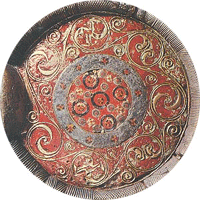
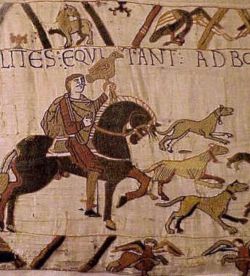
A shield from the Anglo-Saxons' Britain, likely what would be called "bord-wudu."

Back To Top
Abstract

The poet details how those left in the hall arranged their weapons before bed.

Back To Top
Translation

“They set at their heads their battle-shields,
the bright shield-wood. On the benches behind the
princes who’d watched the waves
were the helmets that towered in battle, ringed mailshirts,
glorious spears. Such was their custom,
to be always ready for war,
whether at home or out plundering, or at any time
that their lord showed signs of
need for rallying; that was a brave people.”
(Beowulf ll.1242-1250)

Back To Top
Recordings

Old English:

{Forthcoming}

Modern English:

{Forthcoming}

Back To Top
Serial-Inspired Thoughts on the Military of Beowulf

This passage, though brief, tells how the people it’s referring to are a brave and war-ready people. They’re constantly ready to defend their safety and repel danger. But, more interesting is their being ready to rally around their lord.

I’ve been listening to the second season of Serial, and recently heard of how this season’s subject, Bowe Bergdahl, saw himself as an idealistic soldier, as someone who was supposed to be fighting for a noble cause that he himself believed in. However, as Sarah Koenig (serial’s host) points out, modern armies don’t work like the armies of old on which Bowe had modelled his ideas of soldiering. Modern day privates aren’t individuals fighting for a single cause that brings them together, but are instead tools for the higher ups to send out and fight for them and for their ideas — whether or not the individuals agree with them.

There’s definitely still the mist of nobility around the martial sentiments presented in Beowulf. Whether Anglo-Saxons actually regarded being a warrior as fighting for a single ideal or not, I can’t help but think of these men, “always ready for war” (“oft wæron an wig gearwe” (l.1247)), being like Bowe. Not because they’re fighting for some uniting ideal, but because they’re fighting for individual reasons that happen to align with what their lord can offer them. After all, when society’s on the level of clans and groups (or even city states) rather than centralized massive populations, it’s hard to imagine that the greater good extends beyond defending what you have and maintaining order within the group.

Ultimately, the better a warrior in a lord’s comitatus fought, the better his reward would be either because of merit or just because there’d be more spoils — so it would have been directly in warriors’ (soldiers’) best interests to fight well for their lord. Plus, in a sense, warriors paid their lord in kind, returning the favour of a lord’s political or social protection with physical protection on the battlefield. But even then, squaring up such a deal would be a way of clearing individual (*maybe* familial) indebtedness. But in the end, the warriors in Beowulf seem to fight for individualistic to a greater extent than those from later in history who are remembered for fighting for entire nations or the fates of mass political movements.

That’s not to say that Anglo-Saxon warriors were petty.

The Anglo-Saxons themselves, as unsure of their identity as most teens are, probably saw a grat deal of good in fighting to defend the integrity of what they regarded as theirs and as meaningful to them. Hence the emphasis on honour in Beowulf, and on fighting bravely in this poem and in other major Anglo-Saxon works (like the Battle of Maldon).

But the Anglo-Saxons were, nonetheless, a people who’d left their native Anglia and Saxony, who’d mixed with Celts and met and mingled with Romans, both of which I’d expect had a huge impact on how they saw themselves and how they subtly changed before ultimately being melded with the French, Spanish, and countless other world cultures to become the English that we know today.

So what’s my point here? Simply that among Anglo-Saxon warriors I think there was a strange and unique sense that protecting your individual needs and wants was somehow more in line with, if not entirely synchronized with, the greater good of the group. After all, if all Anglo-Saxons kept up their own business and concerns, then surely the mass of them together would be Anglo-Saxon, right?

Leave your thoughts in the comments!

Back To Top
Defense Through Compound Words

Whatever the ideals or orders behind it, war-time combat’s always been fairly simple at its heart.

For example, When someone strikes out with their “þræc-wudu” (l.1246), or spear, you need to defend yourself. Especially if you consider what’s gone into make that “þræc-wudu”: “þræc” (“throng,” “pressure,” “force,” “violence,” “equipment”) and “wudu” (“wood,” “forest,” “grove,” “tree,” “the cross,” “Rood,” “wood,” “timber,” “ship,” or “spear shaft”), turning the component parts into a kind of “force wood.”

And how better to defend yourself than with a “hilderand” (l.1242)? This kind of shield would be especially helpful in combat in general, at least if you translate “hiderand” literally. Doing so combines “hilde” (“war” or “combat”) and “rand” (“border,” “edge,” “boss of shield,” “rim of shield,” “shield,” or “buckler”), giving you “war shield.”

Though if you’re trying to escape a mortal wounding from a “þræc-wudu” in particular, why not block wood with wood and use a “bord-wudu” (l.1243)? The word “bord-wudu” also means “shield,” but as a compounding of “bord” (“board,” “plank,” “table,” “side of a ship,” “ship,” or “shield”) and “wudu” (“wood,” “forest,” “grove,” “tree,” “the cross,” “Rood,” “wood,” “timber,” “ship,” or “spear shaft”) it sounds much more natural, like a simple “wood shield,” though maybe it’s so simple it’s mystical like a “board from the cross,” a shield perhaps more emblematic than physically effective.

Simpler even than defending yourself in combat, though, is figuring out the size of your weapons and armour. Something small might not be that useful in a pitched battle or melée, but something that’s “heaþu-steap” could be very handy indeed.

Whether it’s a spear or a shield, if it’s “heaþu-steap” (l.1245), then it’s “towering in battle.” Or, more specifically it’s “steap” (“precipitous,” “deep,” “high,” “lofty,” “prominent,” “projecting,” “upright,” “bright,” or “brilliant”) in “heaþu” (war).

While “bord-wudu” sounds like a simpler shield to me, I think that even if a “bord-wudu” were to be “heaþu-steap,” it could be beautifully decorated or something more like a tower shield than a simple buckler.

If you were in a pitched battle with opponents and allies all around you would you rather have a small weapon or a big one? Leave your thoughts in the comments!

Back To Top
Closing

Next week the poet goes to Biblical lengths to describe who pays a nighttime visit to Heorot.

You can find the next part of Beowulf here.

Back To Top

The Danes and Geats bed down with fate, the bench boards’ destiny (ll.1232-1241)

Abstract
Translation
Recordings
Fate’s Just What Happens to You
The Bench Boards’ Destiny
Closing

Back To Top
Abstract

The poet meditates on the inescapability of fate as he tells of how Heorot quieted down for the night.

Back To Top
Translation

“She went then to her seat. There was the greatest of feasts,
men drank great wine; none knew the fate that awaited,
a dolorous destiny, as it would again
and again befall the many, after evening came,
and Hrothgar had retired with his entourage to his chamber,
the ruler gone to rest. The hall was guarded
by warriors without number, as they had oft done before;
the bench boards were cleared; the floor was enlarged
with bedding and pillows. One reveller
was marked and doomed on that couch to depart.”
(Beowulf ll.1232-1241)

Back To Top
Recordings

Old English:

{Forthcoming}

Modern English:

{Forthcoming}

Back To Top
Fate’s Just What Happens to You

It looks like this passage is just the poet talking, filling time. But it sounds like things are about to take a dark turn in Heorot.

Of course, there isn’t much to tell of the revelry at Heorot right now. Things are quieting down for the night. But how the poet tells us this is what I find interesting.

Rather than being overly moralistic about the juxtaposition of revelry and the harshness of fate here (as is my general impression of Christian writing), the poet says the feasting in the hall went on, everyone eventually getting ready for bed and being entirely unaware of what is about to befall them. It’s a simple enough juxtaposition, the difference between an everyday thing and something out of the ordinary. But what draws my attention to this juxtaposition is that there’s no connection between the two of these things. This “dolorous destiny” (“geosceaft grimme” (l.1234)) isn’t about to be visited on Heorot because they were revelling and enjoying to excess. It’s just what happens “as it would again/and again befall the many” (“swa hit agangen wearð/eorla manegum” (l.1234-1235)).

And that line especially, “as it would again/and again befall the many” keeps having fun and being visited with some sort of terrible fate from being truly connected here. It almost sounds like the poet’s stance on destiny or fate or determinism is that bad stuff is bound to happen to people as long as they’re on this earth. But, at the same time there’s the implication that this bad stuff is balanced out with the ability and the chances that people have to enjoy themselves. Like, for example, indulging a bit in the “greatest of feasts” (“symbla cyst” (l.1232)).

Along with the poet’s revealing a bit of how they think about fate, it’s interesting from a narrative perspective that they just say “one reveller/was marked and doomed on that couch to depart” (“beorscealca sum/fus ond fæge fletræste gebeag” (ll.1240-1241)). This line builds up a little bit of tension, and the effect is amplified thanks to the line’s placement around all of this mystical talk of inexorable fate. Everyone dies sometime. Maybe this one who’s doomed to die in Heorot this night will pass quietly?

There’s no question about this person being someone other than Beowulf, since the poem is named for him, and there’s quite a bit of the poem left. Plus, the poet’s very clearly pulled out from the usual tight zoom on this epic’s titular character. Which leaves us with the question of will a Geat die this night or will it be a Dane?

Toss your guess in the comments!

Back To Top
The Bench Boards’ Destiny

The Old English word “geo-sceaft” (l.1234) means “destiny,” or “fate,” and is a word that only appears in Beowulf as far as we know. This word comes from the combination of “geo” (“once,” “formerly,” “of old,” “before,” “already,” or “earlier”) and “sceaft” (“created being,” “creature,” “origin,” “creation,” “construction,” “existence,” “dispensation,” “destiny,” “fate,” “condition,” “nature”), creating a neat image of something that has happened before happening again, maybe on a karmic sort of scale, or maybe because the Anglo-Saxon sense of fate was somehow tied to habits.

But, whatever the Anglo-Saxons’ related fate to, the idea of destiny is pretty high falutin. People die for destiny, they’ll put their all into pursuing it, and they’ll feel like they were made to fulfil it. But I’d rather look at a particular thing’s destiny in this section.

I think it’s safe to say that a “bencþel” (l.1239) has a destiny. That is, a “bench board,” or “wainscotted space where benches stand,” is destined for something – it’s designed for it. In fact, in this passage, I’d say that this thing described by a word born of the union of “benc” (“bench”) and “þel” (“board,” “plank,” “metal plate”), is destined to have “beor-scealca” transform it.

These “beor-scealca” (l.1240; meaning”revellers,” or “feasters,”) are likely to transform the bencþel for a very specific purpose. As you might guess from the combination of “beor” (“strong drink,” “beer,” “mead”) and “scealca” (“servant,” “retainer,” “soldier,” “subject,” “member of a crew,” “man,” “youth”) these “beor-scealca” aren’t in any state to go to their own beds, so instead they’ll transform the “bencþel” into a “flet-ræst.”

A “flet-ræst” (l.1241) is a “couch,” pure and simple (though it applies to just about anywhere soft enough to comfortably lay or bed down in).

Coming from the mix of “flet” (“floor,” “ground,” “dwelling,” “hall,” “mansion”) and “ræst” (“rest,” “quiet,” “repose,” “sleep,” “resting place,” “bed,” “couch,” “grave”), this word sounds like it specifies something more than just a box with some cushions on it. In fact, this word got so comfy for English speakers, that it became the English vernacular for “house” or “apartment”: “flat.”

But transforming an area meant for benches into a soft place to sleep isn’t just some drinking trick (have several pints, look in empty corner, see comfy couch, collapse on bare floor). The “beor-scealca” would transform the “bencþel” by using the process of “geondbrædan.”

The word “geond-bræden” (l.1239) means “to cover entirely,” or, only in Beowulf apparently, “to enlarge,” or “extend.” This word comes from the combination of “geond” (“throughout,” “through,” “over,” “up to,” “as far as,” or “during”) and “bræden” (“make broad,” “extend,” “spread,” “stretch out,” “be extended,” “rise,” “grow,” “roast,” “toast,” “bake,” “broil,” or “cook”).

So, the “beor-scealca” would fulfil the “bencþel”‘s “geo-sceaft” by fluffing the area up with pillows and such (the “geondbræd”-ing process) to make it into a “flet-ræst,” something more than just a place for benches. After the feast, these areas would become the resting place for the feasters. And for one in particular it will be his final resting place.

What do you think it’s you’re destiny to do? Do you even believe in the concept of destiny?

Back To Top
Closing

The Dane’s bedtime ritual continues next week. What could the poet be building to with this talk of fate?

You can find the next part of Beowulf here.

Back To Top

Wealhtheow speaks to Beowulf, another compound chain (ll.1215-1231)

Abstract
Translation
Recordings
What’s Wealhtheow’s Speech Really all About?
A Leader and Their People Bound by Treasure
Closing

Back To Top
Abstract

Amidst all of her gift giving, Wealhtheow speaks up, praises Beowulf, and (maybe) warns him.

Back To Top
Translation

“Wealhtheow spoke, she before the throng said this:
‘Enjoy these rings, dear Beowulf,
young warrior, be with health, and this garment use,
our people’s treasure, and prosper well;
show to these youths your strength, and to them
offer kind advice; I for this reward shall remember you.
You have brought it about, so that far and near
forever among men shall you be praised,
just as widely as the sea encompasses
the home of the wind, the jutting cliffs. Be, long as you live,
prince, blessed! I wish to you great
treasure. Be you to my sons
of kind deed and joyful!
Here each man is to the other true,
of mild heart, under our lord’s protection;
the warriors are united, a people fully prepared
these men all have drunken the pledge and do as I command.'”
(Beowulf ll.1215-1231)

Back To Top
Recordings

Old English:

{Forthcoming}

Modern English:

{Forthcoming}

Back To Top
What’s Wealhtheow’s Speech Really all About?

Wealhtheow’s speech in this passage covers a lot of topics. I mean, first she formally gives Beowulf further gifts, then asks him to be a role model for her sons. Then she says that because of what he’s done Beowulf’s fame will encompass the land just as the seas do before she wraps it all up with a statement about her being in power in the hall.

Actually, that last statement strikes me as the oddest bit of her speech.

I mean, for most of this bit of dialogue she’s been talking about Beowulf, and even before it she’s been described as giving him these gifts. So…what’s the deal with her concluding statement about the order of the hall?

Maybe it’s just a speech formula. The speaker starts by praising and requesting things of the subject of their speech and then jumps right into a little “here’s how things work here” statement. I can see this formula being a useful rhetorical device solely because of the order in which things are presented.

The subject-listener, after having heard so much ego-swelling material is likely giving the speaker their full attention, waiting intently for more to feed their sense of self-worth. But then, rather than praising the subject’s pectorals or gushing about his gluteus maximus, the speaker says “hey, you’re in my hall now, and this is how you need to behave.” It’s like sneaking a PSA into a children’s cartoon so that only the parents watching notice.

But maybe there’s more still going on here, too.

Putting aside all theories that Wealhtheow has the hots for Beowulf (because she is a woman and Beowulf is this young adventuring type), maybe this ordering of topics is meant to cut off the male subject-listener’s understanding of the speaker as coming onto him before the idea can take serious seed in his mind. Just as the male listener expects another flattering comment, maybe the verbal equivalent of batting eyelashes, the female speaker says “but, hot as you are, remember — I’m queen of this place and everyone here is at my command. So don’t try anything.”

Although, taking this rhetorical ordering of topics as a means of diffusing ego tripping and perceptions of sexual advances is just one interpretation. This kind device could also invite further sexual advances. Maybe, broken down into its most basic statements, this whole speech to Beowulf is saying “Hey, you’re pretty hot, I’m pretty powerful, let’s hook up. I can just tell anyone who sees us here to look the other way.”

All of which makes understanding just what’s going on in this speech tricky.

Though, unless the Beowulf poet wanted their hero to have some sort of Oedipal thing going on, I lean a little more toward the warning explanation of this rhetorical ordering.

I mean, Wealhtheow doesn’t just mention her children once, but twice. Though, in both instances she’s asking Beowulf to be a role model for her kids through his strength and generous actions, possibly the role a father should fulfil but that Hrothgar is too old to himself. So, maybe she really is trying to get Beowulf into her bed, even through her mention of her kids.

What do you think? Is this speech proof that Wealhtheow is coming onto Beowulf, or is it just a lady and mother imploring a hero to teach the next generation how to behave? Sound off in the comments below.

Back To Top
A Leader and Their People Bound by Treasure

I thought that chaining together some of last week’s compound words into a kind of story worked pretty well, so I’m doing it again. Here goes:

The word “man-dryhten” (l.1229) denotes something more than just a leader. In particular, it means “lord” or “master.” A combination of “man” (“one,” “people,” or “they”) and “dryhten” (“ruler,” “king,” “lord,” “prince,” “the Lord,” “God,” or “Christ”), there’s a sense that people described by this word aren’t just men who lead, but who are leaders of men. As such, it’s important for them to be “eal-gearo.”

That is, these leaders of men need to be “all ready,” or “prepared.”

The word “eal-gearo” (l.1230) is a great word to express an extreme preparedness because its combination of “eal” (“all,” “every,” “entire,” “whole,” “universal,” or “all men”) and “gearo” (“prepared,” “ready,” “equipped,” or “finished”) gives a clear sense of someone or something that is fully equipped or prepared, meaning that they’re ready to face just about anything. Even if what they need to do involves the emotional state of their “dryht-guman.”

Based on the idea of “man-dryhten” worrying about “dryht-guman” (l.1231), you’d be right to guess that “dryht-guman” are “warriors,” “retainers,” “followers,” “men,” or “bridesmen.” But because this isn’t just a standalone word for warrior like “beorn,” or “wiggend,” there’s something more going on here. This special connotation comes from the combination of “dryht” (“multitude,” “army,” “company,” “body of retainers,” “nation,” “people,” or “men”) and “guman” (“man”), and implies someone who isn’t just a fighter, but who is fighting for a particular cause headed by a particular figure or person. And if that person is truly worth a pack of dedicated fighters, they’ll be able to keep their “dryht-guman” “dream-healdende.”

Despite its length “dream-healdende” (l.1227) simply means “happy,” or “joyful,” and is based on the combination of “dream” (“joy,” “gladness,” “delight,” “ecstasy,” “mirth,” “rejoicing,” “melody,” “music,” “song,” or “singing”) and “healdende” (as “heald”: “keeping,” “custody,” “guard,” “protection,” “observance,” “observation,” “watch,” “protector,” or “guardian”; or as “healdan”: “hold,” “contain,” “hold fast,” “grasp,” “retain,” “possess,” “inhabit,” “curb,” “restrain,” “compel,” “control,” “rule,” “reign,” “keep,” “guard,” “preserve,” “foster,” “cherish,” “defend,” “withhold,” “detain,” “lock up,” “maintain,” “uphold,” “support,” “regard,” “observe,” “fulfil,” “do,” “practice,” “satisfy,” “pay,” “take care,” “celebrate,” “hold,” “hold out,” “last,” “proceed,” “go,” “treat,” “behave to,” “bear oneself,” or “keep in mind”).

So, running with the words compounded into “dream-healdende,” it’s clear that the word conveys an easy sense of “happiness” or “joyfulness,” but with the implication that these states are sustained or long-lasting. And what better way for a “man-dryhten” to sustain the happiness of their “dryht-guman” than with treasure?

That’s where the word “sinc-gestreona” (l.1226) comes in. This word means “treasure” or “jewel” and is a combination of “sinc” (“treasure,” “riches,” “gold,” “valuables,” or “jewel”) and “gestreon” (“gain,” “acquisition,” “property,” “treasure,” “traffic,” “usury,” or “procreation”), which pushes the literal meaning of “sinc-gestreona” beyond that of a mere trinket of treasure and into something that, like “dream-healdende,” sustains wealth over a long period of time. So, really, “sinc-gestreona” might more accurately mean a hoard of treasure or something of incredible value. Perhaps, a piece that’s treasured by a whole people.

Or, you might say, a “þeod-gestreona” (l.1218).

This word means “people’s treasure” or “great possession” and comes from the mixture of “þeod” (“people,” “nation,” “tribe,” “region,” “country,” “province,” “men,” “wartroop,” “retainers,” “Gentiles,” “language” or “fellowship”) and “gestreona” (the same as in the previous compound).

There’s not much more to “þeod-gestreona” than that, since “þeod” literally refers to a collective of people, even getting a little meta to include “language,” so such a treasure that’s a “þeod-gestreona” is something valued by a mass of people, perhaps even something that gains much or even all of its value because of that mass valuation.

In fact, if you went back to the peak of the Beanie Babies craze in the ’90s, those Beanie Babies that were counted the most valuable would be perfectly described by this sense of “þeod-gestreona” — pretty much any sought after collectible is a “treasure of the people,” in a sense, after all. Collecting things really does go that far back!

The Anglo-Saxons collected gold and jewelled treasure, which are still “þeod-gestreona,” but what do you collect just because it’s valuable to you? What’s something that you consider “þeod-gestreona”?

Back To Top
Closing

Next week, things quiet down for the night in Heorot, and the poet talks of fate.

You can find the next part of Beowulf here.

Back To Top

A tale of a torc (pt. 2) and a battle sequence of compound words (ll.1202-1214)

Abstract
Translation
Recordings
A Story Told While a Studio Audience Leers?
Some Compound Words in a Sequence
Closing

Back To Top
Abstract

We hear the other half of the story of the torc that Wealhtheow is giving Beowulf and the revellers in the hall love it.

Back To Top
Translation

“Then the ring had Hygelac the Geat,
Swerting’s grandson, wore it on his final raid,
during that time he defended the treasure under his banner,
protected the spoils of the slain*; but he was carried off by fate,
since he for pride’s sake sought trouble,
bore feud to the Frisians. Yet he carried those adornments away,
took the precious stones over the wide waves,
that mighty man; he fell dead beneath his shield.
Then it passed from the king’s body into the grasp of the Franks,
his mailcoat and the circlet also;
the less worthy warriors plundered the slain,
after the battle carnage; the Geatish people
occupied a city of corpses. The hall swelled with sound.
(Beowulf ll.1202-1214)

Back To Top
Recordings

Old English:

{Forthcoming}

Modern English:

{Forthcoming}

Back To Top
A Story Told While a Studio Audience Leers?

This passage continues the story of the torc that Wealhtheow has just given to Beowulf. Though, honestly, this half of the story is the much more relevant one, I think. After all, it opens with a mention of a Hygelac who is a Geat.

And we’ve already heard of a Hygelac who’s a Geat in this poem, he’s the one who’s the Geat’s (and therefore Beowulf’s) current ruler. Though, since this part of the torc’s story includes Hygelac’s death, it’s pretty clear that the Hygelac of the poem’s present is a descendant of, or at least named for, this famed Hygelac of old.

And why not? This historical (well, at least in that he lived in the past, whether that past the poem talks about is real or not isn’t too important within the poem itself, really) Hygelac was a true badass. He seized the torc, wore it into many battles, fought fiercely against the Franks, and died protecting it and other treasures. That last detail might sound like a waste, but I think the point is that these other treasures were so precious to the Geats that one of their greats was willing to protect them. No doubt, so little is said about these treasures though because they were fairly well known to the audience of Beowulf, or at the very least the concept of treasures — things — that you’d actually want to die for wasn’t as strange as it might be to modern day readers of Beowulf.

Anyway, in this part of the story, it’s mentioned that this Hygelac also had a very special mail coat with him. On line 452 of Beowulf, we’re told that Beowulf himself wears a mail coat that once belonged to a Hygelac.

Maybe this is Beowulf’s lord, but it’d be much more meaningful and exciting if it was this historical Hygelac’s mail coat. If it is, then Beowulf’s being granted the torc is like his receiving the second half of an ancient heirloom, or like Aragorn getting Andúril when it’s reforged from the shards of Narsil that were saved from The War of The Last Alliance of Elves and Men in Tolkien’s Middle Earth lore. If the mailcoat Beowulf has (allegedly forged by the mystical, mythological smith Wade) is this historical Hygelac’s, then Beowulf has just been doubly blessed as a warrior and only really needs an ancient sword to complete his ancestral outfit (three is a magical number after all).

Beyond the significance of a former Geat and Hygelac’s having the torc before Beowulf (its rightful owner?) has it again, this passage has a curious final half line.

After Wealhtheow has related the story of the torc we’re told “The hall swelled with sound” (“Heal swege onfeng” (l.1214)).

If this raucous cheering is because of the story of the torc that Wealhtheow just told in a bizarre non-dialogue way (given the rest of the poem’s being perfectly okay with running long), then it almost seems like the hall is cheering because the Geats lost in that battle against the Franks, the survivors, as we’re told, were left “a city of corpses” (“hreawic” (l.1214)).

That makes me think that Wealhtheow’s story of the torc is more likely the poet interjecting with a quick explanation of the torc’s significance, something that someone like Wealhtheow wouldn’t really have much reason to know. After all, based on her name, she’s likely a British Celt of some kind, or at the very least somehow related to the peoples that the Anglo-Saxons regarded as slaves (since “wealh” can mean “slave,” “foreigner” or “stranger”). So she’s not likely to know much about what to her is a foreign people’s history.

So, if this story is the poet interjecting, then the hall must just be rejoicing because Wealhtheow is giving Beowulf this torc and the other rich treasures mentioned. It must be some torc then, or, at the least, the hall must be in a merry mood if they’re willing to loudly cheer the lady of the hall giving the guest a gift. Unless “The hall swelled with sound” is just Old English equivalent of the modern day sitcom soundtrack’s “oooo!” while two characters kiss.

Do you think Beowulf’s wearing old Hygelac’s mailcoat? Or, do you think the whole hall is “whoo”-ing at Wealhtheow being so generous to Beowulf?

Back To Top
Some Compound Words in a Sequence

Well, because there’s a battle in this week’s passage, there’s a pretty good mix of compounds. To do something a little different with this section, this week I’m going to weave some of them into a bit of a sequence. But I’ll start with those that I didn’t fit into the sequence.

So, on line 1211 we find “breost-gewædu,” the Old English word for “corslet,” or “mailcoat,” either word being more or less interchangeable.

If we break “breost-gewædu” into it’s compounded words we’re left with “breost” (meaning “breast,” “bosom,” “stomach,” “womb,” “mind,” “thought,” or “disposition”) and “gewædu” (meaning “robe,” “dress,” “apparel,” “clothing,” “garment,” or “covering”). Since a this kind of armour covers the breast primarily, it makes sense that it’d be called a “breast robe,” though that’s a bit silly to say.

Then, on line 1214 we have “hreaa-wic” meaning “place of corpses.” This word is a compounding of “hræw” (“living body” “corpse,” “carcase,” or “carrion”) and “wic” (“dwelling place,” “lodging,” “habitation,” “house,” “mansion,” “village,” or “town,”). So it literally means “corpse dwelling place,” an apt name for a battle field, especially one on which battle has involved “guðsceare.”

The word “guðsceare” means simply “slaughter in battle.” But, looking at the words that combine to make this term fleshes it out (if you will).

With “guð” meaning “combat,” “battle,” or “war” and “sceare” meaning “shearing,” “shaving,” or “tonsure,” the word “guðsceare” seems like it’s expressing an idea similar to the Modern English idiom “to be mowed down.” It sounds very much like the word refers to a battle in which one side wasn’t just beaten, but they were absolutely trounced.

In such a battle as that, you’d definitely want to be something more than a warrior, perhaps one who fought with the might and audacity of two warriors? You might say, then, that you’d want to be a “wig-frecan.”

Line 1212’s “wig-frecan” simply means “warrior.” But, coming from a compounding of “wig” (“strife,” “contest,” “war,” “battle,” “valour,” “military force,” “army,” “idol,” or “image”) and “frecan” (“warrior,” or “hero”), it’s clear that this is one of Old English’s doubling or intensifying compounds. After all a “strife warrior” could just be a specialized fighter, but really it’s redundant.

What makes “wiig-frecan” cooler than the compounds that come before it in this entry though, is “wig”‘s possible meaning of “idol,” or “image.” I can’t back up this bit of speculation with any solid evidence, but this interpretation of “wig” leaves me wondering if its “idol” or “image” senses refer to “wig” being used as a shorthand for the eagles that the Roman army used as their sacred standards.

Those standards were often quite plain aside from the eagle at their top, but that’s probably for the better. If they’d had any precious stones — or “eorclan-stanas” — the Anglo-Saxons would’ve likely wanted to steal them more than fear them or associate them with strife and war.

Speaking of, though, the compound “eorclan-stanas” (from line 1208) combines “eorclan” (“chest,” “coffer,” or “ark”) and “stan” (“stone,” “rock,” “gem,” “calculus,” or “milestone”). This compound word’s neatness comes from its communicating its meaning not through just calling the stones “shiny” or “valuable” but making clear that these are stones worthy of being put into a chest or ark — they’re the sorts of things you want to keep protected and therefore, must be precious.

So you definitely wouldn’t want to have any “eorclan-stanas” on you if you were facing “guðsceare,” since those stones would likely become “wæl-reaf”. This word combines “wæl” (“slaughter,” “carnage”) and “reaf” (“plunder,” “booty,” “spoil,” “garment,” “armour,” or “vestment”) to mean “spoil from the slain,” or “act of spoiling the slain.” Which just makes sense since it’s a mix of words meaning “slaughter” and “booty.” I just wonder how the Anglo-Saxons would feel about item drops in modern day RPGs.

What’s you’re favourite of this week’s words? “Wig-frecan” is definitely mine.

Back To Top
Closing

Next week Wealhtheow wishes Beowulf well, and makes a special request of him.

You can find the next part of Beowulf here.

Back To Top