Unknown's avatar

About NSCZach

A writer who translates Beowulf (and other things), freelances, reads voraciously, and is always catching up on (mostly retro) adventure video games/J-RPGs.

Beowulf: A growing character or diplomatic chameleon? (ll.1826-1839)

Introduction
Synopsis
The Original Old English
My Translation
A Quick Question
Closing
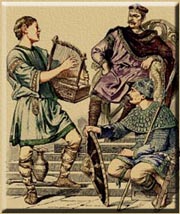
A scop sings his boasts, just like Beowulf does before Hrothgar.

Image found at http://bit.ly/2jumA3j


Back To Top
Synopsis

Hrothgar finishes his final speech to Hrothgar and the Danes.


Back To Top
The Original Old English

“‘Gif ic þæt gefricge ofer floda begang,
þæt þec ymbsittend egesan þywað,
swa þec hetende hwilum dydon,
ic ðe þusenda þegna bringe,
hæleþa to helpe. Ic on Higelac wat,
Geata dryhten, þeah ðe he geong sy,
folces hyrde, þæt he mec fremman wile
wordum ond worcum, þæt ic þe wel herige
ond þe to geoce garholt bere,
mægenes fultum, þær ðe bið manna þearf.
Gif him þonne Hreþric to hofum Geata
geþingeð, þeodnes bearn, he mæg þær fela
freonda findan; feorcyþðe beoð
selran gesohte þæm þe him selfa deah.'”
(Beowulf ll.1826-1839)


Back To Top
My Translation

“‘If, while over the sea’s expanse I learn
that neighbouring peoples threaten you with terror,
as enemies formerly did to your people,
I shall bring the help of a thousand thanes,
the aid of warriors. Of Hygelac, lord of the Geats,
I know, though he is young, that,
as the protector of my people, he will support me
with words and with deeds, so that I may honour thee
and bear to you a forest of spears as help,
the strength of support, when you have need of men.
Then, if Hreþric decides to go to
the Geatish hall, your son, oh prince, he shall
find countless friends there; for far-flung countries
are most hospitable to those who are themselves worth meeting.'”
(Beowulf ll.1826-1839)


Back To Top
A Quick Question

Beowulf happens across some lovely eloquence in this passage. With his “help of a thousand thanes” (“ðe þusenda þegna bringe” (l.1829)), his humbly admitting Hygelac’s youth (relative to Hrothgar, surely), and his “forest of spears” (“garholt” (l.1834)), it’s clear that he’s bringing his “A” speech game. And why not? This is Beowulf’s final big speech to the Danes, after all. So he has to leave a good impression.

More than that, though, this eloquence shows Beowulf’s growth. If you go back and read his earlier speeches to Hrothgar and the Danes he’s not much more eloquent than he is here. But his images seem to be much cleaner and clearer than his boastful stories of beating up monsters and what not. Here Beowulf is the diplomat more than the fighter. And, I think, that we can see this as Beowulf maturing into kingship.

Though it’s definitely possible that Beowulf is just matching his surroundings, as Hrothgar did early on when Beowulf had proven himself to the Danish lord.

His tidy images are just in keeping with a proper farewell speech. Concrete images are bound to land much more of a hit than vague boasts about beating up whole islands’ worth of monsters, after all.

Beyond the images, this speech also matches the occasion through Beowulf’s respectful mention of Hygelac. He is in the presence of another king, so, even though he is his immediate lord, Beowulf can’t pump Hygelac up that much. And he finishes this indirect flattery of Hrothgar off with an open invite for his son, so that Hrothgar’s court can reciprocate Hygelac’s generosity of sending Beowulf off.

This last point is especially important because it means that Hrothgar and Hygelac can be kept in balance. It is a future event, Hreþric’s hypothetical visit to Geatland, but it’s still important because it is one of the greatest ways of showing friendship: offering the same kindness that you were shown.

Do you think that this speech shows Beowulf’s growth towards maturity? Or is he still the same monster-smashing fighter he was when he arrived in Geatland some 1500 lines ago? Share your thoughts in the comments!


Back To Top
Closing

Next week, Hrothgar says that Beowulf will be a great king!

You can find the next part of Beowulf here.

Back To Top

Beowulf’s formal speech as long transition (ll.1813-1825)

Introduction
Synopsis
The Original Old English
My Translation
A Quick Question
Closing

A scop sings his boasts, just like Beowulf does before Hrothgar.

Image found at http://bit.ly/2jumA3j


Back To Top
Synopsis

Beowulf and the Geats gather to say their goodbyes.


Back To Top
The Original Old English

“Ond þa siðfrome, searwum gearwe
wigend wæron; eode weorð Denum
æþeling to yppan, þær se oþer wæs,
hæle hildedeor Hroðgar grette.
Beowulf maþelode, bearn Ecgþeowes:
‘Nu we sæliðend secgan wyllað,
feorran cumene, þæt we fundiaþ
Higelac secan. Wæron her tela
willum bewenede; þu us wel dohtest.
Gif ic þonne on eorþan owihte mæg
þinre modlufan maran tilian,
gumena dryhten, ðonne ic gyt dyde,
guðgeweorca, ic beo gearo sona'”
(Beowulf ll.1813-1825)


Back To Top
My Translation

“And those ready for a journey, they were skillfully
geared as warriors; the leader of those people went
openly to the Danish prince, to where that other worthy was.
The hale hero greeted Hrothgar.
Beowulf spoke, the son of Ecgtheow:
‘Now we seafarers must say,
we who have come from far off, that we are eager to go,
to return to our lord Hygelac. Here we were received as kin,
our desires were entertained; you have indeed treated us well.
If I may do anything on earth
to earn more of your heart’s affection,
oh lord of men, beyond what I have thus far done
by warlike deeds, I will quickly be ready.'”
(Beowulf ll.1813-1825)


Back To Top
A Quick Question

Where are the Danes and Geats meeting here? This detail, not being important, I suppose, is just tossed aside. After all, why focus on the place where the Geats don’t belong? Plus, not naming a concrete place creates more of that displaced feeling mentioned in last week’s post.

That feeling has another purpose, too.

If we’re feeling displaced, then it seems the best thing to do would be to assuage that. And so the poet does. Here it’s only a mention of “Hygelac” on line 1820, but that alone is quite a lot. It pulls our minds from the first half of the poem’s setting and gets it ready to move into the setting for its third part. Beowulf even references Hygelac, giving us a different king to think on. He is also a character whom we’ve only met through reference, so far. So meeting him is an enticing prospect.

Other than that, I don’t think there’s much going on here. Beowulf of course offers future help (if any is needed), and then it seems like the Geats should just be on their way. And yet, there’s a part two of all this next week. What more could be said? Well, check out next week’s post to find out!


Back To Top
Closing

Next week, Beowulf’s farewell address…part 2 (of 2)!

You can find the next part of Beowulf here.

Back To Top

Beowulf: Musical theatre as character exploration

Currently out from writer/director Aaron Sawyer at the Red Theatre is a musical simply (and a little confusingly) called Beowulf. The trailer on the show’s website grabbed my attention as tightly as a man with the strength of 30 could. But, not being able to jet down to Chicago and watch it myself, I’m only able to write about it based on reviews from Third Coast Reviews and The Chicago Reader.

Sawyer’s adaptation of Beowulf is quite an original take, though its focus isn’t anything too new. The basic premise is that Beowulf and Grendel’s mother have been trapped together for all time by Odin. Simple enough. But their past together has not been erased. Grendel’s mother grieves for the loss of her son, and Beowulf questions his heroism as the two become romantically entangled.

These details make this show sound like quite a romp indeed, but it’s definitely playing off of themes that exist in the original poem.

Grendel’s mother is definitely charged with sexual energy in the poem itself. After all, she is the controller of dangerous femininity (giving birth to monsters, wielding a concealed dagger, overpowering Beowulf and landing on top of him (almost fatally)). And she’s certainly contrasted with the much more socially constrained queen Wealhtheow. Wealhtheow is portrayed as nothing but demure, though there are hints of her own desires for Beowulf but she never acts on them.

Grendel’s mother on the other hand acts on her desires for Beowulf so vehemently that she comes very close to killing him. I mean, she pounces on him and then tries to stab him with a dagger. An act of fury, to be sure, but it’s hard for me to not see the symbolism in what she does while on top of him. The dagger she pulls out is pretty phallic as a symbol. Stabbing is a form of penetration. And a female stabbing a male while on top of him seems (at least to me) like a pretty clear metaphor for male rape; a thing no doubt circled by shame and sorrow in the Anglo-Saxon society from whence Beowulf came.

But, interestingly enough, (and maybe this is where Sawyer got the idea for making Grendel’s mother the focus of his play and Tolkien got the idea for having fewer women in the Lord of the Rings trilogy than you could count on both hands), Beowulf never shows much interest in Grendel’s mother.

In fact, he never really shows much interest in any woman. He’s just concerned with glory and heroism (as he is in that trailer).

But maybe Beowulf’s apparent asexuality is part of the bigger picture of the poem. In keeping with medieval ideas of males somehow being closer to god than females, perhaps part of Beowulf’s manly virtue is that he’s beyond all that icky sex stuff. Even when we see him rule his own people there’s no real indication that he’s ever been married or had children. There’s not even any explicit mention or clear implication that he had some kind of mistress.

Ultimately, it sounds like Sawyer’s Beowulf is one that, though it strays pretty far from the source material in terms of story, keeps very close to its characterization of Beowulf and of Grendel’s mother. As goofy and incoherent as Jack Helbig of the Chicago Reader says it is, I think those elements are built into Sawyer’s premise. How else but farce could locking Grendel’s mother and Beowulf in a room turn out? As such, I think this take on Beowulf would be worth seeing just to get a glimpse of two of Beowulf‘s most interesting characters.

Beowulf and the Geats get ready for their costume change (ll.1799-1812)

Introduction
Synopsis
The Original Old English
My Translation
A Quick Question
Closing

A scop sings his boasts, just like Beowulf does before Hrothgar.

Image found at http://bit.ly/2jumA3j


Back To Top
Introduction

Starting with this entry, this shorter format will be the standard for translation posts. If you’ve got any thoughts about this change, please drop them in the comments!


Back To Top
Synopsis

Beowulf and the Geats get up to get down to business.


Back To Top
The Original Old English

“Reste hine þa rumheort; reced hliuade
geap ond goldfah; gæst inne swæf
oþþæt hrefn blaca heofones wynne
bliðheort bodode. ða com beorht scacan
scaþan onetton,
wæron æþelingas eft to leodum
fuse to farenne; wolde feor þanon
cuma collenferhð ceoles neosan.
Heht þa se hearda Hrunting beran
sunu Ecglafes, heht his sweord niman,
leoflic iren; sægde him þæs leanes þanc,
cwæð, he þone guðwine godne tealde,
wigcræftigne, nales wordum log
meces ecge; þæt wæs modig secg.”
(Beowulf ll.1799-1812)


Back To Top
My Translation

“Then he rested his great heart. The hall towered,
gabled and gold-chased; within the guests slept
until the black-plumed raven called out
heaven’s joy with a bright heart. Then came the shadow-shifting
morning light. The warriors hastened,
those nobles were eager to set out
for the lands of their own people; the strangers, bold in spirit,
sought out the prow of their ship.
Beowulf then commanded that hard Hrunting
be born to Ecglaf’s son, ordered that the man be given his sword,
that dear iron; he said his thanks to him for that gift,
went on with wise words, to say it was a good war-friend,
a powerful battle companion, not a word was breathed
against the blade’s edge: all was said sincerely.”
(Beowulf ll.1799-1812)


Back To Top
A Quick Question

The quiet moment that I noted in last week’s translation continues in this week’s. This is definitely a part of the poem that seems not only more reflective than previous sections where the poet took the reins and was just describing what people were doing, but it also feels very much like connective tissue.

But beyond being easily classified with a literary label, I think that this passage does a great job of capturing that feeling that always comes over me as a trip is coming to an end.

Whether it’s something as common as the last day of visiting with family before heading back to work, or as singular as my final day in South Korea before returning to Canada, the poet captures that feeling of moving on. In particular, I think the poet manages this by skimming over certain details — the raven’s calling to the morning, Beowulf and his crew’s getting up to search for their ship, and Beowulf’s returning Hrunting to Unferth.

I think that the poet does this through moving through images fairly quickly. We’re given two lines about the hall and its inhabitants, two about the raven, two about the Geats’ eagerness, two about their search for the ship, and then only six on Beowulf returning Hrunting to Unferth.

Although it’s the longest in this passage, I think that the image of Beowulf returning Hrunting to Unferth is also the most laden with meaning. Hrunting was a gift, but it didn’t help him, and yet to maintain the honour of himself while also propping up Unferth’s reputation it’s Beowulf’s responsibility to give the sword (and thus the giver) sincere praise.

In capturing the transition in this way, I think that they really speak to that sensation of shifting from one setting with all of its social connections, familiar elements, and expectations to another. It’s like changing costumes and feeling that character leave you as take off their clothes and feel yourself become the next character as you don their get-up.

But, what does this passage evoke for you? Does it feel like a transition from one major event to another, or is there some special meaning inherent here that I’m missing? Let me know in the comments!


Back To Top
Closing

Next week, Beowulf begins his farewell address to the Danes.

You can find the next part of Beowulf here.

Back To Top

Tolkien, Beowulf, and inspiration

It’s been almost two months since J.R.R. Tolkien’s 125th birthday, but I think that Tolkien’s influence and presence in the fantasy world merit giving the whole year over to him. So does Suparna Banerjee, writing for TheHindu.com. But why am I posting an article about Tolkien’s contributions to the world of modern fantasy on a blog that’s all about Beowulf?

Well, Tolkien’s connection to the poem is one reason. He wrote vehemently for its serious consideration as a work of meaningful art in his essay “Beowulf: The Monsters and the Critics” (which you cna read in full here). He also translated the poem from Old English, though this wasn’t published until only a few years ago. But, the other reason to mention him is that Beowulf was one of the major taproot texts that influenced his writing for himself and his children.

If you’ve never heard of the term “taproot text” before, it refers to stories that existed well before literature was divided into the various genres we see on bookstore shelves now, but that have major elements of those genres.

So, things like Beowulf, “The Squire’s Tale”, Orlando Furioso, and The Faerie Queene are all taproot texts for fantasy fiction. And, although these taproot texts aren’t required reading for people who write in a genre that grew out of them, they can still bring a great deal of insight. These stories also bring things back to basics, which I think is what happened with Beowulf and Tolkien.

There were fantasy stories before Tolkien and well after Beowulf, after all (Edward Plunkett’s are among my favourites, especially “The Fortress Unvanquishable Save for Sacnoth”). In fact, Banerjee outlines how Tolkien brought these various elements of fantasy together in The Hobbit and The Lord of the Rings. But I don’t think that he would have managed what he did without being as familiar with Beowulf as he was.

Which is why I think Beowulf is so important to come back to as a reader and translator myself.

Beowulf is unlike anything that’s coming out these days, and though it’s a bit dated in some ways, it brings a distant time and society to life. And it does so in a way that combines the historic and the fantastic to make an unforgettable story with a fully realized world. The Beowulf poet took what was mundane when it was being written (political marriages, battling, hall etiquette, the social hierarchy and its attendant wealth distribution system) and adds the fantastic while still being believable.

Though, I wouldn’t go so far as to say that the dragon in Beowulf proves that dinosaurs co-existed with humans, but I would say that Beowulf‘s dragon (and the whole story) never feels as lofty and idealized as, say, the courtly romances of King Arthur. Beowulf is no perfumed prince living apart from everyone but wife and children, he is pure physicality present in the goings on of hall society and the personal and national battlefield alike, and that’s what makes it the story that, I think, inspired Tolkien the most.

What do you think of the idea of Beowulf as an inspiritional story? Let me know in the comments!

What a quiet moment in Beowulf means (ll.1785-1798)

Introduction
Synopsis
The Original Old English
My Translation
A Quick Question
Closing

A scop sings his boasts, just like Beowulf does before Hrothgar.

Image found at http://bit.ly/2jumA3j


Back To Top
Introduction

I know that February is almost done, and so 2017 is already started. But, one of the things that I want to do over the course of this year is to trim back on the padding that I’ve built into my work in the past. I want to make 2017 Twenty-Seven-Lean. Both in that I trim the fat from what I do and in that I use the time I’m left with to lean more into the core of what I do.

I can’t say for sure yet, but I’m starting to consider using these shorter translation post formats from here forward. If you want to share your thoughts on this potential change, let me know in the comments.


Back To Top
Synopsis

Beowulf parties before hitting the hay.


Back To Top
The Original Old English

“Geat wæs glædmod, geong sona to
setles neosan, swa se snottra heht.
þa wæs eft swa ær ellenrofum
fletsittendum fægere gereorded
niowan stefne. Nihthelm geswearc
deorc ofer dryhtgumum. Duguð eal aras.
Wolde blondenfeax beddes neosan,
gamela Scylding. Geat unigmetes wel,
rofne randwigan, restan lyste;
sona him seleþegn siðes wergum,
feorrancundum, forð wisade,
se for andrysnum ealle beweotede
þegnes þearfe, swylce þy dogore
heaþoliðende habban scoldon.”
(Beowulf ll.1785-1798)


Back To Top
My Translation

“The Geat was glad-hearted at that, he descended the dais,
sought out a seat, as the wise one had commanded.
Then was it as it had been before for the bold,
the sitters in the hall spoke fairly with voices renewed.
The mantle of night fell to darken the world
outside the warriors’ hall. All that company arose;
the grey-haired one then sought his bed,
leader of the Scyldings, the Geat, renowned shield warrior
was also eager for such rest. Soon to him,
the one wearied along the warrior’s way, a hall thane came,
one to guide the far-flung one on his way,
he who for etiquette’s sake waited on all
thane’s needs, such as should be had in those days
for far-flung seafaring warriors.”
(Beowulf ll.1785-1798)


Back To Top
A Quick Question

The core of this passage is that Beowulf is shown as a warrior who observes good manners in waiting for his host to go to bed before heading there himself. Other than that, there’s not much here.

Although, the absence of action or conflict or major dramatic events speaks to how quiet this moment in the poem is. This isn’t just a break between beating up monsters, but for Beowulf the character this is the end of his labours in Daneland. He has slept in Heorot before, but this is the first night where he can sleep without worrying about staying awake for Grendel or without the shadow of Grendel’s mother looming over him. Daneland has been saved from monsters, and so his work is done.

But this moment also fits in between the major events in the social drama of Beowulf. Hrothgar has said his piece about kingship, and the big ceremonial giving of gifts happens in the morning. Right now the poet is singing where normally he’d be taking a break. And that’s what makes this part of the poem significant in my mind.

In particular, since it’s about the need for rest, I see this part of the poem as a very human moment in a poem that is otherwise all about the supernatural and non-human.

But what do you think? Should the poet have just said “And after Hrothgar spoke, they all went to bed to rest up for the gift-giving. And what a gift giving!” to get on with it? Or is there some reason for this curious quiet moment? Let me know in the comments!


Back To Top
Closing

Next week, Beowulf’s thoughts turn to home, and Unferth’s sword returns to him.

You can find the next part of Beowulf here.

Back To Top

Authority in Beowulf and scriptures

This is the first page from the Beowulf manuscript, in Old English.

The first page of the original Beowulf manuscript, in Old English. Image from http://bit.ly/2jdxSdW.

I am, at best, a lapsed Catholic/Greek Orthodox Christian. But, I still find a lot of Christianity’s source material interesting. So, when I went searching for Beowulf news and found this post from patheos.com entitled “The Use and Purposes of Scripture: Part One”, I read right through it.

In this article Henry Karlson writes about how a literal reading of scripture either as a source of history or of laws is missing the point. Instead, he argues, the contradictions and various situations concerning similar events that come up in scripture need to be read together and taken as a whole rather than merely as parts. Ultimately, to back up his take on reading scripture, Karlson refers to Beowulf. In particular, he refers to the changes that Beowulf underwent between its origins and the version we have today.

Karlson then uses this analogy to say that the changes made to the scriptures didn’t undermine its authority in the same way that the transformations that the modern Beowulf underwent haven’t undermined its authority. What kept me from just saying “pshaw, whatever” when I read this, though, was that Karlson cements this point with the idea that the Church was just practicing good storytelling when it took all of the various stories and writings that became the scriptures and joined them into a single book.

Those same story-telling principles were guiding those who tinkered with Beowulf over the centuries. After all, Beowulf was restored to a mostly complete version from a single bound copy in a book of monsters and wonders that survived being worm-eaten, burned, and generally ignored as it changed hands over and over again.

Specifically, lines of the poem were clarified, different interpretations of the scribes’ handwriting were argued about, and references to other stories, history, and contemporary culture were worked out. All you need to do to see this sort of work on Beowulf in motion is to pick up an edition from the middle of the 20th century or earlier and flip through the notes. You’ll find them full of arguments about things ranging from Beowulf’s descent into and return from the Grendels’ lair paralleling the crucifixion of Christ, to the lack of clarity about what is really going on in the Finnburh episode, to the discovery that “lindbord” in reference to shields indicated that they were made of linden wood.

And yet, the debate around which version of Beowulf is the most correct isn’t based on any historical level. Most of the changes that were made to the text are largely forgotten now. Which makes sense, since claims of authority are usually based on a version’s poetic merit. The Bible, on the other hand, is only rarely judged on its literary merits. Plus, only academics, poetry, and history fans are really interested in Beowulf, whereas more religions than I could count are constantly arguing about the authority of their version of the Christian scriptures.

In fact, as a poem and not a religious text, preferences for Beowulf just come down to which one is your personal favourite.

I really enjoy Seamus Heaney’s translation, but I’m sure that once I read more editions I’ll find another that I like even more.

The elasticity of such opinions leaves me thinking that all the various branches of Christianity are just practicing the same favouritism but on a massive scale, like people who pour their free time into a particular fandom and then build a world of fanfic around themselves and friends.

But those are just my idle thoughts. What do you think about how the authority of Beowulf versions is measured? Is it even fair to compare the authority of a poem to the authority of scripture? Let me know in the comments!

Hrothgar starts to step out of the story (ll.1769-1784)

Introduction
Synopsis
The Original Old English
My Translation
A Quick Question
Closing

A scop sings his boasts, just like Beowulf does before Hrothgar.

Image found at http://bit.ly/2jumA3j


Back To Top
Introduction

It’s been a busy week, so here’s a short translation post.


Back To Top
Synopsis

Hrothgar sums up his rule, and promises Beowulf great gifts.


Back To Top
The Original Old English

“‘Swa ic Hringdena hund missera
weold under wolcnum ond hig wigge beleac
manigum mægþa geond þysne middangeard,
æscum ond ecgum, þæt ic me ænigne
under swegles begong gesacan ne tealde.
Hwæt, me þæs on eþle edwenden cwom,
gyrn æfter gomene, seoþðan Grendel wearð,
ealdgewinna, ingenga min;
ic þære socne singales wæg
modceare micle. þæs sig metode þanc,
ecean dryhtne, þæs ðe ic on aldre gebad
þæt ic on þone hafelan heorodreorigne
ofer ealdgewin eagum starige!
Ga nu to setle, symbelwynne dreoh
wigge weorþad; unc sceal worn fela
maþma gemænra, siþðan morgen bið.'”
(Beowulf ll.1769-1784)


Back To Top
My Translation

‘”Just so I have ruled the Ring-Danes under the sky
for one hundred half-years, and have protected
them against war with many nations from across this world,
from both spears and swords, such that I have not considered any other beneath the sky’s expanse as an adversary.
But lo! A hard reversal came to my native land,
grief following joy, once Grendel appeared,
that ancient adversary, that invader of my peace;
at that arrival I continually bore persecution
and great sorrow of mind. Thus I now thank God,
the eternal Lord, that I might experience in my life,
after the struggle, the chance to gaze upon with my eyes
the beast’s head blood-stained from battle.
Go now to the bench, joyously join the
mirth of feasting; we two shall share
a great many treasures when the morning comes.'”
(Beowulf ll.1769-1784)


Back To Top
A Quick Question

Hrothgar’s quick summary of the poem leads into a section where Beowulf’s adventures in Daneland come to an end. And there’s a lot of talk of celebration, but it seems very under-hyped to me. Hrothgar mentions that Beowulf will get “a great many treasures” (“maþma gemænra” (l.1784)) for all of his work here, but that’s about it.

Instead, most of the end of Hrothgar’s speech is about his rule. I guess the implication here is that happiness has returned to Heorot, and Hrothgar’s rule will continue as it did before. There’s definitely a strong sense that not only are things returning to normal in Daneland, but all of the characters living there are stepping out of the mythic realm that Beowulf brings with him and returning to history.

What do you get out of Hrothgar’s talking about his rule in Daneland? Let me know in the comments!


Back To Top
Closing

Next week, Beowulf and Hrothgar party on.

You can find the next part of Beowulf here.

Back To Top

A quick update

Hi, everyone! Unfortunately between work and Valentine’s day/weekend plans, I don’t have enough time to put together two posts for this week. So instead of a news post today and a translation post Thursday, I’ll only be putting up a short translation post on Thursday. I should have enough time for both posts again starting next week.

Since the end goal of this blog is to be an archive of my translation of Beowulf before I bring it all together into a book format of some kind (that’s still being figured out), I figure that translation posts are more important to keep putting out.

So, apologies for not being able to get a post about Beowulf news/Beowulf in pop culture this week, but watch for a short translation post Thursday at 6pm EST.

Is Hrothgar motivating Beowulf with death? (ll.1758-1768)

Introduction
Synopsis
The Original Old English
My Translation
A Quick Question
Closing

A scop sings his boasts, just like Beowulf does before Hrothgar.

Image found at http://bit.ly/2jumA3j


Back To Top
Introduction

Unfortunately this week’s been a little too hectic for me to make time for a full translation post. Instead of skipping a week though, here is my translation of the next part of Beowulf.


Back To Top
Synopsis

Hrothgar makes the moral of his story loud and clear for Beowulf.


Back To Top
The Original Old English

“‘Bebeorh þe ðone bealonið, Beowulf leofa,
secg betsta, ond þe þæt selre geceos,
ece rædas; oferhyda ne gym,
mære cempa. Nu is þines mægnes blæd
ane hwile. Eft sona bið
þæt þec adl oððe ecg eafoþes getwæfeð,
oððe fyres feng, oððe flodes wylm,
oððe gripe meces, oððe gares fliht,
oððe atol yldo; oððe eagena bearhtm
forsiteð ond forsworceð; semninga bið
þæt ðec, dryhtguma, deað oferswyðeð.'”
(Beowulf ll.1758-1768)


Back To Top
My Translation

“‘Guard against such evil hostility, dear Beowulf,
best of men, and be sure to make the better choice:
eternal gain; be not intent on pride,
oh renowned warrior! Now is your power prospering
for but a short while; soon will either
illness or the blade deprive you of that strength,
or the grip of flames, or the surging waters,
or an attack by sword, or the flight of spears,
or terrible old age, or the light of your eyes
will fail and grow dim; presently such will come
upon you, oh lord of battle, and death will overpower you.'”
(Beowulf ll.1758-1768)


Back To Top
A Quick Question

A lot of people take the inevitability of their own death as a major inspiration to get on with what they want to do with their lives. Steve Jobs, for example, used his mortality as a way to figure out if what he was doing was what he truly wanted to (he suggests was “meant” to do) on what sounds like a daily basis. At least that’s the impression I get from the speech quoted in this article.

Although Hrothgar’s list of all the ways Beowulf could eventually die is a little gloomy and seems very melancholic do you think he’s doing the same thing here? Is he trying to motivate Beowulf to live each day to the fullest? Or is he just trying to remind Beowulf that he won’t live forever?

Let me know in the comments!


Back To Top
Closing

Next week Hrothgar gives a recap of the whole poem so far — from his perspective.

You can find the next part of Beowulf here.

Back To Top