Taking a break for a brew and some nuanced words (ll.491-498)

Abstract
Translation
Recordings
Breaking for a brew
Words of nuance
Closing

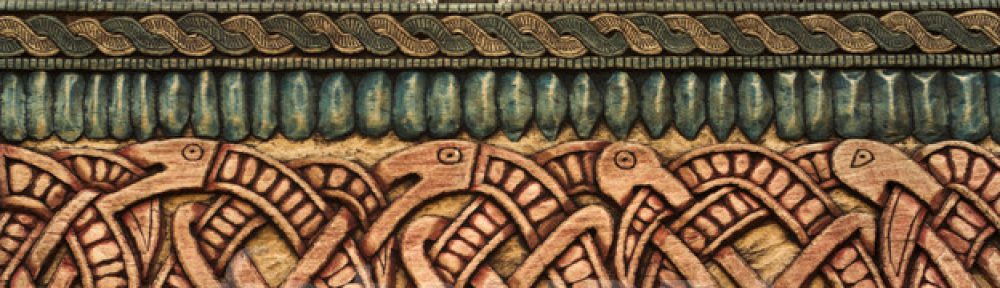
Interlaced men motif. Image from http://public.wsu.edu/~hanly/oe/503.html.

Interlaced men motif. Image from http://public.wsu.edu/~hanly/oe/503.html.

Back To Top
Abstract

Space is cleared for the Geats to sit, ale is poured, and songs are sung in Heorot hall.

Back To Top
Translation

“Then for the Geat men together at once
a space was cleared on a beer hall bench;
there the bold went to sit,
exulting in their strength; a thane acted on that office,
he who in hand bore the adorned ale cup,
poured out the sweet brightness; the poet meanwhile sang
clear in Heorot; there were songs of heroic joy,
among the none too few noble warrior Danes and Geats.”
(Beowulf ll.491-498)

Back To Top
Recordings

Old English:

{Forthcoming}

Modern English:

{Forthcoming}

Back To Top
Breaking for a brew

It’s no secret that the Anglo-Saxons enjoyed their beer. Such could be said for all Germanic peoples, really. But, they weren’t swillers of whatever they could get their hands on. At least, one would hope so after reading such a vivid description of a perfect presentation and pour as that found on lines 494-496.

The best way to approach this description is line by line, since each has a singular focus.

First, the second half of line 494 is about the person doing the pouring. Notice that this is the shortest part of the description. Also, that pouring the ale isn’t just some act or event that stands in the way of drinking it – it’s an “office.”

The Old English word used is “nytt,” which could translate as “use,” “utility,” “advantage;” “duty,” “office,” “employment,” “supervision,” “care;” “useful,” “beneficial,” “helpful,” “profitable.”

The word “office” best captures the sense that I think is implied here, a combination of officialdom with importance.

It goes unsaid throughout these three lines, but aside from the enjoyment of a good brew, ale-pouring would have been one of the major ways in which a host could make an impression upon his guests. Just as various modern cultures have various drinking etiquettes, the Anglo-Saxons surely had their own. As such, knowing how to properly pour was likely included in this and something that was learned early and learned well.

There’s some room for interpretation in the word “þegn,” since it could mean “servant” or “retainer.” But, whether it’s someone who is only a servant in Heorot or who is one of Hrothgar’s remaining retainers, I think that the act of pouring ale in Anglo-Saxon culture confers a great deal of importance on the pourer. Just like a bartender who knows how best to get that stout from the tap to your glass, anyone who could pour ale well no doubt commanded some respect.

After all, it is that servant who bears the ornamented drinking cup (as read on line 495). Probably a large pitcher-sized thing from which the smaller cups were filled, this cup’s exact decoration remains unmentioned. Likely with good reason.

The recitation of poetry in Anglo-Saxon Britain happened in social settings. In such settings just the same sort of pouring and drinking would be going on, so leaving out any fine details that would make this “adorned ale-cup” a specific item allows hearers of the poem to step into the fiction of Beowulf through this detail (or lack thereof).

Perhaps some hearers may even have thought, “maybe this ale-cup that poet’s caterwauling about is just like this one?” as they admired the design carved around their own cup, fingering over its design as much as looking at it.

But the bearer and the cup are just vehicles for the ale itself. That’s why the most vivid brief description of all is saved for the ale (or mead?) itself – that “sweet brightness” of line 496. It doesn’t contain so much detail as to become self-parodying, but the original Old English, “,” is, nonetheless open to interpretation.

Heaney translates the phrase as “bright/helpings of mead.” Wren would render it “bright [or “glorious”] sweet drink.” And Francis Gummere went with “clear mead.” These are all fairly similar, and mead is definitely implied (if not outright stated).

Yet, it’s curious that the word for the drink is not “medu” meaning “mead” or “ealu” meaning “ale.” It’s possible that the poet declined the use of either because it was obvious enough to contemporary audiences what the drink was. Though to us (and to me) it’s rather vague. There’s mention of the ale cup, and yet this is a sweet drink that’s being poured out. So is it mead or is it ale?

A meaning taken for granted is lost to us.

Or maybe I just need to get a little of either in me to work this one out.

Back To Top
Words of nuance

One of the things that drew me to the study of words when I was younger is their power to reflect the values and ideas of the people and cultures who use them.

One of the words that stands out in this week’s extract is “swiðferhð.” Taken together, the word means “bold, brave, rash.”

Curiously, there’s a kind of gradient present in these definitions: to be called “bold” is generally a compliment, calling someone “brave” could go either way, and then calling someone “rash” sounds like a downright insult. Coming from a society that seems steeped in physical conflict and warfare, such nuance to a word that sounds like it should bear only positive connotations is curious. But, of course, contemplation and wisdom were highly valued in that society, too.

Taken apart, the word’s halves, “swið” and “ferð,” mean, respectively: “very,” “much,” “exceedingly,” “severely,” “violently,” “fiercely;” and “mind,” “intellect,” “soul,” “spirit,” “life,” “person.”

All of the definitions of “ferð are benign enough. But, the last four interpretations of “swið” sound like adverbs for something taken too far. Yet someone who is “severely spirited,” for example, could well be an asset or a liability on the battlefield. He’d be a powder keg, as likely to do much good as he would be to do much ill. So characterized are the Geats as they sit amongst the Danes for their entertainment.

I don’t think the poet means this as a backhanded compliment, though. I read the use of “swiðferð (aside from its use for alliteration’s sake) as the poet’s take on the Dane’s feeling about the Geats at this point. They don’t know if Beowulf will be successful against Grendel, or if he and his band will be smeared around their precious Heorot come morning.

Such an atmosphere is perfect for songs of man rejoicing, though. Or are they songs of hero gladness?

Line 497’s “hæleða dream” isn’t exactly a compound word, but its interpretation is still something of a crux.

The words “warrior,” “hero,” and “man” cover “hæleða” well enough. But that leaves the strangely familiar “dream,” a word that has a meaning that’s almost analogous to its Modern English cognate: “joy,” “gladness,” “delight,” “ecstasy,” “mirth,” “rejoicing;” “melody,” “music,” “song,” “singing.”

All of these words are close enough to one another, but the question is: which shade of meaning should someone translating Beowulf go with?

Songs of a warrior’s ecstasy are likely different from those of a warrior’s rejoicing. He might rejoice after a hard-won battle, but he may well be ecstatic right in the middle of it.

That’s kind of a problem of translation, though. Too often, in the process of moving words from one language to another, the original needs to be unpacked since all together it just won’t fit into its target language. It doesn’t help when one such word is attached to another (a man’s ecstasy is likely to be different from a man’s rejoicing, just as a warrior’s ecstasy is different from his rejoicing).

This sort of nuance might not be as wild as that of swiðferð or of other words I’ve covered in previous entries, but it’s still something that makes translating a fascinating task.

Back To Top
Closing

Next week, one of Hrothgar’s closest thanes calls Beowulf out on his boasting.

You can find the next part of Beowulf here.

Back To Top

Hrothgar’s pro-story agenda and two normal compounds (ll.480-490)

Abstract
Translation
Recordings
On the use of stories
Two normal compounds
Closing

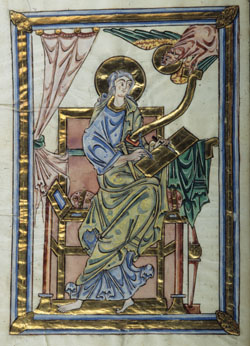
A page from an illuminated manuscript. Image from http://www.myarmoury.com/talk/viewtopic.php?t=28126&view=next.

A page from an illuminated manuscript. Image from http://www.myarmoury.com/talk/viewtopic.php?t=28126&view=next.

Back To Top
Abstract

Hrothgar closes off his speech to detail with an account of the carnage Grendel has wrought upon Heorot.

Back To Top
Translation

“‘Quite often ale-drunken threats
from warriors were issued over ale-cups,
that they would wait in the beer-hall
for Grendel’s onslaught with sword horror.
Yet when morning came to this mead hall,
this noble-hall was blood-stained, as day was lit,
all the bench space was smeared with blood,
the hall battle-bloodied; then had I fewer loyal
dear men, those death had carried off.
Sit now to the feast, and in the hall hear
of heroes’ glorious victories, as thine heart urges thee!
(Beowulf ll.480-490)

Back To Top
Recordings

Old English:

{Forthcoming}

Modern English:

{Forthcoming}

Back To Top
On the use of stories

This week’s passage is pretty straightforward.

Hrothgar tells Beowulf of those who have come before him in sparse, yet gory, detail, and then sends him off to make merry. It’s such a quick turnabout that I wonder if it’s supposed to be comical.

Schadenfreude can’t possibly be that recent a phenomenon after all. Especially when it’d be crystal clear that Beowulf will win, despite the odds. I mean, the poem is named after him and so it’d be hard for it to go on too far beyond his death were Grendel to bring it about.

If not schadenfreude, then maybe there’s some sort of irony at work here. Maybe Hrothgar’s conclusion is meant to be tragicomic.

Or perhaps Hrothgar is just drunk. That’s another possibility for sure.

Whatever his own state is, Hrothgar’s definitely a tragic figure and so that could well be what’s powering the comedy here.

It’s also important to remember that these characters, as much as they are the front end of the poem, are still puppets dancing upon the poet/scribe’s strings of words.

Another possibility is that Hrothgar’s emphasis falls on his final sentence. Maybe he’s trying to get Beowulf to fill his head with stories in which the hero triumphs over the monster. Medieval belief in the idea that what you carried around in your head affected your conduct and life in general was pretty widespread after all. So the big man’s conclusion might be less for comedic effect and more along the lines of “get your head in the game!”

Actually, stepping into the territory usually reserved for the second section of these posts, the word that Hrothgar uses for “urge” in that last sentence is worth a closer look.

In the original Old English it’s “hwette,” a clear ancestor of modern English’s “whet” and also translatable as “sharpen, incite, encourage.” The last two of these definitions are what led me to “urge.” But keeping the first two possibilities in mind makes Hrothgar’s use of “hwette” all the more fascinating.

(A quick note, “hwette” appears not to be used for its alliterative qualities since this line’s sound is “s,” curiously.)

If Hrothgar (or the poet) meant to mean “whet,” or “sharpen” then the line still retains its meaning. Beowulf is still being encouraged to sharpen himself on the whetstone of stories. But what does that say about stories?

I think this line gives us some minor insight into how the Anglo-Saxons (and many other cultures of the time, in keeping with the belief that what you enshrined in your memory affected you) regarded stories. In instances like those in which Beowulf finds himself, they could be used as much for entertainment as they could be for preparation.

Under such circumstances, it’s not likely that such stories were not necessarily closely analyzed. They were likely taken more or less at face value; the heroes are real and the monsters are real and that’s that.

I think we can add a layer of complexity to this matter, though.

I don’t think that the Anglo-Saxon’s necessarily believed that the monsters and heroes of such stories were real. Instead, I think they regarded their deeds as being such stories’ major purpose. Regaling each other with such stories could help to remind people that whether it was with divine or supernatural aid, or merely through human wit and wisdom, people can overcome some very large obstacles.

However, just as it’s possible to over-sharpen a knife, I think that the Anglo-Saxons also believed it was possible to over-sharpen oneself on such stories as those that Hrothgar encourages Beowulf to give an ear to.

However willing you might be to believe that hero x defeated supernatural terror y, hearing too many of these stories would inevitably lead to an awareness of their gaps. Analysis of such stories – whether out loud or only on reflection – would seriously undercut their power to empower.

Though, perhaps that’s why such stories are traded over ale or mead or beer, rather than, say, strong coffee or gentle tea.

Back To Top
Two normal compounds

This week’s passage doesn’t have any wacky compounds.

However, it does have one that apparently isn’t in the Clark Hall & Meritt dictionary that I’m using as my primary reference.

This word is “hreðsecga,” meaning “hero,” and it’s from line 490. The glossary in the back of C.L. Wren’s edition of Beowulf does include this word, though, and in it he gives the quite literal translation of “glorious warrior.”

How is that quite literal?

Well, “hreð” means “victory” or “glory” and “secga” means “warrior,” “hero,” or “man.”

All in all it’s pretty straightforward.

Except that “secga” also translates to “sedge,” “reed,” “rush,” flag,” and “ocean,”

Given the word’s context it’s clear that it’s not meant to mean “glorious reed” or “glorious ocean.” But it’s curious to think that a word for “man,” or “warrior” could also mean things like that. Especially such unwarlike things as “sedge,” or “rush.”

A “flag” could refer to the standard or emblem that a tribe bore into battle for symbolic and psychological reasons. As the Anglo-Saxons (and the Danes and Geats) were familiar with sailing, the “ocean” may have been (and was) commonly characterized as war-like.

But, those plants are just there.

Still, it’s possible that the Anglo-Saxons saw sedge and rushes as bristling clumps of swords and spears respectively, mêlées in which a hundred swords were drawn, raised, and then frozen in the moment before they all strike their targets, preserving these scenes as grasses that bristle in the breeze.

Maybe these alternate translations for “secga” nod towards some forgotten myth about just such a martial scene being transformed into a plant doomed to dress the fen and marshy waste that the Anglo-Saxons populated with beings like Grendel. Such a myth wouldn’t be outside the ken of Western mythology, since Greek mythology is full of origin stories involving people being turned into plants.

The word “oret-mecgas” is another compound word found in this week’s passage (on line 481). It doesn’t carry any mystifying possible alternate meanings like “hreðsecga,” but it’s a compound word that sort of tells a story.

The word’s first part, “oret,” means “contest,” or “battle” and its second part means “man,” “disciple,” or “son.” So, combined, the whole compound literally means “disciple of battle” or “son of contest,” referring to someone deeply versed in combat. Indeed an apt definition for a word meaning “warrior.”

Back To Top
Closing

Next week Beowulf and his crew are treated to an intermission of mead and minstrel song before a new challenger appears.

You can find the next part of Beowulf here.
Back To Top

Hrothgar prefaces Grendel and a word combines “foolish” and “fiend” (ll.473-479)

Abstract
Translation
Recordings
Why preface the massacre?
A terrible jester
Closing

A page from an illuminated manuscript. Image from http://www.myarmoury.com/talk/viewtopic.php?t=28126&view=next.

A page from an illuminated manuscript. Image from http://www.myarmoury.com/talk/viewtopic.php?t=28126&view=next.

Back To Top
Abstract

Hrothgar prefaces his relation of the terror of Grendel’s attacks with a brief summary.

Back To Top
Translation

It grieves me at heart to tell,
to any man, what affliction Grendel has wrought
on me and and Heorot amidst his hostile designs,
those spiteful attacks; by these is my hall troop,
my band of warriors, made thin; wyrd swept them
into Grendel’s terror. God easily may
put an end to the deeds of that fell-destroyer!
(Beowulf ll.473-479)

Back To Top
Recordings

Old English:

{Forthcoming}

Modern English:

{Forthcoming}

Back To Top
Why preface the massacre?

This short passage is what Hrothgar uses as a preface to the retelling of Grendel’s attacks. In it he summarizes what he’s about to say next. But why?

Beowulf already knows about Grendel and the terror that he’s wreaked upon Heorot and the Danes. So why does Hrothgar feel the need to preface the relation of the same?

Maybe it’s because this is a first hand account of the story, and as such its details will be more vivid than those in news that has been blown afar by sailor and wanderer alike.

Maybe it’s not supposed to be taken in the same way as the modern newscasters’ “Now, we must warn viewers that some people may find some of the images in the following report graphic.”

Maybe, instead, it’s supposed to get Beowulf and his crew into the right mindset to hear the story of Grendel’s attacks.

In short, it’s meant to give context rather than to scare or warn.

Giving such a relation context makes fine sense. But I can’t help but think that there’s something more at work here.

Hrothgar’s old fashioned formality is certainly a factor. Someone like Beowulf would probably just rush right into the story and not really establish much beforehand.

Yet, such a formal system of expression seems strange given that Hrothgar’s just confessed openly to Beowulf that he’s not as great a man as his brother was. Normally someone in his position wouldn’t just come out and admit something like that, I think.

So perhaps that was something of a slip on his part, emotionally wrought as he’d been made by meeting Ecgtheow’s son and at last having a hero in whom he firmly believes.

If Hrothgar’s admission of weakness to Beowulf was a slip, then this little preface could well be his way of recovering himself and his manner.

After all, the poet wouldn’t want to waste time with lines about how Hrothgar’s look drooped and then slowly, like a trumpet vine, climbed and bloomed, ready to dispense the sweet nectar of the situation. Instead, the poet/scribe would be better off simply including this shift back to formality in the man’s dialogue. This poem thing has to keep a vigorous pace, right?

One other thing makes me think that this preface is more about context than being a warning.

Within the passage, Hrothgar makes a reference to the power of wyrd (kind of like fate, but beyond any notion of destiny) sweeping away his men (ll.477-478) and he also makes reference to god, whom he believes can put an end to Grendel all together (ll.478-479). This shows a man in transition on the spiritual level, since the concept of “wyrd” predates that of the Christian god among Anglo-Saxons. Hrothgar still holds to the old idea of wyrd while also investing hope in this new “god” figure. That is, so long as the “god” of line 478 is the Christian god and not just some vague reference to Odin or the Norse gods in general.

It’s also curious to note that wyrd and god appear in Hrothgar’s preface in the reverse order that they appear in Beowulf’s earlier speech. Pinning any real meaning on this kind of structure isn’t really worth the effort, since it could just be coincidence. But, Hrothgar’s repetition of these two things could relate to his hope that god will, without any real struggle, choose Beowulf to win. Hrothgar’s ending his preface with “God easily may/put an end to the deeds of that fell-destroyer” (“God eaþe mæg/þone dolsceaðan dæda getwæfan.”(ll.478-479)) definitely suggests this.

Back To Top
A terrible jester

Brief as this passage is there is one word in particular that I want to break down. This word is “dolsceaða” (l.479). As a compound it means “fell destroyer.”

Broken into its constituent parts, though, we’re left with “dol” (meaning “foolish,” “silly;” “presumptuous;” and “folly”) and “sceaða” (meaning “injurious person,” “criminal,” “thief,” “assassin;” “warrior,” “atagonist,” “fiend,” “devil,” and “injury”).

At first glance a combination of a word for things like “foolish,” “presumptuous,” etc. with one for “criminal,” “thief,” “fiend” probably seems strange. How exactly can someone be a “foolish fiend”?

Within the context of Anglo-Saxon society, though, the reason that these two words combine to mean “fell destroyer” becomes clear.

As we saw in last week’s post, Ecgtheow started a feud with the Wulfings when he killed one of them. Along with the feud, Ecgtheow was also exiled from his people. And in Anglo-Saxon culture exile is a fate worse than death.

Death is final. Exile is an ongoing punishment in which the exiled was cut off from their community. Since Anglo-Saxons relied on their community for physical and emotional well being, such separation would leave one leading a solitary, vulnerable life. In exile, a person would cease being a Geat or a Dane and become simply an exile.

Therefore, killing indiscriminately as Grendel does would be foolish. Anyone who carried out such action would definitely be considered as grave a thing as a “fell destroyer” because they would be acting outside of all societal norms. What’s more, such a person would certainly be exiled and would gather all the rage of the slain’s kith and kin would be directed squarely at you. Gathering together so much hatred would surely, and rightly, be seen as a thing of folly.

Thus, combining the word for foolish and the word for criminal to create a third word meaning “fell destroyer” makes perfect sense. Applying it to Grendel makes even more, since his killing is indeed foolishly criminal.

Yet, you could argue that such is his nature as the kin of Cain. So Grendel’s actions aren’t so much mad or foolish as they are natural. He’s killing without any sort of sense of “feud” or “exile.” That’s really only if you take the monster’s perspective, though. From within the Danes and Geats’ frame of reference, in which feuds are a legal means for reparations, Grendel’s actions are indeed insane, those of a “fell destroyer.”

Back To Top
Closing

Next week, Hrothgar goes into gory detail in his telling of Grendel’s visits to Heorot.

You can find the next part of Beowulf here.

Back To Top

Hrothgar’s speech gets casual but his words stay interesting (ll.456-472)

Abstract
Translation
Recordings
Hrothgar gets calculatedly casual
Less colourful words, but words nonetheless
Closing

An example of an image touched with gold leaf from an illuminated manuscript. Image from http://ica.princeton.edu/conferences/2010march16-17.php.

An example of an image touched with gold leaf from an illuminated manuscript. Image from http://ica.princeton.edu/conferences/2010march16-17.php.

Back To Top
Abstract

Hrothgar replies to Beowulf. He opens with an explanation of how and when he knew his father.

Back To Top
Translation

“Hrothgar spoke, protector of the Scyldings:
‘For manly deeds thou, friend of mine Beowulf,
and for our benefit have you sought us.
Thy father fought his way into a terrible feud,
he became Heatholaf’s killer by hand
amongst the Wulfings; so that he might not have
shelter with those kin for dread of war.
From thence he sought South Dane folk
over the surging waves, the Ar-Scyldings;
that was when I had just begun rule of the Danish people
and in youth governed this fierce empire,
walled and treasure-filled towns of warriors;
then was Heregar dead, my elder kinsmen left unliving,
son of Halfdane; he was better than I!
Afterwards I settled that feud with goods;
sent I to the Wulfings over the water’s ridges
old treasures; he to me oaths swore.'”
(Beowulf ll.456-472)

Back To Top
Recordings

Old English:

{Forthcoming}

Modern English:

{Forthcoming}

Back To Top
Hrothgar gets calculatedly casual

It seems that Beowulf has proven himself to Hrothgar.

Certainly not because he’s shown the Danish lord what he can do, but because his words have inspired him with belief. That’s my explanation for Hrothgar’s switching to a more plain speaking style, anyway.

Throughout the entirety of his speech in this week’s extract, Hrothgar leaves out any sort of interlaced structure. He doesn’t start an idea before the caesura of one line and then end it on the opposite side of the next line’s mid-way pause.

Considering that he’s just met Beowulf, and only just heard him speak, Hrothgar is also being quite open and forthwith. Certainly the thanes that he has around him would only faintly correct him when he says that his brother was a better man than he (l.469) at this point in the struggle with Grendel, but it’s still a strange thing to admit to a total stranger.

One thing’s for sure, historical accuracy in regards to these men’s exchange takes a back seat here.

Instead of having to go through several meetings to get to this level of candid speech, Hrothgar just immediately moves to it after hearing Beowulf’s pitch. And that is exactly what the main man’s speech was, a pitch.

Epic poems can’t be all bluster and long-winded speeches after all, so rather than showing a series of meetings between the leaders where Beowulf and Hrothgar gradually build up a rapport and mutual trust (no doubt a decent way to turn this story into a modern novel), the poet just has Hrothgar accept Beowulf at his word. Oh – and at his father’s word, too.

For, although Ecgtheow isn’t present, I think his having sworn oaths to Hrothgar (l.472) gives Beowulf some privileges within his estimation. From the sounds of it Ecgtheow caused Hrothgar some worry when he was just starting to rule over the Danes, but I think something important remains unsaid here.

I think that Hrothgar’s being given the opportunity to solve the feud between Ecgtheow and the Wulfings is something that he used to secure his then new-found position as ruler of the Danes.

On line 467 he describes the Danish people as consisting of “walled and treasure-filled towns of warriors” (“hordburh hæleþa”). These are a people who would probably not readily transition into having a new king. Any one who was fresh to the throne would likely have to prove himself worthy of it.

Such proof would probably come in the form of a show of might, but I think part of why Hrothgar brings up Ecgtheow here is that he sees the man as having given him an alternative way of showing is aptitude. He’s given a diplomatic situation to solve, and he does so handily. Hrothgar sends the Wulfings what amounts to wergild – payment as recompence for a slaying – and gets the exile to swear oaths to him. Thus, the Wulfings are appeased and the threat that is Ecgtheow is neutralized.

So on one hand, Hrothgar helped Ecgtheow when he was in a tight spot. Being exiled because you’ve killed a man with your bare hands isn’t an enviable position. But Hrothgar took Ecgtheow in. On the other hand, Ecgtheow helped Hrothgar, though it seems that this help was much less explicit. Yet, I think that Hrothgar is well aware of both of these and so he feels desperation because only might (something Hrothgar lacks) can deal with Grendel and a sense of obligation to Ecgtheow’s kin.

Hrothgar’s feeling this way explains his shift into a more open style of conversation.

Going further, I think that Hrothgar mentions the oaths that Ecgtheow swore to him to confirm to Beowulf his father’s honorability and to inspire in our hero a sense of filial obligation. Beowulf did not take such oaths. Nor can he be expected to at this point in his relationship with Hrothgar.

Yet, Hrothgar would certainly have been aware of Beowulf’s understanding of the importance of words after hearing his pitch. Thus, he likely mentioned his father’s oaths in a calculated move to appeal to Beowulf’s underlying philosophy of following through on his word.

So Hrothgar’s jumping to much more open speech (though it’s still not free from his use of words like “ðu”) fits into the poem’s current situation. This shift is also, of course, a convenient way to pick up the story’s pace.

Back To Top
Less colourful words, but words nonetheless

Hrothgar’s speech is much less colourful than Beowulf’s. He doesn’t use nearly as many words that could be interpreted in more than one way, nor does he use that many compound words. Though of those that he does use, the curious “hordburh” and “gesloh,” an example of how much the prefix “ge” can change a word, are worth pointing out.

The word “hordburh” is made up of the word “hord” (meaning “treasure”) and the word “burh” (meaning “walled town,” “fort,” or “castle”). This word is noteworthy partially because it also appears in the Anglo-Saxon poetic version of Genesis and the Cartularium Saxonicum (a collection of Old English charters), and apparently in all three can mean simply “treasure city.”

Now, fierce as the Danish people that Hrothgar rules over are, and as likely as they are to live in towns filled with plunder, “treasure city” just doesn’t have enough of a ring to it for my tastes. So I got a little creative and instead rendered “hordburh” as “walled and treasure-filled towns.” It’s a bit wordy, but I think it works.

Modern English just doesn’t compound like its ancestor.

The other word to be aware of in this week’s excerpt is “gesloh.”

This prefixed verb means “to enter into by fighting.” It’s pretty straightforward in context, and I’ve kept it nearly as it is in the passage above. But what happens when you take “ge” away?

The word “sloh” is a form of “slean,” which can mean “strike,” “beat,” “stamp,” “coin (money),” or “forge (weapons)” in one sense, “throw,” “cast,” “sting,” or “pitch,” in another, “strike across,” “dash,” “break,” “rush,” or “come quickly” and “slay,” or “kill” in yet another. It’s a single word that covers a lot of ground. Yet with “ge” added to it, it becomes quite narrowly focused.

Though, in the first sense of “slean” there’s some of “geslean” to be seen. For that first group of words relates to creation in some form or another (as long as you understand “strike” and “beat” as referring to hitting instruments or mixing things. Building on this relationship, I think that you can draw a connection between the first sense of an un-prefixed word and its prefixed form. The latter may also bring in some of the former’s other senses.

Another word that becomes more specific when you add “ge” to it is “ascian.”

On its own, this word means “ask,” “inquire,” “seek for,” “demand,” as well as “call,” or “summon,” and “examine,” or “observe.”

Put a little “ge” on the front, though, and the word means “to learn by asking,” “discover,” or “hear of.”

These “ge-” words are sort of the opposite of the words that I’ve been tracking over the last few weeks because of their specificity, but they’re just too odd to pass up.

There really isn’t anything like the “ge” prefix in Modern English. Just another reason to study these old books.

Back To Top
Closing

Next week Hrothgar continues to speak, telling Beowulf that his thanes are thinning out.

As for this week’s excerpt: What do you make of Hrothgar’s switching tones? Do you think that he’s come to trust Beowulf based on his family connections and speech alone?

What about this week’s words, “is walled, treasure-filled town” a good translation of “hordburh”?

You can find the next part of Beowulf here.

Back To Top

Beowulf focuses though his words run free (ll.442-455)

Abstract
Translation
Recordings
Beowulf focuses his speech for arms’ sake
Words off-book and revealing
Closing

Interlaced men motif. Image from http://public.wsu.edu/~hanly/oe/503.html

Interlaced men motif. Image from http://public.wsu.edu/~hanly/oe/503.html

Back To Top
Abstract

Beowulf finishes his speech with a prediction of what will happen if Grendel takes him and instructions should such a thing occur.

Back To Top
Translation

“‘I expect that he will, if he be allowed,
in the hall of battle, the Geatish people,
devour unafraid, as he often has,
that flower of men. You need not
to cover my head,but he will have me
blood-stained, if death take me;
he will bear away my bloodied body, thinking to taste;
mournlessly will the lone-goer eat me,
staining his moor-den; nor need you be long anxious
about my body’s state.
Send to Hygelac, if me battle take,
this best of battle dresses, that I bear upon my breast,
choicest of garments; that is Hraedlan’s heirloom,
the work of Weland. Always fate shall go as it will!'”
(Beowulf ll.442-455)

Back To Top
Recordings

Old English:

{Forthcoming}

Modern English:

{Forthcoming}

Back To Top
Beowulf straightens his speech for arms’ sake

Beowulf’s first sentence this week offers up more of something that we saw earlier in his speech (see June 13’s entry). The interlace of clauses once more makes the climactic statement “devour unafraid” (“etan unforhte” (l.444)) applicable to Grendel or Geat alike.

Grendel will be unafraid as he devours them because they pose no threat to his otherworldly might, and/or the Geats will be unafraid because they always accept their fate without flinching. If taken in the latter sense, this statement foreshadows Beowulf’s closing remark, actually.

Curiously, however, Beowulf’s clauses stop interlacing after that first sentence. He still retreats into subordinate clauses to add extra description to his subjects, but he doesn’t talk about parallel subjects again.

Why does he make this shift in speech?

My theory is that Beowulf’s speech becomes more focused after he wraps up about Grendel because he stops talking about the battle and matters that involve two feuding parties. Since he’s now discussing serious matters pertaining only to him (he is talking about his own death here) he brings more concentration to his words. They need to convey things clearly after all.

And convey things clearly they do. How could Beowulf’s instructions not be clear when “send my mail coat back to Hygelac” is stretched over four lines?

Part of the extension of his instructions involves some curious information about his mail coat. It’s being the work of Weland is definitely noteworthy. Though, as was the case the last time Weland was mentioned, it’s possible that “the work of Weland” (“Welandes geweorc” (l.455)) is just a very high compliment to the smith responsible for it.

More tangible is Beowulf’s mentioning that his mail coat is an heirloom of Hraedlan’s. Now that’s a name we haven’t seen before.

Though according to every translation of the poem I have at hand (Seamus Heaney’s, Allan Sullivan’s, and R.M. Liuzza’s) “Hraedlan” (l.454) is an alternative spelling of “Hrethel.”

This figure is none other than Beowulf’s maternal grandfather.

So Beowulf’s armour, made by Weland the Smith or not, is at least from Beowulf’s grandfather’s younger days.

Age and history added value to arms, making it obvious why Beowulf would not want to lose this mail coat. A sword that’s passed down from a grandfather is one thing – it can be broken to pieces and reforged. But armour that lasts that long must be doing something right.

Back To Top
Words off-book and revealing

Telling someone “gullible” isn’t in the dictionary is one thing. Using a word that’s not in that language’s dictionary (at least the one you happen to be looking in) is completely another.

Yet that’s just what happened with the word “hreð-manna” (l.445)

This word apparently translates as “flower of men,” but more literally could be “quick-man.”

Combined with the word “mægen,” the first half of line 445 could be taken to mean “mighty fast-men” – people who combine speed and strength. You may well wonder how “flower of men” can be pulled from such a line, but the path from “mighty fast-men” to “flower of men” is fairly logical.

The word “manna” on its own means “men,” and the word “hreð” on its own means “quick,” nimble,” ready,” active,” alert,” prompt.” The general implication of those words is liveliness, a certain vivacity of spirit that could be represented by a vibrant flower.

Plus, it doesn’t hurt that “hreð” + the Old English word for “month,” “monað,” means “March” – traditionally the first month of spring. A very lively season, especially when people had no long-lasting artificial light to extend those short winter days.

From this place of “hreð” comes the translation of “maegan hreð-manna:” “the flower of men,” or “the liveliest/most vital of men.”

Another unclear word in this passage is “byrgean” (l.448).

In the context of Beowulf’s speech the word means “to taste, eat,” but there are two other senses in which it can be taken.

One of these is “to raise a mound, hide, bury, inter,” and the other is “to save, deliver, preserve, guard, defend, fortify, spare; beware of, avoid, guard against.”

Translating “byrgean” as “to taste” definitely makes the most sense, but it’s interesting to see what other meanings branched off of the same word. In a sense they all mean to “bury,” since eating something certainly covers it, and, although drastic, burying something could be a way of saving it. Applied in this situation, though, it’s strange to think that Grendel would want to save Beowulf – or even more so that he would want to bury him.

Though this word’s alternative meanings are one of the poem’s several entry points to the view that Beowulf and Grendel share a certain kinship, that they’re both monstrous in a sense.

If the word “byrgean” is supposed to be translated as “to cover” or “to bury,” then the implication is definitely that Grendel doesn’t take Beowulf back for a midnight snack, but instead to pay the proper respects to his fallen kin.

Actually, maybe it’s just a question of Beowulf’s alignment.

He could be a monstrous being who’s not on the cusp of society as Grendel is because he has learned how to act within it (something shown in his speech to Hrothgar and to the coast guard), yet in the alternate future where Beowulf is beaten by Grendel the only reason he loses is because he comes to identify too closely with his monstrous self.

Without recourse to his association to the godly kin of Seth, Beowulf fails in ridding the Danes (included in the kin of Seth) of Grendel (kin of Cain). Because Beowulf, reminded of his own monstrousness, is set on an equal footing with Grendel he is bested and Grendel takes him back to his den to bury his fallen kin.

But all that is just a theory. A Beowulf theory.

Back To Top
Closing

With that, Beowulf’s speech to Hrothgar and his assembled thanes is finished. Next week Hrothgar takes up the mic to fill us all in on how exactly he came to know Beowulf’s father Ecgtheow.

You can find the next part of Beowulf here.

Back To Top

Beowulf’s forceful resumé and multi-purpose words (ll.419-428)

Abstract
Translation
Recordings
Words of force or forced words?
Multipurpose words
Closing

Back To Top
Abstract

Beowulf’s speech continues. Picking up from last week’s speech about who he is and how he heard of Heorot’s distress, Beowulf now shares the highlights of his deeds.

Back To Top
Translation

“‘They themselves saw, when I cleverly overcame,
foe after foe, when I bound five,
devastated the kin of giants, and upon the sea slew
water-demons by night, I have endured dire need,
have fulfilled the Geat’s hatred – such was the hope they summoned –
it consumed those enemies. And so it shall now against Grendel,
against this monster I will stand alone as it please
in such a meeting with the demon. I to thee now then,
lord of the Bright-Danes, will make my request,
prince of the Scyldings, will proclaim this alone:'”
(Beowulf ll.419-428)

Back To Top
Recordings

Old English:

{Forthcoming}

Modern English:

{Forthcoming}

Back To Top
Words of force or forced words?

The Anglo-Saxons were fond of woven patterns and intricate knotted designs. You can see it in their art (this blog’s header image for example), and poetry (Beowulf‘s interlace structure, is a prime example).

But Beowulf’s speech is a true show of what it means to weave words. Hrothgar has his “thee”‘s and “thou”‘s and the diction of an august figure. But Beowulf brings much more artifice to his speech. As a result, it’s hard to say how seriously we can take his words.

Now, as always when analyzing word use in Old English poetry, it must be noted that alliteration held considerable sway over which words made it to the page or performance. Beowulf’s speech is certainly no exception.

First among its more rhetorical flourishes is the use of ðing on line 426. This word has the same meaning as Modern English “thing,” but it can also mean “lawsuit,” “court of justice” or “meeting.” In this instance the word appears to be chosen for its alliterative properties (line 426’s alliterative sound being the dental fricative “th,”) yet its use gives me pause.

Should Beowulf’s use of this word be taken to mean that Grendel bears more than a mindless hatred toward Heorot?

Or is he just trying to say that Grendel has pursued this hatred of his with all the furor of a legal battle – a fight between two parties with wildly differing opinions about what’s fair?

Though it’s another example of something used for the sake of alliteration, line 428’s “bene” translates as “summon, command, proclaim.” These are strong words for a guest to use to indicate an upcoming request. Not to mention that this is the first time that Beowulf is addressing Hrothgar. As such, using such a forceful word comes across as rude. At the same time, though, the word’s force makes me wonder.

Beowulf is famed for having the might of many men in his grip. His deeds are all deeds of overcoming great odds against (mostly?) supernatural opponents. Beowulf is, at least in some ways, brute force personified. So then is he (or is the poet/scribe) trying to make that forcefulness come across in his speech as well?

Following the conventions of poetry is one thing, and a thing that Beowulf does more than the poet/scribe seems to as far as word-weaving’s concerned (he makes much greater use of interlacing his clauses), but surely words that carry such deep shades of force as “ðing” and “bene” indicate more than the speaker’s (and the poet/scribe’s) awareness of poetic convention.

As far as I know, there’s no pattern to the sounds used for alliteration. Perhaps it’s generally seen as poor form to have two consecutive lines with the same alliterating sound. But there are no hard and fast rules about ordering your alliteration scheme in Old English poetry as there are for, say, Renaissance or Victorian rhyme schemes. As such, any sound could have been chosen for these lines.

Although such interpretations of “ðing” and “bene” goes far too deep into authorial process (as well as authorial intent), I’m left wondering: What came first? Was it a word that gave rise to the line or the line that forced the poet/scribe into using a word that just sort of fit his/her intended meaning?

Since it’s nearly impossible to know for sure, I’ll choose to think that Beowulf is opting more for force than accuracy, more for strength than finesse. After all, Anglo-Saxons aren’t known for their lithe forms, erudite reasoning and appreciation of fine art and music.

Back To Top
Multipurpose words

As is to be expected in such a rhetorical passage as this, some words are curious cases.

The word that Beowulf uses when he talks about the kin of giants to say he’s “devastated” them for example, is “yðde” (a variation of the past form of “ieðan”).

But this word, like so many others in Old English doesn’t have just one meaning.

Along with meanings like “lay waste,” “ravage,” “devastate,” and “destroy,” this word means “to alleviate,” “be merciful.” Having such diverse meanings could be the result of the word’s appearing in different contexts in different Old English works.

However, it’s more interesting to wonder if the Anglo-Saxons had the idea that sometimes being merciful meant devastating something or someone. Monsters for instance. Surely, an existence outside of the love and purview of god was something that any thinking creature would want ended, right?

Such reasoning might stand for inhuman enemies, but, getting back to the previous section’s point about Beowulf brute-forcing his way through his speech, I can’t help but wonder if his using such a strong, double-edged word, leads him to qualify his devastating deeds (particularly those possibly against human enemies, the general “enemies of the Geats,”) as having been deserved (“such was the hope they summoned” (“wean ahsodon” (l.423))). If he is indeed qualifying his acts of violence, then perhaps Beowulf comes from a time of greater tolerance, a time in which the poem’s audience was less interested in wiping out those different from them.

Though there would always be plenty of room for enmity with giants, demons and wizards. In fact, why not roll them all into one word? The term “þyrse” would do nicely.

Yes, Old English has a single word that can mean “giant,” “demon,” or “wizard.” Now, these three things might seem distinct to us, but to a medieval mind (particularly an early medieval mind) they were likely much closer together.

Giants were believed to be enemies of god, a and the word could be a general term for the race of monsters that were the kin of Cain. It was also a handy term for unknown, powerful forces or enemies. In Layamon’s Brut, for example, the original settlers of Britain defeat the native giants before they claim the land.

Demons could have been giants. After all, they were the servants of Satan, the enemies of god, and therefore quite closely related to the kin of Cain. Save that, of course, they weren’t necessarily Cain’s kin. More like the family friend that Cain, in more modern times, might refer to as “uncle” or “aunt.”

And wizards famously enslaved demons to their wills. Surely someone who controlled demons must be somewhat demonic him or herself, right?

Also, wizards are wizards, so they could make themselves appear as giants or be cloaked in reputations of being unknown foes. Maybe they could even be referred to as giants in the general sense since they could be considered adopted members of the Cain family, those who have opted out of being sons of Seth and knowing god’s favour.

Back To Top
Closing

Next week, Beowulf proclaims his intent and explains just how he plans to deal with Grendel.

You can find the next part of Beowulf here.

Back To Top

Beowulf’s poetic introduction and troubling relations (ll.407-418)

Abstract
Translation
Recordings
Beowulf’s “poetic” phrasing
Weird word choices
Closing

Back To Top
Abstract

Beowulf introduces himself to Hrothgar and announces why he has come.

Back To Top
Translation

“‘Be thou, Hrothgar, hale! I am Hygelac’s
relation and man; I have started into
great glory from my youth. News of Grendel
is openly known in my homeland;
It was the talk of sailors, that this hall stood,
best of buildings, idle and emptied
of each man after the evening light
becomes obscured beneath heaven’s brightness.
Then a council urged me to help,
the most esteemed, the cleverest of Geatish men,
the ruler Hrothgar, that I thee seek,
for they all know of my strength:'”
(Beowulf ll.407-418)

Back To Top
Recordings

Old English:

{Forthcoming}

Modern English:

{Forthcoming}

Back To Top
Beowulf’s “poetic” phrasing

When a poem’s titular character speaks up you should listen. But Beowulf’s speech is riddled with strange word choices and odd phrases that seem bewildering to modern perceptions and perspectives.

We first get a taste of Beowulf’s poetry when he describes the situation in Heorot. He explains how he has heard that the hall is “emptied and idle” every night in such a way that almost makes it possible to translate these words as a reference to the Danish men (rinca).

Such a translation isn’t quite right, though, since line 412’s “best of buildings” is an interjection set within “that this hall stood/…idle and emptied/of each man…” (ll.411-412).

Next, he explains how he has heard that the hall is emptied as soon as “the evening light/becomes obscured beneath heaven’s brightness” (“siððan æfenleoht/under heofenes hador beholen weorþeð” (ll.413-414)).

“Heaven’s brightness” sounds like a phrase that could be used for the sun or for a sky full of stars. Since Beowulf uses it along with a reference to the setting sun, though, the latter definition must be more accurate to his meaning. No doubt it is right, but it’s curious how the Anglo-Saxons construed the night sky as a show of “heaven’s brightness.” If it was only by night that heaven shone, then what did they believe the sky showed during the day?

Later in the passage, when describing his own situation, Beowulf explains that a council of “the most esteemed, the cleverest of Geatish laymen” (“þa selestan, snotere ceorlas” l.416) are the ones who suggested he come to Daneland. Once again we have Old English poetry’s penchant for interrupting itself to work with on this line.

As it is line 416 sounds like it’s referring to either one group or two.

Assuming that it is two groups, we’re left with a council made up of the learned advisers of the Geats (the most esteemed) and some of the wiser (hopefully) of the general population. Such a council of peers sounds like a fine group from which to receive advice. However, it’s also possible to read this line as a reference to just one group, and that’s where things get tricky.

Interpreted as just a single group of highly esteemed laymen, Beowulf could well be referring to drinking buddies. In this case the recommendation that he come to seek out Grendel could be a drunken dare or suggestion. As Robin Waugh contended, in some instances, Beowulf is known to struggle with the poet, almost as if he were trying to seize control of his voice and his story. But we’ll see more of that as Beowulf speaks on next week (and in the coming weeks, especially in the verbal showdown with Unferth).

Back To Top
Weird word choices

Along with whole phrases that prove problematic, Beowulf uses a few words that also caused me some confusion.

When detailing his relationship with Hygelac, Beowulf says “relation* and man**” (“mæg ond magoðegn” (l.408)). The word “magoðegn” is pretty straightforward.

It can mean “vassal,” “retainer,” “warrior,” “man,” “servant,” or “minister.” All of these positions are understandable. The basic sense of them being that Beowulf has some clout in the court of Hygelac. He’s not just some common hanger on.

The first word that he uses, however, means “male kinsman,” “parent,” “son,” “brother,” “nephew,” or “cousin.”

This is slightly trickier to parse.

Because of the difference in Beowulf and Hygelac’s ages “parent” and “brother” don’t make sense.

Likewise, we’ve already been told a few times that Beowulf’s father is Ecgtheow, so “son” is out.

The generic “male kinsman” is intriguing, but ultimately too vague to use, and so we’re left with “nephew” and “cousin.”

This instance is one in which the date of the version of the poem that we have is fairly important.

For those tracking lineage in medieval Europe cousins were a much more valued relation than they are today. This is partially because to marry someone the bride and groom had to be at least seven degrees of consanguinity apart (meaning at least your fifth cousin). This was part of medieval canon law rule, and as such, marrying your fourth cousin or closer would make the marriage illegal.

That said, “cousin” could be used in a more general sense, too. Sort of in the same way that a good family friend might be referred to as an “uncle” or “aunt.”

The other definition, “nephew” might actually describe Beowulf and Hygelac’s relationship more accurately. After all, it is possible that Beowulf is indeed Hygelac’s nephew through his mother.

At the very least, Ecgtheow’s marrying into the Geats would make him a legitimate cousin of the Geatish king.

But convention mustn’t have allowed for a court’s greatest warrior to just come out and clearly state his relation to his lord, lest it be his father.

Back To Top
Closing

Next week Beowulf begins to boast about his deeds.

You can find the next part of Beowulf here.

Back To Top

On Danish welcomes and curious compounds (ll.381b-389a) [Old English]

Abstract
Translation
Recordings
Danish welcomes
The case of the curious compounds
Closing

Back To Top
Abstract

Hrothgar finishes his command to Wulfgar, imploring him to make sure the Geats know that they’re welcome.

Back To Top
Translation

“‘He holy god
for our support has sent
to the West-Danes, this I believe,
against Grendel’s terror. I shall well reward
them with treasures for his courage.
Be thou in haste, go with this command,'”
that the peaceful host may hear it together.
Also give him word that they are welcome
in these Danish lands!'”
(Beowulf ll.381b-389a)

Back To Top
Recordings

Old English:

{Forthcoming}

Modern English:

{Forthcoming}

Back To Top
Danish welcomes

Hrothgar very clearly wishes to greet the Geats with glee. From his abbreviation of what he will reward Beowulf and the Geats for down to simply “his courage,” that much is clear. Hrothgar’s speech continues to be dusty (though I’ve done some modernizing with his syntax), but the energy in his speech nonetheless comes through. His line of thinking can even be seen.

It looks like it runs thusly:

Beowulf is rumoured to have the strength of thirty men in his grip and is famed in war (from last week’s translation and commentary). He is god-sent, and has courage, therefore he cannot fail and will be rewarded. Not to mention, we can prepare him for his fight with Grendel with a warm welcome.

But what if Hrothgar was not so inclined to the Geats? What if he had never heard of Beowulf, nor of his father? How does the Danish lord deal with those whom he believes to have no chance against Grendel?

Based on his imploring Wulfgar to make sure that the Geats know “that they are welcome/in these Danish lands!” (“þæt hie sint wilcuman/Deniga leodum.” (ll.388-389a) (which sounds almost as if he’s asking Wulfgar to communicate this welcome in every word), a cold reception would entail a cold welcome.

That sounds obvious enough.

But would that mean an ejection from the hall? An outright attack? The Geats have come quite heavily armed, after all. Such a violent reception could be expected. Though the Geats did respect whatever etiquette exists in putting their spears and shields to the side of the door when they came in. Swords may have been worn as a last line of defense, or as a mark of nobility, though, and so be perfectly allowed even in a hall. Or maybe the Geats didn’t want to drop their guard entirely. We aren’t exactly told that all of the Danes in the hall are wearing swords (or if any are, for that matter).

So a hostile reply would likely be a formal request to leave the hall and return whence they came.

In point of fact, aside from Wulfgar’s being told to warmly welcome them and that they’ll eventually be rewarded for their courage, we’re not really told what a warm Danish welcome entails. Is this the poet/scribe using some telling to set up a bunch of showing?

Back To Top
The case of the curious compounds

Old English compound words are usually very straightforward. There’s some phenomenon or item that is more specific than the usual words for it have connotation to cover and so two words are combined. For example, there’s “sorg” for sorrow, and then there’s “modsorg” for the more intense “heart-sorrow.”

Such compounds make sense because they are the sum of their parts.

But in this week’s passage there are two compound words that are more than the sum of their parts.

The word “arstæfum” is Old English for “support,” “assistance,” “kindness,” “benefit,” or “grace.” It is made up of “ar” (“servant,” “messenger,” “herald,” “apostle,” “angel”) and “stæfum” ((singular, stæf) “staff,” “stick,” “rod;” “pastoral staff;” “letter,” “character,” “writing;” “document;” “letters,” “literature,” “learning”). Maybe to Anglo-Saxon minds the herald or apostle of writing, literature, or learning are a support or a benefit, but I’m willing to bet that to most modern minds that connection isn’t as immediately made as “mod” and “sorg” being “heart-sorrow.”

Nonetheless, there is the religious and poetic combination of “benefit” (or “grace”) and “pastoral staff” which sounds like just what Hrothgar is talking about when he states his belief that Beowulf has been sent by god. So perhaps this word isn’t as literal a compound word as most others, but instead results from the combination of the senses of its two parts.

A similar case could be made for “mod-þræce” meaning “courage.”

This word is a combination of “mod” (“heart,” “mind,” “spirit,” “mood,” “temper;” “arrogance,” “pride,” “power;” “violence”) and “þræce” (“throng,” “pressure,” “fury,” “storm,” “violence,” “onrush,” “attack”). With such individual meanings combining it’s hard to see how these two words combine into one that means “courage.” Especially since modern everyday courage could be described as a “violence of the spirit,” but generally doesn’t happen in violent circumstances. As such, this compound sheds some light on the world from which it comes. Courage then may have included standing up to a bully as it does now, but then the follow through was much more likely to be a violent clash of one sort or another.

Though, that’s just one interpretation.

It’s also possible that combining such words to mean courage is meant to add a slightly negative connotation to the word. Perhaps “mod-þræce” isn’t intended to refer to a clean and tidy courage, but something more akin to the boldness of a berserk state. A kind of controlled fury. Something that even the poem’s early audiences well knew was dangerous, but that was also contained and controlled – for the most part.

Anyone with the strength of thirty men in his grip must have been considered at least a little bit monstrous even then after all.

Back To Top
Closing

Next week, Wulfgar rushes back to the Geats to relay Hrothgar’s message.

You can find the next part of Beowulf here.

Back To Top

Hrothgar as grammatical relic and Beowulf’s grandfather? (ll.371-381a) [Old English]

Abstract
Translation
Recordings
Hrothgar as relic
Ambiguity in spelling
Closing

Back To Top
Abstract

Hrothgar speaks, acknowledging Beowulf’s parentage and his reputation.

Back To Top
Translation

“Hrothgar spoke, protector of the Scyldings:
‘I knew him when he was a boy;
his father of old was called Ecgtheow,
Hrethel of the Geats gave to him
his only daughter; now I hear his son
has come here, seeking favourable friendship.
Once sailors, that brought gifts
from Geatland thither as thanks,
said that he has the might of
thirty men in his hand-grip,
famed in war**.'”
(Beowulf ll.371-381a)

Back To Top
Recordings

Old English:

{Forthcoming}

Modern English:

{Forthcoming}

Back To Top
Hrothgar as relic

Beowulf is an old poem. Whether you agree with those scholars who place its creation as a written piece of literature sometime around the eleventh century or with those who place it around the seventh, it’s still an old poem. As such, many early translations of it gave it a very authoritative “thee and thou” sort of tone. Take this passage from Francis Gummere’s famed Edwardian translation, for instance:

“HROTHGAR answered, helmet of Scyldings: —
‘I knew him of yore in his youthful days;
his aged father was Ecgtheow named,
to whom, at home, gave Hrethel the Geat
his only daughter.'” (ll.371-375a from gutenberg.org)

It sounds like an old poem. Yet, if you compare that to Seamus Heaney’s much more recent translation of the same passage it seems a little younger:

“Hrothgar, protector of Shieldings, replied:
‘I used to know him when he was a young boy.
His father before him was called Ecgtheow.
Hrethel the Geat gave Ecgtheow
his daughter in marriage.'”
(ll.371-375a from Seamus Heaney’s Beowulf)

The difference is clear in Heaney’s preference for a more common, everyday syntax.

Interestingly, though, Hrothgar’s dialogue tends more towards Gummere’s version.

Alliteration is a major feature of Old English poetry. Don’t ask why rhyming hadn’t caught on as much, no doubt it had to do with the sounds that English used at the time. When you learn to read Old English it isn’t a very sing-song tongue after all. But even keeping in mind the frequency of alliteration in the main text of Beowulf, Hrothgar really puts this poetic device to use. What’s more, he seems to really like the first sound of his name since much of the alliteration in his dialogue is “h” alliteration.

Perhaps littering his lines with “h” alliterations was the poet/scribe’s way of showing which lines were Hrothgar’s. Early writing was pretty scant on punctuation marks, and readers would much appreciate that sort of signal whether they were reading aloud or more silently to themselves.

But what Hrothgar’s taste for alliteration signals to me is that even in the world of the poem he’s a relic. Even some of his syntax is so much like Gummere’s translation that I’m left wondering if the original poet/scribe was actively copying a kind of old, poetic style for the elder Dane. I mean, lines like

“ðonne sægdon þæt sæliþende,/þa ðe gifsceattas Geata fyredon/þyder to þance, þæt he XXXtiges/manna mægencræft on his mundgripe”

would translate literally as

“Once said of him sailors,/those that gifts from Geatland brought/thither as thanks, that he thirty/men’s might has in his hand-grip” (ll.377-380).

Word order is shuffled, and clauses are delayed into a strange arrangement. It’s almost as if Hrothgar is a living link to an earlier time in the world, a time that is ending just as Beowulf’s own era is beginning. No wonder Hrothgar came across as depressed in last week’s entry.

But perhaps that’s the point. Amongst all of the battles and the monsters Beowulf is positioned as a figure of transition. From the old ways to the new. From the old gods equated with “the soul-slaying fiend” (l.178) to the new “Lord” who keeps saving Beowulf’s bacon as he gets it ever closer not to the frying pan but to the flames.

Back To Top
Ambiguity in spelling

Old English’s lack of regulated spelling makes translation difficult at times. Most modern editions of texts will have some degree of standardization to their spelling, but there are still some outlier words. Take for example line 373’s “ealdfæder.”

Translated literally, I would render this compound word “old-father” possibly even “grandfather.” Such a translation isn’t out of the question, since “ealdfæder” could be a variation of “ieldrafæder,” the Old English word for “grandfather.”

However, in the context that “ealdfæder” appears, such a translation is troublesome. This difficulty comes up because the word refers to Ecgtheow who is Beowulf’s father and most certainly not his grandfather.

It’s a tiny detail, and, to be honest, “ealdfæder” is probably in that line simply to alliterate with “Ecgtheow.” But nonetheless, it’s a bit disorienting to come across such a word when you expect a simple “father” to come up.

Heaney changed “father” to “father before him” in his translation, and I think that’s a great choice. It sets this appearance of Ecgtheow’s apart from the others, and also acknowledges the element of time inherent in “ealdfæder.” It’s the same reason that I appended “of old” to the word, despite the ambiguity this phrase brings into the matter. Namely, was Beowulf’s father once called “Ecgtheow” but is now called something else? Or is Ecgtheow now long dead and hence is himself “of old”?

Back To Top
Closing

Next week Hrothgar concludes the message he sends back to Beowulf via Wulfgar.

You can find the next part of Beowulf here.

Back To Top

On Hrothgar and "equipment" (ll.356-370) [Old English]

Abstract
Translation
Recordings
Hrothgar as depressed Dane
Noble customs and “equipment”
Closing

Back To Top
Abstract

Wulfgar brings Beowulf’s petition to Hrothgar. His tone makes a positive reply seem like a long shot.

Back To Top
Translation

“Then quickly he turned, to face where Hrothgar sat,
old and hoar among the throng of his thanes;
he went to the one of honourable deeds, stood shoulder to shoulder
with the Danish lord: knew he their noble customs.
Wulfgar spoke to his friend and lord:
‘Here are those who came, who ventured
forth going over the sea from the Geatish lands;
their chief champion
they call Beowulf, he is the petitioner,
the one asking, my lord, if he might mix
words with you. Do not propose to deny
your reply, gracious Hrothgar:
by his war-gear I think their worth
that of esteemed warriors; indeed he seems dependable,
the one warrior who has lead them so far.'”
(Beowulf ll.356-370)

Back To Top
Recordings

Old English:

{Forthcoming}

Modern English:

{Forthcoming}

Back To Top
Hrothgar as depressed Dane

Is this speech a sign of Wulfgar’s knowledge of the Dane’s “duguðe þeaw,” (“noble customs” (l.359)) or is it an honest plea to a forlorn lord?

The honorifics (“my lord” (“þeoden min” (l.365)), “gracious Hrothgar” (“glædman Hroðgar” (l.367))) seem like things said as parts of Wulfgar’s addressing Hrothgar. They sound like what’s required of someone lower speaking to the highest ranking individual in the Dane’s hierarchy.

But, it’s hard to read Wulfgar’s imploring Hrothgar to “not propose to deny/your reply” (“No ðu him wearne geteoh/ðinra gegncwida” (ll.366-67)) without hearing an imploring note. There’s something in those words that speaks to the Dane’s desperation. Perhaps Hrothgar has fallen into a depression after seeing so many warriors fall to Grendel’s might. Or, as Neil Gaiman would have it, Hrothgar is covering up some past misdeed of his with sorrow.

I believe that Hrothgar has fallen victim to depression.

Sitting amongst his warriors he’s no doubt reminded of how he valiantly fought to bring peace to his lands. And, being surrounded by those who are enjoying themselves in Heorot, he is no doubt reminded of the efforts that went into the construction of that glittering mead hall. And yet, empty seats all around him bring phantoms into his vision, ghosts of the past that hang off of his memory like overripe apples heavy with both savour and with worms.

Anyone in that state of mind is likely to wave away petitioners and those willing to help without a further thought. Hrothgar seems to have no reason to look out from the past, he has nothing to look forward too, after all.

Anyone in that sort of state would need someone like Wulfgar to talk them back to the present. Someone to inspire some hope in them, as Wulfgar attempts to. And, as we’ll see next week, there are hints that Wulfgar’s mentioning Beowulf’s name and his merit in bringing his fellow Geats so far that the attempt is successful. Hrothgar brightens – but stays well within the bounds of the customs of the nobility.

Back To Top
Noble customs and “equipment”

As high and noble as the customs of a ruling host may be, they bear a striking resemblance to the customs of modern day politicians. Both are full of seemingly empty words.

At least for our scholarly purposes, there aren’t many words of great interest in Wulfgar’s speech.

Even the words used for “noble customs” (l.359), “duguðe þeaw,” isn’t necessarily all that interesting.

The first word in the pair means “body of noble retainers, people, host, the heavenly host, strength,” and the second means “usage, custom, morals, morality.” So, like most other systems of conduct, there’s a suggestion of the Danes’ system having a higher origin (translating the phrase as “the custom of the heavenly host”). There’s also, perhaps reflecting poorly on Beowulf‘s time to our modern eyes, the translation “the custom of strength,” that could be construed as “might makes right.” Curious how heaven and power have that sort of relation – however distant.

More interesting in an archaic sort of way, part of the word “getawum” (“war-gear” (l.368)) once had a different meaning. This sense of “taw-u,” the root of “getawum,” once meant “genitalia” (along with “apparatus, and “implement”). But, even to Beowulf‘s early audiences, I’m willing to guess whatever sense of “genitalia” was inherent in “getawum” was a distant echo, something that only the scholarly among them would catch.

Nonetheless, maybe this sense (or the spirit?) of “getawum,” after some major transformations, came to rest in modern euphemisms like “bait and tackle.”

Back To Top
Closing

Next week we hear Hrothgar’s whispered reply to Wulfgar, and perhaps see the first stirrings of hope in this downcast ruler of a people.

You can find the next part of Beowulf here.

Back To Top