Beowulf’s effectiveness questioned, words for advisers (ll.1321-1333a)

Synopsis
Translation
Recordings
Beowulf: a Half-Assing Hero?
Seeking Advice when faced with a Murderous Sprite
Closing
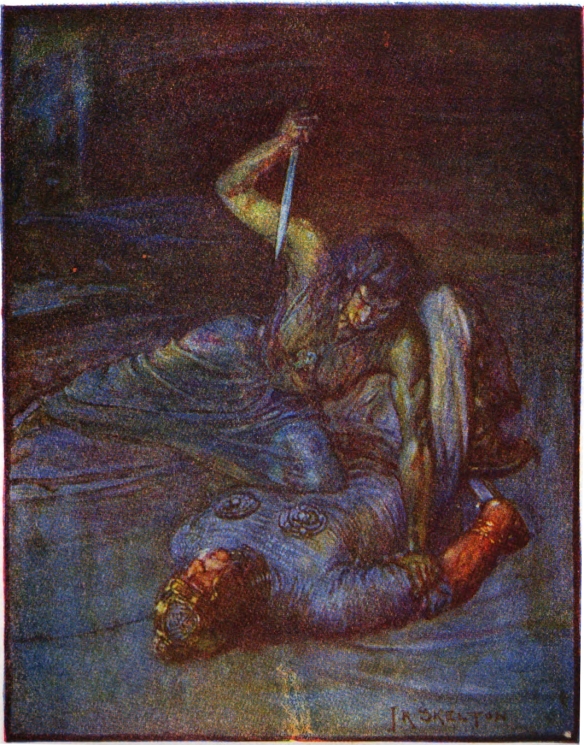
Grendel's mother menaces a pinned Beowulf with a knife.

By J. R. Skelton – Marshall, Henrietta Elizabeth (1908) Stories of Beowulf, T.C. & E.C. Jack, Public Domain, https://commons.wikimedia.org/w/index.php?curid=11001837

Back To Top
Synopsis

Hrothgar explains why Æschere was so dear, and faces the reality that now confronts his taken friend.

Back To Top
Translation

“Hrothgar spoke, protector of the Scyldings:
‘Ask ye not about the night’s joy; sorrow is renewed
to the Danish people. Æschere is dead,
Yrmenlaf’s elder brother,
my counsellor and confidant, my adviser,
my shoulder companion, when we at battle
were both at the fore, when we clashed with foes,
when the boar figures were struck. So should a man be,
a warrior who has proven his worth, so Æschere was!
This deadly creature came wandering to Heorot
to kill him by hand; I know not to what secret place
that terrible one slunk to turn him to carrion,
to make of him a gladdening feast.'”
(Beowulf ll.1321-1333a)

Back To Top
Recordings

Old English:

{Forthcoming}

Modern English:

{Forthcoming}

Back To Top
Beowulf: a Half-Assing Hero?

Hrothgar is laying it all out there. The warrior that Grendel’s mother carried off wasn’t just some thane or some hall dweller, but his dearest companion and, from the sound of it, his trusted long-time adviser. Of course, all of this comes across in Hrothgar’s relating how he and the man fought side by side in the heat of battle, as well as the statement that he “had proven his worth” (“ærgod” (l.1329)). This line is a bit difficult to swallow for me, though.

It sounds like Hrothgar might be calling Beowulf out here, only lightly and through implication, but still. Yet, hasn’t Beowulf also proven himself as a warrior in defeating Grendel? It sounds like the difference is that the foes that Hrothgar and Æschere beat in their heyday didn’t retaliate after a sound thrashing. But, being monsters (and yet, very human since she is motivated by grief for family), Grendel’s mother does so. I definitely get a strong sense that along with Hrothgar’s woe in losing Æschere there’s a sense that Beowulf did not entirely complete the job.

Sure, the Geat killed Grendel, but he didn’t manage to rid Heorot of its monster problem. Though, of course Beowulf and everyone else had no idea that Grendel had a mother, or a family.

In fact, leading up to his appearance, Grendel is only ever referred to as the “kin of Cain.” We’re never really told anything else about his other relations. It’s almost as if Grendel wasn’t born through sex and conception, but instead sprang fully formed from Cain’s murdering Abel; as if he himself is a physical manifestation of a terrible sin. One that would have a lot of resonance with people like the Anglo-Saxons because of their familiarity with stories like Hod’s killing his brother Balder. Though that is a story of accidental fratricide.

What do you think? Is Hrothgar about to lay into Beowulf for not realizing that Grendel’s mother would come crashing in on Heorot’s new “peace”? Or was Grendel’s mother a surprise to everyone and Hrothgar is struggling through his grief and shock to try to say “Beowulf, do it again!”?

Back To Top
Seeking Advice when faced with a Murderous Sprite

If you’re ever about to encounter a “wæl-gæst,” you’d likely want to get some advice. Why? Because running into a “murderous sprite” (from “wæl” (“slaughter,” or “carnage”) and “gæst” (“breath,” “soul,” “spirit,” “life,” “good or bad spirit,” “angel,” “demon,” “Holy Ghost,” “man,” or “human being”)) is no small thing.

You’d definitely want to go and seek a “run-wita.”

Such a person is someone who could be considered an adviser. After all, “wita” means “sage,” “philosopher,” “wise man,” “adviser,” “councillor,” “elder,” “senator,” “witness,” or “accomplice”); and run means “mystery,” “secrecy,” “secret,” “counsel,” “consultation,” “council,” “runic character,” “letter,” or “writing”. So such a person would be able to tell you much that is mysterious or secret.

Though your adviser should also be someone whom you could trust indefinitely because of the mysteriousness of your situation (how else can you be sure of their secretive information?).

So you’d want someone whom you could (or, hopefully already do) consider a person that you’ve been to shoulder to shoulder with before – whether it was in a tight shield wall formation on the battle field or it was waiting together in a packed line at some government office. The kind of person whom you could call an “eaxl-gestealla” with confidence, a person who indeed was a “shoulder-companion” (from the combination of “eaxl” (“shoulder”) and “steall” (“standing,” “place,” “position,” “state,” “stall (for cattle),” “stable,” or “fishing ground”)).

This sort of adviser would, in that way, be more than just someone giving you some pointers, they would be a veritable “ræd-bora.” That is, someone whom you consider a ruler (bora, or “ruler”) of wisdom (ræd (that is: “advice,” “counsel,” “resolution,” “deliberation,” “plan,” “way,” “design,” “council,” “conspiracy,” “decree,” “ordinance,” “wisdom,” “sense,” “reason,” “intelligence,” “gain,” “profit,” “benefit,” “good fortune,” “remedy,” “help,” “power,” or “might”)).

And, of course, given the fact that people might think you’re crazy if you come to them asking for help with a murderous sprite problem, your chosen adviser should be someone whom you knew was good at sharing tips from way back, or, as the Anglo-Saxons would say, was “ær-god.” This word comes from the combination of “ær” (“ere,” “before that,” “soon,” “formerly,” “beforehand,” “previously,” “already,” “lately,” or “’til”) and “god” (“good (of persons or things),” “virtuous,” “desirable,” “favourable,” “salutary,” “pleasant,” “valid,” “efficient,” “suitable,” “considerable,” “sufficiently great,” “good thing,” “advantage,” “benefit,” or “gift”) to mean “good from old times.”

With such an “ær-god” person on your team, you could definitely survive the quest to the murderous sprite and the “eft-sið,” or “journey back” (from “eft” (“again,’ “anew,” “a second time,” “then,” “thereupon,” “afterwards,” “hereafter,” “thereafter,” “back,” “likewise,” or “moreover”) combined with “sið” (“going,” “motion,” “journey,” “errand,” “departure,” “death,” “expedition,” “undertaking,” “enterprise,” “road,” “way,” “time,” “turn,” or “occasion”)).

Back To Top
Closing

Next week Hrothgar talks Beowulf.

You can find the next part of Beowulf here.
Back To Top

Hrothgar’s renewed sorrow, an Anglo-Saxon syllogism (ll.1302-1309)

Synopsis
Translation
Recordings
The Man Grendel’s Mother Seized
An Anglo-Saxon Syllogism
Closing

Back To Top
Synopsis

After a week off from the blog we return to the poet showing us how Hrothgar takes the news of Grendel’s Mother’s visit.

Back To Top
Translation

“Uproar burst forth from Heorot; in blood she’d seized
the best known hand; sorrow was renewed,
it had happened again in that hall. Their trade was harsh,
both parties had to pay a steep price
with the lives of friends. Hrothgar was now an old king,
a grey-haired battle-ruler, troubled at heart,
when he had heard his chief retainer was lifeless,
when he learned his dearest follower was dead.”
(Beowulf ll.1302-1309)

Back To Top
Recordings

Old English:

{Forthcoming}

Modern English:

{Forthcoming}

Back To Top
The Man Grendel’s Mother Seized

Since Grendel’s mother has left the poet returns his focus to Heorot itself. But, he does so only to find it awash in all of the emotions that Beowulf had supposedly rid it of. As the brief half-line 1303b has it: “sorrow was renewed” (“cearu wæs geniwod”).

That might sound like quite an extreme escalation, but it’s clearer than crystal that the man Grendel’s mother took was an important one.

First off there’s the word “ealdor-þegn” on line 1308. I’ve defined this word as “chief retainer,” but one of the definitions of the word “þegn” is “noble” with the clarification that it refers to nobles who are officially so rather than noble by birth. So, this man that Grendel’s mother carried off had truly distinguished himself in the past. We never have the details revealed to us, but he definitely must have done something great to be elevated to a status that’s referred to with a word that means, at least in a sense, “noble by deed rather than by birth.”

Though it is possible that this man was noble by birth and his deed only confirmed this status.

Nonetheless, another word that tells a lot about this man whose death has plummeted Hrothgar into the pit of despair is the incredibly straightforward “freond.” One of the few words that makes it from Old English to Modern English with little modification (aside from the simplifying of the dipthong “eo” into “e”), this word means in Old English what it does in Modern English: friend. It can also mean “relative” or “lover.”

But in the context that we find it here, “freond” refers to Grendel and this taken man.

Grendel is his mother’s son, sure, but what then is this taken man to Hrothgar?

Clearly he’s as close as family since his death causes Hrothgar to lose all the vigour he’d regained upon hearing of Beowulf’s triumph over Grendel. Maybe the two were even lovers, though there don’t seem to be many homoerotic undertones in the poem. Unless, of course, homo-eroticism was just something that happened when Beowulf was being put together and so the signals of it are subtler than I’m used to.

What do you think this taken man was to Hrothgar? Simply a noble friend and advisor? Someone as close as a brother? Or were the two men long-time lovers?

Back To Top
An Anglo-Saxon Syllogism

In this week’s brief passage, there’re only two compound words. So this week’s attempt to string its passage’s compound words together will be brief. And built on what I know of the Anglo-Saxon social hierarchy (which, admittedly, isn’t much).

Every “ealdor-þegn” is a “hilde-rinc,” but not every “hilde-rinc” is an “ealdor-þegn.”

I’ll explain.

The word “ealdor-þegn” means “chief attendant,” “retainer,” “distinguished courtier,” “chieftan,” or “chief apostle.” Since I don’t think the taken man in this passage was just an attendant, I’ve combined a few senses of this compound to translate it as “chief retainer.”

This word comes to its meaning through the combination of “ealdor” (“elder,” “parent,” “ancestors,” “civil or religious authority,” “chief,” “leader,” “master,” “lord,” “prince,” “king,” “source,” “primitive,” or, it could also mean “life,” “vital part,” “age,” “old age,” or “eternity”) and “þegn” (“servant,” “minister,” “retainer,” “vassal,” “follower,” “disciple,” “freeman,” “master (as opposed to slave),” “courtier,” “noble (official as distinguished from hereditary),” “military attendant,” “warrior,” or “hero”).

So the idea behind this compound is that it describes someone in the role of a follower/fighter who has distinguished themselves through long service. In fact, as mentioned above, such a person could even earn a noble standing, which, as far as I know, could be how new noble families got started.

The word “hilde-rinc,” a combination of “hilde” (“war” or “combat”) and “rinc” (“man,” “warrior,” or “hero”), means “warrior” or “hero.”

This word is much more specific, and I’m sure that “hilde-rinc” was sometimes used generally and sometimes used as an emphatic (think of someone today thinking they’re a writer when they’ve written something but they’re a writer when they’ve published something people are buying and reading).

These two are so closely connected because combat was one of the main arenas in which an Anglo-Saxon could show their worth. And, after having been through several combats, their advice (in matters of battle and politics, I imagine) would likely take on more and more weight.

Hence, every chief retainer is a warrior but not every warrior is a chief retainer.

War and battle were a pretty big part of Anglo-Saxon life, so it makes sense that experienced warriors were regarded as authority figures. But war and battle are the expertise of just a few today, so what do you think is the defining job of Western society that gives people authority just because they do that job for long enough?

Back To Top
Closing

In next week’s passage Beowulf is summoned and comes marching in to see Hrothgar.

You can find the next part of Beowulf here.
Back To Top

Wealhtheow notes her nephew, uses two crystalline compounds (1180b-1191)

Abstract
Translation
Recordings
Wealhtheow’s Nephew and Sons
Two Compounds in a Crystalline Speech
Closing

Back To Top
Abstract

Wealhtheow brings up Hrothulf in her speech to Hrothgar before she turns to her sons and Beowulf.

Back To Top
Translation

“‘I myself know
how gracious Hrothulf is, that he will defend
the honour of the youth, if you before him,
friend of the Scyldings, leave this world;
I believe that he will liberally repay
our two sons, if he recalls all the care we’ve given him,
the favour and honour* that we showed him
while he was a child** and still growing up.’
She turned then from the bench, there to where her sons were,
Hreðric and Hroðmund, and to the hero’s son,
all the youths together; for there the good man sat,
Beowulf the Geat, there between the two brothers.”
(Beowulf ll.1180b-1191)

Back To Top
Recordings

Old English:

{Forthcoming}

Modern English:

{Forthcoming}

Back To Top
Wealhtheow’s Nephew and Sons

Wealhtheow’s speech to Hrothgar ends here, and as such she turns towards the subjects of her next few words. This is a very obvious part of this passage, but I think it’s important to note because the connotation of her very properly keeping eye contact with Hrothgar while she addresses him underlines just how controlled and prim Wealhtheow’s speech here is (despite the revelry that’s just got to be continuing on around her).

But what’s here in her mentioning Hrothulf to Hrothgar is the acknowledgement that he is not directly related to either of them. I think that’s why she points him out as she does. Not to mention, it sounds like he’s probably a little older than the sons that she turns to at the end of this passage.

So how, exactly, is Hrothulf related to Hrothgar or Wealhtheow? He’s Hrothgar’s nephew by his sister Halga. Undoubtedly Hrothulf’s at Heorot to learn the ropes of being a member of the ruling part of society away from home. And, as such, Wealhtheow doesn’t need to give much detail when she says that he’s likely to protect her children as a away of repaying them for the care and honour they showed to him while he was growing up (and presumably still is). But so much hangs on his repaying this debt.

If Hrothulf was, in fact, raised well by these foster parents of his, then repaying them by taking care to teach their children will go without saying, and the two of them will be in good care, raised the way that Hrothgar himself and Wealhtheow herself would raise them, should either of them perish before the boys are grown.

As to why Beowulf is seated between Hrothgar and Wealhtheow’s sons, I’m not entirely sure.

On the one hand, I imagine it’s a seat of honour, definitely up near the front of the room.

But at the same time, I can’t help but wonder if it’s kind of like putting an esteemed guest at the kiddie table.

Not that that’s likely to keep Wealhtheow’s sons from sampling some of the wonderful brew that’s being spread around the hall as she speaks.

The best I can come up with for Beowulf’s placement in the hall is that his status as hero is assured and as ally is almost entirely certain, but not yet entirely locked down. Maybe it even shows how great the gulf was between those who had lived at a hall for much of their lives (Unferth, presumably) but hadn’t done many great deeds, and those who showed up, performed amazing feats of strength, and then are bound to head out again. After all, it wouldn’t do to give a seat of high honour or make them a councillor if they’re basically just passing through.

Getting back to the matter of Wealhtheow and Hrothgar’s sons, I think that Wealhtheow’s talking of Hrothulf and the poet’s mention of Beowulf being seated between the two boys, is supposed to emphasize that her sons are surrounded by positive models of masculinity. These boys have their father, their cousin, and this socially productive wayfarer. There could even be some subtext here about the heirs of Heorot being so well prepared that there’s absolutely be no way for them to screw it up and wind up with the hall destroyed because of betrayal and in-fighting.

Do you think there’s supposed to be some sort of joke in Beowulf’s being seated between Wealhtheow and Hrothgar’s sons?

Back To Top
Two Compounds in a Crystalline Speech

Because this part of Wealhtheow’s speech is so straightforward and plain spoken, there are just two compound words in it. It really does seem like they’re just part of bombastic speech — maybe even male speech — rather than the kind of clear-eyed toasting that Wealhtheow’s doing.

Likewise, the compounds that are used are fairly clear. Almost, in fact, to the point of having a kind of crystalline quality.

The first of these two compounds is from line 1186, “weorð-mynd.” This word means “honour,” “dignity,” “glory,” or “mark of distinction,” thanks to the compounding of “weorð” (“worth,” “value,” “amount,” “price,” “purchase-money,” “ransom,” “worth,” “worthy,” “honoured,” “noble,” “honourable,” “of high rank,” “valued,” “dear,” “precious,” “fit,” or “capable”) and “mynd” (“memory,” “remembrance,” “memorial,” “record,” “act of commemoration,” “thought,” “purpose,” “consciousness,” “mind,” or “intellect”).

Literally translated, “weorð-mynd” means “worth remembering,” an idea that transitions pretty easily into any of the compound’s meanings. But a literal definition that helps define “honour” a little bit. Those things that bring you honour being things that are worth remembering.

Which is a simple enough definition, though also very neutral since there can sometimes be horrible events or actions that are worth remembering so that they can be avoided or prepared against. But maybe this general sense of what’s honourable encapsulated in “weorð-mynd” feeds into a medieval way of thinking about memory and its effect on behaviour.

The basic principle I’m referring to here is the idea that what you memorized or filled your brain with — be it poetry, scripture, history, whatever — would influence how you thought and acted in your day to day life. So, memorize beautiful, god-fearing things and you’ll have an easy time enjoying the positives in life, but fill your memory with hatred and darkness and your life will be miserable, your actions terrifying. So, maybe “weorð-mynd” isn’t so neutral. Maybe, baked into the idea of honourable things being those things which are worth remembering is the idea that the best things to remember are those that are good and positive. In other words, it is best to remember honourable things.

The second compound word in this part of Wealhtheow’s speech isn’t quite as exciting. It’s the compound “umbor-wesende” and is found on line 1187.

This compound, quite enticingly given its weird verbiage, means “being a child.” But, its parts offer up only an anti-climax: the Old English word “umbor” means “infant”; and the Old English word “wesende” is a form of the verb “to be.”

So.

Entirely literally, “umbor-wesende” means “being a child” or “to be a child,” or maybe, in the right context, “having been a child.” There is, after all, a sense in the word that what you’re applying it to is no longer a child — their childhood has effectively ended and is behind them. Such must be the case with Hrothulf, not necessarily because of his age, but because he’s been raised with care and honour and is now expected to help do the same with his cousins.

Do you think that there’s anything to the idea that what you memorize or fill your brain with actually has an effect on your day to day life and behaviour?

Back To Top
Closing

Next week, Wealhtheow brings Beowulf a gift of gold.

You can find the next part of Beowulf here.

Back To Top

Danes and Frisians cool the feud, but compound words tell a different story (ll.1095-1106)

Abstract
Translation
Recordings
A Roiling Blood Feud
Compounds Tell a Story
Closing

Back To Top
Abstract

Hrothgar’s poet continues his recital. In this poem within a poem, Finn and Hengest conclude their peace treaty, including a mention of what will happen should the treaty be broken.

Back To Top
Translation

“Then they with trust their two halves together
secured in a peace treaty. Finn to Hengest
with ill-fated courage oaths swore
that he the survivors of the carnage would treat
honourably as his counsellors advised, that no man
there would by word or deed break the treaty,
nor through any artful intrigue complain of it.
All this though they were forced to serve the slayer
of their ring-giver while leaderless, to him necessity bound them;
though if any of those Frisians were to remind them of that
through boldly speaking of the blood feud,
then the sword edge should settle it.”
(Beowulf ll.1095-1106)

Back To Top
Recordings

Old English:

{Forthcoming}

Modern English:

{Forthcoming}

Back To Top
A Roiling Blood Feud

So 11 lines more and then we see the end of the negotiations between Hengest and Finn, between Dane and Frisian. There is some tension here, and it’s pretty clear that the Danes don’t want to have to sit and wait with the Frisians. But it’s still quite a mellow section of the poem as a whole. But perhaps that’s because this part of Beowulf is really reliant on knowing the history behind it.

Actually, without Hildeburh to relate to Grendel’s mother, or something else to relate to the main action of the poem, there’s nothing except history for us to really grab onto. Though we can definitely say with confidence that the “blood feud” (“morþorhetes” (l.1105)) between the Danes and Frisians that this treaty is supposed to quell will probably break out.

But maybe there’s something about the feud between Grendel and the Danes in there.

Without the historical context, but with the trope of the feud that’s gone on so long neither side can remember the reason for it, maybe the poet is telling this story to Hrothgar, Beowulf, and the assembled Danes and Geats as a kind of joke about the situation with Grendel. But to really get a handle on that we’ll need to see the conclusion of the poem first. If Dane and Frisian don’t bloodily clash in the poem’s final lines, but instead amicably part ways then this little diversionary poem is indeed mysterious.

But I don’t think the poet would include lines like 1107’s threat of any disputes with the treaty being settled with “the sword’s edge” (“sweordes ecg”) if this poem didn’t end with some sort of fight.

Anyway, the peace terms themselves (since that is what this passage of the poem is about), offer at least some insight into Anglo-Saxon culture. At least in terms of ideals.

Ideally, counsellors would be listened to, guests/hostages would be treated honourably lest a greater force come seeking to fulfill a renewed blood feud, and, ideally, those who don’t like the treaty are kept in line with the threat of harm or death. Which is kind of a funny way to enforce a peace treaty (I can’t help but visualize a parent snapping a belt as they say “now play nice – or else!” while standing over fuming siblings), but there you go. Though violence may have been the only deterrent, since I get the impression that Danes and Frisians didn’t have much in the way of trade. Plus, this is a treaty between two small sub-groups after all, not an out and out treaty between two entire peoples.

Also, it’s good to see that just who is who is cleared up. The slain ring-giver of lines 1102-1103 was the Dane’s. Even without the historical context for this story, the “them” of line 1104 suggests the Danes since it refers to the people that the Frisians are reminding, and since it’s just Danes and Frisians here, there’s no one else that “them” could refer to. Also, the poet singing this story is himself a Dane, so it makes sense that they’re the underdogs here (just as they were against Grendel, lending some weight to my idea that more than Hildeburh’s mourning relates this little story back to Beowulf at large).

So it sounds like the Danes are without a leader. But if one side’s leader remained, why not just envelop the weakened side while you hold the advantage?

Let me just take a quick look at Wikipedia’ entry on the this part of the poem (under the “Finnsburh Fragment” entry).

Ah. Here we go.

Hildeburh was Finn’s wife, and their marriage was meant to bring harmony between the Danes and the Frisians. So Finn, leader of the Frisians, obviously wanted peace. Hence, he makes a treaty with the Danes rather than just destroying them.

So Finn’s desire for peace is likely genuine (not unlike the well-meaning, but wrong-headed parent from a day dream a few paragraphs back). But that’s obviously not something that’s shared among the other Frisians, since any mention of the Danes serving their lord’s slayer is made punishable by death. And with good reason.

As poems like the Battle of Maldon make clear, loyalty to your lord was paramount in Anglo-Saxon society. So there could be no greater insult than to dishonour your former leader by turning around and working with his killer. Working with your lord’s slayer in any capacity – whether it was simply signing a treaty or running his errands – was the ultimate slander to your fallen leader because it suggests that he inspired no loyalty in those he lead. And, though it might’ve been fuelled by gifts of treasure, a true comitatus (or warrior band) was held together with loyalty. True warriors would stick with their leader no matter what, confident that in the end they would get their reward.

But Finn’s desire for peace doesn’t really clear up why the Danes are hanging around. Are they hostages? Are they trapped by winter’s icy water? Or is there something else keeping them?

I’ve already thrown in my guess that this peace treaty between the Danes and Frisians won’t last. Do you think it’ll make a difference and bring the two groups together, or that it will end in bloodshed?

Back To Top
Compounds Tell a Story

Because of the tension the negotiation between two bitter rivals in this passage, it’s full of compound words.

But what makes these compounds really stick out is that this passage’s compounds tell a story. Here goes.

On line 1096 we find the passage’s first compound word. This is the word “frioðu-wær,” which means “treaty of peace.”

Simply enough it comes from the words “friðo” (“peace,” “safety,” “protection”) and “wær” (“true,” “correct,” “faith,” “fidelity,” “keeping,” “protection,” “agreement,” “treaty,” “compact,” “pledge,” “covenant,” “bond (of friendship)”). So right there in the constituent words you can see the meaning of “peace treaty.” It’s just as straightforward as such a treaty should be.

But things thicken on line 1101. This is where “inwit-searo” is mentioned. This word, meaning “artful intrigue,” comes from the words “inwit” (“evil,” “deceit”; or “wicked,” deceitful) and “searo” (“art,” “skill,” “cleverness,” “cunning,” “device,” “trick,” “snare,” “ambuscade,” “plot,” “treachery”; as well as “work of art,” “cunning device,” “engine (of war),” “armour,” “war-gear,” or “trappings”).

So now we’re faced with a kind of “cunning evil” or “wicked snare,” perhaps the machinations of someone or some group against the peace treaty mentioned above. But what makes these machinations plot-thickening is that they aren’t direct. This isn’t a compound word for “fight” or “sword” but instead comes from a sense of malicious intelligence that has set pieces up only to knock them down in a clever way.

In fact, “inwit-searo” describes just the kind of act that could spark a “morþor-hete,” or “blood feud” like the one on line 1105. This word combines “morþor” (“deed of violence,” “murder,” “homicide,” “manslaughter,” “mortal sin,” “crime,” “injury,” “punishment,” “torment,” or “misery”) and “hete” (“hate,” “envy,” “malice,” “hostility,” “persecution,” or “punishment”).

So at its simplest, aside from “blood feud,” morþor-hete” could simply mean hate-fuelled murder, or any violent act with malicious intent. To my eye at least, the word itself even looks like it could mean the fog that someone gets into when they commit such an act, a “murder-heat” or maybe “murder-haze.”

Without knowing exactly what the big rivalry between Dane and Frisian was, I can’t say if these three compound words tell the probably forgotten origin of the feud between these two peoples. But it is rather neat to see the compounds lined up like this. It might just foreshadow this poem’s own end, but we’ll find that out in four weeks.

Blood feuds were a common problem in Anglo-Saxon society and the early medieval period in general. But, feuds continue to be a super popular idea in TV and movies. Why do you think we still tell stories about feuds?

Back To Top
Closing

Next week, following up on forging this peace, the poet turns to tell of the funeral for all those slain in the tragic combat of Frisian and Dane.

You can find the next part of Beowulf here.
Back To Top

Battlefield mourning and measured compound words (1071-1080a)

Abstract
Translation
Recordings
Two Mothers Mourning
Measured Compound Words
Closing

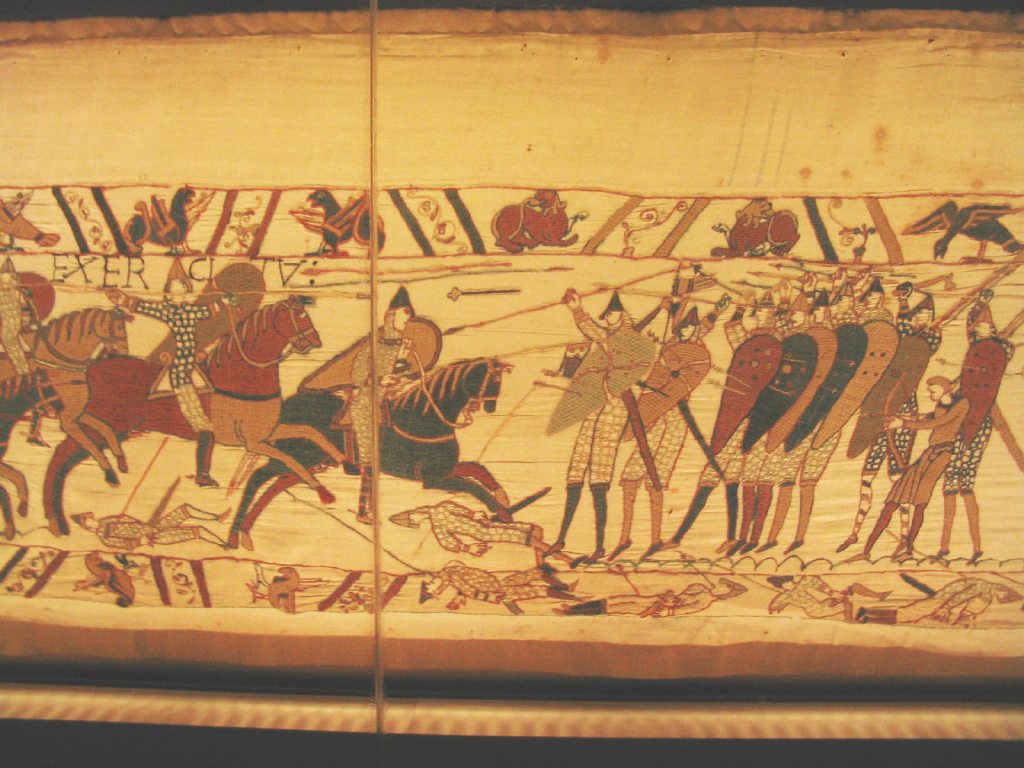
A section of the Bayeux Tapestry showing Anglo-Saxon warfare

Image found here: “Bayeux Tapestry 4” by photo by Gabriel Seah – gssq.blogspot.com. Licensed under Public Domain via Commons.

Back To Top
Abstract

Hrothgar’s poet begins a recitation of the story of Hildeburh, a woman in mourning.

Back To Top
Translation

“Indeed, Hildeburh had no need to praise
Jutish loyalty; guiltlessly she became bereft
of loved ones at the shield play,
of her son and of her brother; they were burdened
with ruinous spear wounds; she was made a mournful woman.
Not without reason was Hoc’s daughter
then fated to mourn, after morning came,
when she might under the sky see
the violent death of her kin, where they earlier
had held the great joy of the world.”
(Beowulf ll.1071-1080a)

Back To Top
Recordings

Old English:

{Forthcoming}

Modern English:

{Forthcoming}

Back To Top
Two Mothers Mourning

The most remarkable thing about this passage is that it’s coming from a woman’s perspective.

Hildeburh, the mother of a warrior, and sister to another, is, for some reason, near enough to the battlefield to go and see her fallen family the morning after a night battle. Her closeness suggests that this battle was probably a siege of some sort. If this is so, then she, distraught as she’s heard no word about her men, has left the city’s walls to see if she can find them herself.

Though it’s also possible that Hildeburh was along with the war party as some sort of supporter.

But I think that the line about “Jutish loyalty” (“Eotena treowe” (l.1072)) suggests that there’s been some treachery afoot, and so a siege is more likely. Or at least some sort of fortification.

Why?

Because when I think about treachery in what’s obviously some sort of war situation, I think of a betrayal that’s resulted in the fall of a fortification or castle that was hitherto impregnable. But Hildeburh’s exact situation isn’t important.

After all, the poet just launches into the story. This cold open likely comes from Hildeburh’s having been understood as a specific figure to the poem’s original audience. She’s someone who’s known to fit in with the context of the children of Finn and Hnaef Scylding, as mentioned in last week’s passage. So there’d be enough information for the poem’s early audience(s), but there definitely is not enough for us.

So, instead of trying to pull more information about the situation from this I just want to jump ahead a bit in the poem. After I’ve jumped back.

Grendel was defeated the night before the celebration at which this poet is singing. The monster’s arm was torn off, and he was left to wander, bleeding, back to his lair on the fens.

Later in the poem (about 200 lines from now) Grendel’s mother shows up to seek revenge for her son’s death.

I like to imagine that the poet’s giving us this episode from history (or common lore) about a woman going out to find her brother and son dead is supposed to parallel what Grendel’s mother is now doing (or has recently done) in the timeline of the poem.

As the Danes and Geats celebrate, Grendel’s mother is mourning. In the harsh light of dawn she’s found her son mangled and dead, having been dealt “ruinous/…wounds” (“hruron/…wunde” (l.1075-1076)). And so I can’t help but think that this part of the poem, a different version of the story found in the “Finnsburh Fragment,” is supposed to be showing us the other side of Beowulf’s great victory.

Grendel, to the Danes, and to the Geats who came to stop him, was monstrous. But Grendel is nonetheless the “kin of Cain.” He’s monstrous and some sort of abomination in the eyes of god, but he still has a family – a mother. And now that mother is grieving, angry.

But her rage comes out 200 lines down the road. Right now we just have Hildeburh. Who, even on her own, makes a curious statement about all of the war and violence in the poem so far. Showing the mourning side of battle adds the dimension of empathy for the fallen and their living relations that up to now hasn’t really been that big a deal.

But now we get to see just how that empathy plays out as Hildeburh’s part continues.

What do you make of a battle-celebrating poem like Beowulf‘s having a character mourn those freshly lost in battle? Is it a balancing element, just a token inclusion, or something else entirely?

Back To Top
Measured Compound Words

This is definitely a passage about battle. Though it’s coming from the side more familiar to most of us – that of the spectator, the person who doesn’t fight but has to live with what comes of fighting. Nonetheless, there are quite a few compound words used here, considering the length of the passage.

What’s particularly notable about these compound words, though is that their use is fairly measured.

For instance, the poet doesn’t throw down a few compounds for the same thing or concept in short succession, nor do these compounds appear in parenthetical clauses that aren’t really part of the passage’s main ideas.

In fact, in this passage, the compound words generally are the main ideas of the sentences, or at least integral to understanding those ideas. I think this measured use suggests a more focused sort of intensity than that which we’ve seen when the poet is simply slamming down compounds. But let’s take a look at these words.

On line 1073 we’re given “lind-plegan,” an innocent sounding word for “battle” that literally means “shield play” (since it combines “lind” (“shield (of wood)”) and “plegan” (“quick motion,” “movement,” “exercise,” “play,” “festivity,” “drama,” “game,” “sport,” “battle,” “gear for games,” or “applause”)).

This word is used for alliteration, but I think it’s also a reference to the sort of close combat that Beowulf and Grendel engaged in just some 300 lines ago.

Next, on line 1077 “metodsceaft” appears. This one means “decree of fate,” “doom,” or “death” and comes from the mix of “metod” (“Measurer,” “Creator,” “God,” or “Christ”) and “sceaft.”

It’s tempting to read the “sceaft” in “metod-sceaft” as the usually prefix-less “sceaft” meaning “staff,” “pole,” “shaft,” “spear-shaft,” or “spear.” I mean, this reading gives us a word that would mean something like “the spear of God,” an apt sounding metaphor for fate. Not to mention taking this compound to mean “spear of God” sees Hildeburh suffering the same sort of wound that killed her brother and son. But, I don’t think that pre-fix resistant “sceaft” is the word meant here.

Instead, there’s a similarly written word that does take prefixes, “sceaft” (“created being,” “creature,” “origin,” “creation,” “construction,” “existence,” “dispensation,” “destiny,” “fate,” “condition,” or “nature”). When this word combines with “metod,” we get the much clearer “God fate,” or “decree of fate” (extrapolated from “Measurer of fate”). Though I’m not sure what the mixture of a name of god and a word for “creature” or “fate” really implies in Old English.

Finally, the third compound word in this passage goes in for emphasis rather than some sort of new concept. The word “morthor-bealu” is already implicit in the two men dying from spear wounds, as it means “violent death,” or “murder.”

And breaking down “morthor-bealu” doesn’t do much to make the word’s implications less violent. On its own, the word “morthor” means “deed of violence,” “murder,” “homicide,” “manslaughter,” “mortal sin,” “crime,” “injury,” “punishment,” “torment,” or “misery”; while the word “bealu” means “bale,” “harm,” “injury,” “destruction,” “ruin,” “evil,” “mischief,” “wickedness,” “malice,” “a noxious thing,” “baleful,” “deadly,” “dangerous,” “wicked,” or “evil.” So we’re left with a double whammy of “murder” on the one hand and “destruction” on the other. It’s definitely a compound word that connotes inescapable violence.

But, just in case we weren’t sure about the fate of Hildeburh’s kin, we’re told through “morthor-bealu” that they met a “violent death” or “murder,” suggesting that even within the realm of warfare, their deaths were particularly grisly. Unless the poet, along with keeping up with alliterating, also wanted to give us a sense of the shock and horror that Hildeburh is likely feeling when she sees them in the dawn’s light, rather than the stoic male perspective we’ve seen the poem through up to this point.

All three of this week’s compound words alliterate with the major sound in their lines (“lind-plegan” with “l”; “metod-sceaft” with “m”; “morthor-bealu” with “m”). Do you think that’s important at all?

Back To Top
Closing

In the next passage we’ll find out what happens in the aftermath of the battle in which Hildeburh lost her son and brother.

You can find the next part of Beowulf here.

Back To Top

One word with two meanings, and two words all about swords (ll.1030-1042)

Abstract
Translation
Recordings
Protection and Aggression
The Wicked Cravings and the Names of Swords
Closing

An example of a 9th-10th century Anglo-Saxon sword

Back To Top
Abstract

The poet describes the helmet Beowulf’s given in more detail. And we see Hrothgar hand over eight horses — one of which is quite special.

Back To Top
Translation

“Around the helmet’s protective top there
was a wire-wound ridge to keep the blows out,
so that its wearer would not be imperilled
by the battle-hardened sword’s bite, when the wicked
craving comes over the blade.
The lord then ordered a man to draw eight mares
with gold-pleated bridles into the hall,
within Heorot’s bounds; among them one stood
with a saddle skilfully coloured, a worthy treasure.
That was the very battle seat of the high king,
the place in which the son of Halfdane rode forth in
to make the battle even; never was he in
wide-known wars laid low, when the ridge was overthrown.”
(Beowulf ll.1030-1042)

Back To Top
Recordings

Old English:

{Forthcoming}

Modern English:

{Forthcoming}

Back To Top
Protection and Aggression

The poet must’ve gotten excited about the mention of the four treasures Beowulf’s given or for the opportunity to weave more words about war, because this passage is particularly rich. Despite that, I’m just going to focus on one word.

In line 1031 “walu” appears in reference to the helmet that Beowulf was given. As part of the description of this wondrous bit of headgear, the “walu” is understood as a kind of ridge which sounds like it gives a little bit of extra protection from blows. That it’s wound about with wire suggests that maybe part of this protection comes from the tightness of the bunched up wound wire in much the same way that a properly wrapped turban is supposed to protect from the downward slice of a sword. Though the wire and the ridge must be working with the basic metal hat-ness of the helmet to begin with.

Anyway, the point is that this first use of “walu” is used to refer to the helmet’s extra protective properties. It’s not just any old helmet, but one that’s specially designed to protect your head in the heat of battle (beautifully expressed as “when the wicked/craving comes over the blade” (“þonne scyldfreca/ongean gramum gangan scolde” (l.1033-1034))).

This instance of “walu” also alliterates with line 1031’s “wirum” and “bewunden.” In fact, as the first word after the caesura, “walu” bridges the two half lines, making (at least to my ear) for a faster paced line when it’s spoken.

The second instance of “walu” comes in on line 1042. Here the word takes on two meanings.

First is the geographic sense that Clark Hall and Meritt provide with their definitions of the word as “ridge,” or “bank.” I understand that this definition fits the line’s meaning because a ridge or bank could easily be the strongest part of an enemy’s (or your own) line in battle, and so the spot likely to have the most intense fighting. Even if it wasn’t the strongest, a ridge would certainly be a spot that a military force primarily made of infantry would want to capture. After all, fighting uphill is much more difficult than downhill when you’re mostly engaging in mêlée combat on foot. So, again, a ridge would likely be among the most intense sites during a battle.

The other possible meaning of “walu” (both Clark Hall and Meritt and C.L. Wrenn consider a secondary meaning, referring to the word “wael”) is “slaughter” or “carnage.” I think that this interpretation has a similar meaning, it’s just much more direct about it and there’s no subtext of why there’s slaughter or carnage.

But whatever the precise meaning of “walu” in line 1042, it’s possible that it’s also here for the purpose of alliteration. The line starts with “wid-cuþes wig” and then “walu” is the second word after the caesura, so it bridges the two parts of the line a little less strongly than in line 1031, but does so all the same.

But even though both instances of the word alliterate, and the second “walu” is possibly just a scribal error or variation for “wael,” I find its double duty in this passage interesting because of what the echoing of “walu” with its very disparate uses suggests.

The first appearance of “walu” refers to protection — specifically protection on the battle field. There’s the sense that the helmet that it’s describing provides extra protection, but hidden in there is also the sense that a ridge is a fairly safe place in a medieval battle (or so I’d guess — being higher ground and all that — arrows not withstanding). But then, on line 1042 the same word is used to denote a place that lacks safety both because it’s a hot spot during battle (definitely a place where the “wicked/craving comes over the blade” (ll.1033-1034)) and because in the context of the poem it refers to the spot where the celebrated Hrothgar is rampaging.

So “walu” is used in practically opposite ways within the same passage — within 12 lines even, and I think that this is at least the scribe trying to throw in a micro-commentary about war. Namely that war is only ever safe for the victors, but that those victors imperil themselves in the process of winning both physically (usually having to fight through the toughest spot) and also spiritually since they gain a fearful reputation for cruelty on the battlefield. It’s not as heavy handed as you might expect from a medieval Christian scribe writing out a pseudo-pagan poem, but I think it’s there.

But what’s your take on this? Is “walu” used twice just because it sounds good or is easy to alliterate with a lot of words? Or is there something about war being said here?

Back To Top
The Wicked Cravings and the Names of Swords

I haven’t been formally recording or watching the instances of compound words since wondering if there’s any sort of pattern a few posts ago, but I think it’s safe to say that war equals compounds. Something about the heat of combat or the rhythm that the poet felt was needed in verses about fighting just seems to require compound words. This passage is full of them.

They range from the simple like heafod-beorge (a mix of heafod, meaning “head,” “source,” “origin,” “chief,” “leader,” or “capital”; and “beorge” meaning “protection,” “defence,” “refuge,” or “mountain,” “hill,” “mound,” “barrow,” or “burial place” that means “prominent hill”) to “faeted-hleore” (mixing faeted “ornamented with gold” and hleore’s “cheek,” “face,” or “countenance” to mean “with cheek ornaments”) which describes the horses to things like “hilde-setl” (“war, combat” and “seat,” “stall,” “sitting,” “place,” “residence,” “throne,” “see,” “siege,” meaning “saddle”).

There’s also “heah-cyninges” (meaning “high king,” or “God” — a mix of “heah,” meaning ” high” “tall,” “lofty,” “high-class,” “exalted,” “sublime,” “illustrious,” “important,” “proud,” “haughty,” “deep,” “right (hand)” and “cyning” meaning “king,” “ruler,” “God,” “Christ,” or “Satan”) and wid-cuþes (simply “widely known,” or “celebrated” from “wid” (“wide,” “vast,” “broad,” or “long”) and “cuþ” (“known,” “plain,” “manifest,” “certain,” “well-known,” “usual,” “noted,” “excellent,” “famous,” “intimate,” “familiar,” “friendly,” or “related”)).

But two of the compounds encountered in this passage stand out — even from the usual crowd of compounds I’ve been coming across lately.

The first of these is “scyld-frecu” from line 1033. This word takes “scyld,” (which means “offence,” “fault,” “crime,” “guilt,” “sin,” “obligation,” “liability,” “due,” “debt”; or as “scield”: “shield,” “protector,” “protection,” “defence,” “part of a bird’s plumage(?)”) and combines it with “frecu” (meaning “greedy,” “eager,” “bold,” “daring” or “dangerous”; or as “freca”: “warrior” or “hero”) to come out with “wicked craving.”

At first glance this looks like a logical combination, a word for “sin” and a word for “greedy” — you’ve got all the necessary parts. But then “frecu” could mean “warrior” or “hero” if it’s read as “freca.” A stretch perhaps, but synonyms and puns are wordplay staples in Modern English, so there must’ve at last been some awareness of these uses of language in Old English.

Take the name “Heorot” itself for instance. It sounds like the Old English term for a stag (“heort”) and also the term for the centre of human feeling (and thought as well, according to some classical natural philosophers), the “heorte.” This three way meeting of meanings can’t just be coincidental. That’s why I see something curious in the “freca” connection to “scyld-frecu.” (Not to mention it sounds an awful lot like this compound could simply mean “shield man”…and maybe it does — but that’s the beauty of poetry!)

So perhaps there’s a connection between the “greedy craving” which you could simplify to “bloodlust,” and being a warrior or hero. This could be acknowledgement of the cost of working in either of these roles.

But as a compound word “scyld-frecu” is completely overshadowed by “scur-heard.”

This compound is completely new to me, and possibly of a type that’s rare even in Beowulf. As Clark Hall and Meritt explain in the entry, this word means “made hard by blows (an epithet for a sword).”

So this compound word doesn’t just bring two terms together to create some other word, it’s an epithet for a sword. The Anglo-Saxons were so into swords that it wasn’t enough to have almost as many words for them as the Inuit have for snow, they had to also have words that were recognized as names for swords — not just words to refer to them (like “hildebill” or “gramum”).

But I digress, the parts of “scur-heard” are “scur” (“shower,” “storm,” “tempest,” “trouble,” “commotion,” “breeze,” or “shower of blows or missiles”) and “heard” (“hard,” “harsh,” “severe,” “stern,” “cruel,” “strong,” “intense,” “vigorous,” “violent,” “hardy,” “bold,” “resistant,” or “hard object”).

So literally read, you could take this one to mean something like “hardened in the shower of blows” or even “violent amidst the many blows.” On the one hand, maybe this is just referring to swords in general. Or. Maybe it’s referring to things a little more broadly. Maybe this is even evidence that the Anglo-Saxons attributed actions or personalities to swords.

Calling a sword (or swords in general) “hardened in the shower of blows” definitely makes me think that some of the power and agency of the sword in question are taken away from the wielder and given to the sword itself. Perhaps this denotes the Anglo-Saxons foisting something like “luck,” or even the intense violence of battle, off on the sword itself.

Or, maybe “scur-heard” contains the sense that the sword is so keen (being modified by that “wicked craving,” remember) that it’s just doing the work of slashing and parrying and drawing away attacks on its own. Perhaps the name’s a hint at an early longing for an inanimate object with a mind of its own.

Sounds crazy, perhaps. But legends and stories of magicians and mystics bringing statues to life (Jewish stories of the golem, the Greek myth of Pygmalion) go back quite a ways into recorded history.

If you could give an inanimate object life, or foist some characteristic of yours off on one (and not be thought crazy) what object would you choose?

Back To Top
Closing

In the next post’s passage, Hrothgar formally bestows these gifts and horses on Beowulf. And the poet comments.

You can find the next part of Beowulf here.

Back To Top

The difference between a son and a sword, functional and fantastical compound words (Beowulf ll.1020-1029)

Abstract
Translation
Recordings
Hrothgar as Son or as Sword
Four Functional Compounds, One That’s Nuanced
Closing

Back To Top
Abstract

Beowulf is given four gifts and the poet says that he’d never seen or heard of anyone receiving such gifts ever before.

Back To Top
Translation

“Then to Beowulf the sword of Halfdane
gave as reward a golden banner of victory,
an ornamented battle banner, helm and byrnie;
a famed treasure sword that many in prior times
had seen a hero use. Beowulf became very
feted on that floor; he felt no need there
to be ashamed for the largesse shown before the warriors.
Never have I heard of a friendlier gift
of four gold-adorned treasures from
such a great man in any other ale hall.”
(Beowulf ll.1020-1029)

Back To Top
Recordings

Old English:

{Forthcoming}

Modern English:

{Forthcoming}

Back To Top
Hrothgar as Son or as Sword

Some of you probably think that all of these commentaries making mountains out of molehills. The tiny nuances of a language long dead can hardly hold any meaning that could possibly be relevant to today, and to try and draw meaning out of Beowulf is like trying to get water from a well that’s been dry for years.

But poetry is poetry. When it’s read all the meaning packed into it comes out. Old poetry’s just in need of a few drops of water to restore it, like something dried out to preserve it. And this entry’s passage practically makes its own sauce once you’ve added a few drops of water. Because this entry’s passage is the site of a decades long controversy.

In line 1020, we’re told that “the sword of Halfdane” (“brand Healfdenes”) is the person who gives Beowulf the gifts featured in this passage. Or is it “the son of Halfdane” (“bearn Healfdenes”)? Seamus Heaney’s text (published in 2001) uses the latter reading of the original manuscript, while C.L. Wrenn’s somewhat older version (published in 1958) goes with the former.

Now, I’m not about to dive into a mess of orthography and manuscript analysis because I don’t think I’m qualified to do so after so much time away from formal academia. But I am going to point out one major thing about this discrepancy.

It’s a small detail, but whether the poem refers to Hrothgar as “the sword of Halfdane” or “the son of Halfdane” makes a big difference in the matter of the passage’s tone.

As the word “feoh-gift” (which I’ve translated as “largesse” (l.1026)) signifies, this is a very important giving of gifts since there’s a sense of a strong bond being formed (akin to marriage – then still primarily a business/financial matter more than one of love, so there’s a sense of legality, or formality here). But whether it’s “the son of Halfdane” — his heir and descendant — doing the giving or “the sword of Halfdane” — his general and foremost warrior — tells us about the nature of that bond. I think. If we take the reference to be to Hrothgar’s being the son of Halfdane, then the bond seems much more familial, as if Beowulf is being welcomed into the family of Hrothgar, whatever that might involve. At the very least, you’d think that a family would be closer than something like a war chief’s comitatus.

Also, if you read the reference to Hrothgar as “the son of Halfdane,” then the bond the gifts signify seems to be more one of strengthened trust than anything else. Beowulf was entrusted with the hall — was legally made its owner — over the course of the night and he handled it well. So he’s proven that he can measure up to his word, and as such can be trusted.

But, if Hrothgar is supposed to be the sword of Halfdane here, then it paints the giving and the bond that comes with it as something that’s much more martial. Hrothgar could be seen as one making a political alliance with a figure that has proven himself strong beyond belief and definitely a force that you wouldn’t want to face in battle. So the four gifts given by the sword of Halfdane become the basis of an alliance of Beowulf (and by extension, the Geats) with Hrothgar. Perhaps this bond is even a continuation or renewal of the older man’s relationship with Beowulf’s father.

Actually, these two readings leave us with a kind of dichotomy. On the one hand the martial alliance is made perhaps out of fear or calculation, while on the other the familial bond comes from something more personal and made out of respect and trust.

Figuring this out would be much easier, I think, if the “jewelled sword” of line 1023 were a little more specific. At least in so far as it’s the most described treasure, so if we knew if it was practical or just decorative could lend itself to either reading.

Given what Beowulf’s done for the Danes up to now, which do you think makes more sense – Hrothgar bringing Beowulf into the family, or Hrothgar making a more formal political alliance with Beowulf and the Geats?

Back To Top
Four Functional Compounds, One That’s Nuanced

One of the things that makes poetry interesting is variety. Whatever the frequency of compound words might mean, Beowulf just wouldn’t be as interesting if there was a very obvious pattern to them; like if the poet always used complex compounds while characters like Beowulf and Hrothgar only did so while boasting. This passage spoken by the poet keeps the use of compounds fresh since it’s got a mix in it that leans more to the simpler side.

First up is line 1022’s “hilde-cumbor,” a “war banner” and one of the gifts given to Beowulf. This compound is a straight up combination of the words “hilde” (“war,” or “combat”) and “cumbor” (“sign,” “standard,” or “banner”) that means exactly that: a “war banner.” Not much to say here since this is very much a compound of function.

Once again, the poet throws words together simply because the poet can on line 1023. The word “maðþum-sweord” is another compound of function since its meaning of “costly sword,” or “ornate sword” comes pretty directly from the combination of “maðm” (“treasure,” “object of value,” “jewel,” “ornament,” or “gift”) and “sweord” (“sword”). Now, which of the meanings of “maðm” you go with can determine the sort of import of the sword in question, but there’s not a lot of wiggle room in interpreting this word. Maybe reading this compound as referring to a “gift” sword is the same as considering it a “jewelled sword” or a “treasure sword.” After all, praiseworthy gifts are often decked out.

Now, line 1026’s “feoh-gift” is where this passage’s words get interesting. On its own, the word “feoh” means “cattle,” “herd,” “movable goods,” “property,” “money,” “riches,” or “treasure,” and the word “gift” means “gift,” “portion,” “marriage,” “gift,” “dowry,” “nuptials,” or “marriage.” So this compound definitely refers to a very valuable gift, but the heavy implication of a bond as strong as marriage makes anything called a “feoh-gift” more than just trinkets exchanged because of a job well one. These gifts are meant to seal a bond between Hrothgar and Beowulf, to somehow ally them. So this word is quite well chosen.

Then line 1029 sends us right back to the obvious compounds with “gum-manna.” Both “gum” and “man” mean “man” and so “gum-manna” means “man.”

But, given the word’s context, the poet uses “gum-manna” to suggest that these men are exemplary. That they’re shining examples of what a man should be. That’s the sort of emphasis that word doubling usually lays on a thing in Old English, after all.

Which brings us around to a compound that’s neat for unexpected reasons. This is 1029’s “ealo-benc,” meaning “ale bench.” This compound, unsurprisingly, comes from combining the words “ealu” (“ale,” or “beer”) and “benc” (“bench”) together. What makes it neat, though is that the poet hangs quite a bit of meaning on this word. Either the poet’s using a single ale bench as a metonymy for all halls everywhere, or the poet’s getting super specific and saying that he’s never heard of anything like this happening on any ale bench – ever.

Which do you find more interesting, practical compounds like “hilde-cumbor” or more nuanced ones like “feoh-gift”?

Back To Top
Closing

In the next entry, the gift giving continues as Hrothgar hands over some more gear and a few horses.

You can find the next part of Beowulf here.

Back To Top

Foreshadowing history, words with secrets (ll.1008b-1019)

Abstract
Translation
Recordings
The Poem gets Historical
Words with Secrets to Unlock
Closing

Wealhtheow serving Hrothgar

Back To Top
Abstract

It’s party time in Heorot once again, though the poet reminds us that this high hall won’t be standing high forever.

Back To Top
Translation

“Then came the due time
that Hrothgar’s son come to the hall;
and Hrothgar himself would come to enjoy the feast.
I have no need to ask if ever a greater group of assembled peoples
has gathered around their revered ring-giver.
The renowned then bowed onto the benches,
filling them with joy; they tore into the fare
and went round after round through cups of mead,
becoming bold minded, in that high hall,
Hrothgar and Hrothulf among them. Within Heorot were
many friends; not at all was treachery
yet made amongst the Scyldings.”
(Beowulf ll.1008b-1019)

Back To Top
Recordings

Old English:

{Forthcoming}

Modern English:

{Forthcoming}

Back To Top
The Poem gets Historical

Okay, so the big thing to take away from this passage is that Heorot has been restored to normal! Huzzah!

But, the Anglo-Saxons must’ve collectively been a Taurus because as soon as the poet establishes that everyone’s enjoying the feast and slugging back mug after mug of mead he decides its time to foreshadow how Heorot meets its ultimate end. He decides that it’s time to lay some history on us. Though only in a way that people who’d have been incredibly familiar with their history (perhaps in the same way that Americans are familiar with their history) would understand it.

After all of this talk of friendship and happiness, even of a level of comfort that allows Hrothgar to bring out his son and heir Hrothulf, the poet says “not at all was treachery/yet made amongst the Scyldings” (“nalles facenstafas/þeodscyldingas þenden fremedon” (ll.1018-1019)).

This passage and even the one about death from last week, but to a lesser extent, really make it seem that these parts of the poem are all about relating to the very specific audience that Beowulf would’ve been initially performed for. Not even written down for (that’s a totally different kettle of fish) but written down for. People who knew about the history of Heorot and the Scyldings.

So what?

Well, it means that this poem must’ve been written a fair bit after all of this stuff happened with the Scyldings. Long enough for it to have become part of the historical record, but not so long before that it would’ve been forgotten. Though I get the feeling that by the time Beowulf was completed (likely as an oral performance piece), this bit of history had passed into legend to some degree. That it was the stuff of Geoffrey of Monmouth’s History of the Kings of England. So it was historical in that it happened some time before the writer/performer lived, but as factually accurate as our stories of Arthur and his knights. Things have been muddied. But then maybe that’s why the poet goes for a vaguely prophetic sort of reference to these future hardships here. Instead of diverting the audience’s attention away from the story that’s being woven over these 3182 lines, the poet’s instead just riveting the story down into the realm of past facts, of history, with references like this one.

In another form of speaking of the future, the poet trots out Hrothulf here. I think Hrothgar might’ve referred to his son earlier, but this is the first time that we see him mentioned by name. I take this action of Hrothgar’s as a sign that he believes the hall is truly saved, and that the Danes’ troubles are over at last. So the young prince, his heir and successor, can come to the hall without any tragedy befalling the Danes.

Getting back to the reference to history, though, I find it interesting that the poet just says that the hall was full of friends and that treachery wasn’t there quite yet. Putting it like that makes it sound like treachery itself is a guest that wouldn’t visit just yet, and that Heorot would host some wild parties before treachery comes calling to totally destroy Heorot later. It seems like treachery is just another house guest.

I feel like this sense of future ruin is a lot of the Norse influence on Anglo-Saxon culture coming through, since sagas of great families falling into ruin account for quite a few of the older legendary ones we still have. There’s definitely not just a sense that whatever goes up must come down but that nothing great lasts because this is a world of change, set below the influence of the ever changing moon and not within what later poets would refer to as the immutable heavens.

Couched within a story that’s very much about a culture shifting from non-Christian to Christian what could such a reference to the fall of a great house mean? Maybe the poet and the others along with them thought that this limit to great things, great families, extended to religion, and believed that just as the Germanic religions gave way to Christianity someday Christianity would also wane? Who knows?

Isn’t literature great?

Back To Top
Words with Secrets to Unlock

The two (yep, just two) standout words from this entry’s passage are “blæd-agende” and “facen-stafas.”

The first of these, coming to us on line 1013, is a combination of “blæd” (“blowing,” “blast,” “inspiration,” “breath,” “spirit,” “life,” “mind,” “glory,” “dignity,” “splendour,” “prosperity,” “riches,” or “success”; or it’s a form of the word “bled” meaning “shoot,” “branch,” “flower,” “blossom,” “leaf,” “foliage,” “fruit,” “harvest,” or “crops”) and “agende” (“owner,” “possessor,” “master,” “lord,” or “the lord”).

Even with its second possible meaning as “bled,” the word “blæd” is undeniably a word of great prosperity (that is, in fact, even one of the original word’s senses). So it’s not very surprising to see that combined with the Old English word for things like “owner” and “master” we get a word that means “renowned.” Such a person is a lord of inspiration, or dignity, or splendour, or success – take your pick, they all really boil down to the same thing: a thing to be renowned for. Though we could get into chicken and egg questions here in that are these people renowned for the splendour that they’ve built up or are they renowned for having reached such a level of success? It’s hard to say from this compound word alone.

The second word has its own secrets to unlock.

The word “facen-stafas” as a combination of “facen” (“deceit,” “fraud,” “treachery,” “sin,” “evil,” “crime;” “blemish,” or “fault (in an object)”) and “stæf” (“staff,” “stick,” “rod,” “pastoral staff”; or, when “stæf” is in the plural form, as it is in this passage, it usually means “letter,” “character,” “writing,” “document,” “letters,” “literature,” or “learning”) curiously means “treachery” or “deceit.”

Obviously the Anglo-Saxons respected the intelligence required for a good bit of intrigue (and if the continuation of the mystery genre of storytelling in the northern parts of Europe’s anything to go by, they still do) since this word essentially combines the idea of treachery with some sense of command, of having power over it as represented by the image of the pastoral staff, or by the control required for things like writing, letters, or literature.

What’s more, the word “stæf” is a part of another compound word, “stæfcraft,” meaning “grammar” or “learning.” So, somewhat unsurprisingly since education still followed the classical model of literally beating concepts into students through corporal punishment and rote memorization, that same staff which I think stands as a controlling influence in “facen-stafas” is essential to learning the basics in a classical education. But this association doesn’t just buttress the idea that “stafas” in this compound refers to some sort of control through intelligence, it builds on the idea that treachery was respected (at least in some way) inherently in Anglo-Saxon culture. Maybe not on the surface, there’s probably no epic poem about a liar who makes their way to the top (unless those lies are stories) left for us to find, but definitely under it. Maybe it could stem from an interest in gossip since rumours are often convoluted and largely constructed to falsely damage reputations at some point over their lifespans.

Do you think it takes a smart person to be successfully treacherous? Or does treachery depend on a trait other than smarts?

Back To Top
Closing

Next up, Beowulf is rewarded for his victory over Grendel with some shiny new armour – which he does not equip at all over the course of the poem. So far as we see, anyway.

You can find the next part of Beowulf here.
Back To Top

Thanks given to Beowulf’s mother, words nuanced but simpler than others (ll.942b-956)

Abstract
Translation
Recordings
Beowulf’s Mother, Divinity
Simple Words Hide Complexity
Closing

Beowulf, Old English, Anglo-Saxon, translation

Back To Top
Abstract

Hrothgar’s speech of thanks continues as he praises Beowulf’s mother and then strengthens his ties with Beowulf.

Back To Top
Translation

“Indeed let those who may say
even to such a woman, who gave birth to such a son
among the human race, if she yet lives,
that the god of old was gracious to her
in her child-bearing. Now I, Beowulf, accept you,
best of warriors, shall see you as a son
in heart and in hand; keep well this
new kinship. And be thee never wanting for
any desirable thing in the world, that I have power to give.
Quite often I’ve given rewards for less,
honouring with gifts men more lowly,
weaker in battle. You yourself have
done this deed, that thy fame may
endure well into the future. The Ruler of All
reward you with good, as it has to now done!”
(Beowulf ll.942b-956)

Back To Top
Recordings

Old English:

{Forthcoming}

Modern English:

{Forthcoming}

Back To Top
Beowulf’s Mother, Divinity

Hrothgar’s speech gets a little more florid now, as he continues to not thank Beowulf. Though, instead of thanking a deity, he thanks Beowulf’s otherwise unmentioned mother. We know that the hero’s father is Ecgtheow, and we can guess his mother is a Geat woman, but we’re never told so and we’re never given her name. Yet Hrothgar thanks her here, after he’s thanked god for getting the deed done.

Now, it’s possible that Hrothgar’s just following a formula here. Maybe the Anglo-Saxons went from god to the family tree to the person themselves when giving praise, but even for an Old English poem it seems very formal. Though, it does tie in rather nicely with the Christian colourings that this poem has. After all, the father, the mother and the son are essential figures in Christianity. So maybe this formulaic thank you is just another finger print of the monks or scholars that wrote Beowulf down. Though what exactly is said when Hrothgar thanks Beowulf’s mother?

Well, Hrothgar starts off with the condition that those who “may say” (“secgan maeg” (l.942)) what follows say it. I think the idea here is that those who are thankful should thank his mother for having him as a son. Next, Hrothgar delivers the subject of this part of his speech in his usual interconnected clause manner. And then he gets to the meat of his praise when he says “the god of old was gracious to her/in her child-bearing.” (“þæt hyre ealdmetod este wære/bearngebyrdo” (ll.945-946)). So he’s thanked Beowulf’s still unnamed (and therefore specifically unrecognized) mother and said that god was good to her. Other than this divine favour, it sounds like Beowulf’s mom just did what all mothers do, though Hrothgar makes no connection at all between Beowulf’s merit as a man of action and his mother’s actions. She’s just being thanked as a vessel, as a conduit, for the mighty Beowulf.

Since we’ve got a possible divine birth and this poem’s context is at least partially Christian, we need to ask: is this at all similar to the way Mary is pictured in the Bible? Well…kind of.

I mean we’re never shown Christ’s childhood in the Bible. He’s born, hangs back to talk to the elders and is separated from his parents then, but they quickly reunite and his parents just have the generic joyous reaction to said reunion. Then, if they’ve even given us that, the gospels skip ahead a few years to when Christ is in his early thirties and preaching. Likewise here, we’re told that Beowulf must’ve indeed been born by a mortal woman (at least by implication), but as far as his childhood goes all we have that comes close is Beowulf’s contest with Breca. The rest is all lost in the mists of history. Christ is Christ because of the divine birth and god wanting to reconcile with people. Beowulf is Beowulf because a woman was fortunate enough to have him as a son, and thanks to the grace of “the god of old.”

So, yeah, there does seem to be a bit of a Christian influence here as far as Beowulf’s mother is presented. Aside from knowing Beowulf’s father (perhaps something kept in explicitly so the poem would retain some of the original Anglo-Saxon flavour), the only other reason we can see that he’s successful as a fighter is the grace of god in both his being born to a woman who, I guess, could handle him, and his own status as a divine vessel of sorts: a vessel for the judgment of god.

What do you think of all this? Is this part of Beowulf another istance where the Christian religion of its scribes shows through, or is this passage left untouched and am I just missing an Anglo Saxon formula for thanking someone via god, parents, and then self?

Back To Top
Simple Words Hide Complexity

Despite using his typical archaic-sounding clause arrangements, Hrothgar’s speech of thanks is pretty straightforward. It seems that to the Anglo-Saxons joy was a feeling that was unfettered by sadness. It was a feeling that, like sunlight itself, simply was and simply streamed into places, lighting and warming them. As such, expressions of joy like Hrothgar’s continuing speech of thanks is pretty simple to follow. He does use two compound words, though. But these are fairly simple combinations.

One of them is “gum-cynnan” meaning “human race,” “men,” or “nation.” This word combines “guma” (“man,” or “lord”) with “cynnan” (“kind,” “sort,” “rank,” “quality,” “family,” “generation,” “offspring,” “pedigree,” “kin,” “race,” “people,” “gender,” “sex,” “propriety,” “etiquette,” “becoming,” “proper,” or “suitable”), so it’s fairly clear that it’s a word for “human kind” as that’s what it literally translates to. Though it’s neat to wonder about the extra weight this word carries when we peek into its constituents words as we do here.

Even “guma” with its sense of “lord” implies that there’s a certain standard that a person needs to meet to be considered a member of this “race” or “family.” And we can see a similar notion of quality reflected in the senses of “cynnan” like “pedigree,” or, simply, “quality.” Actually, there’s a whole set of meanings of this word relating to things that are up to snuff (“becoming,” “proper,” or “suitable”). So, though we think of “human race” as an inclusive term, it seems likely that the Anglo-Saxons thought of it as a more exclusive kind of club. But perhaps in such a violent time such was necessary – after all, how could you fight and kill fellow members of the “human race”? It’s so much easier to slaughter demons or monsters or animals on and off the battlefield.

The other compound word that the poet gives Hrothgar in this half of his speech of thanks is “hord-weorþunge” which means “honouring by gifts.” This one combines “hord” (“hoard,” or “treasure”) and “weorþung” (“honouring,” “distinction,” “honour,” “glory,” “celebration,” “worship,” “excellence,” or “ornament”). Just like “gum-cynnan” this one’s pretty straightforward. But it’s also quite a bit plainer.

You could make the case that Honouring someone and worshipping them (both of which are senses of “weorþung”) are different, but when it comes to gifts I don’t see much distinction. Both of these intentions are similar except that one is more secular. But, if Beowulf is god’s agent, the earthly vessel of god’s will and judgment, and Hrothgar sees him this way, then Beowulf’s being “worshipped” isn’t particularly sacrilegious. Though perhaps it speaks to the Danes’ alleged idol worship earlier in the poem, in that Hrothgar’s framing Beowulf as such a vessel and then praising him at all means that he’s worshipping his “god of old” that much less – unless Beowulf’s being a divine vessel of sorts works both ways.

Such is the nuance of words – especially old ones.

Do you think that words and their meanings or senses reflect the thoughts of the people using them? Like, if one group of people uses the word “chew” while another group uses “masticate” instead, does the second group have more complex thoughts?

Back To Top
Closing

In the next post Beowulf replies to Hrothgar.

You can find the next part of Beowulf here.

Back To Top

The subversive power of the poet’s song, people and sadnesses (ll.898-906)

Abstract
Translation
Recordings
All Hail the King of the Danes
Peoples and Sorrows
Closing

Beowulf, Anglo-Saxons. poetry

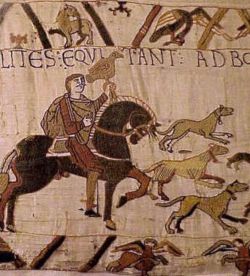
King Harold out for a hunt on the Bayeux Tapestry, no doubt a song was sung soon after. Image found at http://regia.org/research/misc/pastimes.htm.

Back To Top
Abstract

The poet’s song turns from Sigemund and his glorious victory to look instead at a man defeated: Heremod.

Back To Top
Translation

“His fame was pushed most widely
among the nations, protector of warriors,
for deeds of courage — he prospered from then after —
after Heremod retired from war,
his strength and courage; he against the Jutes
had his power stolen in ambush and his force
was quickly slain. His sorrow oppressed him
far too long; to his people he waned,
to all his nobles his life grew too full of care.”
(Beowulf ll.898-906)

Back To Top
Recordings

Old English:

{Forthcoming}

Modern English:

{Forthcoming}

Back To Top
All Hail the King of the Danes

Although there’s no poet interjecting here to keep things from getting messy, this passage is dangerous.

Earlier, before this poet on horseback started to sing of Sigemunde, there was some noise made about everyone praising Beowulf, but being happy with Hrothgar as their king. In fact, the poet goes so far as to give Hrothgar one of the highest epithets: “that was a good king!” (“þæt wæs god cyning” (l.863)).

In light of this passage, though, there could be some sarcasm in that earlier statement.

Here we’re told how Sigemund’s fame grew after he beat the dragon and stole away its treasure, bringing it to his own people. In fact, it even sounds like Sigemund had some sort of happy homecoming because of his courageous deed. In fact, it sounds like he might have been in that far country where the poet alleged his story of the hero came from because of some sort of exile. And, what’s more, possibly exile at the hands of king Heremod. After the first three lines, the poet shifts over to this figure of lore.

Heremod is king of the Danes, and when we meet him here he is the very picture of melancholy. Having suffered a great loss when fighting the Jutes (maybe the giants? the word used is “eotena” which could mean either), Heremod falls into a depression and loses his warlike demeanour. He must’ve been some battler since his entire court is thrown into disarray when he no longer steps out to campaign or bring in treasure from raids.

As a reader of Anglo-Saxon culture as much as Anglo-Saxon poetry, this passage — the poet’s song on horseback in general — is supposed to show the two examples of great man that stand before Beowulf — the man triumphant in Sigemund and the leader who is shackled by shame and fear in Heremod. Later on, Hrothgar talks more explicitly about Heremod as a bad king (the kind Beowulf should not be), but right now this whole thing being an example for Beowulf is just implied.

But it’s really hard to not see it as a subversion of the poet’s saying “the people thought Beowulf was great! But, oh yeah, they still like Hrothgar, too.” I mean, you’ve got the young hero Sigemund who’s just reversed his fortunes by defeating the dragon and winning the treasure and that’s pretty much Beowulf. Sure, our hero hasn’t fought a dragon yet, but he’s beaten Grendel and won great fame that’s quickly spread thanks to the treasure that Grendel left: his arm and claw. Then you’ve got Heremod, the man who sits in his court and bemoans his defeat. Isn’t that too much like the Hrothgar of the last 12 years for any sort of analogy or parallel to be made?

So I think this passage is the poet insinuating that Beowulf could become the new ruler of the Danes. But we can’t know for sure until we get the rest of the story in the next part of the poem.

How subversive do you think the poem Beowulf is? Is it just some light entertainment? Or is it about the young overtaking the old? Or is Beowulf a Christianized Germanic hero bringing new vibrancy to an old tradition?

Back To Top
Peoples and Sorrows

Maybe it’s because sorrow and pitched battle are involved in this passage, but compound words are coming back! Actually, it wouldn’t surprise me if their reappearance was due more to the depression and sorrow of Heremod. If Anglo-Saxon poets wove their words into tangles to accurately represent war, then surely they could do the same to represent the complexities of the deep sadness the old king’s experiencing.

Anyway. Onto the words.

First in the passage, on line 899, is “wer-þeod,” a combination of “wer” (meaning “male being,” “man,” “husband,” “legal money-equivalent of a person’s life,” “a man’s legal value,” “dam,” “fish-trap,” “catch,” “draught,” “troop,” or “band”) and þeod (meaning “people,” “nation,” “tribe,” “region,” “country,” “province,” “men,” “war-troop,” “retainers,” “Gentiles,” “language,” or “fellowship”). This compound is taken to mean “folk,” “people,” or “nation,” and I can see why. It could literally be translated as “people of men.”

But, of course, there are some very interesting nuances to both of these words.

With “wer” we get a look into the Anglo-Saxon idea of the value of life in that the word can mean the “legal money-equivalent of a person’s life,” or “a man’s legal value.” Of course, it has to be noted that a monetary value was attached to human life in Anglo-Saxon society because of law makers’ attempts to control rampant feuding. So, if you happened to kill someone from that group over there, they wouldn’t have to come and kill you, you could just pay that group the value of the life you took and the feud would be called off (legally, anyway). This bunch of laws is an unfortunate imposition since it might’ve been used to turned a few lives into bits of silver, but still. This concept helped to keep people from endlessly feuding so they could do other things. Plus, I bet these laws had some repercussions on ideas of manliness that have resonated down through the centuries, too.

The other half of this compound similarly has some neat meanings. Like “Gentiles” or “language.” In combination with the former, the compound could mean the collection of those who weren’t Jewish, those who weren’t chosen by God. In light of the Anglo-Saxons trying to identify with the Jews of Exodus, a people in search of a homeland, referring to the Danes as Gentiles even through vague implication is interesting. And as a story about pre-Christian times, this meaning seems unlikely to be a coincidence. At the least, I can see the poet smiling after the fact and considering himself very clever indeed for using “wer-þeod where he has.

But combining “wer” with the “language” sense of “þeod” is where things really pick up. The sense of such a combination is that all of those who speak the same language are one group. That’s a really cool idea!

But I digress, since there’re other compounds to get to.

Like the less mysterious “sorh-wylmas.” This combination of “sorg” (“sorrow,” “pain,” “grief,” “trouble,” “care,” “distress,” or “anxiety”) and “wielm” (“boiling,” “swelling,” “surge,” “billow,” “current,” “stream,” “burning,” “flame,” “inflammation,” “fervour,” “ardour,” or “zeal”) means “wave of sorrow.” And its constituent parts don’t really make that meaning a secret. Though I suppose there’s a bit more colour to the idea of a wave of sorrow if you add in the sense of that wave being arduous or zealous. It’s not just a lazy lolling mass of sadness washing over you, but the sort of wave a ship in the middle of the sea might encounter while in a storm’s clutches.

Then, rounding out the bunch but being strangest of the three is “aldor-cearu” of line 906. Meaning “great sorrow,” this one combines “ealdor” (“elder,” “parent,” “ancestors,” “civil or religious authority,” “chief,” “leader,” “master,” “lord,” “prince,” “king,” “source,” “primitive,” “life,” “vital part,” “age,” “old age,” or “eternity”) with “cearu” (a form of “carig” carrying meanings like “sorrowful,” “anxious,” or “grievous”).

“Cearu” is pretty straightforward. But “ealdor” much less so. This one could combine with the former to mean a few shades of “great sorrow.” It could be old sorrow, implying that it’s the sort of sorrow that’s sat and festered for years; it could mean that it is a princely sorrow, a sorrow that comes with the responsibility of ruling over a people; or it could be seen as the sorrow that simply comes with age, the regret and feelings of inadequacy a person experiences as they inevitably compare their present selves to their younger, remembered as happier and stronger, selves. It’s definitely a worthy companion to the much simpler “sorh-wylmas,” though, since both carry a heavy weight with them.

If you agree that the language of the poem is intentionally more complex around descriptions of battles and of sorrow, what do you make of it? Is treating sorrow as the same sort of complex ordered mess as a battle accurate, or just a weak comparison? What do you think of all of this if you don’t agree that the language’s complexity is intentional?

Back To Top
Closing

In the next post, the story of Heremod wraps up.

You can find the next part of Beowulf here.

Back To Top