Beowulf’s ‘Barbaric Yawp’ to Dragonkind [ll.2542-2553] (Old English)

Translation
Recordings
Back to the “grey stone”
On Dragons and the Need for Weapons
Beowulf’s Persistent Youth
Closing

{Old Beowulf in a pose befitting his bellow. Image from Sandra Effinger’s “BEOWULF: Still a Hero” website.}

Back To Top
Translation

“Then by the wall, the man who had survived
with good manly virtue a great many battles,
the crash of combat, when the band on foot clashed,
saw standing a stone arch, a stream out from there
burst from the barrow; there it was a surging stream
of hot deadly fire; he could not be near the hoard
for any length of time without being burned up
could not survive in the depths of the dragon’s flame.
Then he allowed it from his breast, when he was enraged,
the lord of the Weder-Geats sent the word out,
fierce-hearted he shouted; his voice came in
clear as in battle as it roared under the grey stone.”
(Beowulf Ch. XXXV, ll.2542-2553)

Back To Top
Recordings

Old English:

Modern English:

Back To Top
Back to the “grey stone”

The first thing that jumps from this passage is the mention of “grey stone” (hārne stān) in line 2553. Where last week’s section seemed to nod to the story of Sigemund as it’s told earlier in Beowulf, this phrase is practically quoted from the story (“under hārne stān” appears in line 2553 and line 887).

This repetition is evidence of a kind of narrative inverse parabola within the poem, where events in the first part are mirrored by events in the third, with the descent into the mire (lines 1492-1631) being the “depths” of the poem as it were.

What’s most curious here though is that since the precedence is a celebratory story about a victorious dragon slayer, expectations seem to be running against Beowulf’s own disposition. His heart is heavy, and he’s ready for whatever fate has in store for him (“Him wæs geōmor sefa,/wǣfre ond wæl-fūs[;]” “He was of a sorrowful mind,/restless and ready for death” ll.2419-2420).

Back To Top
On Dragons and the Need for Weapons

The previous presence of a dragon was in a story nested in a story (the scop’s song in celebration of Beowulf defeating Grendel, ll.884-915) whereas the dragon is now as ‘real’ as the story’s main character.

Maybe this confrontation between the ‘real’ and what was heretofore imagined is meant to show the way in which the real world twists things – even imagined things – about, but it’s hard to say with certainty just what the poet/scribe is up to here.

Something that any reading of these parallel events also needs to deal with is the fact that the story of Sigemund and the dragon is about a young man fighting a dragon, whereas Beowulf is by no means young any longer. Perhaps his boasts of his youthful exploits are meant to be invocations of his youthful strength, but they’re too tempered by an awareness of his own mortal reality. This awareness is made clear in his admission that if he knew another way to face the dragon he would do so unarmed.

So then, what does it mean for Beowulf, a warrior and king who relied on his natural body for glory so much in the past, to now need to add weapons to that body to win glory?

Is Beowulf cursed in an opposite sense to Grendel – where the monster can’t be harmed by metal, the hero can’t wield metal? The giant’s sword he uses to finish off Grendel’s Mother and Grendel himself could be an exception, but perhaps whatever enchantment it was under nullified his curse?

Back To Top
Beowulf’s Persistent Youth

Given what’s present in the passage, it seems that Beowulf, at least in calling out the dragon, is still as wild as he was when he wrestled Grendel. He doesn’t unsheathe his sword and bang it against his shield or otherwise use what he’s wearing to call out the dragon, but instead shouts. And he shouts so that it “roared under the grey stone” (“hlynnan under hārne stān” l.2553).

The word “hlynnan” could be translated as “resounded” or “reverberated” instead of “roared,” but with what’s come before, and Beowulf’s feeling of unease (brought on, perhaps, because he knows he can’t fight the dragon with his bare hands, and that makes him incredibly nervous), the primal connotations of “roared” makes it seem the best fit.

Back To Top
Closing

Next Tuesday Isidore talks Bull, and the dragon rushes into the open where he and Beowulf stare each other down.
Back To Top

Beowulf’s is no "cowardly course of action!" [ll.2529-2541] (Old English)

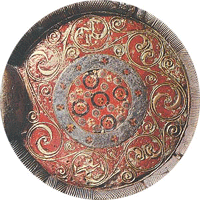
{The sort of shield Beowulf may’ve borne off with him. Image from the Lighthouse Journal}

Translation
Recording
Commentary Intro
Death and Glory
Echoes of Sigemund
Closing

At last in this week’s reading of Beowulf, the hero becomes a man of action once more. Since deeds speak louder than words, let’s check in with the poet/scribe’s own deeds, which, ironically, are words.

Back To Top
Translation

“‘Wait you on the barrow, my armed men,
warriors in war gear, while we see which of
we two can endure the wounds
after the deadly onslaught. This is not your fight,
nor any other man’s, but mine alone
to share my might with the foe,
indeed my courage. By that courage shall
I win the gold, or, in battle,
peril of a violent death, may your lord be taken away!’
Arose then behind the shield that renowned warrior,
hard under helm, bore his battle shirt beneath
the stony cliffs, trusted in the strength of one
man alone. That was no such cowardly course of action!”
(Beowulf ll.2529-2541)

Back To Top
Recordings

Old English:

Modern English:

Back To Top
Commentary Intro

So here we have Beowulf announcing that this is his fight, and then heading off to the dragon’s den. Even the poet/scribe notes that he “trusted in the strength of a single man” (“strengo getruwode/ānes mannes” ll.2541-42). But what’s this all about?

Back To Top
Death and Glory

If Beowulf knows that he is likely to die in this fight it could be argued that he wants to minimize the danger to his thanes by rushing into battle alone. However, that’s a bit of an anachronistic way of looking at the passage.

All puns pardoned, it’s more likely that Beowulf specifically orders his men to stay out of the fray so that he can go out in a blaze of glory. What better way to die than in battle, let alone battle with a dragon – the very embodiment of the greed that all good kings must eschew in order to be good kings.

The passage could also be analyzed as the poet/scribe taking a bit of a jab at a system where a mere man calls the shots in a society that runs on glory and heroic deeds, since it is the doing of such deeds that gets Beowulf killed and ultimately leads to the Geats’ being leaderless, and shortly after war-ravaged.

So, is this merely the vehicle to set up the main character for his triumphant death as hero and dragon slayer, or a Christian twist that’s supposed to undermine the old pagan Germanic way?

Back To Top
Echoes of Sigemund

One thing can definitely be agreed on, there’s an echo of the story of Sigemund and Fafnir in the description of Beowulf’s approach to the barrow’s entrance. It’s only in the phrase “stony cliffs” (“stān-cleofu” l.2540), but the inclusion of “stān” makes this phrase too close to “grey stone” (“hārne-stān”) to be mere coincidence.

Unless dragons are somehow related to these sorts of rocky outcrops, it seems that the poet/scribe is trying to hint at some connection between the Sigemund story and this. Perhaps he is merely foreshadowing the victory (and the curse that comes with it), or trying to suggest that such old stories have no basis in reality. After all, this is Beowulf whose moving under these rocks to kill a dragon, not some distant mythological figure like Sigemund.

Nonetheless, for a passage that’s full of bravado these lines provide a lot more than mere introspection on the part of Beowulf. It really speaks to his own desire to show himself that he’s still as good as he was when he was young.

As the hero of the story he has internalized the very ethos of the Germanic pagan heroic tradition, and it is that which will ultimately cause his downfall. He feels that he is going to die, he’s got that heavy heart, and he constantly talks of how fate is the only one who can decide which of the two will live or die. But yet he still goes on, and his final words to his men suggest a tone of “don’t bother me, I need to show you (and myself) that I can still do this.”

Beowulf needs to validate himself within the system that he has so successfully internalized, first as the celebrated slayer of Grendel and Grendel’s Mother, then as king of the Geats, and then finally (and hopefully, in his current frame of mind), as the slayer of the dragon. But only time will tell.

Back To Top
Closing

Come back next week for Isidore’s brief take on rabbits and longer musing on pigs, and for Beowulf’s final approach to the dragon.

Back To Top