Treasuring Words and Admiring Their Weave [ll.2756-2771a] (Old English)

Abstract
Translation
Recordings
Finding Use for Treasure
A Shining Standard
Closing
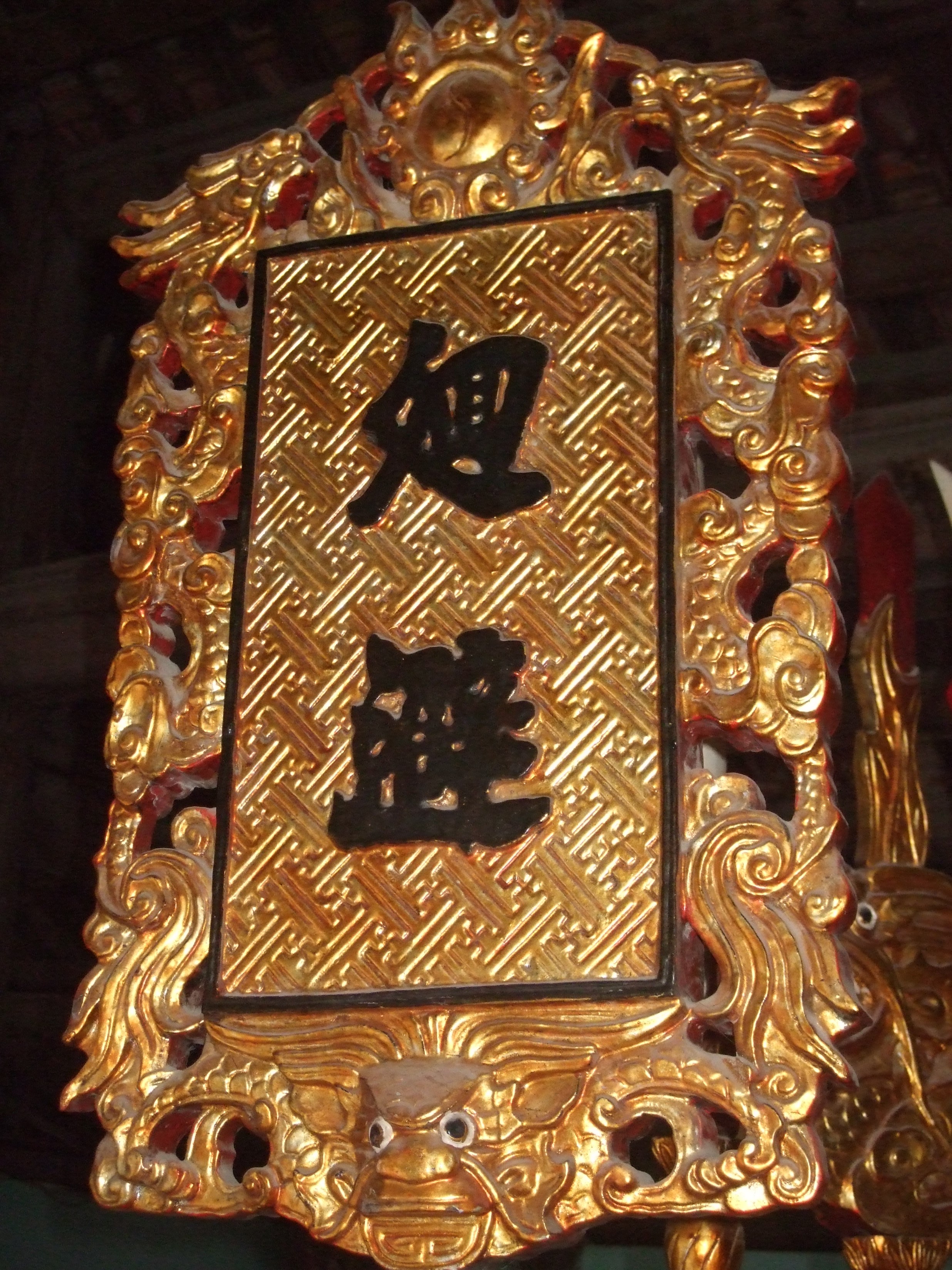
{Shy of the characters, Wiglaf may have seen a standard just like this one. Image found on Wikipedia.}
 

Back To Top
Abstract

Wiglaf hurries to the hoard, where he is mesmerized by the treasure that he finds.

Back To Top
Translation

“He, the triumphant in victory, when he beyond the seat
went, the young brave thane, saw many precious jewels,
glittering gold lay on the ground,
wondrous objects on the wall, and in that dragon’s lair,
daybreak flier of old, cups stood,
vessels of men of old, now lacking a burnisher,
deprived of adornment.* There were many a helmet,
old and rusty, a multitude of arm-rings
skillfully twisted. Treasure easily may,
gold in ground, overpower each one of
mankind, though one may hide it.
Also hanging he saw a standard all of gold
high over the hoard, greatest of marvels made by hand,
woven by skill of craft; from there light
shone out, so that he might see the surface of the floor,
could look at every part of those ornate objects.”
(Beowulf ll.2756-2771a)

Back To Top
Recordings

Old English:

{Forthcoming}

Modern English:

{Forthcoming}

Back To Top
Finding Use for Treasure

After the excitement of the battle with the dragon, and Beowulf’s heartfelt summary of his kingship, this passage is definitely something of a rest. But that doesn’t mean that it’s entirely silent, a point in the story where the poem’s original audiences could entirely rest.

For there is treasure about.

And, along with the treasure comes a very interesting passage: “cups stood,/vessels of men of old,now lacking a burnisher,/deprived of adornment” (“orcas stondan,/fyrnmanna fatu feormendlease,/hyrstum behrorene” (ll.2760-2762)).

What makes this passage more than what it seems is it’s implication about treasure and people’s relationship to it. Because “deprived of adornment” follows “now lacking a burnisher” it sounds as if the burnishing, the polishing, was these cups’ adornment. This makes sense since whatever precious metal they were made of would require maintenance of some sort to keep its shine.

But what’s more is that as this treasure was in the care of a characteristically miserly dragon, it didn’t receive that care that people would have given it. But add to this why people would care to preserve their treasure, especially the sorts of things described here. My own theory is that they would use these things and they would need them to be in their top shape.

Putting this all together you come out with the impression that the passage implies that treasure is ostensibly valuable only when it’s being used by people. And treasure can’t be used by the same person indefinitely, so the best way to keep treasure in use is to give it away. It’s given away to be used by the young, who can then maintain it and then give it away again, thus keeping the cycle going indefinitely.

Not to mention keeping the preciousness of the treasure in tact indefinitely.

However, this reading of treasure as the fuel in a perpetual motion machine of gifting and receiving is troubled by what happens to the treasure hoard that Beowulf and Wiglaf won. It all gets buried with Beowulf.

To be fair, the treasure may well have been buried for a strategic purpose. After all, having great wealth would likely bring down the Geats’ old enemies upon them much more quickly than the news of their loss alone.

Back To Top
A Shining Standard

Another illuminating part of this passage comes at it’s end. The standard that lights the cave in which Wiglaf finds the hoard is clearly very shiny (being described as “all of gold” (“eallgylden” (ll.2767))), and must have sunlight striking it. But this sparkling standard is also significant because it echoes an earlier light in a cave: That which appears when Beowulf kills Grendel’s Mother in her den (ll.1570-1572).

Because of the parallels – the light appears in a cave, comes from a fantastical source, flares up only after the defeat of a powerful monster of one sort or other – it’s tempting to say that Wiglaf’s assist in slaying the dragon is his own killing of Grendel’s Mother. This reading is also bolstered by Wiglaf’s taking treasures back with him to Beowulf just as Beowulf bore the hilt of the giants’ sword and Grendel’s head back to Hrothgar.

Yet, then, we run into the question: Is that where the parallels end? After the treasure is brought back to Beowulf and Wiglaf is cemented as the new leader of the Geats is he not still on the same trajectory as Beowulf?

Maybe he is, but because he isn’t Beowulf (even if he is, for now, nameless) it’s not his fate for a similar trajectory to land him in the same place as the poem’s lead character.

Back To Top
Closing

Next week, the third and final stanza of “O Fortuna” gets translated (and the whole thing gets posted as a recording), and Wiglaf takes as much treasure as he can back to the waiting Beowulf.

You can find the next part of Beowulf here.
Back To Top

Fortune Bemoaned ["O Fortuna," Second Stanza] (Latin)

Abstract
Translation
Quick Notes
Fortuna’s Subtlety
Translating Poetry can be Torturous
Closing

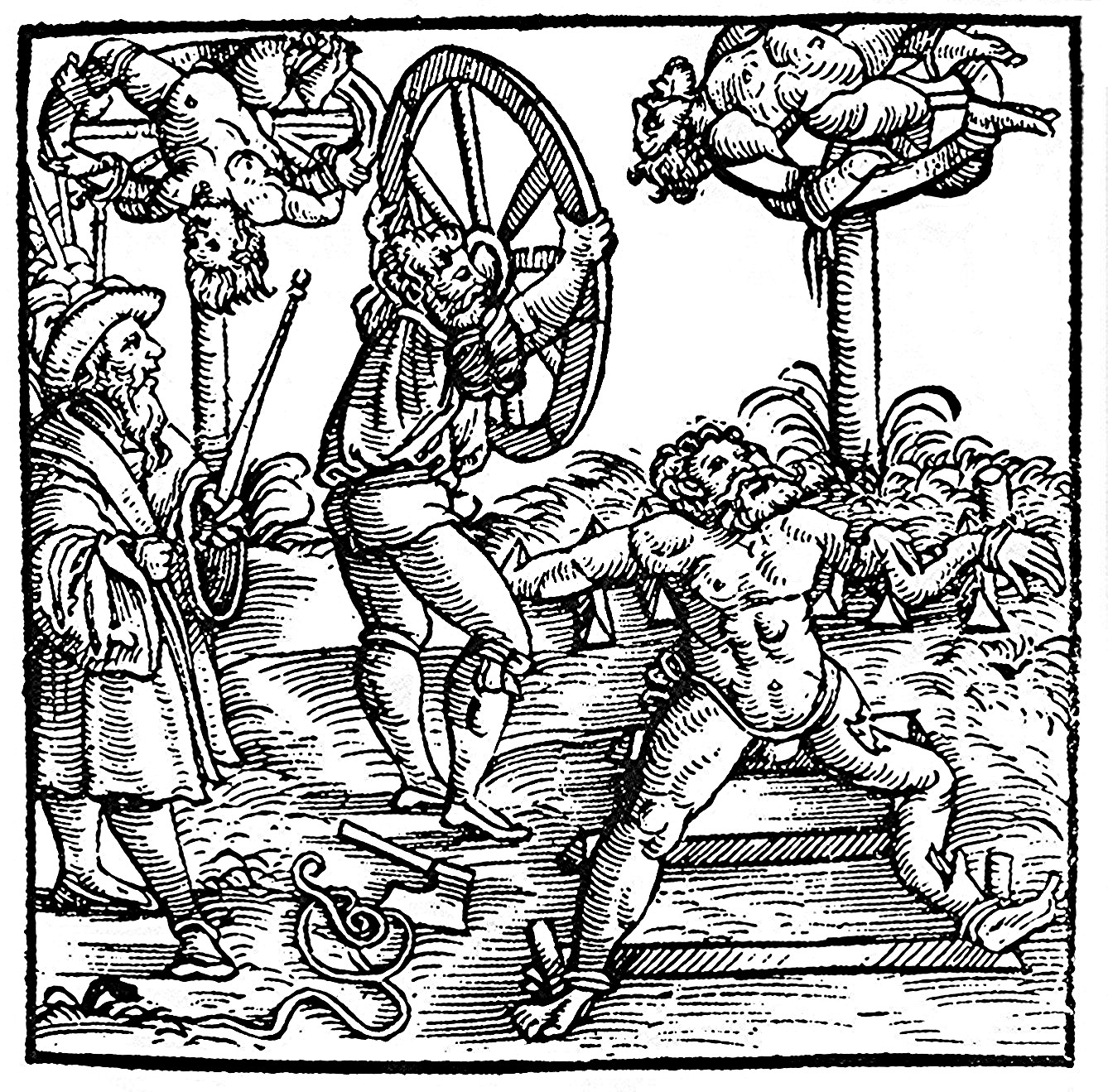
{Another of Fortune’s wheels? Image found on Wikipedia.}

Back To Top
Abstract

The speaker further builds on his complaint against Fortune.

Back To Top
Translation

“Ah, Fortune, vast and void,
On your spinning wheel idle health ay turns to bad standing;
Both ever dissoluble, viewed but darkly,
Yet always to me seeming vainly lovely
As you bring your laughing, desecrating lash
To my naked back.”
(“O Fortuna”, 2nd stanza)

Back To Top
Quick Notes

If you look at the translation offered on Wikipedia, and then at the one that I present here you’ll probably notice some differences. Once more, they’ve been made to keep the medieval flavor of the poem more or less intact.

Line 4 might be going a bit too far with its phrasing, but nothing was ever said about the poem’s original flavor being mild.

Back To Top
Fortuna’s Subtlety

In fact, torture is clearly at play here. The wheel as a torture device was used in the middle ages, and the poem was written right in the middle of this period, sometime in the thirteenth century. But even then, there’re the final two lines of the stanza that explicitly mention a “laughing, desecrating lash” (ludum, ) that is brought to the speaker’s “naked back.”

There’s really no question that torture imagery is at play here. This might even be building on the subtle dominance of women peeked at in the first stanza of the poem.

Though they lacked prominence in places of power, their influence, however subtle and unseen in history books, cannot be overlooked. Even through to today, women who are villains (and even heroines) more often than not work their schemes through wit and wiles rather that brawn and brawling.

The binary stereotype that men are strong and women are smart (though usually not book smart) has persisted for a long time, and “O Fortuna” definitely looks like a medieval manifestation.

Back To Top
Translating Poetry can be Torturous

Although it might be a unique variation, what does it mean for the sort of torture imagery here (variably the breaking wheel, and fortune’s laughingly lashing a person’s back or taking her “pleasure” (“ludum”) on a naked back (“dorsum nudum”))?

The Latin word used for “laughter” or “pleasure” is “ludum.” This word refers to things like laughter, play, jests, or just a generally fun, interactive time. So how does that relate to being whipped?

On the one hand it could be a bit of the repressed seeping through. In the middle ages those who could write and had the means to do so were trained by the Church. So, it could be that the whip is “laughing” as well as “desecrating” because it injures the body that god created while also relieving the pent up desires that that body has through taking on pain: a feeling as extreme as pleasure.

On the other hand, the above translation does take some license in coming out with “As you bring your laughing, desecrating lash/to my naked back.” The poem in Latin reads “…ludum dorsum nudum…,” all three of those words are together, but it’s not entirely clear what’s doing what.

If they all create a single direct object phrase (since they are in the accusative case), then any order could be used. “Laughing naked back,” “back laughing naked,” “naked back laughing.” Even if any of these are used, the element of fun remains in the act of torture.

The only real change in meaning that results from these variations is that the laughter’s moved from the whip to the speaker’s back: the gashes opened by the whip being likened to the open mouth of someone laughing.

In either case, this is definitely a poem that has more going on than another, more pious piece translated earlier.

Back To Top
Closing

Check back here on Thursday when Wiglaf views the hoard for the first time, helped by the luminescence of a battle standard.

Back To Top

A Chatty Wiglaf and an Encouraged Beowulf [ll.2661-2672a] (Old English)

Abstract
Translation
Recordings
Wiglaf: The Chatty Youth
An Early Ascension Speech?
Closing

{Just what the dragon’s doing while Wiglaf stages his dramatic entrance. Image from Quest for Glory V concept art at RPGamer.com}

Back To Top
Abstract

Wiglaf rushes over to Beowulf, and reassures him that his glory will not falter for this difficulty. But, just as Wiglaf finishes his short speech, the dragon starts back towards the pair.

Back To Top
Translation

“Advanced he then through that deadly smoke, in helmet
he bore to the lord his help, few words he spoke:
‘Dear Beowulf, perform all well,
just as you in youth long ago said
that you would not allow while you are alive
your glory to decline; You shall now in deed be famous,
resolute prince, all strength
your life to defend; I you shall help.’
After that word the serpent angry came,
the terrible malicious alien from another time
glowing in surging fire attacked his enemy,
hateful of men.”
(Beowulf ll.2661-2672a)

Back To Top
Recordings

Old English:

Modern English:

Back To Top
Wiglaf: The Chatty Youth

Wiglaf is a very strange character. It’s not that his name is odd (aside from what’s been said before, what could naming someone “war heirloom” mean, anyway?), or that his introduction is hastily foisted onto an explanation of his equipment, but that he gets so many lines of dialog.

After all, considering the length of this poem, there really isn’t that much dialog.

Hrothgar and Beowulf have some long speeches, but they’re both in the poem for a substantial amount of time, while Wiglaf is only prominently featured in the last 500 lines or so.

So, why does Wiglaf have such a major speaking role relative to the length of his presence in the poem?

It could be that speech is shorthand for the kind of thing that his generation of Geats excels in. That the rest of his fellow thanes ran away when Beowulf’s distress became clear is a clear mark of this. Or it could be that Wiglaf, as someone who hasn’t yet seen real battle and killed with his own sword, primarily interacts with the world through speech rather than weaponry.

But then, one thing still stands out.

In almost every instance of Beowulf, the poem’s other major hero, talking, he does it in response to other characters’ actions. He answers Unferth’s challenge to his valor (ll.529-606), he boasts to Wealhtheow when she presents him with a drinking cup (ll.628-638), and he retells his exploits in Daneland when Hygelac asks for a tale of his adventures (ll.1900-2162).

Otherwise, Beowulf is mostly a silent protagonist. The only major instance where he speaks unbidden is before his thanes, when he gives them his lengthy autobiography and assures them that this dragon fight will be tough, but he’ll handle it himself.

Back To Top
An Early Ascension Speech?

With that in mind, is it possible that the poet/scribe behind the poem is setting Wiglaf up as the next Geatish king?

Since Beowulf’s speech to his thanes is the product of his office as well as his emotional state at the time, the only thing that marks Wiglaf as different is his lack of a title. Perhaps his outburst is meant to stand as a kind of shorthand for youthful vigor, a vigor that he tries to impart to or revive in Beowulf through his words of encouragement – themselves completely unbidden.

Going back to the idea that Wiglaf’s speeches are the result of his inexperience in the field of war (a man’s proving grounds in the poem), maybe he is an early case study in the idea behind the phrase “fake it before you make it.”

Having no past battle experience, Wiglaf can only put on a brave face, something expressed through words, but he can’t put on a brave show aside from his apparently impulsive rush from the band of thanes to his lord’s side.

Of course, if all of this is true, then the depiction of Wiglaf speaking to his fellow thanes and rushing to his lord’s side is a great portrayal of a young thane bound for great things.

Back To Top
Closing

Next week, Isidore runs through three of the colors from this week’s guide to good horses. And, in Beowulf, another hardship befalls the rallied lord of the Geats.

You can find the next part of Beowulf here.

Back To Top

On Wiglaf’s Weapons (Pt.1) [ll.2606-2619] (Old English)

{What Weohstan may as well have done in returning Eanmunde’s armor to his kin. Image from the National Library of the Netherlands Medieval Illuminated Manuscripts Collection.}

Abstract
Translation
Recordings
Wound Around Vague Pronouns
No Fuel for a Feud?
Closing

Back To Top
Abstract

Wiglaf remembers all the things that Beowulf has done for him. While Wiglaf wanders the corridors of memory, the narrator tells us the origin of the young warrior’s equipment.

Back To Top
Translation

“Then he remembered that property which Beowulf had
earlier given, the rich dwelling place of the
Waegmundings, how he granted each the common rights,
as his father possessed. Then he could not restrain
himself, he grasped his shield in hand, a yellow shield;
the ancient sword he drew, that was, according to men,
Eanmunde’s heirloom, son of Ohthere. It came to Weohstan
while he was exiled, friendless, the slayer by blade’s
edge of Ohthere’s son, yet he still bore to his kinsman
the spoils of a shiny helm, a ringed mail shirt,
the ancient sword of giant’s craft. Onela gave
them to him, his kinsman’s war garments,
the war-ready garb; no feud was there to speak of,
though Weohstan had slain Onela’s nephew.”
(Beowulf ll.2606-2619)

Back To Top
Recordings

Old English:

Modern English:

Back To Top
Wound Around Vague Pronouns

Although it’s mostly been cleared up, this passage is lousy with vague pronouns.

Lines 2606, 2614, and 2619 originally contain no proper names. Even so, it might seem that there are a few too many pronouns in this section of the poem, possibly because of the intense weaving that the poet/scribe is attempting. In fact, this use of vague pronouns could be a way of verbally showing how the characters involved in this digression are connected to each other.

Actually, if ever a case was to be made that Beowulf really is the product of a long oral tradition finally being written down by someone, this passage should be used as a prime piece of evidence.

Medieval writing is littered with abbreviations, but it’s usually not skimpy on clear pronouns – even if it’s common for some Old English to have been written with the remnants of grammatical gender in effect, meaning that inanimate objects are referred to as “he” and “she” rather than “it.”

Matters of poetry and writing aside, this section presents a curious case.

Back To Top
No Fuel for a Feud?

In Anglo-Saxon culture, the feud was the central means to conflict resolution before there was any kind of central authority figure (ie: a king). Since the events of Beowulf happened before there were really tightly controlled kingdoms (think Charlemagne’s or Alfred the Great’s) feuds were still common and are often at the middle of ballads and poems and stories from the early medieval era (c.400 – c.1066).

So what happened with Weohstan and Eanmunde’s family? Why is it that Weohstan doesn’t get an axe lodged in his skull when he returns Eanmunde’s sword, helmet, and chainmail to his uncle?

Is it possible that Eanmunde’s family took pity on Weohstan because he was an exile? That is, could there have been some sense that a feud against a man without a country is pointless and therefore not worth taking up? Or, is it possible that the act of returning the arms to his family erases any kind of bad blood between that family and Weohstan?

We’re only told that Weohstan kills Eanmunde “at battle” (“æt sæcce” l.2612). Since he is also in exile at the time (“wræccan wine-lēasum” l.2613), maybe Weohstan is fighting as a mercenary and therefore as someone without connections. Or, maybe he and Eanmunde just fought in single combat; they met up while Weohstan wandered, fought, and Eanmunde was killed.

Given what’s present in this part of the poem, it seems that they must have met on the battle field. The strongest piece of evidence for this is the echo of Beowulf’s asking Hrothgar to send his armor back to Hygelac if he gets eaten by Grendel (ll.450-55) in Weohstan’s returning Eanmunde’s equipment to his kin.

Further, Eanmunde’s father (Ohthere) and uncle (Onela) both being referred to must mean that this family was quite famed. So, maybe, as one currently in exile, Weohstan’s beating Eanmunde was viewed by his family not as something that couldn’t be properly repaid with a feud. Why? Perhaps feuding against just one man for the murder of someone from a family of people who are famous or worth many men could make the family appear petty.

Such an appearance might make them seem overly wrathful – something that might not be so bad in strictly Anglo-Saxon terms, but having already told stories of cruel Heremod (ll.1709-1722) and wicked Modthryth (ll.1931-1943), one of the poet/scribe’s purposes in telling/writing Beowulf must be to show that cruelty and wickedness are not good qualities. It’s not a stretch to add wrathfulness to that list of qualities frowned upon in the work.

Possibly, then, Eanmunde’s family’s not taking up a feud with Weohstan to wreak vengeance for their lost kinsman could be the result of that aim to teach.

This part of Beowulf definitely lays down some mysterious circumstances, but at the least it also shows that there’s more to Beowulf than a bunch of guys clubbing each other with pointy sticks.

Back To Top
Closing

Check back next week for Isidore’s take on various horses, and for part two of the history of Wiglaf’s equipment.

Why is the origin of his equipment so long in the telling? Well, in old oral traditions, you’ve got to build up to that sword with +3 attack and chain mail with +2 resistance to dragon’s fire.

Back To Top

While Beowulf Roasts, Wiglaf Breaks from the Host [ll.2593-2605] (Old English)

Abstract
Translation
Recordings
Heralding The Shift
Shiny Armor, but Shinier Lineage
What’s in a Name
Closing

{A fresh faced Wiglaf, as played by Brendan Gleeson. Image from aveleyman.com.}

Back To Top
Abstract

Things aren’t looking good for Beowulf, but though his men are fled, one has a change of heart that may see the dragon bled.

Back To Top
Translation

“The hoard guard in himself took heart – his
breast by breathing heaved – he came out once again;
harsh straits were suffered, he was enveloped by fire,
he who had once ruled the people. Not any of the band
of comrades were with him then, the sons of nobility
stood about in martial virtues, but they fled into
the woods, their lives to save. Of them sorrow surged
in just one mind; he who thinks rightly may
never for anything turn away from kinship.
Wiglaf was his name, son of Weoxstan,
a beloved warrior, man of the Scylfings,
kinsmen of Aelfere; he saw his liege lord
under the battle mask suffering in the heat.”
Beowulf ll.2593-2605

Back To Top
Recordings

Old English:

English:

Back To Top
Heralding The Shift

Beowulf’s getting roasted by the fire in this passage, and the dragon seems almost assuredly guaranteed a nice and toasty roasted Geat for a snack. No doubt he has a very old and fine wine somewhere in his hoard to go with just such a meal, but thanks to a change of heart, one of Beowulf’s thanes is ready to help out his liege lord – and become the poem’s primary perspective character.

Curiously, though, the action is halted for a quick description of our new hero. Though instead of going over his bulging biceps and shiny armor (that gets the narrative treatment in a few lines’ time), we’re treated to his pedigree.

Obviously this kind of description is set up by the preceding bit of gnomic wisdom: “he who thinks rightly may never for anything turn away from kinship” (“sibb ǣfre ne mæg/wiht onwendan þām ðe wēl þenceð” ll.2600-2601). However, what makes pedigree so important here?

Back To Top
Shiny Armor, but Shinier Lineage

The best guess is that it falls in with an older way of thinking about the world. One that involves things like phrenology and eugenics, not all pretty stuff, but essentially the idea held here could be that because Wiglaf comes from good breeding he is one who “thinks rightly” (“wēl þenceð” l.2600). If such is the case, then this passage would set any listener or reader to this tale from hundreds of years ago to the expectation that this Wiglaf is going to solve everything, or at least be of assistance.

However, if Wiglaf is the only one who has his head on properly amongst the elite guard that Beowulf brought with him on his expedition, it also bodes ill for the Geats in general. For if only one of twelve trained warriors has the decency to disobey orders and help his liege lord in his hour of need despite being told otherwise, then such pedigrees as Wiglaf’s must be few and far between.

As a means of foreshadowing the waning power and prowess of the Geats between generations, and the implication that kin, when properly thinking, will help out kin, suggests that either terms like “Geat” are much broader than you might suspect, or that there’s a problem with breeding among the Geats.

Maybe something wicked has been happening in the beds and around the camps when the fires are out – Beowulf’s own marital and sexual situations are not mentioned. It’s possible that the woman who weeps so bitterly by his grave (who could be Hygelac’s queen, Hygd; ll.3150-3155) is Beowulf’s wife, but the latter situation is left un-noted, likely because of the contemporary sense of decorum.

Back To Top
What’s in a Name

A brief note on the name of the new perspective character in the poem is rather telling. It’s also much easier to look into the meaning of Wiglaf’s name than Beowulf’s name, since it’s a much more obvious compound word.

“Wīg” is Old English for “war,” “strife,” or “battle,” and “lāf” is Old English for “leaving,” or “heirloom.” Thus, Wiglaf is named for some kind of battle memento – maybe this name is one that the poet/scribe came up with after having conceived of the pedigree of Wiglaf’s arms. For his armor and his sword are all described as the spoils of a combat fought by Weohstan (ll.2610-2625).

However, if Wiglaf’s name is taken as a kenning, it could be interpreted in a different way.

If we take “wīglāf” as a kenning, then perhaps it refers to one who is the product of a broken marriage, or of a couple made of partners from rival or feuding families. In that way he’s much more literally an heirloom of some kind of strife, since perhaps he’s the child of rape or of some kind of passionate affair between star-crossed lovers who never after saw each other.

Of course, being an Anglo-Saxon poem, none of that is explicitly explained.

Back To Top
Closing

Next week Isidore gets into the matter of the cud and of donkeys; and in Beowulf, Wiglaf can’t hold back, just as the poet bursts into a (brief) digression.

Back To Top

Young Beowulf’s Melancholic Tale [ll.2430-2440] (Old English)

Summary
What is and What’s to Come
All About a Name
Beowulf’s Phrasing
Closing

Back To Top
Summary

This part of Beowulf is one that makes the Anglo-Saxon propensity for melancholic reflections painfully obvious. We see the old king sitting on the sea cliffs and talking with his thanes about his life, and how even at an early age he witnessed something tragic – fratricide.

Back To Top
What is and What’s to Come

Lines 2430 to 2440 actually present a curious kind of contrast. In the first five lines Beowulf tells of Hreðel’s (Hrethel) warm reception (“mindful as kin,” “sibbe gemunde” (l.2431)).

But then in the second, we get his report of the murder. According to Beowulf (no mean storyteller, he did, after all, boast to Hrothgar about his deeds, clear up the matter of the swim with Breca, and give Hygelac a slightly diverging story about his fights with the Grendels upon his return to Geatland) Hreðel’s eldest son, Herebeald, was shot and killed by the youngest, Hæðcyn (Haethcyn).

Within his account, two things come up that I want to expand upon here. First is one of the brother’s names, and second is Beowulf’s phrasing.

Back To Top
All About a Name

Perhaps a bit of Christian propaganda, Herebeald’s name echoes a similarly killed Aesir in Norse mythology.

This Aesir is the son of Odin, Baldur, god of Light and Spring. For the full story of his death check here. The gist of it is that Baldur’s death is foretold, all of the things on the earth take an oath that they will not hurt Baldur, yet through some of Loki’s trickery and a technicality Hodor is given a sprig of mistletoe that did not take the oath. Hodor fires and Baldur is killed.

This could be some low level Christian propaganda because it points towards fratricide within Nordic myth, thus attempting to show its wrong-headedness. However, Beowulf seems to be defending Hæðcyn.

Here is how he describes Hæðcyn’s act: “he aimed for a misted mark and shot his own kin” (“miste mercelses ond his mǣg ofscēt” (l.2439)). Because this is a whole line and not just a word or phrase, I think that strategic language on the poet/scribe’s part for the sake of form can be ruled out.

Back To Top
Beowulf’s Phrasing

Within the phrase itself, all of the words are quite clear. “Miste,” “ond,” “his,” and “ofscēt” are all more or less left unchanged on their way into Modern English. “Mǣg” is less immediately clear, but translates as “kin, family.” Ah, but “mercelses,” that offers some difficulty.

Knowing that the word is a form of “mearc” meaning “mark, sign, standard, border, etc.” means that it’s just a matter of figuring out its case. That it ends in “es” gives solid ground to say that it is indeed in the genitive case, which I expressed by adding in “aim” to clarify a more literal translation.

Such a literal translation is: “mark of mist and his brother shot.” Since it’s mentioned that Hæðcyn has a bow in line 2437 (“bogan”), the logical step that must come between his having it and the mention of a “mark of mist” is that he must have been aiming his bow. Hence the addition.

Though even without this addition, the emphasis that the line’s alliteration puts on “misty” suggests that Hæðcyn was in some sort of daze.

I think that this ambiguity absolves him of the murder, in a way. it certainly makes it more ambiguous, and might even be pointing towards the moral idea that a person cannot be judged on their actions but only on their intent.

Beowulf (and/or the poet/scribe) might just be unclear on what his motivation was, but there is a germ of something more here, I believe. Why? Because it’s coming in at a part of the larger story of Beowulf in which Beowulf is looking for solace in the sorrows of his past.

Perhaps, some might argue that he is trying to forgive himself for killing Grendel whom he somehow viewed as a brother. Or perhaps he is just trying to work out his feelings for the Geats that he will be leaving behind through an analogy with Hreðel and the loss of his son.

Beowulf has seen the Geats come far, but also has seen their youth lose their spark. Whatever the case is, the ambiguity presented here makes it plain that this whole episode is more opaque than evil dragons and troublesome killers.

Back To Top
Closing

Next week the story continues, as Beowulf adds more detail to his tale – what becomes of Hæðcyn? Just how melancholic can Anglo-Saxon poetry get? Read on next week to find out!

And if you’ve got any opinions, arguments, or points on or about this week’s section, toss them in the comments.

Back To Top

Beowulf [ll.2419-2429] (Old English)

Introduction
Summary
Beowulf’s Greatest Foe?
Beowulf’s Opening Lines
Genæs: Further Analysis
Briefly Autobiographical
Closing

Back To Top
Introduction

When we last left Beowulf, he was sitting on a cliff, looking out to sea. His mind was heavy with thoughts of his impending death, and this week’s section gives us an idea of what those thoughts were like.

Back To Top
Beowulf’s Greatest Foe?

We’re told that Beowulf knows that he would soon “encounter old age,” (“gomelan grētan sceolde,” l. 2421) that it would seek his “hoarded (?) soul,” (“sēcean sāwle hord,” l. 2422). And before Beowulf at last addresses the 12 with him the poet offers the elaborations of Beowulf’s life being rent from his body (“sundur gedǣlan/līf wið līce,” l. 2422-3) and of his “flesh…soon unravel[ing] from his spirit” (“nō þon lange wæs/feorh æþelinges flǣsce bewunden,” l. 2423-4).

Death is definitely violent, but very firmly not the end, and Beowulf knows this well. But all of this is mentioned in the context of Beowulf sitting in “sorrowful mind” (“geōmor sefa,” 2419). There’s definitely a strong sense of the elegy that J.R.R. Tolkien detected in the poem here (see page 14 of this article). And there’s also the sense that Beowulf feels some remorse. But why?

Because his kingdom has been ruined by the dragon and, upon seeing its lair, he realizes that he will die fighting it? Because he feels that those he has taken with him, the leaders of the next generation, surely, are not capable of the glory that he achieved? Perhaps he regrets the conquests and triumphs of his youth? Or is it merely an expression of the extreme anxiety around death?

Back To Top
Beowulf’s Opening Lines

The first line and a half of the section set the atmosphere by telling us that Beowulf was “restless and ready for death,” that he could feel “fate immeasurably near” (“wǣfra ond wæl-fūs, wyrd ungemete nēah,” l. 2420). Then the poet/scribe offers things more concrete.

Beowulf’s ensuing speech is about his youth and accomplishments, but I’ll get more into that next week. This week, I just want to focus on the first two lines (one sentence) of it.

Beowulf opens by saying that he “survived” (genæs) countless battles and war-times in his youth. His choice of words here is curious, since, according to my dictionary, all senses of “genæs” suggest the last-minute removal from a dire situation (survive, escape from, be saved).

Why doesn’t Beowulf (or the scribe/poet) simply use “won glory,” or “succeeded”? Is this a sign that Beowulf is well aware of the horrors of war and that the poem itself can be read not as a document glorifying it, but maybe the first recorded account in English of someone who has experienced Post Traumatic Stress Disorder (PTSD)? Or, is it just the only word that would fit the line’s meter and/or alliteration?

Back To Top
Genæs: Further Analysis

Following the line of reasoning that the poet/scribe could have used another word in place of “genæs,” here’s my analysis.

“Survived” makes it sound as though all of the battles that Beowulf has seen were trials or hardships sent by some greater entity, or merely as a part of life. “Escaped from” makes armed conflict seem like some terrible, impersonal machine or happening.

And, “been saved” makes it seem as though Beowulf got lucky each time he fought and was spared from the sword or arrow by the intervention of his fellow warriors or some sort of supernatural being. This last meaning of “genæs” perhaps gels the best with the laggard that everyone at the Geatish court believed Beowulf to be until he returned from Daneland with stories of slaying Grendel and his mother.

So then did Beowulf actually change from a weakling boy into a fierce warrior, or was his original softness just masked by luck – is this a propagandic Christian twist that suggests that trusting in god will keep you safe in skirmishes and war time?

Beowulf at this point is 50 years old – the same age as Hrothgar and Grendel’s mother when he was in Daneland. Rulers in the world of Beowulf seem to last their 50 winters and then tip off the mortal coil in one way or another. Though in such a world, living to see 50 does seem remarkable.

Whatever the case may be, modern interpretations of “genæs” all come with this connotation of getting through something larger than an individual human’s machination.

At the least, I feel secure in saying that this word suggests that human conflict is something outside of the control of individual people and possibly even groups of people. In fact, the word could be read as the poet/scribe suggesting that war is another kind of natural disaster. The cosmological implications are fascinating.

Back To Top
Briefly Autobiographical

The next sentence of Beowulf’s speech begins his auto-biography. At the age of seven he went to his treasure lord (“sinca baldor,” l. 2428) for fostering at his father’s command. This treasure lord, “leader and friend of the people” (“frēa-wine folca,” l. 2429), seems benevolent enough, and the practice of fostering is evident throughout the middle ages. Even Chaucer was fostered.

The transition from the first sentence of his speech and the second is where these two get interesting.

Beowulf ends his first sentence with the bold statement that he “remembers all of [the conflicts]” (“ic þaet eall gemon,” l. 2427). And from what comes next it seems that he also remembered much of his youth. He specifically recalls a story from his youth that may well be the earliest political strife he encountered. But I’ll get into that next week.

Back To Top
Closing

Think I’m a little too loose with my translations of words or phrases? Or that I dig too deep for meaning? Or do you think that I’m right on and should just write a book about it all already? Let me know in the comments.

Back To Top