The changing words of Beowulf (and language, too)

This is the first page from the Beowulf manuscript, in Old English.

The first page of the original Beowulf manuscript, in Old English. Image from http://bit.ly/2jdxSdW.

After I told people I was studying English in university a strange change came over them. They would start listening to me a little more closely. They would hang on my every word for a few minutes after learning that fact. And they would point out any grammatical mistakes I’d make while speaking.

Sometimes these corrections would take me aback. But I can’t say that I blame those who would, jokingly, jump down my throat when my verbs and subjects didn’t agree or I threw an “ain’t” into what I was saying to blend in with the people around me. When I was in university I was the person those who learned of my major became. I was a grammar Nazi.

That is, until I learned about things like Old English and Middle English, and the joy of learning to read languages that were different enough from Modern English to be unintelligible at first look, but that were familiar enough to grasp with a mix of knowledge and intuition. Exposure to these things, and even to the idea that the Latin ancient people spoke changed over time, really made me realize that spoken English doesn’t need to be “perfect”. Neither does written English.

In fact, correctness just comes down to authorial intent and audience. After all, language is most correct when it’s a medium for clear communication between people, so knowing your audience and tailoring your language to make your meaning as clear as possible for that audience is the best way to make it “correct”.

Anyway, the fact that languages change is something that’s pretty well known in general. As Tristin Hopper points out in this article from The National Post, things written around the second world war have totally different uses of words like “queer” and “ejaculate”. Underscoring the article’s point that all languages adapt to what modern speakers need to say about modern life, even the word “humbled” has changed from something with negative connotations to something that gets paired with “honoured”.

Where Beowulf fits in with all of this is that it stands as a marker of the starting point for English. But, it’s also something that even now is constantly changing since our understanding of it is based on best guesses rather than the insight that a native speaker could bring to it. I was pretty shocked to learn that the first word of the poem “Hwaet!” may mean “How” rather than my dearly enjoyed “Listen!” as I read Hopper’s piece.

Ultimately, if you like a language, no matter what your age, you should definitely study it. Even if it’s a dead language like Latin or Old English, there’s likely still more for us to find out about them, and there are still useful insights to pull out of old stories and poems and expression. I’d say this is especially true if the stories and written expression of today don’t speak to you. After all, one of the reasons I went into English after finishing high school was to learn more of the medieval stories that were in seriously short supply throughout my high school run.

If you could learn any language, which language would you want to learn? Why?
Continuing adventures in philosophy via Beowulf: The root of arrogance (ll.1735-1744)

Synopsis
Original
Translation
Recordings
The Continuing Story of the Ruler and the Lazy Conscience
Arrogance and Jest in Warfare
Closing

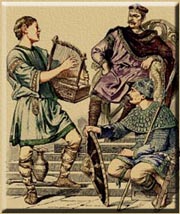
A scop sings his boasts, just like Beowulf does before Hrothgar.

Image found at http://bit.ly/2jumA3j


Back To Top
Synopsis

Hrothgar’s story of the hypotehtical ruler who’s handed all (thanks to the accident of his birth I’m guessing) continues.


Back To Top
Original

Wunað he on wiste; no hine wiht dweleð
adl ne yldo, ne him inwit-sorh
on sefan sweorceð, ne gesacu ohwær
ecg-hete eoweð, ac him eal worold
wendeð on willan (he þæt wyrse ne con),
oðþæt him on innan ofer-hygda dæl
weaxeð ond wridað. þonne se weard swefeð,
sawele hyrde; bið se slæp to fæst,
bisgum gebunden, bona swiðe neah,
se þe of flan-bogan fyrenum sceoteð.
(Beowulf ll.1735-1744)


Back To Top
Translation

“He dwells in prosperity, not at all is he hindered
by sickness or age, neither does his mind go dark
with evil anxieties, nor does enmity bare its blade
to him anywhere, and he goes through all the world
according to his desires. He knows nothing is wrong,
until within him a measure of arrogance grows
and flourishes, when the guard sleeps,
his soul’s shepherd; that sleep is too deep,
weighed down with a diet of worldly cares; the slayer then slinks near,
he who wickedly notches an arrow to his bow* and shoots.”
(Beowulf ll.1735-1744)


Back To Top
Recordings

Old English:

{Forthcoming}

Modern English:

{Forthcoming}


Back To Top
The Continuing Story of the Ruler and the Lazy Conscience

In this continuation of Hrothgar’s story about the ruler who has all and lives in peace, he starts to develop a bit of a psychological theory. Namely, Hrothgar makes the point that too much mindless comfort leads a person’s conscience gets lazy, which leaves them open to arrogance and a sense that they are more than what they actually are. Here the danger that he seemed to be foreshadowing with his perfect situation in last week’s post comes to fruition. And all because god gave this person all that they could want: plenty, friends, power.

So what’s he really saying here? He very easily foists the blame for this perfectly situated person’s fall onto them themselves. But, are they really to blame?

Let’s take a step back here for a second to get a better sense of the philosophy behind this part of Hrothgar’s story.

The person that Hrothgar is talking about in his allegory is supposed to be a ruler. What I take from it then, is the idea that what sets a ruler apart from everyone else isn’t just birth or divine favour, but an inherent ability to handle everything that their position brings or to keep awake to the psychological dangers they face.

After all, in Hrothgar’s story the ruler falls victim to excessive comfort. It’s excessive cares that have lulled their conscience to sleep. In fact, the literal translation of “bið se slæp to fæst,/bisgum gebunden” on lines 1742-1743 is closer to “that sleep was to secure,/bound up with business”, which isn’t quite my “that sleep is too deep,/weighed down with a diet of worldly cares”.

But I think that the relation between a deep sleep after a big meal and the kind of deep sleep that this person’s soul’s guard undergoes are very similar. That guard (the conscience perhaps?) has glutted itself on all the fine things in life and so has let its guard down, leaving the core of the ruler’s being open to attack from arrogance or anxiety or egoism of some kind that leads this ruler down a dark path.

In the end then, is the ruler really to blame?

In Hrothgar’s philosophy (and in some people’s today), this person was merely born where they were born by divine will, in accordance with its plan. But if this ruler to be is the kind of person who is going to get a fat, lazy conscience in such circumstances should they be expected to be able to help it? They have no more control over their nature than they do over where and when they were born.

Or is a lazy conscience supposed to be the inherent state of human nature? Perhaps a “better” ruler would have learned how to avoid getting so indulgent?

But if a person isn’t naturally inclined towards things that are supposed to build “character” or toughen them up, are those faults or just strengths that aren’t in the right social setting? If so, isn’t that kind of twisted for an all powerful deity to inflict such punishment on a select few of their creation, putting them in what seems like the wrong place or time?

Such would seem especially cruel in a cosmology that doesn’t allow for reincarnation and the learning potential that such a situation provides, such as the Christian (and pagan?) context from which Beowulf comes.

But I feel that those questions drift away from Hrothgar’s main point here: don’t let the good life make you soft, either internally or externally. As we’ll see next week, the consequences of doing so are dire.

What do you make of Hrothgar’s story so far? Is he laying blame for his hypothetical ruler’s fall, or is this figure just doing what comes naturally when one isn’t aware of their own power and privilege? Leave your thoughts in the comments!


Back To Top
Arrogance and Jest in Warfare

Is it “ofer-hygd”1 of the flesh that leads to “ecg-hete”2?
Leads the sons and daughters of farmers
to raise sword and shield against the foe,
to hoist “flan-boga”3 and spear against former friends?
Such fighting is like that between brothers,
like that day when Hoðr, laughing,
Drew the godly “flan-boga”3 and mistletoe arrow against Baldr, laughing.
That game ended with “inwit-sorh”4 and weeping,
the shedding of blood and of tears.


1ofer-hygd: pride, conceit, arrogance, highmindedness, haughty, proud. ofer (over, beyond, above, upon, in, across, past) + hygd (mind, thought, reflection, forethought)

Back Up

2ecg-hete: sword-hatred, war. ecg (edge, point, weapon, sword, battle-axe) + hete (hate, envy, malice, hostility, persecution, punishment)

Back Up

3flan-boga: bow. flan (barb, arrow, javelin, dart) + boga (bow (weapon), arch, arched place, vault, rainbow, folded parchment) [A word that is exclusive to Beowulf.]

Back Up

4inwit-sorh: sorrow. inwit (evil, deceit, wicked, deceitful) + sorg (sorrow, pain, grief, trouble, care, distress, anxiety)

Back Up


Back To Top
Closing

Next week, Hrothgar’s story comes to its close and our hypothetical ruler meets their end.

You can find the next part of Beowulf here.

Back To Top

When Beowulf tackled supercomputer tech

A Beowulf cluster supercomputer at McGill  University

Image from http://bit.ly/2j1HN7N. Copyrighted free use.

In my searching for a Beowulf story to cover this week, I discovered one of the ways in which the poem carries on in secret. Through a simple search for “Beowulf” I came across the website for Project Beowulf. On the “History” page of this site, it’s explained that the company specializes in multi-node computing, particularly the kind known as “Beowulf Clusters”. Multi-node computing refers to the connection of two or more commercial grade computers to create a single virtual supercomputer, and these are called “Beowulf clusters” when connected in a community-sourced, and DIY way (as defined by Wikipedia).

Reading deeper into this matter, I discovered that this style of virtual supercomputer construction was invented by Thomas Sterling and Donald Becker, in 1994 while the two were working for NASA. After that point in his career, Becker went on to found Scyld Computing Corporation, a company that specializes in Linux-based Beowulf supercomputing.

Despite the fact that Becker’s company is another reference to Old English culture (a “scyld” was a bard or poet of the time), according to Becker in this interview with Joab Jackson of GCN.com, it was actually Thomas Sterling who came up with the name. In his own words, Sterling was something of an Anglophile, and the line ‘Because my heart is pure, I have the strength of a thousand men.’ This line only appears in some translations, but it resonated with what the two wanted to do: create a supercomputer that anyone could build, and which would therefore lead to the formation of a community around its further development. So “Beowulf” fit.

I find this connection to Beowulf especially interesting because it’s a subtle way in which the poem’s legacy carries on. Sterling may have been a fan of Beowulf, but it doesn’t seem that it was just enthusiasm that led them to the name.

Like the heroic protagonist of the poem’s having the strength of 30 men, Beowulf clusters contain the power of several individual processors. They’re also able to undertake heroic feats of scientific computing, answering questions that science conjures up just as Beowulf was able to destroy the monsters which the actions of humanity stirred to life.

Beowulf is a great name for such supercomputers, and a fantastic reference that gives the ancient poem a subtle presence in our lives. After all, back in 2005 Beowulf clusters made up over half of the supercomputers on the annual list of the top 500 supercomputers. Even more recently, the ease of these clusters’ creation has allowed at least one person to build a supercomputer out of inexpensive raspberry pi processors, and Thomas Sterling, the co-creator of the Beowulf cluster is still working with it to push the boundaries of High Performance Computing (HPC).

Although I’m not much of a tech guy, and really only know a thing or two about simple programming languages like HTML, this connection between Beowulf and the modern world might just be my favourite to date. It feels like an in-joke that I can easily smirk at when it’s tossed across the cafeteria table even if I wasn’t there when it happened.

What do you think of naming modern inventions after ancient characters and stories? What’s your favourite example of a new thing having an old name?

Beowulf and the Creationist: A lesson in critical thinking

Maybe it’s possible that, ceolocanth-like, one or two species of dinosaur lived on into the ancient Greek world. Maybe one even made it far enough to meet a knight or medieval king. Although, if the stories are to be taken literally, any dinosaur in such a situation would be summarily slain.

As an explanation for the dragon in fiction, the idea that some giant lizard from a long lost age doesn’t seem too far fetched if you limit it to the stories that early sailors no doubt told about giant sea serpents. These kinds of stories could have easily inspired the the water-based dragons of stories like Perseus and Andromeda. From there, poets and artists could have easily added their own twist to the terrible monster of the deep by bringing it onto land, letting it breathe fire, and having it fly on enormous leathery wings.

But to think that the flying dragon of medieval Europe was itself a dinosaur is a little too much. And claiming that the dragon that terrorizes the Geats in the last third of Beowulf is an eye-witness account of a dinosaur is downright dumb. Yet, according to this article, that’s exactly what geologist Andrew Snelling claimed when reporter Charles Wolford asked about the matter.

Now, Snelling is a staunch creationist. Wolford caught up with him at the Noah’s Ark theme park in Williamstown, Kentucky. So Snelling’s understanding of the world’s history is necessarily compressed. But to think that a dragon’s being in Beowulf is eye-witness proof is problematic on two levels.

First, there are no fossils (as far as I know) for a dinosaur that’s long and serpentine like a Chinese dragon but that also has wings like the dragon on the Welsh flag. Even setting that aside in the “physical evidence category,” I also know of now dinosaur which paleontologists believe could breathe fire. There are a lot of “what if” books about this point of dragon physiology, and many of them try to be as “scientific” as possible. But these books, like Beowulf, are fiction.

Which brings me to my second point. The use of Beowulf‘s dragon as evidence that humans and dinosaurs lived together at some point in the past is a fantastic example of people picking and choosing what they want to get out of a story. Because if the dragon is a real monster, then so too must Grendel and Grendel’s mother be based on real monsters.

Now, I’ve spent a lot of time making the case that Grendel and Grendel’s mother are sympathetic characters, maybe even the remnants of a displaced clan of people. But even if they were inspired by such, the details that we’re given about them in the poem are far from being based in reality.

Grendel is immune to weapons made of iron. But I can guarantee that 10 out of 10 people who try to nick themselves with an iron knife will bleed – humans are not iron resistant.

Along similar lines, Grendel’s blood melted the blade of an ancient sword. I’m guessing that most people who are reading this have bled before, and probably didn’t have the bandage or tissue they used to staunch the bleeding melt away as the red stuff spilled out onto these pads.

So if people like Snelling want to say that Beowulf is proof that humans and dinosaurs co-existed, then they must also believe that there are humanoids on earth that bleed a kind of acid and who are immune to iron weapons.

Now, I feel like I’ve come down a little hard on Snelling. And I kind of mean to.

After all, I think that there is some truth both philosophical and historical in Beowulf.

The prevalence of trolls and dragons in stories suggests that they were popular for a reason, though I don’t think that it’s because they were ever real in the way that ancestral swords were. I understand Beowulf as being historically reflective of tropes and metaphors and ideas that were popular when it was written.

It’s one thing to say that, for example, Beowulf took on the people of early Sweden and died in a pyrrhic victory, but it’s much more interesting and hardcore to say that he fought a dragon that was terrorizing his people and died doing so. Making a battle with a dragon the climax of a story about a man whose power makes him as monstrous as the monsters he fights is just far more suiting than saying that he died fighting some war.

Likewise, let’s say that there’s a historical analogy for the first two thirds of the poem. If so, then it’s much more heroic and exciting to read about a man defeating two monsters that no one has even got close to scratching for twelve years than to read about a bully from Geatland coming in and killing off the last two of a tribe of people who have an ancestral claim to the lands where Heorot stands.

Part of the power of fiction is embellishment, and when we forget that, we leave ourselves open to looking very foolish indeed.

But that’s also what makes knowing the difference between fiction and fact and knowing how fiction can be given the sheen of fact (think fake news) that makes thinking critically about what we read incredibly important. And what Snelling’s interpretation of Beowulf teaches us here is that it’s important to think just as critically about what gets written today as what was written 1000 and more years ago.

Hrothgar offers hopeful words to Beowulf (ll.1700-1709a)

Synopsis
Original
Translation
Recordings
Hrothgar’s Hopeful Praise
What a Memorable Ruler Needs to Do
Closing
Special Announcement

The decorative grip and pommel of the Gilling Sword, like Beowulf's ancient giant sword?

The grip and pommel of the Gilling Sword, found in a stream in Yorkshire in 1976. Did the giant’s sword that Beowulf found have a similar hilt? Copyright York Museums Trust http://bit.ly/2gh8HXJ. Image from http://bit.ly/2gpntKw.


Back To Top
Synopsis

Hrothgar praises Beowulf and gives a hearty recommendation for his being king.


Back To Top
Original

“þæt, la, mæg secgan se þe soð ond riht
fremeð on folce, feor eal gemon,
eald eðelweard, þæt ðes eorl wære
geboren betera! Blæd is aræred
geond widwegas, wine min Beowulf,
ðin ofer þeoda gehwylce. Eal þu hit geþyldum healdest,
mægen mid modes snyttrum. Ic þe sceal mine gelæstan
freode, swa wit furðum spræcon. ðu scealt to frofre weorþan
eal langtwidig leodum þinum,
hæleðum to helpe.
(Beowulf ll.1700-1709a)


Back To Top
Translation

“Indeed, it may be said, by he who upholds
right and truth for his people, for all humanity,
even by the old realm lord, that this man
is born to greatness! Your success is wide-flung
over the sea-ways, my friend Beowulf,
your fame is spread over every people. All you do
is done with steadfastness, strength, and wisdom of heart.
To you I give my lasting honour, as we two had earlier agreed. You shall be
to your people an everlasting pillar and help to warriors’ hands.”
(Beowulf ll.1700-1709a)


Back To Top
Recordings

Old English:

{Forthcoming}

Modern English:

{Forthcoming}


Back To Top
Hrothgar’s Hopeful Praise

On a bit of a technical note out front, in the original, Hrothgar’s lines from line 1705-1707 are a lot longer than the others. It’s not that the words the poet uses here are any longer than usual or anything like that. Instead, it seems to be some sort of aesthetic choice. If this part of the poem was performed before it was written down, maybe these long lines are meant to show Hrothgar’s rambling praise of Beowulf. The old “realm lord” (“eðel weard” (l.1702)) is simply beside himself with gratefulness.

And why not?

Beowulf has finally stopped the attacks on Heorot, and given Hrothgar an unexpected gift. The hilt of a giant’s sword is no mere trinket. Especially since it has a story written on it, something no doubt incredibly curious because of the clarity of the runes on it and the craft evident in the hilt’s overall quality. After all, the blade melted in Grendel’s blood, but the hilt did not.

But along with this celebration of Beowulf’s growing fame comes Hrothgar’s proclamation of Beowulf’s future success. Maybe the old schoolyard saying “takes one to know one” could apply here, since as a successful king throughout most of his reign (he did unite his people and organize the building of Heorot, after all), Hrothgar can see the same qualities in Beowulf. And so he assures him that he will be a help to warriors and a pillar for his people going forward. In true poetic fashion Hrothgar then turns around to talk about Heremod, someone undecidedly un-kingly especially in the Anglo-Saxon sense.

Which brings me around to a timely note.

There’s still plenty more Beowulf to work through (just over 900 or so lines before I meet myself where I started this blog with line 2631). There’s also more of Hrothgar’s speech. But, since this is a time of year when many celebrate hope and joy (from the observation of daylight’s slow return from the solstice onwards to the celebration of the birth of a saviour), I figured that ending the 2016 leg of my translation on this hopeful note is appropriate. So enjoy whatever celebrations you may have left for 2016 and this blog will return in the new year (further details on that below).


Back To Top
What a Memorable Ruler Needs to Do

For an “eðel-weard”1 to achieve “lang-twidig”2 fame,
even in days when warriors revered their spear-bearing forebears,
more than conquest and overturning mead-benches were required.
Such a ruler to be remembered would need to flip those benches
back upright, and sit his people, new and old, down at them,
spreading golden wealth like butter on bread, an even swath
that covered even those from the most “wid-wegas”3
all of those there assembled in that ruler’s glowing hall.

1eðel-weard: lord of the realm, man. eðel (country, native land, ancestral home, name of the rune for oe) + weard (watching, ward, protection, guardianship, advance post, waiting for, lurking, ambuscade)

Back Up

2lang-twidig: lasting, assured. lang (long, tall, lasting) + twi (two, double) [A word that is exclusive to Beowulf.]

Back Up

3wid-wegas: distant regions. wid (wide, vast, broad, long) + wegas (way, direction, path, road, highway, journey, course of action)

Back Up


Back To Top
Closing

In the new year, Hrothgar tells the story of bad king Heremod. Don’t miss it!

You can find the next part of Beowulf here.


Back To Top
Special Announcement

In news about this blog itself, I’ll be taking a break from updating A Blogger’s Beowulf as we roll through the holidays. But a new post about Beowulf news will appear on January 10, 2017, and the next translation post will go up on January 12.

If the holidays that you celebrate have already passed by, I hope that they were fantastic! And if your holidays are coming up, I hope that they will be fantastic!

Watch for the new posts in the new year!

Back To Top

The book that changed Beowulf’s course in pop culture

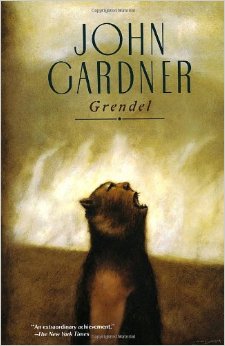
The cover for the 1989 edition of John Gardner's Beowulf-inspired Grendel.

The cover for the 1989 edition of John Gardner’s Grendel. Image from http://amzn.to/2gZcPqK

I first read John Gardner’s novel Grendel while studying for my master’s degree at the University of Victoria. The same copy I read then now sits on my shelf, begging for a reread. And it’s deserving of one, I think. I remember the novel being a complex web of meanings and interpretations, though the meaning that was front and centre was a straightforward critique of human society through the eyes of Grendel.

Yes, as the book’s title suggests, it focuses on Grendel and what he gets up to between bouts of terrorizing Heorot. But it’s not all loping around the moors, scaring animals and feasting on his victims. The humans intrigue him as they build Heorot and celebrate its beauty and light. But he also sees and feels just how different he is from the Danes. And when Grendel first sees Beowulf he has this eerie feeling that his days are numbered.

It’s a good read, and from Gardner’s flipping of the original poem’s focus, to his social commentary through the monster’s eyes, to his use of zodiac symbolism, there’s a lot to its 174 pages. If you have the chance you should check it out!

But what brought Gardner’s book to mind today was my discovery of this extract from an article that centres around Gardner’s Grendel.

The extract explains how the pop culture scholars Michael Livingstone and John William Sutton argue that though the 20th century is full of adaptations of Beowulf, Gardner’s Grendel marks a turning point in these works. Whereas those that came before the novel are usually just retellings of Beowulf tailored to suit various genres and audiences, those that came after it share in Gardner’s use of the poem and of Grendel to generate social commentary on specific figures, incidents, or observed traits of the human condition.

If you’re interested in reading their article in full, you can find it here.

Along with Livingston and Sutton’s main thesis, the article is a treasure trove of adaptations that I never even knew existed. So if you’re interested in reading historical fiction based around Beowulf, or tracking down a rock musical in which Grendel’s a punk rocker, check out that article for some extra details.

Why do you think the Beowulf story is so widely adapted? What is it about the story and its characters that make it so flexible?

Struggling against giants: A sword’s story (ll.1687-1699)

Synopsis

Original

Translation

Recordings

Europe and its Giants

A Retelling of the Flood: Poetic Fragment

Closing

The decorative grip and pommel of the Gilling Sword, like Beowulf's ancient giant sword?

The grip and pommel of the Gilling Sword, found in a stream in Yorkshire in 1976. Did the giant’s sword that Beowulf found have a similar hilt? Copyright York Museums Trust http://bit.ly/2gh8HXJ. Image from http://bit.ly/2gpntKw.

Back To Top

Synopsis

Hrothgar hefts the sword hilt that Beowulf hands him and then marvels at the wondrous story told on it.

Back To Top

Original

“Hroðgar maðelode, hylt sceawode,
ealde lafe, on ðæm wæs or writen
fyrngewinnes, syðþan flod ofsloh,
gifen geotende, giganta cyn
(frecne geferdon); þæt wæs fremde þeod
ecean dryhtne; him þæs endelean
þurh wæteres wylm waldend sealde.
Swa wæs on ðæm scennum sciran goldes
þurh runstafas rihte gemearcod,
geseted ond gesæd hwam þæt sweord geworht,
irena cyst, ærest wære,
wreoþenhilt ond wyrmfah. ða se wisa spræc
sunu Healfdenes (swigedon ealle):”
(Beowulf ll.1687-1699)

Back To Top

Translation

“Hrothgar spoke, as he was shown the hilt,
that old treasure. On it was written the origins
of a great struggle, after the flood had slain many,
sloshed through in torrents, a struggle with giant-kind;
peril was brought to all; that was a people
estranged from the eternal Lord; from the Almighty
came the final retribution of rising waters.
Thus was the pommel work written upon in gold
with runes properly inscribed,
inset and incarved, by the one who worked that sword,
the best of blades, first among weapons,
with wire-wound hilt and edge damescened like snakes. Then
the wise one spoke, the son of Healfdane — the hall hushed:”
(Beowulf ll.1687-1699)

Back To Top

Recordings

Old English:

{Forthcoming}

Modern English:

{Forthcoming}

Back To Top

Europe and its Giants

I’m glad that the poet gives us this description. It’s all too easy to imagine a sword hilt as just a piece of metal used to hold a sword, and depending on the design, maybe to help catch or parry incoming blows. But here we’re told that there’s a full blown story printed across what I imagine is the crossbar of the sword. In the picture at the top of this entry, the Gilling sword’s crossbar is just outside of the lower right corner of the frame.

The how of this story on a sword isn’t quite my strong suit. There’re runes describing the events, and they’re inlaid with gold. But what the poet means when they say that these runes are “properly inscribed” (“rihte gemearcod” (l.1695)) is quite a mystery to me. Maybe they were neatly made, unlike the chicken scratch of the poet’s day.

What I do know about is just how prevalent wars against giants are in the European imagination.

There are the Greek myths that detail the fight between the Olympian gods and the Titans.

In the Brut, an epic poem about people travelling to Britain to settle there, the travellers must first defeat a giant or two to make the land safe for themselves.

Even much much later, there are still stories of giants in things like fairy tales (“Jack and the Beanstalk”) and Jonathan Swift’s Gulliver’s Travels.

I think that the Beowulf poet is referring specifically to a race of giants called the Nephilim here. These were the offspring of fallen angels and human women, which fits since the mention of the flood seems to circle around it being a destructive force that god sent out. And the note that the sword this hilt came from was one of the first weapons (“ærest wære” (l.1697)) gels with the idea that the fallen angels who fathered those giants taught humanity about things like smithing and warfare.

What’s unclear about this story, though is if the flood came after or before the great struggle with the giants. It seems like a torrential flood would be a pretty good way to deal with oversized earth dwellers, so my guess is before, but it’s left a little ambiguous.

Why do you think this story was written on the sword’s hilt?

Back To Top

A Retelling of the Flood: Poetic Fragment

Before the “primeval struggle”1, when the world was yet young,
God on high inscribed a “rune”2 in the sky, a letter of unbinding,
That tore a hole between the clouds, as that word was sung
By angels standing all around, with ancient garment winding

around their firm frames, robes “adorned with figures of snakes”3,
Suiting costume for the “final retribution”4‘s sake.


1fyrn-gewin: primeval struggle. fyrn (former, ancient, formerly, of old, long ago, once) + winn (toil, labour, trouble, hardship, profit, gain, conflict, strife, war) [A word that is exclusive to Beowulf.]

Back Up

2run-stæf: runic letter, rune. run (mystery, secrecy, secret, counsel, consultation, council, runic character, letter, writing) + stæf (staff, stick, rod, pastoral staff, letter, character, writing, document, letters, literature, learning)

Back Up

3wyrm-fah: adorned with figures of snakes, damescened. wyrm (reptile, serpent, snake, dragon, work, inset, mite, poor creature) + fag (variegated, spotted, dappled, stained, dyed, shining, gleaming) [A word that is exclusive to Beowulf.]

Back Up

4ende-lean: final retribution. ende (end, conclusion, boundary, border, limit) + lean (reward, gift, loan, compensation, remuneration, retribution)

Back Up


Back To Top

Closing

Next week, Hrothgar speaks his mind about Beowulf.

You can find the next part of Beowulf here.

Back To Top

A Connection between The Odyssey and Beowulf? (ll.1677-1686)

Synopsis
Original
Translation
Recordings
Really Zooming in on Gift-Giving
The Value of a Skilled Smith
Closing

The decorative grip and pommel of the Gilling Sword, like Beowulf's ancient giant sword?

The grip and pommel of the Gilling Sword, found in a stream in Yorkshire in 1976. Did the giant’s sword that Beowulf found have a similar hilt? Copyright York Museums Trust http://bit.ly/2gh8HXJ. Image from http://bit.ly/2gpntKw.


Back To Top
Synopsis

The poet describes Beowulf’s gifting the hilt of his found giant sword to Hrothgar, and reiterates the Grendels’ defeat.


Back To Top
Original

Ða wæs gylden hilt gamelum rince,
harum hildfruman, on hand gyfen,
enta ærgeweorc; hit on æht gehwearf
æfter deofla hryre Denigea frean,
wundorsmiþa geweorc, ond þa þas worold ofgeaf
gromheort guma, godes ondsaca,
morðres scyldig, ond his modor eac,
on geweald gehwearf woroldcyninga
ðæm selestan be sæm tweonum
ðara þe on Scedenigge sceattas dælde.

(Beowulf ll.1677-1686)


Back To Top
Translation

“Then was the golden hilt given into the hand
of the old battle-chief, an ancient work of giants
for the aged ruler. It became the possession
of the Danish prince after those devils perished,
the craft of a skilled smith; when the hostile-hearted,
the enemies of god, gave up this world,
guilty of murder, he and and his mother as well.
Thus the hilt came into the power of the worldly king
judged to be the best between the two seas,
a treasure freely given to the Danes.”
(Beowulf ll.1677-1686)


Back To Top
Recordings

Old English:

{Forthcoming}

Modern English:

{Forthcoming}


Back To Top
Really Zooming in on Gift-Giving

This passage is weird. I mean, why spend so many words on the simple act of Beowulf giving Hrothgar the hilt of the sword that Grendel’s mother’s blood melted? It’s a strange thing to dwell on, and I can’t help but feel like it might have been a late addition.

Or, maybe like Homer’s asides and flashbacks in the Odyssey, this is meant to be a moment outside of and within time simultaneously. I’m thinking particularly of when Odysseus gets back to Ithaca and the nurse who raised him recognizes him because of a scar on his thigh. Homer uses her seeing the scar as an in to explain its origin in a brief aside.

But, maybe because the Beowulf poet’s story is about people who see themselves as a little rougher around the edges than the ancient Greeks saw themselves, scars don’t matter. And so this aside comes from an act of giving. After all, the act of giving in early British cultures was huge. It was through giving that wealth was distributed and people were meant to feel that things were given fairly. So, perhaps, along with defeating the monsters terrorizing Heorot, this hilt is meant as a tangible gift that Beowulf gives in return for all that Hrothgar gives him.

Which is kind of suiting since, although the poet calls Hrothgar a “battle-chief” (“hild-fruma” (l.1678)), he is also called “old” twice in close succession (“gamelum” on line 1677, and “harum” on line 1678). These mentions make it clear that Hrothgar’s fighting days are over.

With that in mind, how better to mark the ending of the need for such a strong leader to fight than with the hilt of an ancient sword? It too can no longer be used to fight effectively, but it also has much to say and old stories to share — as we’ll see in next week’s post.

What do you think the poet meant by going on for so long about Beowulf giving Hrothgar the hilt of the sword he found in the Grendels’ hall?


Back To Top
The Value of a Skilled Smith

It is the wish of every leader, every “battle-chief”1,
who finds themselves standing tall as an “earthly king”2,
that they have a “skilled smith”3 in their midst,
one familiar with the methods and means of “ancient works”4.
If such a smith is truly skilled and willing, then that ruler
May wield power and style against the “hostile minded”5.

1hild-fruma: battle-chief, prince, emperor. hild (war, combat) + frum (prince, king, chief, ruler)

Back Up

2woruld-cyning: earthly king. woruld (world, age) + cyning (king, ruler, God, Christ, Satan)

Back Up

3wundor-smiþ: skilled smith. wundor (wonder, miracle, marvel, portent, horror, wondrous thing, monster) + smiþ (handicraftsman, smith, blacksmith, armourer, carpenter)

Back Up

4aer-geweorc: work of olden times. aer (before that, soon, formerly, beforehand, previously, already, lately, till) + geweorc (work, workmanship, labour, construction, structure, edifice, military work, fortification)

Back Up

5gram-heort: hostile-minded. gram (angry, cruel, fierce, oppressive, hostile, enemy) + heorte (heart, breast, soul, spirit, will, desire, courage, mind, intellect, affections)

Back Up


Back To Top
Closing

Next week, Hrothgar handles the hilt and reveals its meaning.

You can find the next part of Beowulf here.

Back To Top

Beowulf meets Hollywood in Beowulf: The Blockbuster

Bryan Burroughs in Beowulf: The Blockbuster, a one man show pop culture-infused retelling of the epic.

A still from Bryan Burroughs’ one man show Beowulf: The Blockbuster. Looks like a great show! (Image from http://www.beowulftheblockbuster.com/)

I had always figured that Seamus Heaney would be the only prominent Irish figure to take on Beowulf. But. I was wrong.

The actor Bryan Burroughs has tackled the story in his one man show Beowulf: The Blockbuster. You can check out the show’s website here.

The premise for the play is that Burroughs’ character is a terminally ill father telling his son the final bed time story that he will get to tell him. But, rather than just being a straight retelling of Beowulf, it is an improvised retelling full of elements that Burroughs’ character’s son adds in.

So, instead of Beowulf just being about a lone warrior taking on demons there are things from Jaws or Nightmare on Elm Street thrown in. Or, more specifically, as Burroughs mentioned in an interview with Shelley Marsden of The Irish World, the son suggests that Grendel sounds like Chewbacca, and so Burroughs’ character obliges.

It sounds like an awesome sight to behold. Especially because, as Burroughs plays all of these different parts, he also attempts various impressions to keep them separate. I may not be able to read Beowulf‘s dialogue without slipping into a bit of Sean Connery’s accent after reading that it’s what Burroughs uses for the Geat.

Though what makes this performance interesting to me is that it wasn’t initially going to be about Beowulf.

As he explains in that interview, Burroughs wanted to explore the question of what a parent who knew they had one hour left with their child would say to them. Beowulf only came into play because it has a tight three act structure (whether he covers the whole poem or just the Grendel bit is unclear, but either way there are three acts involved), and was a way for him to tell a story about how wonderful it is to be mortal. Plus, I think that as such an archetypal story Beowulf lends itself to having other characters and stories attached to it.

As always with performances like this, the only thing I don’t really like is that it’s not likely I’ll see the whole thing. Thankfully, though, there is this excerpt. Enjoy!

A balanced Beowulf translation: J.B. Kirtlan

The cover for J.B. Kirtlan's 1913 translation of Beowulf.

Cover of J.B. Kirtlan’s 1913 Beowulf translation. Image from: http://www.gutenberg.org/ebooks/50742

This is another busy week for me, so I want to take this opportunity to bring your attention to a different kind of Beowulf adaptation: translations!

In particular, I want to share the translation that the Legends Myths and Whiskey podcast used for their Beowulf: A Mythosymphony (a reading of the story with original music and some commentary in between). This is J.B. Kirtlan’s 1913 translation.

The most notable thing about this translation is that it’s in prose rather than poetry. Though this might seem to ruin the effect of the original a bit, I think that Kirtlan’s prose makes the story pop for an audience who might not be comfortable with reading line after line of alliterative verse.

At the same time, though, since it was written over 100 years ago, the language is somewhat dated as Kirtlan throws words like “byrnie” and “banesman” around without any kind of explanation. A quick internet search will reveal the meanings of these words, but that might detract from the story for some. Likewise, he’s written with a bit of an “Olde Englyshe” affectation as he changes word order and spelling to look more archaic than the English of 1913.

Luckily, however, Kirtlan keeps the story’s pace going strong and even with the quirks of the language used, manages to tell an entrancing rendition.

All in all, Kirtlan’s is a pretty balanced translation in that its prose format keeps the story moving (even through asides), while its free use of older words maintains the flavour of the original.

Here’s a link to several formats of the complete J.B. Kirtlan translation online (via project Gutenberg). You can judge for yourself, but I think this is a translation that brings Beowulf into the modern age while also retaining some of the original’s old-ness and mixing in some turn of the century philology as well.

When it comes to a story as old and foreign-seeming as Beowulf, what do you think makes an ideal translation?