Hrothgar leaps into action, words to find an empty vassal by (ll.1397-1407)

Synopsis
Translation
Recordings
Hrothgar on the Move
Tracking an Empty Vassal
Closing

Back To Top
Synopsis

Hrothgar responds immediately to Beowulf’s egging on and sets out after Grendel’s mother.

Back To Top
Translation

“Then the old one leapt up, thanked God,
the mighty Lord, for what the man had said.
Then Hrothgar’s horse was bridled,
the one with the braided hair; the wise king
rode out in fine array; the troop of shield-bearers
marched on. Tracks were widely seen
over the trails through the wood,
leading over earth, going straight
over to the darkened moor, where the
lifeless body of the dear servant had been drug,
he who had watched over the home of Hrothgar.”
(Beowulf ll.1397-1407)

Back To Top
Recordings

Old English:

{Forthcoming}

Modern English:

{Forthcoming}

Back To Top
Hrothgar on the Move

Now we’re on the hunt! And the trail is fresh!

Though it’s hard to say which trail exactly Hrothgar and his gang are following.

At first, it sounds like it must be Grendel’s Mother’s tracks. But then we’re told that Æschere’s “lifeless body…had been drug” (“magoþegna bær/…sawolleasne” (ll.1405-1406)), so maybe the furrow left behind by his feet or head are what they’re following. If that’s the case, then the humans here involved are sowing the seeds of destruction! After all, it sounds like Hrothgar’s riding out with quite a bit of force; he is in his finest array and riding out on a horse that has a braided mane. Though the detail of the horse makes me wonder if it’s more of a show horse — perhaps even making it a reflection of Hrothgar’s own existence as more of a figurehead than the machismo-dripping leader he had been in younger days. All the while accompanied by a “troop of shield-bearers” (“gumfeþa…/lindhæbbendra” (ll.1401-1402)). So, despite appearances (maybe because of them?), Hrothgar’s serious in his ride out to the mere.

And, of course, at the head of all of this forward momentum is Beowulf. The lad’s jab about Hrothgar’s needing to be the ruler Beowulf expects him to be was likely particularly stinging.

Still, it’s telling that Beowulf is able to inspire the old king like this. It makes it pretty clear, I think, that he’s not only some great monster slayer, but he’s got charisma and diplomatic skill as well — he can slay supernatural foes with the sword (or handgrip) and he can slay human ones with his tongue.

Actually, that makes it pretty neat and tidy when it comes to the morality of Beowulf himself. There’s no weird amorality to him despite the death that he’s steeped in because all of the stories of his fights we’ve heard so far involve fights with monsters. Yes, later Beowulf tells stories of fights against armies, but there the foes are far from humanized. The old trick of making enemies into monsters being well practiced well beyond the medieval period and into antiquity. Though thinking about that practice makes me wonder what Grendel and Grendel’s mother were before they were constantly called “kin of Cain.”

Do you think that Grendel and Grendel’s mother are monsters or people whom the Danes just want to exterminate?

Back To Top
Tracking an Empty Vassal

A bunch of “lind-hæbbendra,” a “gum-fetha” of them you might even say, is on the march. Such a bunch of “lind-hæbbendra” sounds rather intimidating. And no doubt the sight of a group of “shield-bearers” or “warriors” heading somewhere would be, after all they literally “have” (“hæbben”) “shields of wood” (“lind”). So you know just by looking at them that they’re serious business. Particularly because of that “gum-feþa” formation

But what else, if not a “gum-feþa” would warriors move in? The word “troop” just feels too appropriate. All the more so, since it’s a mix of “gums” (“man,” “lord,” or “hero”) and “feþa” (“foot-man,” “foot-soldier,” “band of foot-soldiers,” or “troops”).

Just for fun now, imagine each warrior in this troop having “wunden-feax”. Such “braided hair” might make them fulfil a lot of popular conceptions of what Vikings looked like, and why not?

Along with horned helmets, braids have always been a favourite of Viking cartoonists, but what’s really surprising is how straightforward the compound “wunden-feax” is. “Wunden” just means “wind,” “plait,” “curl,” “twist,” “unwind,” “whirl,” “brandish,” “swing,” “turn,” “fly,” “leap,” “start,” “roll,” “slip,” or “go,” and “feax” just means “hair,” or “head of hair”.

What’s more, this word is exclusive to Beowulf as far as we know, so there’s got to be a pretty good understanding of what “wound hair” is. And such an understanding is most likely to come out of braided hair being a familiar sight.

Now imagine this troop of warriors with braided hair heading down a “weald-swaþu.” Somehow knowing that “weald-swaþu” means “” (weald (“forest,” “wood,” “grove,” “bushes,” or “foliage”) + swaþu (“footstep,” “track,” “pathway,” “trace,” “vestige,” or “scar”)) doesn’t make this too much easier. I mean, it’s really hard to tell how deep this forest is.

But they are tracking the “sawol-leas” “mago-þegna,” so there might be more than one track to follow.

Not that anything “lifeless” (or soul-less) would be moving much (hence the very visceral “sawol” (“soul,” “life,” “spirit,” or “living being”) + “leas” (“without,” “free from,” “devoid of,” “bereft of,” “false,” “faithless,” “untruthful,” “deceitful,” “lax,” “vein,” “worthless,” “falsehood,” “lying,” “untruth,” or “mistake”)).

And, much like the near sound alike “vessel,” a “vassal” is pretty empty if you remove its life or its soul, so our mago-þegna (“mago” (“male kinsman,” “son,” “descendant,” “young man,” “servant,” or “warrior”) + “þegna” (“servant,” “minister,” “retainer,” “vassal,” “follower,” “disciple,” “freeman,” “master,” “courtier,” “noble (official rather than hereditary),” “military attendant,” “warrior,” or “hero”)) likely did nothing but drag as it was carried off.

Though the empty furrow formed from the empty body’s dragging could be what fills our braided troop of shield-bearers with hope.

Back To Top
Closing

Next week, the trip toward the home of the Grendels continues.

You can find the next part of Beowulf here.
Back To Top

Hrothgar’s motives, wolves and ancient treasure (ll. 1368-1382)

Synopsis
Translation
Recordings
Hrothgar Holding Out?
Of Wolves and Ancient Treasure
Closing

Beowulf, Grendel, Old English, Anglo-Saxon

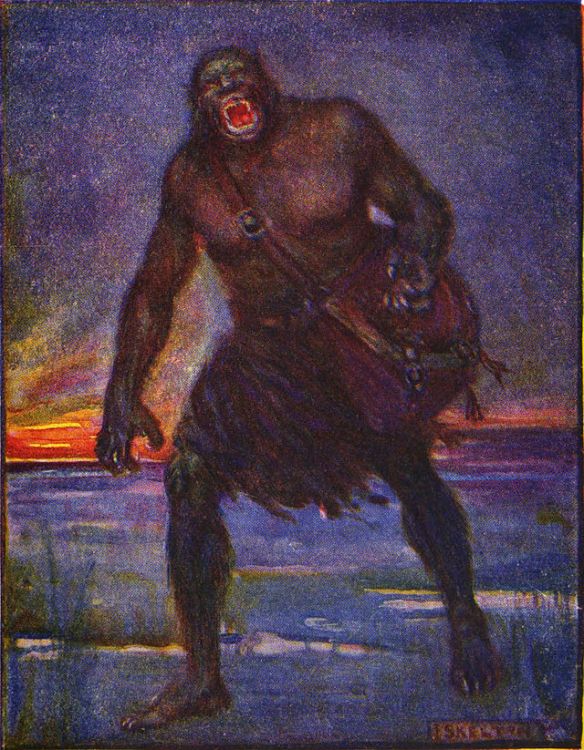
An illustration of Grendel by J.R. Skelton from Stories of Beowulf. Grendel is described as “Very terrible to look upon.”Stories of beowulf grendel” by J. R. Skelton – Marshall, Henrietta Elizabeth (1908) Stories of Beowulf, T.C. & E.C. Jack. Licensed under Public Domain via Wikimedia Commons.

Back To Top
Synopsis

Hrothgar tells Beowulf more about the terrifying surroundings of the Grendels’ home, and offers a generous reward.

Back To Top
Translation

“Even the stag harassed by wolves,
that hart strong of horn would seek security in the wood,
even if it was far off, would turn to offer its horns,
lose its life on the bank, before it would enter that water,
conceal his head. That is no pleasant place;
thence rise up surging waves
to a darkened sky, there the winds stir
hateful storms, so much so that the air becomes gloomy,
and the sky weeps. Now as before we depend
upon you alone for help. That region is not yet known,
a perilous place, there thou mayst find
the very guilty creature; seek it out if thou darest.
I will reward you with great wealth for ending this feud,
award you with ancient treasures, as I did already,
works of twisted gold, if thou goest on this way.”
(Beowulf ll.1368-1382)

Back To Top
Recordings

Old English:

{Forthcoming}

Modern English:

{Forthcoming}

Back To Top
Hrothgar Holding Out?

In the moment, Beowulf probably didn’t think twice about Hrothgar’s offer. “More treasure? For just killing another monster? Sure!” could very well be his internal monologue.

But does Hrothgar know more than he lets on?

Considering the fact that he’s able to go on for lines about the characteristics of the mere, and yet he says “that region is not yet known” (“[e]ard git ne const” (l.1377)) really makes me wonder. Plus, I don’t think that anyone who knew nothing about a place could paint as rich a picture as Hrothgar does when he uses the example of the buck who would rather die than escape the wolves by swimming away through the mysterious burning waters.

Sure, fear could be a factor here.

Maybe Hrothgar is speaking as someone who is terrified of this place, and so his description of it is tinged with the fear of the unknown; he has released his doubts about the place in exchange for grasping whatever slivers of information there are available to him as tightly as possible. And then he’s blown them out of proportion.

Though, perhaps this description isn’t coming from a frightened old man.

As a warrior himself, and someone who had to prove himself in his earlier days just as Beowulf is doing now, maybe Hrothgar is being quite shrewd here. The description he gives, with all of its extreme dangers and air of mystery despite the details would definitely appeal to Beowulf’s sense of hunting down glory. Though, really, even if Hrothgar said that Grendel’s mother could be found in the bread wall at the local grocery store, I’m sure Beowulf would go after her. He is that kind of fighter after all.

What’s more troubling anyway is that Hrothgar’s marking the end of this feud with the death of Grendel’s mother suggests something other than rhetoric. I think that it’s the poet’s way of suggesting that gaining a reputation for fighting and slaying monsters as Beowulf did when he beat Grendel (and even before if his boasts are to be believed) leads not to an end of your struggles with the unknown but to their continuation.

In fact, if you become known as an expert monster slayer, you’ll do it until the thing fighting as the supernatural’s representative naturally overcomes you, the natural. After all, as the stakes are raised more and more the best a mere mortal can do is take down the monstrous with them.

What do you think Hrothgar knows about the Grendels that he’s not telling Beowulf?

Back To Top
Of Wolves and Ancient Treasure

I feel like it’s a bit judgy, from the perspective of a people relying on crops and livestock for sustenance and trade a “hæð-stapa” would be very bad news. At least in some cases.

The word “hæð-stapa” is kind of an odd one since it can mean either “wolf” or “hart.” As strange as that sounds, it makes sense since the word’s literal translation is simply “heath-stalker.”

In fact, since “hæð-stapa is a combination of “hæð” (“heath,” “untilled land,” “waste,” or “heather”) and “stapa” (“going,” “gait,” “step,” “pace,” “spoor,” “power of locomotion,” “short distance,” or “measure of length”), it could be taken to mean just about anything that is known to wander land that is unused by humans. Perhaps that’s why adding “fela-sinnigne” to “hæð-stapa” points it towards “wolf”.

After all, I haven’t met many deer that I would call “very guilty,” the very literal meaning of “fela-sinnigne” (fela (“many,” or “much”) + sinnigne (“guilty,” “punishable,” “criminal,” or “sinful”)).

But whatever judgments are passed, such a “fela-sinnigne” “hæð-stapa” is right at home in a “holt-wudu.”

That word combines “holt” (“forest,” “wood,” “grove,” “thicket,” “wood,” or “timber”) and “wudu” (“wood,” “forest,” “grove,” “tree,” “the Cross,” “Rood,” “wood,” “timber,” “ship,” or “spear shaft”) to mean simply “forest,” “grove,” or “wood,” though I’m sure that the doubling of a similar meaning in both words means that this is the deepest of forests.

Just as “yð-geblond” could refer to the mysterious waters of casa Grendel or to the roiling waves of the open sea. I mean, this compound does literally mean “wave” (“yð”) “mix” (“blandan”) after all.

But wolves (guilty or otherwise) are in short supply on the open sea, while something much more valuable is there for the taking thanks to shipwrecks and Viking burials. Yes, the ocean is home to much “eald-gestreon.”

Once again (seems there’s a trend in this passage’s compound words) the word “eald-gestreon” literally means “ancient treasure” (being a mix of “eald” (“aged,” “ancient,” “antique,” “primeval,” “elder,” “experienced,” “tried,” “honoured,” “eminent,” or “great”) and “streon” (“gain,” “acquisition,” “property,” “treasure,” “traffic,” “usury,” or “procreation”)).

So, in a sense you could say that the “fela-sinnigne hæð-stapa” is to the “holt-wudu” as the “eald-gestreona” is to the “yð-geblond.”

Back To Top
Closing

Next week: Beowulf’s reply!

You can find the next part of Beowulf here.
Back To Top

Where Beowulf meets baseball

Whoops, it’s Friday, isn’t it?

Since I was getting over a nasty cold earlier in the week and then had a job to finish off for the end of the week (and a podcast to edit in between), I didn’t get to finish this week’s Beowulf entry.

As a bit of a fill-in for this week, I found a neat news piece related to Beowulf. Surprisingly, baseball, Beowulf, and J.R.R. Tolkien’s The Hobbit cross over.

Click through to find out how:

http://www.forbes.com/sites/maurybrown/2016/05/11/remembering-the-epic-new-york-times-correction-on-the-hobbit-name-of-r-a-dickeys-baseball-bat/#57d50a4f25e8

Flaming waters and who measures out miles anyway? (ll.1357b-1367)

Synopsis
Translation
Recordings
A Weird Home with Flaming Water
The Wondrous Life of a Mile Measurer
Closing

Beowulf, Grendel, Old English, Anglo-Saxon

An illustration of Grendel by J.R. Skelton from Stories of Beowulf. Grendel is described as “Very terrible to look upon.”Stories of beowulf grendel” by J. R. Skelton – Marshall, Henrietta Elizabeth (1908) Stories of Beowulf, T.C. & E.C. Jack. Licensed under Public Domain via Wikimedia Commons.

Back To Top
Synopsis

Hrothgar tells Beowulf (and us) about where the Grendels live.

Back To Top
Translation

&nbsp:&nbsp:&nbsp:&nbsp:&nbsp:&nbsp:&nbsp:&nbsp:&nbsp:&nbsp:&nbsp:&nbsp:&nbsp:”They occupy that
strange land, along wolf-inhabited slopes, near wind-wracked cliffs,
up the perilous fen-path, where mountain streams
fall through mists from the headlands,
water creeping from underground. It is not many miles
hence that their mere can be found,
with frost-covered groves overhanging it;
tree roots overshadow those waters with their interlocking embrace.
Each night there you can see the oddest of wonders,
the water catches fire; none among the dear wise
children of humanity know of those waters’ bottom.”
(Beowulf ll.1357b-1367)

Back To Top
Recordings

Old English:

{Forthcoming}

Modern English:

{Forthcoming}

Back To Top
A Weird Home with Flaming Water

Wonder upon wonder! After telling us that Grendel and Grendel’s mother were known to the people living on his lands, Hrothgar goes on to describe where the two live. And it doesn’t sound very hospitable.

Wolves on the slopes (“wulfhleoþu” l.1358), paths that cut through the marsh (“fengelad” l.1359), and everything is covered in mist (“genipu” l.1360). It sounds downright swampy.

Given this description of the monstrous Grendels’ home it’s no wonder it’s the Anglo-Saxon (read British) default to ascribe brutality and low intelligence to people who live in the backwoods and hills. If the presentation of Grendel and Grendel’s mother are anything to go on, making these people monsters (as we still do in horror movies to this day), is one of the oldest stereotypes carried down by speakers of English.

But that’s not the worst of it.

Along with being in such a perilous place, the water there burns by night. Water’s not supposed to burn. And especially not at night. And yet this stuff does.

Maybe it’s marsh gas (viewers of the Jon Pertwee Doctor Who story “Carnival of Monsters” might know how flammable the stuff can be).

Or maybe it’s just the light of the moon rippling off the water between tree branches in such a way that it looks like the water is glowing.

Or, weirdest of all, maybe the fires that dance upon the lake’s surface at night are lights for those below. Maybe this is the site of an anti-Heorot, a place where monsters kick back, drink their malts and eat strictly vegetarian meals.

It sounds crazy, but, as we’ll learn later on, the Grendels do have a rather mysterious cave/hall to call their own.

And why not introduce an anti-Heorot here?

So few people adapt the poem beyond the confrontation with Grendel’s mother. But, if you look at the poem as a thing divided into thirds based on the three major fights something interesting appears. Along with three monsters (Grendel, Grendel’s mother, and the dragon) there are three halls that are featured (Heorot, the Grendel’s, and Beowulf’s). So why shouldn’t the water on fire be lights coming up from the deep, where monsters play and frolic, while one of them plays an old rib cage like a xylophone?

What do you think is causing the water of this strange lair to look like it’s burning by night?

Back To Top
The Wondrous Life of a Mile Measurer

The area that Hrothgar talks about in this passage seems quite remote. It contrasts quite a bit with the tame paths and meadows around Heorot. At some point though, he must have asked someone to “mil-gemearc” the distance between Heorot and this place.

Literally, such a request would have been to “mark the miles” between the two, though “measure by miles” is far less imperative. Not that it’d be difficult to make these two words sound like a command when put together. They’re quite straightforward. “Mil” means “mile” and “gemearc” means “mark,” “sign,” “line of division,” “standard,” “boundary,” “limit,” “term,” “border,” “defined area,” “district,” or “province.”

What I wonder, though, is whether or not Hrothgar sent the same person or another to measure out the “fen-gelad.” Measuring out a “marsh-path” would be a bit more treacherous, since I doubt the ground would be very solid. I mean the two words “fen” (“mud,” “mire,” “dirt,” “fen,” “marsh,” “moor,” or “the fen country”) and “gelad” (“course,” “journey,” “way,” “street,” “water-way,” “leading,” “carrying,” “maintenance,” or “support”) going together don’t really give the sense of a path around the marsh, but rather directly through it. “Fen-gelad” sounds like it describes a path that is itself marshy.

It’d be all the worse for our measurer if they were told to go all the way to where the “fyrgen-stream” drop down into the marsh. Those “mountain streams” would be pretty deep into the fen, I’d wager. After all, the only interpretation for “fyrgen” in this context is “mountain,” so whatever sense of “stream” you went with (“stream,” “flood,” “current,” “river,” or “sea”), would need to be coming off of a mountain. And it sounds like Heorot is quite far from most mountains.

As hard a task as all this measuring out would be, I imagine that the person doing it would see some “nið-wundor.” How could they not see a “dire wonder” or “portent” along such a path? Though seeing such a thing wouldn’t necessarily uplift their spirits. “Wundor” is at least neutral, meaning simply “wonder,” “miracle,” “marvel,” “portent,” “horror,” “wondrous thing,” or “monster”. But “nið” refers to “abyss,” “strife,” “enmity,” “attack,” “war,” “evil hatred,” “spite,” “oppression,” “affliction,” “trouble,” or “grief.” So these sights may leave whatever measurer of miles that sees them with grief.

Indeed, such “nið-wundor” likely include sights like a “wulf-hleothu.” I’d be pretty distressed if I had to pass by a hillside where wolves lived after all. They’d have the higher ground and all sorts of advantages. Though, they might also be devils in disguise since “wulf” can translate as “wolf,” “wolfish person,” or “devil”. They’d definitely be on a hillside, though: “hleoþu” only means “cliff,” “precipice,” “slope,” “hillside,” or “hill”.

Back To Top
Closing

Next week, Hrothgar further describes this strange place and promises Beowulf a great reward.

You can find the next part of Beowulf here.
Back To Top

Hrothgar tells tales of the Grendels, idyllic country-dwellers risk exile (ll.1345-1357a)

Synopsis
Translation
Recordings
Hrothgar Lays his Land Claims
The Rise and Fall of a Country-Dweller
Closing

Beowulf, Grendel, Old English, Anglo-Saxon

An illustration of Grendel by J.R. Skelton from Stories of Beowulf. Grendel is described as “Very terrible to look upon.”Stories of beowulf grendel” by J. R. Skelton – Marshall, Henrietta Elizabeth (1908) Stories of Beowulf, T.C. & E.C. Jack. Licensed under Public Domain via Wikimedia Commons.

Back To Top
Synopsis

Hrothgar shares what his people have told him about Grendel and his mother.

Back To Top
Translation

“I have heard the dwellers in the land, my people,
and my hall counsellors say,
that they have seen two such
mighty prowlers of the murky moors protecting them,
alien creatures; there one of them,
they all can say with great certainty,
has a woman’s likeness; the other unfortunate
in a man’s form treads the path of exile,
but never had they seen a bigger man;
in earlier times the dwellers in the land named
him Grendel; they knew not their lineage,
their parentage was said to be hidden among
mysterious spirits.”
(Beowulf ll.1345-1357a)

Back To Top
Recordings

Old English:

{Forthcoming}

Modern English:

{Forthcoming}

Back To Top
Hrothgar Lays his Land Claims

After Hrothgar has questioned Beowulf’s effectiveness, the hall ruler changes his approach. He starts to finally tell us more about Grendel and Grendel’s mother. And it sounds like there are things that Hrothgar can tell us — even if they are just hearsay.

It’s definitely important that there are only two of these creatures. Though it’s curious that the way that all of Hrothgar’s people go when wondering about their origins is down the road of “mysterious spirits” (“dyrnra gasta” (l.1357)). None of Hrothgar’s people say that these two are just two exiles from long ago.

In fact, since in earlier times people would often cast out children who were born with physical defects, maybe that’s what Grendel is: a person with a physical disability of some kind. His mother, then, is indeed a woman but, since Grendel’s as big as he is, in this scenario she probably went out into the wilderness with him. Then the two were away from human society for so long that they’ve forgotten how to talk and express themselves in a recognizable way.

Whatever the case is, Hrothgar’s sharing these mysterious stories of Grendel sightings call into question just how objectively the two are monsters after all. As I’ve said before, maybe the “monster” label is just Hrothgar’s label for two people that were exiled so long ago that all they share with his people are their shapes and likenesses.

I also really wonder about the use of “land-buend” (l.1345) and “fold-buend” (l.1355) in this passage.

Both words basically mean “someone living in the land” as opposed to someone living in a more populated settlement like the one that’s undoubtedly around Heorot. So not only does Hrothgar not recognize these two monsters as long exiled and unfamiliar people, it also sounds like he’s asserting his ownership of the land via possession pretty hard here. Almost as if he (or maybe just the poet) is well aware of how he encroached on the land that Grendel and his mother once had to themselves.

The matter of land ownership and identifying yourself with the land and the people living on it with the land is the angle that hooks me to tightest when I’m reading through Beowulf. It’s so interesting to me because I’m thoroughly convinced that politics of land ownership and identification as a singular people are major themes in Beowulf. And here Hrothgar’s pushing pretty hard to put the beings that he’s feuding with in the “not us” category otherwise known as “monsters” dwelling on the borders of his territory while also working to convince Beowulf that the people living on the land are indeed his people.

What do you think Hrothgar’s history with Grendel and Grendel’s mother is? Are the two creatures exiles or monsters? Could Grendel be an illegitimate son of Hrothgar whom he threw out to secure his power?

Back To Top
The Rise and Fall of a Country-Dweller

Being a person who “lives on the land” sounds like a rough life. But, I think even when Beowulf was being dreamed up there was a sense that such a life was simpler. After all, if you were a “land-buend,” you literally were a “dweller” or “inhabitant” (buend) on the “land” (the Old English word “land” meaning “earth,” “land,” “soil,” “territory,” “realm,” “province,” “district,” “landed property,” “country (not town),” or “ridge in a ploughed field”).

That there’s an almost identical word with similar meaning convinces me that country life was idealized even more.

“Fold-buend” after all, just means “earth-dweller” or “man” or “inhabitant of a country” — it’s the more concrete cousin of “land-buend” no doubt because the one word that makes the difference between the two, “fold” means “earth,” “ground,” “soil,” “terra firma,” “land,” “country,” “region,” or “world”. But really, it’s just a difference of degrees. “Land” is somehow more abstract (with its meanings of “territory,” or “province” or “country (as opposed to town)”), while “fold” is more about the dirt and soil themselves.

But aside from understanding those who lived on the land as country-dwellers and also as people living somehow more in tune with the earth (living capital “o” “On it”), country people might’ve been regarded as more fortunate because they had the protection of a “sele-raedend” without having much to do with them.

Sure farmers would have to go to war with their “sele-raedend,” he is the “hall ruler or possessor” after all, but they wouldn’t have been expected to perform great deeds or distinguish themselves in battle. That would be the duty of the hall ruler’s closest posse (the “comitatus”).

Although, since “sele-raedend” breaks down into “sele” (“hall,” “house,” “dwelling,” or “prison”) and “raedend” (“controller,” “disposer,” “ruler,” or “diviner”) it’s quite possible that simple household owners or heads of families would regard themselves as the “sele-raedend” of their own dwelling.

Which is all fine and good until one of these heads of an outlying family got it into their heads that they could do a better job of ruling the people. If their plot succeeded, great! But if it failed, they’d either be killed on the spot or forced onto the “wraec-lastas” or “path of exile.”

The word comes from the mix of “wraec” (“misery,” “vengeance,” “persecution,” “enmity,” “punishment,” “penalty,” “cruelty,” “misery,” “distress,” “torture,” or “pain”) and “lastas” (“sole of foot,” “spoor,” “footprint,” “track,” “trace,” “gait,” or “step”), which outlines quite nicely what exile is all about: a path of punishment, torture, and misery.

I mean, in a time when everyone in a community relied on each other not just for niceties and a sense of connectedness but for food and protection, being forced out on your own would indeed make you “earm-sceapan.” You would be left “unfortunate” or “miserable.”

Such is the outcome of failed rebellion and such is the meaning of that mix of “earm” (“arm,” “foreleg,” “power,” “poor,” “wretched,” “pitiful,” “destitute,” or “miserable”) and “sceapan” (“shape,” “form,” “created being,” “creature,” “creation,” “dispensation,” “fate,” “condition,” “sex,” or “genitalia”).

Although, perhaps all hope would not be lost. If you managed to survive long enough to say that your being forced into exile happened in “gear-dagum” you could then call yourself (perhaps with pride) a “mearc-stapa.”

Although, if you were living outside of society for so long that you’d think of your exile as having happened in “the days of yore,” then maybe you’d have lost touch with reality enough to come up with the combination of “mearc” (“mark,” “sign,” “line of division,” “standard,” “boundary,” “limit,” “term,” “border,” “defined area,” “district,” or “province”) and “stapa” (“going,” “gait,” “step,” “pace,” “spoor,” “power of locomotion,” “short distance,” “measure of length,” “step,” “stair,” “pedestal,” “socket,” “grade,” or “degree”) to mean “march-haunter.”

Perhaps, if he or his mother were given any dialogue, that’s what Grendel or Grendel’s mother would be calling themselves.

Back To Top
Closing

Next week, Hrothgar tells us more about Grendel and his mother, and about where the duo live.

You can find the next part of Beowulf here.

Back To Top

Wondering about the central feud, a treasure-giver’s compassion (ll.1333b-1344)

Synopsis
Translation
Recordings
Who’s Feud is it Anyway?
A Treasure-Giver’s Potentially Life-Changing Compassion
Closing

Beowulf, Grendel, Old English, Anglo-Saxon

An illustration of Grendel by J.R. Skelton from Stories of Beowulf. Grendel is described as “Very terrible to look upon.”Stories of beowulf grendel” by J. R. Skelton – Marshall, Henrietta Elizabeth (1908) Stories of Beowulf, T.C. & E.C. Jack. Licensed under Public Domain via Wikimedia Commons.

Back To Top
Synopsis

Hrothgar laments the continuation of his feud with the Grendels.

Back To Top
Translation

“‘She carried on that feud,
that you the other night enflamed by killing Grendel
in your violent manner with the might of your grip,
since he had for so long a time terrified my people,
rended and grieved them. He fell in the fight
and forfeited his life; and now another
wicked ravager has come, looking to avenge her kin,
she who has already done much for her vengeance,
so it may seem to many thanes,
after they have seen their ring-giver weeping from the heart,
his dire distress; now that the hand lay still,
the hand that proved generous to every desire.'”
(Beowulf ll.1333b-1344)

Back To Top
Recordings

Old English:

{Forthcoming}

Modern English:

{Forthcoming}

Back To Top
Who’s Feud is it Anyway?

This time around Hrothgar calls out Beowulf not for doing well in killing Grendel, but for calling a second, unexpected, wicked ravager down upon Heorot.

It’s not like Beowulf could know that this would happen of course. In fact, although feud terminology had been used before, since it’s only after Grendel’s killed that we hear about his kin at all really makes me wonder how apt the word “feud” (“fæhðe” l.1333) is here. I mean, a feud in Anglo-Saxon Britain consisted of two groups clashing over and over again because of a single grievance or a string of grievances.

So, is the only grievance that Grendel and his kind had with Heorot that Hrothgar put a noisy party hall up so close to their quiet and simple fen? And if this did actually cause something that could be called a feud, then why was Grendel the sole ravager of Heorot? Why did Grendel care so much to lash out against the Danes while his mother only came on the scene once Grendel was killed?

Basically, what is this feud that Beowulf “enflamed” (l.1334)?

Weren’t Hrothgar’s danes only feuding against Grendel? Or were they actually feuding against all of monsterkind and Grendel was just that side’s representative, while the Danes had no single entity to represent them?

This is a very weird moment in the poem for these reasons. Although the poet doesn’t explicitly make the situation all that more complicated by adding in the mother character and renewing the feud that Hrothgar has with the Grendels, the concept of a feud passing from one family member who is incredibly invested to another who seems unable to care any less about it is baffling. I mean, I know she lost her son to the feud, but can it really be considered the same feud if Grendel was attacking Heorot because they barged into his home while his mother attacks for vengeance? Or did Hrothgar, Dorothy Gale-like, drop Heorot on Grendel’s dad?

Maybe this is so baffling because it’s supposed to illustrate the human misunderstanding of the natural world of which it is a part. Hrothgar calls Grendel’s apparent grudge a feud only because that’s the closest thing he knows to describe the way that Grendel is acting. But maybe the reality of the situation is entirely different; there is no feud, only one creature fighting for his land and another fighting to gain vengeance for her son.

Who do you think the feud is against? Hrothgar and the Grendels? Humans and monsters?

Back To Top
A Treasure-Giver’s Potentially Life-Changing Compassion

If there were ever an ideally compassionate “sinc-giefa” they would feel a great “hreþer-bealo” for “wel-hwylcra” “man-scaða.”

After all, it is the “sinc-giefa”‘s role in Anglo-Saxon society to distribute treasure. It’s right there in the name — a mix of “sinc” (“treasure,” “riches,” “gold,” “valuables,” or “jewel”) and “giefa” (“donor”).

And so an ideal “sinc-giefa” would feel a deep sadness, a heart sorrow for those they cannot given to, that their tremendous gifts cannot extend bonds of loyalty and friendship to. A good Old English name for that feeling is “hrether-bealo,” a combo of “hrether” (“breast,” “bosom,” “heart,” “mind,” “thought,” or “womb”) and “bealo” (“bale,” “harm,” “injury,” “destruction,” “ruin,” “evil,” “mischief,” “wickedness,” “malice,” “noxious thing,” “baleful,” “deadly,” “dangerous,” “wicked,” or “evil”). A “poison thought” could be another way to look at that. Though what would that mean?

Whatever it meant, I’m sure that all those who declared themselves that giver’s enemy would leave such a giver of treasure feeling treacherously sad. Yes, “wel-hwylc” of those self-declared enemies would have that effect. And you can’t get much more all encompassing than “wel-hwylcra” since “wel” means “well,” “abundantly,” “very,” “very easily,” “very much,” “fully,” “quite,” or “nearly”; and “hwylc” means “each,” “any,” “every (one),” “all,” “some,” “many,” “whoever,” or “whatever”. Put them together and you have a “fully all” situation on your hands (“nearly some” notwithstanding).

Though, if all of those “mān-scaða” were to turn away from being enemies, if they were to repent as “sinners” might, then our all-compassionate treasure giver could offer quite lovely rewards. Though it would take a lot for a “mān-scaða” to turn around on their path — each word in that compound has heavy negative connotations,after all.

I mean, we’ve got “mān” (evil deed, crime, wickedness, guilt, sin; false oath; bad, criminal, false) and “sceaða” (“injurious person,” “criminal,” “thief,” “assassin,” “warrior,” “atagonist,” “fiend,” “devil,” or “injury”), so you know that such an enemy or sinner is pretty steeped in their opposition of our hypothetical compassionate ring giver.

And, unfortunately, that’s just about that. All of the “hreþer-bealo” our compassionate “sinc-giefa” feels won’t turn “wel-hwylcra” “mān-scaða” from foe to friend. Though their compassion might get a few to switch over if that compassion is truly irresistible.

Back To Top
Closing

Hrothgar reveals some local lore about the Grendels, next week at A Blogger’s Beowulf.

You can find the next part of Beowulf here.

Back To Top

Beowulf’s effectiveness questioned, words for advisers (ll.1321-1333a)

Synopsis
Translation
Recordings
Beowulf: a Half-Assing Hero?
Seeking Advice when faced with a Murderous Sprite
Closing

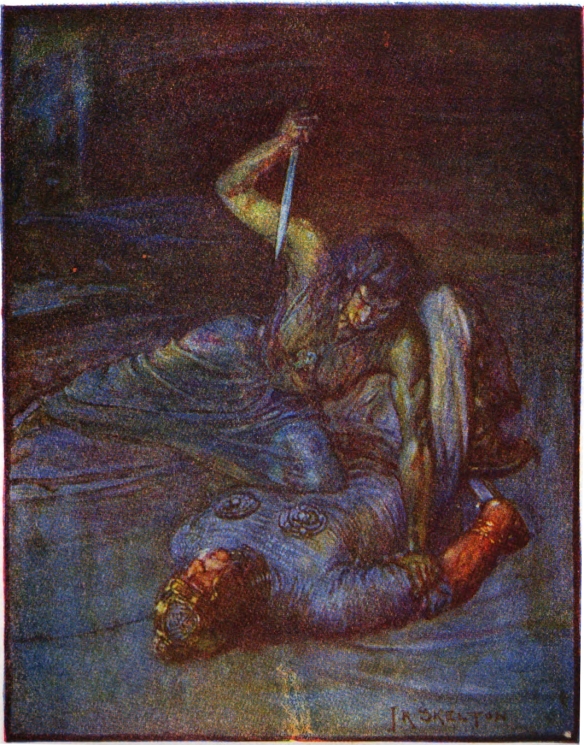
Grendel's mother menaces a pinned Beowulf with a knife.

By J. R. Skelton – Marshall, Henrietta Elizabeth (1908) Stories of Beowulf, T.C. & E.C. Jack, Public Domain, https://commons.wikimedia.org/w/index.php?curid=11001837

Back To Top
Synopsis

Hrothgar explains why Æschere was so dear, and faces the reality that now confronts his taken friend.

Back To Top
Translation

“Hrothgar spoke, protector of the Scyldings:
‘Ask ye not about the night’s joy; sorrow is renewed
to the Danish people. Æschere is dead,
Yrmenlaf’s elder brother,
my counsellor and confidant, my adviser,
my shoulder companion, when we at battle
were both at the fore, when we clashed with foes,
when the boar figures were struck. So should a man be,
a warrior who has proven his worth, so Æschere was!
This deadly creature came wandering to Heorot
to kill him by hand; I know not to what secret place
that terrible one slunk to turn him to carrion,
to make of him a gladdening feast.'”
(Beowulf ll.1321-1333a)

Back To Top
Recordings

Old English:

{Forthcoming}

Modern English:

{Forthcoming}

Back To Top
Beowulf: a Half-Assing Hero?

Hrothgar is laying it all out there. The warrior that Grendel’s mother carried off wasn’t just some thane or some hall dweller, but his dearest companion and, from the sound of it, his trusted long-time adviser. Of course, all of this comes across in Hrothgar’s relating how he and the man fought side by side in the heat of battle, as well as the statement that he “had proven his worth” (“ærgod” (l.1329)). This line is a bit difficult to swallow for me, though.

It sounds like Hrothgar might be calling Beowulf out here, only lightly and through implication, but still. Yet, hasn’t Beowulf also proven himself as a warrior in defeating Grendel? It sounds like the difference is that the foes that Hrothgar and Æschere beat in their heyday didn’t retaliate after a sound thrashing. But, being monsters (and yet, very human since she is motivated by grief for family), Grendel’s mother does so. I definitely get a strong sense that along with Hrothgar’s woe in losing Æschere there’s a sense that Beowulf did not entirely complete the job.

Sure, the Geat killed Grendel, but he didn’t manage to rid Heorot of its monster problem. Though, of course Beowulf and everyone else had no idea that Grendel had a mother, or a family.

In fact, leading up to his appearance, Grendel is only ever referred to as the “kin of Cain.” We’re never really told anything else about his other relations. It’s almost as if Grendel wasn’t born through sex and conception, but instead sprang fully formed from Cain’s murdering Abel; as if he himself is a physical manifestation of a terrible sin. One that would have a lot of resonance with people like the Anglo-Saxons because of their familiarity with stories like Hod’s killing his brother Balder. Though that is a story of accidental fratricide.

What do you think? Is Hrothgar about to lay into Beowulf for not realizing that Grendel’s mother would come crashing in on Heorot’s new “peace”? Or was Grendel’s mother a surprise to everyone and Hrothgar is struggling through his grief and shock to try to say “Beowulf, do it again!”?

Back To Top
Seeking Advice when faced with a Murderous Sprite

If you’re ever about to encounter a “wæl-gæst,” you’d likely want to get some advice. Why? Because running into a “murderous sprite” (from “wæl” (“slaughter,” or “carnage”) and “gæst” (“breath,” “soul,” “spirit,” “life,” “good or bad spirit,” “angel,” “demon,” “Holy Ghost,” “man,” or “human being”)) is no small thing.

You’d definitely want to go and seek a “run-wita.”

Such a person is someone who could be considered an adviser. After all, “wita” means “sage,” “philosopher,” “wise man,” “adviser,” “councillor,” “elder,” “senator,” “witness,” or “accomplice”); and run means “mystery,” “secrecy,” “secret,” “counsel,” “consultation,” “council,” “runic character,” “letter,” or “writing”. So such a person would be able to tell you much that is mysterious or secret.

Though your adviser should also be someone whom you could trust indefinitely because of the mysteriousness of your situation (how else can you be sure of their secretive information?).

So you’d want someone whom you could (or, hopefully already do) consider a person that you’ve been to shoulder to shoulder with before – whether it was in a tight shield wall formation on the battle field or it was waiting together in a packed line at some government office. The kind of person whom you could call an “eaxl-gestealla” with confidence, a person who indeed was a “shoulder-companion” (from the combination of “eaxl” (“shoulder”) and “steall” (“standing,” “place,” “position,” “state,” “stall (for cattle),” “stable,” or “fishing ground”)).

This sort of adviser would, in that way, be more than just someone giving you some pointers, they would be a veritable “ræd-bora.” That is, someone whom you consider a ruler (bora, or “ruler”) of wisdom (ræd (that is: “advice,” “counsel,” “resolution,” “deliberation,” “plan,” “way,” “design,” “council,” “conspiracy,” “decree,” “ordinance,” “wisdom,” “sense,” “reason,” “intelligence,” “gain,” “profit,” “benefit,” “good fortune,” “remedy,” “help,” “power,” or “might”)).

And, of course, given the fact that people might think you’re crazy if you come to them asking for help with a murderous sprite problem, your chosen adviser should be someone whom you knew was good at sharing tips from way back, or, as the Anglo-Saxons would say, was “ær-god.” This word comes from the combination of “ær” (“ere,” “before that,” “soon,” “formerly,” “beforehand,” “previously,” “already,” “lately,” or “’til”) and “god” (“good (of persons or things),” “virtuous,” “desirable,” “favourable,” “salutary,” “pleasant,” “valid,” “efficient,” “suitable,” “considerable,” “sufficiently great,” “good thing,” “advantage,” “benefit,” or “gift”) to mean “good from old times.”

With such an “ær-god” person on your team, you could definitely survive the quest to the murderous sprite and the “eft-sið,” or “journey back” (from “eft” (“again,’ “anew,” “a second time,” “then,” “thereupon,” “afterwards,” “hereafter,” “thereafter,” “back,” “likewise,” or “moreover”) combined with “sið” (“going,” “motion,” “journey,” “errand,” “departure,” “death,” “expedition,” “undertaking,” “enterprise,” “road,” “way,” “time,” “turn,” or “occasion”)).

Back To Top
Closing

Next week Hrothgar talks Beowulf.

You can find the next part of Beowulf here.

Back To Top

Hrothgar’s renewed sorrow, an Anglo-Saxon syllogism (ll.1302-1309)

Synopsis
Translation
Recordings
The Man Grendel’s Mother Seized
An Anglo-Saxon Syllogism
Closing

Back To Top
Synopsis

After a week off from the blog we return to the poet showing us how Hrothgar takes the news of Grendel’s Mother’s visit.

Back To Top
Translation

“Uproar burst forth from Heorot; in blood she’d seized
the best known hand; sorrow was renewed,
it had happened again in that hall. Their trade was harsh,
both parties had to pay a steep price
with the lives of friends. Hrothgar was now an old king,
a grey-haired battle-ruler, troubled at heart,
when he had heard his chief retainer was lifeless,
when he learned his dearest follower was dead.”
(Beowulf ll.1302-1309)

Back To Top
Recordings

Old English:

{Forthcoming}

Modern English:

{Forthcoming}

Back To Top
The Man Grendel’s Mother Seized

Since Grendel’s mother has left the poet returns his focus to Heorot itself. But, he does so only to find it awash in all of the emotions that Beowulf had supposedly rid it of. As the brief half-line 1303b has it: “sorrow was renewed” (“cearu wæs geniwod”).

That might sound like quite an extreme escalation, but it’s clearer than crystal that the man Grendel’s mother took was an important one.

First off there’s the word “ealdor-þegn” on line 1308. I’ve defined this word as “chief retainer,” but one of the definitions of the word “þegn” is “noble” with the clarification that it refers to nobles who are officially so rather than noble by birth. So, this man that Grendel’s mother carried off had truly distinguished himself in the past. We never have the details revealed to us, but he definitely must have done something great to be elevated to a status that’s referred to with a word that means, at least in a sense, “noble by deed rather than by birth.”

Though it is possible that this man was noble by birth and his deed only confirmed this status.

Nonetheless, another word that tells a lot about this man whose death has plummeted Hrothgar into the pit of despair is the incredibly straightforward “freond.” One of the few words that makes it from Old English to Modern English with little modification (aside from the simplifying of the dipthong “eo” into “e”), this word means in Old English what it does in Modern English: friend. It can also mean “relative” or “lover.”

But in the context that we find it here, “freond” refers to Grendel and this taken man.

Grendel is his mother’s son, sure, but what then is this taken man to Hrothgar?

Clearly he’s as close as family since his death causes Hrothgar to lose all the vigour he’d regained upon hearing of Beowulf’s triumph over Grendel. Maybe the two were even lovers, though there don’t seem to be many homoerotic undertones in the poem. Unless, of course, homo-eroticism was just something that happened when Beowulf was being put together and so the signals of it are subtler than I’m used to.

What do you think this taken man was to Hrothgar? Simply a noble friend and advisor? Someone as close as a brother? Or were the two men long-time lovers?

Back To Top
An Anglo-Saxon Syllogism

In this week’s brief passage, there’re only two compound words. So this week’s attempt to string its passage’s compound words together will be brief. And built on what I know of the Anglo-Saxon social hierarchy (which, admittedly, isn’t much).

Every “ealdor-þegn” is a “hilde-rinc,” but not every “hilde-rinc” is an “ealdor-þegn.”

I’ll explain.

The word “ealdor-þegn” means “chief attendant,” “retainer,” “distinguished courtier,” “chieftan,” or “chief apostle.” Since I don’t think the taken man in this passage was just an attendant, I’ve combined a few senses of this compound to translate it as “chief retainer.”

This word comes to its meaning through the combination of “ealdor” (“elder,” “parent,” “ancestors,” “civil or religious authority,” “chief,” “leader,” “master,” “lord,” “prince,” “king,” “source,” “primitive,” or, it could also mean “life,” “vital part,” “age,” “old age,” or “eternity”) and “þegn” (“servant,” “minister,” “retainer,” “vassal,” “follower,” “disciple,” “freeman,” “master (as opposed to slave),” “courtier,” “noble (official as distinguished from hereditary),” “military attendant,” “warrior,” or “hero”).

So the idea behind this compound is that it describes someone in the role of a follower/fighter who has distinguished themselves through long service. In fact, as mentioned above, such a person could even earn a noble standing, which, as far as I know, could be how new noble families got started.

The word “hilde-rinc,” a combination of “hilde” (“war” or “combat”) and “rinc” (“man,” “warrior,” or “hero”), means “warrior” or “hero.”

This word is much more specific, and I’m sure that “hilde-rinc” was sometimes used generally and sometimes used as an emphatic (think of someone today thinking they’re a writer when they’ve written something but they’re a writer when they’ve published something people are buying and reading).

These two are so closely connected because combat was one of the main arenas in which an Anglo-Saxon could show their worth. And, after having been through several combats, their advice (in matters of battle and politics, I imagine) would likely take on more and more weight.

Hence, every chief retainer is a warrior but not every warrior is a chief retainer.

War and battle were a pretty big part of Anglo-Saxon life, so it makes sense that experienced warriors were regarded as authority figures. But war and battle are the expertise of just a few today, so what do you think is the defining job of Western society that gives people authority just because they do that job for long enough?

Back To Top
Closing

In next week’s passage Beowulf is summoned and comes marching in to see Hrothgar.

You can find the next part of Beowulf here.

Back To Top

A great Danish warrior? And compact reward words (ll.1292-1301)

Abstract
Translation
Recordings
How Great is this “Famed Fighter”?
Treasure for Glory
Closing

Grendel's mother menaces a pinned Beowulf with a knife.

By J. R. Skelton – Marshall, Henrietta Elizabeth (1908) Stories of Beowulf, T.C. & E.C. Jack, Public Domain, https://commons.wikimedia.org/w/index.php?curid=11001837

Back To Top
Abstract

Grendel’s mother grabs a Dane for the road.

Back To Top
Translation

“She was in haste, she wished to be away from there,
to save her life, since she had been discovered.
Quickly, before she went, she seized one
man fast, as she fled to the fens.
That man was Hrothgar’s dearest warrior,
his closest companion of all people living between the seas,
a powerful shield-warrior, that was the man she killed while at rest,
that famed fighter. Beowulf was not there,
he had been assigned a different resting place earlier,
during the gift giving for that renowned Geat.”
(Beowulf ll.1292-1301)

Back To Top
Recordings

Old English:

{Forthcoming}

Modern English:

{Forthcoming}

Back To Top
How Great is this “Famed Fighter”?

Grendel’s mother flees now, but takes one with her. Why, exactly she grabbed anyone isn’t entirely clear. I mean, I guess she came for revenge, was frightened by all the clamour and such that met her and then just grabbed someone in lieu of killing several. I guess it’s just her luck that she grabbed one so dear to Hrothgar. First her son’s killed, now she’s unwittingly called down the wrath of the Danish fighting force (and Beowulf, too, since he’s still around somewhere).

If he was such a renowned warrior, though, then why was this Dane so easily carried off?

Perhaps, like Hrothgar, this warrior was past his prime but was quite a fighter in his day? That seems most likely, though if that was the case, I just don’t understand the blocking of the scene.

I mean. at this point in Grendel’s mother’s attack, everyone in the hall has grabbed their swords and shields. They’ve left behind their helmets and mail shirts, so that’s how you know that they’re in haste. In a sense, they’ve forgone the proper defensive measures (putting on armour) in favour of just getting right to their offense. Like someone who slinks down to the kitchen and grabs their biggest knife when they hear someone breaking in, the Danes here aren’t thinking of their own personal safety but are more interested in getting the intruder out.

I can understand that.

But why, then, is this one guy taken away?

Reading the passage again, it sounds like the Dane Grendel’s mother grabbed was probably out front, being such a renowned fighter and all of that. Which does make sense, though it also shows just how hasty everyone was in the face of this new terror. Unless the one that Grendel’s mother carried off was well in front of everyone else, I don’t see why those around him didn’t struggle against her or somehow try to wrench him from her grasp.

Though if any of the Danes had the wits about them to do that, I suppose that they wouldn’t have had much need for Beowulf in the first place.

Do you think Grendel’s mother plucked the Dane she took from a crowd, or just from the front of the Danes’ group?

Back To Top
Treasure for Glory

This week’s passage doesn’t have many compound words, but here’s a short sort of sentence all the same.

A truly worthy “rand-wiga” would enjoy great “blaed-faestne” on the battlefield. And rightfully so, since fighting well with a spear or sword and shield, as a “rand-wiga,” (combining “rand” (“border,” “edge,” “boss of a shield,” “rim of a shield,” “shield,” or “buckler”) and “wiga” (“fighter,” or “man”)) or “shield-warrior” (or “man at arms,” more generally), would require a lot of skill.

Though that skill would help such a “rand-wiga” to be “blaed-fastne,” (“blaed” (“blowing,” “blast,” “inspiration,” “breath,” “spirit,” “life,” “mind,” “glory,” “dignity,” “splendour,” “prosperity,” “riches,” or “success”) and “faeste” (“fast,” “firmly,” “securely,” “straitly,” “strictly,” “heavily,” or “speedily”)). And being “blaed-faestne” is a great thing, since the word means “glorious,” “prosperous,” or “[a] success.”

Plus, based on the meanings of “blaed,” it sounds like just about anyone could be “blaed-faestne” if they were well practiced enough. You’d just need to hold securely enough your spirit, or inspiration.

And, in the world of Beowulf, if you were “blaed-faestne” with anything that was relevant to someone with wealth, you’d no doubt be given a “maþðum-gife,” or “gift of treasure.” Perhaps because it was such a common practice to reward good work with treasure, this word combines “maþðum” (“treasure,” “object of value,” “jewel,” or “ornament”) and “giefu” (“giving,” or “gift”) to mean just what those words together suggest: a gift of treasure, whether that treasure is just something valuable or something shiny.

One other thing to note about the compounds in this week’s passage is that they’re all concentrated around the Dane that Grendel’s mother seized and Beowulf. Given how the poet tends to use more compounds in war scenes, I’d have thought they’d be more spread out in this passage, but I guess he’d used enough to talk about Grendel’s mother and wanted to put the spotlight back on male glory.

Maybe all that time on monstrous femininity was a bit too much for the poem’s early audiences.

What do you think about the distribution of compound words in this week’s passage?

Back To Top
Closing

Next week, more on what Grendel’s mother stole from Heorot.

You can find the next part of Beowulf here.

Back To Top

The threat Grendel’s mother poses, more war words (ll.1279-1291)

Abstract
Translation
Recordings
Grendel’s Mother’s Real Threat?
Of War-Terror and Armed Men
Closing

Grendel's mother menaces a pinned Beowulf with a knife.

By J. R. Skelton – Marshall, Henrietta Elizabeth (1908) Stories of Beowulf, T.C. & E.C. Jack, Public Domain, https://commons.wikimedia.org/w/index.php?curid=11001837

Back To Top
Abstract

Grendel’s mother arrives at Heorot, and even though the poet pretends like they don’t, everyone freaks out.

Back To Top
Translation

“It came then to Heorot, where the ring-Danes
within that hall slept. There would soon be
a reversal among the warriors when
in came Grendel’s mother. The terror she inspired
was only lessened slightly, as a woman warrior’s might
may be against the great strength of an armed man
when with ornamented sword, hammer forged,
blade bloody and raised over the boar helm,
the sharp edge shears the opponent.
Then in the hall were swords drawn,
blades pulled over benches, many a broad shield
held firm in hand; but they paid no mind to helmets,
or the battle shirt, when terror returned to the hall.”
(Beowulf ll.1279-1291)

Back To Top
Recordings

Old English:

{Forthcoming}

Modern English:

{Forthcoming}

Back To Top
Grendel’s Mother’s Real Threat?

All right, I can’t let the mention of warrior women slip by me here. What’s up with the reference to warrior women in line 1283?

It sounds like the assumption is that these women warriors would be unarmed. Or is it that they’d be armed but couldn’t handle their weapon as well as men? Or is it that these woman warriors seldom used swords whereas men were used to swinging their sharpened metal sticks around and so anyone else using them was a joke?

But why is there even this assumption? Is it that a man with a sword is a natural fighter because he’s a man? Or is it that “sword” refers to what a man has between his legs, and so a woman would indeed be “unarmed”?

Yes, this part of this week’s passage really bothers me.

Seamus Heaney’s translation of “wig-gryre wifes” as “amazon [sic] warrior’s” makes it clearer, but even the Amazonian women were armed and expert in the use of their weapon of choice. But if the poet is referring to Amazons here (quite possible, given their popularity in Greek and Roman mythology, not to mention women like Boudicca who may have been a little closer to the poet’s experience if he was Germanic or Celtic), then it just sounds like he’s making the assumption that women just aren’t as skilled when it comes to fighting as men are. Well, maybe slicing through someone’s head to a palm below the neck is more spectacular than just getting hit with an arrow in the heart, but both are going to kill you.

Though that kind of thinking does make a little sense for a poet. Spectacle is a pretty important part of Beowulf after all. Though subtlety also comes in, too. I guess that part of the poet’s world was a kind of misogyny. Maybe that’s just how it is with such old writings.

Or, maybe this passage is evidence that women didn’t “know their place” back then and were trying to fight despite whatever assumption they were running up against.

As a poet who must’ve had some renown or at least patronage in some form (no matter how advance we become, writing poetry – epic poetry especially – takes time, and the human body needs nourishment during that time, and nourishment doesn’t come free), maybe this is just a reflection of the poet’s patron’s view of things. It wouldn’t be the first time certain people were propped up while others were knocked down in a long poem because of the poet’s own interests (see Dante’s Divine Comedy for a great example of this).

Though, if men are really that powerful, shouldn’t they then be able to fend off a woman even if she’s a warrior or even if she’s armed?

Maybe there is a sexual tinge to this, and perhaps that’s the true terror that Grendel’s mother brings. She’s not just another Grendel – some sort of monstrous creature bent on killing for fun or sport – but she’s an example of what all of the women in the poem so far aren’t: untamed and fierce in the face of men.

It’s a broad assumption to make, but do you think that the Beowulf poet was a misogynist?

Back To Top
Of War-Terror and Armed Men

Based on this passage, it sounds like a “waepned-men” is only a “wig-gryre” when he’s armed. That might sound redundant, since “waepned” sounds liked “weaponed” which sounds like it means “armed.”

Not so.

Apparently “waepned-men” means nothing more than “male” or “man.” That’s because the word “waepned” means “male” or “male person” and “men” means “person (male or female)”, “man,” “mankind,” “brave man,” “hero,” “vassal,” “servant,” “the rune for ‘m,'” or “one.” So that is actually the only redundancy here.

Though if you have enough armed “waepned-men” of the same type together, that sort of redundancy could inspire “wig-gryre” or “war-terror.” This word comes from the combination of “wig” (“strife,” “contest,” “war,” “battle,” “valour,” “military force,” or “army”) and “gryre” (“horror,” “terror,” “fierceness,” “violence,” or “horrible thing”), which seems like it should just refer to war in general. The idea of “war-terror” itself sounds like a broken record since the two are so closely linked.

Just as “heard-ecg” and “sid-rand” are closely linked.

These words, after all, refer to a “sword” and “broad shield,” respectively. The first, “heard-ecg” is a little literal, since “heard” means “hard,” “harsh,” “severe,” “stern,” “cruel (things and persons),” “strong,” “intense,” “vigorous,” “violent,” “hardy,” “bold,” “resistant,” or “hard object” while “ecg” means “edge,” “point,” “weapon,” “sword,” or “battle axe”. Putting them together makes “sword” just as easily as putting forged steel and leather wrappings together would.

Likewise, a “sid-rand” could draw its strength from the simple yet powerful connection that exists between its parts. After all, the word “sid” means “ample,” “wide,” “broad,” “large,” or “vast” and “rand” means “border,” “edge,” “boss of shield,” “rim of shield,” “shield,” or “buckler.” So it’s pretty clear what the deal is there.

Actually, now that I think of it, a lot of Old English words for war and its implements are pretty tightly constructed. Not too surprising coming from a culture mad for war and fighting, though they also had enough people willing to war with words to create things like Beowulf.

What do you think of the word “war-terror” (“wig-gryre”)? Is it just a synonym for war, or do you think the Anglo-Saxons thought that some wars were not at all terrible or terrifying?

Back To Top
Closing

The poet briefly turns to Grendel’s mother’s perspective in next week’s passage.

You can find the next part of Beowulf here.

Back To Top