Hrothgar prefaces Grendel and a word combines “foolish” and “fiend” (ll.473-479)

Abstract
Translation
Recordings
Why preface the massacre?
A terrible jester
Closing

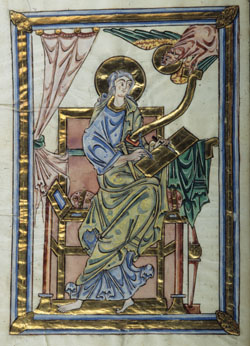
A page from an illuminated manuscript. Image from http://www.myarmoury.com/talk/viewtopic.php?t=28126&view=next.

A page from an illuminated manuscript. Image from http://www.myarmoury.com/talk/viewtopic.php?t=28126&view=next.

Back To Top
Abstract

Hrothgar prefaces his relation of the terror of Grendel’s attacks with a brief summary.

Back To Top
Translation

It grieves me at heart to tell,
to any man, what affliction Grendel has wrought
on me and and Heorot amidst his hostile designs,
those spiteful attacks; by these is my hall troop,
my band of warriors, made thin; wyrd swept them
into Grendel’s terror. God easily may
put an end to the deeds of that fell-destroyer!
(Beowulf ll.473-479)

Back To Top
Recordings

Old English:

{Forthcoming}

Modern English:

{Forthcoming}

Back To Top
Why preface the massacre?

This short passage is what Hrothgar uses as a preface to the retelling of Grendel’s attacks. In it he summarizes what he’s about to say next. But why?

Beowulf already knows about Grendel and the terror that he’s wreaked upon Heorot and the Danes. So why does Hrothgar feel the need to preface the relation of the same?

Maybe it’s because this is a first hand account of the story, and as such its details will be more vivid than those in news that has been blown afar by sailor and wanderer alike.

Maybe it’s not supposed to be taken in the same way as the modern newscasters’ “Now, we must warn viewers that some people may find some of the images in the following report graphic.”

Maybe, instead, it’s supposed to get Beowulf and his crew into the right mindset to hear the story of Grendel’s attacks.

In short, it’s meant to give context rather than to scare or warn.

Giving such a relation context makes fine sense. But I can’t help but think that there’s something more at work here.

Hrothgar’s old fashioned formality is certainly a factor. Someone like Beowulf would probably just rush right into the story and not really establish much beforehand.

Yet, such a formal system of expression seems strange given that Hrothgar’s just confessed openly to Beowulf that he’s not as great a man as his brother was. Normally someone in his position wouldn’t just come out and admit something like that, I think.

So perhaps that was something of a slip on his part, emotionally wrought as he’d been made by meeting Ecgtheow’s son and at last having a hero in whom he firmly believes.

If Hrothgar’s admission of weakness to Beowulf was a slip, then this little preface could well be his way of recovering himself and his manner.

After all, the poet wouldn’t want to waste time with lines about how Hrothgar’s look drooped and then slowly, like a trumpet vine, climbed and bloomed, ready to dispense the sweet nectar of the situation. Instead, the poet/scribe would be better off simply including this shift back to formality in the man’s dialogue. This poem thing has to keep a vigorous pace, right?

One other thing makes me think that this preface is more about context than being a warning.

Within the passage, Hrothgar makes a reference to the power of wyrd (kind of like fate, but beyond any notion of destiny) sweeping away his men (ll.477-478) and he also makes reference to god, whom he believes can put an end to Grendel all together (ll.478-479). This shows a man in transition on the spiritual level, since the concept of “wyrd” predates that of the Christian god among Anglo-Saxons. Hrothgar still holds to the old idea of wyrd while also investing hope in this new “god” figure. That is, so long as the “god” of line 478 is the Christian god and not just some vague reference to Odin or the Norse gods in general.

It’s also curious to note that wyrd and god appear in Hrothgar’s preface in the reverse order that they appear in Beowulf’s earlier speech. Pinning any real meaning on this kind of structure isn’t really worth the effort, since it could just be coincidence. But, Hrothgar’s repetition of these two things could relate to his hope that god will, without any real struggle, choose Beowulf to win. Hrothgar’s ending his preface with “God easily may/put an end to the deeds of that fell-destroyer” (“God eaþe mæg/þone dolsceaðan dæda getwæfan.”(ll.478-479)) definitely suggests this.

Back To Top
A terrible jester

Brief as this passage is there is one word in particular that I want to break down. This word is “dolsceaða” (l.479). As a compound it means “fell destroyer.”

Broken into its constituent parts, though, we’re left with “dol” (meaning “foolish,” “silly;” “presumptuous;” and “folly”) and “sceaða” (meaning “injurious person,” “criminal,” “thief,” “assassin;” “warrior,” “atagonist,” “fiend,” “devil,” and “injury”).

At first glance a combination of a word for things like “foolish,” “presumptuous,” etc. with one for “criminal,” “thief,” “fiend” probably seems strange. How exactly can someone be a “foolish fiend”?

Within the context of Anglo-Saxon society, though, the reason that these two words combine to mean “fell destroyer” becomes clear.

As we saw in last week’s post, Ecgtheow started a feud with the Wulfings when he killed one of them. Along with the feud, Ecgtheow was also exiled from his people. And in Anglo-Saxon culture exile is a fate worse than death.

Death is final. Exile is an ongoing punishment in which the exiled was cut off from their community. Since Anglo-Saxons relied on their community for physical and emotional well being, such separation would leave one leading a solitary, vulnerable life. In exile, a person would cease being a Geat or a Dane and become simply an exile.

Therefore, killing indiscriminately as Grendel does would be foolish. Anyone who carried out such action would definitely be considered as grave a thing as a “fell destroyer” because they would be acting outside of all societal norms. What’s more, such a person would certainly be exiled and would gather all the rage of the slain’s kith and kin would be directed squarely at you. Gathering together so much hatred would surely, and rightly, be seen as a thing of folly.

Thus, combining the word for foolish and the word for criminal to create a third word meaning “fell destroyer” makes perfect sense. Applying it to Grendel makes even more, since his killing is indeed foolishly criminal.

Yet, you could argue that such is his nature as the kin of Cain. So Grendel’s actions aren’t so much mad or foolish as they are natural. He’s killing without any sort of sense of “feud” or “exile.” That’s really only if you take the monster’s perspective, though. From within the Danes and Geats’ frame of reference, in which feuds are a legal means for reparations, Grendel’s actions are indeed insane, those of a “fell destroyer.”

Back To Top
Closing

Next week, Hrothgar goes into gory detail in his telling of Grendel’s visits to Heorot.

You can find the next part of Beowulf here.
Back To Top

Hrothgar’s speech gets casual but his words stay interesting (ll.456-472)

Abstract
Translation
Recordings
Hrothgar gets calculatedly casual
Less colourful words, but words nonetheless
Closing

An example of an image touched with gold leaf from an illuminated manuscript. Image from http://ica.princeton.edu/conferences/2010march16-17.php.

An example of an image touched with gold leaf from an illuminated manuscript. Image from http://ica.princeton.edu/conferences/2010march16-17.php.

Back To Top
Abstract

Hrothgar replies to Beowulf. He opens with an explanation of how and when he knew his father.

Back To Top
Translation

“Hrothgar spoke, protector of the Scyldings:
‘For manly deeds thou, friend of mine Beowulf,
and for our benefit have you sought us.
Thy father fought his way into a terrible feud,
he became Heatholaf’s killer by hand
amongst the Wulfings; so that he might not have
shelter with those kin for dread of war.
From thence he sought South Dane folk
over the surging waves, the Ar-Scyldings;
that was when I had just begun rule of the Danish people
and in youth governed this fierce empire,
walled and treasure-filled towns of warriors;
then was Heregar dead, my elder kinsmen left unliving,
son of Halfdane; he was better than I!
Afterwards I settled that feud with goods;
sent I to the Wulfings over the water’s ridges
old treasures; he to me oaths swore.'”
(Beowulf ll.456-472)

Back To Top
Recordings

Old English:

{Forthcoming}

Modern English:

{Forthcoming}

Back To Top
Hrothgar gets calculatedly casual

It seems that Beowulf has proven himself to Hrothgar.

Certainly not because he’s shown the Danish lord what he can do, but because his words have inspired him with belief. That’s my explanation for Hrothgar’s switching to a more plain speaking style, anyway.

Throughout the entirety of his speech in this week’s extract, Hrothgar leaves out any sort of interlaced structure. He doesn’t start an idea before the caesura of one line and then end it on the opposite side of the next line’s mid-way pause.

Considering that he’s just met Beowulf, and only just heard him speak, Hrothgar is also being quite open and forthwith. Certainly the thanes that he has around him would only faintly correct him when he says that his brother was a better man than he (l.469) at this point in the struggle with Grendel, but it’s still a strange thing to admit to a total stranger.

One thing’s for sure, historical accuracy in regards to these men’s exchange takes a back seat here.

Instead of having to go through several meetings to get to this level of candid speech, Hrothgar just immediately moves to it after hearing Beowulf’s pitch. And that is exactly what the main man’s speech was, a pitch.

Epic poems can’t be all bluster and long-winded speeches after all, so rather than showing a series of meetings between the leaders where Beowulf and Hrothgar gradually build up a rapport and mutual trust (no doubt a decent way to turn this story into a modern novel), the poet just has Hrothgar accept Beowulf at his word. Oh – and at his father’s word, too.

For, although Ecgtheow isn’t present, I think his having sworn oaths to Hrothgar (l.472) gives Beowulf some privileges within his estimation. From the sounds of it Ecgtheow caused Hrothgar some worry when he was just starting to rule over the Danes, but I think something important remains unsaid here.

I think that Hrothgar’s being given the opportunity to solve the feud between Ecgtheow and the Wulfings is something that he used to secure his then new-found position as ruler of the Danes.

On line 467 he describes the Danish people as consisting of “walled and treasure-filled towns of warriors” (“hordburh hæleþa”). These are a people who would probably not readily transition into having a new king. Any one who was fresh to the throne would likely have to prove himself worthy of it.

Such proof would probably come in the form of a show of might, but I think part of why Hrothgar brings up Ecgtheow here is that he sees the man as having given him an alternative way of showing is aptitude. He’s given a diplomatic situation to solve, and he does so handily. Hrothgar sends the Wulfings what amounts to wergild – payment as recompence for a slaying – and gets the exile to swear oaths to him. Thus, the Wulfings are appeased and the threat that is Ecgtheow is neutralized.

So on one hand, Hrothgar helped Ecgtheow when he was in a tight spot. Being exiled because you’ve killed a man with your bare hands isn’t an enviable position. But Hrothgar took Ecgtheow in. On the other hand, Ecgtheow helped Hrothgar, though it seems that this help was much less explicit. Yet, I think that Hrothgar is well aware of both of these and so he feels desperation because only might (something Hrothgar lacks) can deal with Grendel and a sense of obligation to Ecgtheow’s kin.

Hrothgar’s feeling this way explains his shift into a more open style of conversation.

Going further, I think that Hrothgar mentions the oaths that Ecgtheow swore to him to confirm to Beowulf his father’s honorability and to inspire in our hero a sense of filial obligation. Beowulf did not take such oaths. Nor can he be expected to at this point in his relationship with Hrothgar.

Yet, Hrothgar would certainly have been aware of Beowulf’s understanding of the importance of words after hearing his pitch. Thus, he likely mentioned his father’s oaths in a calculated move to appeal to Beowulf’s underlying philosophy of following through on his word.

So Hrothgar’s jumping to much more open speech (though it’s still not free from his use of words like “ðu”) fits into the poem’s current situation. This shift is also, of course, a convenient way to pick up the story’s pace.

Back To Top
Less colourful words, but words nonetheless

Hrothgar’s speech is much less colourful than Beowulf’s. He doesn’t use nearly as many words that could be interpreted in more than one way, nor does he use that many compound words. Though of those that he does use, the curious “hordburh” and “gesloh,” an example of how much the prefix “ge” can change a word, are worth pointing out.

The word “hordburh” is made up of the word “hord” (meaning “treasure”) and the word “burh” (meaning “walled town,” “fort,” or “castle”). This word is noteworthy partially because it also appears in the Anglo-Saxon poetic version of Genesis and the Cartularium Saxonicum (a collection of Old English charters), and apparently in all three can mean simply “treasure city.”

Now, fierce as the Danish people that Hrothgar rules over are, and as likely as they are to live in towns filled with plunder, “treasure city” just doesn’t have enough of a ring to it for my tastes. So I got a little creative and instead rendered “hordburh” as “walled and treasure-filled towns.” It’s a bit wordy, but I think it works.

Modern English just doesn’t compound like its ancestor.

The other word to be aware of in this week’s excerpt is “gesloh.”

This prefixed verb means “to enter into by fighting.” It’s pretty straightforward in context, and I’ve kept it nearly as it is in the passage above. But what happens when you take “ge” away?

The word “sloh” is a form of “slean,” which can mean “strike,” “beat,” “stamp,” “coin (money),” or “forge (weapons)” in one sense, “throw,” “cast,” “sting,” or “pitch,” in another, “strike across,” “dash,” “break,” “rush,” or “come quickly” and “slay,” or “kill” in yet another. It’s a single word that covers a lot of ground. Yet with “ge” added to it, it becomes quite narrowly focused.

Though, in the first sense of “slean” there’s some of “geslean” to be seen. For that first group of words relates to creation in some form or another (as long as you understand “strike” and “beat” as referring to hitting instruments or mixing things. Building on this relationship, I think that you can draw a connection between the first sense of an un-prefixed word and its prefixed form. The latter may also bring in some of the former’s other senses.

Another word that becomes more specific when you add “ge” to it is “ascian.”

On its own, this word means “ask,” “inquire,” “seek for,” “demand,” as well as “call,” or “summon,” and “examine,” or “observe.”

Put a little “ge” on the front, though, and the word means “to learn by asking,” “discover,” or “hear of.”

These “ge-” words are sort of the opposite of the words that I’ve been tracking over the last few weeks because of their specificity, but they’re just too odd to pass up.

There really isn’t anything like the “ge” prefix in Modern English. Just another reason to study these old books.

Back To Top
Closing

Next week Hrothgar continues to speak, telling Beowulf that his thanes are thinning out.

As for this week’s excerpt: What do you make of Hrothgar’s switching tones? Do you think that he’s come to trust Beowulf based on his family connections and speech alone?

What about this week’s words, “is walled, treasure-filled town” a good translation of “hordburh”?

You can find the next part of Beowulf here.

Back To Top

Beowulf’s slip of the tongue and linden wood’s importance? (ll.429-441)

Abstract
Translation
Recordings
Beowulf’s ego between the lines?
A balance of compound words
Closing

Back To Top
Abstract

Standing before Hrothgar himself, Beowulf states that he will face Grendel unarmed.

Back To Top
Translation

“‘That you do not refuse me, protector of warriors,
close friend of the people, that for which I have now come from afar,
that I might alone and my band of warriors,
this hardy heap, to cleanse Heorot.
I have also learned, by asking, that this demon
in his recklessness does not care for weapons.
I the same shall scorn, that Hygelac may be for me,
my liege-lord, blithe of heart,
that I neither sword nor the broad shield shall bear,
the linden-bound battle buckler; and I shall grapple
against the fiend with my grasp and struggle for life,
hater against hated; in that I shall trust
in god’s judgement to take whom he will in death.'”
(Beowulf ll.429-441)

Back To Top
Recordings

Old English:

{Forthcoming}

Modern English:

{Forthcoming}

Back To Top
Beowulf’s ego between the lines?

As has been the case since Beowulf opened his mouth a few weeks ago, he says some curious things in this week’s passage. Either that, or the space of centuries has changed English so much that (my) modern interpretations are mismatched with his intentions.

Also, as has been the case with past posts, this week’s most curious passage could be the result of poetic conventions.

In lines 431-432 Beowulf states that he and his crew are here to cleanse Heorot. But in line 432 there’s a curious division between him and the rest of the Geats.

In Old English poetry, each line consists of two parts separated by a medial caesura. The medial caesura is a full stop used to give poetry a set meter and rhythm. On line 431, however, the caesura happens to fall at a crucial point in Beowulf’s statement.

The first part of this line ends with the nearly complete thought “that I might alone” (“þæt ic mote ana” (431)). At first glance such a statement seems perfectly normal. But then the audience/readers are reminded of the other Geats in the second part of the line “and my band of warriors” (“ond minra eorla gedryht”).

The caesura’s separating these two thoughts so cleanly leads me to believe that Beowulf, for a second, forgot about his fellow Geats.

He may have became so inflated with thoughts of the personal glory to be won that his focus was entirely on himself. But then something must have twinged in his memory and he snapped back to his senses, just in time to realize that there were other Geats – his “band of warriors” – with him.

Because the break in the line occurs in such a perfect place I find it hard to write off this apparent mental slip as merely the result of Old English poetic convention. Using a multifaceted word rather than a definite one to fill in alliteration is one thing. Splitting the line between clauses like this is entirely another.

But does such a slip necessarily mean that Beowulf is temporarily blinded by an egotistical drive for glory? Or could it be that his continuing use of interlacing clauses is starting to confuse him, showing that his forceful use of rhetorical speech is nearly too much for even him to handle?

Or, again, if you want to approach things on the meta level, is having the hero become so tongue-tied the poet’s way of stepping in to say, in a small way, “this poetry stuff is so hard even Beowulf here can’t fully handle it!”?

It’s this poem’s ability to generate these sorts of questions that makes it so fascinating. That’s why I keep coming back to it time and again and why I run this blog in the first place. What are your thoughts on Beowulf’s mental slip?

If Beowulf has tied himself into a bit of a rhetorical knot here, by the end of this part of his speech he’s pretty much recovered.

The phrase “lað wið laþum” is a linguistic gem. A near literal translation of this phrase is “the hater against the hated.” In the context of Beowulf’s fight with Grendel it works wondrously well no matter who its subject and object are between the two.

Back To Top
A balance of compound words

Unlike the other parts of his speech that we’ve seen so far, Beowulf’s boast is rather short on strange compound words. The word “wonhydum” (a variation of “wanhygd”) is kind of neat, but it’s one of those compounds that makes perfect sense.

The first part, “wan” means “wanting,” “deficient,” “lacking,” or “absent,” and the second means “mind,” thought,” “reflection,” or “forethought.” So “wanhygd” translates into “reckless” quite nicely.

However, “gealobord,” meaning “buckler covered with yellow linden bark,” is something of a find.

Why should it matter that a shield is covered within yellow? And why is it linden bark?

Maybe it’s just because linden bark is the best bark suited to covering a shield and it happens to be yellow? Maybe one or both have special significance outside of practicality?

From what I’ve been able to turn up online the reason that linden bark (or more likely just plain old linden wood – unless there’s a ship metaphor in there somewhere (“bark” could mean “ship”) – was used for shields is because it’s soft and light. It didn’t tend to split like harder woods such as oak, and could even catch and hold spear blades.

Such is the explanation that this page about arms and armour on Regia Anglorum has to offer anyway.

Also, Della Hook notes on page 215 of Trees in Anglo-Saxon England: Literature, Lore and Landscape that linden wood was so commonly used for shields that the word “lind” came to be used as a metonymy for shields in poetry.

Perhaps there was also some mythic or folkloric understanding of why linden wood was so well-suited to shields, but I’d need to dig deeper to find it. If you happen to know of such a thing though, please drop a link (or a line) in the comments.

Back To Top
Closing

Next week Beowulf balances his boasting with a description of his gruesome defeat and outlines what the Danes should do with his remains. If he happens to lose, that is.

You can find the next part of Beowulf here.

Back To Top

Beowulf’s forceful resumé and multi-purpose words (ll.419-428)

Abstract
Translation
Recordings
Words of force or forced words?
Multipurpose words
Closing

Back To Top
Abstract

Beowulf’s speech continues. Picking up from last week’s speech about who he is and how he heard of Heorot’s distress, Beowulf now shares the highlights of his deeds.

Back To Top
Translation

“‘They themselves saw, when I cleverly overcame,
foe after foe, when I bound five,
devastated the kin of giants, and upon the sea slew
water-demons by night, I have endured dire need,
have fulfilled the Geat’s hatred – such was the hope they summoned –
it consumed those enemies. And so it shall now against Grendel,
against this monster I will stand alone as it please
in such a meeting with the demon. I to thee now then,
lord of the Bright-Danes, will make my request,
prince of the Scyldings, will proclaim this alone:'”
(Beowulf ll.419-428)

Back To Top
Recordings

Old English:

{Forthcoming}

Modern English:

{Forthcoming}

Back To Top
Words of force or forced words?

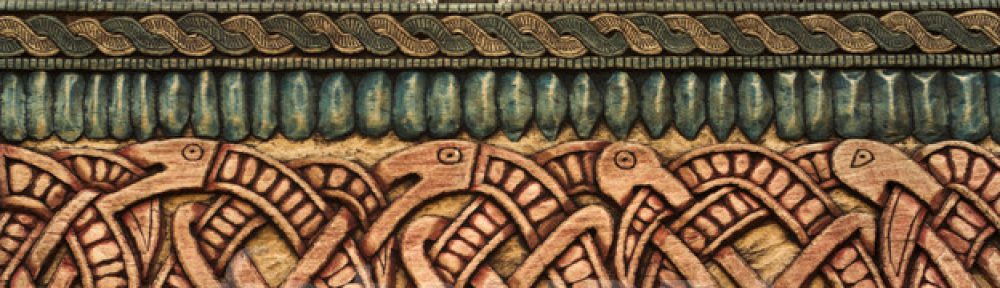
The Anglo-Saxons were fond of woven patterns and intricate knotted designs. You can see it in their art (this blog’s header image for example), and poetry (Beowulf‘s interlace structure, is a prime example).

But Beowulf’s speech is a true show of what it means to weave words. Hrothgar has his “thee”‘s and “thou”‘s and the diction of an august figure. But Beowulf brings much more artifice to his speech. As a result, it’s hard to say how seriously we can take his words.

Now, as always when analyzing word use in Old English poetry, it must be noted that alliteration held considerable sway over which words made it to the page or performance. Beowulf’s speech is certainly no exception.

First among its more rhetorical flourishes is the use of ðing on line 426. This word has the same meaning as Modern English “thing,” but it can also mean “lawsuit,” “court of justice” or “meeting.” In this instance the word appears to be chosen for its alliterative properties (line 426’s alliterative sound being the dental fricative “th,”) yet its use gives me pause.

Should Beowulf’s use of this word be taken to mean that Grendel bears more than a mindless hatred toward Heorot?

Or is he just trying to say that Grendel has pursued this hatred of his with all the furor of a legal battle – a fight between two parties with wildly differing opinions about what’s fair?

Though it’s another example of something used for the sake of alliteration, line 428’s “bene” translates as “summon, command, proclaim.” These are strong words for a guest to use to indicate an upcoming request. Not to mention that this is the first time that Beowulf is addressing Hrothgar. As such, using such a forceful word comes across as rude. At the same time, though, the word’s force makes me wonder.

Beowulf is famed for having the might of many men in his grip. His deeds are all deeds of overcoming great odds against (mostly?) supernatural opponents. Beowulf is, at least in some ways, brute force personified. So then is he (or is the poet/scribe) trying to make that forcefulness come across in his speech as well?

Following the conventions of poetry is one thing, and a thing that Beowulf does more than the poet/scribe seems to as far as word-weaving’s concerned (he makes much greater use of interlacing his clauses), but surely words that carry such deep shades of force as “ðing” and “bene” indicate more than the speaker’s (and the poet/scribe’s) awareness of poetic convention.

As far as I know, there’s no pattern to the sounds used for alliteration. Perhaps it’s generally seen as poor form to have two consecutive lines with the same alliterating sound. But there are no hard and fast rules about ordering your alliteration scheme in Old English poetry as there are for, say, Renaissance or Victorian rhyme schemes. As such, any sound could have been chosen for these lines.

Although such interpretations of “ðing” and “bene” goes far too deep into authorial process (as well as authorial intent), I’m left wondering: What came first? Was it a word that gave rise to the line or the line that forced the poet/scribe into using a word that just sort of fit his/her intended meaning?

Since it’s nearly impossible to know for sure, I’ll choose to think that Beowulf is opting more for force than accuracy, more for strength than finesse. After all, Anglo-Saxons aren’t known for their lithe forms, erudite reasoning and appreciation of fine art and music.

Back To Top
Multipurpose words

As is to be expected in such a rhetorical passage as this, some words are curious cases.

The word that Beowulf uses when he talks about the kin of giants to say he’s “devastated” them for example, is “yðde” (a variation of the past form of “ieðan”).

But this word, like so many others in Old English doesn’t have just one meaning.

Along with meanings like “lay waste,” “ravage,” “devastate,” and “destroy,” this word means “to alleviate,” “be merciful.” Having such diverse meanings could be the result of the word’s appearing in different contexts in different Old English works.

However, it’s more interesting to wonder if the Anglo-Saxons had the idea that sometimes being merciful meant devastating something or someone. Monsters for instance. Surely, an existence outside of the love and purview of god was something that any thinking creature would want ended, right?

Such reasoning might stand for inhuman enemies, but, getting back to the previous section’s point about Beowulf brute-forcing his way through his speech, I can’t help but wonder if his using such a strong, double-edged word, leads him to qualify his devastating deeds (particularly those possibly against human enemies, the general “enemies of the Geats,”) as having been deserved (“such was the hope they summoned” (“wean ahsodon” (l.423))). If he is indeed qualifying his acts of violence, then perhaps Beowulf comes from a time of greater tolerance, a time in which the poem’s audience was less interested in wiping out those different from them.

Though there would always be plenty of room for enmity with giants, demons and wizards. In fact, why not roll them all into one word? The term “þyrse” would do nicely.

Yes, Old English has a single word that can mean “giant,” “demon,” or “wizard.” Now, these three things might seem distinct to us, but to a medieval mind (particularly an early medieval mind) they were likely much closer together.

Giants were believed to be enemies of god, a and the word could be a general term for the race of monsters that were the kin of Cain. It was also a handy term for unknown, powerful forces or enemies. In Layamon’s Brut, for example, the original settlers of Britain defeat the native giants before they claim the land.

Demons could have been giants. After all, they were the servants of Satan, the enemies of god, and therefore quite closely related to the kin of Cain. Save that, of course, they weren’t necessarily Cain’s kin. More like the family friend that Cain, in more modern times, might refer to as “uncle” or “aunt.”

And wizards famously enslaved demons to their wills. Surely someone who controlled demons must be somewhat demonic him or herself, right?

Also, wizards are wizards, so they could make themselves appear as giants or be cloaked in reputations of being unknown foes. Maybe they could even be referred to as giants in the general sense since they could be considered adopted members of the Cain family, those who have opted out of being sons of Seth and knowing god’s favour.

Back To Top
Closing

Next week, Beowulf proclaims his intent and explains just how he plans to deal with Grendel.

You can find the next part of Beowulf here.

Back To Top

Beowulf’s poetic introduction and troubling relations (ll.407-418)

Abstract
Translation
Recordings
Beowulf’s “poetic” phrasing
Weird word choices
Closing

Back To Top
Abstract

Beowulf introduces himself to Hrothgar and announces why he has come.

Back To Top
Translation

“‘Be thou, Hrothgar, hale! I am Hygelac’s
relation and man; I have started into
great glory from my youth. News of Grendel
is openly known in my homeland;
It was the talk of sailors, that this hall stood,
best of buildings, idle and emptied
of each man after the evening light
becomes obscured beneath heaven’s brightness.
Then a council urged me to help,
the most esteemed, the cleverest of Geatish men,
the ruler Hrothgar, that I thee seek,
for they all know of my strength:'”
(Beowulf ll.407-418)

Back To Top
Recordings

Old English:

{Forthcoming}

Modern English:

{Forthcoming}

Back To Top
Beowulf’s “poetic” phrasing

When a poem’s titular character speaks up you should listen. But Beowulf’s speech is riddled with strange word choices and odd phrases that seem bewildering to modern perceptions and perspectives.

We first get a taste of Beowulf’s poetry when he describes the situation in Heorot. He explains how he has heard that the hall is “emptied and idle” every night in such a way that almost makes it possible to translate these words as a reference to the Danish men (rinca).

Such a translation isn’t quite right, though, since line 412’s “best of buildings” is an interjection set within “that this hall stood/…idle and emptied/of each man…” (ll.411-412).

Next, he explains how he has heard that the hall is emptied as soon as “the evening light/becomes obscured beneath heaven’s brightness” (“siððan æfenleoht/under heofenes hador beholen weorþeð” (ll.413-414)).

“Heaven’s brightness” sounds like a phrase that could be used for the sun or for a sky full of stars. Since Beowulf uses it along with a reference to the setting sun, though, the latter definition must be more accurate to his meaning. No doubt it is right, but it’s curious how the Anglo-Saxons construed the night sky as a show of “heaven’s brightness.” If it was only by night that heaven shone, then what did they believe the sky showed during the day?

Later in the passage, when describing his own situation, Beowulf explains that a council of “the most esteemed, the cleverest of Geatish laymen” (“þa selestan, snotere ceorlas” l.416) are the ones who suggested he come to Daneland. Once again we have Old English poetry’s penchant for interrupting itself to work with on this line.

As it is line 416 sounds like it’s referring to either one group or two.

Assuming that it is two groups, we’re left with a council made up of the learned advisers of the Geats (the most esteemed) and some of the wiser (hopefully) of the general population. Such a council of peers sounds like a fine group from which to receive advice. However, it’s also possible to read this line as a reference to just one group, and that’s where things get tricky.

Interpreted as just a single group of highly esteemed laymen, Beowulf could well be referring to drinking buddies. In this case the recommendation that he come to seek out Grendel could be a drunken dare or suggestion. As Robin Waugh contended, in some instances, Beowulf is known to struggle with the poet, almost as if he were trying to seize control of his voice and his story. But we’ll see more of that as Beowulf speaks on next week (and in the coming weeks, especially in the verbal showdown with Unferth).

Back To Top
Weird word choices

Along with whole phrases that prove problematic, Beowulf uses a few words that also caused me some confusion.

When detailing his relationship with Hygelac, Beowulf says “relation* and man**” (“mæg ond magoðegn” (l.408)). The word “magoðegn” is pretty straightforward.

It can mean “vassal,” “retainer,” “warrior,” “man,” “servant,” or “minister.” All of these positions are understandable. The basic sense of them being that Beowulf has some clout in the court of Hygelac. He’s not just some common hanger on.

The first word that he uses, however, means “male kinsman,” “parent,” “son,” “brother,” “nephew,” or “cousin.”

This is slightly trickier to parse.

Because of the difference in Beowulf and Hygelac’s ages “parent” and “brother” don’t make sense.

Likewise, we’ve already been told a few times that Beowulf’s father is Ecgtheow, so “son” is out.

The generic “male kinsman” is intriguing, but ultimately too vague to use, and so we’re left with “nephew” and “cousin.”

This instance is one in which the date of the version of the poem that we have is fairly important.

For those tracking lineage in medieval Europe cousins were a much more valued relation than they are today. This is partially because to marry someone the bride and groom had to be at least seven degrees of consanguinity apart (meaning at least your fifth cousin). This was part of medieval canon law rule, and as such, marrying your fourth cousin or closer would make the marriage illegal.

That said, “cousin” could be used in a more general sense, too. Sort of in the same way that a good family friend might be referred to as an “uncle” or “aunt.”

The other definition, “nephew” might actually describe Beowulf and Hygelac’s relationship more accurately. After all, it is possible that Beowulf is indeed Hygelac’s nephew through his mother.

At the very least, Ecgtheow’s marrying into the Geats would make him a legitimate cousin of the Geatish king.

But convention mustn’t have allowed for a court’s greatest warrior to just come out and clearly state his relation to his lord, lest it be his father.

Back To Top
Closing

Next week Beowulf begins to boast about his deeds.

You can find the next part of Beowulf here.

Back To Top

The coastguard’s farewell (ll.312-319) [Old English]

Abstract
Translation
Recordings
A boastful coastguard?
Meet the new god, same as the old god
Closing

Back To Top
Abstract

The coastguard takes his leave of the Geats, wishing them god’s protection.

Back To Top
Translation

“He took the battle brave to the bright
high-souled hall, that he may thither them
go; that hero of combat turned his horse
about, spoke he these words next:
‘It is time for me to go. The almighty
father’s grace keep you healthy
amidst your quest! I am to the sea,
to hold the shore against fiendish foes.'”
(Beowulf ll.312-319)

Back To Top
Recordings

Old English:

{Forthcoming}

Modern English:

{Forthcoming}

Back To Top
A boastful coastguard?

The coastguard’s being called “hero of combat” (“guðbeorna”) seems strange. That is, until you notice that it’s the third word in an alliterative sequence. But is it only there to hold up a preferred Old English poetic form?

Yeah, probably.

I mean, the coastguard does mention that he has to go back to the coast to guard against “fiendish foes” (“wrað werod” (l.319)). So there could be some verity to his being a “hero of combat.” But that term seems a little inflated to me.

Could the poet be having a laugh at the coastguard’s expense? “guðbeorna” fit the line that he had written and so he just ran with that and made the coastguard into a bit of a boaster at the end of his speech?

Maybe.

I mean, on the one hand, as much of an exile such a person might feel (even if he does have a crew out there), it definitely wouldn’t be wise to send some fop out to guard your coast.

The Danes wouldn’t have had the troops to keep a barracks there or anything like that. His crew included, the Danish coastguard in Beowulf probably wouldn’t exceed ten men. Tops. So he, the lead coastguard if you will, would definitely need to have proven his mettle in combat.

Though, it’s also possible that the position of coastguard is reserved for warriors who are past their prime. No longer able to perform as vigourously on the battlefield they’re charged to put their skills and battle-sharpened wits to the test in judging new comers and putting on a fearsome face. With a coast as quiet as the Dane’s must be (who, aside from heroes would want to come to a monster-terrorized-golden-hall party?), the job of coastguard definitely seems like something that would get filled by a veteran.

And maybe that’s what the poet was going for with the narrative riff on the coastguard’s past and then his own seemingly over-zealous admission of what he was heading off to do.

Back To Top
Meet the new god, same as the old god

Throughout Beowulf, people give thanks to a generic male, father god. Many translations (and some instances in the original text) make many of these references into “lord.” As such, it’s very easy to read these instances of reference to god as references to the Christian god. Since “lord” is frequently used as a deific pronoun in Christianity.

However.

Christianity wasn’t the only religion to have a wise, solemn, wrathful, and benevolent patriarchical deity.

The Norse peoples (who definitely had some influence on Beowulf since it’s set largely in Daneland of all places) had Odin. The Germanic people had Woden. The Anglo-Saxon creators or audience for this poem were themselves Germanic.

So who’s to say that these generic references to god aren’t to these pagan gods? The Geats and Danes aren’t exactly quoting Old or New Testament verses at each other. Though there is that lengthy reference to Grendel as the kin of Cain and god’s war with the giants. That could be a reference to the apparently standard stories told among the peoples of northern Europe about unexplored places.

Knowing with certainty who the deity is that’s constantly being referred to is an impossibility. But the idea that it could be either the Christian god or one of the chief Pagan gods isn’t just a neat alternative. That could well have been the intention.

No matter where you place our version of Beowulf‘s composition within the 400 year window generally agreed upon (between 600 and 1000 AD) contemporary Christianity had yet to really spread over all of Europe. As such this story that’s ostensibly about a hero’s quests and fights with the supernatural could have been used as a way to infiltrate and convert.

Or, any male deity could be read into it as a way of making sure that the epic simply wasn’t too preachy.

Beowulf‘s being bundled with a collection of fantastic tales from the east in the Noel codex could in fact be the book creator’s way of sort of sweeping it under the rug because these god references weren’t clear then either. That book maker would have been a Christian monk of some sort or another after all.

So, when you’re reading Beowulf and come across a reference to the “alwalda” don’t just think surfer dude with a long white robe and beard, but think one-eyed, helmeted warrior god, too.

Back To Top
Closing

Next week, the Geats step into Heorot and duly unequip themselves.

You can find the next part of Beowulf here.

Back To Top

Speculation along the way to Heorot (ll.301-311) [Old English]

Abstract
Translation
Recordings
Gold as guardian
Of ships and mothers
Closing

Back To Top
Abstract

The coastguard leads Beowulf and his entourage to Heorot.

Back To Top
Translation

“They went upon their way. The boat was bound,
the capacious craft tethered with cord,
secure at anchor. Boar-shapes shone
atop their cheek guards; ornamented gold,
glistening and firmament firm, securely held life:
war-hearted grim men. They all hurried onward,
going down together, until from that high hall of a building,
ornamented and gold-dappled for all to see
that it was foremost among humanity of all
the buildings beneath heaven, the ruler called for them;
light of the people over so great a land.”
(Beowulf ll.301-311)

Back To Top
Recordings

Old English:

{Forthcoming}

Modern English:

{Forthcoming}

Back To Top
Gold as guardian

Gold is pretty prevalent in this passage. It’d be easy just to dismiss the metal’s shining presence in the Geats’ helmets and on Heorot as indicators of wealth and prestige, but I think there’s more to it than that. Of course.

In both of these instances I think that the gold is present in the helmet and the hall as a ward against harm. Or maybe as an outward show of the value of the people under the helmets and in the hall.

Putting a monetary value on a life or a major injury isn’t something modern. The Anglo-Saxons had a law covering the same thing that required the perpetrator to pay their victim (or, in the case of murder, the victim’s next of kin) a fee called “wergild.” The major purpose of this fee was to stem the outbreak of feuds and to bring disparate groups together into a group that extended beyond family ties.

It’s a bit broad, but literally translated, “wergild” becomes “man price.”

This is where this theory gets a little crazy, mostly because of timing issues. If the concept of we-gild had been around for a few generations before Beowulf was put together/originally written, then what would stop payments from becoming a preventative measure? Once it was so established, it’s not much further to get to a point where the association of gold with prevention of harm takes on a magical or superstitious flavour.

With such perception of gold as a protective metal in the culture, it would make good sense for it to adorn helmet and horn alike. Thus, pointing out the gold in the helmets and in Heorot’s exterior firmly establishes the protective properties of both.

However, in this passage, I think that a contrast is implied.

If gold is a metal that the Anglo-Saxons of Beowulf’s time believed to have protective properties then it’s already clear to the audience that it hasn’t worked so well for Heorot. The mention of gold being in the Geats’ helmets, then, calls into question just how effective they’ll be in guarding their lives. It’s also possible to read the failure of Heorot’s golden exterior as evidence for Grendel’s chaotic influence. His presence as a kin of Cain causes the proper function of gold to cease.

If all of this rang true for the poem’s original audience, then it’s hard to believe how much more anticipation there would have been for the fight once Beowulf reveals that he’ll faced Grendel completely unarmed. Heck, you could even say that if all this is true and Grendel’s power to negate weapons extends to negating the protective properties of gold, then Beowulf’s facing him with his bare hands alone evens the field all the more.

Back To Top
Of ships and mothers

“Capacious” of line 302 is, in Old English, “wide-bosomed,” or “sidfæþmed.”

While a modern interpretation of “wide-bosomed” might be simply “large breasted,” the two definitions of “sidfæþmed” suggest that the Anglo-Saxons regarded it as more a matter of volume than size. Considering that all children of the period were nursed, this is hardly surprising. The greater capacity a mother had for milk the more nourishment her child would get, giving that child a better chance to make it through childhood and come into healthy adolescence.

How that relates to a ship is beyond me, except for the idea that travelling in comfort is better than travelling in a cramped space. Plus, a boat with some room would make rowing much easier. Easier rowing means faster travel. So a capacious boat is definitely optimal.

Getting back to this passage in particular, what can be made of the repeat mentions of Beowulf’s boat being securely tethered?

Running with the connection between mothers and boats via “sidfæþmed,” and taking along for the jog the tradition of referring to boats with feminine pronouns, Beowulf’s boat could be regarded as his anima being securely left behind, enabling him to act without sentiment, if necessary. If you want to take the Jungian tack.

Much more straightforward is the interpretation that Beowulf’s ship is his only means of getting him back to his homeland. As such, its security is of the utmost importance.

Or, it could symbolize his identity as a true Geat. If he had no way of getting back home, his liege Hygelac could think him dead or gone native, erasing his status as outsider among the Danes and making him a quasi-exile.

Back To Top
Closing

Next week, the coastguard takes the Geats to Heorot’s doors and then takes his leave.

You can find the next part of Beowulf here.

Back To Top

The coastguard’s reply (Pt.1) (ll. 286-292) [Old English]

Abstract
Translation
Recordings
Enter a horse
The coastguard’s backstory?
Closing

Back To Top
Abstract

The coastguard answers Beowulf, and passes judgement on what the Geat has told him.

Back To Top
Translation

“The guard spoke, there astride his horse,
the fearless officer: ‘Everyone shall
come to know and understand your sharp skill,
words and deeds, as they shall determine.
I hear this, that this warrior is true
to the Scylding lord. Come forth bearing
your weapons and armour; I will lead you:'”
(Beowulf ll.286-292)

Back To Top
Recordings

Old English:

{Forthcoming}

Modern English:

{Forthcoming}

Back To Top
Enter a horse

In the run up to the coastguard’s speech we’re told that he’s on horseback.

This little fact might seem something strange to include before a speech, but I think there’s a practical side to doing so. The most obvious benefit to the coastguard being that while on horseback he would be able to project his voice much more effectively than if he were on foot.

The sense that I get from the poet/scribe’s having thrown this reference in, though, is that it would have been taken for granted that the coastguard would be ahorse and that is why it’s not mentioned until now. After all, it would be kind of difficult to effectively guard a coast on foot. You’d just be too slow.

But then, was it only mentioned now to fill out the poetic meter, or was it only mentioned now to emphasize and remind the audience that the speaker here is in a position of power, of authority? Being ahorse, the coastguard is placed in authority over Beowulf – quite literally.

If this horse is mentioned for emphasis, then it bears directly on what the coastguard says. Specifically line 290, on which the guard restates what he has heard. It makes the guard’s judgement of Beowulf as being true in his words, and to be put to the test in front of the rest of the Danes a true one within the court of the coast.

If it’s a matter of meter, though, then the poet/scribe’s choice says a lot about the contemporary conception of poetry.

Let’s say that to the original audience, the coastguard was, of course, on horseback. The mention of that fact brings that fact into high relief. Mentioning the horse, draws it out of the scene that the poet has already evoked so far and places it at the fore of the audience’s attention.

Back To Top
The coastguard’s backstory?

Related to the coastguard’s being on horseback, he, like any gatekeeper, plays a filtering role among the Danes. In his reply to Beowulf he specifically mentions that “Everyone shall/come to know and understand your sharp skill” (“æghwæþres sceal/scearp scyldwiga gescad witan” (l.287b-288)). Yet he was the one to know Beowulf first. It was he that gave Beowulf admittance into the Dane’s land on his word as a warrior and destroyer of fiends.

The question I’m left with after this passage, though, is who is this man to arbitrate for the whole of Hrothgar’s folk?

It’s easy to dismiss a lone coastguard as some sort of near cast out who somehow wound up with the short straw when the guards were pulling for their positions. But he’s the one who checks everyone’s character before they’re admitted into the land. He must have some importance, or he must in some way be an extension of Hrothgar. Perhaps in his younger days he fought alongside the Danish king. Or the position of coastguard is one of two branches of promotion – the other of equal esteem being Hrothgar’s comitatus.

Whatever he was, he is now the coastguard. And his position as arbiter of taste has just admitted a gang of warriors into the land.

Back To Top
Closing

Next week the coastguard finishes his speech.

You can find that part of Beowulf here.

Back To Top

On words of evil and Beowulf’s cover letter (ll.270-277a) [Old English]

Abstract
Translation
Recordings
Words of evil
Beowulf and cover letter writing
Closing

Back To Top
Abstract

Beowulf introduces the problem he’s come to Daneland to solve.

Back To Top
Translation

“‘We have much to declare towards your errand,
the freedom of the Danes, no longer shall there evil
be, this I believe. You know – if it is
truly as we have heard –
that against the Scyldings fights a fiend unknown to me,
a thriving ravager, that in the dark of night
threatens you with unknowable fear,
oppression and slaughter.'”
(Beowulf ll.270-277a)

Back To Top
Recordings

Old English:

{Forthcoming}

Modern English:

{Forthcoming}

Back To Top
Words of evil

Line 275 of this passage suggests a pattern in Old English words. Those starting with the letter “d” are more often than not related to evil or, that intention’s favoured cover, darkness.

The words that suggest this pattern are “deogol” (“unknown”), “daed-hata” (“ravager”), “deorcum” (“dark of”). In a passage containing roughly 50 words, four may not seem like a lot, but what’s important here is that these words were chosen for their alliterative properties.

Now, bringing the poem’s use of alliteration into an argument about the meaning of the poem’s words might seem backwards.

Calling attention to the fact that Beowulf is written alliteratively can remind people that its words aren’t necessarily chosen for their meaning, after all. But, my point in doing so is to also remind readers that any single word in a line of Old English poetry could be used for alliteration. The fact that line 275 contains three words that are linked by both alliteration and connotation seems far too coincidental to be anything but intentional.

So what can be said about this combination of words relating to evil and darkness?

Well, first off, that they’re related concepts in the Old English mind.

Further, that since the Old English perception of colour is more about lustre than shade, these words show the association of darkness and evil at work. Dark colours, those lacking lustre, are still regarded as being more dire than their brighter counterparts, just as they would have been regarded during the time that Beowulf strives to capture.

Putting these three things together also establishes Grendel, the subject of this line, as being utterly separate from god. To the Anglo-Saxons, god was a concept of light and intricate patterns (both things negated by such darkness). That his utterance implies an understanding of this association also marks Beowulf as a rather smooth talker, one who can turn a memorable phrase as well as parry and riposte a well timed strike.

Back To Top
Beowulf and cover letter writing

Speaking of Beowulf as well-spoken. This section of his speech to the coastguard fits very nicely into a rhetorical outline of his speech as a whole.

The previous section of his speech was all about his introduction. That section established who Beowulf is as a person and where he stands in relation to the hierarchy of power. That is, he’s related to Ecgtheow, who had helped the Danes previously, he’s in the service of Hygelac, a famed warrior, and has accomplished deeds of renown in the past.

This week’s section has him move from that self-introduction to an explanation of why he (and his crew) have come to Daneland. Although the coastguard would already be well-versed in the troubles of his people, Beowulf’s stating the problem (before running through his ability to solve it next week), establishes that he is familiar with said problem. Thus, Beowulf offers the coastguard a view onto his own understanding of what it is he is here to help with.

Rhetorically speaking, this sort of complete introductory speech is still used today.

Unless I’ve been doing it wrong this whole time, the classic cover letter follows a relatively similar format. You introduce yourself, state the purpose of your application, and then why you’re a good fit for the job to which you’re applying. The biggest difference between this staple of serious job applications and Beowulf’s speech is that instead of explicitly describing the job you’re applying for, you implicitly do so in the skills and experiences that you emphasize in your cover letter.

Boasts are also sometimes a shared feature between Anglo-Saxon discourse and cover letter writing. But we won’t see any of those in Beowulf until this coming week’s extract.

Back To Top
Closing

Check back here on Thursday for the third part of Beowulf’s introductory speech. In it he claims to be able to solve all the Danes’ problems.

You can find the next part of Beowulf here.

Back To Top

What the Danes’ coastguard says of Beowulf (ll.247b-257) [Old English]

Abstract
Translation
Recordings
A matter of translation
Beowulf’s self control
Closing

Back To Top
Abstract

The Dane’s coastal watchman gaurdedly compliments the Geats’ leader and calls on him to identify himself and his purpose.

Back To Top
Translation

“‘Never saw I a mightier man
upon this earth, than this one before me,
this man of might; is that not a retainer,
one worthy of weapons; never would his mien betray him,
a singular sight. Now, you of the far off dwelling place,
sea-farer, I would hear tell of
your singular purpose; haste is best
in saying why you are come hence.'”
(Beowulf ll.247b-257)

Back To Top
Recordings

Old English:

{Forthcoming}

Modern English:

{Forthcoming}

Back To Top
A matter of translation

The last word of line 249 doesn’t quite work. I’m not working to get a set meter into my translation of Beowulf, nor am I worried about rhythm. But even John R. Clark Hall and Herbert D. Meritt are bothered by the word at the end of line 249, that they translate as “retainer?” (Hall 302a).

This word is “seld-guma.”

Its only ascription in my dictionary is to this instance of it in Beowulf. Apparently the words “seld” and “guma” are not combined anywhere else in the extant body of Old English writing.

The former of the two words in this compound means “hall, palace, residence; seat, throne, dais,” and the latter means “man, lord, hero.” So literal combinations could be “hall hero,” “palace lord,” or “throne man.” One of these is better than simply “retainer,” I think. “Hall hero” does the best job of capturing the sense of “seld-guma.”

Just what is that sense?

I think, aside from its literal meaning, “seld-guma” connotes someone who is a regular attendant upon a hall or palace who has distinguished himself somehow. I’m pulling this connotation from the combination itself, since an appellation like “seld-guma” doesn’t seem to be something lightly given.

The Anglo-Saxons put a high value on halls, after all, and so to be called “seld-guma” could be considered a great commendation. What’s more, in this specific instance it must mean that Beowulf has a very dignified look about him since the coastguard is riffing off of his appearance alone. Association with a hall or residence would confer certain airs upon a person, and Beowulf very clearly carries himself with these in full effect.

Another way to think of the combination is that it connotes “household guard.” To lightly assign warriors to guard your house (and by extension your family, valuables, and own life) would be to invite peril. Thus, naming Beowulf as such not only signifies that he has this title back in Geatland, but also that he is a hall hero because a stranger recognizes such qualities in him.

Back To Top
Beowulf’s self control

Further along in this week’s extract, the coastguard says of Beowulf “never would his mien betray him” (“næfne him his wlite leoge” (l.250)). It’s my opinion that this is meant to build on Beowulf as a “seld-guma.”

As a warrior, even as a debater, it’s important that you control yourself as much as possible. Attacks can be telegraphed by the body in strange ways, after all.

With that in mind, saying that Beowulf’s countenance would never betray him suggests that he is in complete control of his expression, letting nothing at all slip out unintentionally.

Once more, this comes back to the coastguard assessing Beowulf on how he carries himself. Based on what’s said here, it must be very well indeed. Not to mention, if Beowulf can really keep a lid on things to the extent that’s suggested, it’s fair to guess that he’s a truly great warrior since he would leave his opponents guessing until he struck.

More generally, it must also mean that Beowulf could erase things like fear and joy from his face, making him just as dangerous with words as with swords, as we’ll see next week.

Back To Top
Closing

In next week’s extract, we hear, for the first time in the poem, from Beowulf himself.

You can find the next part of Beowulf here.

Back To Top