Quietly Boar-ish about Bulls [12:27-29] (Latin)

Introduction
Translation
Recordings
Persistent Etymologizing
Bull on Bulls?
Closing

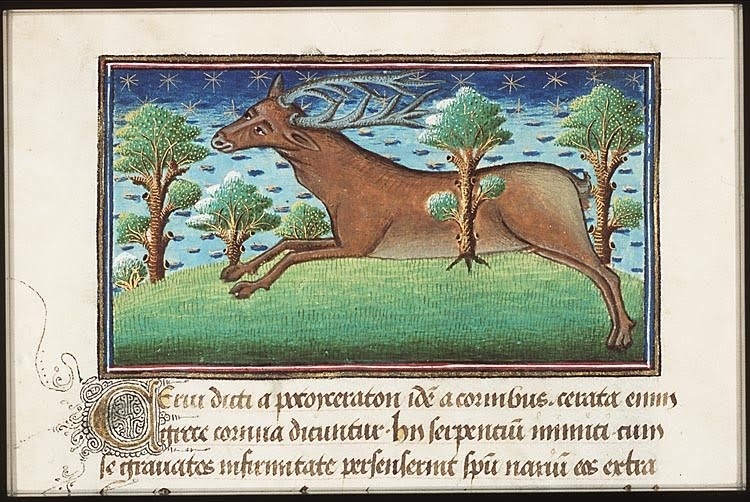
{One of today’s featured animals, looking very much like its hide will ‘refuse all weapons.’ Image from the National Library of the Netherlands Illuminated Manuscript Collection.}

Introduction

In this special weekend make-up edition of Tongues in Jars, St. Isidore talks boars and bulls:

Back To Top
Translation

“[27] The boar is named for its savagery, take away the letter F and replace it with a P. From whence and cloely the Greek Saugros, that is, wild, by which it’s called. Truly all, that are wild and irritable, we call wild marauders.
[28] A bullock it is called, which began as a help to men in cultivating the earth, or which the pagans always and everywhere sacrifice to Zeus/Jupiter, never a bull. For the age of the sacrifice is considered. Taurus is the name in Greek, as it is here.
[29] A dun colour indicates the bull, agility of a bird, its hair in opposing rows; the head they flexibly turn any way they wish; their back is quite hardy, refusing all weapons brought to bear against it.”
(St. Isidore of Seville, Etymology 12:27-29)

Back To Top
Recordings

Latin:

Modern English:

Back To Top
Persistent Etymologizing

Sticking true to his work’s name (Etymology, the origin of words), St. Isidore tries his darndest to relate the word “aper” (boar) to “feritate” (savagery) by replacing the “F” with a “P.” Words starting with the letter “f” could logically begin to start with “p” so maybe “aper” broke off from “feritate” at some point. Nonetheless, the connection isn’t quite as strong as some of Isidore’s other efforts.

Back To Top
Bull on Bulls?

What’s really curious in this passage is Isidore’s description of the bull. Its agility would definitely be impressive given its size and its weight, but the description of its hair and flexible neck is quite odd.

Do the opposing rows of hair suggest curliness? Is the flexible neck considered something to prize – a sort of flexibility in being commanded? These are both things that we’re left to wonder, as St. Isidore does not elaborate.

The toughness of leather (being a cow’s skin, even on its back, after all) is also mentioned here, though the fact (likely the exaggeration) that it “refus[es] all weapons brought to bear against it” (“omne telum respuunt inmiti feritate” (12:29)) suggests that bulls just aren’t made like they used to be. The drying process must make the cow hide too stiff, and thus unable to be flexible enough to turn weapons any which way it pleases.

Back To Top
Closing

Though he doesn’t do much of it here, St. Isidore does elaborate on cattle in this week’s regular Tuesday entry. And Beowulf strikes a blow against the dragon on Thursday, don’t miss it!

Back To Top

Beowulf & the Dragon: Little Appetite for Mutual Destruction [ll.2554-2565] (Old English)

Introduction
Translation
Recordings
Shorter Sentences
Beowulf Attacks the Dragon, or Fends it Off?
Closing

{Benjamin Bagby knows well the power of shorter sentences. Image from Benjamin Bagby’s Beowulf}

Back To Top
Introduction

Roused by Beowulf’s heavy metal scream at the end of last week’s passage, the dragon is angry this week. Yet neither of the two fighters are particularly pleased to be forced into battle:

Back To Top
Translation

“Hatred was aroused, the hoard guardian recognized
man speech; then there was no more time
to ask for friendship. First came the
breath of the fierce assailant from out of the stones,
a hot vapour of battle; the earth resounded.
The warrior below the barrow, the lord of the Geats
swung the rim of his shield against the dreadful stranger;
then was the coiled creature incited at heart
to seek battle. The good war-king
had already drawn his sword, the ancient heirloom,
sharp of edges; each was in horror from a mutual
intent upon destruction evident in the both of them.”
(Beowulf ll.2554-2565, Ch.XXXV)

Back To Top
Recordings

Old English:

Modern English:

Back To Top
Shorter Sentences

One constant in narratives from all ages is that action sequences are made up of shorter sentences. Although this passage doesn’t include any that are shorter than 19 words, the sentences here are, on average, quite a bit shorter than those in previous weeks. The shorter sentence length here makes it clear that the poet/scribe is moving into the thick of the action – things are happening now, and in real time.

In fact, it could even be argued that the shorter sentences here are the natural Old English mode of the reportage of action as it is happening. Whenever the poet describes things such as passages of time, or the interaction of characters, various details tend to be lingered upon, providing extra information that’s really ornamental rather than practical.

Back To Top
Beowulf Attacks the Dragon, or Fends it Off?

The action that’s currently taking place, however, takes on a different dimension when considered alongside the other major fights in the poem.

Unlike when Grendel comes to Beowulf or when Beowulf seeks out Grendel’s mother to continue their feud, Beowulf is pure interloper in regards to the dragon. In fact, had it not been for the thief that stole the cup, the dragon may never have left its barrow and may never have caused the Geats any distress.

So, in a sense, this is a new kind of fighting for Beowulf. Rather than being the avenging hero who is reacting to something that has happened to him or to his retainer, he is taking the initiative.

In his youth, Beowulf fought battles for others, now in his old age he fights them for himself. Perhaps this aspect of the fight is meant to reflect the simplicity in fighting for another, a person from whom you can sever yourself if it happens to be necessary to do so. On the other hand, fighting the battles made necessary to fight because of being a king are made out to be all the more difficult since you can no longer defer to some ring-lord or other but are ultimately answerable to yourself.

Perhaps Beowulf’s having a “sorrowful heart” (as noted in last week’s entry) is not just because of some direct feeling of his impending death, but the feeling that he has become the cause of the problem, and in order to defeat the problem, he also needs to destroy its cause: himself.

Back To Top
Closing

As will be seen in next week’s entry, that is indeed a valid reading of the fight.

Also on Saturday hear St. Isidore talk more of boar, and next Tuesday he’ll move onto bull and oxen.

Back To Top

Beowulf’s ‘Barbaric Yawp’ to Dragonkind [ll.2542-2553] (Old English)

Translation
Recordings
Back to the “grey stone”
On Dragons and the Need for Weapons
Beowulf’s Persistent Youth
Closing

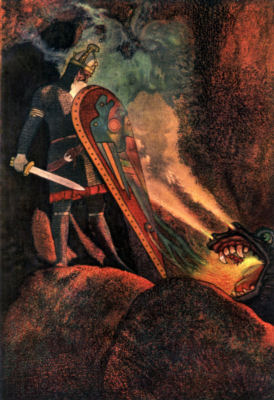
{Old Beowulf in a pose befitting his bellow. Image from Sandra Effinger’s “BEOWULF: Still a Hero” website.}

Back To Top
Translation

“Then by the wall, the man who had survived
with good manly virtue a great many battles,
the crash of combat, when the band on foot clashed,
saw standing a stone arch, a stream out from there
burst from the barrow; there it was a surging stream
of hot deadly fire; he could not be near the hoard
for any length of time without being burned up
could not survive in the depths of the dragon’s flame.
Then he allowed it from his breast, when he was enraged,
the lord of the Weder-Geats sent the word out,
fierce-hearted he shouted; his voice came in
clear as in battle as it roared under the grey stone.”
(Beowulf Ch. XXXV, ll.2542-2553)

Back To Top
Recordings

Old English:

Modern English:

Back To Top
Back to the “grey stone”

The first thing that jumps from this passage is the mention of “grey stone” (hārne stān) in line 2553. Where last week’s section seemed to nod to the story of Sigemund as it’s told earlier in Beowulf, this phrase is practically quoted from the story (“under hārne stān” appears in line 2553 and line 887).

This repetition is evidence of a kind of narrative inverse parabola within the poem, where events in the first part are mirrored by events in the third, with the descent into the mire (lines 1492-1631) being the “depths” of the poem as it were.

What’s most curious here though is that since the precedence is a celebratory story about a victorious dragon slayer, expectations seem to be running against Beowulf’s own disposition. His heart is heavy, and he’s ready for whatever fate has in store for him (“Him wæs geōmor sefa,/wǣfre ond wæl-fūs[;]” “He was of a sorrowful mind,/restless and ready for death” ll.2419-2420).

Back To Top
On Dragons and the Need for Weapons

The previous presence of a dragon was in a story nested in a story (the scop’s song in celebration of Beowulf defeating Grendel, ll.884-915) whereas the dragon is now as ‘real’ as the story’s main character.

Maybe this confrontation between the ‘real’ and what was heretofore imagined is meant to show the way in which the real world twists things – even imagined things – about, but it’s hard to say with certainty just what the poet/scribe is up to here.

Something that any reading of these parallel events also needs to deal with is the fact that the story of Sigemund and the dragon is about a young man fighting a dragon, whereas Beowulf is by no means young any longer. Perhaps his boasts of his youthful exploits are meant to be invocations of his youthful strength, but they’re too tempered by an awareness of his own mortal reality. This awareness is made clear in his admission that if he knew another way to face the dragon he would do so unarmed.

So then, what does it mean for Beowulf, a warrior and king who relied on his natural body for glory so much in the past, to now need to add weapons to that body to win glory?

Is Beowulf cursed in an opposite sense to Grendel – where the monster can’t be harmed by metal, the hero can’t wield metal? The giant’s sword he uses to finish off Grendel’s Mother and Grendel himself could be an exception, but perhaps whatever enchantment it was under nullified his curse?

Back To Top
Beowulf’s Persistent Youth

Given what’s present in the passage, it seems that Beowulf, at least in calling out the dragon, is still as wild as he was when he wrestled Grendel. He doesn’t unsheathe his sword and bang it against his shield or otherwise use what he’s wearing to call out the dragon, but instead shouts. And he shouts so that it “roared under the grey stone” (“hlynnan under hārne stān” l.2553).

The word “hlynnan” could be translated as “resounded” or “reverberated” instead of “roared,” but with what’s come before, and Beowulf’s feeling of unease (brought on, perhaps, because he knows he can’t fight the dragon with his bare hands, and that makes him incredibly nervous), the primal connotations of “roared” makes it seem the best fit.

Back To Top
Closing

Next Tuesday Isidore talks Bull, and the dragon rushes into the open where he and Beowulf stare each other down.

Back To Top

Pigging Out on Early Medieval Animal Notions [12:23-26] (Latin)

Translation
Recordings
First Thoughts
On Connections
On Pigs
Closing

{A curious scene for a curious animal. Image from the Medieval Illuminated Manuscript Collection at the National Library of the Netherlands}

Translation

This week, Isidore’s focus is on names. Quite a bit more than usual:

[23] “The hare (lepus), from light-footed (levipes), are those that run quickly. And they are called from the Greek for running “Lagos”; truly, fast is this animal, and very timid.
[24] The rabbit is a type of wild animal as is the wild dog, that which dogs entrap to capture or that they draw out from their warrens.
[25] Sows they are called, which root in the pastures, they dig in the earth in search of food. Boars (verres), those that have power (vires) when older. Pigs (porcus), since they are as filth (spurcus). Truly they pour in their own filth, they immerse in mires, they cover themselves with mud. As per Horace (Letters 1.2.26):

And the friend of filth, pigs.

[26] This is also smut or foulness. Pigs’ hair is called bristly and hair of the sow: it is called this especially by shoemakers, the likes of which hair and hide they are used to, that is accustomed to, working with.”
(St Isidore of Seville, Etymologiae 12:23-26)

Back To Top
Recordings

Latin:

Modern English:

Back To Top
First Thoughts

So, what we have here is a quick write up about the hare and its habits, launching into the pig and its thorough association with filth. Knowing that these sorts of medieval encyclopedias were a mash-up of original and “borrowed” material does something to explain the order in which Isidore is treating animals, but it remains curious.

Back To Top
On Connections

The connection between deer and rabbits is their timidity. This makes good sense, as the end of the passage on deer is indeed a quotation about that very quality.

But, then what’s the connection between the rabbit and the sow or pig? Is it that the pig roots around in the ground for food as the dog does for the rabbit? It seems like that’s the case – unless the connection (if there even is one) is based on the fact that both animals live quite a bit of their lives in the dirt.

What’s also curious is that only the pig’s skin is mentioned as something used by a profession. Rabbits would’ve been fairly plentiful in Isidore’s part of the world, but it seems the fur didn’t have much value. Certainly, no one was “accustomed to” (“suant” or “consuant” (12:26)) using it.

I guess pigskin wasn’t so much what was kicked in those days as it was that with which you kicked.

Back To Top
On Pigs

The association between pigs and filth, mud, and smut is something that St. Isidore seems particularly intent on getting across. Why exactly is unclear. Though, if the animal itself is so filthy, then why is its skin so commonly used for leather?

Inhering in his entry on pigs is there some kind of commentary on the commoner’s choice of footwear material? Or is it just that St. Isidore is emphasizing the pig’s uncleanliness in order to make it more obvious that all creatures have a purpose when he reveals that the pig is what the shoemaker is used to using?

It’s a curious question, but one that can’t be grasped if we look only at the words of the Etymologiae. Nonetheless, a guess is that St. Isidore is just reporting what he’s found here, perhaps trying to make people remember their humble connections to this humble animal.

What’s most surprising, though, is that he doesn’t even mention how tasty the pig can be. Ah well, probably not a lot of room in the life of a bishop to have copious amounts of an animal sliced into strips and fried up to celebrate the birth of a savior.

Back To Top
Closing

Check back here Thursday evening for the telling of Beowulf’s rousing the dragon (Ch.XXXV, ll.2542-2553).

Back To Top

Beowulf’s is no "cowardly course of action!" [ll.2529-2541] (Old English)

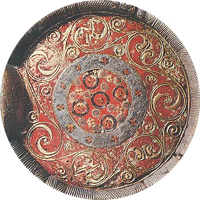
{The sort of shield Beowulf may’ve borne off with him. Image from the Lighthouse Journal}

Translation
Recording
Commentary Intro
Death and Glory
Echoes of Sigemund
Closing

At last in this week’s reading of Beowulf, the hero becomes a man of action once more. Since deeds speak louder than words, let’s check in with the poet/scribe’s own deeds, which, ironically, are words.

Back To Top
Translation

“‘Wait you on the barrow, my armed men,
warriors in war gear, while we see which of
we two can endure the wounds
after the deadly onslaught. This is not your fight,
nor any other man’s, but mine alone
to share my might with the foe,
indeed my courage. By that courage shall
I win the gold, or, in battle,
peril of a violent death, may your lord be taken away!’
Arose then behind the shield that renowned warrior,
hard under helm, bore his battle shirt beneath
the stony cliffs, trusted in the strength of one
man alone. That was no such cowardly course of action!”
(Beowulf ll.2529-2541)

Back To Top
Recordings

Old English:

Modern English:

Back To Top
Commentary Intro

So here we have Beowulf announcing that this is his fight, and then heading off to the dragon’s den. Even the poet/scribe notes that he “trusted in the strength of a single man” (“strengo getruwode/ānes mannes” ll.2541-42). But what’s this all about?

Back To Top
Death and Glory

If Beowulf knows that he is likely to die in this fight it could be argued that he wants to minimize the danger to his thanes by rushing into battle alone. However, that’s a bit of an anachronistic way of looking at the passage.

All puns pardoned, it’s more likely that Beowulf specifically orders his men to stay out of the fray so that he can go out in a blaze of glory. What better way to die than in battle, let alone battle with a dragon – the very embodiment of the greed that all good kings must eschew in order to be good kings.

The passage could also be analyzed as the poet/scribe taking a bit of a jab at a system where a mere man calls the shots in a society that runs on glory and heroic deeds, since it is the doing of such deeds that gets Beowulf killed and ultimately leads to the Geats’ being leaderless, and shortly after war-ravaged.

So, is this merely the vehicle to set up the main character for his triumphant death as hero and dragon slayer, or a Christian twist that’s supposed to undermine the old pagan Germanic way?

Back To Top
Echoes of Sigemund

One thing can definitely be agreed on, there’s an echo of the story of Sigemund and Fafnir in the description of Beowulf’s approach to the barrow’s entrance. It’s only in the phrase “stony cliffs” (“stān-cleofu” l.2540), but the inclusion of “stān” makes this phrase too close to “grey stone” (“hārne-stān”) to be mere coincidence.

Unless dragons are somehow related to these sorts of rocky outcrops, it seems that the poet/scribe is trying to hint at some connection between the Sigemund story and this. Perhaps he is merely foreshadowing the victory (and the curse that comes with it), or trying to suggest that such old stories have no basis in reality. After all, this is Beowulf whose moving under these rocks to kill a dragon, not some distant mythological figure like Sigemund.

Nonetheless, for a passage that’s full of bravado these lines provide a lot more than mere introspection on the part of Beowulf. It really speaks to his own desire to show himself that he’s still as good as he was when he was young.

As the hero of the story he has internalized the very ethos of the Germanic pagan heroic tradition, and it is that which will ultimately cause his downfall. He feels that he is going to die, he’s got that heavy heart, and he constantly talks of how fate is the only one who can decide which of the two will live or die. But yet he still goes on, and his final words to his men suggest a tone of “don’t bother me, I need to show you (and myself) that I can still do this.”

Beowulf needs to validate himself within the system that he has so successfully internalized, first as the celebrated slayer of Grendel and Grendel’s Mother, then as king of the Geats, and then finally (and hopefully, in his current frame of mind), as the slayer of the dragon. But only time will tell.

Back To Top
Closing

Come back next week for Isidore’s brief take on rabbits and longer musing on pigs, and for Beowulf’s final approach to the dragon.

Back To Top

Wacky Swimmers and Shaggy Shoulders [12:19-22] (Latin)

Introduction
Translation
Recording
First Thoughts
Physical Traits
The Martial
Closing

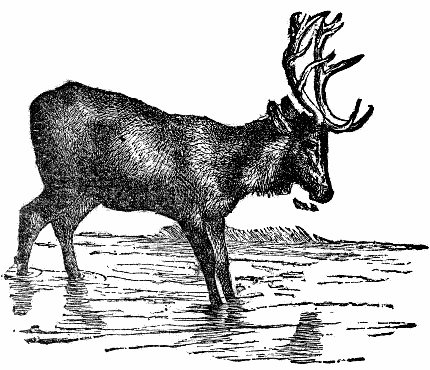
{A stag testing the depths. Image from The Gutenberg Project eBook of Aesop’s Fables}

Introduction

St. Isidore talks more of deer today. His differentiation between them gets so fine, in fact, that their Modern English equivalent is simply “deer.”

Back To Top
Translation

[19]”Their upright ears miss no sound, no matter how low. And when they swim over vast rivers or seas they feel no extra labour, they put their head in first and then alternately dip it and then their buttocks into the water.
[20]”Tragelaphi is the Greek name for them, which, although they are like hinds, have shaggy shoulders like the he-goat, and from their chin a long beard, which no other around the river of Colchis have.
[21]”Fawns (hinnuleus) are the sons of these deer (called such from “to give a nod to” (innuere), referring to the tottering that they leave behind at maturity).
[22]”Deer they are called which flee from hands: a timid and non-warlike animal; from which Martial:
“Why oh deer, who defends by horn, do you all fear the boar’s tusk, take no prey?”
(St. Isidore of Seville, Etymologiae 12:19-22)

Back To Top
Recording

Here’s the above section of the Etymologiae in Latin:

And in Modern English:

Back To Top
First Thoughts

So, much like Beowulf’s speech in last Thursday’s entry, this description of the deer is quite straightforward. The two things that stick out are the description of the deer’s long-range swimming style, and Isidore’s quotation of Martial.

Back To Top
Physical Traits

The description of their swimming style is curious for its vividness. Literally, he says that they alternate between dipping their head and their buttocks in the water, as if they propel themselves by an extreme alternating motion.

In fact, it’s a very vivid description of swimming not just by moving the hind and fore legs, but instead by moving the whole body. It comes across as a kind of undulation that would give the animals more propulsion through the water.

Their comparison with he-goats is also interesting, but sadly nothing more is said than that they share the shagginess of their shoulders. Perhaps there was a significance to this that was common place and well known, maybe shaggy shoulders signified stubbornness or that an animal possessed hidden strength?

Back To Top
The Martial

And then we come to the quotation of Martial. Perhaps this is included because to the medieval mind the deer’s horns, though thinner, were multiple, and so the deer itself was regarded as stronger than a boar (with it’s mere two tusks).

But, it seems that the deer’s fear of the boar in spite of its antlers is another aspect of the animal that adds to its aura of grace and greatness.

For the deer is perceived as an animal that, despite being so heavily armed, prefers to flee than to fight – but not in a clumsy way (they outgrow that, after all). When described as “alternately dip[ing] [their head] and then their buttocks into the water,” (“capita clunibus praecedentium superponunt sibique invicem succedentes” 12:19) these graceful deer may sound a little goofy, but to contemporary ears, it perhaps suggested that the deer had a greater understanding of how to move its body in the most effective way possible.

Back To Top
Closing

On Thursday check back for Beowulf’s commands to his men, and the first few steps towards the fight with the dragon.

Back To Top

All About Beowulf’s Final "Boast-Words" [ll.2510-2528] (Old English)

Translation
Recordings
Initial Thoughts
Why so Compounded?
Three Possibilities
Closing

{What Beowulf imagines his fight with the dragon will look like – war-fire, breath, venom, shield, and all. Image from eKits.}

Back To Top
Translation

This week’s section of Beowulf sees him boast for the last time, before turning and addressing his thanes. Let’s listen in:

“Beowulf spoke, gave form to boast-words
for the final time: ‘In youth I
risked much in combat; yet I will once more
though an old king of the people, pursue the feud,
gain glory, if only the fiend to men
will come out from his earth-hall to face me!’
Addressed he then each warrior,
each helm-wearer for truly the final time,
each dear companion: ‘I would not bear a sword,
bring the weapon to the worm, if I knew how
I might otherwise gloriously grapple against
that foe, as I once with Grendel did;
but there will be hot war-fires, I expect,
breath and venom; thus I have on
both shield and byrnie. Nor will I give a foot’s length
when I meet the barrow’s guard, but between us two
what is to happen later on this sea wall, that is as fate,
measurer of men, is drawn to decide. I am firm of heart,
so that I may cease from boasting over this war-flyer.'”
(Beowulf ll.2510-2528)

Back To Top
Recordings
Now, to give you a sense of how that would sound:

And in Modern English:

Back To Top
Initial Thoughts

This passage, for all of its high boast density, is quite straightforward. Beowulf says that he will fight the dragon as long as he comes out of the barrow, and then turns to his men to tell them why he’s carrying a shield and wearing armor. Then, he closes it all off by saying that he is “firm of heart,/so that I may desist from boasting over this war-flyer” (“Ic eom on mōde from/þæt ic wið þone guð-flogan gylp ofersitte” ll.2527-8)

That’s it.

There’s definitely something to say for its directness. This quality might even be the result of Beowulf’s melancholic belief that this will be his last fight, and the poet’s own admission of the same. But, as always, there is one curious thing to poke at – like a sleeping dragon coiled around a heap of gold.

Back To Top
Why so Compounded?

This passage uses a fair number of compound nouns: “Bēot-wordum” for “boast-words;” “mān-sceaða,” for “fiend to men;” “eorð-sele” for “earth-hall;” “helm-berende;” for “helm-wearers;” “heaðu-fyres,” for “war-fires;” “guð-floga” for “war-flyer.”

All of these compound words share two characteristics. They’re all related to war, and they’re all direct , straightforward terms. Though it might be contentious, none of them are the fancier type of compound words known as kennings (like “līchama” for “body” (literally “body-raiment”) or “heofon-candel” for “sun” (literally “sky-candle”).

Maybe Beowulf isn’t in the mood for speeches wrought with fine words like cups studded with jewels. Maybe the poet is trying to just skate on through this section being straight to the point and direct. Or maybe, there’s something more going on here – something at the level of connotation and association.

Maybe direct, clear compound words, are those that are related to war specifically. Granted, you might be able to come up with more elaborate compounds that are used to describe battles and what not, but at least here, it’s curious that they’re so streamlined. If this is indicative of something about the poem that’s one thing. But what if it’s pointing to something present in all of Anglo-Saxon poetry, maybe even the culture itself?

Back To Top
Three Possibilities

If we run with the idea that this compounding cluster relates to Anglo-Saxon culture, then the compound words/phrases relating to war being straightforward and direct could mean a number of things. It could be meant to reflect the manly nature of war, men being more direct and active. Though this is a little bit anachronistic, since Anglo-Saxon women could rise to the same level of martial power as men.

Alternatively, this straightforwardness of war-related compounds could mean that war itself was something that the Anglo-Saxons regarded as straightforward. Or, maybe they saw it as something that need not be embellished when its reality is about to be brought home.

For all of Beowulf’s boasting up to this point has been about the past, only now does he actually boast about what he is going to do next. Maybe the rough drafts of boasts, boasts for deeds undone, are underplayed so that they can be elevated to ecstatically glorious places after the deeds they describe are done.

Or, again, maybe this straightforward language on the part of Beowulf (and the poet) is meant to be taken as a deference to fate.

Everything is cold and windy on the promontory. Beowulf is about to face the dragon, and talking to his men before the worm comes from its underground lair. Things are tense. Things are heavy. Beowulf knows that he’s an old man, “an old king of the people” (“frōd folces weard” l.2513). He knows that the dragon’s breath and venom are to be feared, to be protected against. So maybe his direct boasting, and its firm, resolute ending, are meant to show his humility before fate. After all, for our two combatants, it will be as fate decides, “swā…wyrd getēoð” (l. 2526).

Back To Top
Closing

What do you make of this crowd of compound words, these straightforward and unassuming combinations? Let me know down in the comments.

Next week, be ready for more of St. Isidore’s writing on deer, and Beowulf gives his final commands to the men before heading off to draw the dragon from its den.

Back To Top
St. Isidore’s En-deer-ing Take on a Natural Pharmacist [12:16-18] (Latin)

Translation
Spoken Versions
Thoughts on Deer
An Unexpected Discovery
Closing

{It’s true – things were bigger in the past. Image from the National Library of the Netherlands Medieval Illuminated Manuscripts Collection}

St. Isidore wastes no time shifting to a new class of animal, so let’s not waste any time getting to what he’s got to say:

Translation

[16] “Likewise the deer; also ibexes, avice as it were, those that appear as the birds amidst the hills and hold to heights and live in the acme of the mountains, so that they are rarely open to the human gaze.
[17] “From whence they are called bird ibexes in the southern parts, [birds] that live by the Nile river. This animal also, so called, dwells in the high rocks; and if they sense danger by human or by chase, they escape unhurt to the high mountains where they sharpen their own horns beforehand.
[18] “Deer are called “Apo Ton Keraton,” he is of horn; “Kerata” is truly what the Greeks call horns. This animal has the serpent as an enemy yet it can anticipate the severe injury from it, but it draws the spirit out from its nostrils in its caves, they overcome this terrible venom by their food. For dittany is known to them; that they use while in the field to shake off that poison. Moreover they wonderfully hiss as panpipes do.”
(St. Isidore of Seville, Etymologiae 12:16-18)

Back To Top
Spoken Versions

In an effort to bring these dead languages new life, here’s the above in spoken Latin:

And in spoken English:

Back To Top
Thoughts on Deer

Now, unfortunately there’s not as much lore in this passage as there’s been in recent weeks.

But, there’s at least an implication that deer are revered as quasi-sacred animals since the height of their homes is emphasized.

The fact that they also know of the curative properties of wild marjoram (“dittany,” or the Latin “dictamnum”) also suggests that they’ve got a measure of intelligence that goes beyond that of most other animals. Underwriting this implication about deer is Isidore’s use of “ipsi” “self, himself, herself, etc.” in the sentence about dittany being “known to them” (“prodiderunt”). This wording makes it plain that the deer have figured this out on their own.

And then there’s the strange mention of the deer’s hissing sounding like panpipes (“fistularum,” or “bagpipes, tubes, panpipes”). Maybe such a high pitched sound is supposed to further highlight the deer’s harmonious state in its natural place. Or maybe it’s supposed to gently disprove pagan belief in satyrs, since there’s a natural explanation within the bounds of Christian creation.

Back To Top
An Unexpected Discovery

Fairly unrelated to all this talk of deer is a discovery made away from the translated page.

The word “avices” wasn’t turning anything up in the Collins Gem Latin Dictionary used for reference, so the words around where it should be were poked at. Among these words is “Avernus,” which refers to a lake that was “believed to be an entrance to the lower world” (according to the Dictionary’s definition).

It doesn’t seem to be related to the hall of Grendel and Grendel’s mother in Beowulf, but the idea that a lake and not just a cave could lead to the lower world suggests a Roman precedent for the underwater hall of the epic. Undoubtedly there are also precedents in Germanic myth and lore, but this one from the Romans (Virgil uses it as this in the Aeneid) is indeed curious.

Perhaps the Romans spread this story amongst the Britons and those living in the Roman-occupied British Isles?

Perhaps those stories were then passed around and eventually picked up by a Briton poet or scop ([shaw-op] Old English for “poet”) savvy enough to know that underwater halls were already popular with/known to his new patrons?

Tracking that sort of historical progression is tricky – but that’s just what makes it so fascinating.

Back To Top
Closing

Like that hypothetical scop, Beowulf also minds his words in this week’s passage from the poem as he makes the bulk of his war-boast before at last going into the barrow. Check back on Thursday for it!

Back To Top

Beowulf’s Boasts – Dayraven’s and Dragon’s Bane [2496-2509] (Old English)

Translation
A Word and a Name
Compounded Words
Conclusion and Wrap Up

There’s more boasting from Beowulf today, as he recalls the turning point in his career and then starts to talk some smack about the dragon’s hoard.

{Perhaps the younger Beowulf that our hero has in mind. Image created by Sandra Effinger}

Translation

“Always would I go on foot before him,
first in the line, and so ’til age takes me
shall I conduct war, so long as this sword survives,
that which has and will endure;
ever since before the hosts I became the
hand slayer of Dayraven,the Frankish warrior
No treasure at all did he
bring back to the Frisian king,
No breast plate could he have carried,
for, in the field as standard bearer, he fell,
princely in courage; he was not slain by the sword
but by hostile grip I halted the surge of his heart,
broke his bone-house. Now shall the sword’s edge,
hand and hard blade, be heaved against the hoard.”
(Beowulf ll.2496-2509)

As with any passage that concentrates so much on warfare there are some bits here that are so loud that they can’t be ignored.

Return To Top
A Word and a Name

One such bit is the word “feðan.” It looks like it should be a verb because of its “an” ending, but the Clarke Hall & Meritt dictionary isn’t quite so sure about it.

However, the translation of “marched” or “go on foot” makes sense since the entry right before it is feða, meaning “footsoldier.” It might not be a perfect translation, but just turning that word into a verb might be an all right way to go. Sense be damned, right?

Speaking of sense, the name Dayraven (originally Dæghrefne) could carry an odd one. As came up in an earlier entry, the raven is one of the three beasts of battle. But the significance of the raven isn’t finished there.

Based on the appearance of a raven at daybreak earlier in the poem (l.1801, during the celebration of Beowulf defeating Grendel’s mother), the bird is definitely a bringer of joy. So what could it mean for Beowulf to kill a warrior named for this good omen-bearing bird?

Moreover, should we take the suggestion that Beowulf has killed a symbol of joy to mean that he has doomed himself, or is this joy only that of the Franks who have lost their standard bearer and a man that is “princely in courage” (“æþeling on elne,” l.2506)?

Dayraven’s being identified with the Franks twice within two consecutive lines suggests that if he is to be understood as some sort of embodiment of joy he is definitely the Franks’ joy only. But given what happens to Beowulf when he faces the dragon, one wonders.

Return To Top
Compounded Words

As this passage is one of the climaxes of Beowulf’s boasting there are some cool compound words in it. Among them are “brēost-weorðunge,” “hilde-grāp” and “bān-hūs.” None of these yield any crazy literal translations, being breast-ornament, hostile grip, and bone-house respectively, but they’re all compounds that hint at bits of the poem’s culture.

“Brēost-weorðunge” is possibly the most nebulous. A breast ornament could be decorative plate armor, but maybe it refers to something like a heavy necklace, or something that you could hang off of armor – medals, maybe. But that such an accessory was important enough to have its own name (poetic or otherwise) implies that the Anglo-Saxons took their bling seriously.

“Hilde-grāp” and “bān-hūs” are clearer and more direct, but no less curious. Why? Because they’re both readily translatable into words/phrases that could easily transfer into today’s English.

Also, that “hilde-grāp” specifies a certain kind of grip makes it clear that grappling was pretty important to Anglo-Saxons. Beowulf’s feats earlier in the poem also back up this implication about their culture.

With “bān-hūs” the implication seems to be more metaphysical, or at the least spiritual. Referring to a body as a “bone-house” might hint at there being something not of flesh dwelling within that house. That Clark Hall & Meritt translate it as “body, chest, breast” supports this idea that it hints at a belief in a soul of in-dwelling life force, since the “chest” or “breast” contains the heart.

All of this connotation puts me in mind of another Old English compound: “word-hoard.”

Return To Top
Conclusion and Wrap Up

Since Beowulf has talked up his sword skill with all of this boasting the dragon definitely needs to fear what’s coming to it. But – it won’t be coming just yet. Beowulf still has some more boasting to get out of the way before he’s ready to head over to the beast’s den. And, at the opposite end of things, Isidore gets into talk of ibexes next week.

So, be sure to check back next week for those two entries. In the meantime, what do you make of Beowulf’s killing Dayraven? Feel free to leave your thoughts in a comment.
Return To Top

Edible Kids, Lust-Eyed He-Goats, and Eccentric She-Goats [12:13-15] (Latin)

Translation
On Kids
He-Goats
She-Goats
Conclusion

Goats and she goats are St. Isidore’s topic this week, and there are, as with last week’s section on lambs and sheep, some curious bits of lore thrown in with his definitions.

{Can’t you just see the lust in those eyes? Image from the CR4 article “Is Going Green Getting Your Goat?”}

Translation

[13]”Kids {“haedus”} are so named for eating {“edulare”}. For the small are the fattest and of a delightful taste, from whence [and to eat, from whence] comes the word for edible.

[14]”The he-goat is a truly lascivious animal and a butter and always eager for sex; and we can see lust lying across its eye, from whence its name {“hircus”} is drawn. For the eyes of the he-goat are angular as it is in the second book of Suetonius (Prat 171); whose nature is indeed the hottest like diamond stone, material which neither fire nor iron is able to break into, and which blood alone can dissolve. Many he-goats are called Cinyphri for the river Cinyphrus in Libya, where many were born.

[15] “We call she-goats and she-goats* {capra} for their nibbling {carpo}
of thickets. Others are caught bitterly. Some rattle the blood, from which they can be called rattlers; which are wild she goats, which for the Greeks are sharp to look upon, they are called by them ‘Oksuderkesteron durka.’ In fact, they are seen in the height of mountains, and ever so of those in the distance, however all come that far nevertheless.”
(Book 12:13-15 of St. Isidore of Seville’s Etymologiae)
(*This phrase caused me difficulty since the Latin is “capros et capras,” which suggests male and female “she-goats.”)

Back To Top
On Kids

“Kid’s are so named for eating.” Out of context, this could be a terrifying statement. And even in context, it’s not entirely clear automatically.

On the one hand, it makes sense that you would want to fatten an animal up before eating it. On the other, if you’re eating all of the young of an animal (the textbook definition of “kid”), then how are you to get more of the adults? A certain degree of moderation must’ve been practiced by people of that age.

Or maybe, since the kids are also known to have a “pleasing/delightful taste” they were saved for special occasions only.

But alas, St. Isidore doesn’t pause to give us such a detail. Instead, he plunges ahead into the realm of lust and cheap casinos. Or, well, maybe just lust.

Yes, he moves onto he-goats (“hircus”).

Back To Top
He-Goats

One question that comes up immediately on reading this passage is, why does lust live laying across the eye? Or, if you translate “transversus” differently, the corner of the eye? This could be a reference to the slitted pupil of the goat, or perhaps to an idea that lust wasn’t something generally conveyed with a direct look, but instead a glance out of the corner of an eye.

Maybe, in such a situation, if such a glance went unchecked by the glancer and the glancer turned to get a full look of what lust had pulled his or her attention to, then it would become full blown desire.

In the ancient world there was also a belief that a person’s gaze was more of a beam than a passive receiver of information, so maybe such a direct look was also associated with things like Cupid’s arrows. They could be pulled from a quiver (the sidelong glance) and then fired at the victim (the object of the full on look) and maybe there’d be return fire or the shot would just be deflected and all for naught. It’d be great if there’s some love poetry that uses such warlike imagery. A find like that would really cement this connection.

When St. Isidore compares the goat’s fiery nature to the impenetrable nature of diamonds a few more questions might be raised.

Why compare something like an animal’s nature to a diamond in terms of hardness?

Did having a “hard nature” carry the same meaning that it does today, stubborn and wanton, difficult to really get along with?

That “fire and iron” represent the greatest forces that St. Isidore can describe in single words is also curious, since the martial influence is again visible. And that sort of influence is quite clear in the verb “domare” (meaning to tame, break into, conquer). It’s interesting how even 1300 years ago sex and violence were associated with each other.

And speaking of sex, the characteristics that St. Isidore attributes to she goats are also intriguing (partially because the Latin seems especially dense here).

Back To Top
She-Goats

The fact that they “rattle” is definitely something lost in translation – much like how “kids are so named for eating.” A good guess is that she-goats are noisy, in that they rattle their voices, or bleat, frequently.

What’s out and out weird, is the way that St. Isidore describes she-goats as being seen in the high and far mountains but only by those who bother to look. What does this even mean? That the wild she goats are so plentiful in Greece that they just go unnoticed? Or are she-goats taking on a more spiritual meaning here?

Back To Top
Conclusion

If you’ve got some ideas about what St. Isidore is talking about when it comes to she-goats’ travel habits, or if you know of any warlike love poetry from the 7th century or earlier, simply let me know in a comment.

And check back Thursday for the continuation of Beowulf’s boasting about his deeds and for a clear statement about what he’s going to do with his sword and the dragon’s hoard.

Back To Top