What a quiet moment in Beowulf means (ll.1785-1798)

Introduction
Synopsis
The Original Old English
My Translation
A Quick Question
Closing

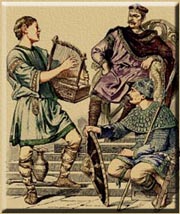
A scop sings his boasts, just like Beowulf does before Hrothgar.

Image found at http://bit.ly/2jumA3j


Back To Top
Introduction

I know that February is almost done, and so 2017 is already started. But, one of the things that I want to do over the course of this year is to trim back on the padding that I’ve built into my work in the past. I want to make 2017 Twenty-Seven-Lean. Both in that I trim the fat from what I do and in that I use the time I’m left with to lean more into the core of what I do.

I can’t say for sure yet, but I’m starting to consider using these shorter translation post formats from here forward. If you want to share your thoughts on this potential change, let me know in the comments.


Back To Top
Synopsis

Beowulf parties before hitting the hay.


Back To Top
The Original Old English

“Geat wæs glædmod, geong sona to
setles neosan, swa se snottra heht.
þa wæs eft swa ær ellenrofum
fletsittendum fægere gereorded
niowan stefne. Nihthelm geswearc
deorc ofer dryhtgumum. Duguð eal aras.
Wolde blondenfeax beddes neosan,
gamela Scylding. Geat unigmetes wel,
rofne randwigan, restan lyste;
sona him seleþegn siðes wergum,
feorrancundum, forð wisade,
se for andrysnum ealle beweotede
þegnes þearfe, swylce þy dogore
heaþoliðende habban scoldon.”
(Beowulf ll.1785-1798)


Back To Top
My Translation

“The Geat was glad-hearted at that, he descended the dais,
sought out a seat, as the wise one had commanded.
Then was it as it had been before for the bold,
the sitters in the hall spoke fairly with voices renewed.
The mantle of night fell to darken the world
outside the warriors’ hall. All that company arose;
the grey-haired one then sought his bed,
leader of the Scyldings, the Geat, renowned shield warrior
was also eager for such rest. Soon to him,
the one wearied along the warrior’s way, a hall thane came,
one to guide the far-flung one on his way,
he who for etiquette’s sake waited on all
thane’s needs, such as should be had in those days
for far-flung seafaring warriors.”
(Beowulf ll.1785-1798)


Back To Top
A Quick Question

The core of this passage is that Beowulf is shown as a warrior who observes good manners in waiting for his host to go to bed before heading there himself. Other than that, there’s not much here.

Although, the absence of action or conflict or major dramatic events speaks to how quiet this moment in the poem is. This isn’t just a break between beating up monsters, but for Beowulf the character this is the end of his labours in Daneland. He has slept in Heorot before, but this is the first night where he can sleep without worrying about staying awake for Grendel or without the shadow of Grendel’s mother looming over him. Daneland has been saved from monsters, and so his work is done.

But this moment also fits in between the major events in the social drama of Beowulf. Hrothgar has said his piece about kingship, and the big ceremonial giving of gifts happens in the morning. Right now the poet is singing where normally he’d be taking a break. And that’s what makes this part of the poem significant in my mind.

In particular, since it’s about the need for rest, I see this part of the poem as a very human moment in a poem that is otherwise all about the supernatural and non-human.

But what do you think? Should the poet have just said “And after Hrothgar spoke, they all went to bed to rest up for the gift-giving. And what a gift giving!” to get on with it? Or is there some reason for this curious quiet moment? Let me know in the comments!


Back To Top
Closing

Next week, Beowulf’s thoughts turn to home, and Unferth’s sword returns to him.

You can find the next part of Beowulf here.

Back To Top

Hrothgar starts to step out of the story (ll.1769-1784)

Introduction
Synopsis
The Original Old English
My Translation
A Quick Question
Closing

A scop sings his boasts, just like Beowulf does before Hrothgar.

Image found at http://bit.ly/2jumA3j


Back To Top
Introduction

It’s been a busy week, so here’s a short translation post.


Back To Top
Synopsis

Hrothgar sums up his rule, and promises Beowulf great gifts.


Back To Top
The Original Old English

“‘Swa ic Hringdena hund missera
weold under wolcnum ond hig wigge beleac
manigum mægþa geond þysne middangeard,
æscum ond ecgum, þæt ic me ænigne
under swegles begong gesacan ne tealde.
Hwæt, me þæs on eþle edwenden cwom,
gyrn æfter gomene, seoþðan Grendel wearð,
ealdgewinna, ingenga min;
ic þære socne singales wæg
modceare micle. þæs sig metode þanc,
ecean dryhtne, þæs ðe ic on aldre gebad
þæt ic on þone hafelan heorodreorigne
ofer ealdgewin eagum starige!
Ga nu to setle, symbelwynne dreoh
wigge weorþad; unc sceal worn fela
maþma gemænra, siþðan morgen bið.'”
(Beowulf ll.1769-1784)


Back To Top
My Translation

‘”Just so I have ruled the Ring-Danes under the sky
for one hundred half-years, and have protected
them against war with many nations from across this world,
from both spears and swords, such that I have not considered any other beneath the sky’s expanse as an adversary.
But lo! A hard reversal came to my native land,
grief following joy, once Grendel appeared,
that ancient adversary, that invader of my peace;
at that arrival I continually bore persecution
and great sorrow of mind. Thus I now thank God,
the eternal Lord, that I might experience in my life,
after the struggle, the chance to gaze upon with my eyes
the beast’s head blood-stained from battle.
Go now to the bench, joyously join the
mirth of feasting; we two shall share
a great many treasures when the morning comes.'”
(Beowulf ll.1769-1784)


Back To Top
A Quick Question

Hrothgar’s quick summary of the poem leads into a section where Beowulf’s adventures in Daneland come to an end. And there’s a lot of talk of celebration, but it seems very under-hyped to me. Hrothgar mentions that Beowulf will get “a great many treasures” (“maþma gemænra” (l.1784)) for all of his work here, but that’s about it.

Instead, most of the end of Hrothgar’s speech is about his rule. I guess the implication here is that happiness has returned to Heorot, and Hrothgar’s rule will continue as it did before. There’s definitely a strong sense that not only are things returning to normal in Daneland, but all of the characters living there are stepping out of the mythic realm that Beowulf brings with him and returning to history.

What do you get out of Hrothgar’s talking about his rule in Daneland? Let me know in the comments!


Back To Top
Closing

Next week, Beowulf and Hrothgar party on.

You can find the next part of Beowulf here.

Back To Top

Is Hrothgar motivating Beowulf with death? (ll.1758-1768)

Introduction
Synopsis
The Original Old English
My Translation
A Quick Question
Closing

A scop sings his boasts, just like Beowulf does before Hrothgar.

Image found at http://bit.ly/2jumA3j


Back To Top
Introduction

Unfortunately this week’s been a little too hectic for me to make time for a full translation post. Instead of skipping a week though, here is my translation of the next part of Beowulf.


Back To Top
Synopsis

Hrothgar makes the moral of his story loud and clear for Beowulf.


Back To Top
The Original Old English

“‘Bebeorh þe ðone bealonið, Beowulf leofa,
secg betsta, ond þe þæt selre geceos,
ece rædas; oferhyda ne gym,
mære cempa. Nu is þines mægnes blæd
ane hwile. Eft sona bið
þæt þec adl oððe ecg eafoþes getwæfeð,
oððe fyres feng, oððe flodes wylm,
oððe gripe meces, oððe gares fliht,
oððe atol yldo; oððe eagena bearhtm
forsiteð ond forsworceð; semninga bið
þæt ðec, dryhtguma, deað oferswyðeð.'”
(Beowulf ll.1758-1768)


Back To Top
My Translation

“‘Guard against such evil hostility, dear Beowulf,
best of men, and be sure to make the better choice:
eternal gain; be not intent on pride,
oh renowned warrior! Now is your power prospering
for but a short while; soon will either
illness or the blade deprive you of that strength,
or the grip of flames, or the surging waters,
or an attack by sword, or the flight of spears,
or terrible old age, or the light of your eyes
will fail and grow dim; presently such will come
upon you, oh lord of battle, and death will overpower you.'”
(Beowulf ll.1758-1768)


Back To Top
A Quick Question

A lot of people take the inevitability of their own death as a major inspiration to get on with what they want to do with their lives. Steve Jobs, for example, used his mortality as a way to figure out if what he was doing was what he truly wanted to (he suggests was “meant” to do) on what sounds like a daily basis. At least that’s the impression I get from the speech quoted in this article.

Although Hrothgar’s list of all the ways Beowulf could eventually die is a little gloomy and seems very melancholic do you think he’s doing the same thing here? Is he trying to motivate Beowulf to live each day to the fullest? Or is he just trying to remind Beowulf that he won’t live forever?

Let me know in the comments!


Back To Top
Closing

Next week Hrothgar gives a recap of the whole poem so far — from his perspective.

You can find the next part of Beowulf here.

Back To Top

Further adventures in philosophy via Beowulf: The best use of wealth (ll.1745-1757)

Synopsis
Original
Translation
Recordings
Hrothgar’s Thoughts on Wealth and Sharing It
The Way to Our Best Futures
Closing

A scop sings his boasts, just like Beowulf does before Hrothgar.

Image found at http://bit.ly/2jumA3j


Back To Top
Synopsis

Hrothgar’s hypothetical ruler meets his tragic end.


Back To Top
Original

“þonne bið on hreþre under helm drepen
biteran stræle (him bebeorgan ne con),
wom wundor-bebodum wergan gastes;
þinceð him to lytel þæt he lange heold,
gytsað grom-hydig, nallas on gylp seleð
fædde beagas, ond he þa forð-gesceaft
forgyteð ond forgymeð, þæs þe him ær god sealde,
wuldres waldend, weorð-mynda dæl.
Hit on ende-stæf eft gelimpeð
þæt se lic-homa læne gedreoseð,
fæge gefealleð; fehð oþer to,
se þe unmurnlice madmas dæleþ,
eorles ær-gestreon, egesan ne gymeð.”
(Beowulf ll.1745-1757)


Back To Top
Translation

“Then that sharp arrow slides beneath his defenses,
it bites into his heart — he knows not to guard himself —
the perverse strange command of the evil spirit then has hold.
He begins to think little of what he had long held;
going forth angry-minded he only covets, for pride he never gives
rings of hammered gold; and what he had been destined for
is forgotten and neglected, what was shown in the Almighty’s past gifts,
God’s glory, all that was made clear in his share of honour.
Afterwards the common end comes to him,
that prince’s transitory body declines,
what is fated to die falls; then another takes what had been his,
one who ungrudgingly shares that former prince’s ancient treasures
among their earls, fearing no retribution.”
(Beowulf ll.1745-1757)


Back To Top
Recordings

Old English:

{Forthcoming}

Modern English:

{Forthcoming}


Back To Top
Hrothgar’s Thoughts on Wealth and Sharing It

In my reading of this passage the thing that Hrothgar is getting at is that the best use of wealth is to share it.

His hypothetical ruler who had it all gets greedy after their soul (their humanity) is killed by feelings of anxiety and uncertainty. After this murder the ruler turns to the world of things rather than to the world of their fellow people to soothe themselves. However, this leads to a miserly and covetous existence in which the ruler surrounds themselves with things, and then passes away with no fanfare whatever. And, after they’re gone another comes along and doles out what their predecessor had so closely guarded with an open hand, proving that such miserliness only causes pointless suffering.

Ultimately, then, this passage reinforces the Anglo-Saxon value of the wealthy class sharing their wealth. A lesson that’s just as important then as it is today.

And the past, which so many people are quick to call only brutish and cruel, is littered with such sentiments. Just look at Hammurabi’s Code, one of the earliest sets of laws, which stipulated that payment for medical care be related to a person’s wealth. If someone like a king needed a doctor, they would pay full price, but if a non-land owning plebeian needed a doctor, they would get a deep discount.

The values put forth in Beowulf are similar. In practice, they may not lead to a utopia (too many rulers are like Hrothgar’s hypothetical prince), but in theory they are far more progressive than most people would ever credit for something coming out of the middle ages.

After all, the whole driving force behind the Anglo-Saxon ideal of a king who shares out wealth to those who have earned it is merit. It’s a system designed to make wealth more even while also being a system through which there could be some mobility. Though, it does concentrate the power over wealth into a single person, which comes with a host of problems.

I mean, despite Hrothgar’s historical connection, Beowulf is still a piece of fiction, and so this ideal of a magnanimous king, doling out wealth to those who have proven themselves is equally fictitious. Some historical rulers may have come close to doing so, but centralizing power in a single figure all too often results in what happened to Hrothgar’s ideally set up ruler. They are corrupted; if not by power, then they’re corrupted by paranoid ideas or selfishness. The shininess of gold grabs our attention, but sometimes it grabs so much of it that we have none left to share with other people, no matter how those others might strive to get it.

Though, along with poetry, there’s another antidote for power’s corrupting force. And that antidote is in this extract, on line 1753: “common end” (“ende-stæf”). Everyone dies and no one can take their physical wealth with them. But the friendships and connections that people make over their lifetime conquer death and help people’s memory live on long after their bodies have passed away, whether they were finely attired in the smoothest silk or wore the same cotton shirt and blue jeans day after day.

On a related note, in Carl Sagan’s The Demon Haunted World he wrote about the idea that humanity progresses, but is always able to slide back into darkness. History is the story of people, after all.

What do you think about the idea that wealth poses a danger to people’s sense of humanity and compassion? Is it as necessary as Hrothgar’s story suggests to be ever-vigilant when you come into wealth?


Back To Top
The Way to Our Best Futures

Love should not be a “wundor-bebod”1,
Something that our greed or selfishness make us “grom-hydig”2 toward,
like a dog beaten into brutally barking at each passerby.
Hatred burns the bridges to our best “forð-gesceaft”3,
brings us to our “ende-staef”4 before our “lic-homa”5 runs down, is put in ground.
Love and “weorð-mynd”6 are the best of “aer-gestreon”7 we can wear, then and now.


1wundor-bebod: strange command. wundor (wonder, miracle, marvel, portent, horror, wondrous thing, monster) + bebod (command, injunction, order, decree) [A word that is exclusive to Beowulf.]

Back Up

2grom-hydig: hostile, malignant. gram (angry, cruel, fierce) + hygdig (heedful, thoughtful, careful, chaste, modest)

Back Up

3forð-gesceaft: future destiny, creature, created being or thing, world. forð (forth, forwards, onwards, further, hence, thence, away, continually, still, continuously, henceforth, thenceforward, simultaneously) + sceaft (created being, creature, origin, creation, construction, existence, dispensation, destiny, fate, condition, nature)

Back Up

4ende-staef: end, conclusion. ende (end, conclusion, boundary, border, limit, quarter, direction, part, portion, division, district, region, species, kind, class, death) + staef (staff, stick, rod, pastoral staff, letter, character, writing, document, letters, literature, learning)

Back Up

5lic-homa: body, corpse, trunk. lic (body, corpse) + homa (village, hamlet, manor, estate; home, dwelling, house, region, country)

Back Up

6weorð-mynd: honour, dignity, glory, mark of distinction. weorð (worth, value, amount, price, purchase-money, ransom; worth, worthy, honoured, noble, honourable, of high rank; valued, dear, precious; fit, capable) + mynd (memory, remembrance, memorial, record, act of commemoration, thought, purpose, consciousness, mind, intellect)

Back Up

7aer-gestreon: ancient treasure. aer (ere, before that, soon, formerly, beforehand, previously, already, lately, till) + streon (gain, acquisition, property, treasure)

Back Up


Back To Top
Closing

Next week Hrothgar makes his allegory relevant to Beowulf.

You can find the next part of Beowulf here.

Back To Top

Continuing adventures in philosophy via Beowulf: The root of arrogance (ll.1735-1744)

Synopsis
Original
Translation
Recordings
The Continuing Story of the Ruler and the Lazy Conscience
Arrogance and Jest in Warfare
Closing

A scop sings his boasts, just like Beowulf does before Hrothgar.

Image found at http://bit.ly/2jumA3j


Back To Top
Synopsis

Hrothgar’s story of the hypotehtical ruler who’s handed all (thanks to the accident of his birth I’m guessing) continues.


Back To Top
Original

Wunað he on wiste; no hine wiht dweleð
adl ne yldo, ne him inwit-sorh
on sefan sweorceð, ne gesacu ohwær
ecg-hete eoweð, ac him eal worold
wendeð on willan (he þæt wyrse ne con),
oðþæt him on innan ofer-hygda dæl
weaxeð ond wridað. þonne se weard swefeð,
sawele hyrde; bið se slæp to fæst,
bisgum gebunden, bona swiðe neah,
se þe of flan-bogan fyrenum sceoteð.
(Beowulf ll.1735-1744)


Back To Top
Translation

“He dwells in prosperity, not at all is he hindered
by sickness or age, neither does his mind go dark
with evil anxieties, nor does enmity bare its blade
to him anywhere, and he goes through all the world
according to his desires. He knows nothing is wrong,
until within him a measure of arrogance grows
and flourishes, when the guard sleeps,
his soul’s shepherd; that sleep is too deep,
weighed down with a diet of worldly cares; the slayer then slinks near,
he who wickedly notches an arrow to his bow* and shoots.”
(Beowulf ll.1735-1744)


Back To Top
Recordings

Old English:

{Forthcoming}

Modern English:

{Forthcoming}


Back To Top
The Continuing Story of the Ruler and the Lazy Conscience

In this continuation of Hrothgar’s story about the ruler who has all and lives in peace, he starts to develop a bit of a psychological theory. Namely, Hrothgar makes the point that too much mindless comfort leads a person’s conscience gets lazy, which leaves them open to arrogance and a sense that they are more than what they actually are. Here the danger that he seemed to be foreshadowing with his perfect situation in last week’s post comes to fruition. And all because god gave this person all that they could want: plenty, friends, power.

So what’s he really saying here? He very easily foists the blame for this perfectly situated person’s fall onto them themselves. But, are they really to blame?

Let’s take a step back here for a second to get a better sense of the philosophy behind this part of Hrothgar’s story.

The person that Hrothgar is talking about in his allegory is supposed to be a ruler. What I take from it then, is the idea that what sets a ruler apart from everyone else isn’t just birth or divine favour, but an inherent ability to handle everything that their position brings or to keep awake to the psychological dangers they face.

After all, in Hrothgar’s story the ruler falls victim to excessive comfort. It’s excessive cares that have lulled their conscience to sleep. In fact, the literal translation of “bið se slæp to fæst,/bisgum gebunden” on lines 1742-1743 is closer to “that sleep was to secure,/bound up with business”, which isn’t quite my “that sleep is too deep,/weighed down with a diet of worldly cares”.

But I think that the relation between a deep sleep after a big meal and the kind of deep sleep that this person’s soul’s guard undergoes are very similar. That guard (the conscience perhaps?) has glutted itself on all the fine things in life and so has let its guard down, leaving the core of the ruler’s being open to attack from arrogance or anxiety or egoism of some kind that leads this ruler down a dark path.

In the end then, is the ruler really to blame?

In Hrothgar’s philosophy (and in some people’s today), this person was merely born where they were born by divine will, in accordance with its plan. But if this ruler to be is the kind of person who is going to get a fat, lazy conscience in such circumstances should they be expected to be able to help it? They have no more control over their nature than they do over where and when they were born.

Or is a lazy conscience supposed to be the inherent state of human nature? Perhaps a “better” ruler would have learned how to avoid getting so indulgent?

But if a person isn’t naturally inclined towards things that are supposed to build “character” or toughen them up, are those faults or just strengths that aren’t in the right social setting? If so, isn’t that kind of twisted for an all powerful deity to inflict such punishment on a select few of their creation, putting them in what seems like the wrong place or time?

Such would seem especially cruel in a cosmology that doesn’t allow for reincarnation and the learning potential that such a situation provides, such as the Christian (and pagan?) context from which Beowulf comes.

But I feel that those questions drift away from Hrothgar’s main point here: don’t let the good life make you soft, either internally or externally. As we’ll see next week, the consequences of doing so are dire.

What do you make of Hrothgar’s story so far? Is he laying blame for his hypothetical ruler’s fall, or is this figure just doing what comes naturally when one isn’t aware of their own power and privilege? Leave your thoughts in the comments!


Back To Top
Arrogance and Jest in Warfare

Is it “ofer-hygd”1 of the flesh that leads to “ecg-hete”2?
Leads the sons and daughters of farmers
to raise sword and shield against the foe,
to hoist “flan-boga”3 and spear against former friends?
Such fighting is like that between brothers,
like that day when Hoðr, laughing,
Drew the godly “flan-boga”3 and mistletoe arrow against Baldr, laughing.
That game ended with “inwit-sorh”4 and weeping,
the shedding of blood and of tears.


1ofer-hygd: pride, conceit, arrogance, highmindedness, haughty, proud. ofer (over, beyond, above, upon, in, across, past) + hygd (mind, thought, reflection, forethought)

Back Up

2ecg-hete: sword-hatred, war. ecg (edge, point, weapon, sword, battle-axe) + hete (hate, envy, malice, hostility, persecution, punishment)

Back Up

3flan-boga: bow. flan (barb, arrow, javelin, dart) + boga (bow (weapon), arch, arched place, vault, rainbow, folded parchment) [A word that is exclusive to Beowulf.]

Back Up

4inwit-sorh: sorrow. inwit (evil, deceit, wicked, deceitful) + sorg (sorrow, pain, grief, trouble, care, distress, anxiety)

Back Up


Back To Top
Closing

Next week, Hrothgar’s story comes to its close and our hypothetical ruler meets their end.

You can find the next part of Beowulf here.

Back To Top

Adventures in philosophy via Beowulf: Power and corruption (ll.1724b-1734)

Synopsis
Original
Translation
Recordings
Hrothgar Talks Ego-Centrism
Minds like Fortified Cities
Closing

A scop sings his boasts, just like Beowulf does before Hrothgar.

Image found at http://bit.ly/2jumA3j


Back To Top
Synopsis

Hrothgar’s still talking about kingship and ruling as he starts to muse on the bigger picture.


Back To Top
Original

Wundor is to secganne
hu mihtig god manna cynne
þurh sidne sefan snyttru bryttað,
eard ond eorlscipe; he ah ealra geweald.
Hwilum he on lufan læteð hworfan
monnes modgeþonc mæran cynnes,
seleð him on eþle eorþan wynne
to healdanne, hleoburh wera,
gedeð him swa gewealdene worolde dælas,
side rice, þæt he his selfa ne mæg
for his unsnyttrum ende geþencean.
(Beowulf ll.1724b-1734)


Back To Top
Translation

“It is a wonder to say,
how mighty God distributes amongst us the depths of wisdom,
land and rank; indeed He wields all power.
At times he lets the minds of men wander
toward dreams of fame to match their kin’s,
gives him a native country and earthly pleasures
to protect and enjoy, a fortified city to control and friends to help;
lets him hold sway over a region of the world,
to rule far and wide. until, that is, unwisely, the man never thinks
of his own end or considers the limit of his life.”
(Beowulf ll.1724b-1734)


Back To Top
Recordings

Old English:

{Forthcoming}

Modern English:

{Forthcoming}


Back To Top
Hrothgar Talks Ego-Centrism

The idea that god controls all is nothing really new. But it is interesting to note that this world view that Hrothgar is speaking from here is the same one that Don Quixote adopts in Cervantes’ famed novel.

Like Hrothgar, Don Quixote is an old man who has done much and risen to local prominence. Unlike Hrothgar (depending on what you think of his character), though, Don Quixote is obsessed with the fantasy stories of his day to the point of recreating them and endangering himself and those around him. It’s a story all about longing so strongly for the idealized stories of yesterday to be real that you lose your mind and start living them.

Hrothgar, I think, still has enough control of his senses for this to not happen (besides, what’s the far off paradisaical time for someone ruling in the early middle ages?).

Yet here we see Hrothgar start to speak as if he’s staring past Beowulf and all of his retainers and those who people his hall. And what is he talking about? Ego. Plain and simple.

Hrothgar’s hypothetical person who’s given all by god and then gets so wrapped up in their privilege and power that they forget it’s all a gift (or at the least, temporary) is ego-tripping hard.

To me this kind of ruler recalls the stories of kings from nearly every culture who paid great sums of money for the development of an elixir that could grant eternal life. They’ve forgotten that, as powerful as they are, they’re still just people. And people die.

Hrothgar’s words, then, aren’t just for those who rule. I think that his words can extend out to any who enjoy privilege but ignore the responsibilities that come with it. One of those being sharing the much more tangible benefits that come with such privilege.

And that’s what keeps Hrothgar’s words relevant. They’re about one of the most poisoning aspects of power: alienation.

As we see on line 1731, Hrothgar’s hypothetical ruler has friends. But this ruler forgets about them, they start to see themselves as separate from those friends and those whom they don’t know directly but may see suffer. At this point in Hrothgar’s little hypothetical situation, this ruler has lost his humanity. And that is the greatest threat of the power of which Hrothgar speaks.

A neat summary of what Hrothgar’s saying here is “power corrupts”. The companion part of a version of this saying is “poetry cleanses”. What do you think is a means to countering power’s corrupting quality? What’s a great way to remind the powerful of their humanity? Leave your thoughts in the comments!


Back To Top
Minds like Fortified Cities

The “hleo-byrig”1 were the centre of old philosophy
Just as sure as those credited with the thoughts
that after centuries of debate we’ve come to scorn or admire
had “mod-geþancas”2 built like wall and gate.


1hleo-burh: protecting city, fortified city. hleo (covering, refuge, defence, shelter, protection, protector, lord) + burh (a dwelling or dwellings within a fortified enclosure, fort, castle; borough, walled town.) [A word that is exclusive to Beowulf.]

Back Up

2mod-geþanc: thought, understanding, mind. mod (heart, mind, spirit, mood, temper; arrogance, pride, power, violence) + ðanc (thought, reflection, sentiment, idea, mind, will, purpose, grace, mercy, favour, pardon, thanks, gratitude, pleasure, satisfaction; reward, recompense)

Back Up


Back To Top
Closing

Next week Hrothgar dives deeper as he reflects on life and death.

You can find the next part of Beowulf here.

Back To Top

The lessons of bad king Heremod and Hrothgar’s bluster (ll.1709b-1724a)

Synopsis
Original
Translation
Recordings
Hrothgar’s Anti-Heremod Bluster and Compounds that Sing Beowulf’s Praises
A Cruel Heart and its Cure
Closing


Back To Top
Synopsis

Having told Beowulf how to be a good king, Hrothgar shares the story of bad king Heremod.


Back To Top
Original

Ne wearð Heremod swa
eaforum Ecgwelan, Arscyldingum;
ne geweox he him to willan, ac to wæl-fealle
ond to deað-cwalum Deniga leodum;
breat bolgen-mod beod-geneatas,
eaxl-gesteallan, oþþæt he ana hwearf,
mære þeoden, mon-dreamum from.
ðeah þe hine mihtig god mægenes wynnum,
eafeþum stepte, ofer ealle men
forð gefremede, hwæþere him on ferhþe greow
breost-hord blod-reow. Nallas beagas geaf
Denum æfter dome; dream-leas gebad
þæt he þæs gewinnes weorc þrowade,
leod-bealo longsum. ðu þe lær be þon,
gum-cyste ongit; ic þis gid be þe
awræc wintrum frod.
(Beowulf ll.1709b-1724a)


Back To Top
Translation

“‘Heremod was not so
to the sons of Ecgwelan, the Ar-Scyldings;
he did not grow into joy, but to slaughter,
a death dealer to the Danish people.
With enraged heart he killed table companions
and shoulder comrades alike, until he was truly alone,
he of renown, of power, was away from human joy,
though mighty God had given him all,
raised him in strength, put him ahead of
all other men in all things. Yet in his heart he harboured
secret and cruel bloodthirsty thoughts; never gave he
any rings to the Danes who strove for fame. He lived joylessly,
such that his struggles made him suffer misery,
his life was a long-lasting affliction to his people. By this be taught,
see what is manly virtue! That is why I, wise from many winters,
tell you this tale.'”
(Beowulf ll.1709b-1724a)


Back To Top
Recordings

Old English:

{Forthcoming}

Modern English:

{Forthcoming}


Back To Top
Hrothgar’s Anti-Heremod Bluster and Compounds that Sing Beowulf’s Praises

One of the elements of Hrothgar’s short story that catches my eye is the compound words. A little harder to pick up on in Modern English, these are the words that are hyphenated in the Old English original above.

Hrothgar is no stranger to using these verbal embellishments, but there’re a lot of them clustered around the height of Heremod’s cruelty.

In fact, when Hrothgar tells of how he treated those closest to him, from lines 1711-1715, we get six of them.

That’s six compounds out of a total of 11 in four lines out of a total of 15. So more than half of this passage’s compounds are concentrated in less than 1/3 of its lines.

This clustering of compounds makes me think that Hrothgar is getting particularly agitated as he shares this part of the story. His anger at recalling this terrible king working his words into the much more artful compounds, perhaps expressing something that singular words just can’t reach. Indeed, Heremod’s reckless slaughtering of those close to him sounds like something that defies words.

Which is maybe the poet’s point here, putting aside matters of alliteration and prosody.

I mean, before there were widespread written records (so, snugly in the time of Beowulf‘s oral original), heroes and villains alike were memorialized through shared stories and poetic performances. So, if everyday words couldn’t capture a person’s deeds, then they must be quite extreme.

Actually, if you’ll excuse the spoilers, if we look at the last lines of the poem, Beowulf isn’t remembered with a bunch of compound words after his death, he’s simply remembered as the one who was “the mildest among men and most gracious, the/kindest to people and most eager for fame” (“manna mildust ond mon-ðwærust,/leodum liðost ond lof-geornost” (l.3181-3182)). That phrase “most eager for glory” is encapsulated in the compound “lof-geornost”. The word “mon-ðwærust” is also a compound, which literally means “most gracious of men”.

But that’s just two compounds in two lines.

Even looking at the preceding lines from the end of the poem, there’s no more than one compound per line of the poem. Contrasted with Hrothgar’s apopleptic barrage of compound words, the much more regular rhythm of compound words when the poet is memorializing Beowulf seems calmer, even melodious in comparison.

Thus, maybe the compound words Hrothgar concentrates around Heremod’s cruelty reflects how his memory is an onerous one, and something that can only be to teach. Actually, I can’t help but think that Hrothgar explicitly tells Beowulf he shares this tale to teach him how to be a good king is a bit of classic English understatement, a bit of comedic relief after the heavy telling of the cruel and stingy king Heremod.

What do you think of the words Hrothgar uses to describe Heremod’s cruelty to his companions? Are they embellished to highlight the cruelty as the story’s main lesson? Let me know in the comments.


Back To Top
A Cruel Heart and its Cure

Any ruler who holds “blod-hreow”1 thoughts in their “breost-hord”2
freezes the fountain that flows from their heart.
So “bolgen-mod”3, they are always ready to dole out “wæl-feall”4,
to call for “deað-cwalu”5 whether for prisoner or “beod-geneatas”6.
In their “dream-leas”7 soul they bristle with the weapons needed to be
the “leod-bealu”8. To these rulers, and to all,
“man-dream”9 with “eaxl-gestealla”10 is “gum-cyst”11, a way
to pour the warmth of joy over the ice-lock of cruelty
that numbs their magnanimity and threatens their people and themselves.


1blod-hreow: sanguinary, cruel. blod (blood, vein) + hreow (sorrow, regret, penitence, repentance, penance, sorrowful, repentent)

Back Up

2breost-hord: thought, mind. breost (breast, bosom, stomach, womb, mind, thought, disposition, ubertas) + hord (hoard, treasure)

Back Up

3bolgen-mod: enraged. belgan (to be or become angry, offend, provoke) + mod (heart, mind, spirit, mood, temper, courage, arrogance, pride, power, violence)

Back Up

4wæl-feall: slaughter, death, destruction. wæl (slaughter, carnage) + fiell (fall, destruction, death, slaughter, precipice, case, inflection)

Back Up

5deað-cwalu: death by violence. deað (death, dying, cause of death) + cwalu (killing, murder, violent death, destruction) [A word that is exclusive to Beowulf.]

Back Up

6beod-geneatas: table companion. beod (table, bowl, dish) + geneata (companion, follower (especially in war), dependant, vassal, tenant who works for a lord)

Back Up

7dream-leas: joyless, sad. dream (joy, gladness, delight, ecstasy, mirth, rejoicing, melody, music, song, singing) + lease (without, free from, devoid of, bereft of,(+/-) false, faithless, untruthful, deceitful, lax, vain, worthless falsehood, lying, untruth, mistake)

Back Up

8leod-bealu: calamity to a people. leod (man) + bealu (bale, harm, injury, destruction, ruin, evil, mischief, wickedness, malice, a noxious thing, baleful, deadly, dangerous, wicked, evil)

Back Up

9man-dream: revelry, festivity. man (one, people, they) + dream (joy, gladness, delight, ecstasy, mirth, rejoicing, melody, music, song, singing)

Back Up

10eaxl-gestealla: shoulder-companion, comrade, counsellor, competitor. eaxl (shoulder) + steall (standing, place, position, state, stall (for cattle), stable, fishing ground)

Back Up

11gum-cyst: excellence, bravery, virtue, liberality. guma (man, lord, hero) + cyst (free-will, choice, election, picked host, moral excellence, virtue, goodness, generosity, munificence)

Back Up


Back To Top
Closing

Next week Hrothgar stares off into the distance as he talks about humanity’s place in the world, fate, and god.

You can find the next part of Beowulf here.

Back To Top
Hrothgar offers hopeful words to Beowulf (ll.1700-1709a)

Synopsis
Original
Translation
Recordings
Hrothgar’s Hopeful Praise
What a Memorable Ruler Needs to Do
Closing
Special Announcement

The decorative grip and pommel of the Gilling Sword, like Beowulf's ancient giant sword?

The grip and pommel of the Gilling Sword, found in a stream in Yorkshire in 1976. Did the giant’s sword that Beowulf found have a similar hilt? Copyright York Museums Trust http://bit.ly/2gh8HXJ. Image from http://bit.ly/2gpntKw.


Back To Top
Synopsis

Hrothgar praises Beowulf and gives a hearty recommendation for his being king.


Back To Top
Original

“þæt, la, mæg secgan se þe soð ond riht
fremeð on folce, feor eal gemon,
eald eðelweard, þæt ðes eorl wære
geboren betera! Blæd is aræred
geond widwegas, wine min Beowulf,
ðin ofer þeoda gehwylce. Eal þu hit geþyldum healdest,
mægen mid modes snyttrum. Ic þe sceal mine gelæstan
freode, swa wit furðum spræcon. ðu scealt to frofre weorþan
eal langtwidig leodum þinum,
hæleðum to helpe.
(Beowulf ll.1700-1709a)


Back To Top
Translation

“Indeed, it may be said, by he who upholds
right and truth for his people, for all humanity,
even by the old realm lord, that this man
is born to greatness! Your success is wide-flung
over the sea-ways, my friend Beowulf,
your fame is spread over every people. All you do
is done with steadfastness, strength, and wisdom of heart.
To you I give my lasting honour, as we two had earlier agreed. You shall be
to your people an everlasting pillar and help to warriors’ hands.”
(Beowulf ll.1700-1709a)


Back To Top
Recordings

Old English:

{Forthcoming}

Modern English:

{Forthcoming}


Back To Top
Hrothgar’s Hopeful Praise

On a bit of a technical note out front, in the original, Hrothgar’s lines from line 1705-1707 are a lot longer than the others. It’s not that the words the poet uses here are any longer than usual or anything like that. Instead, it seems to be some sort of aesthetic choice. If this part of the poem was performed before it was written down, maybe these long lines are meant to show Hrothgar’s rambling praise of Beowulf. The old “realm lord” (“eðel weard” (l.1702)) is simply beside himself with gratefulness.

And why not?

Beowulf has finally stopped the attacks on Heorot, and given Hrothgar an unexpected gift. The hilt of a giant’s sword is no mere trinket. Especially since it has a story written on it, something no doubt incredibly curious because of the clarity of the runes on it and the craft evident in the hilt’s overall quality. After all, the blade melted in Grendel’s blood, but the hilt did not.

But along with this celebration of Beowulf’s growing fame comes Hrothgar’s proclamation of Beowulf’s future success. Maybe the old schoolyard saying “takes one to know one” could apply here, since as a successful king throughout most of his reign (he did unite his people and organize the building of Heorot, after all), Hrothgar can see the same qualities in Beowulf. And so he assures him that he will be a help to warriors and a pillar for his people going forward. In true poetic fashion Hrothgar then turns around to talk about Heremod, someone undecidedly un-kingly especially in the Anglo-Saxon sense.

Which brings me around to a timely note.

There’s still plenty more Beowulf to work through (just over 900 or so lines before I meet myself where I started this blog with line 2631). There’s also more of Hrothgar’s speech. But, since this is a time of year when many celebrate hope and joy (from the observation of daylight’s slow return from the solstice onwards to the celebration of the birth of a saviour), I figured that ending the 2016 leg of my translation on this hopeful note is appropriate. So enjoy whatever celebrations you may have left for 2016 and this blog will return in the new year (further details on that below).


Back To Top
What a Memorable Ruler Needs to Do

For an “eðel-weard”1 to achieve “lang-twidig”2 fame,
even in days when warriors revered their spear-bearing forebears,
more than conquest and overturning mead-benches were required.
Such a ruler to be remembered would need to flip those benches
back upright, and sit his people, new and old, down at them,
spreading golden wealth like butter on bread, an even swath
that covered even those from the most “wid-wegas”3
all of those there assembled in that ruler’s glowing hall.

1eðel-weard: lord of the realm, man. eðel (country, native land, ancestral home, name of the rune for oe) + weard (watching, ward, protection, guardianship, advance post, waiting for, lurking, ambuscade)

Back Up

2lang-twidig: lasting, assured. lang (long, tall, lasting) + twi (two, double) [A word that is exclusive to Beowulf.]

Back Up

3wid-wegas: distant regions. wid (wide, vast, broad, long) + wegas (way, direction, path, road, highway, journey, course of action)

Back Up


Back To Top
Closing

In the new year, Hrothgar tells the story of bad king Heremod. Don’t miss it!

You can find the next part of Beowulf here.


Back To Top
Special Announcement

In news about this blog itself, I’ll be taking a break from updating A Blogger’s Beowulf as we roll through the holidays. But a new post about Beowulf news will appear on January 10, 2017, and the next translation post will go up on January 12.

If the holidays that you celebrate have already passed by, I hope that they were fantastic! And if your holidays are coming up, I hope that they will be fantastic!

Watch for the new posts in the new year!

Back To Top

Struggling against giants: A sword’s story (ll.1687-1699)

Synopsis

Original

Translation

Recordings

Europe and its Giants

A Retelling of the Flood: Poetic Fragment

Closing

The decorative grip and pommel of the Gilling Sword, like Beowulf's ancient giant sword?

The grip and pommel of the Gilling Sword, found in a stream in Yorkshire in 1976. Did the giant’s sword that Beowulf found have a similar hilt? Copyright York Museums Trust http://bit.ly/2gh8HXJ. Image from http://bit.ly/2gpntKw.

Back To Top

Synopsis

Hrothgar hefts the sword hilt that Beowulf hands him and then marvels at the wondrous story told on it.

Back To Top

Original

“Hroðgar maðelode, hylt sceawode,
ealde lafe, on ðæm wæs or writen
fyrngewinnes, syðþan flod ofsloh,
gifen geotende, giganta cyn
(frecne geferdon); þæt wæs fremde þeod
ecean dryhtne; him þæs endelean
þurh wæteres wylm waldend sealde.
Swa wæs on ðæm scennum sciran goldes
þurh runstafas rihte gemearcod,
geseted ond gesæd hwam þæt sweord geworht,
irena cyst, ærest wære,
wreoþenhilt ond wyrmfah. ða se wisa spræc
sunu Healfdenes (swigedon ealle):”
(Beowulf ll.1687-1699)

Back To Top

Translation

“Hrothgar spoke, as he was shown the hilt,
that old treasure. On it was written the origins
of a great struggle, after the flood had slain many,
sloshed through in torrents, a struggle with giant-kind;
peril was brought to all; that was a people
estranged from the eternal Lord; from the Almighty
came the final retribution of rising waters.
Thus was the pommel work written upon in gold
with runes properly inscribed,
inset and incarved, by the one who worked that sword,
the best of blades, first among weapons,
with wire-wound hilt and edge damescened like snakes. Then
the wise one spoke, the son of Healfdane — the hall hushed:”
(Beowulf ll.1687-1699)

Back To Top

Recordings

Old English:

{Forthcoming}

Modern English:

{Forthcoming}

Back To Top

Europe and its Giants

I’m glad that the poet gives us this description. It’s all too easy to imagine a sword hilt as just a piece of metal used to hold a sword, and depending on the design, maybe to help catch or parry incoming blows. But here we’re told that there’s a full blown story printed across what I imagine is the crossbar of the sword. In the picture at the top of this entry, the Gilling sword’s crossbar is just outside of the lower right corner of the frame.

The how of this story on a sword isn’t quite my strong suit. There’re runes describing the events, and they’re inlaid with gold. But what the poet means when they say that these runes are “properly inscribed” (“rihte gemearcod” (l.1695)) is quite a mystery to me. Maybe they were neatly made, unlike the chicken scratch of the poet’s day.

What I do know about is just how prevalent wars against giants are in the European imagination.

There are the Greek myths that detail the fight between the Olympian gods and the Titans.

In the Brut, an epic poem about people travelling to Britain to settle there, the travellers must first defeat a giant or two to make the land safe for themselves.

Even much much later, there are still stories of giants in things like fairy tales (“Jack and the Beanstalk”) and Jonathan Swift’s Gulliver’s Travels.

I think that the Beowulf poet is referring specifically to a race of giants called the Nephilim here. These were the offspring of fallen angels and human women, which fits since the mention of the flood seems to circle around it being a destructive force that god sent out. And the note that the sword this hilt came from was one of the first weapons (“ærest wære” (l.1697)) gels with the idea that the fallen angels who fathered those giants taught humanity about things like smithing and warfare.

What’s unclear about this story, though is if the flood came after or before the great struggle with the giants. It seems like a torrential flood would be a pretty good way to deal with oversized earth dwellers, so my guess is before, but it’s left a little ambiguous.

Why do you think this story was written on the sword’s hilt?

Back To Top

A Retelling of the Flood: Poetic Fragment

Before the “primeval struggle”1, when the world was yet young,
God on high inscribed a “rune”2 in the sky, a letter of unbinding,
That tore a hole between the clouds, as that word was sung
By angels standing all around, with ancient garment winding

around their firm frames, robes “adorned with figures of snakes”3,
Suiting costume for the “final retribution”4‘s sake.


1fyrn-gewin: primeval struggle. fyrn (former, ancient, formerly, of old, long ago, once) + winn (toil, labour, trouble, hardship, profit, gain, conflict, strife, war) [A word that is exclusive to Beowulf.]

Back Up

2run-stæf: runic letter, rune. run (mystery, secrecy, secret, counsel, consultation, council, runic character, letter, writing) + stæf (staff, stick, rod, pastoral staff, letter, character, writing, document, letters, literature, learning)

Back Up

3wyrm-fah: adorned with figures of snakes, damescened. wyrm (reptile, serpent, snake, dragon, work, inset, mite, poor creature) + fag (variegated, spotted, dappled, stained, dyed, shining, gleaming) [A word that is exclusive to Beowulf.]

Back Up

4ende-lean: final retribution. ende (end, conclusion, boundary, border, limit) + lean (reward, gift, loan, compensation, remuneration, retribution)

Back Up


Back To Top

Closing

Next week, Hrothgar speaks his mind about Beowulf.

You can find the next part of Beowulf here.

Back To Top

A Connection between The Odyssey and Beowulf? (ll.1677-1686)

Synopsis
Original
Translation
Recordings
Really Zooming in on Gift-Giving
The Value of a Skilled Smith
Closing

The decorative grip and pommel of the Gilling Sword, like Beowulf's ancient giant sword?

The grip and pommel of the Gilling Sword, found in a stream in Yorkshire in 1976. Did the giant’s sword that Beowulf found have a similar hilt? Copyright York Museums Trust http://bit.ly/2gh8HXJ. Image from http://bit.ly/2gpntKw.


Back To Top
Synopsis

The poet describes Beowulf’s gifting the hilt of his found giant sword to Hrothgar, and reiterates the Grendels’ defeat.


Back To Top
Original

Ða wæs gylden hilt gamelum rince,
harum hildfruman, on hand gyfen,
enta ærgeweorc; hit on æht gehwearf
æfter deofla hryre Denigea frean,
wundorsmiþa geweorc, ond þa þas worold ofgeaf
gromheort guma, godes ondsaca,
morðres scyldig, ond his modor eac,
on geweald gehwearf woroldcyninga
ðæm selestan be sæm tweonum
ðara þe on Scedenigge sceattas dælde.

(Beowulf ll.1677-1686)


Back To Top
Translation

“Then was the golden hilt given into the hand
of the old battle-chief, an ancient work of giants
for the aged ruler. It became the possession
of the Danish prince after those devils perished,
the craft of a skilled smith; when the hostile-hearted,
the enemies of god, gave up this world,
guilty of murder, he and and his mother as well.
Thus the hilt came into the power of the worldly king
judged to be the best between the two seas,
a treasure freely given to the Danes.”
(Beowulf ll.1677-1686)


Back To Top
Recordings

Old English:

{Forthcoming}

Modern English:

{Forthcoming}


Back To Top
Really Zooming in on Gift-Giving

This passage is weird. I mean, why spend so many words on the simple act of Beowulf giving Hrothgar the hilt of the sword that Grendel’s mother’s blood melted? It’s a strange thing to dwell on, and I can’t help but feel like it might have been a late addition.

Or, maybe like Homer’s asides and flashbacks in the Odyssey, this is meant to be a moment outside of and within time simultaneously. I’m thinking particularly of when Odysseus gets back to Ithaca and the nurse who raised him recognizes him because of a scar on his thigh. Homer uses her seeing the scar as an in to explain its origin in a brief aside.

But, maybe because the Beowulf poet’s story is about people who see themselves as a little rougher around the edges than the ancient Greeks saw themselves, scars don’t matter. And so this aside comes from an act of giving. After all, the act of giving in early British cultures was huge. It was through giving that wealth was distributed and people were meant to feel that things were given fairly. So, perhaps, along with defeating the monsters terrorizing Heorot, this hilt is meant as a tangible gift that Beowulf gives in return for all that Hrothgar gives him.

Which is kind of suiting since, although the poet calls Hrothgar a “battle-chief” (“hild-fruma” (l.1678)), he is also called “old” twice in close succession (“gamelum” on line 1677, and “harum” on line 1678). These mentions make it clear that Hrothgar’s fighting days are over.

With that in mind, how better to mark the ending of the need for such a strong leader to fight than with the hilt of an ancient sword? It too can no longer be used to fight effectively, but it also has much to say and old stories to share — as we’ll see in next week’s post.

What do you think the poet meant by going on for so long about Beowulf giving Hrothgar the hilt of the sword he found in the Grendels’ hall?


Back To Top
The Value of a Skilled Smith

It is the wish of every leader, every “battle-chief”1,
who finds themselves standing tall as an “earthly king”2,
that they have a “skilled smith”3 in their midst,
one familiar with the methods and means of “ancient works”4.
If such a smith is truly skilled and willing, then that ruler
May wield power and style against the “hostile minded”5.

1hild-fruma: battle-chief, prince, emperor. hild (war, combat) + frum (prince, king, chief, ruler)

Back Up

2woruld-cyning: earthly king. woruld (world, age) + cyning (king, ruler, God, Christ, Satan)

Back Up

3wundor-smiþ: skilled smith. wundor (wonder, miracle, marvel, portent, horror, wondrous thing, monster) + smiþ (handicraftsman, smith, blacksmith, armourer, carpenter)

Back Up

4aer-geweorc: work of olden times. aer (before that, soon, formerly, beforehand, previously, already, lately, till) + geweorc (work, workmanship, labour, construction, structure, edifice, military work, fortification)

Back Up

5gram-heort: hostile-minded. gram (angry, cruel, fierce, oppressive, hostile, enemy) + heorte (heart, breast, soul, spirit, will, desire, courage, mind, intellect, affections)

Back Up


Back To Top
Closing

Next week, Hrothgar handles the hilt and reveals its meaning.

You can find the next part of Beowulf here.

Back To Top