Rafting through Battlefields ["Dum Diane vitrea" Eighth Stanza] (Latin)

Abstract
Translation
Recordings
An Opening Question
Pondering Love’s Dualities
Closing
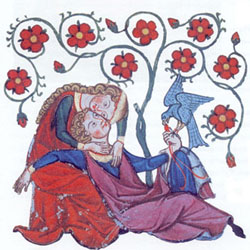
{Enjoined in love’s embrace – along with that bird’s. Image found on Michael Delahoyde’s Courtly Love webpage.}

Back To Top
Abstract

The poem wraps up with a brief meditation on the nature of love (possibly both physical and emotional).

Back To Top
Translation

“Oh in how great the unreliable varying
of the spirit of love!
It is as a wandering raft upon the seas,
when free from anchor,
In flux between hope and fear, both dubious;
So goes the battle of Venus.”
(“Dum Diane vitrea” Stanza 8)

Back To Top
Recordings

The entire poem will be recorded once it’s all been translated and posted.

Back To Top
An Opening Question

As the cap on the bottle of wisdom that is this poem, this final stanza rings so true that some might call it cliché. All’s fair in love and war, love is a many faceted thing, etc, etc, etc. But there’s more to it than that.

The images that this stanza evokes are those of the unanchored raft (“ratis”), and a battle (or, more stiffly, “campaign,” (“militia”)). Both of these are set at the whim of chance, and no manner of preparation can bring complete success. Neither being incredibly knowledgeable about seamanship nor a well-seasoned veteran will grant you a 100% guaranteed survival or victory. And of course, so it goes with love.

But why the image of a raft and a battle? Why not double down on the same image, rather than invoking both?

Back To Top
Pondering Love’s Dualities

Because, at least so far as my theory goes, this stanza cuts to the quick of the poem and the poet’s point for one final time. These images, at their most basic, are about the conflict of humans v. nature, and humans v. humans. Such a duality of imagery sets up the poem to make a point about the dual facets of love that seem to be the poet’s major concern.

If this was written by Abelard, than his feelings towards love (particularly if it was written *after* the business of Eloise was *ahem* cut off) would definitely be much more than something romantic or cynical. Though both are certainly present. What could be more romantic than comparing one’s feelings of love to an unmoored raft, and what more cynical than reducing them to something that can be worked through with a mixture of tactics, strategy and chance?

But the argument to be made about the poem being about physical and emotional love gets most of its steam from the adjective attached to battle – “Venus” (“Veneris”).

Without delving too deep into ancient meanings of the goddess Venus (or Aphrodite) – at my own peril, I admit – invoking this love goddess suggests a leaning much more to the physical side of things. First and foremost among my reasons for thinking so is the fact that whomeever the poet is, they are more than likely Christian, and so any pagan deity is going to be used as a simple reference rather than anything particularly deep.

Besides that, there is something of a tradition of referring to the journey of the Christian mystic to god as being adrift at sea (and, though it may not directly relate, Anglo-Saxons associated such journeying with the extremities of loneliness, something that might come into the emotional mix of vacillating love). Because there’s the possibility of the raft image making this religious reference, I think that it’s quite likely that the direct reference to Venus is included to balance the poem.

The placement of these images, then, takes on some extra meaning. After all, it’s definitely no secret that the majority of the poem has had connotations of physical rather than spiritual love, and so placing the spiritual before the physical in this the final stanza suggests that the spiritual must precede the physical. Or, at the least, it implies that it can in itself be a mooring for the fluxes in the physical aspect of love, if you can manage to find anchor.

What then, the poem ultimately says is that it’s necessary to love spiritually, or platonically, or just plain emotionally, before loving physically. This highlighting of the spiritual while closing with the physical is a convenient and brief way to excuse what has come before while keeping tongue firmly in cheek (just as Chaucer’s retraction does for The Canterbury Tales).

Back To Top
Closing

That’s it for new entries for the rest of the month. Watch this blog on Tuesday 4 December, for the final “Dum Diane vitrea” entry (including recordings of it in Latin and English), and a special announcement about a major change coming to this blog.

Back To Top

Spreading the Word [ll.2892-2899] (Old English)

Abstract
Translation
Recordings
Why so few Thanes?
More ‘Limits Lessening’
Closing

Looks like those knights have maille. Image found on iStockPhoto.
 

Back To Top
Abstract

Wiglaf commands a messenger to go to tell the encamped Geats about Beowulf’s battle with the dragon.

Back To Top
Translation

“Commanded he then that the battle work be
reported to those encamped on the cliff-edge, where the
noble warrior host sat sorrow-hearted the morning length of day,
the shield bearers, each entertained both possibilities:
that it was the end of the dear man’s days and that
the prized prince would return again. The messenger
kept little silent in his story, so that naught was left
unsaid, and so he spoke truth to them all:”
(Beowulf ll.2892-2899)

Back To Top
Recordings

Old English:

Modern English:

Back To Top
Why so few Thanes?

The first thing that comes to mind upon reading this passage is – if Beowulf had all of these shield bearers at his command, why didn’t he have all the Geatish warriors lay on the dragon at once? I can only imagine how poorly he’d do in Pikmin or in Little King’s Story.

Pitifully anachronistic references aside, it is a wonder why Beowulf wanted to travel only with 13. Sure, it could be said that he simply wanted to endanger as few as possible, but then you need to ask: Why 13 and not 3? Or, if there had been some hint of Wiglaf being the most valiant of the bunch, why not just the two of them with the thief as their guide?

However, as a poem that might’ve been used as a missionary tool, or that may have been hurriedly adapted from a pagan original by some deft bard, it makes sense that Beowulf travel with 13. After all, he’s he’s a Christ-figure (having survived the harrowing of the Grendels’ lair) and so to complete the analogy he needs 12 companions. One needs to betray him (the thief in this case, I suppose), and few need to prove true. In Beowulf only one the apostle analogues proves his mettle, but I’m sure that even when this change, or this narrative choice, was made, it was done to keep things interesting rather than boring its listeners with a thinly veiled Christian tale.

Back To Top
More ‘Limits Lessening’

Stranger than any analogy, however, is this messenger that Wiglaf commands to go to the people. He’s clearly quick, and he’s clearly trained in the art of delivering messages (unless his heart and mind were so affected by the sight of Beowulf that he speaks truth to the people). It’s possible that it could be one of the cowardly thanes, but then, where did he come from? I’m not an early medieval military historian, by any means, but given the nature of communications then, it would make perfect sense to have a messenger in every military unit.

To hopefully suss this out a little bit more, let’s look back to lines 2878-2879 where Wiglaf says that he felt his “limits lessen”:

“…ongan swa þeah/ofer min gemet mæges helpan;”

“…I felt my limits/lessen when I strove to help our lord.”

Is it possible that just as Wiglaf found a previously unknown reserve of courage as he defended Beowulf, that the thane who delivers the news of the battle experiences the same?

If Beowulf, as we have it today, is truly a work that’s been influenced by early Christianity, as many believe it is, then this otherwise minor detail might be a major part of its Christianization. A major part of Christianity is the idea that everyone has freewill, and that one way to find your destiny is to essentially give that freewill up of your own choice so that you willingly accept “god’s plan.”

Wiglaf and this nameless messenger may not give up their freewill in doing what they do, but I don’t think it’s far from the mark to say that they both do what they’re supposed to do, and being part of the younger generation (which is almost always cast as defiant in literature), doing what these two do doesn’t come as naturally to them as it might to a young man with something to prove to kin that think he’s a good-for-nothing weakling.

Cutting right to it, then, I think that Wiglaf’s feeling his limits lessen and the messenger (assuming that it’s one of the cowardly thanes, and not some mysteriously a-horse messenger specialist) speaking freely to the gathered Geats are examples of two people finding their callings. Wiglaf is to be the battle leavings: something he can be as long as he goes to battle (if he wins, he survives and is a leaving, and if he loses he dies, and is an heirloom of the battle left to the crows and the sun). And the messenger…well…we don’t get enough information on him to be sure, but if there were certainty in analysis of English literature, science majors wouldn’t be so adverse to it.

Back To Top
Closing

That wraps things up for both blogs this week.

Come Monday, a new short story will appear over at A Glass Darkly, and expect a movie review (title TBA), and Annotated Links entry on Friday and Saturday respectively. Here at Tongues in Jars, the usual Latin and Old English entries will be updloaded on Tuesday and Thursday.

And you can find the next part of Beowulf here.

Back To Top

Of Sleep, Nature, and Maidens Bright ["Dum Diane vitrea" Seventh Stanza] (Latin)

Abstract
Translation
Recordings
Euphemisms and Implications
So What
Transformations
Closing

{Edmund Spenser’s Una with the lion and the lamb, a maiden bright indeed. Image found on Wikipedia}

Back To Top
Abstract

Pure nature comes alive in this penultimate stanza.

Back To Top
Translation

“As beneath a leafy canopy of trees,
it is so sweet to cease when the nightingale sings.
How sweet to play in the meadow grass
with a bright beauty of a maid,
if there be many fragrant herbs to breath
if there be a bed of roses on which to lay,
oh how sweet the nourishment of sleep
after being exhausted by the chase of Venus’ trade,
which instills such sleepiness.”
(“Dum Diane vitrea” Stanza 7)

Back To Top
Recordings

The entire poem will be recorded once it’s all been translated and posted.

Back To Top
Euphemisms and Implications

Where stanza four offered us a look at some quasi-natural imagery, this stanza brings it all back to pure nature. And, as was the case with previous stanzas, the poet’s lingering obsession seems to be on sleepiness after sex.

But, more importantly, the reference to sex is never made directly. “Venus’ trade” (“Veneris commercia”) appears as it did in stanza five, but that is, after all, a euphemism. However, the romp described throughout this stanza can be likened to a sort of Edenic experience, and things that have made their way into modern romance (such as the “bed of roses” (“torum rosa”), make the association between this sort of natural play and sex quite clear.

But so what? The connections are there, but why are they there? Matters of who wrote this poem aside, the question to tackle now is why this poem – up to this stanza – has been written quite clearly about sex in such an indirect way.

Back To Top
So What?

The lack of direct reference to sex is definitely not suspect considering the poem’s medieval origin. It was only the most bawdy of broadsheets that would refer to sex directly, and even when Chaucer wants to emulate the style of the basest of the base with his Cook he doesn’t reference sex directly but uses the contemporary equivalent of our “fuck” (“swyve” (The Canterbury Tales, l.4422 (or II.iv.98, depending on your edition))).

So the euphemism via natural imagery and the idyllic setting are certainly not out of place. The connection to sex is essentially there because it’s how medieval poets spoke of such things.

After all, the last thing sex was supposed to be then (and some would no doubt argue still is to be in the eyes of the Catholic Church) was fun or pleasurable. People who shared the opinion of the Wife of Bath, that human genitals are there to use, come kids or not, were definitely in the vocal minority. Hence, the need for this sort of natural imagery to create an allegorical window between the subject of a poem like this and readers.

It could be argued that as readers themselves, writers and poets like the composer of “Dum Diane vitrea” would be aware of these sorts of double meanings, but things like poetry and fiction could be dismissed as frivulous entertainments with no deeper meanings (hence there being so much lewdness couched within them).

Back To Top
Transformations

And what imagery it is! the poet here definitely describes something as any poet should: with brevity, depth, and affect. More importantly, however, is the fact that the image of a forest and a bright maid definitely contrast with the dusk and night imagery from poem’s first stanza.

This shift in tone reflects a shift in the poem’s subjects, from worn out daily toilers to rested and enraptured lovers. And, perhaps that is the poet’s point. That in the eye of the storm that is the everyday, there is to be found a moment of calm, quiet, sunshiny love that inspires poetry, frolics, and fine words.

Back To Top
Closing

Check back here Thursday for Beowulf!

Back To Top

Wiglaf’s Prognosticatings [ll.2877-2891] (Old English)

Abstract
Translation
Recordings
Wiglaf’s Learned Look at the Future
Early Thoughts on Early Medieval English Nationhood
Closing

{Wiglaf casts no runes, but peers into the future nonetheless. Image found on the Daily 23 blog.}
 

Back To Top
Abstract

Wiglaf foretells of terrible times ahead for the Geats, but concludes on a defiant note.

Back To Top
Translation

“I of life protection little could
offer him in the fray, and yet I felt my limits
lessen when I strove to help our lord.
It was ever weakening, when I landed sword blows
on the mortal enemy, the fire from his head then
grew sluggish. As he became desperate, too few rallied
around the prince, at the time of the beast’s final
thrashing. Now shall the sword-gifting and treasure
sharing, all the native-land joy of our people,
our hope, be subdued; each of us will have
our land-right become idle
among our people, afterwards princes from afar
will come seeking, driving us all to flee,
an inglorious deed. Death is better
to every warrior than a life of dishonour!”
(Beowulf ll.2877-2891)

Back To Top
Recordings

Old English:

Modern English:

Back To Top
Wiglaf’s Learned Look at the Future

Here Wiglaf’s rant becomes less about pure anger directed at the thanes (and perhaps redirected from himself, partially) to a bit of prognosticating.

He predicts that now the Geats are doomed because stronger neighbours will overrun them once it becomes known that the Geats have found great treasure and lost a greater leader. However, it’s not fair to pin nothing but prognostication onto Wiglaf’s words here, I think it’s fair to say that they’re simply predictions borne of observation.

Wiglaf has never fought in any battle before, but surely he’d have heard stories about them from his father, or from bards while at the court of Beowulf. With all the time the Geats spent in the meadhall it would be a wonder if their heads weren’t as full of tales as their bellies seem to be of mead and ale. So it’s safe to say that Wiglaf would know about the dangers of being without a powerful leader.

Back To Top
Early Thoughts on Early Medieval English Nationhood

Anyway, the bigger thing here, at least, as far as I’m concerned, is the compound word “londrihtes” (l.2887). In modern English, this literally translates as “joy of land ownership” or “native land joy.”

The importance of this word, and its connotation appearing earlier in the use of words like “leodscip” (meaning “nation,” “people,” “country,” or “region”) is great. It suggests that the Geats, or the Anglo-Saxons who composed and refined and listened to and watched this poem, had more than just a concept of land ownership – they had a concept of their belonging to the land as much as they did of the land belonging to them.

What makes this so important is that it implies that they weren’t just roving bands of mercenaries, but felt some kind of connection to the land that they occupied, much in the same way that Wiglaf feels a connection to the land that he fears and predicts the Geats will be forced to flee. This isn’t a major aspect of the story, by any means, but its being mentioned and its being used as a threat of future doom buttresses its importance.

Follow me here. Earlier in the poem, speeches to inspire have involved the prospect of treasure or of glory of one kind or another. Even Wiglaf’s speech to the thanes involves reminding them of Beowulf’s generosity with his war spoils, themselves a kind of treasure (in the same way that an iPhone might be considered a treasure today – something ubiquitous that could also have a great deal of sentimental or personal meaning).

However, when Wiglaf starts his doom-saying about the entirety of the Geats he doesn’t say that their war gear will be snatched away, or even that they’ll lose the hoard of treasure – instead he says that they’ll be forced from the land. They’ll be forced to flee. In my mind, and I think, throughout this poem, this is the absolute worst thing that could happen to an Anglo-Saxon because it’s a form of exile.

Yes, the Geats will be forced to flee together, but they’ll still have to flee from the place that they call home. And if being exiled is such a big deal, and it can be expressed through a reference to land, then it seems to me that these Geats have at least some sense of living in a country – in Geatland.

That this is mentioned in this poem matters because its Anglo-Saxon creators wouldn’t waste their breath composing something meaningless. Even setting matters of structure and oratorial decoration aside, the word is there, and it comes at the climax of Wiglaf’s prediction. Therefore, the threat of land-loss must be things that strike a chord in medieval Anglo-Saxon minds. And if the notion of losing one’s country strikes a chord, then there needs to be a concept of even having a country for it to do so.

Thus, these references are important because they point to the importance of a nascent sort of nationalism that, admittedly needs to be expressed (or at least is only expressed as far as we can tell from surviving records/literature) through the story of another nation. It needs to be projected, in other words, which suggests that the nation doing the projecting might not be fully defined as yet, but nonetheless has some sense of nationhood.

Of course, for the reference to concepts of nationhood within Beowulf to suggest some nascent sense of nationalism, the poem would need to have been written (or at least first composed) around the time of Alfred the Great (ninth century) or earlier. All the same, there’s something to be said for the poem’s implications about nationhood.

Back To Top
Closing

Tomorrow, watch for a review of The Room – it’s coming!

And you can find the next part of Beowulf here.

Back To Top

Wiglaf looks back in Anger [ll.2864-2876] (Old English)

Abstract
Translation
Recordings
Venting Frustrations
Invocations as Self-Summonings
Closing

{What Wiglaf may’ve looked like, with sword drawn and shield ready – here, as in his speech, his own spirit is his armour. Image found on The Wall Machine.}
 

Back To Top
Abstract

Wiglaf lays into the thanes, but calms when he speaks more specifically of Beowulf.

Back To Top
Translation

“‘Lo! That it may be said, by he who will speak truth,
that the liege lord, he who gave you that treasure,
that military gear, that you there stand in,
when he at ale-bench oft gave
to sitters in the hall helms and byrnies,
the prince over his retainers, the strongest that he could
find either far or near, all that he may
as well have furiously tossed away, that war gear
that he from battle won.
Not at all did that folk-king have cause to boast
of comrades in arms; yet god allowed him, the
victorious ruler, so that he himself could drive forward
with his sword alone, when he had need for courage.'”
(Beowulf ll.2864-2876)

Back To Top
Recordings

Old English:

Modern English:

Back To Top
Venting Frustrations

The first thing that you most likely noted when reading this week’s translation is that the first sentence is both long and syntactically awkward.

In an effort to keep the dialogue as accurate as possible, I tried to keep this opening in the same order in which it appeared in my version of the original text. What this opening sentence boils down to is the idea that Beowulf wasted his generous gifts on the thanes that ran away.

But the way in which Wiglaf expresses this, with a series of subordinate clauses, underscores his anger. However, it’s not necessarily that he’s shouting these lines, he could just as easily be letting the words slide from between clenched teeth as he stands over Beowulf’s body.

Using such a tangle of words makes Wiglaf’s anger clear not only in that it gives his words the sense that they’re tumbling out in a torrent of emotion, but also because it’s a way to verbally represent the clashing emotions that Wiglaf feels in the moment. After all, he currently stands close to the dear lord he has just lost while those whom he considers little better than social leeches are crowding near.

Since the following sentences see Wiglaf delve more into Beowulf and move away from directly addressing the thanes, they become much clearer.

Back To Top
Invocations as Self-Summonings

Nonetheless, his rage is not lost as Wiglaf moves on to talk of Beowulf. Although we have nothing more than words on a page to run with, it’s not difficult to imagine any scop worth his salt giving a slightly sarcastic ring to “Not at all did that folk-king have cause/To boast of comrades in arms” (“Nealles folccyning fyrdgesteallum/gylpan þorfte” ll.2873-74). And, just as with anyone speaking from the heart, or while in a passion, Wiglaf says some curious things in this last sentence of this week’s excerpt.

The reference to god may seem old hat by now, but what’s curious about it is the immediate shift from it to what Beowulf could pull from himself because of his recourse to god.

On the one hand Wiglaf is saying, god helped him when you guys didn’t, but on the other he’s also saying that god helped him to see what he had all along and to use it when he found himself in his great need.

Although as faint as sections of the Noel codex itself (the manuscript in which Beowulf was found), there’s a slight mysticism that can be found in these words of Wiglaf’s, as he seems to be expressing the idea that a person’s true self can be found only in god and that this true self can help them to accomplish supernatural deeds.

In turn Wiglaf’s implication suggests that the thanes are not just cowards, but also ungodly – a curious thing of which to accuse warriors, but it must be remembered that if nothing else, Beowulf always made reference to god in his stories of his own feats, and though the only feat of Wiglaf’s that we know of is his helping with the dragon, it seems that he is now doing the same.

However, as we’ll see next week, Wiglaf’s emphasis on himself may foreshadow more than his valiant leadership of the Geats.

Back To Top
Closing

Tomorrow, at A Glass Darkly be sure to read all about the good and the bad in the b-horror movie The Convent as the fourth and final part of my Shocktober set of movie reviews!

And you can find the next part of Beowulf here.

Back To Top

On the "dealings of Venus" ["Dum Diane vitrea" Fifth Stanza] (Latin)

Abstract
Translation
Recordings
A Flick of the Tongue
From the Other Side of the Bed
A Lament for Love
Closing

{A modern take on an ancient goddess of an ancient emotion. Image found on tribe.net.}

Back To Top
Abstract

In the name of Venus, post-coital sleepiness is described.

Back To Top
Translation

“After the smooth-tongued dealings of Venus
fatigue the mind’s wealth.
This wonderful new mist swims
and settles in the eyelids.
Oh, how favourable the shift from love to slumber,
Yet how a kiss gives new rise to love!”
(“Dum Diane vitrea” Stanza 5)

Back To Top
Recordings

The entire poem will be recorded once it’s all been translated and posted.

Back To Top
A Flick of the Tongue

The word “blanda” can translate as things like “charming” or “flattering,” but given the fact that this poem is essentially about sex I could hardly resist going with “smooth-tongued.” For, so often are the dealings of Venus done with a smooth tongue, or those dealings make a tongue to be smooth.

Back To Top
From the Other Side of the Bed

At any rate, this section of the poem seems at first like it could be the last. However, there’s a suggestion that, despite the onset of sleep, the desire for love continues to burn in the speaker and possibly in his partner as well.

What’s curious about this stanza, though, is that it repeats the previous verse’s theme to some extent. Where last week, we delved into the three images that were used for post-coital sleepiness, they were associated with their own mythological figure: Morpheus – a Greek god.

On the other hand, this week we have the Roman version of Aphrodite, the Greek goddess of love. So is it possible that these two stanzas are working on a kind of call and answer basis? Or did last week’s give the male’s sense of sleepiness after sex while this week’s gives the female’s? It’s hard to tell without looking forward to next week’s, but there’s one more thing to look at before we close for this week.

Back To Top
A Lament for Love

The final couplet of this week’s stanza begins with the same words as verse three (“quam felix,” “how favourable”).

Given that stanza three is one in praise of sex, and that this week’s stanza refers specifically to an antique deity in charge of sex and matters of the heart, what can be said about these two stanzas?

The closing image of stanza three is of sore open eyes being joys of love, and here the final image is that of the love-generating kiss.

So are there the seeds of a love lament in here, since we’re being pointed toward a comparison of the propagation of love with love’s seeing and revelling in things that could be considered worn out? Or is this final line just a confirmation that when things wear out it’s love that perpetuates our need for them?

At the very least, this subtle hint towards a comparison of these two things suggests some hesitancy about love on the speaker’s part, lending some credence to the idea that the infamous Abelard wrote this poem.

Back To Top
Closing

Come Thursday we’ll hear and look into Wiglaf’s opening words to the cowardly thanes. Watch for it!

Back To Top

On God and Wiglaf’s Re-Naming [ll.2852b-2863] (Old English)

Abstract
Translation
Recordings
Invocations
Wiglaf Smoulders
Closing

Tir, perhaps akin to the god Mars, the Norse god of warriors like Beowulf.

The Norse god of warriors Tir, Tiw to the Anglo-Saxons. Also strongly related to justice and law — is he what Beowulf’s audience would think of when they think of “The Measurer”? Image from https://commons.wikimedia.org/wiki/File:IB_299_4to_Tyr.jpg.

Back To Top
Abstract

Wiglaf’s grief continues, and he turns his anger toward the cowardly thanes.

Back To Top
Translation

                     “He sat exhausted,
the warrior on foot near his lord’s shoulder;
tried to revive him with water – not at all did that speed him.
He might not on earth make that chieftan keep his life,
though he wished well to,
nor could he at all change the decree of the Ruler;
God’s decree would rule over the deeds
of each man, as he now yet does.
Then from that young warrior a grim answer
was easy to obtain for those who earlier had lost their courage.
Wiglaf spoke, Weohstan’s son,
the man sad at heart – he saw them as not dear:”
(Beowulf ll.2852b-2863)

Back To Top
Recordings

Old English:

Modern English:

Back To Top
Invocations

The reference to god on lines 2857-2859 lends Beowulf’s death finality. Every other reference to god has been at a set points, nodes even, of the story.

When Beowulf defeats Grendel he thanks god for the victory, when he comes back from the mire, he thanks god again. References to god and fate like this one seem to be the pillars that hold Beowulf on high. But then, what are they holding it up for? If the poem’s like a woven piece of Anglo-Saxon sculpture or jewelry, then what is the purpose of having anchor points? I suppose, because they’re references to cosmic forces, and are references to things that would hold the swirling designs of the universe in place. God’s referenced at the points in the story that emphasize order where things are otherwise going wrong.

A king’s hall being assaulted by a monster, a terrible she-beast wreaking havoc, a kingdom in turmoil, a dragon ravaging the land. Like any good fantasy story, this isn’t about a bunch of men talking about the latest tourney that went off without a hitch, or a bunch of ladies in waiting discussing what to bring their lady from the kitchen. This is a tale of action and adventure, particularly that of a young man who proves his worth and grows into greatness. References to god at key moments accentuate those moments and subtly nudge Christianity, or at the least the conception of there being just one god, into early audiences’ minds.

Back To Top
Wiglaf Smoulders

After this reference to god, we then move onto the epilogue. And with the return of Wiglaf’s name, and therefore, I argue, his agency, we swing back into his perspective.

Wiglaf’s frustrated with the thanes who ran since all of them working together could have very well slain the dragon without losing Beowulf. He’s also frustrated because of the immensity of the responsibility that he’s been saddled with (Beowulf having made him his successor). The whole trouble of dealing with a people who are very obviously not ready to defend themselves as valiantly as they had in the past is also now a worry of Wiglaf’s.

So it’s fair to say that Wiglaf is feeling quite overwhelmed by the task ahead of him now. He’s also moving into the anger stage of his grieving, lashing out at those whom he can easily pin the blame on. And rightfully so within Anglo-Saxon culture – but we won’t see just how direly he lays into them until next week.

Back To Top
Closing

In the meantime, check out A Glass Darkly tomorrow for a tip-toeing into the 2011 horror flick Silent House for Part Three of Shocktober. And come next week, watch for the Sixth stanza of “Dum Diane vitrea” and Wiglaf’s words to the cowardly thanes.

And, you can find the next part of Beowulf here.

Back To Top

Natural Exhaustion ["Dum Diane vitrea" Fourth Stanza] (Latin)

Abstract
Translation
Recordings
Teasing Meaning from Images
It’s all about Sleep
Closing

{An idyllic windmill scene. Image found on JA Tappero’s Main Page.}

Back To Top
Abstract

The poet waxes on about satisfying (?) post-coital sleepiness.

Back To Top
Translation

“Morpheus then draws forth
an urge in the mind
Like gentle wind over mature corn,
clear shoreside river murmurings,
the circuitous orbit of mill arms,
he who steals sleep from clear eyes.”
(“Dum Diane vitrea” Stanza 4)

Back To Top
Recordings

The entire poem will be recorded once it’s all been posted. This recording will then be posted with a final, full edition of my translation.

Back To Top
Teasing Meaning from Images

What this stanza describes sounds unequivocally like post-coital sleepiness. The way it’s described with rustic, idyllic even, similes strengthens this reading, too.

After all, If love is often romanticized in classical literature as the affection between a shepherd and a shepherdess, why not also romanticize the urge to sleep afterwards with a bunch of natural imagery? Though it definitely needs to be noted that this stanza’s imagery isn’t entirely natural.

Corn may grow on its own, but it’s made into fields by human hands, just as much as a windmill is something of human design and construction. Yet, associating these things with sleep makes sense on many different levels.

There’s the obvious level of their soothing nature, and that of all three working together to paint a very calm and relaxed scene. And relaxed is the best word for this scene, since all of these actions are passive. The corn merely bends in the wind, the water is just running to lower ground, and the mill’s arms turn as gusts go by.

Further, the first and third of these images are visual cues of something invisible but audible: wind, while the second of the three is an aural representation of something very visual. This synaesthetic description of the sweeping desire to sleep is incredibly effective if you think about the last time you felt utterly exhausted. Alternatively, you could compare this stanza’s main image to the gradual release of tension in a yogic meditation or that you might experience if you just lay in bed, close your eyes, and concentrate on your breathing.

But why, if the poet wanted to depict an idyllic country scene, did he use these three things? Why does the poet choose the wind in a cornfield, the babbling of a river, and the wind through the arms of a windmill? These are all things found in the countryside, sure. But why these three? How do they work together? And why move from wind to water to wind?

Back To Top
It’s all about Sleep

It’s possible that this arrangement offers further reflection on the medieval biphasic sleep pattern.

The wind could be the gentle and effortless rest that sleep affords, while the water, coming in between wind images, could be the awake phase in between sleep periods (or sex itself, depending on how far you want to take the flow of the river).

What’s more, shifting the wind image to that of a mill after that middle water image works perfectly well within an interpretation of this stanza as the medieval sleep pattern in miniature. After all, a windmill would often be used to grind grains (corn included) into meal or flour, and medieval associations between this flour and male potency (or more generally the active principle) are many.

So reading these three images as a representation of the night as a whole is certainly possible within context. What’s especially significant about such a reading though is that it shows the poet’s associating this sleep pattern with human use of nature, and the way that nature and humanity interact. On the surface, this kind of idea sounds tame enough, but through such a series of associations, the poet could well be asserting that sex is merely something natural.

Maybe the poet is even trying to go so far as to bring sex, something contemporarily thought of as dangerous and needing control (a natural, base urge), into the more civilized and human realm. Moreover, because of the cyclical nature of this series of images, the poet seems to suggest that sex is just another part of a natural cycle that can be put under human control, or under human use (as water and its flow can be).

Back To Top
Closing

Of course, all of this is speculation – go right ahead and share your own in the comments!

Also, don’t miss Thursday’s Beowulf entry – Beowulf is firmly cut from the story, as its focus moves over to the grieving Wiglaf.

Back To Top

The Fallen Hero and the Fleeing Thanes [ll.2836-2852a] (Old English)

Abstract
Translation
Recordings
Reflection amidst Grief
Joining the Two
The Battle-Leaving
Closing

Back To Top
Abstract

Today’s excerpt is very clearly in two parts. In the first we see the wrapping up of explicit mourning for Beowulf, and in the second the return of the cowardly thanes who fled when the dragon grew fierce.

Back To Top
Translation

“Indeed few mighty men on earth
have so succeeded, as I have heard,
though every deed they did was daring,
few of them would make a rush against the breath of the
fierce ravager or could disturb a hall of rings by hand,
if he discovered the ward awakened
dwelling in the barrow. Beowulf had paid
for his share of the noble treasures with his death;
each had reached the end of
their loaned lives. It was not long then
before the laggards in battle left the wood,
ten cowardly traitors together,
those that dared not fight by the spear when
their liege lord was in greatest need;
but they were ashamed when they came bearing shields,
dressed in war garments to where their lord lay;
they gazed on Wiglaf. ”
(Beowulf ll.2836-2852a)

Back To Top
Recordings

Old English:

Modern English:

Back To Top
Reflection amidst Grief

The first half of this excerpt clearly expresses closure for Wiglaf, whether directly or indirectly.

Where the earlier meditation on the dragon might seem more like the poet/scribe’s own musing on death, it’s much easier to relate these lines about Beowulf’s sacrifice and his grand deeds to Wiglaf’s own thoughts. Yet, at the same time, having had a hand in defeating the dragon, it’s fair to say that Wiglaf may also have marvelled at the dragon’s corpse.

In fact, it could well be that Wiglaf first had to marvel at the corpse in order to really register the magnitude of Beowulf’s deed. And, as one of the poem’s audience proxies (since the warriors in the audience – of any skill level – could probably relate to Wiglaf’s facing a major, brand new challenge), it’s fair to say that he may have been so shocked by Beowulf’s death that it takes the meditation on the dragon to make him realize that its corpse was his and Beowulf’s doing.

Victory seemed impossible, but together they achieved it – though they can never be together again.

Back To Top
Joining the Two

What’s interesting about the way the poet/scribe transitions between the meditation on Beowulf and the thanes’ return is that he uses a statement involving both parties. It’s not that Beowulf had reached the end of his loaned days, nor that the dragon did, but that both did. In death all things are just creations of the god that the poet/scribe may have been trying to tell his audience about.

Or, all things are ultimately and equally the toys of fate, depending on a person’s outlook. The fact that both the dragon and Beowulf reached the end of their loaned days, though, points to a deeper connection than anything implied by a mere whim like that so often associated with fate or wyrd.

After the transition to the thanes’ return we aren’t given much in the way of juicy material. They wend their way back to see the aftermath of the fight, and we’re not given any solid reason why aside from implications of feeling guilty and ashamed. However, what the poet/scribe chooses to point out in his description of the thanes is very telling.

Back To Top
The Battle-Leaving

After describing them as cowards they’re described as “ashamed when they came bearing shields,/dressed in war garments.” This fits in nicely with the idea of hypocrisy, and may also touch on a distrust of any consciously known dissonance in a person’s appearance.

It’s important for the poet/scribe to mention this here because it underlines a concern with a mismatch of appearance and essence. The thanes that fled are ashamed to be wearing the garb that marks them as warriors since these things were to help them become warriors but their own essences weren’t up to the task.

Further, since the majority of the thanes fled it’s implied that the old ways have failed the Geats. As a result of this, they’ve all gone soft in the face of new challenges, save for one. And, after nearly 100 lines of being without it, he is outfitted once more with his proper name: Wiglaf.

Renaming Wiglaf at this point may seem strange, but I think that it’s a positive example of the exterior matching the interior.

As mentioned in a previous entry, his name literally means battle-leaving or battle-heirloom. Since Wiglaf is the one left after the battle with the dragon, it seems almost as though he has fulfilled his name. Since he is indeed now a battle-leaving, he has achieved its proper meaning and is now a figure of authority that not just the thanes, but that the rest of the Geats will look to for guidance.

Unlike the cowardly thanes who are ashamed of the dissonance between their equipment and their conduct, through his courage Wiglaf has transcended into a perfect alignment between his name and his being which leads to his becoming as major a figure as Beowulf was, though his part of the story is much shorter.

Back To Top
Closing

All the same, check back next week for the continuation of that story on Thursday as Wiglaf lays into the thanes. Also, don’t miss verse four of “Dum Diane vitrea,” which will be posted come next Tuesday.

A little more immediately, go over to A Glass Darkly tomorrow for Part Two of Shocktober: a look at Leprechaun in the Hood

And you can find the next part of Beowulf here.

Back To Top

Moon Fruit ["Dum Diane vitrea" Third Stanza] (Latin)

Abstract
Translation
Recordings
A Fruitful Opening
That Spontaneous Spark
Closing

{Handle it, but don’t hold it, the poem counsels. Image found on a blog called Imprint.}

Back To Top
Abstract

Some of the virtues of sex are indirectly extolled.

Back To Top
Translation

“Oh how fruitful is that remedy of drowsiness,
Which tempestuous cares and sorrows sedates!
So long as it steals up to sore open eyes,
themselves a sweet joy of love to have.”
(“Dum Diane vitrea” Stanza 3)

Back To Top
Recordings

The entire poem will be recorded once it’s all been posted.

Back To Top
A Fruitful Opening

The opening pun of this week’s stanza is, thankfully, something that works in both languages.

“Felix” may not unerringly translate into “fruitful” but it’s one of many possibilities, just as one could say that there are many English synomnyms for “fruitful.” In any case, this is about as subtle as it gets, since the rest of the poem is just a celebration of sex.

Turning back to the pun in line one, though, it’s possible that the play on the word fruitful/felix, could be a reference to the fertility rate of having sex during this waking interval.

But even something like the Domesday book didn’t keep records of when children that women managed to carry to term were conceived down to the hour, so the potency of the hours between midnight and second sleep isn’t really something we can check.

It’s possible, though, that since the two hour window of wakefuless would be the best time for sex from a social/scheduling point of view (one of the few times you wouldn’t be toiling away at your daily labour, eating, or, well, sleeping), that this is billed as the ideal time.

After all, it’s not like that was the only time that medieval people knocked boots. Any time at which they could gain a private moment they’d do it, just as we do. There’s no particular evidence that I can cite for that, but it’s definitely something that just stands to reason.

With that sort of sexual freedom from a temporal standpoint, it makes sense that an authority like the Church would try to suggest an ideal time for sex.

It’s a cold view of what is through-and-through a love poem, but since the “Dum Diane vitrea” was written in Latin, and Latin was the language of the Church and the educated (who were educated by the Church), it’s not outside of the realms of the probable that this poem is a propaganda piece aiming to keep sex in (or move it to) a set time.

This interpretation of stanza three is also supported by the idea that Abelard may have written the whole of the “Dum Diane vitrea.” Having been a victim of wild passions with his student, Eloise, and winding up castrated for his pleasures, he’d be the perfect person to get to sit down and write a stirring love song about how sex should be kept in the appropriate place. Make that appropriateness cosmic, and you’ve got a powerhouse on your hands.

Back To Top
That Spontaneous Spark

Once we get to line three, things heat up a bit further.

At this part of the stanza we get the conditional “So long as” (“Dum”). So, though the exclamation effectively closes the statement that covers lines one and two, we also have to consider sex something that sneaks up on a person.

In other words, it can’t be a cold duty between a married couple (assuming that those are the people the poem addresses), but rather something spontaneous.

Back To Top
Closing

Check back here on Thursday for the rest of Wiglaf’s mourning, and the return of the cowardly thanes!

Back To Top