Beowulf as storyteller, words sharp and simple (ll.957-970a)

Abstract
Translation
Recordings
Beowulf Embellishes Grendel
Rich and Simple Compounds
Closing

Beowulf, Old English, Anglo-Saxon, translation

Back To Top
Abstract

Beowulf speaks of his fight with Grendel and the monster’s god-defying strength.

Back To Top
Translation

“Beowulf spoke, the son of Ecgtheow:
‘We that brave deed did with much good will,
carried out the fight, daringly risked ourselves
against strength unknown. Wish I very much
that thee thyself might have seen it,
the enemy entangled and exhausted to the point of death!
I swiftly grasped him tight and thought
to bind him then and there to his death bed,
so that for my handgrip he should
lie struggling for life, but his body slithered out.
For I might not, though god willed it not,
prevent him from going, nor could I then firmly enough grasp him,
that deadly foe.'”
(Beowulf ll.957-970a)

Back To Top
Recordings

Old English:

{Forthcoming}

Modern English:

{Forthcoming}

Back To Top
Beowulf Embellishes Grendel

The first thing that struck me about this passage is Beowulf’s first word. He says that “we” defeated Grendel (l.958).

He doesn’t put the brunt of the glory on himself, but on his team of Geats. His team that was, as far as the poet told us, not even really around for the start of the fight and not really all that effective by the time that they came in to help. Yet Beowulf spreads the credit around. Almost as if, being a warrior but not yet a leader with a castle and treasure of his own, all he has to share out among his band is that glory.

It’s a curious idea, if you think about it. I mean, it’s what would happen with Anglo-Saxon social groups with treasure, so why not with glory, too? After all, the actions of the leader reflect upon that leader’s followers. So Beowulf’s defeating Grendel suggests that his fellow Geats are also quite powerful and formidable.

Though not so powerful as Grendel is made out to be.

Because as a boaster and storyteller Beowulf knows his way around suspense, we’re told by our hero that he had Grendel in a grasp designed to kill the fiend. Yet, the monster’s “body slithered out,” suggesting that he lithely escaped Beowulf (l.967). Though there’s the implication that Grendel’s morale took a serious hit. What I’ve translated as “body” is “lic”, after all, a word that is hard to disassociate from the notion of a physical form (since it generally means “body” or “corpse” and is the root of the Modern English word “lich,” referring to a sort of zombie). So Grendel’s body slithered out, but his spirit might not have escaped quite so easily.

What’s more, Beowulf doesn’t let this example of Grendel turning the tables on him work as an example of his own mortal weakness. No. Beowulf quickly moves on to the point that he didn’t want Grendel to escape and that he did so even “though god willed it not” (“þe Metod nolde” (l.967)). So, first off Grendel was a bit more of a slippery guy than Beowulf imagined. And he was strong enough to openly and effectively defy god itself. In this single line, Grendel is made into the ultimate outlaw. Even if you don’t buy the idea that Beowulf is the instrument of God’s justice in the world of the poem, at the very least Grendel’s escape from our hero is said to go against god’s own will. According to Beowulf, anyway.

He is, after all, the one retelling this story.

And that in itself is neat.

Here (and elsewhere in the poem) Beowulf is framed as a hero not just because he’s got the strength and the poise for the job, but because he’s also an experienced speaker and storyteller. So he can do the deed, sure, but he can then head back to the hall and spread the word about that deed himself. It’s like he’s a self-publishing author writing a novel and then going out and shouting about it himself rather than relying on someone else to cover marketing. Here, though, his duality of fighter and storyteller is mildly threatening to the poet writing this epic and to every poet before or since – poets after all were said to be the ones with the ultimate power, no matter what the strength of a hero, since it was the poets who made and kept the detailed records of their deeds.

Do you think that Beowulf is a reliable story teller? He’s a known boaster, sure, but does that mean that his retellings of events will always be embellished?

Back To Top
Rich and Simple Compounds

This passage is rich in compound words. So, let’s get right to them.

Up first is line 962’s “fyl-werigne.” This is a straightforward compound, especially if you can wrap your mind around the words “fyl” and “werigne” and sort of sense by linguistic intuition, that the compound brings together a word generally meaning “very” and another meaning “weary.” More specifically, “fyl” (a form of “fyllu” meaning “fulness (of food),” “fill,” “feast,” “satiety,” or “impregnation”) and “werig” (“weary,” “tired,” “exhausted,” “miserable,” “sad,” or “unfortunate”). The one thing to note here is that the Old English word for weary doesn’t just encompass physical weariness, as Modern English’s “weary” seems to (you can be “weary in spirit” or “weary of heart” but need to specify as much in most instances), it also includes more emotional or spiritual weariness as well. So when someone or something is “fyl-werigne” you know that they’re simply done.

Next up is another straightforward word (it seems that Beowulf is laying rhetoric on thick, but keeping it simple, too – maybe as a courtesy to a Hrothgar who’s just woken up?): “wael-bedd.” This word just means “slaughter bed.” That’s it. Even the combinations across the different senses of “wael” (“slaughter,” or “carnage”) and “bedd” (“bed,” “couch,” “resting place,” “garden bed,” or “plot”) come out to this (though there could be a bit of a horticultural slant to some combos). So, onto number three.

The word “lif-bysig” isn’t entirely what it seems. At first glance you might think that it refers to having a busy life or some such, but there’s a bit of a spin that seems to have been lost over millennia. Indeed, this word does bring “lif” (“life,” “existence,” or “lifetime”) and “bysig” (“busy,” “occupied,” or “diligent”) together, but the result is a word meaning “struggling for life.” This word is exclusive to Beowulf, and definitely sounds like something a performer could’ve come up with on the fly or to fill out a line. Either way, it’s neat how this word demonstrates the compound’s power to be more than the sum of its parts.

Actually, the next word in my list does something similar. And this one’s exclusive to Beowulf; it’s the word “feorh-geniðlan.” This word means “mortal foe.” And it comes to that meaning through a combination of “feorh” (“life,” “principle of life,” “soul,” or “spirit”) and “nið” (“strife,” “enmity,” “attack,” “war,” “evil,” “hatred,” “spite;” “oppression,” “affliction,” “trouble,” “grief”). So, much like “lif-bysig,” “feorh-geniðlan” takes its parts and twists them together to create its compound meaning rather than just sticking two concepts together. By combining the concept of life and struggle this compound refers to something or someone that is striving against the principle of life or oppressing it in a major way. Hence “mortal foe.”

Do you think that Beowulf’s going easy on the compound words because Hrothgar’s just waking up, or is there another reason for his relatively simple diction?

Back To Top
Closing

In the next passage Beowulf finishes his account of the fight with Grendel, and declares his opponent painfully dead.

You can find the next part of Beowulf here.
Back To Top

Missionary Beowulf, propaganda, words plain and poetic (ll.928-942a)

Abstract
Translation
Recordings
Beowulf as Beefy Missionary or Hrothgar’s Propaganda
Poetic Compounds found in Poetry
Closing

Beowulf, Old English, Anglo-Saxon, translation

Back To Top
Abstract

Hrothgar makes a speech thanking god – and so far only god – for ridding the Danes of Grendel.

Back To Top
Translation

“For this sight to the almighty thanks
be given immediately! Great grief I endured,
the affliction of Grendel; always may god work
wonder after wonder, the shepherd of glory!
It was not long ago, that I expected never
to meet anyone who could soothe
my miseries, when blood-bedecked
stood the best of halls gory from battle,
wide-reaching woe knew everyone so that
none would venture near, so that for a long time
the people in their stronghold had to hold out against
hated demons and evil. Now shall we have through
the might of god this deed done,
a thing requiring skill that that none before
may have even conceived of.”
(Beowulf ll.928-942a)

Back To Top
Recordings

Old English:

{Forthcoming}

Modern English:

{Forthcoming}

Back To Top
Beowulf as Beefy Missionary or Hrothgar’s Propaganda

In this passage, or rather, in this the first half of Hrothgar’s speech, Beowulf is suspiciously absent. Instead, this god character gets top billing.

So what’s the deal with this?

I mean, Beowulf makes mention of god and god’s favour and help in his boasts and stories of past deeds, but Hrothgar really doesn’t say much of anything about god up until now. The way I see it, this could mean that Beowulf is an Anglo-Saxon twist on a missionary – think Rambo crossed with an evangelist – or that Hrothgar has converted (or just always been quietly Christian) and is now using Beowulf’s victory as a bit of propaganda to stir his people to conversion.

In the first instance, Beowulf makes for an archetypically macho missionary. And, the first half of the poem definitely supports this interpretation.

With the Danes you’ve got a people at their wits end. Their own gods have done nothing to help them and none who have come to deal with Grendel have succeeded for the last twelve years. Then this Beowulf fellow shows up and suddenly that Grendel problem’s dealt with. Of course, if in this analogy Grendel represents something like wrong belief or vile practices or the perceived wickedness that comes from being a non-Christian, then things are definitely sped up for dramatic effect. Though the speed at which missionary Beowulf turns his audience toward his message can be found in other stories, like that of Saint Boniface, who chopped down a sacred oak tree in one swing and replaced it with an evergreen, unwittingly setting up what would become the Christmas tree and, according to the story, converting crowds. Of course, Christianity has always brought its own host of problems to the various places it’s been taken, either because of the people bearing it or the way in which it melded or failed to meld with the target peoples’ beliefs. Still. With Beowulf as a super hero missionary who spreads the Word through his thirty-men strong grip, things getting done quickly is unsurprising.

What’s more when it comes to this missionary reading, though, is that if we jump ahead to the instance with Grendel’s mother, we can then read that as Beowulf facing off with powerful and seductive temptation. In which case Grendel’s mother represents the possible feelings that Beowulf has for Wealhtheow and/or vice versa, feelings that could lead to a terrible scandal. But, when he defeats Grendel’s mother, Beowulf proves himself to be so good at what he does that he’s able to overcome that potential scandal, too.

The alternative reading, that Hrothgar is just using Beowulf’s victory as a way to do some preaching himself, digs up a thing or two, as well. Namely that Hrothgar may have been so dejected when we first meet him because he’d converted but his people hadn’t followed since it alone hadn’t rid them of Grendel. But with the defeat of Grendel at the hands of Beowulf – a warrior who entrusts himself to fate and to god – Hrothgar sees an opportunity to put Christianity into a positive light and proceeds to do so by saying that without god none of this would be possible. It wouldn’t even be conceivable (ll.941-942a).

In the light of these two possible readings of this passage I think it’s important to note that I feel I can get away with these sorts of analyses because Beowulf would’ve been written down by someone who had at least experienced the Church’s educational system. In other words, whatever this story was when it was simply being told, it took on a few Christian elements in its being written down. And maybe the possibility of reading Beowulf as a missionary or Hrothgar as a Christian propaganda opportunist are just products of it having been written that way. Maybe.

What do you think is happening with religion here? Is Beowulf a macho missionary? Is Hrothgar a propagandist? Or are both true?

Back To Top
Poetic Compounds found in Poetry

I’m not sure if prolonged exposure to Beowulf has made me a little jaded when it comes to Anglo-Saxon compound words or what. But this passage’s crop of them just isn’t doesn’t stack up to previous passages’. Gone are the combinations of words with almost opposite meanings, or senses that you’d normally not put together. Instead we have stuff that’s much more straightforward, but that still carries the quirk of age.

Take for instance “un-geara.” This isn’t a compound word in the truest sense, since it’s just the word for “yore,” “formerly, “in former times,” “once,” or “long since” with the prefix “un” stuck to it. But still, it’s pretty interesting to look at. I mean, this one means “not long ago” but literally translates as “not formerly.” You can clearly see the connection there, in that if something isn’t formerly, then it’s simply “not long ago.”

The word “heoro-dreorig” gets more straightforward as it’s just a combination of “heoro” (“sword”) and “dreorig” (“bloody,” “blood-stained,” “cruel,” “grievous,” “sad,” “sorrowful,” or “headlong?[sic]”). So it means “gory from battle,” though a more literal translation would be “sword gory.” I think it gets across its sense of the messy leavings of battle quite nicely. After all, even the sharpest knife, the most battle ready, is going to catch some of the gore, some of the blood on itself, and so too would anything that was the setting for battle, such as Heorot.

The word “wide-scofen” gets a little more poetic, thankfully. A combination of “wide” (“wide,” “vast,” “broad,” or “long”) and “scufan” (“shove,” “thrust,” “push,” “push with violence,” “urge,” “impel,” “push out,” “expel,” “deliver up,” or “display”) this word means “scattered far and wide.” A simple translation of the two words gives the sense of things being shoved or pushed wide apart, though. And I think the nuance here is important because unlike the modern English “scattered far and wide” to say that something’s been shoved far apart suggests a more forceful and immediate agency to me. It’s not that some invisible force from on high has scattered these things involved, but something more immediate, something that exercised force directly on them or on their surroundings has forced these things apart. Shoving things wide apart is just so much more evocative than the seemingly random sense of being “scattered far and wide”. So it goes without saying that this is my favourite compound of the passage.

Though “land-geweorc” is a close second. Combining “land” (“earth,” “land,” “soil,” “territory,” “realm,” “province,” “district,” “landed property,” “country as opposed to town,” or “ridge in a ploughed field”) and “weorc” (“work,” “workmanship,” “labour,” “construction,” “structure,” “edifice,” “military work,” or “fortification”), this word comes out as “fortified place,” though literally translated it means something like “earth structure.” So it’s not just some sort of structure built on the land, but there’s a very real sense here that this structure or fortification is built very much with the land in mind. Whether that means that it’s built into its area’s natural features or if it means that it’s simply taking advantage of those features, this combination really makes me think of something built cleverly rather than with a lot of sweat and labour. Actually, as with “wide-scofen” there’s a certain connotation of immediacy to this word which I find really interesting. Why? Because it carries with it a sense almost of being closer to the natural world and being able to take advantage of knowledge of its rhythms and patterns.

Why do you think old words like “wide-scofen” (which looks like “wide-shoved” if you think about it) changed to different phrases with similar meanings? Does this just reflect a change in taste, or is there something more at work in these changes?

Back To Top
Closing

In the next entry, Hrothgar’s speech continues and he mentions the man of the hour.

You can find the next part of Beowulf here.
Back To Top

The subversive power of the poet’s song, people and sadnesses (ll.898-906)

Abstract
Translation
Recordings
All Hail the King of the Danes
Peoples and Sorrows
Closing

Beowulf, Anglo-Saxons. poetry

King Harold out for a hunt on the Bayeux Tapestry, no doubt a song was sung soon after. Image found at http://regia.org/research/misc/pastimes.htm.

Back To Top
Abstract

The poet’s song turns from Sigemund and his glorious victory to look instead at a man defeated: Heremod.

Back To Top
Translation

“His fame was pushed most widely
among the nations, protector of warriors,
for deeds of courage — he prospered from then after —
after Heremod retired from war,
his strength and courage; he against the Jutes
had his power stolen in ambush and his force
was quickly slain. His sorrow oppressed him
far too long; to his people he waned,
to all his nobles his life grew too full of care.”
(Beowulf ll.898-906)

Back To Top
Recordings

Old English:

{Forthcoming}

Modern English:

{Forthcoming}

Back To Top
All Hail the King of the Danes

Although there’s no poet interjecting here to keep things from getting messy, this passage is dangerous.

Earlier, before this poet on horseback started to sing of Sigemunde, there was some noise made about everyone praising Beowulf, but being happy with Hrothgar as their king. In fact, the poet goes so far as to give Hrothgar one of the highest epithets: “that was a good king!” (“þæt wæs god cyning” (l.863)).

In light of this passage, though, there could be some sarcasm in that earlier statement.

Here we’re told how Sigemund’s fame grew after he beat the dragon and stole away its treasure, bringing it to his own people. In fact, it even sounds like Sigemund had some sort of happy homecoming because of his courageous deed. In fact, it sounds like he might have been in that far country where the poet alleged his story of the hero came from because of some sort of exile. And, what’s more, possibly exile at the hands of king Heremod. After the first three lines, the poet shifts over to this figure of lore.

Heremod is king of the Danes, and when we meet him here he is the very picture of melancholy. Having suffered a great loss when fighting the Jutes (maybe the giants? the word used is “eotena” which could mean either), Heremod falls into a depression and loses his warlike demeanour. He must’ve been some battler since his entire court is thrown into disarray when he no longer steps out to campaign or bring in treasure from raids.

As a reader of Anglo-Saxon culture as much as Anglo-Saxon poetry, this passage — the poet’s song on horseback in general — is supposed to show the two examples of great man that stand before Beowulf — the man triumphant in Sigemund and the leader who is shackled by shame and fear in Heremod. Later on, Hrothgar talks more explicitly about Heremod as a bad king (the kind Beowulf should not be), but right now this whole thing being an example for Beowulf is just implied.

But it’s really hard to not see it as a subversion of the poet’s saying “the people thought Beowulf was great! But, oh yeah, they still like Hrothgar, too.” I mean, you’ve got the young hero Sigemund who’s just reversed his fortunes by defeating the dragon and winning the treasure and that’s pretty much Beowulf. Sure, our hero hasn’t fought a dragon yet, but he’s beaten Grendel and won great fame that’s quickly spread thanks to the treasure that Grendel left: his arm and claw. Then you’ve got Heremod, the man who sits in his court and bemoans his defeat. Isn’t that too much like the Hrothgar of the last 12 years for any sort of analogy or parallel to be made?

So I think this passage is the poet insinuating that Beowulf could become the new ruler of the Danes. But we can’t know for sure until we get the rest of the story in the next part of the poem.

How subversive do you think the poem Beowulf is? Is it just some light entertainment? Or is it about the young overtaking the old? Or is Beowulf a Christianized Germanic hero bringing new vibrancy to an old tradition?

Back To Top
Peoples and Sorrows

Maybe it’s because sorrow and pitched battle are involved in this passage, but compound words are coming back! Actually, it wouldn’t surprise me if their reappearance was due more to the depression and sorrow of Heremod. If Anglo-Saxon poets wove their words into tangles to accurately represent war, then surely they could do the same to represent the complexities of the deep sadness the old king’s experiencing.

Anyway. Onto the words.

First in the passage, on line 899, is “wer-þeod,” a combination of “wer” (meaning “male being,” “man,” “husband,” “legal money-equivalent of a person’s life,” “a man’s legal value,” “dam,” “fish-trap,” “catch,” “draught,” “troop,” or “band”) and þeod (meaning “people,” “nation,” “tribe,” “region,” “country,” “province,” “men,” “war-troop,” “retainers,” “Gentiles,” “language,” or “fellowship”). This compound is taken to mean “folk,” “people,” or “nation,” and I can see why. It could literally be translated as “people of men.”

But, of course, there are some very interesting nuances to both of these words.

With “wer” we get a look into the Anglo-Saxon idea of the value of life in that the word can mean the “legal money-equivalent of a person’s life,” or “a man’s legal value.” Of course, it has to be noted that a monetary value was attached to human life in Anglo-Saxon society because of law makers’ attempts to control rampant feuding. So, if you happened to kill someone from that group over there, they wouldn’t have to come and kill you, you could just pay that group the value of the life you took and the feud would be called off (legally, anyway). This bunch of laws is an unfortunate imposition since it might’ve been used to turned a few lives into bits of silver, but still. This concept helped to keep people from endlessly feuding so they could do other things. Plus, I bet these laws had some repercussions on ideas of manliness that have resonated down through the centuries, too.

The other half of this compound similarly has some neat meanings. Like “Gentiles” or “language.” In combination with the former, the compound could mean the collection of those who weren’t Jewish, those who weren’t chosen by God. In light of the Anglo-Saxons trying to identify with the Jews of Exodus, a people in search of a homeland, referring to the Danes as Gentiles even through vague implication is interesting. And as a story about pre-Christian times, this meaning seems unlikely to be a coincidence. At the least, I can see the poet smiling after the fact and considering himself very clever indeed for using “wer-þeod where he has.

But combining “wer” with the “language” sense of “þeod” is where things really pick up. The sense of such a combination is that all of those who speak the same language are one group. That’s a really cool idea!

But I digress, since there’re other compounds to get to.

Like the less mysterious “sorh-wylmas.” This combination of “sorg” (“sorrow,” “pain,” “grief,” “trouble,” “care,” “distress,” or “anxiety”) and “wielm” (“boiling,” “swelling,” “surge,” “billow,” “current,” “stream,” “burning,” “flame,” “inflammation,” “fervour,” “ardour,” or “zeal”) means “wave of sorrow.” And its constituent parts don’t really make that meaning a secret. Though I suppose there’s a bit more colour to the idea of a wave of sorrow if you add in the sense of that wave being arduous or zealous. It’s not just a lazy lolling mass of sadness washing over you, but the sort of wave a ship in the middle of the sea might encounter while in a storm’s clutches.

Then, rounding out the bunch but being strangest of the three is “aldor-cearu” of line 906. Meaning “great sorrow,” this one combines “ealdor” (“elder,” “parent,” “ancestors,” “civil or religious authority,” “chief,” “leader,” “master,” “lord,” “prince,” “king,” “source,” “primitive,” “life,” “vital part,” “age,” “old age,” or “eternity”) with “cearu” (a form of “carig” carrying meanings like “sorrowful,” “anxious,” or “grievous”).

“Cearu” is pretty straightforward. But “ealdor” much less so. This one could combine with the former to mean a few shades of “great sorrow.” It could be old sorrow, implying that it’s the sort of sorrow that’s sat and festered for years; it could mean that it is a princely sorrow, a sorrow that comes with the responsibility of ruling over a people; or it could be seen as the sorrow that simply comes with age, the regret and feelings of inadequacy a person experiences as they inevitably compare their present selves to their younger, remembered as happier and stronger, selves. It’s definitely a worthy companion to the much simpler “sorh-wylmas,” though, since both carry a heavy weight with them.

If you agree that the language of the poem is intentionally more complex around descriptions of battles and of sorrow, what do you make of it? Is treating sorrow as the same sort of complex ordered mess as a battle accurate, or just a weak comparison? What do you think of all of this if you don’t agree that the language’s complexity is intentional?

Back To Top
Closing

In the next post, the story of Heremod wraps up.

You can find the next part of Beowulf here.

Back To Top

Beowulf gets introspective, even plain words can be lovely (ll.884b-897)

Abstract
Translation
Recordings
Myth on Myth
Passing Judgement on Words
Closing

Beowulf, Old English, translation, poetry

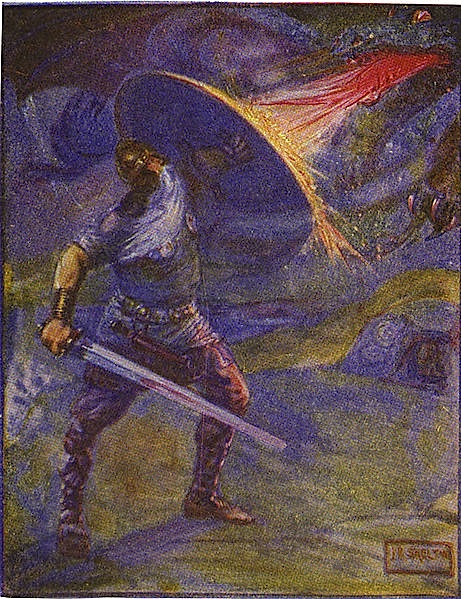
Beowulf fighting the dragon. There are striking similarities between this fight and Sigemund’s. Image found at https://upload.wikimedia.org/wikipedia/commons/6/6f/Beowulf_and_the_dragon.jpg.

Back To Top
Abstract

The poet in the poem sings of Sigemund defeating the dragon alone and winning its treasures.

Back To Top
Translation

“Sigemund’s fame saw
no small surge after his death day,
after ward in cruel combat he killed the dragon,
the hoard’s guardian. Under the grey stone,
the nobleman’s son, alone he dared to do
the dangerous deed; Fitela was not with him then;
without that comrade, he plunged his sword through
the wondrous wyrm, so that it stuck in the wall,
that lordly iron; the dragon died its death.
His courage over the foe won him its treasure fully,
so that he the ring hoards had to give
as he saw fit; a boat they loaded,
they bore in the ship’s bosom bright treasures,
Waels’ son; the hot wyrm melted.”
(Beowulf ll.884b-897)

Back To Top
Recordings

Old English:

{Forthcoming}

Modern English:

{Forthcoming}

Back To Top
Myth on Myth

We’ve got another simple, straightforward type passage here. Though it begs an important question: what’s the story of Sigemund doing here? It’s something that the poet on horseback has conjured up out of his knowledge of the hero, and there are definitely analogues to Beowulf. Though these analogues are really only present if you’re already familiar with Beowulf. Otherwise, all of the talk of Sigemund fighting the dragon and winning is just foreshadowing. Weirdly, though, the exact phrase “under the grey stone” (“under harne stan” (l.887)) comes up when Beowulf faces the dragon in the last third of Beowulf. Anyway, I think what’s going on here with the analogues to Beowulf — his slaying a dragon, driving the sword through a dragon who guarded a bunch of treasure,and the dragon being liquid in some way — is a bit of play with the nature of myth and legend.

Where Sigemund beats the dragon and lives, Beowulf beats his dragon but dies in the process. Nonetheless, as spoils Beowulf gains control over the dragon’s hoard much like Sigemunde does. Though this control passes from Beowulf to his own Fitela figure: Wiglaf. These twists on the events of the Sigemunde story — Beowulf’s death, his Fitela being with him — I think are the poet trying to make the myth of Beowulf more realistic. Maybe it’s even the product of an imagination that knew that the age of deathless heroes who earned great glory forever was past. So, perhaps with Sigemund foreshadowing or contrasting with Beowulf the poet is trying to make sense of what a mythic figure might look like in a world with a new religious system that overturned much of what went before and in an era in which law and order were starting to centralize. Heroes were still needed in this new world, they were still craved, but the shifting realities of the Anglo-Saxons (or maybe their blending Germanic, Roman, and Celtic traditions and ideas into a single culture) forced them to create a hero who followed the mythic formula of fighting a dragon and triumphing, but whose glorious victory cost him his life. The point perhaps being: “glory comes at a great cost these days. Be wary of glory.”

It’s also interesting that when the ring hoard of the dragon comes into Sigemund’s possession it’s not a cause for celebration because he has the treasure for himself. Instead, it’s a great event because Sigemund’s able to spread the wealth among his closest relations. Beowulf also celebrates the gain of the treasure not as a personal victory but as one for his people.

How much do you think is going on with this story of Sigemund? Is it here because the poet’s trying to say something about heroes? Or just something sung while the people of Heorot rejoice?

Back To Top
Passing Judgement on Words

I’m starting to wonder if the language of the poem is getting simpler as this other poet sings because of how the actual poet wants this in-tale poet to look. If the actual poet of Beowulf is trying to put his all into it, then there can’t be a poet in the story who’s use of language is more complex or descriptive, right?

Anyway, the simplicity of the language throughout this section means that there aren’t many compound words. And generally when there are, they’re pretty simple.

The word “beah-hordes” meaning “ring hoard” is the only compound of note in the passage for this entry. It’s a combination of the word “beah” (meaning “ring,” “coil,” “bracelet,” “collar,” “crown,” or “garland”) and “hord” (meaning “hoard,” or “treasure”). And that’s really all there is to it. Combining these two words really does nothing more than specify the kinds of rings that you’re dealing with. Not much more fantastical stuff beyond that, really.

But, there are two words in the passage for this entry that do offer a little more. Even if they’re perfectly normal, singular words.

The first of these is “dōm” a word meaning “doom,” “judgement,” “ordeal,” “sentence,” “decree,” “law,” “ordinance,” “custom,” “justice,” “equity,” “opinion,” “advice,” “choice,” “option,” “free will,” “condition” “authority,” “supremacy,” “majesty,” “power,” “might,” “reputation,” “dignity,” “glory,” “honour,” “splendour,” “court,” “tribunal,” “assembly,” “meaning,” or “interpretation.”

What makes “dōm” stand out is that in the context of the passage it means “glory” or “reputation,” meanings that are kind of a ways down the list. But even so, it’s not an interesting word because its in-context meaning is low on its list of meanings. The word itself seems to really express what underpins reputation, and therefore fame, in a very neutral way.

Judgement underlies fame, after all. And, weirdly, in Modern English the connotations have shifted, since to us “fame” generally seems like a good thing while “judgement” feels like it’s the face of a beast called guilt. Maybe there’s something to say here about the perceptions of judgement and the cultural influence of Christianity, a religion promising judgement with eternal consequences.

But in Old English, the sense of “dōm” meaning judgement and its forms and offshoots is much more neutral. Simply put, you need to be judged to have a reputation or fame, so “dōm” covers a lot of this area of meaning. Maybe because it also seems to be a general sort of word. It’s used as it is here to mean” reputation or “fame” and it’s used elsewhere to refer to divine judgement and elsewhere still to refer to the day the world ends in judgement (so I guess its appearances in Old English are soaked in Christianity, too). But maybe more than anything it all just comes from the Old English “dōm” being narrowly cognate with our own “doom,” a much much more streamlined term for having been judged and found wanting, or for hopeless consequences.

The other weird word in this passage is much lighter. In line 887, the poet describes the dragon as the “hierde” of his hoard of treasure. The use for the sake of alliteration here is supremely obvious, but I still find it neat that the word for “shepherd,” “herdsman,” “guardian,” “keeper,” or “pastor” could be stretched in this way.

A “guardian” makes sense in reference to gold, as does a “keeper.” But what about the sense of guidance in “shepherd,” “herdsman,” and “pastor”? How could you guide a hoard of treasure, especially if you weren’t sharing or spending it, but just sitting on it as dragons do? Maybe there’s a bit of foreshadowing in this sense of the word, or even a judgement passed on the dragon, since when Sigemund becomes master of the treasure he does much more to guide it into the hands of his people. There’s a Christ analogy here, too, with the dragon as Satan or a pre-Christian deity, while Sigemund, going it alone under the grey stone (itself perhaps a reference to Jesus going into the sealed tomb after the crucifixion, or even a reference to the harrowing of hell) is the Christ figure and the treasure is salvation, which Sigemund gives freely.

Old English words have a lot of different shades of meaning to them. Do you think the same is still true with Modern English, or, as English has changed over the years its vocabulary has become specialized?

Back To Top
Closing

In the next passage, we hear how Sigemund’s victory affected his home and old king Heremod’s court.

You can find the next part of Beowulf here.

Back To Top