Grendel’s mother inspires a new trope

A depiction of Grendel's mother from the graphic novel adaptation of the 2007 Beowulf movie.

Grendel’s mother in IDW’s graphic novel adaptation of the 2007 Beowulf movie. Image from: http://www.comicosity.com/buttkickn-moms-in-comics-beowulf-aliens-and-lois-lane/

On the translation side of this blog, I’m currently working through Beowulf’s fight with Grendel’s mother. Out of the three monsters, she somehow seems the one most shrouded in darkness.

For starters, we never really get a good description of her. We’re only told on lines 1349-1351 that she has a woman’s likeness. Beowulf encounters her in the depths of a strange lake, and fights her in an underwater cave. And, although she’s a monster, some sort of creature like Grendel, she pulls out a dagger at one point in their fight and tries to stab Beowulf.

So she’s definitely mysterious, but entirely monstrous? That’s left quite unclear.

Especially if you focus in on her motivation for attacking Heorot and killing Æschere.

Grendel’s mother only kicks into action once she learns that her son has been killed. So she’s plainly motivated by revenge and the sort of anguished sorrow that only a parent who loses a child can really know.

This mysterious figure whose motivations are not only clear but also relatable has inspired comics fan and writer Michael Hale to identify a new trope.

Writing for Comicosity, Hale jumps from Grendel’s mother’s motivation to the presence of other female characters stepping up when their children are in danger. He calls this trope the “Ripley Twist,” based on Ripley’s fighting the alien at the end of Aliens to protect her ward Newt. You can read Michael’s full article here.

Finding the connection that Hale makes with Beowulf reminds me of how relevant the poem remains. As he points out in his first sentence, the poem isn’t too well known anymore. And, sometimes it seems like people groan and bemoan its existence in favour of things wittier and more polite (Victorian lit, I’m looking at you).

And why not?

In Victorian literature the gruesome brutality of human nature is tucked away in things like My Secret Life.

Beowulf, on the other hand, makes no excuses for the brutality of life. Its brutality is much more physical and visceral, but that makes its violence a potent analogy to the to the social, psychological, and emotional brutality that people experience today.

As brutal as it can be, Beowulf is something that allows us to look back at ourselves in a very different context. That people like Hale can bring ideas like the “Ripley Twist” out of it, then I’d say Beowulf‘s definitely worth reading. Who knows what you’ll find within its wordhoard?

What’s your favourite era of stories and why?

Beowulf-based end of summer movie fun

Beowulf and Hrothgar talking in the movie Beowulf & Grendel.

Beowulf and Grendel talking in the 2005 movie Beowulf & Grendel. Image from https://moviesoothsayer.wordpress.com/2011/05/08/the-top-10-viking-movies-part-three/.

As summer winds down, it’s important to get it into a firm headlock and squeeze as much fun out of the season as possible. Movies might not seem like the most active way to do just that, but when those movies are based on Beowulf, I think that there’s an exception to be made.

Now, there have been quite a few movie adaptations of Beowulf across the decades that film has been around. But, in keeping with this article from Folio Weekly, I’m just going to share my thoughts on three: The 13th Warrior (1999), Beowulf & Grendel (2005), and Beowulf (2007).

The 13th Warrior (1999)

I remember watching this movie as part of a weekly family ritual from when I was growing up.

Every Friday my Dad, the resident movie nut, would rent two movies from the local video store. (To give you an idea of how old I am, it wasn’t until I was in my late teens that we stopped renting VHS tapes and started renting DVDs).

I could not tell you for the life of me what the other movie we rented with this one was, but I can still remember watching this movie on that long ago Friday night. I can recall sitting on the couch with a bag of chips or popcorn between the five of us, a glass of cola in my hand and Antonio Banderas playing a reluctant, unlikely hero-type early medieval Arab ambassador to the Northmen. And I definitely remember the way that the creatures he and the other 12 warriors were fighting, since they were quite well put together.

I remember much more recently reading the Michael Crichton novel Eaters of the Dead on which The 13th Warrior was based, and being much more interested in how it told the story. Crichton’s inclusion of “real” sources from Banderas’ character that back up his story was also a nice touch that couldn’t really be pulled off in a movie.

That said, though, I remember this being a fun movie that I probably wouldn’t sit down and re-watch now. Instead, I’d have it playing in the background or on my phone on Netflix as I went about my day.

Beowulf and Grendel (2005)

One of my biggest gripes with a lot of movie adaptations of Beowulf is that they never seem to get the story right. The movie always ends with Beowulf killing Grendel. Or Beowulf winds up inheriting Heorot instead of a hall over in Geatland and the dragon he fights is really his son and in some cases all sorts of crazy liberties get taken.

Beowulf & Grendel falls into the former category, since it just deals with Beowulf’s facing off with Grendel, but it’s probably my favourite adaptation to date.

It’s also much more of a thinking movie than The 13th Warrior. Though that sets the bar pretty low since The 13th Warrior is very much a dumb action movie. Beowulf & Grendel, on the other hand, has some action sequences, but is more about really asking what it means to be a hero.

Since I think that this question can be found all over the poem, I think that this movie does a lot to capture the feel of a more “realistic” Beowulf. Which is just what the movie was going for.

I also really love the inclusion of the Geat who’s something of a poet. Seeing him come up with lines from the poem as Beowulf’s adventures in Daneland unfold onscreen is a really nice touch.

So, yeah, this movie’s definitely one that I would turn on and be absorbed in for an hour and three quarters.

Beowulf

And that brings us to a movie that’s guilty of including all three of the monsters Beowulf fights but presenting those fights in weird and non-canonical ways: Robert Zemeckis’ 2007 adaptation Beowulf.

Though, with Neil Gaiman as one of the movie’s writers, you know that it’s all going to come together somehow. And, honestly, with Crispin Glover as Grendel (great casting!), Angelina Jolie as Grendel’s mother (great casting!) and Ray Winstone as the shape-shifting dragon (casting!), Zemeckis does manage to bring together a decent adaptation.

And, just as with Beowulf & Grendel, though Gaiman takes some liberties with the story’s setting, characters, and Beowulf’s relationship with them, I still see a lot of what this movie has in the original poem.

I mean, it’s entirely possible that Grendel’s mother is such a threat because of her sexuality, which means that Angelina Jolie is a fine fit. Also, in an email exchange with Victor Davis about Beowulf: A Musical Epic, he shared that when they staged their show they also had a seductive woman playing Grendel’s mother. In a poem that focuses so much on men and machismo, an enemy who is not just a monster but also an attractive woman definitely presents a very frightening threat, right?

Even Beowulf’s creating the dragon himself isn’t too far a cry from some of the themes later in the poem. I think this interpretation is particularly valid if you see the dragon as an embodiment of human greed and cunning, the very things that Hrothgar warns Beowulf about when he tells the story of the stingy and disloyal king Heremod.

So, pop this one in and get ready for a wild ride through quite an interpretation of Beowulf.

And, enjoy the rest of the summer everyone!

A board game built on Beowulf

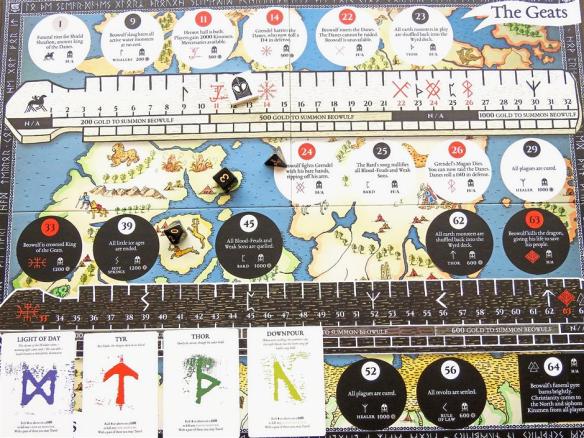
The board for King Port's Beowulf game, complete with a bunch of cards and pieces.

I admit that my experience with board games is pretty limited. And I’m not too saddened by that.

There are definitely some board games I’d love to play again or pick up. But whenever I think about board games, the problem that always looms in my mind is getting the players together. Coordinating enough interested people, getting over the rules if others (or I) need to learn them, and then finally getting to a place where we can just sit and play can take a lot of time.

But I think such a commitment would be worth it to play King Post’s own Beowulf. This game came to my attention thanks to this review.

This is a board game that uses the story of Beowulf as the background for play. Instead of taking up the role of Beowulf, players step into the shoes of various Geat tribes. Players then progress systematically through turns that see Beowulf moving down the timeline of his life as monsters, events, and a trading/raiding phase unfold. It definitely sounds like a complicated game to grasp at first (kind of like Dominant Species), and even like it might take some getting used to even once you get the basics.

But because this game is more about exploring the context of the Beowulf story than about the story itself, I find it infinitely fascinating. Pairing that with the care and effort that clearly went into the game’s board, cards, and pieces makes me really consider buying the game. Not even to play it, I think it’d be neat to just read all the cards and bask in the atmosphere that this game looks like it exudes.

Though I can’t help but feel like admiring the game is all I’d get to do.

As mentioned above, it’s always seemed difficult to me to bring together enough interested people to try out a new game. Mind you, I’ve never coordinated a board game night before (I’d sooner just read or play video games or, thanks in part to Pokemon GO, go for a walk until my phone dies in my free time). But reading about King Port’s Beowulf board game makes me reconsider that. It definitely sounds like a game that I’d love to learn and play.

I might also stand a decent chance of getting the first turn advantage, since the game dictates that the “hairiest” player gets to go first. Finally a game where Eastern-European genes pay off!

All about a legendary new Beowulf album

The cover art for LMAW's Beowulf album.

Art by Paolo Puggioni. Follow this link for more details: https://lmaw.bandcamp.com/

Full disclosure: I am in no way affiliated with The Legends, Myths, and Whiskey Podcast (LMAW). I’m just a big fan and want their Beowulf album to be a huge success so that they can give similar treatment to other epic stories from other cultures.

The world of podcasts is a very densely populated one. Since the medium’s rise to popularity among people with things to say, characters to share, or stories to tell, around 2009 (when over 1/5 of the population of the US over 12 became listeners), just about everyone of those sorts of people has launched a podcast. In terms of topics, these podcasts cover a range of things: politics, pop culture, science, serial radio dramas — there are even a few about history!

But one area that you don’t hear much about when it comes to podcasts is the stories that people have told for millennia. There aren’t very many podcasts about mythology or folklore.

There are some shows that are like excellent creepy pasta come to life (Welcome to Night Vale), but there aren’t many that focus exclusively on retelling old myths, legends, and folklore. Thankfully, there is one podcast that covers all three of these kinds of stories and does so expertly: The Legends, Myths, and Whiskey Podcast.

On each episode of the show, hosts Tanner Campbell and Eric DeMott take two stories and one whiskey. They read translations of the stories, sample the whiskey and tell listeners what they think of both. Thanks to these gents I’ve learned about stories like The Faithlessness of Sinogo or A Parrot Named Hiraman. And although I’m not much of a whiskey drinker, their commentary on what they’re drinking for the episode consistently leaves me feeling intrigued.

But this isn’t just an entry to share one of my new favourite podcasts with you all. I’m writing about the LMAW podcast because after hours and hours of work they’ve put together their first album: Beowulf: A Mythosymphony. This album features Tanner and Eric reading J.B. Kirtlan’s 1913 prose translation of Beowulf and adding their summaries, commentary, and analysis after finishing each of the story’s sections.

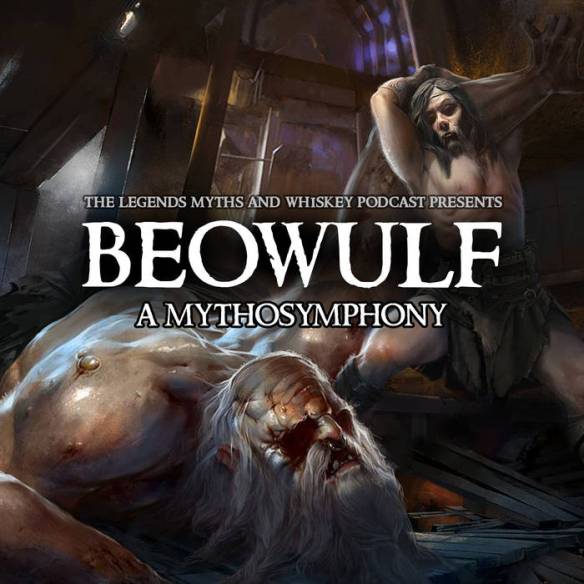
Beowulf facing off against Grendel in art for "Beowulf: A Mythosymphony".

Original art from Paolo Puggioni for the upcoming “Beowulf: A Mythosymphony” album. https://lmaw.bandcamp.com/

Along with the hosts reading and reflecting on Beowulf, this extended version of the LMAW podcast features brand new music that composer Nico Vettese (https://wetalkofdreams.com/) made specifically for this reading. It also features original art by Paolo Puggioni (http://www.paolopuggioni.com/).

If you’re at all curious about this album and want to find out more, I highly recommend that you check out the LMAW podcast’s bandcamp page. There you can listen to a couple of sample tracks. You can also put in a pre-order for the Beowulf: A Mythosymphony, which is set to be released on September 15.

After having listened to the two tracks that Tanner and Eric have made available, it sounds like the complete Beowulf album will be amazing. Tanner nails reading Kirtlan’s translation and the musical accompaniment fits the tone and content of Beowulf’s boasting beautifully.

If this album sounds like something you’d enjoy, definitely check it out!

What are your thoughts on podcasts as a way to tell stories?

Leave your thoughts in the comments!

Thoughts on Beowulf’s new rock musical adaptation

So, come September, Beowulf will be getting the musical treatment!

And not just any sort of musical treatment, but the rock ‘n’ roll musical treatment!

Though, according to this article, this musical isn’t going to be a straight telling of Beowulf. Not entirely, anyway.

The twist with Beowulf: A Thousand Years of Baggage is that while the events of Beowulf unfold (simplified so that all three monsters attack Heorot), a panel of academics criticizes and unpacks what’s going on in the story.

This sounds like a really cool concept, especially because of the “rock” label that’s being applied to it. Musicals with the flavour of rock music are some of my favourite operas, after all. From prog rock concept albums to early attempts like The Phantom of the Paradise — the rock musical is a solid genre.

But what sticks out about this to me more than anything is that a new Beowulf musical suggests that history does indeed repeat itself.

Back in the 70s there was a musical version of Beowulf, simply called Beowulf: A Musical Epic. It might have slipped under the radar of many because it was a Canadian production, and I don’t think it had much of a run south of the border. But this production’s varied (too varied for “Rock” alone to suit, I think) musical score by Victor Davies and the lyrics by Betty Jane Wylie make for a fantastic retelling of the story.

But what I like most about the 70s adaptation is that there really aren’t any changes to the story.

Some of the digressions in the original are cut out or reworked, and at least one character is renamed, but other than that, Beowulf: A Musical Epic stays true to the poem: Beowulf goes to Heorot to fight Grendel, fights Grendel’s mother, then goes back to Geatland where he eventually becomes king, has to fend off a dragon, and leaves his warrior legacy in the hands of Wiglaf. For its fidelity alone, I think Beowulf: A Musical Epic is worth listening to, since so few adaptations let Beowulf grow old and show us his end.

In the popular culture (all of the movie, and book adaptations) Beowulf is usually seen only defeating Grendel and maybe Grendel’s mother, but we never really see Beowulf fighting the dragon as an old man and his death, and I think this is an essential part of the poem. The fact that the poem covers it suggests that the early audience of the poem thought much differently (maybe more complexly?) about heroes than many of us do today, and certainly more so than most modern people would give early medieval people credit for.

So I’m excited for this new musical, but, whenever (and however) I manage to engage with it, I know to approach it as something more than just an adaptation. Though, that said, I’m hoping for some raucous academic commentary to go along with the brutal physicality of so much of the story.

How do you think this new Beowulf musical will work out? Will it be the next Hamilton, or just enjoy a small run in Providence, Rhode Island? Leave your thoughts in the comments!